

Being good at something and finding it easy are two entirely different things.
At a glance
- ADHD masking involves concealing or suppressing aspects of ADHD.
- The masking tax describes the hidden effort involved in maintaining appearances.
- Professional success and ADHD support needs can coexist.
- Helpful coping strategies are not necessarily masking.
- Persistent overcompensation may contribute to exhaustion.
- Reducing unnecessary demands can help create more sustainable everyday routines.
You're the person everyone relies on.
The one who remembers birthdays, organises the family holiday, delivers projects on time and somehow knows where everyone else's belongings are.
You're good at your job. You're there for your friends. You remember to bring something when you're invited to dinner.
People regularly ask how you manage to fit everything in.
You smile and tell them you're just organised.
What they don't see is the evening you spent working because you couldn't concentrate during the day. The six reminders you set for a single appointment. The conversations you rehearsed in your head. The Sunday afternoon you spent recovering from an apparently ordinary week.
They see the outcome.
They don't see what it costs you to achieve it.
For many women with ADHD, this hidden effort is an everyday experience. And when that effort accumulates over months, years or even decades, it can come at a considerable personal cost.
We call it the masking tax.
What is ADHD masking?
ADHD masking describes behaviours people use to conceal, suppress or disguise aspects of their ADHD, often to meet social expectations or avoid negative reactions from others.
It can be deliberate, but it can also become so habitual that you barely recognise you're doing it.
You might suppress the urge to move during a meeting, pretend to have followed instructions you've lost track of, or carefully monitor how much you're talking during a conversation.
You might spend considerably longer preparing for an activity than other people realise because you're determined not to make a mistake.
Masking is not a formal diagnostic criterion for ADHD, nor is it exclusive to women or people with ADHD.
However, researchers are increasingly interested in how masking and compensatory behaviours affect the recognition, diagnosis and everyday experiences of girls and women with ADHD.
For someone who has spent years adapting to environments that don't naturally accommodate their needs, these behaviours may simply feel like part of being an adult.
What is the masking tax?
The masking tax is a way of describing the additional time, energy and emotional effort involved in concealing difficulties or maintaining an appearance of effortless competence.
It isn't a recognised medical condition or a clinically measurable quantity. It's a useful metaphor for understanding the hidden cost of certain ways of coping.
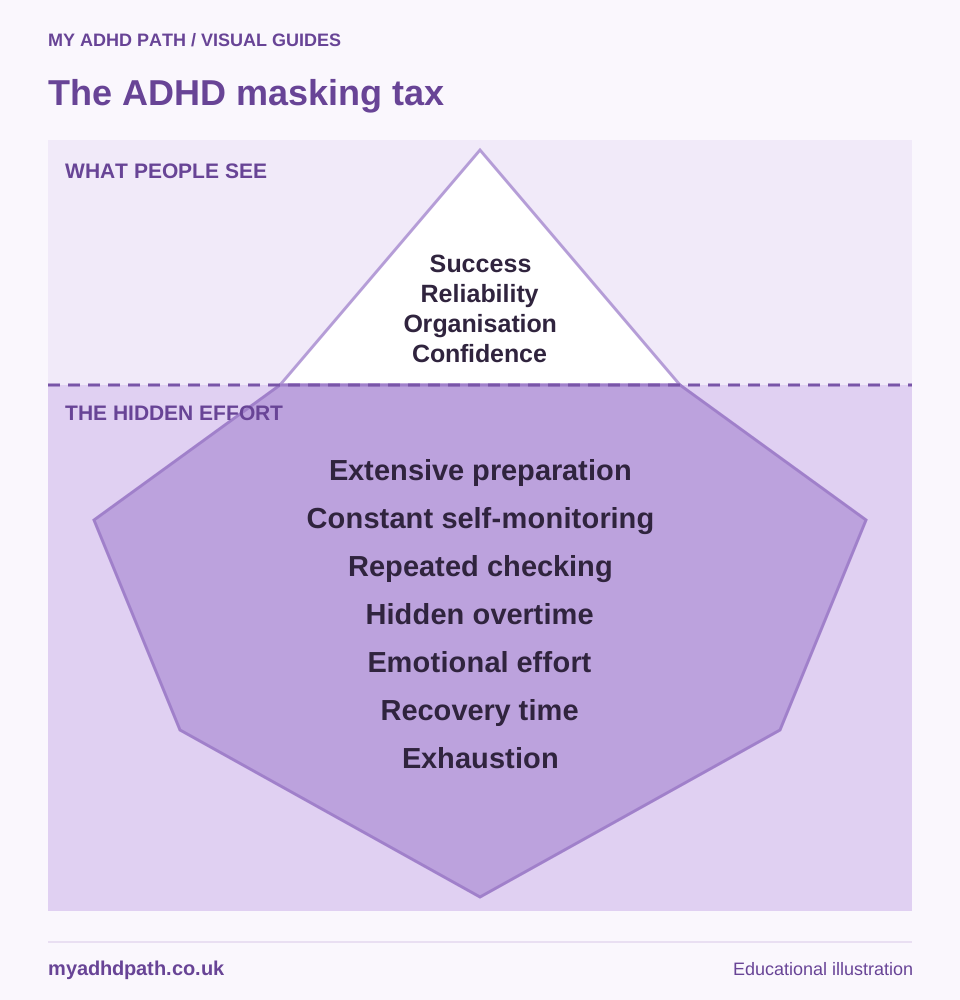
Imagine two colleagues delivering equally impressive presentations.
One prepares for an hour, reviews her notes and delivers the presentation confidently.
The other spends much of the previous evening preparing, repeatedly checks her slides, rehearses possible questions and arrives forty minutes early because she's worried about forgetting something.
Both receive excellent feedback.
But the personal cost of delivering those presentations may be very different.
The second colleague's achievement is no less genuine. Her knowledge, skills and professional abilities are every bit as real.
It's the additional effort behind the achievement that remains invisible.
And when that pattern is repeated across work, relationships, parenting and everyday responsibilities, the accumulated demands can become substantial.
Why women with ADHD may become particularly skilled at masking
From an early age, girls absorb messages about how they are expected to behave.
Be polite. Pay attention. Don't interrupt. Remember your manners. Be helpful. Think about other people's feelings.
Of course, these expectations aren't exclusive to girls. But gender-related social expectations can influence how ADHD traits are expressed, interpreted and managed.
A girl who repeatedly interrupts conversations may learn to remain unusually quiet.
A girl who forgets her homework may become meticulous about checking her schoolbag.
A girl who struggles to follow classroom instructions may watch what her classmates are doing rather than ask the teacher to repeat something.
Over time, these adaptations can develop into increasingly sophisticated ways of navigating everyday life.
What the research says
A 2020 expert consensus statement on ADHD in girls and women highlighted that compensatory behaviours can conceal underlying difficulties and contribute to delayed recognition. More recent qualitative research has explored how some individuals learn to hide behaviours and maintain demanding coping strategies to fit into social and educational environments. These studies offer important insights into lived experiences, although they do not establish that every woman with ADHD masks or that women necessarily mask more than men.
Ten signs you might be masking ADHD
Masking can take many forms. You may recognise several of these experiences, or none at all.
These examples are intended to encourage reflection, not establish whether you have ADHD.
1. You prepare for everything excessively
A straightforward meeting requires extensive preparation.
A telephone call needs a written script.
An unfamiliar journey involves checking the route, parking arrangements, travel time and several alternative options.
Preparation can be genuinely helpful. But if preparing for ordinary activities regularly consumes more time and energy than the activities themselves, it may be worth exploring why.
Are you preparing because it helps you feel comfortable, or because you're frightened of what might happen if you don't?
2. You pretend you've understood something when you haven't
Someone gives you several instructions in quick succession.
You catch the first part, lose track of the middle and find yourself nodding enthusiastically at the end.
Rather than ask for clarification, you attempt to reconstruct the information later.
Perhaps you quietly ask a colleague what was agreed or spend time searching through previous emails.
The original difficulty remains hidden, but you've created additional work for yourself.
3. You're never late because you're always ridiculously early
People describe you as exceptionally punctual.
What they don't realise is that you've built enormous margins into your schedule because judging how long things take feels unreliable.
You leave home forty-five minutes earlier than necessary. You arrive before everyone else. You spend time sitting in your car waiting for appointments.
Arriving early can be an excellent strategy. But if every commitment requires a significant sacrifice of your time because you're anxious about being late, that additional effort deserves recognition.
4. You constantly monitor yourself during conversations
Instead of simply participating in a conversation, you're also running a separate internal commentary.
Am I talking too much?
Have I interrupted?
Did I remember to ask about her holiday?
Am I making enough eye contact?
Have I been telling this story for too long?
By the time you get home, you're exhausted.
Not necessarily because you didn't enjoy seeing people, but because you spent so much of the interaction monitoring how you were being perceived.
5. You compensate for mistakes before anyone notices
A forgotten deadline becomes a late-night working session.
A misplaced document becomes an hour of searching.
An overlooked email becomes a carefully worded response that makes it appear you were already dealing with the matter.
You become remarkably skilled at solving problems before anyone realises they existed.
Unfortunately, that can also mean nobody recognises how much additional support you might benefit from.
6. You struggle to say no
You take on another project, help organise another event or agree to another favour.
Sometimes it's because you genuinely want to help.
Sometimes it's because you worry about disappointing someone, appearing unreliable or being perceived as less capable.
Before long, you've agreed to more than your available time and energy can accommodate.
People-pleasing is not unique to ADHD, but for some people it may develop alongside experiences of criticism, misunderstanding or a strong desire to fit in.
7. You hide how overwhelmed you feel
Someone asks how you are.
"Absolutely fine. Just busy!"
Meanwhile, you've got twenty-seven browser tabs open, three unfinished tasks, a forgotten appointment and no clear idea what you're making for dinner.
Perhaps you've become so accustomed to being seen as capable that admitting you're struggling feels uncomfortable.
You keep finding ways to manage privately.
Until managing privately becomes a responsibility of its own.
8. You hold yourself to unusually high standards
You check emails repeatedly, revisit completed work and spend longer than necessary refining details.
You might feel that everything needs to be exceptionally good to compensate for the occasions when something goes wrong.
Your ability to produce high-quality work is genuine.
But perfectionism may become problematic when the additional effort no longer improves the outcome in a meaningful way.
There's a difference between caring about the quality of your work and feeling unable to stop working on it.
9. You need considerable recovery time after ordinary activities
You manage a full working day, attend a social gathering or spend an afternoon organising family activities.
Then you need hours of uninterrupted time before you feel ready to engage with anything else.
You might find conversation, noise or further decisions particularly demanding.
Rest after a busy day is normal. But repeatedly needing substantial recovery time after activities that appear manageable may be a useful signal to examine your overall workload and the effort involved.
10. People are surprised when you tell them you have ADHD
"But you're so organised."
"You've always done really well."
"You don't seem like someone with ADHD."
These responses can be particularly frustrating when the qualities people point to are the very things you've invested considerable effort in developing.
Organisational ability, professional success and academic achievement do not automatically rule out ADHD.
An appropriate assessment considers the broader history of symptoms and impairment, including the strategies and support someone relies on.
Masking, coping and overcompensation are not the same thing
This distinction matters.
Not every adaptation you make to manage ADHD is masking.
Using reminders doesn't automatically mean you're hiding something. Writing everything down doesn't make you any less authentic.
Many strategies are extremely valuable and worth keeping.
The important questions are what the strategy achieves, how much it costs you and whether you're using it to meet your needs or conceal them.
| Helpful coping | Masking or costly overcompensation |
|---|---|
| Requesting a written meeting agenda | Pretending you followed everything and reconstructing the meeting later |
| Setting a reminder for an appointment | Repeatedly checking the appointment because you're frightened of forgetting |
| Allowing a reasonable travel buffer | Regularly arriving an hour early because being late feels unacceptable |
| Using an agreed proofreading process | Checking a routine email repeatedly long after it's ready |
| Taking a quiet break when needed | Suppressing discomfort until you reach home |
| Discussing a manageable workload | Secretly working every evening to maintain appearances |
The same behaviour can serve different purposes in different circumstances.
A detailed checklist might save one person considerable energy whilst becoming an exhausting obligation for someone else.
You don't need to abandon useful organisational tools simply because you've recognised that you sometimes mask.
The goal is to retain the strategies that genuinely support you and reconsider those that consistently demand more than they return.
The problem with being described as high-functioning
The expression high-functioning ADHD is commonly used in everyday conversation, particularly to describe people who achieve well academically or professionally despite experiencing difficulties.
However, it isn't an official ADHD diagnosis or clinical subtype.
It can also create a misleading impression.
Someone might run a successful business, manage a team or excel in a highly demanding profession whilst regularly struggling with everyday administration, household organisation or emotional wellbeing.
Another person might function very differently depending on their environment, health, available support and the nature of the task.
Good to know
A person's outward achievements tell us relatively little about how much effort those achievements require. Functioning isn't fixed, and it isn't uniform across every area of life. You can be exceptionally capable in one setting and need considerable support in another. Both experiences can be true.
When the masking tax comes due
For a while, your coping strategies may work remarkably well.
You manage the deadlines. You maintain your relationships. You keep the household functioning.
Then something changes.
Perhaps you receive a promotion, have a baby, begin caring for a relative or experience perimenopause.
Maybe nothing dramatic happens at all. There are simply more responsibilities, fewer opportunities to recover and less flexibility than there used to be.
Gradually, the effort required to keep everything running becomes harder to sustain.
You might notice:
- Persistent mental and physical exhaustion.
- Greater difficulty beginning familiar tasks.
- Increased irritability.
- Reduced enjoyment of activities.
- Difficulty making straightforward decisions.
- A greater need for quiet and uninterrupted time.
- More noticeable ADHD symptoms.
- Feeling overwhelmed by responsibilities you previously managed.
Some people describe this experience as ADHD burnout.
Although ADHD burnout is widely discussed within ADHD communities, it does not currently have a universally accepted clinical definition or diagnostic criteria.
Persistent exhaustion and changes in everyday functioning can have several explanations, including depression, anxiety, sleep disorders, physical health conditions and occupational stress.
These deserve appropriate assessment rather than being automatically attributed to ADHD.
Masking may contribute to exhaustion, but research has not established a simple causal relationship between ADHD masking and burnout.
Why you might hold everything together at work and unravel at home
You've had a productive day.
You've attended meetings, answered questions, managed deadlines and been perfectly pleasant to everyone.
Then you walk through your front door and someone asks what's for dinner.
Suddenly, you feel as though you cannot manage another decision.
For some people with ADHD, different environments require different levels of self-monitoring and effort.
At work, there may be clear expectations about behaviour, communication and performance.
At home, you may feel comfortable allowing yourself to relax those expectations.
Your family might consequently see a different side of your everyday experience from your colleagues.
This can be confusing for everyone involved.
Your partner may wonder why you can manage complicated professional responsibilities but struggle to organise an evening meal.
You may wonder exactly the same thing.
One possible explanation is that you've already used considerable energy navigating the demands of your working day.
Recognising that pattern can help you establish more realistic evening routines, communicate your needs and share responsibilities differently.
It doesn't excuse hurtful behaviour towards others, but it can help identify ways to prevent difficulties from escalating.
Three different faces of the masking tax
The following examples are fictional illustrations of how these experiences might appear in different lives.
The business owner
Emma runs a successful small business.
She's creative, knowledgeable and excellent at solving problems for her clients.
But she struggles to establish priorities when several projects compete for her attention.
Rather than ask for help, she works late into the evening, repeatedly switches between tasks and spends weekends catching up on administration.
Her clients see an exceptionally responsive business owner.
Emma experiences a working week that never quite finishes.
Her most useful change might be introducing clearer project boundaries, external planning support and more effective ways of prioritising work.
Not finding another hour in the day.
The working mum
Rachel works part-time and has two school-age children.
She manages school communications, appointments, household supplies, family birthdays and after-school activities.
Her partner is happy to help but usually waits to be told what needs doing.
Rachel consequently remains responsible for remembering, planning and delegating most household tasks.
She's exhausted, despite appearing to have a relatively manageable schedule.
For Rachel, the answer might involve redistributing ownership of responsibilities, rather than trying to become more efficient at managing everyone's lives.
The high-achieving professional
Priya has built a successful career and recently moved into a senior management role.
She's comfortable with complex strategic work but struggles with constant meetings, interruptions and competing administrative demands.
She compensates by preparing extensively and working outside normal hours.
From the outside, her promotion appears to be going brilliantly.
Behind the scenes, she has very little energy left for anything else.
Written agendas, protected concentration time and administrative support could help her continue using her professional strengths without relying on unsustainable working patterns.
The invisible mental load
Many women are familiar with the mental load involved in keeping everyday life functioning.
It's the constant background responsibility of noticing what needs doing, anticipating future needs, making decisions and remembering information.
For someone with ADHD, managing these responsibilities may introduce particular challenges.
You might be perfectly capable of booking a dental appointment.
The greater difficulty may be remembering that it needs booking, finding the right moment to call, checking everyone's availability and following through when something interrupts you.
Multiply that by dozens of recurring responsibilities and the mental load becomes easier to understand.
Then add the effort of appearing as though none of it is particularly difficult.
The difference between helping and taking ownership
Consider the responsibility of managing children's school uniforms.
Helping might mean putting a wash on when asked.
Taking ownership means noticing which clothes need washing, making sure clean uniforms are available, checking whether anything needs replacing and completing those tasks without another person having to coordinate them.
Redistributing tasks can be helpful.
Redistributing the responsibility for planning those tasks can be even more significant.
This distinction is worth exploring in households where one person has gradually become the default organiser.
Why masking can make ADHD harder to diagnose
Successful compensation may influence how difficulties are perceived by other people.
Teachers might see good grades without knowing how much additional work went into assignments.
Employers might see reliable performance without knowing about the unpaid hours involved.
Healthcare professionals may see someone who appears articulate, organised and successful during an appointment.
What the research says
Research into women's experiences of adult ADHD diagnosis has identified masking as one of several perceived reasons why ADHD was not recognised earlier. A comprehensive ADHD assessment should look beyond how someone presents during a consultation. It should explore developmental history, symptoms across different environments, everyday impairment and relevant alternative explanations.
If you're preparing for an assessment, consider explaining not only what you achieve but also what happens behind the scenes.
What you could say
"I rarely miss deadlines, but that's because I regularly work late and spend considerable time checking that I haven't forgotten anything."
Or:
"I appear organised because I've developed several overlapping reminder systems. When those systems are interrupted, I find everyday responsibilities much harder to manage."
These details may help provide a more complete picture of your experiences.
What does the research say about ADHD masking?
Research specifically examining ADHD-related masking is still developing.
A 2025 qualitative study published in the British Journal of Psychiatry interviewed twelve young adults about how ADHD had manifested during their younger years.
Participants described strategies for adapting their behaviour, avoiding unwanted attention and compensating for difficulties. Some also discussed the effort and exhaustion involved.
A 2026 study published under the title "I wish I could just be myself" examined adults' experiences of social camouflaging in ADHD.
It explored both perceived benefits, such as navigating social situations, and difficulties, including exhaustion, self-perception and effects on relationships.
These studies contribute to a growing understanding of ADHD beyond its externally observable symptoms.
However, qualitative research is primarily concerned with understanding people's experiences. It cannot establish how common particular behaviours are across the entire ADHD population.
Further research is needed to understand the long-term consequences of masking, how it differs across individuals and which forms of support are most effective.
Does unmasking mean changing your personality?
No.
Unmasking doesn't mean abandoning your responsibilities, becoming inconsiderate or expressing every thought that enters your head.
It also doesn't mean that the person you've been for the past twenty or thirty years somehow wasn't genuine.
Your kindness is real.
Your ambition is real.
Your professional achievements are real.
Your ability to care about other people is real.
Understanding your masking behaviours is about recognising which adaptations help you live in a way that feels comfortable and which demand unnecessary effort.
You may decide to keep many of the strategies you've developed.
You may also discover that you no longer need to maintain certain behaviours in environments where you feel supported.
It's a gradual, individual process.
Ten ways to reduce the masking tax
You don't need to transform your entire life overnight.
Small changes that make ordinary responsibilities easier may provide a more sustainable starting point.
1. Notice where you're using the most energy
For a week, pay attention to the activities that leave you particularly exhausted.
Is it meetings? Social events? Managing emails? Organising the household? Making decisions?
Consider whether the activity itself is demanding or whether the effort involved in preparing, monitoring and compensating is contributing significantly.
Understanding the difference can help you identify more useful solutions.
2. Ask for information in the format you need
If you find verbal instructions difficult to retain, request written information.
What you could say
"Would you mind sending me the key points afterwards? I find it easier to work accurately when I have something written to refer back to."
You don't necessarily need to disclose ADHD to explain a practical working preference.
3. Make helpful adjustments visible
Perhaps headphones improve your concentration.
Maybe you need quieter surroundings, notes during conversations or protected time to complete demanding work.
Where appropriate and safe, make these preferences part of your everyday environment rather than attempting to compensate privately.
You don't need to wait until you're overwhelmed before discussing what helps you work well.
4. Decide what good enough actually looks like
Before beginning a task, establish what a satisfactory outcome would be.
For a straightforward email, that might mean communicating the information accurately and politely.
It probably doesn't require twelve revisions.
For household tasks, it might mean a comfortable and reasonably functional home rather than an immaculate one.
Setting an appropriate standard in advance can help prevent routine activities from becoming unnecessarily demanding.
5. Practise a less immediate yes
If you regularly agree to responsibilities before considering your availability, introduce a little space between the request and your answer.
Try this
"Let me check what I've already committed to and get back to you."
This gives you the opportunity to make a decision based on your actual circumstances rather than the pressure of the moment.
It's a small change that could make a considerable difference to your workload.
6. Protect the time you need to recover
If a particularly demanding working day leaves you needing some quiet time, consider allowing for that when planning your evening.
You might need half an hour without further decisions, a walk, time outdoors or simply a comfortable space without demands.
Recovery looks different for everyone.
It doesn't need to become another activity you have to perform perfectly.
7. Share responsibility, not just tasks
Review the recurring responsibilities you manage at home or work.
Consider which ones genuinely need your involvement and which could be owned by someone else.
Where possible, transfer the planning, remembering and decision-making alongside the practical activity.
Shared calendars and agreed routines can help, provided maintaining those systems doesn't become another of your responsibilities.
8. Use tools that reduce thinking effort
Sometimes the issue isn't remembering that you have fifteen things to do.
It's working out which of those fifteen things matters most, where to begin and how to make progress.
A suitable digital assistant or AI tool may help organise information, break down activities and establish a manageable sequence.
AI prompt
I have several competing responsibilities and I'm spending more energy trying to organise them than actually completing them. Help me identify what genuinely matters today, what can wait and what could be delegated. Give me one manageable starting action.
Check the output, use appropriate privacy safeguards and avoid sharing confidential or sensitive personal information with unsuitable services.
The purpose of assistive technology is to reduce demands, not create a more impressive-looking task list.
9. Choose safe places to experiment with unmasking
You don't need to begin by discussing ADHD with everyone you know.
Start in environments where you feel comfortable.
Perhaps you ask a trusted friend to repeat something rather than pretending you heard it.
Perhaps you explain to your partner that you need a quiet evening.
Perhaps you use a discreet fidget tool during a conversation instead of concentrating on keeping completely still.
Consider your personal safety, circumstances and the potential consequences of disclosure.
You have control over how much information you choose to share.
10. Access professional support where appropriate
Understanding ADHD may help you recognise patterns that have been present for years.
An ADHD assessment, treatment review, ADHD-informed psychological support or practical workplace adjustments may be appropriate depending on your circumstances.
Coaching may also provide practical support for some individuals, although qualifications and approaches vary and the evidence base is still developing.
If you're persistently exhausted, experiencing significant emotional distress or struggling with everyday functioning, speak to your GP or another suitably qualified healthcare professional.
You don't have to manage everything through self-help strategies alone.
Try a seven-day masking tax audit
This simple reflection exercise can help you identify where your additional effort is going.
It is not a clinical assessment, and there is no score you need to achieve.
Each day, choose one activity that required more effort than you expected.
Record four things:
| Reflection | Example |
|---|---|
| What was the activity? | An afternoon team meeting |
| What did other people see? | I contributed confidently |
| What additional effort was involved? | Extensive preparation, monitoring interruptions and reconstructing missed information afterwards |
| What could make this easier next time? | A written agenda and agreed action notes |
At the end of the week, look for recurring patterns.
Perhaps you're doing a considerable amount of invisible preparation.
Perhaps interruptions are creating additional work.
Perhaps your commitments leave very little opportunity for recovery.
Choose one recurring difficulty and experiment with one practical adjustment.
You don't need to address everything simultaneously.
Free resource
My Seven-Day Masking Tax Audit
Track where your hidden effort is going and identify practical changes.
What to say when you need support
Finding the right words can be particularly valuable if you're accustomed to managing difficulties privately.
At work
"I've noticed that I'm spending considerable time reconstructing information after meetings. Having written action points would help me work more efficiently and reduce unnecessary follow-up."
At home
"I'm finding the responsibility of remembering and organising everything quite demanding. Could we agree which household responsibilities each of us will manage completely, including the planning?"
With friends
"I'd really love to see you, but I've had a particularly demanding week. Could we arrange something quieter instead?"
With your healthcare professional
"I've developed a lot of strategies that help me appear organised and capable, but maintaining them is becoming increasingly exhausting. I'd like to explore what's contributing to that and what support might help."
These conversations don't need to involve lengthy explanations or justifications.
Often, identifying a specific difficulty and a practical change is a useful starting point.
When exhaustion needs more than rest
Taking time away from responsibilities may help you recover from a demanding period.
However, persistent exhaustion should not automatically be understood as the consequence of masking.
Speak to a healthcare professional if you're experiencing ongoing low mood, loss of enjoyment, significant sleep difficulties, persistent anxiety, unexplained physical fatigue or noticeable deterioration in everyday functioning.
Physical health problems, depression, anxiety and other conditions can coexist with ADHD.
Hormonal changes during perimenopause may also introduce additional difficulties.
Understanding what is contributing to your experiences can help you access appropriate care.
Important
If you're considering hurting yourself or feel unable to stay safe, seek urgent support. In the UK, Samaritans can be contacted on 116 123. In an immediate emergency, call 999 or attend A&E.
Frequently asked questions
It can involve concealing forgetfulness, suppressing restlessness, monitoring social behaviour or using demanding compensatory strategies to maintain an appearance of being organised and capable.
Yes. Some adaptations become habitual over time, particularly when they've been used since childhood.
No. Organisational skills and professional achievement do not automatically rule out ADHD. A specialist assessment considers a much wider range of information.
Masking and overcompensation may contribute to exhaustion. However, the precise relationship with burnout requires further research, and persistent fatigue can have many other explanations.
No. People-pleasing involves prioritising other people's approval or needs, sometimes at personal cost. It may overlap with masking for some individuals, but the two are not interchangeable.
Medication may help manage ADHD symptoms for some people, potentially reducing the need for particular compensatory strategies. However, it does not necessarily change established social habits or responses to expectations.
Yes. Masking can occur across genders. Individual experiences are shaped by personal circumstances, social expectations and environments.
You may be able to reduce certain masking behaviours gradually, particularly in supportive environments. There is no requirement to disclose ADHD or abandon useful coping strategies.
Absolutely. Achievement and support needs can coexist. Appropriate support may help someone maintain their achievements more sustainably.
Perhaps you don't want to change careers, have fewer ambitions or become a completely different person.
Perhaps you simply want to finish a working day and have enough energy left to enjoy your evening.
To spend time with friends without analysing every conversation afterwards.
To manage your responsibilities without constantly reconstructing information, compensating for interruptions or catching up late at night.
You can value everything you've achieved whilst recognising that there may be easier ways to maintain it.
Your abilities don't become more impressive because using them leaves you exhausted.
And receiving support doesn't make your achievements any less yours.
The aim isn't necessarily to do less with your life.
It's to spend less of your life managing the hidden effort behind everything you do.
Sources and further reading
- Young, S. et al. (2020). Females with ADHD: An expert consensus statement taking a lifespan approach providing guidance for the identification and treatment of attention-deficit/hyperactivity disorder in girls and women. BMC Psychiatry. doi.org/10.1186/s12888-020-02707-9
- Reflections on the manifestation of attention-deficit hyperactivity disorder in girls from young adults with lived experiences: a qualitative study (2025). British Journal of Psychiatry. pmc.ncbi.nlm.nih.gov/articles/PMC12550658/
- "I wish I could just be myself": Experiences of social camouflaging in adults with ADHD (2026). sciencedirect.com
- Exploring women's experiences of diagnosis of ADHD in adulthood: a qualitative study. doi.org/10.1080/18387357.2023.2268756
- The experiences of adults with ADHD in interpersonal relationships and online communities: A qualitative study (2023). pmc.ncbi.nlm.nih.gov/articles/PMC10399076/
- NICE - Attention deficit hyperactivity disorder: diagnosis and management (NG87). nice.org.uk/guidance/ng87
- Acas - Reasonable adjustments. acas.org.uk/reasonable-adjustments
- GOV.UK - Access to Work. gov.uk/access-to-work
This article provides general educational information and is not a substitute for professional medical advice, diagnosis or treatment. Masking tax, high-functioning ADHD and ADHD burnout are descriptive expressions rather than formal clinical diagnoses. The reflection exercises are intended for personal understanding and are not diagnostic screening tools.