

You haven't become a different person. You've discovered something important about the person you've always been.
At a glance
- Receiving an ADHD diagnosis in adulthood can bring relief, grief, validation and excitement.
- Girls and women may develop compensatory strategies that contribute to delayed recognition.
- There is no universal emotional journey following diagnosis.
- Your diagnosis provides additional understanding without redefining your entire identity.
- Practical adjustments, appropriate treatment and support can help improve everyday functioning.
- It is never too late to explore a more sustainable way of living.
You finally have an answer.
After years of wondering why certain things seemed more difficult for you than for other people, you've received an ADHD diagnosis.
Perhaps you're in your thirties, forties or fifties. Perhaps your own child's diagnosis prompted you to start asking questions. Or perhaps you reached a point in your life when the strategies you'd always relied upon simply weren't enough anymore.
Initially, there's an enormous sense of relief.
Suddenly, things begin to make sense.
The school reports. The unfinished projects. The relationships. The endless ideas. The difficulties with everyday organisation despite being capable of managing extraordinarily complicated things.
You start connecting the dots between experiences that previously seemed completely unrelated.
And then, somewhere amongst the relief, another thought arrives.
What if I'd known sooner?
It's a question that can bring with it a surprising amount of emotion.
A late ADHD diagnosis isn't simply the conclusion of an assessment process. For many women, it's the beginning of a much bigger journey of understanding themselves.
Why an ADHD diagnosis can change the way you see your entire life
Most of us develop an understanding of who we are gradually.
Our experiences at school, our relationships, our achievements and the feedback we receive from other people all contribute to the picture we build of ourselves.
By adulthood, that picture can feel relatively established.
You know what you're good at. You know which things you find challenging. You've developed explanations for why certain situations keep occurring.
An ADHD diagnosis can introduce an entirely new perspective.
You might begin to understand why you could spend hours absorbed in a subject you loved but struggled to complete a relatively straightforward homework assignment.
Why you were excellent at generating ideas but found managing the details more demanding.
Why you remembered remarkably specific information from conversations years earlier but regularly forgot what you'd walked into a room to do.
Why you could perform brilliantly under pressure yet find it difficult to begin a task when the deadline was weeks away.
These experiences don't suddenly change.
But your understanding of them might.
And that can influence how you see not only your present circumstances but also the person you were throughout childhood, adolescence and early adulthood.
Why so many women receive an ADHD diagnosis later in life
ADHD has historically been associated with externally noticeable behaviours, particularly hyperactivity and impulsivity in children.
Although girls and women can experience these symptoms, some may present with difficulties that are less immediately apparent to others.
They may also develop substantial compensatory strategies that conceal the extent of their difficulties.
A girl who struggles to concentrate might spend additional time completing her homework at home.
A teenager who frequently forgets things might become exceptionally organised to compensate.
A young woman who finds managing everyday responsibilities difficult might rely heavily on routines, reminders and preparation.
From the outside, everything may appear to be working reasonably well.
The effort involved remains less visible.
What the research says
Research and expert consensus have highlighted several factors that may contribute to ADHD being overlooked in girls and women, including differences in presentation, referral patterns, compensatory behaviours, coexisting mental health conditions and gender-related expectations.
Sometimes, ADHD only becomes apparent when circumstances change.
That might happen when someone:
- Leaves the structured environment of school.
- Starts university.
- Begins a demanding career.
- Becomes a parent.
- Takes on additional caring responsibilities.
- Experiences significant life changes.
- Enters perimenopause.
- Encounters increasing difficulties maintaining established coping strategies.
Receiving a diagnosis later in life doesn't mean ADHD suddenly developed in adulthood.
ADHD is a neurodevelopmental condition, and an appropriate diagnostic assessment considers symptoms originating during the developmental period, alongside their impact across different areas of life.
The unexpected emotions of a late ADHD diagnosis
There is no prescribed emotional journey following diagnosis.
Some people experience immediate relief and move forward without particularly difficult feelings.
Others need considerable time to understand what their diagnosis means.
You might experience several apparently contradictory emotions within the same day.
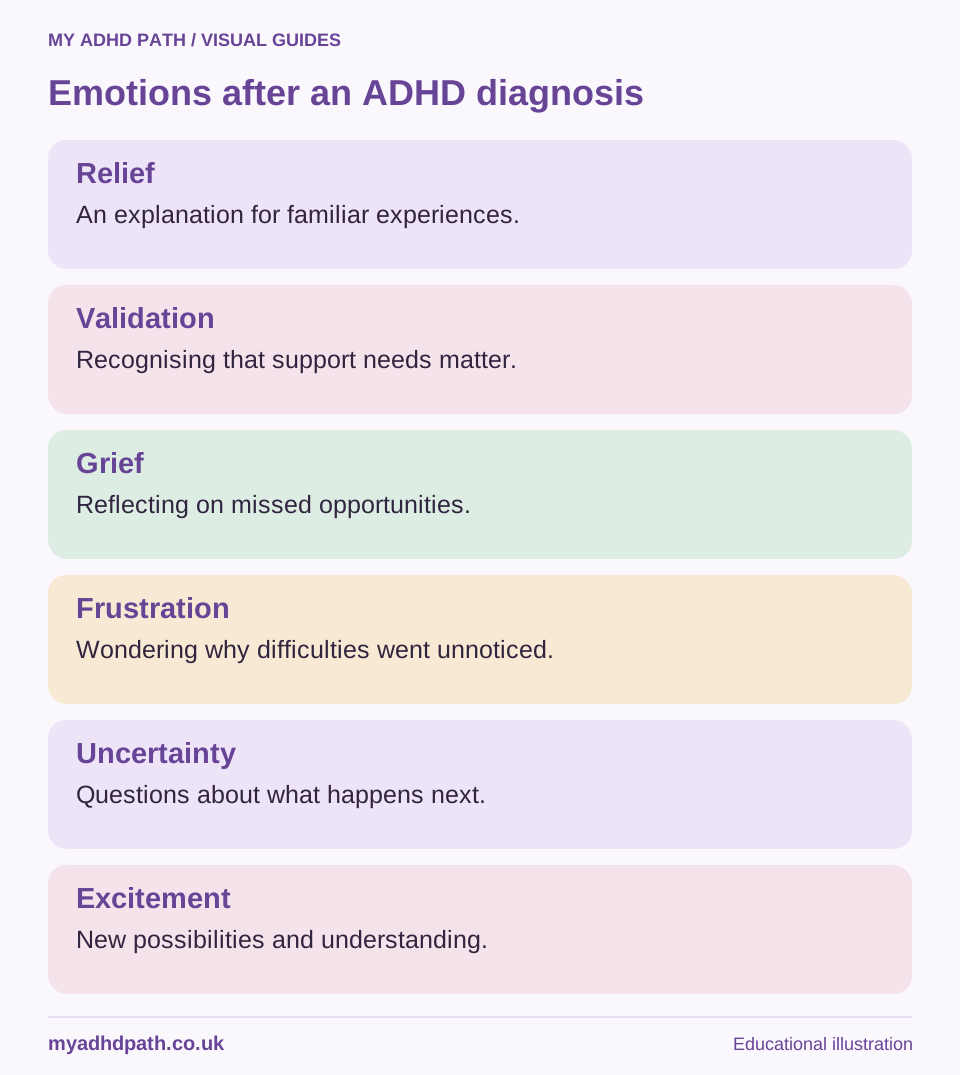
Relief
Finally, there is an explanation.
You no longer need to spend quite so much time wondering why certain experiences keep repeating themselves.
For some people, receiving a diagnosis provides a sense of clarity that has been missing for years.
It creates a starting point for exploring support that is better suited to their needs.
Validation
Perhaps you've spent years explaining that certain things were more difficult for you than they appeared to be.
Other people may not have recognised those difficulties, particularly if you were performing well.
Receiving a diagnosis can help you understand that your experiences deserve attention, even when your achievements suggested otherwise.
Grief
You may find yourself thinking about missed opportunities, difficult experiences or decisions you might have approached differently with greater understanding and appropriate support.
This is sometimes described as post-diagnosis grief.
It is not a formal ADHD-related medical diagnosis, but it can be a meaningful way of describing the sadness some people experience when reconsidering their past.
Frustration
You might wonder why nobody recognised the signs earlier.
Perhaps you remember repeatedly asking for help, attending appointments or explaining difficulties that were attributed to something else.
You may feel frustrated by the time, money or effort involved in reaching a diagnosis.
These feelings can be particularly complicated if you believe earlier support might have made a significant difference.
Uncertainty
What happens now?
Do you need medication? Should you tell your employer? Does this change how you approach relationships? What does it mean for your children?
Receiving an answer can produce an entirely new collection of questions.
You don't need to resolve them immediately.
Excitement
For many people, diagnosis also brings a renewed sense of possibility.
There are strategies to explore, new ways of understanding yourself and opportunities to make everyday life more manageable.
Perhaps, for the first time, you're approaching familiar challenges with information that feels genuinely relevant.
All these emotions can coexist.
There is no requirement to experience them in a particular order, and no correct amount of time to spend processing your diagnosis.
Grieving the life you might have lived
One of the more complicated aspects of receiving an ADHD diagnosis in adulthood is considering how different your life might have been.
Perhaps you would have chosen different subjects at school.
Perhaps you would have completed a university course, pursued a particular career or approached a relationship differently.
Perhaps you would have asked for support before reaching a point of exhaustion.
Perhaps you would have spent considerably less time wondering why you couldn't manage things in the same way as everyone else.
These thoughts can feel particularly significant because you cannot go back and explore those alternative possibilities.
You are considering a version of your life that might have existed under different circumstances.
The school years
You might remember being told you had enormous potential but needed to apply yourself more consistently.
Perhaps you performed well in subjects that captured your interest but struggled with others.
Maybe you spent evenings completing work that appeared to take your classmates considerably less time.
You might wonder what you could have achieved with appropriate adjustments, different teaching approaches or a better understanding of how you learned.
Your career
Perhaps you've changed jobs several times, despite being highly capable.
You may have chosen a career that seemed sensible rather than one that suited your natural interests and preferred way of working.
Or perhaps you've been professionally successful but relied on working considerably longer hours than other people realised.
Understanding ADHD may introduce new explanations for those experiences and new possibilities for the future.
Your relationships
You might reconsider disagreements about forgetfulness, communication, household responsibilities or emotional reactions.
Perhaps there were misunderstandings you could have approached differently if you'd understood your own needs more clearly.
An ADHD diagnosis cannot resolve every relationship difficulty, but it may provide a useful shared language for discussing certain recurring experiences.
Your emotional wellbeing
You may realise how much energy you've spent monitoring yourself, compensating for difficulties and meeting expectations.
Perhaps there were periods of exhaustion that make more sense in hindsight.
Our guide to the masking tax explores the hidden effort that can sit behind outward achievement.
Can you really know what would have happened?
It's natural to imagine that an earlier diagnosis would have changed particular experiences.
And appropriate recognition and support can make a meaningful difference.
But there's an important distinction between acknowledging that possibility and assuming that everything would have been better.
Good to know
An earlier diagnosis would not necessarily have guaranteed effective treatment, understanding teachers, supportive workplaces or successful relationships. Your life has been shaped by many things besides ADHD. You can recognise the support you might have benefited from whilst also valuing the experiences, relationships and achievements that have become part of your life. Those two perspectives can exist together.
What happens to your sense of identity after diagnosis?
You may find yourself asking a rather unexpected question.
Which parts of me are ADHD, and which parts are simply me?
Perhaps you've always considered yourself spontaneous, curious, energetic, creative or someone who enjoys taking on new challenges.
Now you begin wondering how much of that relates to ADHD.
It can be tempting to reinterpret absolutely everything through the lens of your diagnosis.
For a while, you might read every article, listen to every podcast and recognise yourself in an extraordinary number of descriptions.
That process can be fascinating and valuable.
But ADHD is one part of a considerably bigger picture.
Your interests are shaped by your experiences.
Your values are shaped by what matters to you.
Your abilities have developed through learning, practice and opportunity.
Your personality cannot be reduced to a collection of diagnostic characteristics.
ADHD may help explain some patterns in your life, but it doesn't need to become the explanation for everything.
You are still the person who enjoys particular things, cares about particular people and has ambitions that are entirely your own.
When your achievements begin to look different
One unexpected consequence of diagnosis is recognising how much you've already accomplished.
Perhaps you've completed qualifications, built a business, developed a career, raised children or supported people through difficult circumstances.
These achievements may previously have seemed relatively ordinary to you.
Now you might recognise the additional organisation, determination or problem-solving that some of them required.
That doesn't mean every achievement occurred despite ADHD.
Some of your personal characteristics, interests and preferred ways of thinking may have contributed positively to the opportunities you've pursued.
Other aspects of ADHD may have introduced challenges along the way.
Both deserve recognition.
Your diagnosis doesn't diminish anything you've achieved.
It may simply give you a more complete understanding of how you achieved it.
When diagnosis doesn't immediately make everything easier
Receiving a diagnosis can feel like reaching the end of an exceptionally long journey.
Naturally, you might expect everyday life to become easier quite quickly.
Sometimes, however, the first few months bring additional challenges.
You may become more aware of difficulties you previously managed almost automatically.
You might begin noticing how often you lose track of time, how demanding certain environments feel or how much preparation goes into everyday activities.
That increased awareness can temporarily make ADHD feel more prominent.
It doesn't necessarily mean your symptoms have become more severe.
Good to know
You may also be waiting for treatment, exploring different support options or trying to establish which strategies are genuinely useful. Diagnosis provides information. Finding the right combination of support, treatment and everyday adjustments can take time. It is perfectly possible to feel pleased about finally receiving a diagnosis whilst still finding particular aspects of life challenging.
What if you receive your diagnosis in your forties, fifties or beyond?
There is no age at which understanding yourself stops being valuable.
A diagnosis in midlife or later adulthood may arrive at a point when you've already established a career, developed long-term relationships and navigated significant responsibilities.
You might wonder whether there is much point in changing how you approach things now.
But understanding your ADHD can still influence many areas of your life.
It might help you:
- Develop more sustainable working arrangements.
- Explore treatment options.
- Communicate your needs more clearly.
- Understand recurring difficulties in relationships.
- Make retirement or career transition plans.
- Find more effective ways to manage household responsibilities.
- Reduce unnecessary pressure on your time and energy.
- Approach new interests and opportunities with greater confidence.
Good to know
For women diagnosed during perimenopause, understanding the potential interaction between ADHD and hormonal changes may be particularly relevant. Our dedicated guide to ADHD and perimenopause explores this in greater detail.
The value of a diagnosis isn't measured solely by how many years earlier you could have received it.
It can also be measured by what it allows you to understand and change today.
Three different experiences of late diagnosis
The following fictional examples illustrate how receiving an ADHD diagnosis can influence different stages of adult life.
Illustrative scenario
Sophie, 34 - The career reconsideration
Sophie has spent most of her adult life working in marketing.
She enjoys developing campaigns, exploring ideas and solving creative problems.
However, she finds the administrative aspects of her role considerably more demanding and frequently spends evenings catching up.
Following her diagnosis, Sophie initially wonders whether she has chosen the wrong career.
As she begins exploring her experiences, she realises that she genuinely enjoys much of her work.
The problem is not necessarily the profession itself, but the combination of responsibilities and working arrangements within her current role.
She starts discussing clearer priorities, protected creative time and support with project administration.
Rather than abandoning a career she has spent years building, she explores ways to make it more sustainable.
Illustrative scenario
Helen, 45 - Understanding her family
Helen begins researching ADHD after her teenage son receives a diagnosis.
She recognises many of his experiences from her own childhood.
Following her assessment, she feels an unexpected mixture of excitement and sadness.
She remembers how difficult school sometimes felt and wonders whether additional support might have changed those experiences.
Her diagnosis also gives her a new perspective on parenting.
She begins exploring ways to support both her son's needs and her own.
The family experiments with shared calendars, clearer routines and more explicit communication.
For Helen, diagnosis creates an opportunity to use what she has learned to improve the way her family manages everyday life.
Illustrative scenario
Anita, 57 - A new chapter
Anita has managed a successful professional career for more than thirty years.
During perimenopause, difficulties with concentration, organisation and fatigue become increasingly noticeable.
An ADHD assessment eventually identifies a pattern of symptoms extending back to childhood.
Initially, Anita questions whether receiving a diagnosis at this stage is particularly useful.
But as she explores appropriate healthcare support and changes to her working environment, she begins to discover how much additional effort she has been investing in certain responsibilities.
She introduces clearer boundaries, reduces unnecessary administrative demands and makes more time for interests she has previously struggled to prioritise.
Her diagnosis doesn't change the career she's already built.
It influences how she wants to approach the years ahead.
Should you tell people about your ADHD diagnosis?
Receiving a diagnosis doesn't create an obligation to share it with everyone.
You may feel excited to tell friends and family because the information explains so many aspects of your experiences.
Alternatively, you may prefer to process it privately before discussing it with others.
Some people are selective about who they tell.
You might share your diagnosis with a partner, a close friend or someone at work who can help arrange practical support.
When telling someone feels helpful
Consider what you would like the conversation to achieve.
Perhaps you want someone to understand your experiences more clearly.
Perhaps you're looking for practical assistance.
Perhaps you simply want to share something important you've discovered about yourself.
Knowing what you hope to achieve can make the conversation easier to approach.
When someone responds unexpectedly
Not everyone will immediately understand what ADHD looks like in adulthood.
You might hear:
"But you've always been so successful."
"Everyone forgets things."
"I never would have guessed."
"Does it really make a difference now?"
These responses may reflect limited knowledge rather than a deliberate attempt to dismiss your experiences.
You can explain as much or as little as you feel comfortable sharing.
What you could say
"Having ADHD doesn't mean I can't achieve things. What the diagnosis has helped me understand is why certain everyday activities require considerably more effort and how I might manage them differently."
You don't need to turn every conversation into an educational presentation.
Telling your employer
If you're considering workplace disclosure, our dedicated ADHD at Work guide explores the potential benefits, practical considerations and ways of requesting support.
Good to know
In Great Britain, some people with ADHD may meet the disability definition under the Equality Act 2010 and therefore be entitled to reasonable adjustments. Access to Work may also provide additional support, depending on individual eligibility and circumstances. There are separate arrangements in Northern Ireland.
Consider your own needs and circumstances when deciding what to share and with whom.
Do you need medication after receiving a diagnosis?
There is no single approach to ADHD management that suits everyone.
Medication is an established treatment option for ADHD and may help reduce symptoms for some individuals.
However, treatment decisions depend on several factors, including symptom severity, functional difficulties, medical history, existing health conditions and personal preferences.
Some people benefit from medication alongside practical adjustments and psychological support.
Others may have reasons for choosing a different approach or may find particular medications unsuitable.
If you are considering medication, discuss the available options with an appropriately qualified ADHD clinician.
Questions to ask your clinician
- Which treatment options are appropriate for me?
- What benefits might I expect?
- What potential side effects should I understand?
- How will treatment be monitored?
- How will we assess whether it is helping?
- What should I do if I experience difficulties?
- What additional non-medication support is available?
The purpose of treatment is not to replace your personality.
It is to address symptoms and associated difficulties in ways that support your everyday functioning and wellbeing.
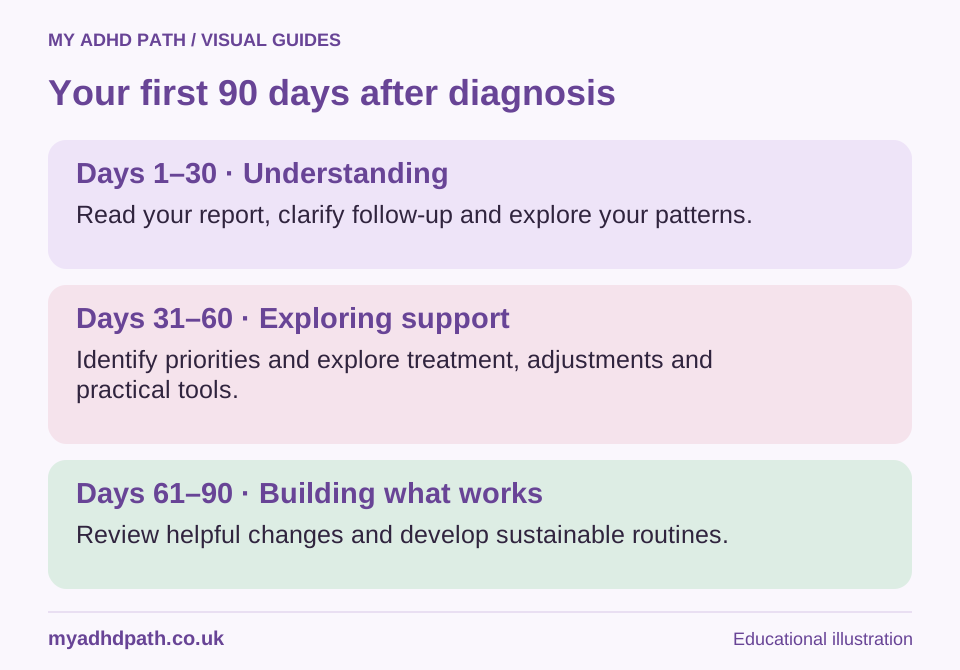
Your first 90 days after an ADHD diagnosis
It can be tempting to make a considerable number of changes immediately after diagnosis.
You might want to redesign your routines, reconsider your career, explore every available treatment and read everything you can find about ADHD.
But trying to do everything at once can become exhausting.
The following framework offers a more gradual approach.
It is a suggested starting point, not a clinical treatment programme or timetable.
Days 1-30: Understanding
Give yourself some time to absorb the information.
Useful priorities might include:
- Reading your assessment report.
- Clarifying anything you don't understand.
- Exploring reliable information about adult ADHD.
- Discussing any agreed treatment or follow-up arrangements.
- Noticing how ADHD affects different areas of your life.
- Deciding whether there is anyone you would like to tell.
You don't need to make major decisions during this period.
Understanding your experiences is a worthwhile activity in itself.
Days 31-60: Exploring support
Begin identifying the areas where additional support could make the greatest difference.
Perhaps organising work feels particularly demanding.
Perhaps household responsibilities are consuming considerable energy.
Perhaps remembering information, getting started or managing appointments is your biggest challenge.
Consider exploring:
- Workplace adjustments.
- ADHD-informed psychological support.
- Appropriate treatment.
- Assistive technology.
- Practical organisational strategies.
- Shared household responsibilities.
- Peer support or coaching, where suitable.
Choose one or two areas to focus on rather than attempting to redesign your entire life.
Days 61-90: Building what works
Review what you've learned.
Which changes have genuinely made everyday life easier?
Which strategies are difficult to maintain?
Which types of support are worth exploring further?
You may begin establishing a more personalised collection of routines, tools and working practices.
This is an ongoing process.
There is no requirement to reach a particular stage of acceptance, obtain medication or establish a complete support system within ninety days.
The framework simply provides somewhere to begin.
Ten practical ways to move forward after diagnosis
1. Review your past with curiosity
When memories arise, consider what you now understand about those experiences.
Rather than focusing exclusively on what might have happened differently, ask what the experience reveals about the support, environment or approach that might suit you today.
Try this
Your past can become a useful source of information. When a memory surfaces, ask: what does this tell me about what I need now?
2. Create a personal ADHD profile
ADHD varies considerably between individuals.
Write down the areas where you experience the greatest difficulties, alongside the activities and environments in which you tend to perform well.
You could include:
- How you concentrate best.
- How you prefer to receive information.
- Which activities you find particularly demanding.
- What helps you get started.
- How you respond to interruptions.
- The routines and tools you already find useful.
This can become a practical reference when making decisions about work, home and healthcare support.
3. Recognise the strategies you've already developed
Receiving a diagnosis doesn't invalidate everything you've learned about managing your life.
Perhaps you've developed excellent reminder systems, become skilled at preparing for meetings or discovered particular ways of organising information.
Some of those strategies may be extremely valuable.
Try this
Keep the strategies that genuinely help. Consider adapting the ones that require disproportionate effort.
4. Identify your most significant source of unnecessary effort
Instead of attempting to improve everything, identify one recurring difficulty that consumes considerable time or energy.
Perhaps it's reconstructing information after meetings.
Perhaps it's managing competing priorities.
Perhaps it's remembering everybody's appointments.
Explore whether an adjustment, tool or redistribution of responsibilities could make that particular activity easier.
Small improvements in frequently repeated activities can have a meaningful cumulative effect.
5. Explore ADHD-friendly technology
Some forms of technology can provide practical support with executive functioning.
Calendars, visual timers, reminders and project management applications are familiar examples.
AI assistants may also help with organising information, establishing priorities and breaking down complicated tasks.
For some people, the greatest benefit is not having another place to store tasks, but having support in deciding what to do with them.
Try this
Choose tools that reduce demands rather than create additional systems you need to maintain. Always check important AI outputs and use appropriate privacy safeguards.
6. Reconsider your working arrangements
You may discover that aspects of your working environment are more demanding than the actual work itself.
Constant interruptions, unclear priorities, lengthy meetings or poorly defined responsibilities can all introduce unnecessary difficulties.
Consider whether changes to your environment would allow you to use your existing abilities more effectively.
You may not need a different career.
You may need a different way of working within it.
7. Make space for interests and enjoyment
Understanding ADHD can initially lead to spending considerable time focusing on difficulties.
However, your life also contains interests, relationships, ambitions and activities that give you enjoyment.
Make room for those things too.
You don't need to turn every new interest into a business, every hobby into a qualifications course or every enjoyable activity into something productive.
Sometimes, enjoying something is a perfectly good reason to do it.
8. Find people who understand your experiences
Connecting with others who have received an ADHD diagnosis in adulthood can be valuable.
You may discover practical strategies, different perspectives and experiences that feel familiar.
Peer communities can offer encouragement and companionship, although they are not a substitute for individual medical advice.
Remember that someone else's experience of ADHD may be quite different from yours.
You can benefit from their insights without adopting every aspect of their approach.
9. Consider professional emotional support
For some people, receiving a diagnosis brings up difficult experiences that deserve further exploration.
An appropriately qualified counsellor or psychologist with an understanding of adult ADHD may help you process emotions, relationships and changes in self-perception.
You do not need to wait until those feelings become severe before exploring support.
Equally, not everyone who receives a late diagnosis will need counselling.
Choose according to your own circumstances.
10. Give yourself something to look forward to
A considerable amount of post-diagnosis reflection can focus on the past.
Try introducing a question about the future.
What would you like to do with this new understanding?
Perhaps you'd like to explore a subject you've always found interesting.
Perhaps you want to approach your business differently, improve your working arrangements or make more time for your family.
Perhaps you'd simply like everyday life to require a little less effort.
Try this
Your next chapter doesn't need to involve an extraordinary transformation. It can begin with something small that matters to you.
Create your own personal ADHD instruction manual
Imagine that you could give someone a short guide to how you work best.
Not a list of everything you find challenging, but a practical description of the conditions that help you thrive.
It might look something like this:
| Area | What I have discovered |
|---|---|
| Concentration | I work best without background conversations |
| Information | Written instructions help me retain important details |
| Planning | I need help establishing priorities, not simply collecting tasks |
| Motivation | A clear starting action helps me begin |
| Interruptions | I benefit from leaving myself notes before switching activities |
| Meetings | Agendas and written action points are particularly helpful |
| Recovery | I need uninterrupted time after demanding days |
| Strengths | I enjoy solving complicated problems and developing new ideas |
| Communication | Clear expectations help me work confidently |
This is a fictional example.
Your own instruction manual might look completely different.
The idea is to create a useful summary of what you've learned about yourself, rather than relying entirely on general descriptions of ADHD.
You can update it as your circumstances change.
How AI could help you understand your ADHD patterns
If you're processing a considerable amount of information following diagnosis, an AI assistant may offer a useful way to organise your thoughts.
You could use it to structure personal reflections, identify recurring themes or prepare questions for healthcare appointments.
AI prompt
Understanding my everyday patterns
"I have recently received an ADHD diagnosis. I would like to explore the activities I find demanding, the environments in which I work well and the strategies I already use. Ask me one question at a time and help me create a practical personal ADHD profile."
AI prompt
Preparing for my next appointment
"Help me organise my questions about ADHD treatment and support into a concise appointment checklist. Separate my observations from questions that require a healthcare professional's advice."
AI prompt
Making sustainable changes
"I want to make everyday life more manageable following my ADHD diagnosis. Help me identify one or two practical changes that could make a meaningful difference without requiring me to redesign all my routines."
AI can be useful for organising information, but it cannot determine whether a particular memory, behaviour or personality trait was caused by ADHD.
It is not a substitute for a qualified healthcare professional or psychological support.
Avoid sharing identifiable medical records or sensitive personal information with services that are not appropriate for handling it.
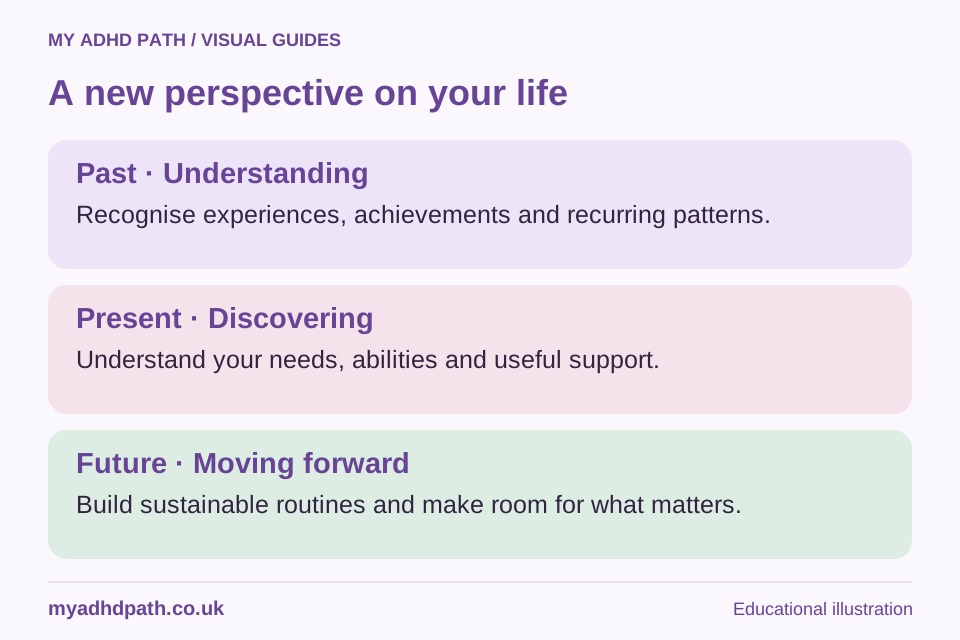
A reflection exercise: Looking backwards and looking forwards
You may find it helpful to spend some time considering what your diagnosis means to you personally.
There is no requirement to revisit difficult experiences if you would prefer not to.
Choose the questions that feel useful.
Looking backwards
- Which experiences make more sense to me now?
- Which abilities helped me navigate demanding circumstances?
- Which strategies have I developed over the years?
- What support might have made particular situations easier?
- Which achievements would I like to recognise?
Understanding the present
- What do I understand about my ADHD today?
- Where am I using more energy than I would like?
- Which environments help me work and feel well?
- What practical support would make the greatest difference?
- Who could help me explore that support?
Looking forwards
- What would I like more of in my life?
- Which responsibilities could become easier?
- What interests would I like to explore?
- What would a more sustainable working week look like?
- What is one change I could make this month?
You don't need to complete the exercise in one sitting.
You may prefer to return to these questions over several weeks as your understanding develops.
The answers may change over time.
What does research tell us about receiving an ADHD diagnosis in adulthood?
What the research says
Qualitative studies examining women's experiences of diagnosis in adulthood have identified themes including relief, greater self-understanding, frustration about earlier experiences and challenges accessing appropriate support. These findings highlight that the psychological and social experience of receiving a diagnosis can extend beyond the immediate clinical assessment. They also reinforce the importance of considering gender-related expectations and the compensatory behaviours some people develop over time.
There are limitations to the available evidence.
Qualitative studies often involve relatively small groups of participants. They provide valuable insight into personal experiences but cannot establish that everyone follows the same emotional journey.
There is currently no established sequence of emotional stages through which every newly diagnosed adult must progress.
Your experience is individual, and it may evolve in ways you did not initially expect.
When the emotions following diagnosis become overwhelming
Reflecting on earlier experiences can sometimes bring up significant sadness, anxiety or distress.
If these feelings persist, interfere with everyday functioning or become increasingly difficult to manage, consider speaking to a GP or appropriately qualified mental health professional.
An ADHD diagnosis does not mean that every emotional difficulty should be attributed to ADHD.
Depression, anxiety and other mental health conditions may require their own assessment and support.
Good to know
If you experience suicidal thoughts or thoughts of self-harm, seek professional help promptly. In the UK, you can contact Samaritans on 116 123. For urgent medical advice, contact your local urgent healthcare service, including NHS 111 where available. If you are in immediate danger or unable to keep yourself safe, call 999 or attend A&E.
Downloadable resource
My First 90 Days After an ADHD Diagnosis
A practical personal framework covering understanding your diagnosis, exploring support options and building sustainable strategies for everyday life.
Download PDFFrequently asked questions
Is it normal to feel sad after an ADHD diagnosis?
Some people experience sadness alongside relief following diagnosis in adulthood. They may reflect on previous difficulties or opportunities that could have been different with earlier support. Others experience predominantly positive emotions.
What is ADHD diagnosis grief?
It is an informal expression describing feelings of loss or regret that may arise when someone reconsiders earlier life experiences following an ADHD diagnosis. It is not a separate clinical diagnosis.
Is it too late to be diagnosed with ADHD at 40 or 50?
No. An appropriately conducted diagnosis in adulthood can help someone understand their experiences and explore treatment, adjustments and practical support, regardless of their age.
Why does my ADHD seem worse after diagnosis?
You may have become more aware of symptoms and compensatory behaviours that previously went unnoticed. Changes in stress, health or responsibilities may also contribute. Discuss significant or persistent changes with a healthcare professional.
Can a late ADHD diagnosis change my personality?
Receiving a diagnosis does not itself change your personality. However, it may influence how you understand your experiences, communicate your needs and approach everyday responsibilities.
Do I need to tell my family I have ADHD?
No. Disclosure is a personal decision. Sharing your diagnosis may be helpful in certain relationships, but you can decide when, how and with whom to discuss it.
Should I reconsider my career after being diagnosed?
Not necessarily. Start by considering which aspects of your work suit you and which are particularly demanding. Adjusting your working arrangements may be more appropriate than changing careers.
Do all newly diagnosed adults need medication?
No. Treatment decisions should be individual and discussed with an appropriately qualified clinician. Medication, psychological support and environmental adjustments may all have a role, depending on someone's circumstances.
How long does it take to come to terms with an ADHD diagnosis?
There is no standard timeframe. Some people adjust relatively quickly, whilst others continue reflecting on their diagnosis for months or years.
What should I do first after receiving an ADHD diagnosis?
Start by understanding your assessment report and any recommended follow-up arrangements. Explore reliable information, identify your most significant support needs and consider one manageable practical change.
The years ahead
You cannot return to your first day at school with everything you know today.
You cannot revisit every difficult conversation, reconsider every career decision or provide your younger self with a complete explanation of what she was experiencing.
But you can take that understanding into the decisions you make now.
You can explore ways to work that suit your attention.
You can communicate your needs with greater clarity.
You can discover tools that reduce unnecessary effort.
You can recognise the abilities that have helped you reach this point in your life.
And you can approach new opportunities with information you didn't previously have.
Perhaps there are experiences you would have liked to have been different.
There may also be friendships, achievements, relationships and memories that you wouldn't exchange for anything.
Your diagnosis doesn't require you to rewrite your entire life story.
It gives you another perspective from which to understand it.
Whatever age you receive your diagnosis, there are still things to discover, interests to explore, opportunities to pursue and experiences to enjoy.
You know more about yourself today than you did yesterday.
And that is a rather wonderful place from which to begin.
Sources and further reading
- Young, S. et al. (2020). Females with ADHD: An expert consensus statement taking a lifespan approach providing guidance for the identification and treatment of attention-deficit/hyperactivity disorder in girls and women. BMC Psychiatry, 20, 404. https://doi.org/10.1186/s12888-020-02707-9
- Exploring women's experiences of diagnosis of ADHD in adulthood: a qualitative study. https://doi.org/10.1080/18387357.2023.2268756
- Hinshaw, S. P. et al. (2022). Annual Research Review: Attention-deficit/hyperactivity disorder in girls and women: underrepresentation, longitudinal processes, and key directions. Journal of Child Psychology and Psychiatry. https://doi.org/10.1111/jcpp.13480
- Faraone, S. V. et al. (2021). The World Federation of ADHD International Consensus Statement: 208 Evidence-based conclusions about the disorder. https://doi.org/10.1016/j.neubiorev.2021.01.022
- NICE - Attention deficit hyperactivity disorder: diagnosis and management (NG87). https://www.nice.org.uk/guidance/ng87
- NHS - Attention deficit hyperactivity disorder (ADHD). https://www.nhs.uk/conditions/attention-deficit-hyperactivity-disorder-adhd/
- Acas - Reasonable adjustments. https://www.acas.org.uk/reasonable-adjustments
- GOV.UK - Access to Work. https://www.gov.uk/access-to-work
- Samaritans. https://www.samaritans.org/
This article provides general educational information and is not a substitute for professional medical advice, diagnosis, psychological support or treatment. Post-diagnosis grief is a descriptive expression rather than a formal medical diagnosis. The reflection activities and suggested ninety-day framework are intended as practical personal resources, not clinically validated assessment or treatment programmes.