

Same responsibilities. Same brain. A very different experience of everyday life.
At a glance
- ADHD is not caused by hormones, but hormonal fluctuations may influence ADHD symptoms.
- Oestrogen interacts with brain systems involved in attention and motivation.
- Some women report increased difficulties before their period.
- Tracking symptoms across two or three cycles can reveal recurring patterns.
- Medication effectiveness may appear to vary throughout the month.
- Discuss persistent cyclical changes with your healthcare professional.
Last week, you were flying.
You were making decisions, finishing projects, remembering appointments and feeling genuinely on top of things. You even cleared the pile of paperwork that had been sitting on your desk for a month.
This week?
You've read the same email five times. Everything feels irritating. You can't decide what to have for dinner, and the thought of opening your laptop makes you want to go back to bed.
Nothing significant has changed in your life. You're taking the same medication, following the same routines and managing the same responsibilities.
Then you check your calendar.
Your period is due in four days.
For some women with ADHD, this is a familiar pattern. Yet the relationship between ADHD and reproductive hormones remains an often overlooked aspect of understanding and managing the condition.
What the research says
Emerging research suggests that hormonal fluctuations may influence ADHD symptoms, emotional regulation and experiences of medication. Understanding that relationship could help you make more informed decisions about your health, your responsibilities and the support you need.
Is there a connection between ADHD and hormones?
ADHD is a neurodevelopmental condition. It is not caused by hormonal imbalances, menstruation or changes in reproductive hormones.
However, hormones can influence the way the brain functions.
Oestrogen and progesterone, two of the principal hormones involved in the menstrual cycle, have effects that extend far beyond reproductive health.
They interact with brain systems involved in attention, motivation, memory, sleep and emotional regulation.
These are also areas in which people with ADHD may experience difficulties.
Researchers are increasingly interested in whether changes in reproductive hormones can influence the severity and experience of existing ADHD symptoms.
What the research says
A 2025 systematic review published in the Journal of Attention Disorders identified 11 relevant studies examining ADHD and sex hormones. The findings suggested a possible relationship, particularly during puberty and across the menstrual cycle, although the researchers emphasised the limitations of the available evidence.
There is growing scientific interest in something many women have been describing for years: their ADHD doesn't necessarily feel the same throughout the month.
Understanding the relationship between oestrogen and dopamine
To understand why hormonal fluctuations might affect ADHD, it helps to explore the role of dopamine.
Dopamine is a neurotransmitter involved in several important brain functions, including:
- Motivation.
- Learning.
- Reward processing.
- Attention.
- Movement.
- Goal-directed behaviour.
ADHD is associated with differences in several brain networks and neurotransmitter systems, including those involving dopamine and noradrenaline.
Common misconception
It would be an oversimplification to describe ADHD as simply a dopamine deficiency. The underlying neurobiology is considerably more complex. However, dopamine signalling is one important area of ADHD research.
Where does oestrogen come into it?
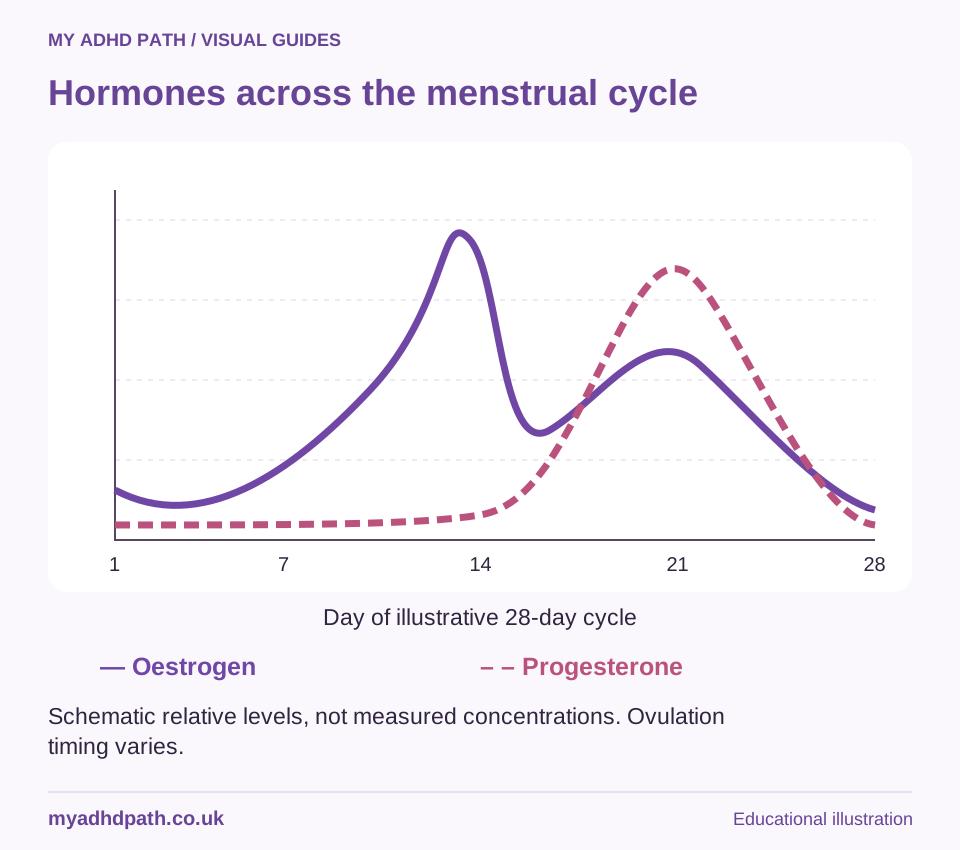
Oestrogen can influence dopamine signalling and other neurotransmitter systems involved in cognition and emotional regulation.
Researchers are investigating whether fluctuations in oestrogen may alter the functioning of these systems in ways that affect ADHD symptoms.
This could potentially help explain why some women report greater difficulties with motivation, concentration or emotional regulation when oestrogen levels are falling or relatively low.
But the relationship isn't as straightforward as saying that more oestrogen means better concentration.
Hormones interact with one another, and their effects vary between individuals. Sleep, stress, physical health and medication may also influence the overall experience.
What about progesterone?
Progesterone rises after ovulation and falls before menstruation if pregnancy does not occur.
One of its metabolites, allopregnanolone, interacts with brain systems involved in regulating nervous system activity.
Researchers are exploring whether sensitivity to changes in progesterone and its metabolites may contribute to differences in mood and cognition.
This is particularly relevant to research into premenstrual dysphoric disorder (PMDD).
The combined effects of reproductive hormones on ADHD remain an area of ongoing investigation.
ADHD and the four phases of your menstrual cycle
The menstrual cycle is commonly described using four phases.
Good to know
Although educational diagrams often show a 28-day cycle, healthy menstrual cycles vary in length. Ovulation does not always occur on day 14, and some cycles do not involve ovulation at all. Hormonal contraception, reproductive health conditions and perimenopause can also change these patterns. The following descriptions are therefore a general guide, not a prediction of how your ADHD will behave.
Phase one: Menstruation
The cycle begins on the first day of your period.
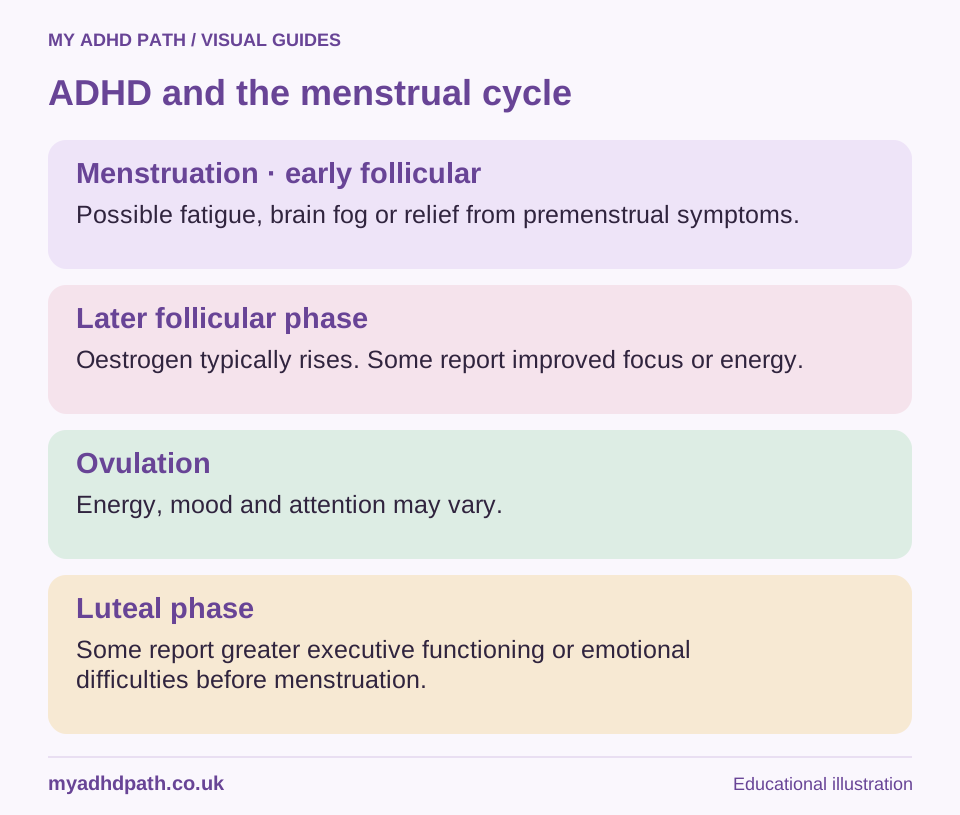
Oestrogen and progesterone are generally relatively low around the beginning of menstruation.
You may also be managing physical symptoms such as cramps, headaches, disrupted sleep and fatigue.
Some women with ADHD describe:
- Increased distractibility.
- Difficulties getting started.
- Brain fog.
- Reduced motivation.
- Lower tolerance for interruptions.
- Greater need for rest.
Others experience a sense of relief as premenstrual emotional symptoms begin to settle.
You may find that your mood improves before your physical energy returns.
There is no universal experience.
What might help
Reduce unnecessary demands where possible, make everyday tasks easier to begin and allow time for physical recovery.
Phase two: The follicular phase
The follicular phase begins on the first day of menstruation and continues until ovulation. Menstruation therefore overlaps with the beginning of this phase.
During the later follicular phase, oestrogen generally rises as the body prepares for ovulation.
Some women report that concentration, motivation and emotional resilience improve during this stage.
You might notice that tasks feel easier to begin, decisions require less effort and you have more enthusiasm for projects.
For some, this feels like a welcome return to their usual level of functioning.
However, not everyone experiences a noticeable improvement.
What might help
If you identify a period when you tend to feel more focused, consider using some of that capacity for demanding work or forward planning. Be careful not to commit yourself to more than you can realistically manage later in the month.
Phase three: Ovulation
Ovulation occurs when an ovary releases an egg.
Oestrogen rises before ovulation and then briefly falls, whilst other hormonal changes support the release of the egg.
Some women describe feeling energetic, confident or sociable around ovulation.
Others experience headaches, discomfort, changes in mood or difficulties with attention.
Research has explored whether changes around ovulation might influence impulsivity or other ADHD symptoms, but there is insufficient evidence to predict a consistent pattern.
What might help
Observe your own experiences rather than assuming this should automatically be your most productive time.
Phase four: The luteal phase
The luteal phase begins after ovulation and continues until the next period.
Progesterone rises during this phase. Oestrogen also fluctuates, and both hormones generally fall towards menstruation if pregnancy does not occur.
The later part of the luteal phase is when premenstrual symptoms commonly occur.
Some women with ADHD report greater difficulties during this period, including:
- Reduced concentration.
- Forgetfulness.
- Task paralysis.
- Irritability.
- Emotional sensitivity.
- Impulsive decisions.
- Difficulties managing sensory information.
- Feeling unusually overwhelmed.
- A perception that ADHD medication is less effective.
Physical symptoms, sleep disturbances and changes in appetite may add to these difficulties.
What might help
Make priorities clearer, reduce avoidable decisions, use external reminders and discuss persistent or significant symptom changes with your healthcare professional.
Your menstrual cycle and ADHD at a glance
| Cycle phase | Typical hormonal pattern | Possible experiences |
|---|---|---|
| Menstruation | Oestrogen and progesterone relatively low initially | Fatigue, brain fog or relief from premenstrual symptoms |
| Later follicular phase | Rising oestrogen | Improved energy, motivation or concentration |
| Ovulation | Oestrogen peaks and subsequently falls | Changes in energy, mood or impulsivity |
| Luteal phase | Progesterone rises; both hormones fall towards menstruation | Increased executive functioning difficulties or emotional sensitivity |
Good to know
This is an illustrative overview of reported experiences, not an established ADHD symptom timetable. Your own pattern may be different, and you may experience very little variation throughout your cycle.
Why does my ADHD feel worse before my period?
You might normally be able to manage a demanding working day, prepare dinner and deal with everyday household responsibilities.
Then, during the week before your period, the same responsibilities feel considerably more difficult.
It's tempting to conclude that you've somehow become less organised or that your productivity strategies have stopped working.
But several factors may be involved.
Hormonal fluctuations
Falling reproductive hormone levels may influence brain systems involved in attention and emotional regulation.
Although the mechanisms are not fully established, this is an area of increasing scientific interest.
Reduced sleep quality
Premenstrual discomfort, temperature changes and mood symptoms can interfere with sleep.
Poor sleep can independently affect concentration, memory, impulse control and emotional regulation.
If you're already managing ADHD, that additional difficulty can be particularly noticeable.
Physical discomfort
Headaches, bloating, cramps, breast tenderness and fatigue can compete for your attention.
Concentrating on a complicated task is naturally more demanding when you're physically uncomfortable.
Emotional demands
Some women experience increased anxiety, irritability or low mood before menstruation.
Managing these emotions can require additional mental effort, leaving fewer resources available for other responsibilities.
The cumulative effect
You may not be dealing with one dramatic change.
Instead, several relatively small changes may occur at the same time.
You're sleeping slightly less well. You're more sensitive to interruptions. You're finding it harder to organise your thoughts. You're experiencing discomfort and have less patience for unexpected problems.
Put all of those together and an ordinary Tuesday can feel anything but ordinary.
ADHD, PMS and PMDD: understanding the differences
Premenstrual symptoms are common, but their severity and impact vary considerably.
It is important not to dismiss significant mood or behavioural changes as simply part of having ADHD.
What is PMS?
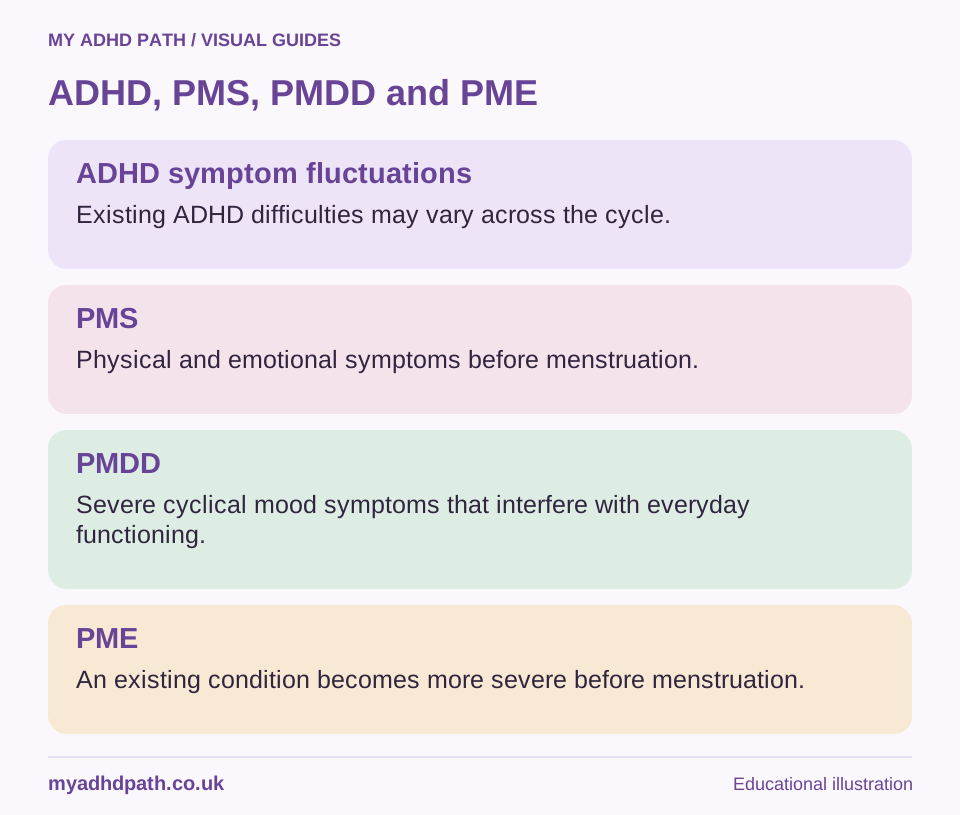
Premenstrual syndrome (PMS) describes physical and emotional symptoms that occur before menstruation.
Symptoms can include:
- Irritability.
- Mood changes.
- Tiredness.
- Headaches.
- Bloating.
- Breast tenderness.
- Changes in sleep or appetite.
PMS can affect people with or without ADHD.
For someone with ADHD, these additional symptoms may make existing difficulties harder to manage.
What is PMDD?
Premenstrual dysphoric disorder is a more severe condition involving significant cyclical mood and other symptoms that interfere with everyday functioning.
People with PMDD may experience intense irritability, anxiety, low mood, emotional distress or feelings of hopelessness before menstruation.
Symptoms typically improve shortly after the period begins and become minimal or absent during the following week.
PMDD is distinct from ADHD, although the two conditions can coexist.
What the research says
Emerging research suggests there may be an association between ADHD and premenstrual difficulties, including PMDD. More robust research is needed to establish the extent of this association.
What is premenstrual exacerbation?
Premenstrual exacerbation (PME) describes an existing condition becoming more severe before menstruation.
For example, someone might experience ADHD-related difficulties throughout the month but notice that those difficulties intensify during the premenstrual phase.
People with anxiety or depression can also experience premenstrual exacerbation.
| ADHD symptom fluctuation | PMS | PMDD |
|---|---|---|
| Existing ADHD difficulties may intensify | Physical and emotional premenstrual symptoms | Severe cyclical mood symptoms |
| ADHD symptoms may remain present throughout the month | Symptoms usually improve after menstruation begins | Symptoms significantly interfere with daily functioning |
| May involve greater organisational or attention difficulties | May involve bloating, discomfort and irritability | May involve profound distress, depression or anxiety |
These experiences can overlap, and this comparison cannot establish a diagnosis.
A healthcare professional can help distinguish between them, often with the assistance of prospective daily symptom tracking.
When to seek urgent help
Severe premenstrual mood symptoms should not be something you feel obliged to endure every month. If you experience persistent hopelessness, thoughts of self-harm or suicidal thoughts, seek professional support promptly. In the UK, you can contact Samaritans on 116 123. For urgent medical advice, use your local urgent healthcare service, including NHS 111 where available. If you are in immediate danger or unable to keep yourself safe, call 999 or attend A&E. You do not need to wait for your period to begin before seeking help.
Can your menstrual cycle affect ADHD medication?
Some women describe a particularly frustrating experience.
Their ADHD medication works reasonably well for much of the month, but before their period, it appears to become less effective.
They may find it harder to concentrate, initiate tasks or maintain emotional stability despite taking their medication as prescribed.
What the research says
Researchers have begun investigating whether hormonal fluctuations influence the experience or effectiveness of stimulant medication. A 2025 literature review examining psychostimulants in menstruating women with ADHD highlighted how little research has been conducted in this area.
There are several possible explanations for perceived changes in medication effectiveness.
Hormonal changes might influence brain systems involved in medication response. Alternatively, sleep disruption, physical symptoms or additional mood difficulties could increase the overall demands someone is experiencing.
The relationship may involve several factors rather than one simple hormonal mechanism.
What about increasing medication before your period?
Small preliminary studies have explored clinician-led medication adjustments during the premenstrual phase.
However, the available evidence is not sufficient to establish a standard cycle-based dosing approach for everyone with ADHD.
Medication decisions need to account for individual symptoms, medical history, side effects, cardiovascular health and other treatments.
Good to know
Do not increase, reduce, stop or otherwise change your ADHD medication independently. If you repeatedly notice changes in how well your medication seems to work, record those experiences and discuss them with your prescribing clinician. A pattern observed over several months may be more informative than describing one particularly difficult day.
Can hormonal contraception affect ADHD?
Hormonal contraception changes reproductive hormone patterns in different ways depending on the method used.
Combined hormonal contraception contains oestrogen and a progestogen, whilst other methods use a progestogen alone.
Some methods suppress ovulation, whilst others do not do so consistently.
Women report a wide range of experiences when using hormonal contraception. Some notice improvements in premenstrual symptoms or mood stability. Others report unwanted changes in mood, energy or wellbeing.
However, evidence specifically examining hormonal contraception and ADHD symptoms remains limited.
There is currently no single contraceptive method that can be recommended as best for everyone with ADHD.
When discussing contraception with a healthcare professional
- Mention your ADHD diagnosis and medication.
- Describe any noticeable cyclical symptom changes.
- Share previous experiences with hormonal contraception.
- Mention premenstrual mood symptoms.
- Note other health conditions and relevant medication.
- Consider practical preferences and difficulties remembering daily medication.
If you're considering changing contraception, discuss the potential benefits, risks and alternatives with a qualified healthcare professional.
Why hormonal changes during puberty matter
The beginning of puberty introduces considerable physical, emotional and social changes.
For girls with ADHD, these changes may occur alongside increasing academic expectations, more complicated friendships and greater responsibility for managing their own lives.
A child who previously coped well in primary school might begin struggling at secondary school.
It can be difficult to separate the effects of hormonal development from changing environmental demands.
Both may be relevant.
Greater awareness of ADHD in adolescent girls could help families, schools and healthcare professionals recognise difficulties earlier.
Good to know
Apparent moodiness, forgetfulness or academic inconsistency should be considered in the context of the young person's wider wellbeing and developmental history.
What happens during pregnancy and after childbirth?
Pregnancy involves substantial changes in reproductive hormones.
After childbirth, hormone levels change again, alongside potentially significant disruption to sleep, routines and everyday responsibilities.
Women with ADHD may experience changes in their ability to organise tasks, regulate attention or manage emotional demands during these periods.
However, experiences vary, and research into ADHD symptoms throughout pregnancy and the postpartum period remains limited.
Medication decisions also become particularly important.
Good to know
If you are pregnant, planning a pregnancy or breastfeeding, discuss ADHD medication with your prescribing clinician and maternity healthcare team. Do not make medication changes without appropriate professional guidance. Persistent emotional distress after childbirth should be assessed rather than automatically attributed to ADHD or ordinary hormonal changes.
Why everything can change again during perimenopause
Perimenopause is another stage when some women begin noticing significant changes in concentration, memory, sleep and emotional regulation.
For someone who has managed ADHD using established strategies for decades, these changes can feel particularly disruptive.
Hormonal fluctuations and menopause-related symptoms may make existing difficulties more apparent.
Some women also receive their first ADHD diagnosis during this stage of life.
However, new cognitive symptoms during perimenopause do not automatically indicate ADHD. An assessment should consider developmental history alongside other possible causes.
The relationship between ADHD and perimenopause deserves considerably more attention, which is why we have dedicated an entire guide to this subject.
How to track your ADHD symptoms throughout your cycle
If you suspect that your ADHD symptoms vary throughout the month, tracking can help you understand whether a recurring pattern exists.
You do not need an elaborate spreadsheet or an application requiring fifteen minutes of data entry every evening.
In fact, the simpler the system, the more likely it is to remain useful.
Start with six areas
Each day, briefly record your experience of:
- Concentration.
- Task initiation and organisation.
- Mood and emotional regulation.
- Energy.
- Sleep.
- Perceived medication effectiveness, if applicable.
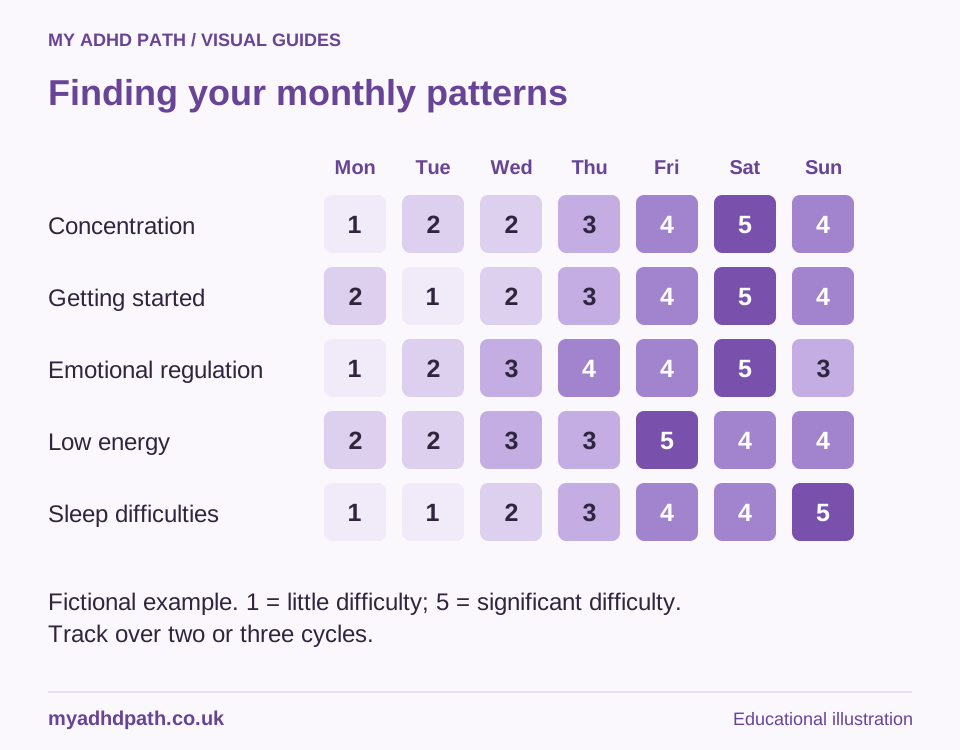
You can use a simple scale from one to five, with one representing little or no difficulty and five representing significant difficulty.
Record the first day of your period and any notable physical symptoms.
You might also make a short note of unusually stressful events, illness, changes in medication or other relevant circumstances.
An example of a symptom diary
| Area | Daily observation |
|---|---|
| Cycle information | Four days before expected period |
| Concentration | 4/5 difficulty |
| Getting started | 5/5 difficulty |
| Emotional regulation | 4/5 difficulty |
| Energy | 3/5 difficulty |
| Sleep | 3/5 difficulty |
| Medication experience | Usual prescribed dose; felt less helpful |
| Other factors | Busy working day and headache |
This is a fictional example of how someone might record their experiences.
It is not a diagnostic scoring system.
Track for at least two cycles
A single difficult week doesn't establish a hormonal pattern.
Tracking across two or three menstrual cycles may help you identify whether similar difficulties repeatedly occur at approximately the same stage.
If your periods are irregular, record symptoms and bleeding dates without trying to assign an exact cycle phase.
And if maintaining a detailed diary becomes another source of stress, simplify it.
A few words each day are better than an elaborate system you abandon after a week.
How to work with fluctuating ADHD symptoms
Understanding possible hormonal influences doesn't mean reorganising your entire life around your menstrual cycle.
Most of us cannot rearrange work deadlines, school holidays, caring responsibilities and appointments according to changes in our reproductive hormones.
But understanding your individual patterns may help you identify smaller, more practical adjustments.
1. Make difficult days easier to navigate
Create a short list of essential responsibilities for days when managing everyday life feels particularly demanding.
Instead of expecting yourself to complete everything, establish what genuinely needs your attention.
Use your usual productivity systems, but simplify them.
2. Prepare when you have the capacity
If you notice periods when organisation feels easier, use some of that capacity to prepare for later.
You could organise upcoming appointments, prepare familiar meals, review deadlines or make important decisions in advance.
The aim isn't to squeeze every minute of productivity out of your better days.
It's to make future responsibilities more manageable.
3. Reduce unnecessary decision-making
Deciding what to eat, wear, prioritise or respond to can become particularly demanding when you're already overwhelmed.
Keep a small collection of familiar meal options, straightforward routines and reusable checklists.
There is nothing wrong with eating the same reliable dinner twice in one week.
4. Protect your sleep
Sleep difficulties can intensify attention and emotional regulation problems.
Where possible, create a consistent sleep routine and address factors that interfere with sleep, including pain or persistent night-time symptoms.
If sleep problems are significant or ongoing, seek appropriate medical advice.
5. Create realistic boundaries
If you regularly agree to additional responsibilities during periods when you're feeling energetic, consider how those commitments will affect you later.
Leave enough flexibility in your schedule to accommodate ordinary changes in energy and concentration.
Your most productive day doesn't need to become the standard against which every other day is measured.
6. Communicate what you need
You don't necessarily need to share intimate details of your menstrual health with colleagues, friends or family members.
But you can explain that you're finding information overload, competing responsibilities or interruptions particularly difficult.
Requesting written instructions, clearer priorities or time to concentrate can be helpful regardless of the underlying cause.
7. Use technology to reduce the mental load
Calendar reminders, recurring task lists and digital planning tools can support organisation on more demanding days.
An AI assistant may also help turn an unstructured list of responsibilities into a clearer sequence of actions.
AI prompt
I'm finding it difficult to concentrate and make decisions today. Help me separate urgent responsibilities from things that can wait. Give me one manageable starting action at a time.
Good to know
Check any AI-generated recommendations and avoid sharing sensitive health or confidential workplace information with services that are not appropriate for handling it.
The problem with rigid cycle syncing
You may have encountered advice encouraging women to organise their professional, social and personal lives around the four phases of their menstrual cycle.
Sometimes this is described as cycle syncing.
There can be value in noticing individual patterns and adapting activities where appropriate.
Common misconception
Rigid claims that every woman will be creative during one phase, confident during another and unable to concentrate during another are not supported by sufficiently strong evidence. Your experience will be influenced by far more than reproductive hormones. Your sleep, health, environment, relationships, job, interests and personal circumstances all matter. A menstrual cycle is not a fixed personality timetable.
Use tracking to learn about yourself, rather than adopting someone else's expectations about how you should feel.
How to discuss ADHD and hormonal symptoms with your doctor
Describing fluctuating symptoms can be difficult during a short appointment.
You might attend on a relatively good day and struggle to communicate how different things felt the previous week.
A short symptom record can provide useful context.
What you could say
"I've noticed that my concentration, organisation and emotional regulation become significantly more difficult in the week before my period. I've been recording these changes across several cycles, and there appears to be a recurring pattern. I'd like to discuss whether hormonal fluctuations or another condition could be contributing."
You may also want to ask:
- Could these changes relate to PMS, PMDD or premenstrual exacerbation?
- Could sleep problems or other health conditions be contributing?
- Would a review of my ADHD treatment be appropriate?
- Could my current contraception be relevant?
- Should I continue tracking my symptoms?
- Would a referral to another healthcare professional be helpful?
Depending on your circumstances, it may be appropriate to involve your GP, ADHD prescribing clinician or a specialist in reproductive health.
When symptoms might have another explanation
Not every change in concentration, mood or energy is caused by ADHD or reproductive hormones.
Other potential contributors include:
- Iron deficiency, particularly with heavy periods.
- Thyroid conditions.
- Sleep disorders.
- Anxiety or depression.
- Medication side effects.
- Chronic pain.
- Other reproductive health conditions.
- Significant stress or illness.
If you're experiencing substantial changes, persistent exhaustion, unusually heavy bleeding, severe pain or symptoms that interfere with everyday life, speak to a healthcare professional.
Identifying other contributing factors can be an important part of improving your overall wellbeing.
What does the latest research say?
Research into the relationship between ADHD and reproductive hormones is developing.
What the research says
A 2025 systematic review found evidence suggesting an association between reproductive hormonal changes and ADHD symptoms. However, the researchers highlighted the limited number and size of available studies. A 2026 scoping review examining menstrual health and ADHD identified 20 eligible studies. It explored associations with menstrual difficulties, changes in symptoms across the cycle and early investigations into cycle-specific interventions. Researchers highlighted ongoing limitations in study design and the need for more rigorous investigations. Clinical publications have also begun exploring how menstrual symptom tracking might inform ADHD assessments and treatment reviews.
These developments are encouraging, but they do not yet establish a universal approach to hormone-related ADHD management.
Important questions remain about:
- Which individuals are most affected by hormonal fluctuations.
- How different hormones interact with ADHD-related brain systems.
- Whether particular medication strategies are effective and safe.
- The impact of hormonal contraception.
- Changes throughout pregnancy and perimenopause.
Understanding the limitations of current research is just as important as recognising the emerging findings.
Frequently asked questions
Some women report increased ADHD-related difficulties during the premenstrual phase. Hormonal fluctuations, changes in sleep, mood symptoms and physical discomfort may all contribute. Not everyone experiences this pattern.
Oestrogen interacts with brain systems involved in attention and cognition. Researchers are investigating whether lower or fluctuating oestrogen levels contribute to changes in ADHD symptoms, but the relationship remains incompletely understood.
Some women report reduced perceived medication effectiveness before menstruation. Possible explanations include hormonal influences and increased demands associated with sleep, mood or physical symptoms. Discuss recurring changes with your prescriber rather than altering your medication independently.
Emerging research suggests there may be an association between ADHD and significant premenstrual symptoms, including PMDD. They are separate conditions that can coexist, and a professional assessment can help distinguish between them.
Some people experience changes in mood or premenstrual symptoms when using hormonal contraception. However, evidence does not establish the contraceptive pill as a treatment for ADHD.
No. ADHD is diagnosed through a specialist clinical assessment. Hormone tests may be appropriate when investigating other health concerns, but they cannot establish an ADHD diagnosis.
Some women report changes in ADHD symptoms during pregnancy and after childbirth, although experiences and available evidence vary considerably.
Tracking may be helpful if you suspect recurring symptom changes. It can provide information for discussions with your healthcare professional, but it is not a requirement for managing ADHD.
Yes, symptom fluctuations can occur even when menstrual cycles are irregular. Tracking actual symptoms and bleeding dates may be more useful than trying to predict specific hormonal phases.
You don't need to feel the same every day
There's an expectation in modern life that we should be able to deliver a consistent level of performance every single day.
But human beings aren't particularly consistent machines.
Our energy changes. Our concentration changes. Our physical health, circumstances and emotional experiences change.
For some women with ADHD, reproductive hormonal fluctuations may introduce another layer of variability.
Understanding those patterns can help you approach your responsibilities with more flexibility and make better-informed decisions about your support.
Perhaps the most useful question isn't why you can't perform exactly as you did last week.
Perhaps it's what would make this week more manageable.
Sources and further reading
- Osianlis et al. (2025). ADHD and Sex Hormones in Females: A Systematic Review. Journal of Attention Disorders. https://doi.org/10.1177/10870547251332319
- Menstrual Health and Attention-Deficit/Hyperactivity Disorder (ADHD) Symptoms: A Scoping Review (2026). https://pubmed.ncbi.nlm.nih.gov/42274016/
- Findeis and Strauss (2025). The Effects of Psychostimulants in Menstruating Women with ADHD. https://doi.org/10.1016/j.pnpbp.2025.111261
- Kooij et al. (2025). Research Advances and Future Directions in Female ADHD: The Lifelong Interplay of Hormonal Fluctuations with Mood, Cognition, and Disease. https://doi.org/10.3389/fgwh.2025.1613628
- Practical Tools for Female-Specific ADHD: The Impact of Hormonal Fluctuations in Clinical Practice and from the Literature. https://doi.org/10.1192/j.eurpsy.2025.10120
- NICE - Attention Deficit Hyperactivity Disorder: Diagnosis and Management (NG87). https://www.nice.org.uk/guidance/ng87
- NHS - Premenstrual Syndrome (PMS). https://www.nhs.uk/conditions/pre-menstrual-syndrome/
- NHS - Menopause. https://www.nhs.uk/conditions/menopause/
This article provides general educational information and is not a substitute for professional medical advice, diagnosis or treatment. Research into ADHD and reproductive hormones remains developing. Always consult an appropriately qualified healthcare professional before making changes to ADHD medication, contraception or hormonal treatments.