

When the brain you've spent a lifetime learning to manage starts changing the rules.
At a glance
- Perimenopause may make existing ADHD difficulties more noticeable.
- Recent research suggests women with ADHD may experience a greater burden of perimenopausal symptoms.
- ADHD and menopause can involve overlapping cognitive and emotional experiences.
- HRT is an established menopause treatment, not an established ADHD treatment.
- Changes in medication effectiveness should be discussed with a prescribing clinician.
- Workplace adjustments and practical strategies may help reduce everyday demands.
You've spent years working out how to manage your life.
You've developed systems, created routines, found ways to remember things and built a career around your abilities. You know what helps you concentrate, what overwhelms you and how to get yourself back on track when things become chaotic.
Then, somewhere in your forties, everything starts feeling different.
You're forgetting words halfway through sentences. Making decisions feels exhausting. You're losing track of conversations, struggling to concentrate and becoming irritated by things that never previously bothered you.
You walk into a room with absolutely no idea why you're there.
And the strategies you've relied on for years suddenly seem considerably less effective.
For women with ADHD, perimenopause can introduce an entirely new set of challenges. For others, it's the stage of life when they first begin to wonder whether they've had ADHD all along.
Yet despite the growing awareness of both ADHD and menopause, the relationship between the two has historically received remarkably little attention.
Thankfully, that's beginning to change.
Why is perimenopause particularly challenging for women with ADHD?
Perimenopause is the transition leading up to menopause, during which ovarian hormone production becomes increasingly variable.
It commonly begins during your forties, although it can happen earlier, and may last several years.
Menopause itself is generally identified retrospectively after twelve consecutive months without a period, where hormonal contraception or another explanation does not account for the absence of menstruation. Postmenopause describes the stage that follows.
For many women, perimenopause involves changes in concentration, memory, sleep, energy and emotional wellbeing.
If you already experience difficulties in some of these areas because of ADHD, the additional demands can be particularly noticeable.
Illustrative scenario
Imagine you've spent years managing your responsibilities using a carefully constructed collection of coping strategies.
Those strategies work, but they require considerable effort.
Now imagine trying to maintain them whilst sleeping badly, experiencing unexpected hormonal fluctuations and finding it increasingly difficult to retrieve information from your memory.
The strategies themselves haven't necessarily become inadequate. The circumstances in which you're using them have changed.
What does the research tell us about ADHD and perimenopause?
For years, much of the discussion surrounding ADHD and menopause was based on individual experiences and clinical observations.
We are now beginning to see more substantial research.
What the research says
A population-based cohort study published in European Psychiatry in 2025 examined perimenopausal symptoms in 5,392 women, including 535 who reported an ADHD diagnosis.
The differences were striking.
| Severe perimenopausal symptoms | Percentage of participants |
|---|---|
| Women with ADHD | 54.2% |
| Women without ADHD | 30.1% |
Women with ADHD reported greater difficulties across psychological, physical and urogenital symptom categories.
The difference in overall symptom scores was particularly noticeable among women aged 35-39.
These findings suggest that women with ADHD may experience a greater burden of perimenopausal symptoms, potentially at younger ages.
However, the study relied in part on self-reported information. It does not establish that ADHD causes earlier biological menopause or that every woman with ADHD will experience more severe symptoms.
Nevertheless, research of this kind is helping to bring greater attention to an area of women's health that has previously been underexplored.
What happens to oestrogen during perimenopause?
Oestrogen is often discussed in relation to reproductive health, but its influence extends throughout the body and brain.
During perimenopause, oestrogen levels can fluctuate considerably before generally settling at lower levels after menopause.
These fluctuations are not necessarily a gradual, predictable decline.
Hormone levels may rise and fall unevenly, which can make symptoms feel inconsistent.
You might have several weeks when you feel relatively normal, followed by a period when concentration, sleep and emotional wellbeing become significantly more difficult to manage.
Why does this matter for ADHD?
Oestrogen interacts with neurotransmitter systems, including those involving dopamine and noradrenaline.
These systems play important roles in attention, motivation, memory and other cognitive processes relevant to ADHD.
Researchers are investigating whether hormonal fluctuations influence existing ADHD symptoms through changes in these systems.
Although there are plausible biological explanations, the precise relationship is not yet fully understood.
Good to know
ADHD is not simply a dopamine deficiency, and perimenopausal cognitive difficulties cannot be explained entirely by changes in oestrogen. Sleep, physical symptoms, stress, mental health and environmental demands can all contribute.
Ten changes women with ADHD may notice during perimenopause
Not every woman will experience these difficulties. Many can also occur without ADHD.
However, recognising changes from your usual level of functioning may help you understand what is happening and communicate your experiences to healthcare professionals.
1. Brain fog becomes more noticeable
Brain fog is an informal expression describing experiences such as mental cloudiness, difficulty concentrating and problems retrieving information.
You might struggle to find the right word, lose track of what you're saying or find it difficult to follow a complicated discussion.
For someone who already experiences attention or working memory difficulties, brain fog can feel like an additional obstacle between having a thought and being able to do something with it.
2. Your working memory feels less reliable
Working memory helps you temporarily retain and use information whilst completing an activity.
You use it when following instructions, remembering what someone has just said or holding several pieces of information in mind whilst making a decision.
During perimenopause, some women notice that tasks requiring these abilities become more demanding.
You might open an email to check something, read it, close it and immediately forget the information you were looking for.
Or find yourself walking between rooms repeatedly because you've forgotten what you intended to collect.
3. Getting started becomes harder
Tasks that previously required a little encouragement may now feel almost impossible to begin.
You understand what's needed. You've done it hundreds of times before.
But getting from intention to action feels considerably more difficult.
Changes in energy, mood, concentration and sleep may all contribute to these experiences.
4. Your tolerance for interruptions decreases
Perhaps you've always managed a busy household or a demanding working environment.
Now, someone asking you a straightforward question whilst you're concentrating can feel disproportionately disruptive.
You might find yourself needing longer periods of uninterrupted time to complete work that previously felt manageable.
Recognising this change can help you establish more suitable working boundaries.
5. Emotional reactions become more intense
Some women notice increased irritability, anxiety or emotional sensitivity during perimenopause.
If emotional regulation was already an area of difficulty, these changes may feel particularly pronounced.
A minor disagreement can occupy your thoughts for hours. Unexpected changes feel harder to manage. Noise or repeated interruptions become exhausting.
Persistent or significant changes in mood deserve professional attention rather than being automatically attributed to hormones or ADHD.
6. Your usual organisational systems stop working
You've got the calendar. You've got the reminders. You've got the notebook.
You may even have a rather elaborate system involving several carefully synchronised applications.
Yet somehow you're still missing appointments, forgetting deadlines or struggling to establish what needs doing next.
A system designed around your previous level of functioning may now require more effort than you have available.
Simplifying it might be more useful than adding another organisational tool.
7. Sleep becomes a much bigger issue
Sleep difficulties are already experienced by many adults with ADHD.
Perimenopause may introduce additional disruption through night sweats, hot flushes, discomfort, anxiety or changes in sleep patterns.
Repeatedly waking during the night can affect attention, memory and emotional regulation the following day.
Sometimes what appears to be a dramatic worsening of ADHD may be partly connected to persistent sleep disruption.
8. Your sensory preferences change
You might become less tolerant of background noise, busy environments, bright lights or uncomfortable clothing.
Some women describe needing greater control over their surroundings than they previously required.
Research specifically connecting changes in sensory processing with ADHD during menopause remains limited.
Nevertheless, noticeable changes in your sensory experiences are worth acknowledging when considering what helps you feel comfortable and concentrate.
9. You feel less confident in your abilities
Perhaps you've always been the person other people rely on.
You're knowledgeable, experienced and good at solving problems.
Then you start forgetting important information during meetings or struggling to complete familiar activities.
It can be difficult not to interpret those changes as evidence that you've somehow become less capable.
But encountering new cognitive difficulties doesn't erase your knowledge, experience or achievements.
It may indicate that your current circumstances require different support.
10. ADHD medication feels different
Some women report that medication which previously helped them manage ADHD symptoms seems less effective during perimenopause.
Others notice changes in sleep, anxiety or medication tolerability.
There are several possible explanations, and research specifically examining ADHD medication during menopause remains limited.
Any significant or persistent change in your medication experience should be discussed with your prescribing clinician.
Is it ADHD, perimenopause or both?
This is one of the most challenging questions facing women and healthcare professionals.
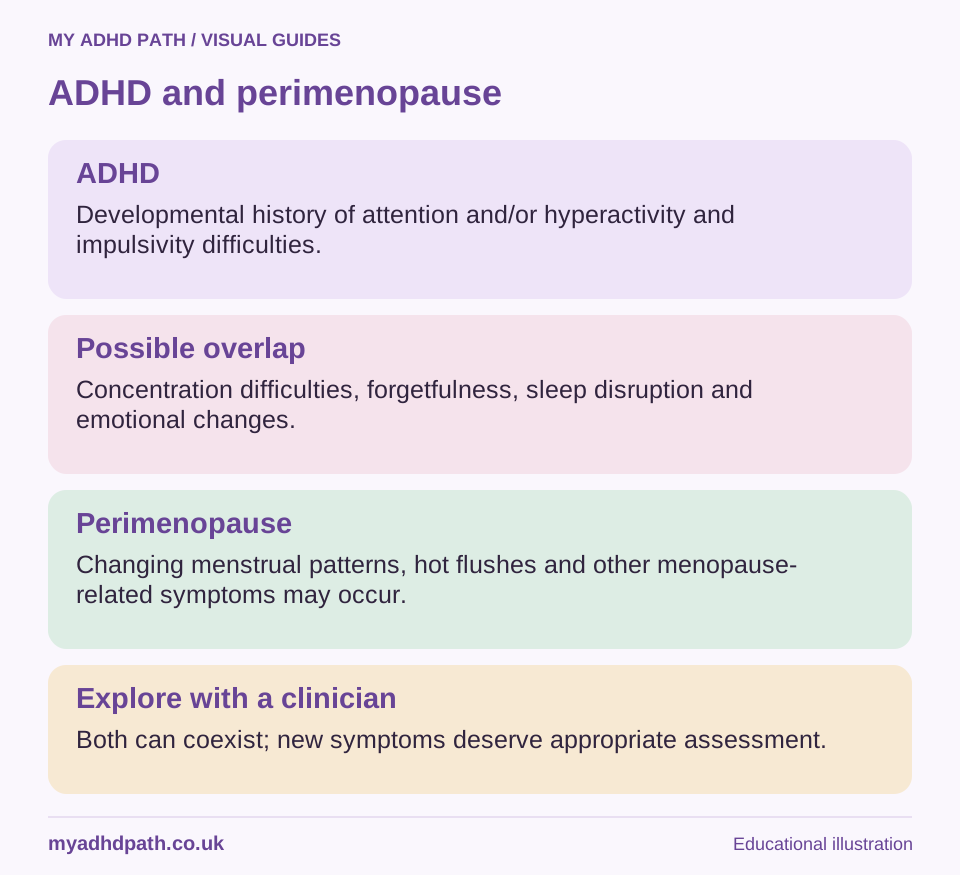
ADHD and perimenopause can involve overlapping experiences, particularly in relation to concentration, memory, mood and sleep.
But they are distinct.
ADHD is a neurodevelopmental condition involving symptoms that begin during childhood. Perimenopause is a reproductive transition that typically occurs during midlife.
The timing and history of your experiences can provide important clues.
| Experience | ADHD | Perimenopause |
|---|---|---|
| Difficulty concentrating | May form part of a lifelong pattern | May emerge or become more noticeable during midlife |
| Forgetfulness | Often associated with attention and working memory difficulties | May involve newly noticeable memory or word-finding difficulties |
| Emotional regulation difficulties | Can occur throughout life | May change alongside hormonal fluctuations |
| Sleep difficulties | Can occur at any age | May be associated with night sweats and other menopause symptoms |
| Time management problems | May have been present since childhood | Can become more difficult when concentration and energy change |
| Hot flushes and night sweats | Not core ADHD symptoms | Common menopause-associated symptoms |
| Changes in menstrual cycle | Not caused by ADHD itself | Common during perimenopause |
This comparison is educational rather than diagnostic.
A woman can have ADHD and experience perimenopause simultaneously. She may also have other physical or mental health conditions contributing to her symptoms.
The aim of an assessment should be to understand the complete picture, rather than choosing one explanation and dismissing the others.
Why so many women discover ADHD in their forties and fifties
For some women, perimenopause doesn't simply bring a change in known ADHD symptoms.
It brings the possibility of ADHD into consideration for the first time.
Illustrative scenario
Imagine someone who has spent her entire adult life managing a successful career, maintaining a household and supporting her family.
She's always relied heavily on reminders, lists and deadlines. She's frequently worked longer hours than her colleagues and found everyday administration disproportionately exhausting.
But she's managed.
Then she reaches her mid-forties and her usual strategies become less reliable.
She begins researching memory difficulties, concentration problems and hormonal changes.
Somewhere along the way, she encounters information about ADHD in women.
Suddenly, she recognises experiences that stretch back considerably further than the beginning of perimenopause.
School reports about daydreaming. University assignments completed the night before. Forgotten appointments. The constant mental effort involved in appearing organised.
For some women, perimenopause may expose difficulties that were previously compensated for.
That doesn't mean menopause has caused ADHD.
It may mean that the combination of changing circumstances and longstanding symptoms has finally prompted someone to investigate.
You can explore this further in our guide to why ADHD in women gets missed.
The fear that something more serious is happening
One of the more frightening experiences of midlife cognitive changes is wondering whether you're developing a serious neurological condition.
When you've always been articulate and suddenly struggle to retrieve familiar words, it's understandable to feel concerned.
Menopause-associated brain fog can be unsettling, and difficulties with attention can also affect how information is stored and retrieved.
But neither menopause nor ADHD should automatically be assumed to explain significant new cognitive symptoms.
Good to know
Speak to your GP if memory or concentration changes are persistent, worsening or interfering with your everyday functioning. Other potential explanations may include sleep disorders, thyroid problems, vitamin deficiencies, medication effects, depression and neurological conditions.
Sudden confusion, facial weakness, difficulty speaking or other possible signs of a stroke require emergency medical attention.
Getting changes properly investigated can help you understand what is happening rather than living with uncertainty.
Can HRT help women with ADHD?
Hormone replacement therapy, commonly known as HRT, is an established treatment for certain menopause-associated symptoms.
But does it also help ADHD?
The answer is more complicated than many online discussions suggest.
What HRT can help with
Depending on the individual and treatment selected, HRT may help manage symptoms such as hot flushes, night sweats and some menopause-associated mood difficulties.
If these symptoms have been disrupting sleep, concentration or everyday functioning, managing them could indirectly make ADHD-related difficulties easier to navigate.
For example, someone who begins sleeping more comfortably may find that her attention and emotional regulation improve during the day.
However, that is not the same as demonstrating that HRT directly treats ADHD.
Is HRT an ADHD treatment?
No. HRT is not currently an established treatment for ADHD.
What the research says
A 2026 narrative review by Dora Wynchank and Sandra Kooij explored the management of ADHD during perimenopause, menopause and postmenopause. The authors discussed the possible role of menopause hormone therapy alongside ADHD treatment but highlighted the absence of robust clinical trials establishing its specific effects on ADHD treatment outcomes.
Some women report improvements in concentration or mental clarity after starting HRT. Others experience little cognitive change.
These individual experiences cannot establish how another person is likely to respond.
Understanding different types of HRT
HRT may contain oestrogen alone or a combination of oestrogen and a progestogen.
Treatments come in several forms, including tablets, patches and gels.
People who still have a uterus generally require appropriate progestogen alongside systemic oestrogen to protect the womb lining.
The most suitable treatment depends on symptoms, medical history, personal preferences and individual risk factors.
HRT has potential benefits and risks, which should be discussed with a qualified healthcare professional.
Having ADHD does not automatically mean that HRT is appropriate for you.
Equally, having ADHD should not prevent you from discussing menopause treatment options.
Can you take HRT and ADHD medication together?
Some women receive treatment for both ADHD and menopause at the same time.
The suitability of combining treatments depends on individual circumstances, including the specific medications, medical history, side effects and cardiovascular health.
What the research says
A 2026 review of ADHD pharmacological management during menopause highlighted the limited direct research into treatment effectiveness and safety specifically in this population. It also emphasised the value of individualised monitoring and collaboration between healthcare professionals.
If you're receiving treatment for ADHD and considering HRT, make sure your GP, ADHD prescriber and any menopause specialist are aware of your current medications.
Discussion points for your clinician
- Changes in concentration and executive functioning.
- Sleep difficulties.
- Blood pressure and heart rate.
- Mood changes.
- Medication side effects.
- Existing cardiovascular risk factors.
- Your previous experiences of hormonal treatments.
Important
Do not change your ADHD medication or HRT independently. A coordinated approach is particularly valuable when symptoms and potential side effects overlap.
Why managing both conditions can feel so complicated
Healthcare services are often organised around individual conditions.
Your ADHD specialist may focus primarily on attention, impulsivity and medication management.
Your menopause care may focus on hormonal symptoms, sleep and reproductive health.
Your GP may be helping you manage several other health concerns.
Yet you're experiencing all of those things in one body, at the same time.
It can be frustrating to feel as though you're responsible for connecting information between different appointments.
Try this
Keep a short, updated record of your treatments, symptoms and recent changes. Where appropriate, ask your healthcare professionals whether they can communicate directly about your care.
You shouldn't have to become an expert in both neurodevelopmental conditions and reproductive endocrinology to have an informed conversation about your wellbeing.
The midlife mental load nobody talks about
Perimenopause often arrives during a period of life that is already particularly demanding.
You may be managing an established career, supporting teenage children, helping ageing parents, maintaining relationships and dealing with financial responsibilities.
Your children might be approaching important examinations or preparing to leave home.
Your parents may increasingly need your help.
You could be running a business, managing a team or considering what you want from the next stage of your career.
And somewhere amongst all of that, your own health needs attention.
For women with ADHD, the combined demands of this stage of life may be particularly challenging.
When you're the person who remembers everything
Many households rely on someone to keep track of the invisible details.
Who needs a dental appointment? When is the car insurance due? Has the school form been completed? What medication needs collecting? Is there enough food for dinner?
These responsibilities involve far more than completing individual tasks.
They involve anticipating needs, remembering information, making decisions and coordinating other people's lives.
If your concentration and working memory are becoming less reliable, maintaining that mental overview can become exhausting.
Try this
This may be a good opportunity to reconsider how household responsibilities are shared. Not simply asking someone to help with a task, but transferring responsibility for remembering, planning and completing it.
There's a significant difference between someone doing the food shopping and someone taking ownership of deciding what needs buying in the first place.
ADHD, perimenopause and your working life
Many women reach their most experienced professional years at approximately the same time that perimenopause begins.
They may be managing greater responsibilities than ever before.
Yet cognitive changes, fatigue and sleep difficulties can make familiar work feel unexpectedly challenging.
Some start questioning whether they should reduce their hours, leave a senior position or change careers altogether.
Before making a significant career decision, consider whether changes to your working environment could help.
Workplace adjustments worth exploring
Workplace adjustments checklist
- Written meeting agendas and action summaries.
- Protected periods of uninterrupted concentration.
- More flexible working arrangements.
- A comfortable working temperature.
- Reduced unnecessary interruptions.
- Clearer priorities and deadlines.
- Access to suitable assistive technology.
- Regular workload reviews.
- A quieter working environment.
In Great Britain, ADHD or menopause-related difficulties may meet the legal definition of disability under the Equality Act 2010, depending on their severity, impact and duration.
Where the relevant legal requirements are met, employers may have a duty to make reasonable adjustments.
Workplace support can also be discussed without first establishing a legal entitlement.
Eligible individuals may be able to explore additional disability-related support through Access to Work.
Our ADHD at Work hub provides more detailed guidance on workplace conversations, productivity and employment support.
Practical ways to manage ADHD during perimenopause
You don't necessarily need a completely new approach to managing ADHD.
You may simply need to adapt your existing strategies to reflect your changing circumstances.
1. Reduce the number of systems you're maintaining
If you're currently using three calendars, several task management applications and a collection of notebooks, maintaining the system itself may be consuming unnecessary energy.
Start with the essentials.
One reliable place to capture tasks. One calendar. One short daily planning process.
Build additional complexity only when it genuinely solves a problem.
2. Stop relying on your memory where you don't need to
If information is important, record it somewhere accessible.
Use reminders for appointments, written notes for conversations and checklists for recurring activities.
External memory tools are not a lesser way of working.
They're practical resources that allow you to reserve your attention for activities that actually require it.
3. Protect your concentration
Notice when you tend to feel most mentally alert.
For some women, that's first thing in the morning. Others need time to settle into the day.
Where your circumstances allow, reserve those periods for activities requiring greater concentration.
Group routine administration together and reduce unnecessary notifications.
You may find that changing the conditions around a task is more effective than trying to increase the amount of effort you put into it.
4. Give yourself somewhere to restart
Interruptions can be particularly difficult when working memory feels unreliable.
Before moving away from a task, leave a short note explaining what you were doing and what needs to happen next.
For example:
"Finished checking the first three supplier quotes. Next: compare delivery costs and update the spreadsheet."
That small note could save you considerable time reconstructing your previous train of thought.
5. Use technology as a thinking partner
For some people with ADHD, the greatest difficulty isn't capturing information. It's organising that information into something meaningful.
An AI assistant can help break down complicated tasks, summarise approved documents, identify competing priorities and reconstruct the context of unfinished projects.
AI prompt
I have several responsibilities competing for my attention and I'm struggling to establish where to begin. Help me organise them into genuine deadlines, essential tasks and things that can wait. Give me one clear starting action for the most important task.
Use appropriate privacy safeguards, check the accuracy of the output and avoid sharing sensitive information with unapproved services.
Technology should reduce the mental work involved in organising your life, not introduce another system you have to manage.
6. Make sleep a health priority
If night sweats, insomnia or other symptoms are repeatedly disrupting your sleep, discuss them with a healthcare professional.
Where possible, maintain a comfortable sleeping environment and a reasonably consistent routine.
Regular physical activity may also support general wellbeing and sleep.
However, good sleep habits alone may not resolve persistent menopause-related sleep difficulties.
Appropriate treatment and investigation can be important.
7. Make movement something you enjoy
Exercise has established benefits for cardiovascular health, bone health and general wellbeing.
Some people with ADHD also find that physical activity helps them manage restlessness, attention or stress.
Walking, swimming, cycling, strength training, dancing and gardening are all possibilities, depending on your health and physical abilities.
You don't need to adopt a complicated exercise programme to begin benefiting from movement.
Finding something you genuinely enjoy may make it easier to continue.
8. Avoid making commitments based on your best day
When you've had several difficult days and suddenly feel energetic again, it's tempting to catch up with everything.
You agree to additional work, make ambitious plans and fill your calendar with things you've been meaning to do.
Then your energy changes again.
Try planning around a realistic range of functioning rather than assuming every day will resemble your most productive one.
Leave some flexibility in your commitments.
9. Reconsider what genuinely needs your attention
Midlife can be a useful time to review responsibilities that have gradually accumulated.
Are you still organising things that other people could manage themselves?
Are you maintaining commitments that no longer reflect your priorities?
Are there recurring tasks you could simplify, automate, share or outsource?
Reducing unnecessary demands can be just as valuable as developing new ways to manage them.
10. Seek support before everything becomes unmanageable
You don't need to wait until your work, relationships or wellbeing are significantly affected before exploring support.
A conversation with your GP, ADHD specialist, employer or a suitably qualified therapist may help you identify options earlier.
Practical strategies, appropriate medical care and changes to your environment can complement one another.
What about supplements for ADHD and menopause?
You'll find no shortage of products marketed towards women experiencing brain fog, fatigue, hormonal changes or difficulties concentrating.
Magnesium, omega-3, herbal remedies, vitamins and various supplements promoted for cognitive performance are frequently discussed online.
However, marketing claims can extend considerably beyond the available evidence.
Good to know
Supplements are not established replacements for ADHD medication or appropriate menopause treatment. If investigations identify a nutritional deficiency, your healthcare professional may recommend appropriate treatment.
Some supplements can also interact with prescription medication or affect existing health conditions.
Discuss any products you're considering with a pharmacist or healthcare professional, particularly if you're taking ADHD medication, HRT or other prescribed treatments.
Tracking ADHD and perimenopause symptoms without creating another demanding task
Keeping a record of your experiences may help identify patterns and make medical appointments more productive.
But you don't need to turn symptom tracking into a full-time occupation.
Start by recording a few relevant areas.
| Area | What you might record |
|---|---|
| Menstrual cycle | Period dates and changes in bleeding patterns |
| Concentration | Whether focusing feels easier or harder than usual |
| Working memory | Noticeable changes in forgetfulness or information retention |
| Sleep | Approximate sleep quality and night-time waking |
| Emotional wellbeing | Significant changes in mood, anxiety or irritability |
| Physical symptoms | Hot flushes, night sweats, headaches or discomfort |
| Medication | Prescribed treatments and any perceived changes |
| Daily functioning | The activities or responsibilities most affected |
Use a simple scale or a few descriptive words.
If you forget to record something, continue the following day.
The purpose is to provide useful information, not achieve a perfect record.
Download our free ADHD and Menopause Symptom Tracker to get started.
Preparing for an appointment with your GP
When you're experiencing several overlapping symptoms, explaining everything during a short appointment can be difficult.
You might forget some of the most important details until you're halfway home.
A little preparation can help.
Appointment preparation checklist
- When you first noticed significant changes.
- Whether you had similar difficulties earlier in life.
- Changes to your menstrual cycle.
- Relevant physical symptoms.
- Your sleep quality.
- Existing diagnoses and medication.
- How your responsibilities are being affected.
- What you would like help with.
What you could say
"Over the past year, I've noticed significant changes in my concentration, memory and emotional regulation. I'm also experiencing changes in my menstrual cycle and sleep. I'd like to explore whether perimenopause could be contributing and how this might interact with ADHD."
If you suspect undiagnosed ADHD, explain whether relevant difficulties were also present during childhood and earlier adulthood.
This helps distinguish longstanding patterns from more recent changes.
Do you need a blood test to diagnose perimenopause?
Not necessarily.
Under NICE guidance, perimenopause or menopause can often be identified from symptoms and menstrual history in otherwise healthy people aged 45 and over.
Testing may be considered in younger individuals or particular clinical circumstances.
Your GP might also recommend investigations to explore other possible causes of fatigue, cognitive changes or related symptoms.
The appropriate approach depends on your age, symptoms and medical history.
Important
Seek medical advice if you experience possible menopause symptoms before the age of 45, particularly before 40. Any vaginal bleeding after menopause should also be assessed, even if it happens only once. If you're taking HRT, discuss unexpected bleeding with your clinician, as the appropriate next steps depend on the treatment regimen and timing.
Does ADHD improve after menopause?
For some women, the end of unpredictable menstrual cycles may bring a sense of greater stability.
Others continue experiencing cognitive difficulties, sleep problems or changes in their ADHD symptoms after menopause.
Research has not established a universal pattern.
ADHD itself does not disappear simply because menopause has occurred.
However, individual symptoms and support needs can change throughout life.
Appropriate treatment, environmental adjustments and strategies that reflect your circumstances may help you manage those changes.
What we still don't know about ADHD and menopause
What the research says
Scientific interest in this subject has increased considerably. Research is beginning to explore questions that many women have been asking for years.
But important gaps remain.
We still need stronger evidence about the direct effects of hormonal changes on ADHD symptoms, whether and how menopause influences medication responses, and which treatment combinations provide the greatest benefit for different individuals.
We also need greater understanding of how sleep, physical health, social circumstances and lifelong coping strategies contribute to the experience of ADHD during midlife.
The growing research interest is encouraging.
It is equally important that emerging findings are not turned into promises about treatments before sufficient evidence exists.
This chapter of your life can look different
There is something particularly unsettling about finding that the ways you've approached life for decades no longer seem to work as reliably.
Especially when you've invested considerable effort in developing those strategies in the first place.
But midlife can also provide an opportunity to reconsider how you want your everyday life to function.
Perhaps you need more uninterrupted time. Different working arrangements. Better support with household responsibilities. A medical review. Or a simpler way of managing competing demands.
Understanding the relationship between ADHD and perimenopause is not about attributing every frustration, forgotten appointment or difficult day to your hormones.
It's about recognising that your experiences deserve consideration in the broader context of your health and circumstances.
The knowledge, experience and abilities you've developed throughout your life are still yours.
You may simply need a different way of putting them to work.
Frequently asked questions
Some women experience greater ADHD-related difficulties during perimenopause. Hormonal fluctuations, disturbed sleep, mood changes and increasing environmental demands may all contribute.
No. ADHD is a neurodevelopmental condition with symptoms beginning in childhood. Menopause may make pre-existing symptoms more noticeable or introduce cognitive difficulties that resemble aspects of ADHD.
Some women report changes in perceived medication effectiveness. The reasons may involve several interacting factors, and research remains limited. Discuss persistent changes with your prescribing clinician.
HRT may help manage menopause symptoms that contribute to difficulties with sleep, mood and everyday functioning. However, it is not an established treatment for ADHD itself.
Yes. ADHD can be diagnosed in adulthood, including later life, provided the diagnostic requirements are met. An assessment should establish relevant developmental history and consider other explanations for symptoms.
Research suggests that some women with ADHD report significant perimenopausal symptoms at younger ages. However, this does not establish that ADHD causes earlier biological menopause.
Menopause-associated cognitive experiences vary. Some women notice improvements, whilst others continue experiencing difficulties. Persistent or worsening symptoms should be investigated.
Yes. You can discuss practical support with your employer. Depending on your circumstances, disability discrimination legislation may also require reasonable adjustments.
Your GP can be a useful starting point. Depending on your needs, support from both an ADHD prescribing specialist and a healthcare professional with menopause expertise may be appropriate.
No. Experiences vary considerably. Some women notice significant changes, whilst others experience relatively little disruption to their ADHD symptoms.
Sources and further reading
- Perimenopausal symptoms in women with and without ADHD: A population-based cohort study (2025). European Psychiatry. doi.org/10.1192/j.eurpsy.2025.10101
- Wynchank, D. and Kooij, S. (2026). Pharmacological Management of ADHD in Women Across Perimenopause, Menopause and Post-Menopause. Drugs & Aging. doi.org/10.1007/s40266-026-01291-z
- Vigus, V., Bacon, A. M. and Jones, B. (2026). Attention Deficit Hyperactivity Disorder (ADHD) experiences in perimenopause and menopause: a qualitative exploration. doi.org/10.1080/18387357.2026.2673126
- Boyd et al. (2026). ADHD and the female reproductive stages: menstruation, perinatal and menopause. doi.org/10.1007/s00737-026-01718-x
- NICE - Menopause: identification and management (NG23). nice.org.uk/guidance/ng23
- NICE - Attention deficit hyperactivity disorder: diagnosis and management (NG87). nice.org.uk/guidance/ng87
- NHS - Menopause. nhs.uk/conditions/menopause
- NHS - Hormone replacement therapy. nhs.uk/medicines/hormone-replacement-therapy-hrt
- Acas - Menopause at work. acas.org.uk/menopause-at-work
- GOV.UK - Access to Work. gov.uk/access-to-work
This article provides general educational information and does not constitute individual medical or legal advice. Research into ADHD and menopause continues to develop. Always consult an appropriately qualified healthcare professional before starting, stopping or changing ADHD medication, HRT or other treatments.