

Just because you've learnt to manage something doesn't mean it has stopped being difficult.
At a glance
- ADHD in adult men can involve much more than observable hyperactivity.
- Inner restlessness, organisational difficulties and impulsivity may be less visible to others.
- Professional achievement and ADHD support needs can coexist.
- Emotional regulation difficulties may occur alongside ADHD.
- Some individuals develop compensatory strategies that conceal difficulties.
- Appropriate treatment, practical adjustments and support can improve everyday functioning.
When someone mentions ADHD in males, what comes to mind?
Perhaps it's a young boy who struggles to sit still in class. Someone who interrupts conversations, acts impulsively and seems to have an endless supply of energy.
But what does that boy look like thirty years later?
He might be running a successful business. Working in a demanding profession. Raising a family. Managing a team of people.
He might also be struggling to switch off at night, repeatedly forgetting important conversations, working excessively long hours or wondering why the smallest inconvenience sometimes feels disproportionately frustrating.
He may not even consider the possibility that he has ADHD.
The reality of adult ADHD is considerably more complicated than the childhood stereotypes many of us grew up with.
And some of its less visible effects deserve far more attention.
What does ADHD look like in adult men?
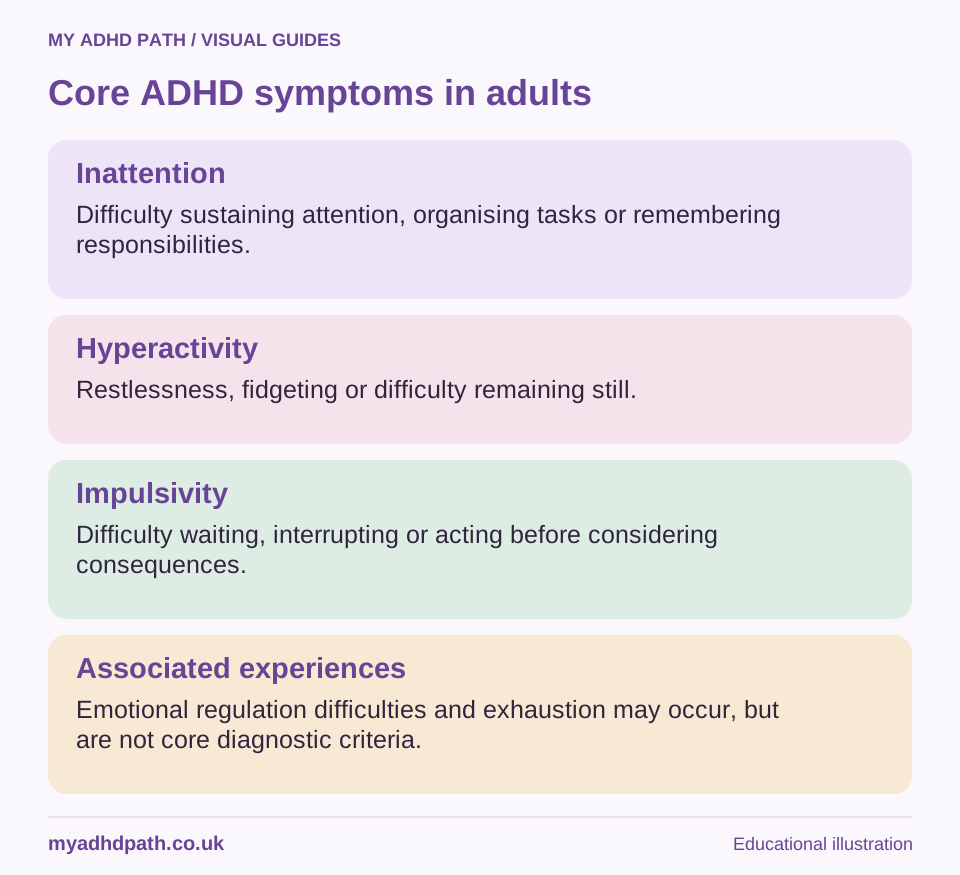
Attention deficit hyperactivity disorder (ADHD) is a neurodevelopmental condition that can affect attention, activity levels and impulse control.
It can also affect executive functioning, including the processes involved in planning, organising information, managing time and working towards goals.
Although ADHD originates during childhood, its presentation can change considerably as someone grows older.
A child who struggled to remain seated might become an adult who feels constantly restless.
A teenager who regularly forgot homework might become a professional who relies heavily on calendars, reminders and last-minute deadlines.
Someone who was described as impulsive at school might experience difficulties with spending decisions, interruptions or managing frustration in adulthood.
The responsibilities change. The environment changes. The strategies someone develops may change.
But the underlying difficulties can remain.
Is ADHD different in men and women?
Men and women can experience the same core ADHD symptoms.
There is no separate male or female diagnostic definition.
Historically, boys have been more likely to be identified and referred for ADHD assessment, partly because externally noticeable hyperactive and impulsive behaviours may attract greater attention.
However, boys and men can also experience predominantly inattentive ADHD, which may be less obvious to other people.
Equally, girls and women can experience significant hyperactivity and impulsivity.
Social expectations, personality, upbringing, individual circumstances and coexisting conditions may all influence how someone expresses or manages their difficulties.
It's more helpful to understand an individual's experiences than to assume that their ADHD must follow a particular gender-related pattern.
Why ADHD in men can go unnoticed until adulthood
Some men receive a diagnosis during childhood and continue accessing support throughout their lives.
Others reach adulthood without having considered ADHD.
Perhaps they performed well academically. Perhaps they were particularly interested in practical subjects or sport. Perhaps a highly structured school environment helped them manage responsibilities.
Some found careers that naturally suited their interests and preferred ways of working.
Other people developed effective coping strategies without recognising why they needed them.
For years, these approaches may have been sufficient.
Then life becomes more demanding.
A promotion introduces administrative responsibilities. Parenthood brings interruptions and additional decisions. Running a business requires long-term planning as well as creative problem-solving.
The strategies that once worked may become increasingly difficult to maintain.
It is sometimes during these transitions that ADHD-related difficulties become more noticeable.
Twelve overlooked signs and experiences associated with ADHD in men
The following experiences may occur alongside ADHD, but they are not all formal diagnostic symptoms.
They can also have other explanations. Recognising yourself in this list does not establish that you have ADHD.
1. Your mind rarely switches off
You're sitting on the sofa after a long day.
Physically, you're doing very little.
Mentally, you're planning tomorrow, thinking about a new business idea, remembering an unfinished conversation and researching something you became interested in earlier that afternoon.
You might find it difficult to relax without occupying your attention in some way.
Even when you're tired, your thoughts may continue jumping between subjects.
Hyperactivity in adulthood can sometimes be experienced as inner restlessness rather than constant physical movement.
However, persistent racing thoughts can also occur with anxiety, sleep problems and other conditions.
2. You are productive when there's a crisis but struggle with routine work
An unexpected problem appears at work.
Everyone else is trying to decide what to do.
Within minutes, you've identified a solution, contacted the right people and established a plan.
But the expense form you've needed to complete for three weeks remains untouched.
Many people with ADHD describe considerable variation in their ability to engage with tasks depending on their interest, urgency and perceived reward.
A demanding problem may capture your attention far more effectively than a predictable administrative responsibility.
This doesn't mean that everyday work is beyond your abilities.
It may mean that the conditions required to engage with it are different.
3. Small frustrations can feel surprisingly intense
You can't find your keys.
The computer freezes.
Someone changes an arrangement at the last minute.
Individually, these might appear to be relatively minor inconveniences.
But when they occur alongside several other demands, the frustration can feel disproportionately intense.
Difficulties regulating emotional responses are commonly associated with ADHD, although emotional dysregulation is not a core diagnostic criterion in its own right.
It's also important to distinguish experiencing an intense emotion from how you choose to express it.
Understanding what contributes to frustration can help you develop safer and more constructive responses.
4. You work considerably longer hours than anyone realises
Your colleagues see completed projects and reliable results.
What they don't see is the evening you spent catching up after a distracted afternoon.
Or the weekend you used to organise work that had accumulated during the previous week.
Some men become highly skilled at compensating for organisational or attention difficulties through additional effort.
Over time, this can make their underlying support needs less visible.
Successful performance does not necessarily mean the approach used to achieve it is sustainable.
5. You forget conversations that genuinely mattered to you
Your partner mentions an arrangement.
You agree to it.
A few days later, you have absolutely no recollection of the conversation.
From their perspective, it may seem as though you weren't interested or didn't care.
From yours, the information simply hasn't remained accessible.
ADHD-related attention and working memory difficulties can affect how information is initially registered, retained and retrieved.
This can create misunderstandings in relationships, particularly when someone interprets forgetfulness as a reflection of their importance.
Shared reminders, written arrangements and more deliberate communication may help.
6. You become completely absorbed in particular interests
A new project catches your attention.
You begin researching it in the evening.
Before you know it, you've spent several hours comparing specifications, watching videos and investigating every available option.
Some people with ADHD describe periods of intense absorption, often referred to as hyperfocus.
Hyperfocus is not a formal diagnostic criterion, and it can occur in people without ADHD.
However, difficulty shifting attention away from an engaging activity can create practical challenges.
You might forget meals, delay going to bed or lose track of other responsibilities.
The ability to become deeply interested in something can be valuable. Managing when and how to disengage may be the more difficult part.
7. You have a collection of ambitious unfinished projects
The exercise equipment.
The home improvement project.
The online course.
The business idea with a domain name, a logo and several pages of research.
Starting something new can feel exciting and rewarding.
Maintaining progress after the novelty has faded may be considerably more difficult.
This can affect hobbies, professional projects and everyday responsibilities.
Rather than abandoning new interests altogether, it may help to introduce clearer project stages, realistic commitments and external accountability.
8. You find it difficult to recognise when you're overwhelmed
Perhaps you become quieter.
Perhaps you're more irritable than usual.
Perhaps you find yourself spending increasing amounts of time alone, scrolling through your phone or becoming absorbed in a hobby.
You might not immediately recognise that several competing responsibilities have become difficult to manage.
Some people notice physical or behavioural changes before recognising how much pressure they're experiencing.
Learning to identify your own early warning signs can make it easier to respond before those demands accumulate further.
9. You make decisions quickly and reconsider them later
You agree to a new commitment, buy something you've just discovered or make a significant change to a project before fully considering the consequences.
Sometimes, quick decisions are useful.
They may allow you to act confidently, respond to opportunities and solve unexpected problems.
In other circumstances, impulsivity can create financial, professional or relationship difficulties.
Introducing a short delay before decisions involving significant money, time or commitments may help you retain the benefits of decisiveness whilst reducing avoidable problems.
10. You struggle to maintain friendships despite valuing them
You genuinely enjoy seeing your friends.
Yet weeks or months can pass without arranging anything.
You remember that you need to reply to a message whilst doing something else and then forget again.
You might intend to organise a social event but struggle with all the planning involved.
Maintaining friendships requires a collection of executive functioning skills that are easy to overlook.
Remembering, initiating contact, coordinating schedules and following through can all require effort.
Practical reminders and recurring arrangements may help make maintaining relationships easier.
11. You find asking for support uncomfortable
You've become accustomed to resolving problems independently.
If something isn't working, your instinct might be to spend longer on it, learn a new skill or develop another way of managing it.
Asking for assistance may feel unfamiliar.
Social expectations surrounding independence, competence and emotional expression can influence how some men approach support.
These expectations are not universal, but they may contribute to some individuals managing difficulties privately for longer than is helpful.
Appropriate support doesn't diminish your independence or abilities.
It may provide more effective ways to use them.
12. You feel exhausted by responsibilities you appear to manage well
You're maintaining your career, contributing at home and meeting your commitments.
But you're increasingly tired.
Tasks you previously completed without much difficulty require more effort.
You find it harder to concentrate and need longer periods to recover from demanding days.
For some people, years of compensating for ADHD-related difficulties may contribute to chronic stress and exhaustion.
However, persistent fatigue can also result from physical illness, sleep disorders, depression, anxiety and other conditions.
It deserves attention rather than being automatically attributed to ADHD.
The difference between what people see and what you experience
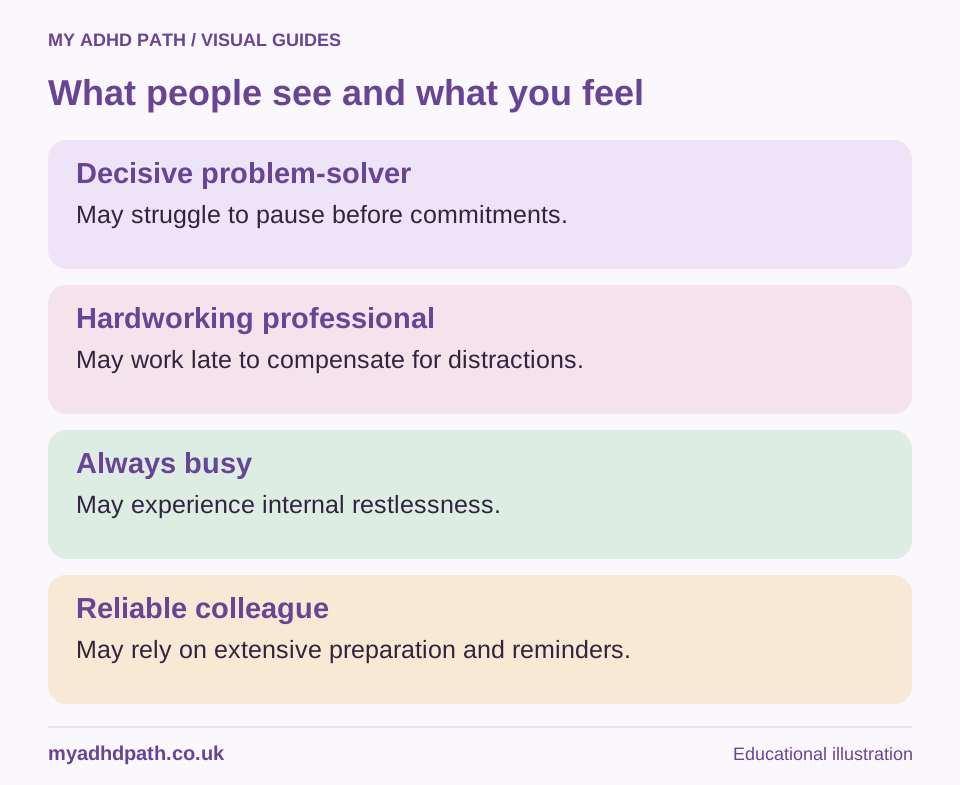
One of the reasons ADHD can remain overlooked in adulthood is the difference between outward behaviour and the effort involved in managing it.
| What other people might see | What you might experience |
|---|---|
| A decisive problem-solver | Difficulty pausing before making commitments |
| A hardworking professional | Regularly working late to compensate for distractions |
| Someone who is always busy | Difficulty relaxing or disengaging from activities |
| A man who enjoys new challenges | Difficulties maintaining progress on routine tasks |
| A quiet person | Considerable internal mental activity |
| An independent individual | Reluctance to ask for additional support |
| A reliable colleague | Extensive reminder systems and preparation |
These experiences are not exclusive to men or ADHD.
The important distinction is that someone's outward achievements may not tell you very much about their everyday support needs.
ADHD and emotional regulation in men
ADHD is often discussed in relation to attention, movement and impulsivity.
But for many adults, managing emotional responses is an equally significant part of their everyday experience.
You may recognise situations in which frustration arrives quickly, disappointment feels particularly intense or returning to a calmer state takes longer than expected.
Several factors might contribute.
You may be processing competing demands. You may be finding it difficult to pause before responding. You may already be tired or overwhelmed.
An emotional reaction that appears to relate to one small event may actually occur after a series of demanding experiences.
Understanding your own patterns can help you identify opportunities to respond differently.
Recognising emotion without excusing behaviour
Experiencing difficulty regulating emotions does not justify intimidation, aggression, controlling behaviour or harm towards another person.
ADHD can help explain certain difficulties, but it does not remove personal responsibility.
If frustration or anger is affecting your relationships or making other people feel unsafe, professional support is particularly important.
Our separate guides to emotional dysregulation and ADHD-related anger explore these subjects in more depth.
ADHD and the pressure to be capable
For some men, competence and independence form an important part of their identity.
They take pride in solving problems, providing for their families, managing responsibilities and being someone other people can rely on.
These are valuable qualities.
But difficulties can arise when maintaining that identity leaves very little room for acknowledging support needs.
Perhaps you regularly work late because asking someone to help organise a project feels uncomfortable.
Perhaps you avoid discussing how overwhelmed you feel because you're accustomed to being the person who resolves problems for everyone else.
Perhaps you're always doing something because slowing down makes you more aware of how tired you've become.
Understanding your ADHD may help you distinguish between the responsibilities you genuinely enjoy and the additional demands you have gradually become accustomed to carrying.
You can remain capable and independent whilst accessing support that makes everyday life more manageable.
Three different faces of ADHD in men
These fictional examples illustrate how ADHD-related difficulties can appear in very different lives.
Illustrative scenario
James, 38 - The business owner
James runs a successful engineering business.
He's excellent at solving technical problems and enjoys developing new services.
However, managing invoices, emails, supplier schedules and competing project deadlines is considerably more difficult.
He regularly works late because administrative responsibilities build up throughout the week.
An ADHD assessment helps James explore why particular aspects of running his business require so much effort.
He introduces external planning support, clearer systems and additional administrative assistance.
He doesn't need to stop being an entrepreneur. He needs a business structure that supports the way he works.
Illustrative scenario
Daniel, 44 - The family organiser
Daniel works full-time and has two children.
He enjoys spending time with his family but frequently loses track of arrangements and struggles to remember household responsibilities.
His partner becomes frustrated by repeatedly having to remind him about things.
Daniel begins to recognise the difference between intending to do something and having a reliable system for following through.
He takes full ownership of several recurring household responsibilities and introduces appropriate reminders.
The aim is not for his partner to become better at reminding him. It's for Daniel to develop reliable ways of managing his own commitments.
Illustrative scenario
Mark, 56 - The professional approaching retirement
Mark has worked in a senior technical role for most of his career.
He's always enjoyed the problem-solving aspects of his job.
However, increasing administrative responsibilities, constant meetings and frequent interruptions have made work progressively more demanding.
Following an ADHD diagnosis, Mark begins reconsidering his working arrangements.
He explores protected concentration time, more structured meetings and a future career transition that allows him to spend more time on work he finds rewarding.
Receiving a diagnosis later in life gives him a different perspective on the years ahead.
ADHD versus stress, anxiety and depression
Difficulties with concentration, motivation, memory and emotional regulation can occur for many reasons.
One of the important aspects of an ADHD assessment is considering alternative explanations and coexisting conditions.
| Experience | Possible ADHD-related pattern | Other possible explanations |
|---|---|---|
| Difficulty concentrating | Long-standing difficulties regulating attention | Stress, anxiety, depression, sleep disorders |
| Inner restlessness | Persistent need for stimulation or activity | Anxiety, medication effects, other conditions |
| Irritability | Impulsive responses or difficulty managing competing demands | Stress, pain, mood disorders, sleep deprivation |
| Forgetfulness | Difficulties registering and organising information | Poor sleep, physical illness, anxiety |
| Low motivation | Difficulty initiating or sustaining particular tasks | Depression, exhaustion, physical health conditions |
| Exhaustion | Sustained compensatory effort | Occupational stress, sleep apnoea, anaemia, thyroid conditions |
This comparison is not a diagnostic tool.
ADHD generally involves a developmental history of symptoms, with difficulties affecting more than one area of life.
If your symptoms have appeared recently or changed substantially, it is particularly important to consider other potential causes.
ADHD and other health conditions can also coexist.
When ADHD affects your physical health
Managing ADHD can involve more than attention and organisation.
Some individuals find it difficult to maintain consistent sleep routines, remember appointments, prepare regular meals or establish sustainable exercise habits.
Others become so absorbed in work or interests that they overlook basic physical needs.
Research has also identified associations between ADHD and certain health-related risks, including accidents, sleep difficulties and substance use disorders.
These are population-level associations, not predictions about an individual.
Sleep deserves particular attention
If you're frequently staying up later than intended, struggling to switch off or waking feeling exhausted, consider whether your sleep needs further attention.
Poor sleep can make ADHD symptoms more difficult to manage.
Sleep disorders can also produce symptoms that resemble ADHD.
Persistent snoring, pauses in breathing during sleep or substantial daytime sleepiness warrant discussion with a healthcare professional.
A better understanding of your sleep may be an important part of understanding your overall wellbeing.
Using substances to manage everyday experiences
Some individuals use alcohol or other substances to relax, seek stimulation or cope with difficult emotions.
There is an established association between ADHD and an increased risk of substance use disorders.
However, having ADHD does not mean someone will develop problems with substance use.
If you're concerned about your own habits, discussing them with a healthcare professional can help you explore appropriate support.
We will examine this subject in greater detail in our dedicated guide to ADHD and substance use.
Ten practical ways to make everyday life more manageable
You don't need to redesign your entire life.
Begin with the activities that most frequently cause frustration or require disproportionate effort.
1. Create an external working memory
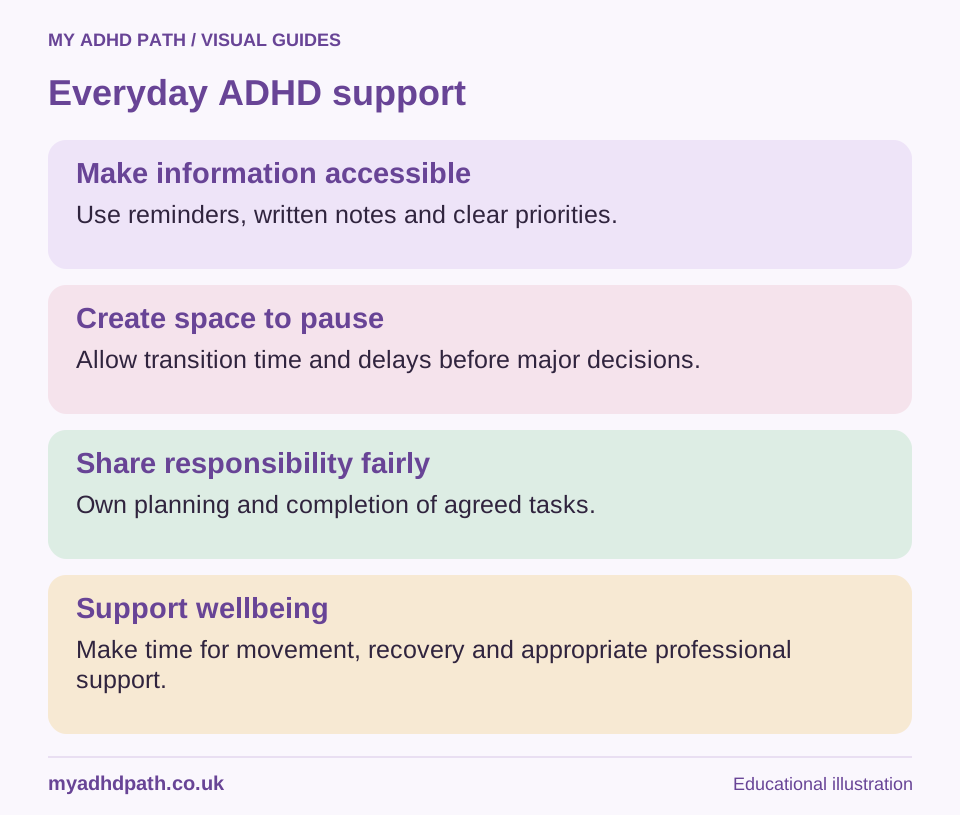
Use a reliable place to record commitments, important information and unfinished responsibilities.
This could be a digital calendar, notebook, task manager or appropriate assistive technology.
The aim is to make important information accessible without relying entirely on remembering it at the right moment.
2. Separate planning from doing
Before beginning a working day, identify what genuinely matters.
Choose one essential responsibility and a small number of additional priorities.
Avoid regularly switching between planning your work and trying to complete it.
Our ADHD-friendly productivity guide explores this approach in more detail.
3. Introduce a pause before significant decisions
For non-urgent decisions involving substantial money, time or commitments, consider introducing a waiting period.
Make a note of the idea and return to it later.
A short delay may help you evaluate the longer-term implications without losing the benefit of your initial enthusiasm.
4. Leave transition time between activities
Moving directly from a demanding working day into household responsibilities can feel particularly challenging.
Where possible, allow a short period to finish one activity and prepare for the next.
This might involve closing your work applications, writing down unfinished tasks or taking a brief walk.
Agree arrangements with other people where your responsibilities affect them.
5. Identify your early signs of frustration
Notice what happens before you become particularly frustrated.
You might speak more quickly, become physically tense, struggle to process further information or feel an urge to leave the situation.
Recognising these signs can help you choose a constructive response earlier.
For example, you might agree to return to a difficult conversation after a short break.
The important part is returning to it rather than indefinitely avoiding it.
6. Explore movement that suits you
Regular physical activity can support general physical and mental wellbeing.
Some people with ADHD find that movement also helps them manage restlessness or prepare for concentration.
You might enjoy cycling, swimming, walking, strength training, team sports or another activity.
Choose something that fits your circumstances, interests and health.
Exercise can complement appropriate ADHD management but should not be presented as a replacement for necessary treatment.
7. Take ownership of recurring responsibilities
If you share a home with other people, establish which recurring tasks you are responsible for managing.
Ownership includes remembering, planning and completing the task, not simply doing it when someone reminds you.
Use external systems to support that responsibility.
This can reduce misunderstandings and avoid transferring the organisational demands to another person.
8. Use technology to reduce administrative effort
Technology can help with tasks that require frequent organisation, planning or information management.
For example, you might use an approved AI assistant to organise project notes, establish priorities or break down a complicated administrative task.
AI prompt
Organise competing priorities
"I have several projects competing for my attention. Help me establish what is genuinely urgent, what requires a decision and what can wait. Give me a clear sequence of actions that I can realistically complete."
Check important outputs and avoid sharing confidential or sensitive information with inappropriate services.
9. Make recovery part of your routine
If your days involve considerable concentration, physical demands or emotional effort, allow opportunities to recover.
Rest might involve time outdoors, a quiet activity, exercise, seeing friends or simply spending time away from demanding responsibilities.
You don't need to fill every period of free time with another project.
Recovery is part of maintaining a sustainable routine.
10. Explore appropriate professional support
If ADHD-related difficulties are significantly affecting your everyday life, consider discussing them with your GP or another appropriately qualified healthcare professional.
For individuals with ADHD, treatment options may include medication, ADHD-informed psychological interventions and environmental adjustments.
Practical workplace support and assistive technology may also be helpful.
The aim is to find an approach that addresses your individual needs.
Could you have ADHD if you were successful at school?
Yes.
Academic success does not automatically rule out ADHD.
Some children and teenagers develop effective compensatory strategies. Others perform particularly well in environments that provide frequent structure, clear deadlines or subjects that capture their interest.
An ADHD assessment explores a broader developmental history.
You might find it helpful to consider:
- How you managed homework.
- Whether you regularly forgot belongings.
- How much additional effort assignments required.
- Whether you needed reminders or supervision.
- How you responded to repetitive activities.
- Whether teachers commented on attention, organisation or impulsivity.
- How difficulties appeared outside the classroom.
School reports and recollections from people who knew you during childhood may provide useful information where available.
A specialist clinician will consider this alongside other relevant evidence.
What if your child has recently been diagnosed?
For some fathers, learning about ADHD begins when their child receives a diagnosis.
You might recognise aspects of your own childhood whilst reading about their experiences.
Perhaps their difficulties with homework remind you of your school years.
Perhaps their intense interests, forgetfulness or frustration feel particularly familiar.
ADHD has a substantial genetic component and can run in families.
Having a child with ADHD does not establish that you have the condition, but recognising recurring patterns in your own life may encourage you to explore them further.
Understanding your own needs might also help you develop family routines that support both you and your child.
How to prepare for an adult ADHD assessment
If you're considering an assessment, begin by gathering examples of difficulties from different stages and areas of your life.
It can be useful to explain both the observable difficulties and the strategies you've developed to manage them.
| Area | Questions to consider |
|---|---|
| Childhood | Which activities were difficult to manage consistently? |
| Education | How did you approach homework, deadlines and organisation? |
| Employment | Which aspects of work require considerable additional effort? |
| Relationships | Do recurring misunderstandings relate to attention, communication or responsibilities? |
| Everyday life | How do you manage appointments, finances and household tasks? |
| Support strategies | Which routines, tools or other people help you manage these responsibilities? |
These questions are reflection prompts, not a screening questionnaire.
You do not need to arrive with every answer.
If you're struggling to organise your observations, a trusted person or suitable planning tool may help you prepare a concise summary.
A qualified clinician should determine whether your experiences meet diagnostic criteria.
What does the research say?
What the research says
Research into ADHD has established that the condition can persist into adulthood and affect occupational, social and personal functioning. Reviews have identified difficulties associated with executive functioning, emotional regulation and several coexisting mental and physical health conditions. Research also suggests that ADHD-related outcomes vary significantly according to individual circumstances, access to appropriate support and the presence of other conditions. However, not every commonly discussed ADHD experience has an equally strong evidence base. Concepts such as hyperfocus and ADHD burnout continue to attract interest, but definitions and research methods vary. It is important to distinguish well-established ADHD symptoms from associated experiences and emerging areas of research. Understanding ADHD means recognising both what the evidence tells us and where further investigation is needed.
When to seek additional support
You don't need to wait until your career, relationships or health are significantly affected before discussing difficulties with a healthcare professional.
Consider seeking advice if you're experiencing:
- Persistent low mood or loss of enjoyment.
- Significant difficulties with sleep.
- Increasing exhaustion.
- Problems controlling anger or impulsive behaviour.
- Difficulties maintaining work or relationships.
- Concerns about alcohol, drugs or gambling.
- Changes in concentration or memory that affect everyday functioning.
Good to know
If you experience thoughts of suicide or self-harm, seek professional support promptly. In the UK, Samaritans can be contacted on 116 123. For urgent medical advice, contact your local urgent healthcare service, including NHS 111 where available. If you are in immediate danger, unable to keep yourself safe or there is an immediate risk of harm to someone else, call 999 or attend A&E as appropriate.
Frequently asked questions
What are the most common symptoms of ADHD in adult men?
Core symptoms involve inattention and/or hyperactivity and impulsivity. These may appear as difficulties managing attention, organising tasks, remembering responsibilities, remaining still or pausing before acting.
Can men have ADHD without being hyperactive?
Yes. Some individuals have a predominantly inattentive presentation, with relatively little observable hyperactivity.
Is anger a symptom of ADHD in men?
Anger is not a core diagnostic symptom of ADHD. However, some people with ADHD experience difficulties regulating emotions, including frustration and irritability. Other possible causes should also be considered.
Why are some men only diagnosed with ADHD in their forties or fifties?
Some individuals develop effective coping strategies or find environments that support their needs. Later changes in responsibilities may make long-standing difficulties more noticeable.
Can successful men have ADHD?
Absolutely. Professional achievement and ADHD-related support needs can coexist.
Can ADHD affect relationships?
Yes. Difficulties with attention, impulsivity, organisation and communication can affect relationships. Appropriate treatment, practical adjustments and shared understanding may help.
Does ADHD cause exhaustion?
Managing ADHD-related difficulties can require considerable effort and may contribute to exhaustion. However, persistent fatigue can have several other explanations and deserves appropriate assessment.
Can exercise help adults with ADHD?
Physical activity can support general health and wellbeing. Research suggests it may also benefit some aspects of ADHD-related functioning, although it does not replace necessary clinical treatment.
Is ADHD hereditary?
ADHD has a substantial genetic component and is more common among biological relatives of people with the condition. Genetics is not the only contributing factor.
What should I do if I think I have ADHD?
Explore reliable information, gather examples of your experiences and discuss your concerns with a healthcare professional who can advise you about appropriate assessment options.
Understanding yourself changes what is possible
Perhaps you've spent years finding ways to manage responsibilities that other people never realised were difficult.
Perhaps you've developed a successful career, built a family or become exceptionally good at solving complicated problems.
You may also have noticed that some aspects of everyday life require considerably more effort than you would like.
Understanding ADHD may help you identify why.
It can give you a starting point for exploring different strategies, communicating more effectively and accessing support that makes your life easier to navigate.
You don't necessarily need to change the things you enjoy or the ambitions you've worked towards.
You may simply need a more effective way of supporting yourself whilst pursuing them.
And that is something worth exploring, whatever stage of life you're at.
Sources and further reading
- NICE - Attention deficit hyperactivity disorder: diagnosis and management (NG87). https://www.nice.org.uk/guidance/ng87
- NHS - Attention deficit hyperactivity disorder (ADHD). https://www.nhs.uk/conditions/attention-deficit-hyperactivity-disorder-adhd/
- Faraone, S. V. et al. (2021). The World Federation of ADHD International Consensus Statement: 208 Evidence-based conclusions about the disorder. https://doi.org/10.1016/j.neubiorev.2021.01.022
- Kooij, J. J. S. et al. (2019). Updated European Consensus Statement on diagnosis and treatment of adult ADHD. https://doi.org/10.1016/j.eurpsy.2018.11.001
- Shaw, P. et al. (2014). Emotion dysregulation in attention deficit hyperactivity disorder. https://doi.org/10.1176/appi.ajp.2013.13070966
- GOV.UK - Access to Work. https://www.gov.uk/access-to-work
- Samaritans. https://www.samaritans.org/
This article provides general educational information and is not a substitute for professional medical advice, diagnosis or treatment. The examples and associated experiences described are not specific to men or sufficient to establish an ADHD diagnosis.