

What if the things you've spent years judging yourself for were the very things you needed more support with?
At a glance
- Years of unidentified ADHD may influence confidence and self-esteem.
- Personal value and professional achievement are not the same thing.
- Successful performance can conceal considerable additional effort.
- An ADHD diagnosis can provide a new perspective on previous experiences.
- Confidence can develop through manageable goals and appropriate support.
- Understanding your strengths and support needs can help shape your future.
You're capable of solving complicated problems.
You've managed demanding responsibilities, developed valuable skills and achieved things that other people genuinely admire.
Yet you still find yourself wondering why certain aspects of everyday life seem so unnecessarily difficult.
Why can't you consistently stay organised?
Why do you keep leaving things until the last minute?
Why can you spend six hours developing an idea but struggle to complete a relatively straightforward administrative task?
Perhaps you've spent years believing that if you could just become a little more disciplined, a little more organised or a little more consistent, everything would finally fall into place.
Then you receive an ADHD diagnosis.
Suddenly, you're looking at decades of experiences from an entirely different perspective.
The diagnosis may explain some of the difficulties you've encountered. But understanding ADHD and changing how you feel about yourself are not necessarily the same thing.
That second part deserves just as much attention.
How ADHD can affect your sense of self-worth
Self-worth describes the underlying sense of value you place on yourself as a person.
It's related to self-esteem and confidence, but there are useful distinctions between them.
Confidence might describe how capable you feel when approaching a particular task.
Self-esteem relates more broadly to how you evaluate yourself.
Self-worth concerns whether you recognise your value independently of your performance and achievements.
For someone who has spent years experiencing inconsistent performance, these distinctions can become particularly important.
You might feel confident in your professional abilities whilst privately questioning why you're unable to manage certain responsibilities consistently.
You might receive positive feedback from other people whilst focusing almost exclusively on the things you haven't achieved.
You might recognise that you're good at what you do, yet still feel as though you should be doing considerably better.
What the research says
Research has identified associations between ADHD and lower self-esteem, although experiences vary considerably between individuals. Your sense of self is influenced by many things, including relationships, upbringing, opportunities, health and the environments in which you've spent your life. ADHD may be one important part of that picture.
Growing up being told you could do better
“You're capable of more than this.”
“If only you applied yourself.”
“You need to concentrate.”
“Stop rushing.”
“You've forgotten again?”
These comments may sound familiar to adults who grew up with unidentified ADHD.
Sometimes they came from teachers who genuinely wanted to encourage you. Sometimes they came from frustrated parents or other people who couldn't understand the inconsistency they were seeing.
Perhaps you were particularly good at certain subjects but struggled with homework.
Perhaps you performed exceptionally well when interested in something but found it difficult to engage with other activities.
Perhaps you were frequently described as someone with considerable potential.
Over time, repeated experiences of being told you could do better may influence how you interpret your own abilities.
Rather than recognising that particular tasks require different kinds of support, you might have concluded that you simply weren't trying hard enough.
Those conclusions can follow someone well beyond their school years.
When achievement becomes a measure of personal value
For some men, professional achievement, independence and the ability to provide for others form an important part of their identity.
There is nothing inherently problematic about taking pride in these things.
The difficulty arises when your achievements become the primary way you determine your value.
A successful week at work makes you feel capable.
A missed deadline makes you question your competence.
A new business opportunity makes you feel optimistic about the future.
An unfinished project makes you question whether you're capable of following anything through.
When self-worth becomes closely connected to performance, the variations in attention, motivation and executive functioning associated with ADHD can create a particularly demanding cycle.
Your view of yourself may change considerably depending on what you've managed to accomplish that day.
But your abilities haven't necessarily changed.
The conditions under which you're trying to use them may have.
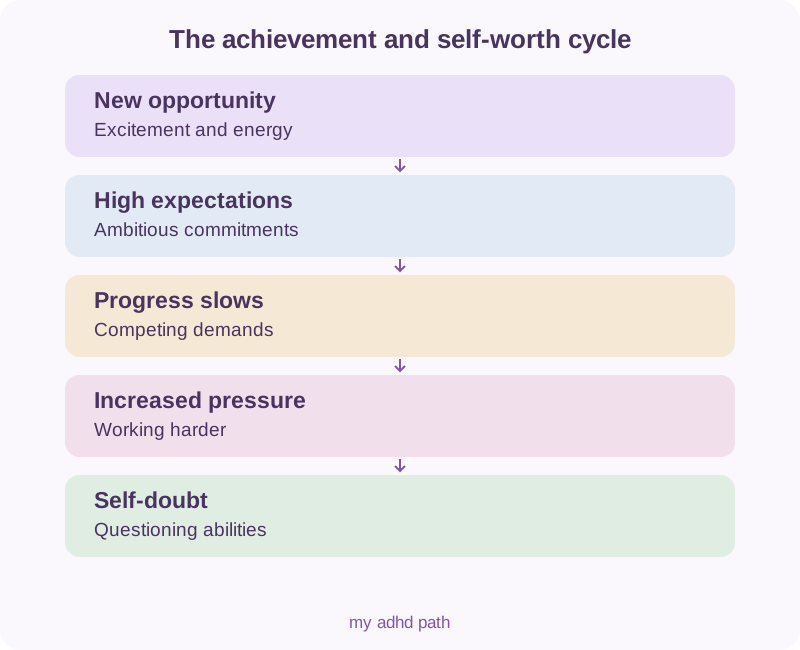
The achievement and self-worth cycle
Imagine beginning a new project.
You're enthusiastic. You're motivated. You've identified several exciting possibilities and you're making rapid progress.
You establish ambitious expectations for yourself.
As the project develops, the work becomes more repetitive. New responsibilities compete for your attention. Progress begins to slow.
You respond by working longer hours or increasing the pressure you place on yourself.
Perhaps the project eventually gets completed, but at considerable personal cost.
Alternatively, you become frustrated and turn your attention towards something new.
Either way, you might conclude that next time you simply need to be more disciplined.
And the cycle begins again.
Good to know
This is an illustrative pattern, not an established clinical model, and it won't reflect everyone's experience of ADHD. However, recognising whether a similar pattern occurs in your own life may help you identify where practical changes could make a difference. The answer may not be working harder. It may be designing a more sustainable way of working.
Ten ways ADHD can influence how you see yourself
The following experiences are not exclusive to ADHD and do not form a diagnostic checklist.
1. You judge yourself by your most productive days
You've experienced days when everything seems to come together.
You're focused, decisive and remarkably productive.
You solve problems quickly and complete an impressive amount of work.
Those days become the benchmark against which you measure every other day.
But peak performance isn't necessarily sustainable performance.
Expecting yourself to reproduce your most productive day repeatedly may leave very little room for ordinary variations in energy, attention and circumstances.
2. You remember your mistakes more readily than your achievements
You complete a substantial project successfully.
There are several positive comments and one criticism.
By the end of the day, the criticism is the thing you're thinking about.
Over time, repeatedly focusing on mistakes may create an incomplete picture of your performance.
Recording successes alongside difficulties can help you develop a more balanced understanding of your abilities.
3. You feel as though you're constantly catching up
Perhaps friends reached certain professional milestones earlier than you did.
Perhaps colleagues established careers whilst you were still working out what interested you.
Perhaps you've changed direction several times and feel as though you should have achieved more by now.
Comparing yourself with other people can be particularly difficult when you're not comparing the circumstances, opportunities or challenges that shaped each person's journey.
A different route through life does not automatically mean a less valuable one.
4. You struggle to take compliments seriously
Someone tells you that you've done a brilliant job.
You immediately think about how much better you could have done it.
You know how close you came to missing the deadline, how much extra time the project required or how disorganised parts of the process felt.
You might dismiss the compliment because you know what happened behind the scenes.
But the quality of what you achieved and the difficulty involved in achieving it can both be genuine.
5. You avoid opportunities unless you're certain you can succeed
You might be interested in a promotion, a new qualification or a different career.
However, previous experiences of unfinished projects or inconsistent performance make you uncertain about taking the next step.
Avoiding situations where you might struggle can sometimes feel safer than discovering whether you could succeed with appropriate support.
Exploring what would make an opportunity manageable may be more useful than deciding whether you feel completely ready for it.
6. You compensate for uncertainty by overworking
You prepare more extensively than other people realise.
You repeatedly check your work.
You make yourself available outside normal working hours.
You might find it difficult to finish something because you're concerned about how it will be received.
These strategies may help produce good results, but they can also make your underlying support needs less visible.
7. You find asking for help uncomfortable
You may have built an identity around being capable, independent and someone who solves problems for other people.
Asking for support can feel inconsistent with that identity.
Yet many successful people rely on tools, colleagues, professional advice and specialised assistance.
Independence does not necessarily mean completing every responsibility without support.
It can also mean knowing how to access the resources that allow you to manage your responsibilities effectively.
8. You feel guilty when you're resting
There is always something else you could be doing.
Another email. Another household job. Another project that needs finishing.
Even when you've deliberately set aside time to relax, part of your attention remains focused on unfinished responsibilities.
If you regularly measure your value through productivity, rest can begin to feel like something you need to earn.
But recovery is part of maintaining your ability to function sustainably.
9. You worry that other people will discover how difficult things are
Your colleagues see completed work.
Your friends see your achievements.
Your family sees the responsibilities you've managed.
They may not see the reminders, preparation, extra working hours and considerable effort behind them.
Some people describe feeling as though their apparent competence might eventually be exposed as something less impressive than it seems.
This is sometimes referred to as imposter feelings.
These experiences are not specific to ADHD, but they may be relevant to people who have spent years compensating for unidentified difficulties.
10. You've lost sight of what you actually enjoy
If much of your time is spent trying to meet expectations, there may be relatively little opportunity to explore what matters to you personally.
You might pursue achievements because they demonstrate competence rather than because the activities themselves are meaningful.
Receiving an ADHD diagnosis can provide an opportunity to reconsider that balance.
What do you genuinely enjoy?
Which responsibilities are important to you?
What would you spend more time doing if you felt less pressure to prove yourself?
These questions can be useful at any stage of life.
Why some men experience ADHD diagnosis as a change in identity
An adult ADHD diagnosis can bring considerable relief.
For the first time, you may have a clearer understanding of experiences that previously seemed difficult to explain.
But it may also introduce questions about how you've understood yourself for years.
You might wonder which aspects of your personality relate to ADHD.
You might reconsider professional decisions, relationships or experiences from childhood.
You might question whether particular difficulties could have been managed differently.
And you may feel uncertain about what the diagnosis means for the future.
There is no prescribed emotional response to receiving an ADHD diagnosis.
Some people feel relieved almost immediately. Others experience a mixture of optimism, sadness, uncertainty and frustration.
Some find that their understanding develops gradually over several months or years.
Good to know
Your diagnosis does not replace your identity. It adds information that may help you understand it more fully. You are still the person who developed those skills, built those relationships, pursued those interests and made those achievements. The difference is that you now have another way of understanding some of the experiences involved.
Self-worth, confidence and self-efficacy
Self-efficacy describes your belief in your ability to carry out a particular action or manage a particular situation.
It's a useful concept when considering how to rebuild confidence after an ADHD diagnosis.
| Concept | Example |
|---|---|
| Self-worth | I have value regardless of how productive I've been today. |
| Self-esteem | I generally recognise and appreciate my abilities and qualities. |
| Confidence | I feel comfortable presenting my ideas to other people. |
| Self-efficacy | I believe I can complete this task using the right approach and support. |
These concepts overlap, and definitions vary within psychology.
Nevertheless, the distinctions can be useful in everyday life.
You might have strong professional confidence but struggle with self-worth when something goes wrong.
You might recognise your value as a person but have relatively low confidence in your ability to manage particular administrative responsibilities.
Understanding which aspect is affected may help you identify what kind of support would be most useful.
Sometimes, the most effective way to build confidence is to make a particular activity easier to accomplish consistently.
Reconsidering your achievements after diagnosis
When you first learn about ADHD, it can be tempting to revisit the things you didn't achieve.
The qualification you didn't finish.
The opportunity you didn't pursue.
The career that took longer to establish than you expected.
The projects you started but never completed.
These experiences deserve acknowledgement.
But they aren't your entire history.
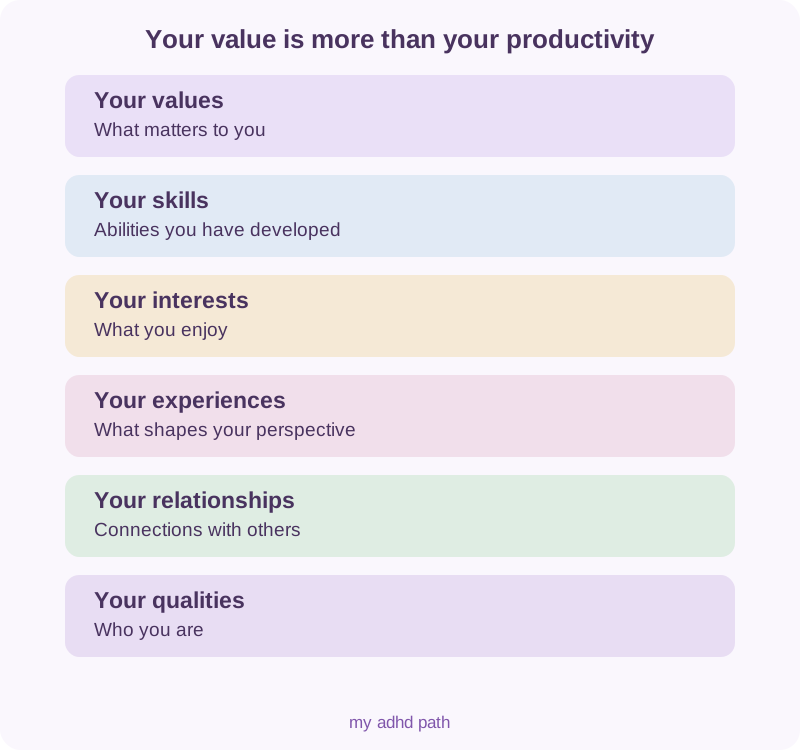
Consider the other side of your experience.
The complicated problems you worked out how to solve.
The skills you developed independently.
The times you adapted to unexpected circumstances.
The people you supported.
The projects you successfully completed.
The responsibilities you continued managing despite finding aspects of them particularly difficult.
Understanding your ADHD might change how you interpret those achievements too.
It may help you recognise the resourcefulness, persistence and effort involved.
This isn't about automatically attributing every positive quality to ADHD.
It's about recognising the abilities you've developed as an individual.
Three different journeys towards rebuilding confidence
These fictional examples illustrate how an ADHD diagnosis might influence someone's understanding of themselves.
Illustrative scenario
Chris, 37 - The career that never quite followed a plan
Chris has worked in several different industries. He enjoys learning new skills and solving practical problems, but becomes frustrated when his roles involve increasing amounts of repetitive administration. He compares himself with friends who have followed more predictable career paths.
Following an ADHD diagnosis, Chris begins identifying the aspects of his previous jobs in which he performed particularly well. He discovers recurring themes: troubleshooting, client communication, technical learning and developing practical solutions.
Rather than seeing his employment history exclusively as a series of changes, he recognises that he's accumulated a useful combination of skills. He uses that information to explore roles that better match his abilities and support needs.
Illustrative scenario
Martin, 48 - The business owner who never switches off
Martin runs a successful business. He works long hours, regularly catches up on administration during weekends and rarely takes a complete day away from his responsibilities. Despite his achievements, he often feels as though he should be accomplishing more.
After receiving an ADHD diagnosis, Martin begins examining the distinction between his professional abilities and the systems supporting his work. He introduces administrative assistance, clearer project priorities and technology that helps organise information.
Gradually, he develops a working routine that requires less compensatory effort. His ambitions haven't changed. His approach to achieving them has.
Illustrative scenario
David, 61 - The diagnosis that changes his view of the future
David receives an ADHD diagnosis after his adult daughter encourages him to explore his experiences. He begins reconsidering his school years, career and the difficulties he's encountered with everyday organisation.
Initially, he spends considerable time wondering what might have been different. Over time, he also begins identifying things he'd like to do in the years ahead. He reconnects with an old interest, develops more manageable routines and becomes more comfortable discussing his support needs with family members.
His diagnosis hasn't changed what happened in the past. But it has given him information that may help shape his future.
The difference between high standards and perfectionism
Having high standards can be a valuable quality.
You might take pride in producing excellent work, meeting commitments and paying attention to detail.
Perfectionism can become more difficult when your expectations make it hard to begin, complete or feel satisfied with something.
| High standards | Potentially unhelpful perfectionism |
|---|---|
| I want to produce good work. | Anything less than exceptional feels unacceptable. |
| Feedback can help me improve. | Criticism makes me question my overall competence. |
| I can decide when something is complete. | There is always something else I should improve. |
| Mistakes help me identify changes. | Mistakes feel like evidence that I'm inadequate. |
| I can adjust expectations when circumstances change. | My expectations remain the same regardless of circumstances. |
For some adults with ADHD, perfectionism may develop partly as a compensatory strategy.
Repeated checking, extensive preparation and additional working hours might reduce the likelihood of others noticing organisational or attention difficulties.
Over time, those approaches can become increasingly demanding.
Sometimes, reducing the pressure involved in completing a task allows you to produce better results more consistently.
ADHD, relationships and feeling good enough
Self-worth can influence how we communicate with the people closest to us.
Perhaps your partner raises a concern about something you've forgotten.
You hear the concern, but you also immediately begin questioning whether you're meeting expectations more generally.
A discussion about a household responsibility becomes something that feels much more personal.
Recognising this distinction may help you respond to the actual issue rather than every previous experience it brings to mind.
What you could say
“I know this task needs sorting out. I'm finding the conversation difficult because I'm already frustrated about forgetting it. Let's work out a better way for me to manage it.”
This acknowledges both the emotional experience and the practical responsibility.
Developing a healthier sense of self-worth does not mean avoiding feedback or expecting everyone else to adjust their expectations.
It means becoming better able to consider feedback without automatically interpreting it as a judgement of your entire identity.
Both people in a relationship deserve to feel heard, respected and supported.
Twelve ways to rebuild confidence after an ADHD diagnosis
1. Separate your identity from your performance
Notice the difference between describing what happened and describing who you are.
Compare these statements:
“I didn't complete that task.”
“I'm incapable of completing things.”
The first describes a specific experience.
The second draws a much broader conclusion from it.
Practise identifying the actual difficulty before deciding what it means about your abilities.
2. Explore why particular tasks are difficult
Instead of asking why you can't manage something, consider which part of the activity creates difficulty.
Is it getting started?
Remembering the deadline?
Organising information?
Maintaining concentration?
Switching between responsibilities?
Identifying the specific difficulty can help you select a more appropriate strategy.
3. Keep a record of completed work
To-do lists can be useful, but they naturally draw attention to outstanding responsibilities.
A completed list provides a different perspective.
At the end of the day, record a few things you've accomplished.
Include decisions made, problems resolved and responsibilities managed, not just major projects.
This can help create a more accurate record of how you're spending your time and using your abilities.
4. Define success before beginning a task
Before starting something, establish what a successful outcome actually requires.
Try this
Before beginning a task, write down what “done” looks like. For example: “This report needs to explain the findings clearly, include the relevant evidence and be completed by Thursday.” You don't necessarily need to make it the most impressive report you've ever produced. Clear completion criteria may help reduce unnecessary perfectionism and repeated checking.
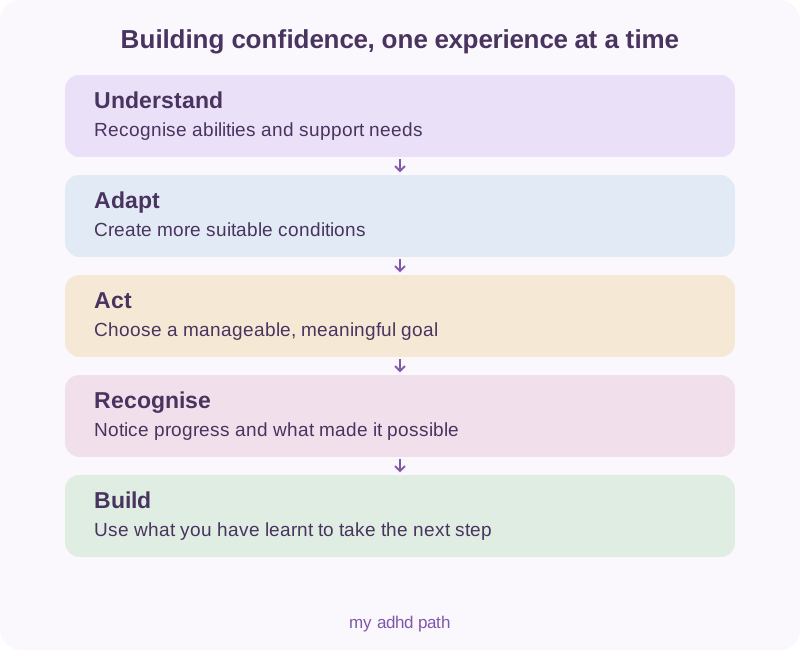
5. Build confidence through manageable commitments
Confidence can develop through repeated experiences of completing tasks successfully.
Start with a commitment that is meaningful and realistic.
Establish the support you'll need, identify the first action and make the endpoint clear.
Once you've completed it, consider what helped.
Build on that information rather than immediately increasing your expectations.
6. Stop comparing your internal experience with somebody else's visible results
You know how much effort your own achievements required.
You rarely know the complete circumstances behind another person's achievements.
Their available support, financial resources, opportunities, health and personal responsibilities may be considerably different from yours.
Comparisons become more useful when they help you identify an approach you'd like to explore, rather than become a measure of your personal value.
7. Identify the environments in which you work well
Think about the occasions when you've felt particularly engaged, capable or satisfied.
What was different?
Perhaps you had greater autonomy, clearer expectations, practical work, fewer interruptions or opportunities to develop new ideas.
These observations can help you make decisions about your working environment, responsibilities and future career.
8. Introduce support without waiting for a crisis
You don't need to reach exhaustion before deciding that a different approach might be useful.
External planning tools, ADHD-informed coaching, appropriate technology and professional assistance may help with recurring practical difficulties.
Some people may also be eligible for workplace adjustments or support through Access to Work in Great Britain.
The aim is to create conditions that allow your abilities to be used more effectively.
9. Make room for interests that aren't measured by achievement
Spend time doing something because you enjoy it.
It might be cycling, cooking, gardening, building something, reading or playing an instrument.
You don't need to monetise it, become exceptionally good at it or turn it into another demanding project.
Enjoyment can be a valuable outcome in itself.
10. Develop a more constructive way of reviewing mistakes
Practical checklist
- What actually happened?
- What contributed to the difficulty?
- What was within my control?
- What could I change next time?
- What support might make a difference?
This approach allows you to take responsibility without turning every mistake into a judgement about your overall abilities.
11. Connect with people who understand adult ADHD
Talking with other adults who have ADHD can introduce different perspectives and practical ideas.
You might discover that experiences you've rarely discussed are familiar to other people.
Peer support can be valuable, although individual experiences differ and community advice should not replace appropriate clinical guidance.
Choose communities that encourage constructive discussion, respect individual circumstances and support personal responsibility.
12. Explore professional support where appropriate
If persistent self-criticism, low confidence or emotional difficulties are affecting your everyday life, an appropriately qualified mental health professional may help.
ADHD-informed psychological interventions can support some adults with practical difficulties, emotional wellbeing and coping strategies.
Your ADHD clinician or GP can help you explore suitable options.
Medication may help manage core ADHD symptoms for some people, but it does not automatically resolve every difficulty involving self-esteem or self-worth.
These experiences may benefit from attention in their own right.
Your personal ADHD strengths and support profile
Understanding your abilities alongside your support needs can provide a more useful picture of how you function.
Try completing a reflection table like this one.
| What I do well | What makes it possible | What I find difficult | Support I could introduce |
|---|---|---|---|
| Solving technical problems | Clear goals and uninterrupted time | Routine administration | Scheduled admin time or assistance |
| Developing new ideas | Autonomy and opportunity to explore | Maintaining project momentum | Milestones and accountability |
| Working with customers | Interesting conversations | Remembering follow-up actions | Automatic reminders |
| Completing demanding projects | Clear deadlines and priorities | Managing competing commitments | External workload planning |
These are examples, not universal ADHD strengths.
You might identify completely different abilities and circumstances.
The exercise is designed to help you make practical decisions about your life rather than assign yourself a particular personality type.
Consider using your completed profile when discussing workplace arrangements, career changes or other forms of support.
Try a seven-day confidence reflection
For the next seven days, spend a few minutes recording your experiences.
This doesn't need to become another demanding daily responsibility.
Choose four questions:
- What did I manage well today?
- What required more effort than expected?
- What helped me make progress?
- What could make tomorrow more manageable?
Here's an example.
What I managed well: I resolved a complicated issue for a client.
What required more effort: Organising several follow-up tasks.
What helped: Talking through the problem and writing down my immediate priorities.
What might help tomorrow: Asking an assistant to organise the follow-up notes into a clear action plan.
At the end of the week, look for recurring themes.
Which circumstances helped you perform well?
Which activities regularly required additional effort?
Were there achievements you would ordinarily have overlooked?
Choose one practical adjustment to explore during the following week.
Good to know
This is a personal reflection exercise, not a validated measure of self-esteem or psychological wellbeing.
Can AI help you build a more accurate picture of your abilities?
An AI assistant may be useful for organising reflections, identifying recurring patterns and turning experiences into practical plans.
The aim isn't to receive automatic reassurance or compliments.
It's to make information about your abilities, circumstances and support needs easier to understand and use.
AI prompt
Recognising transferable skills
“Review this description of my previous roles, projects and interests. Help me identify transferable skills, using specific examples from the information I've provided. Don't invent achievements or exaggerate my abilities.”
AI prompt
Reviewing a difficult experience
“Help me review this experience constructively. Separate what happened, what contributed to the difficulty, what I could reasonably control and what practical changes might help next time. Avoid making broad judgements about my personality.”
AI prompt
Building a strengths and support profile
“Help me organise these observations into a personal profile covering my abilities, preferred working conditions, recurring difficulties and practical support options. Identify patterns without attempting to diagnose me.”
AI prompt
Creating a sustainable working week
“Help me plan my week around my priorities, realistic available time and existing commitments. Include opportunities for recovery and identify responsibilities that could be simplified, delegated or postponed.”
AI can help structure information, but it cannot determine your personal value, independently evaluate your mental health or replace professional psychological support.
Review its suggestions and avoid sharing sensitive or confidential information with unsuitable services.
What does the research say about ADHD and self-esteem?
What the research says
Research into adult ADHD has identified associations with difficulties in occupational functioning, relationships, emotional wellbeing and quality of life. Some studies have also reported lower self-esteem among adults with ADHD compared with people without the condition. However, these findings describe patterns across groups of people. They do not mean every adult with ADHD will experience low self-esteem. The relationship is likely to involve several factors, including individual experiences, coexisting mental health conditions, social support and the impact of ADHD-related difficulties.
Research into adult ADHD also supports the importance of appropriate diagnosis and individually tailored management.
Treatment may improve aspects of functioning and quality of life, although outcomes vary.
For someone who has spent years interpreting their experiences in a particular way, developing a different understanding of themselves may take time.
That process can involve practical adjustments, supportive relationships, psychological assistance and opportunities to experience progress under more suitable conditions.
When low self-worth may need additional attention
Occasionally questioning your abilities is a common human experience.
However, persistent feelings of worthlessness, hopelessness or inadequacy may indicate difficulties that deserve professional assessment.
Practical checklist
- Persistent low mood.
- A loss of interest in activities you previously enjoyed.
- A continuing sense of hopelessness.
- Increasing withdrawal from friends or family.
- Significant changes in sleep or appetite.
- Difficulty maintaining everyday responsibilities.
- Increasing reliance on alcohol or other substances to cope.
- Thoughts of self-harm or suicide.
ADHD can coexist with depression, anxiety and other mental health conditions.
These difficulties deserve appropriate support rather than being automatically attributed to ADHD.
Good to know
If you're experiencing suicidal thoughts or thoughts of self-harm, seek professional support promptly. Samaritans offers emotional support in the UK on 116 123. For urgent medical advice, contact your local urgent healthcare service, including NHS 111 where available. If your life is in immediate danger or you are unable to keep yourself safe, call 999 or attend A&E.
Frequently asked questions
Can ADHD cause low self-esteem in adults?
ADHD-related difficulties and repeated negative experiences may contribute to lower self-esteem for some adults. However, self-esteem is influenced by many factors, and low self-esteem is not inevitable for people with ADHD.
Why do some men with ADHD feel like failures despite being successful?
Professional success may coexist with considerable hidden effort, inconsistent performance and demanding personal expectations. These experiences can influence how someone evaluates their own achievements.
Can receiving an ADHD diagnosis improve confidence?
For some people, understanding their ADHD provides relief and a more useful explanation for previous difficulties. Developing confidence may also involve practical support, treatment and changes to familiar patterns of thinking.
Is imposter syndrome common in people with ADHD?
Some adults with ADHD describe imposter feelings, particularly when compensating for difficulties that other people don't recognise. Imposter syndrome is not a formal medical diagnosis, and these experiences are not exclusive to ADHD.
Does ADHD make you a perfectionist?
Not necessarily. Some people develop perfectionistic approaches as a way of compensating for difficulties or managing uncertainty. Others do not experience significant perfectionism.
Can ADHD medication improve self-esteem?
Effective ADHD treatment may help some people manage symptoms and improve everyday functioning, which could positively influence confidence. However, medication is not a direct treatment for low self-esteem, and individual responses vary.
Why do I feel guilty when I relax?
There may be several contributing factors, including unfinished responsibilities, high personal expectations and a tendency to connect productivity with personal value. Exploring these patterns may help you develop a more sustainable approach to rest.
Is ADHD coaching useful for rebuilding confidence?
Some people find ADHD-informed coaching helpful for establishing goals, developing practical strategies and managing everyday responsibilities. Coaching quality and evidence vary, and it is not a substitute for clinical treatment where needed.
Is it too late to rebuild confidence after an ADHD diagnosis in your fifties or sixties?
No. Greater understanding of your abilities and support needs can be valuable at any age. Your priorities and opportunities may change throughout life, but there is no age limit on exploring more suitable ways to live and work.
How can I help my partner develop confidence after an ADHD diagnosis?
Listen to their experiences, recognise genuine achievements and encourage appropriate support. Maintain respectful communication and fair shared responsibilities. You can be supportive without becoming responsible for managing their self-esteem.
Your diagnosis is information, not a verdict
Perhaps there are things you'd like to have achieved sooner.
Perhaps some experiences would have been easier with a better understanding of ADHD.
Perhaps there are opportunities you would have approached differently.
But there are also the skills you've developed, the friendships you've built, the problems you've solved and the experiences that have shaped who you are.
All of those things remain part of your story.
Receiving an ADHD diagnosis doesn't mean you need to reinvent yourself.
It may mean discovering more effective ways to pursue the things that already matter to you.
You can remain ambitious without measuring your value exclusively through achievement.
You can take pride in your independence whilst recognising the benefits of support.
You can enjoy being productive without turning every moment of rest into another source of pressure.
And you can look forward to what comes next, knowing considerably more about yourself than you did before.
Your potential hasn't disappeared with the passing of time.
You simply have more information about how to make use of it.
Sources and further reading
- NICE - Attention deficit hyperactivity disorder: diagnosis and management (NG87). https://www.nice.org.uk/guidance/ng87
- Faraone, S. V. et al. (2021). The World Federation of ADHD International Consensus Statement: 208 Evidence-based conclusions about the disorder. https://doi.org/10.1016/j.neubiorev.2021.01.022
- Kooij, J. J. S. et al. (2019). Updated European Consensus Statement on diagnosis and treatment of adult ADHD. https://doi.org/10.1016/j.eurpsy.2018.11.001
- NHS - Attention deficit hyperactivity disorder (ADHD). https://www.nhs.uk/conditions/attention-deficit-hyperactivity-disorder-adhd/
- NHS - Raising low self-esteem. https://www.nhs.uk/mental-health/self-help/tips-and-support/raise-low-self-esteem/
- NICE - Depression in adults: treatment and management (NG222). https://www.nice.org.uk/guidance/ng222
- GOV.UK - Access to Work. https://www.gov.uk/access-to-work
- Samaritans. https://www.samaritans.org/
This article provides general educational information and is not a substitute for professional medical advice, diagnosis, psychological support or treatment. The achievement cycle, strengths profile and reflection exercises are illustrative editorial resources rather than clinically validated psychological assessment tools.