

Understanding where your anger comes from can help you change where it goes.
At a glance
- Anger is a normal human emotion, not a core diagnostic symptom of ADHD.
- ADHD-related emotional regulation difficulties may influence frustration and irritability.
- Understanding personal triggers can help reduce recurring difficulties.
- Experiencing anger is different from behaving aggressively.
- Practical adjustments, appropriate treatment and psychological support may help.
- ADHD never justifies abusive, controlling or harmful behaviour.
You've just lost your patience over something relatively insignificant.
Perhaps somebody interrupted you whilst you were concentrating. Perhaps a conversation didn't go the way you expected. Perhaps you've spent twenty minutes looking for something you were certain you'd left in a particular place.
Whatever happened, your reaction was stronger than you intended.
Later, when things have settled, you find yourself wondering why you became quite so frustrated.
You might even have recognised that your reaction was disproportionate whilst it was happening.
But recognising an emotion and being able to manage your response to it are two different things.
For some adults with ADHD, that distinction is particularly familiar.
Understanding the relationship between ADHD and anger can provide a useful starting point for developing different ways of responding.
Does ADHD cause anger?
Anger is a normal human emotion.
It can help us recognise unfairness, communicate boundaries, respond to difficulties and identify situations that need to change.
Everyone experiences anger, regardless of whether they have ADHD.
However, some people with ADHD experience difficulties regulating emotions, managing frustration and pausing before responding.
These difficulties may influence how quickly anger develops, how intensely it is experienced and how long it takes to settle afterwards.
Anger itself is not a core diagnostic symptom of ADHD.
Common misconception
Having ADHD means someone is naturally aggressive, confrontational or short-tempered. In reality, many people with ADHD rarely experience significant anger difficulties. Others experience considerable frustration but direct it inwards rather than expressing it openly. Understanding these individual differences matters.
ADHD may contribute to certain emotional difficulties, but it is rarely the complete explanation for someone's behaviour.
Why frustration can escalate so quickly with ADHD
Several processes associated with ADHD may influence how someone experiences and responds to frustration.
Impulse control
Imagine receiving a message that appears dismissive or unfair.
You immediately want to respond.
For someone who experiences difficulties with inhibitory control, creating a gap between that initial impulse and the eventual response may require considerable effort.
You may find yourself speaking, interrupting or sending a message before you've fully considered the situation.
Try this
Developing ways to introduce a pause can help create more opportunities to choose your response. Before replying to a frustrating message, try drafting your response without adding the recipient's address.
Attention regulation
Once something has captured your attention, moving away from it may be difficult.
This can apply to enjoyable interests, but also to frustrating experiences.
Perhaps an argument has finished, yet you continue replaying it in your mind.
You remember additional things you wanted to say. You reconsider what the other person meant. You find yourself becoming irritated again.
Difficulty redirecting attention may contribute to the persistence of an emotional response.
Working memory
Managing a disagreement requires you to process several things simultaneously.
You need to listen, remember what has already been said, consider the other person's perspective and organise your own thoughts.
When you're already frustrated, these demands may become particularly challenging.
You might lose track of your original point, repeat yourself or struggle to explain what you actually mean.
Cognitive flexibility
Unexpected changes often require us to stop, reconsider an existing plan and develop a new one.
If you've already invested considerable mental effort in organising something, changing direction may feel particularly demanding.
Your frustration might relate as much to the additional processing required as to the change itself.
Emotional regulation
Research has identified emotional regulation difficulties as an important associated feature of ADHD.
For some people, the challenge is not simply experiencing strong emotions but managing their intensity, expression and duration.
These processes can interact with stress, sleep, physical health and individual circumstances.
There is no single neurological explanation that accounts for every experience of anger in ADHD.
Anger, irritability and aggression are not the same thing
These terms are sometimes used interchangeably, but understanding their differences can be useful.
| Experience | What it means |
|---|---|
| Frustration | An emotional response to obstacles, difficulties or unmet expectations |
| Irritability | An increased tendency to become annoyed or frustrated |
| Anger | An emotional response that can arise from perceived threat, unfairness, frustration or other experiences |
| Aggression | Behaviour intended to intimidate or cause harm |
| Assertiveness | Expressing your needs, concerns or boundaries respectfully |
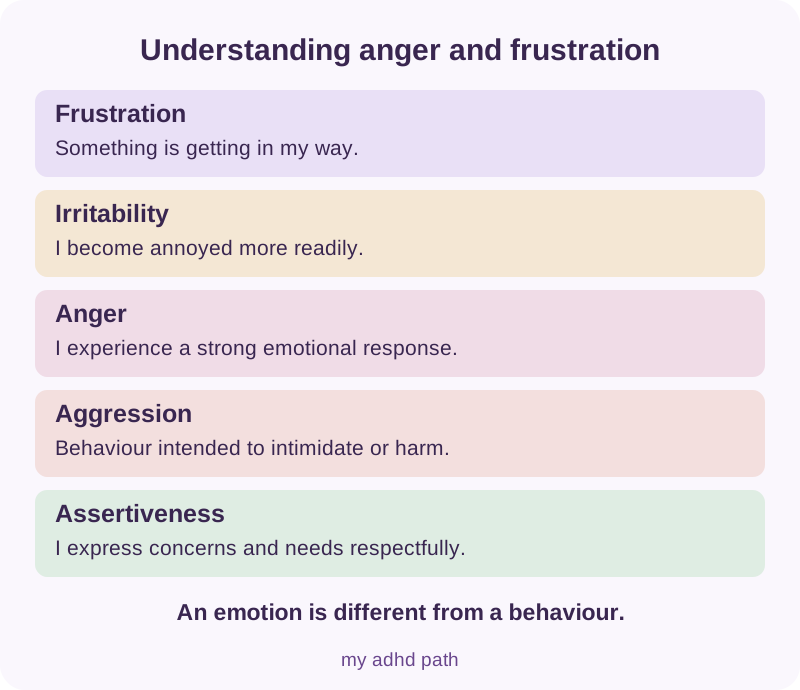
You can experience intense anger without behaving aggressively.
You can also communicate dissatisfaction, establish boundaries and challenge unfair treatment without losing your temper.
The goal is not to eliminate anger.
It's to develop ways of expressing and responding to it that are safe, constructive and consistent with your intentions.
Ten common anger triggers for adults with ADHD
These triggers are not exclusive to ADHD. You may recognise several of them, or your experiences may be entirely different.
1. Being interrupted whilst concentrating
You've finally managed to get started on a demanding task.
You've organised your thoughts, established what needs doing and reached a point where you're making progress.
Then somebody interrupts you.
The interruption itself might last thirty seconds, but recovering your concentration can take considerably longer.
Understanding why interruptions feel frustrating can help you establish clearer working boundaries and develop strategies for returning to tasks.
2. Unexpected changes to plans
You've organised your day around a particular arrangement.
Something changes.
You now need to reconsider your schedule, rearrange other commitments and work out what happens next.
The person communicating the change may see it as relatively minor.
For you, it might represent a substantial amount of additional mental work.
3. Repeated technical problems
The printer stops working.
A password needs resetting.
An application crashes just as you're finishing something.
These difficulties can be particularly frustrating when you've already spent considerable effort getting started.
Try this
Sometimes, taking a short break before troubleshooting can be more productive than repeatedly attempting the same solution whilst becoming increasingly irritated.
4. Feeling misunderstood
You're trying to explain something important, but the other person appears to interpret your words differently from how you intended them.
You become increasingly frustrated as you attempt to clarify your point.
You might start speaking more quickly, interrupting or repeating yourself.
Try this
Writing down your main concern before returning to the conversation may make it easier to communicate clearly.
5. Too many simultaneous demands
Your phone is ringing.
Someone is asking you a question.
An email requires an immediate response.
You're trying to remember something you need to do later.
None of those demands may be particularly difficult individually.
Managing them simultaneously can be considerably more challenging.
Reducing the number of inputs may be more useful than attempting to process everything at once.
6. Perceived criticism
A colleague questions how you've approached a task.
A partner raises a concern about something you've forgotten.
You might immediately interpret the comment as criticism of your competence rather than feedback about a particular situation.
Some people with ADHD describe heightened sensitivity to criticism or perceived rejection.
However, this experience is not universal, and the concept of rejection sensitive dysphoria is not a formally recognised clinical diagnosis.
7. Waiting without knowing how long
Queues, delayed appointments and uncertain delivery times can be frustrating.
For some people with ADHD, waiting is particularly demanding when there is no clear endpoint or opportunity to engage in something else.
Having an alternative activity available may help in situations where waiting cannot be avoided.
8. Noise and competing conversations
A busy household, office or public environment can involve several conversations and background noises simultaneously.
When you're already concentrating or feeling overwhelmed, additional sensory demands may become harder to tolerate.
Sensory sensitivity is not specific to ADHD, but recognising your individual preferences can help you make useful environmental adjustments.
9. Repeatedly losing or forgetting things
You need to leave the house.
You can't find your wallet.
You've already misplaced your keys twice this week.
Sometimes the frustration is directed primarily at yourself.
Try this
Creating designated places for frequently used items may help reduce the number of occasions when you encounter this particular difficulty.
10. Feeling exhausted
You may notice that your patience is considerably lower after a poor night's sleep or a particularly demanding day.
Hunger, physical discomfort, stress and prolonged concentration can all influence emotional regulation.
Recognising these factors may help you understand why situations you normally manage comfortably sometimes become unusually difficult.
Why the last thing that happened isn't always the real problem
Imagine that you've spent the entire day managing competing responsibilities.
You dealt with unexpected problems at work.
You missed lunch.
Traffic was particularly heavy.
You arrived home later than intended.
Then somebody asks whether you've remembered to complete a household task.
You experience an immediate surge of frustration.
The question itself may be entirely reasonable.
But you're experiencing it against the background of everything else you've been managing.
Good to know
Our guide to emotional dysregulation introduces the idea of emotional stacking: the accumulation of everyday demands that can make a subsequent experience feel more difficult to manage.
Recognising this pattern may help you identify opportunities to reduce pressure earlier in the day.
It can also help you explain what's happening without suggesting that the other person is responsible for your emotional response.
Understanding the anger escalation curve
Anger doesn't always develop gradually.
Sometimes, it arrives with relatively little warning.
However, many people can identify physical, emotional or behavioural changes that accompany increasing frustration.
Think of anger as an illustrative curve with five possible points.
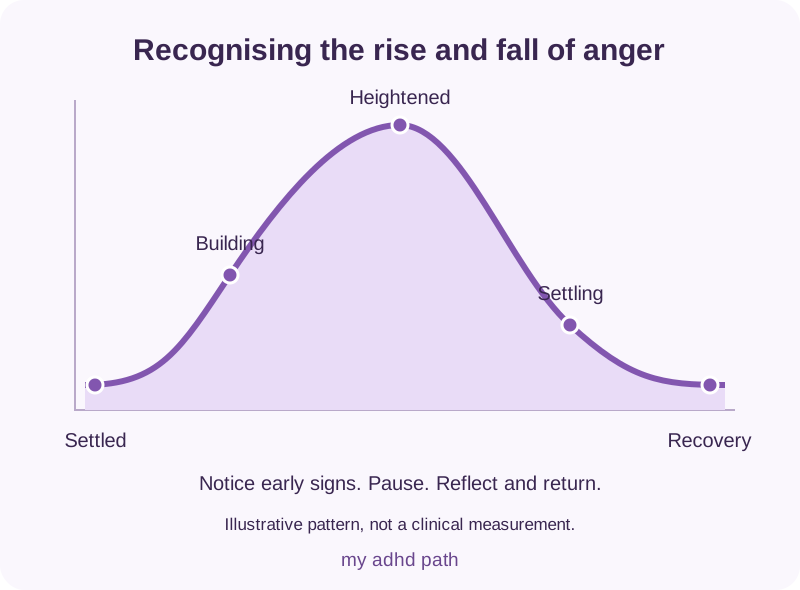
1. Settled
You feel relatively comfortable and able to manage everyday demands.
This is a useful time to establish routines, discuss communication preferences and identify practical adjustments.
2. Building frustration
You begin noticing tension, impatience or difficulty processing additional information.
You may speak more quickly, become restless or find interruptions particularly irritating.
This can be an opportunity to reduce competing demands.
3. Heightened emotion
Your attention becomes increasingly focused on the frustrating experience.
You may feel a strong urge to respond immediately.
Consider whether continuing the conversation or making a decision at this moment will be helpful.
4. Settling
The intensity of the emotion begins to reduce.
You may find it easier to consider alternative explanations and organise your thoughts.
Give yourself enough time before returning to a demanding situation.
5. Recovery and reflection
You can review what happened, consider its impact and identify practical changes for next time.
If your behaviour affected someone else, this may also be an appropriate time to acknowledge that impact and make a meaningful repair.
Good to know
This curve is an editorial illustration, not a clinically validated model. Emotions do not always follow predictable stages, and recognising warning signs does not guarantee that every difficult situation can be prevented.
What happens in your body when you're angry?
Anger can involve physical changes as well as thoughts and feelings.
You might notice:
- Increased heart rate.
- Tension in your jaw or shoulders.
- A feeling of warmth.
- Changes in your breathing.
- Restlessness.
- Difficulty concentrating on anything other than the immediate situation.
- An urge to move, speak or act.
These responses can occur as part of the body's wider stress response.
Recognising your own physical signals can be particularly useful because they may become noticeable before you've fully understood what you're feeling.
For example, you might recognise that your shoulders are tense and you're speaking more quickly than usual.
That awareness could encourage you to step away from a non-urgent disagreement before your frustration increases further.
You don't need to analyse every physical sensation.
Simply becoming familiar with your own recurring signs can provide useful information.
When anger is actually directed at yourself
Not everyone who experiences ADHD-related frustration expresses it outwardly.
Some people become increasingly critical of themselves.
Perhaps you've forgotten another appointment.
You've missed a deadline despite intending to complete the work earlier.
You've spent hours trying to organise something that appears straightforward to everyone else.
You may find yourself becoming frustrated by the difference between what you know you're capable of and what you've managed to accomplish that day.
This can be particularly difficult when you've experienced similar situations repeatedly.
Rather than spending additional energy reviewing everything you should have done differently, consider what practical support could change the situation next time.
For instance:
- A second calendar reminder.
- Written instructions.
- A clearer starting action.
- Support with establishing priorities.
- Fewer competing responsibilities.
- A more suitable working environment.
Understanding a recurring difficulty can be more productive than repeatedly judging yourself for experiencing it.
ADHD, anger and relationships
Anger can become particularly complicated in close relationships.
The people we live with are often the people who see us when we're tired, distracted or managing the accumulated demands of a busy day.
Perhaps your partner asks about something you've forgotten.
You immediately feel defensive.
From your perspective, you're already aware that you haven't completed the task and you're frustrated with yourself.
From their perspective, they're raising a legitimate concern about a shared responsibility.
Your ADHD may provide useful context for some of the difficulties involved.
But your partner's experience matters equally.
Understanding is a shared opportunity, not a one-sided responsibility
Learning about ADHD can help both partners understand recurring misunderstandings.
However, it should not result in one person becoming responsible for anticipating, preventing or managing the other person's anger.
Practical arrangements might include clearer communication, shared calendars and agreed ways to take breaks during difficult conversations.
These arrangements should benefit both people.
They should not require one partner to avoid reasonable concerns because they're worried about how the other person might respond.
How to ask for a constructive break
If a conversation becomes overwhelming, you could say:
What you could say
"I want to discuss this properly, but I'm finding it difficult to think clearly right now. Can we come back to it in twenty minutes?"
This works best when the intention is genuinely to return to the conversation.
If you need longer than anticipated, communicate that rather than allowing the discussion to disappear indefinitely.
Taking a break is a way of managing your own response, not a way of controlling when another person is allowed to express their concerns.
When ADHD is used to justify hurtful behaviour
Good to know
ADHD does not justify threatening or intimidating someone, repeatedly shouting at someone to frighten them, destroying possessions, blocking someone from leaving a room, controlling another person's activities or relationships, physical violence, or blaming someone else for your harmful behaviour. These behaviours deserve appropriate attention regardless of whether someone has ADHD. An explanation for emotional difficulties is not permission to harm another person.
If your behaviour is making someone feel unsafe, seek specialist professional support.
If you are experiencing intimidation, controlling behaviour or violence from another person, you have the right to seek confidential support. You are not responsible for managing their ADHD or preventing their harmful behaviour.
ADHD anger in the workplace
Professional environments can introduce several potential sources of frustration.
Unclear instructions, constant interruptions, last-minute changes and competing deadlines can all create difficulties.
However, responding impulsively to a frustrating workplace situation can produce additional problems.
Responding to difficult emails
An email arrives that appears unnecessarily critical.
Instead of replying immediately, consider drafting your response without adding the recipient's address.
Return to it when you have had an opportunity to review the situation.
Ask yourself whether the response clearly communicates the issue you want to resolve.
Managing interruptions
If interruptions regularly affect your concentration, discuss practical arrangements with colleagues where appropriate.
These might include protected concentration time, agreed communication channels or clearer expectations around response times.
Handling conflicting priorities
When several people expect their work to take priority, frustration may arise from uncertainty rather than the work itself.
What you could say
"I currently have three competing deadlines. Could we agree which one takes priority so I can allocate my time appropriately?"
This turns an emotional difficulty into a practical discussion.
Some employees with ADHD may also benefit from reasonable adjustments and additional workplace support.
Three everyday examples of managing anger differently
The following fictional scenarios illustrate how different approaches might help in everyday situations.
Illustrative scenario
Rob, 39 - The interrupted working day
Rob works from home and finds it particularly difficult to regain concentration after an interruption. He becomes increasingly frustrated when family members ask him questions during periods of demanding work.
Rob recognises that expecting nobody to interrupt him throughout the entire day is unrealistic. Instead, he establishes agreed periods of protected concentration time, alongside times when he is available.
He also starts leaving himself a short note whenever he needs to step away from a task.
These adjustments help him manage interruptions without making his family responsible for his emotional responses.
Illustrative scenario
Adam, 46 - The recurring household argument
Adam frequently forgets a recurring household responsibility. When his partner reminds him, he becomes defensive.
He eventually recognises that part of his frustration comes from already feeling disappointed with himself.
Adam apologises for the way he has responded and establishes a recurring reminder with a clear completion deadline. He takes responsibility for managing the task rather than relying on his partner to remind him.
The practical change addresses the recurring difficulty, whilst the conversation acknowledges its emotional impact.
Illustrative scenario
Simon, 54 - The frustrating feedback
Simon receives feedback on a project he's spent several weeks developing. His immediate response is to challenge every criticism.
Instead, he asks for the feedback in writing and explains that he'd like time to consider it.
Later, he identifies several useful suggestions alongside two points he genuinely disagrees with. He returns to the discussion prepared to explain his concerns calmly.
His initial frustration hasn't prevented him from expressing a legitimate difference of opinion.
Twelve practical strategies for managing ADHD-related anger
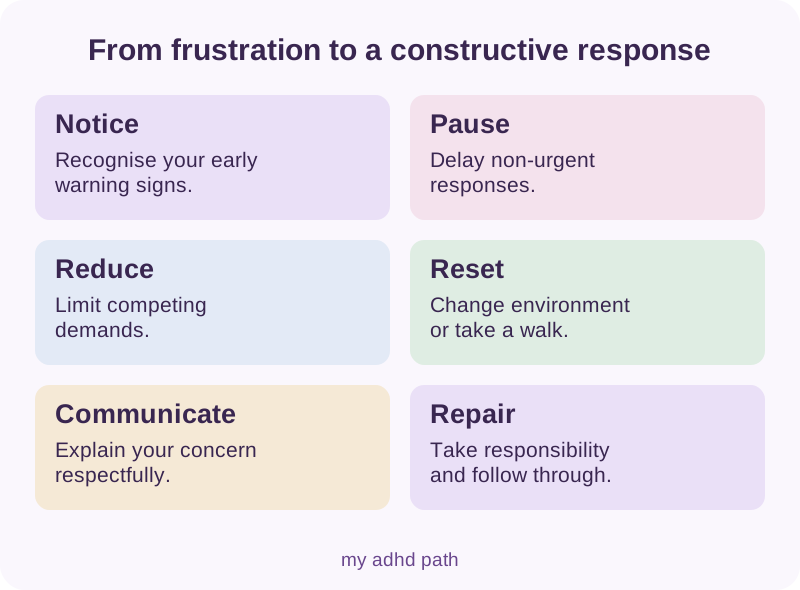
1. Identify your earliest warning signs
Notice what happens before your frustration becomes particularly intense.
You might experience physical tension, impatience, difficulty listening or a growing urge to interrupt.
Recognising these signs can provide an opportunity to act earlier.
2. Reduce the number of simultaneous demands
If you're already struggling to process information, additional conversations, notifications or background noise may increase frustration.
Where appropriate, move to a quieter environment or focus on one issue at a time.
3. Create a pause before responding
For non-urgent situations, delay sending the email, making the decision or continuing the argument.
You don't need to resolve every difficulty immediately.
A pause can create space to consider what you actually want to communicate.
4. Use comfortable, slower breathing
Some people find that gently slowing their breathing helps reduce physical tension.
You might try breathing comfortably in and out for a minute or two, allowing the exhalation to be slightly longer if that feels natural.
Avoid forcing your breathing or continuing if you feel uncomfortable or dizzy.
This is a simple coping strategy, not a treatment for significant anger difficulties.
5. Try a change of environment
A short walk, time outdoors or moving away from a noisy environment may help you redirect your attention.
If you're very angry, avoid driving until you can do so safely.
Physical activity should be used to manage your own state, not to intimidate others or act aggressively towards objects.
6. Check whether your basic needs have been met
Have you eaten?
Have you slept well?
Are you physically uncomfortable?
Have you spent several hours concentrating without an opportunity to rest?
Addressing these factors won't resolve every frustrating situation, but it may make emotional regulation easier.
7. Separate what happened from what you think it means
Someone hasn't replied to your message.
That's the observable event.
Assuming they're deliberately ignoring you is an interpretation.
There may be several other explanations.
Considering these possibilities may help you avoid reacting to an assumption as though it were an established fact.
8. Make recurring frustrations easier to manage
If particular situations repeatedly trigger frustration, consider practical ways to redesign them.
Create a designated place for your keys.
Use written meeting instructions.
Establish clearer household responsibilities.
Introduce a reminder before recurring deadlines.
Sometimes, the most effective way to manage frustration is to reduce the number of occasions when the same problem arises.
9. Communicate concerns before they accumulate
If something is repeatedly causing difficulty, discuss it when you're relatively calm.
Waiting until you've reached a point of considerable frustration may make the conversation more demanding for everyone involved.
Try explaining the specific problem and the change you would like to explore.
10. Set realistic expectations for your available capacity
A day containing fourteen significant responsibilities may not allow sufficient time for unexpected difficulties.
Where possible, introduce flexibility into your schedule.
Distinguish essential commitments from activities that could be postponed, delegated or approached differently.
11. Take responsibility and make a meaningful repair
If your response has hurt someone, acknowledge the impact without making your apology conditional on their understanding of ADHD.
What you could say
"I spoke to you in a way that wasn't appropriate. I'm sorry. I'm going to work on responding differently when I feel overwhelmed."
A meaningful apology should be followed by practical efforts to change the behaviour.
The other person is not obliged to accept an apology or resume a conversation before they feel comfortable doing so.
12. Explore appropriate professional support
If anger is repeatedly affecting your work, relationships or wellbeing, consider seeking professional assistance.
A qualified clinician may help you explore ADHD treatment, psychological interventions and other factors contributing to emotional difficulties.
If your behaviour involves intimidation, aggression or abuse, specialist behaviour-change support may be necessary.
Managing significant difficulties does not have to be a self-help project.
Create your personal anger management plan
Having a plan prepared when you're relatively calm may make it easier to decide what to do when frustration increases.
Here's a fictional example.
| Area | My personal plan |
|---|---|
| Common triggers | Interruptions, conflicting deadlines, unexpected changes |
| Early warning signs | Jaw tension, speaking quickly, impatience |
| Immediate action | Stop responding and reduce competing demands |
| Helpful environment | Quiet room or outdoor space |
| Communication | Explain that I need a short break |
| Returning to the issue | Agree a suitable time to resume the conversation |
| Longer-term adjustments | Clearer priorities, better sleep routine, written arrangements |
| Additional support | Discuss recurring difficulties with my clinician |
Your plan may look considerably different.
The purpose is to identify realistic actions that you can practise and refine over time.
If there is a risk of harm to yourself or another person, prioritise immediate safety and professional assistance rather than relying solely on a personal plan.
Does ADHD medication help with anger?
Medication is an established treatment for ADHD.
Some people experience improvements in emotional regulation when their ADHD symptoms are effectively managed.
However, the relationship between medication and irritability varies between individuals.
Some may notice that ADHD-related frustration improves.
Others may experience irritability as a potential side effect, or notice changes in their emotional state at particular times of day.
For some people taking stimulant medication, changes as the medication wears off may be relevant.
Other factors, including sleep, appetite, stress, dosage and coexisting health conditions, can also influence emotional experiences.
If you're noticing changes in anger or irritability since starting ADHD medication, record when they occur and discuss them with your prescribing clinician.
Practical checklist
- When you take your medication.
- When irritability begins and how long it lasts.
- Whether you've noticed changes in sleep or appetite.
- Any recent changes in medication or dosage.
- Other circumstances occurring at the same time.
Do not independently change your medication, dose or schedule based on general online information.
Your clinician can help determine whether a treatment adjustment or further assessment is appropriate.
Could something other than ADHD be contributing to your anger?
Anger and irritability can have many explanations.
It's important to consider the wider picture, particularly if your emotional responses have changed significantly or appeared relatively recently.
Other contributing factors may include:
- Chronic stress.
- Sleep deprivation or sleep disorders.
- Anxiety.
- Depression.
- Trauma-related difficulties.
- Chronic pain.
- Alcohol or other substance use.
- Medication side effects.
- Physical health conditions.
- Mood disorders.
ADHD can coexist with other conditions.
Receiving an ADHD diagnosis does not mean every subsequent emotional or behavioural difficulty should automatically be attributed to it.
If you're experiencing significant changes in mood, energy, sleep or behaviour, seek an appropriate professional assessment.
Can AI help you think through frustrating situations?
An AI assistant may be useful for organising your thoughts before you respond to a difficult situation.
It can help you distinguish practical concerns from assumptions, explore communication options and develop a clearer description of what happened.
AI prompt
Separating facts from frustration
"Help me organise my thoughts about this situation. Identify what actually happened, what I'm assuming, what concerns I need to address and which aspects are within my control. Don't automatically agree with my interpretation."
AI prompt
Responding professionally
"Help me rewrite this message so that it communicates my concern clearly and respectfully, without unnecessary accusations or defensiveness."
AI prompt
Identifying recurring triggers
"Review these anonymised notes about situations in which I became frustrated. Help me identify recurring circumstances and possible practical changes. Don't diagnose me or assume other people's intentions."
AI should not be used to determine whether another person's behaviour justifies aggression, assess immediate safety risks or replace psychological support.
Check its suggestions and avoid sharing confidential information or identifiable details about other people.
What the research says
Research has consistently identified emotional regulation difficulties as an associated feature of ADHD. A review published in the American Journal of Psychiatry explored the relationship between ADHD and emotional dysregulation, including difficulties with emotional responses and associated impairment. A meta-analysis published in BMC Psychiatry in 2020 also examined emotional dysregulation in adults with ADHD, supporting the importance of considering emotional experiences alongside traditional ADHD symptoms. Research suggests that emotional regulation difficulties can contribute to challenges in social, occupational and personal functioning. However, these findings should not be interpreted as evidence that people with ADHD are inherently aggressive or that aggression is an inevitable consequence of ADHD. Anger, irritability, emotional impulsivity and aggressive behaviour are distinct experiences and outcomes. Studies also use differing definitions and measurement methods. Individual circumstances, coexisting conditions, environmental demands and access to appropriate treatment can all influence emotional and behavioural outcomes.
When to seek help
It's worth speaking with a healthcare professional if anger or irritability is regularly:
- Affecting your relationships.
- Causing difficulties at work.
- Interfering with everyday responsibilities.
- Leading to decisions you later regret.
- Associated with persistent anxiety or low mood.
- Accompanied by significant changes in sleep or behaviour.
- Making it difficult for you or others to feel safe.
Good to know
If you're concerned about your own controlling, threatening or violent behaviour, you can contact the Respect Phoneline for specialist support in the UK on 0808 802 4040. If you're experiencing domestic abuse, confidential support is available through specialist organisations, including Refuge and the Men's Advice Line. Samaritans can be contacted on 116 123 if you need emotional support. If there is an immediate risk of harm to yourself or another person, call 999.
Understanding your anger gives you more choices
Anger can tell you that something matters.
Perhaps you're frustrated by an obstacle.
Perhaps you're carrying too many responsibilities.
Perhaps an important boundary needs to be communicated.
Perhaps you're exhausted and need an opportunity to recover.
Understanding what contributes to your anger can help you identify what actually needs attention.
It can also help you recognise the difference between experiencing an emotion and deciding how to respond to it.
You can feel frustrated and communicate respectfully.
You can disagree with someone and listen to their perspective.
You can acknowledge a difficult day without transferring its consequences onto the people around you.
And you can ask for additional support whilst remaining the capable, independent person you've always been.
Managing anger isn't about never becoming frustrated again.
It's about developing more choices when frustration arrives.
Downloadable resource
My ADHD Anger Management Toolkit
A practical toolkit to help you identify your anger triggers, recognise early warning signs and develop constructive ways to respond to everyday frustration.
Download PDFFrequently asked questions
Is anger a symptom of ADHD?
Anger is not a core diagnostic symptom. However, emotional regulation difficulties, impulsivity and low frustration tolerance may contribute to anger-related experiences for some people with ADHD.
Why do I lose my temper so quickly with ADHD?
Several factors may contribute, including difficulties pausing before responding, managing competing demands and regulating emotional intensity. Stress, poor sleep and other conditions can also influence your responses.
What is ADHD rage?
ADHD rage is an informal expression sometimes used to describe particularly intense anger or frustration experienced by someone with ADHD. It is not a recognised standalone medical diagnosis.
Can ADHD cause anger towards a partner?
ADHD-related difficulties may contribute to misunderstandings, frustration and relationship challenges. However, ADHD does not justify hurtful, controlling or aggressive behaviour towards a partner.
Is irritability common in adults with ADHD?
Some adults with ADHD experience significant irritability, particularly when managing emotional or environmental demands. Persistent irritability may also have other causes and deserves appropriate assessment.
Does ADHD medication reduce anger?
Some individuals experience improved emotional regulation during treatment. Others may notice irritability or other emotional changes. Discuss your individual response with your prescribing clinician.
Can ADHD medication make someone more irritable?
Irritability can occur as a side effect of some ADHD medications. Changes as medication wears off may also be relevant. A prescribing clinician can help explore the possible reasons.
Is ADHD anger the same as bipolar disorder?
No. Bipolar disorder involves distinct episodes of changes in mood, energy and activity. Anger and emotional intensity alone cannot establish either diagnosis, and the conditions can coexist.
Can exercise help manage ADHD-related frustration?
Physical activity may help some individuals manage restlessness, stress and attention. It can support general wellbeing alongside appropriate clinical treatment and other strategies.
Can adults with ADHD learn to manage anger differently?
Yes. Many people develop more effective ways of responding to anger through practical adjustments, psychological support, appropriate treatment and increased understanding of their emotional patterns.
Sources and further reading
- Shaw, P., Stringaris, A., Nigg, J. and Leibenluft, E. (2014). Emotion dysregulation in attention deficit hyperactivity disorder. American Journal of Psychiatry. https://doi.org/10.1176/appi.ajp.2013.13070966
- Beheshti, A., Chavanon, M. L. and Christiansen, H. (2020). Emotion dysregulation in adults with attention deficit hyperactivity disorder: a meta-analysis. BMC Psychiatry. https://doi.org/10.1186/s12888-020-2442-7
- Faraone, S. V. et al. (2021). The World Federation of ADHD International Consensus Statement: 208 Evidence-based conclusions about the disorder. https://doi.org/10.1016/j.neubiorev.2021.01.022
- NICE - Attention deficit hyperactivity disorder: diagnosis and management (NG87). https://www.nice.org.uk/guidance/ng87
- NHS - Get help with anger. https://www.nhs.uk/mental-health/feelings-symptoms-behaviours/behaviours/get-help-with-anger/
- Respect Phoneline. https://respectphoneline.org.uk/
- Men's Advice Line. https://mensadviceline.org.uk/
- Refuge. https://refuge.org.uk/
- Samaritans. https://www.samaritans.org/
This article provides general educational information and is not a substitute for professional medical advice, diagnosis, psychological support or treatment. The anger escalation curve and personal management plan are illustrative editorial resources, not clinically validated assessment tools. ADHD does not justify intimidation, aggression, abuse or violence.