

Sometimes, it's not the size of the problem. It's the amount you're already carrying when it happens.
At a glance
- Emotional dysregulation is a commonly associated feature of ADHD.
- Emotional intensity can involve positive and negative experiences.
- Accumulated demands may influence emotional responses.
- Emotional regulation difficulties are not exclusive to ADHD.
- Creating space between feeling and responding may help.
- Understanding emotional responses does not remove personal responsibility for behaviour.
You've had a reasonably ordinary day.
A couple of meetings ran over. You forgot to reply to an important email. Traffic was particularly frustrating on the way home.
Nothing especially dramatic.
Then you discover that somebody has moved your keys.
And suddenly, you're experiencing a level of frustration that seems completely disproportionate to the situation.
You know they're only keys. You know you'll find them. You know this isn't a particularly significant problem.
Knowing all of that doesn't immediately change how you feel.
Twenty minutes later, you might be wondering why something so small affected you so much.
For many adults with ADHD, experiences like this are familiar.
Yet emotional regulation remains one of the less widely understood aspects of living with ADHD.
What is emotional dysregulation?
Emotional dysregulation describes difficulties managing the intensity, duration or expression of emotional responses.
It doesn't mean experiencing emotions that other people don't experience.
It may mean finding it more difficult to:
- Pause before responding to an emotion.
- Manage the intensity of frustration or disappointment.
- Shift your attention away from an upsetting experience.
- Think clearly when emotionally overwhelmed.
- Return to a calmer emotional state.
- Express your feelings in a way that reflects what you actually want to communicate.
Emotional dysregulation is not unique to ADHD, and it is not currently a core diagnostic criterion for the condition.
However, research has consistently identified emotional regulation difficulties as an important associated feature for many people with ADHD.
These difficulties can affect relationships, professional responsibilities and overall wellbeing.
Why ADHD can affect emotional regulation
ADHD is commonly associated with attention, hyperactivity and impulsivity.
But the brain processes involved in managing attention and behaviour are also relevant to how we respond to emotional experiences.
Several aspects of ADHD may contribute to difficulties regulating emotions.
Impulse control
You receive an unexpected criticism.
Before you've had time to consider what was said, you've already responded.
ADHD-related difficulties with inhibitory control may make it harder to create a pause between experiencing an emotion and acting on it.
That pause can provide an opportunity to interpret the situation, consider alternative explanations and decide how you want to respond.
Attention regulation
Attention doesn't necessarily move away from an emotional experience simply because you want it to.
You might repeatedly revisit a conversation, replay a disappointing event or struggle to concentrate on something else after receiving difficult news.
The ability to redirect attention can play an important role in emotional regulation.
Working memory
When you're emotionally overwhelmed, keeping several pieces of information in mind may become particularly difficult.
You might lose track of the wider context of an argument or forget what you originally intended to explain.
Recognising different perspectives and remembering relevant details can require additional effort when your attention is occupied by an intense emotion.
Cognitive flexibility
Sometimes, managing an emotional response involves changing how you interpret a situation.
Perhaps a colleague didn't respond because they were busy, rather than because they were unhappy with your work.
Considering an alternative explanation may be harder when you're already absorbed in your initial interpretation.
These processes are interconnected. Emotional regulation involves multiple brain systems, and there is no single mechanism that explains every emotional experience associated with ADHD.
Emotional intensity isn't always negative
When emotional dysregulation is discussed, the emphasis is usually on anger, frustration or distress.
But emotional intensity can also involve positive experiences.
You might feel extraordinarily enthusiastic about a new idea.
You might become deeply excited about a project, a sporting achievement or an upcoming holiday.
Perhaps you experience a powerful sense of satisfaction when something you've worked towards finally comes together.
These experiences can be enjoyable and meaningful.
However, intense positive emotions can sometimes influence impulse control too.
You might commit to something before considering your availability, spend more than intended or take on several new projects during a particularly enthusiastic afternoon.
Good to know
The aim of emotional regulation isn't to make every emotion quieter. It's to help you respond to your emotions in ways that support your intentions and wellbeing. You can enjoy your enthusiasm whilst introducing sensible boundaries around the decisions you make when you're particularly excited.
The emotional volume dial
Imagine that your emotional responses have a volume dial.
A particular event might turn that dial up slightly on one day and considerably more on another.
The difference may relate to several factors:
- How well you've slept.
- How many decisions you've already made.
- Whether you've eaten.
- How much uninterrupted time you've had.
- Your current workload.
- Physical discomfort.
- Previous emotional experiences.
- Unexpected changes or interruptions.
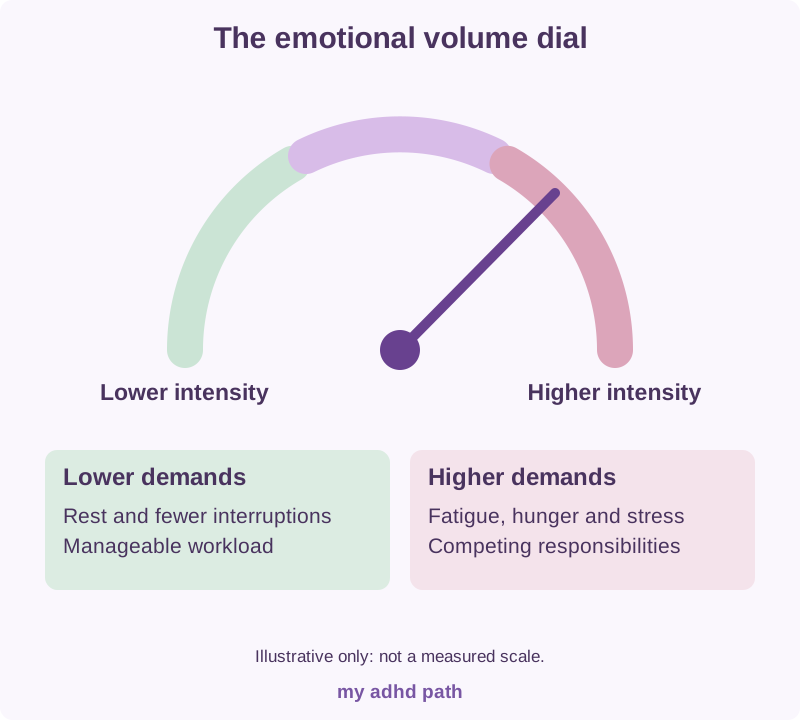
The volume dial is a useful metaphor, not a scientific measurement.
It helps illustrate why the same situation might produce very different responses depending on your circumstances.
On a Saturday morning after a restful night's sleep, discovering that you've misplaced your keys might be mildly irritating.
On a Wednesday evening after a demanding day, when you're running late and several other things have already gone wrong, the same experience may feel considerably more intense.
The event hasn't changed.
Your available capacity to manage it may have.
The emotional stacking effect
Many emotional reactions are easier to understand when you consider what happened before them.
Imagine the following working day.
At 8.30am, you realise you've forgotten something important.
At 10am, a meeting interrupts the work you'd hoped to complete.
At midday, you discover another deadline has been brought forward.
At 2pm, you haven't eaten properly.
At 4pm, somebody asks you to make another decision.
At 6pm, you arrive home and discover that an arrangement has changed unexpectedly.
That final change might be the event that triggers an emotional response.
But it's not necessarily the only event contributing to it.
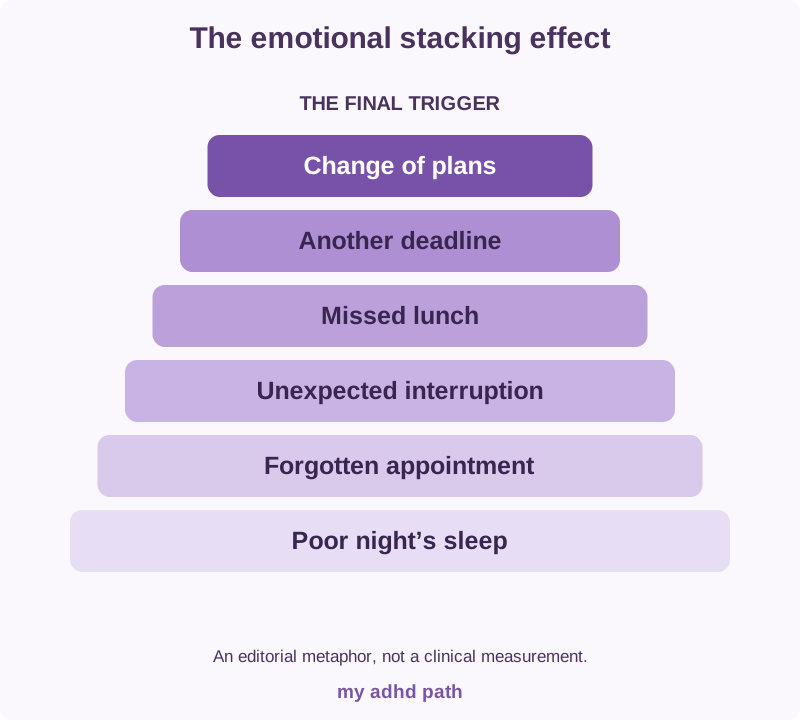
We can think of this as emotional stacking: everyday demands accumulating until something relatively small becomes difficult to manage.
Emotional stacking is an illustrative concept rather than an established clinical diagnosis.
It encourages you to consider your wider circumstances instead of focusing exclusively on the final trigger.
Sometimes, preventing an intense emotional response is less about managing the last event and more about recognising the demands that preceded it.
Ten ways emotional dysregulation may appear in everyday life
Good to know
These examples are not exclusive to ADHD and should not be used as a diagnostic checklist.
1. You react before you've had time to think
You receive a message, hear a comment or discover a problem.
Your response arrives almost immediately.
Later, you may recognise that you would have preferred to express yourself differently.
Creating even a brief pause may help you respond in a way that more accurately reflects your intentions.
2. Disappointment affects you more than you expected
A project doesn't go ahead.
Plans you've been looking forward to are cancelled.
Something you've worked hard towards doesn't produce the outcome you anticipated.
You may find it difficult to redirect your attention towards something else.
The disappointment can feel particularly significant when you've invested considerable time, energy or enthusiasm in the experience.
3. Unexpected changes feel unusually frustrating
You've mentally prepared for how your day will unfold.
Then somebody changes the arrangements.
Even when the new plan is perfectly reasonable, reorganising your expectations can require considerable effort.
You're not necessarily responding only to the change itself. You may also be responding to the additional planning and mental adjustment involved.
4. You replay conversations afterwards
A colleague makes a passing comment.
You spend much of the evening considering what they meant, whether you responded appropriately and whether they might have interpreted your words differently.
This kind of repetitive thinking can also occur with anxiety and other conditions.
If it happens frequently, it may help to distinguish what you actually know from what you're imagining might be true.
5. You struggle to explain yourself when overwhelmed
You know what you want to communicate, but the words aren't coming together.
You might lose track of your main point, become increasingly frustrated or find yourself discussing something completely different.
Taking some time to organise your thoughts may make the conversation easier to return to.
6. Your enthusiasm leads to overcommitment
You're excited about a new opportunity.
Within hours, you've agreed to take part, started researching it and committed several weekends to making it happen.
Once the initial excitement settles, you realise that the commitment is considerably more demanding than you anticipated.
Try this
A short decision-making delay can help you enjoy new ideas without immediately turning them into responsibilities. Write down the opportunity and revisit it after 48 hours.
7. You become unusually quiet when things feel too much
Not every intense emotional response is externally noticeable.
Some people withdraw, stop contributing to conversations or find it difficult to process additional information.
You may need time away from competing demands before you can engage effectively again.
There can be several reasons for this experience, and recognising your own patterns is more useful than assuming every period of withdrawal relates to ADHD.
8. Criticism stays with you for longer than expected
You receive generally positive feedback, alongside one suggestion for improvement.
Hours later, you're still thinking about that one suggestion.
Some people with ADHD describe heightened sensitivity to criticism or perceived rejection.
Rejection sensitive dysphoria, often abbreviated to RSD, is a commonly discussed expression within ADHD communities, but it is not a recognised standalone clinical diagnosis.
Our dedicated guide explores this experience and its evidence base in greater detail.
9. Your patience changes considerably throughout the day
A relatively demanding task feels manageable in the morning.
By late afternoon, ordinary interruptions are becoming difficult to tolerate.
Fatigue, hunger, stress and prolonged concentration can all affect emotional regulation.
Recognising when your available capacity is changing may help you make more realistic decisions about your remaining responsibilities.
10. You need time to recover after an emotional experience
The conversation has finished.
The problem has been resolved.
Everyone else appears to have moved on.
But you're still experiencing the physical and mental effects of what happened.
You might need quiet time, movement, a change of environment or an opportunity to organise your thoughts.
Recovery time varies between individuals and circumstances.
Understanding your personal emotional response pattern
An emotional response often involves several interconnected experiences.
There might be an event, an interpretation, a physical response, a feeling, an urge to act and an eventual action.
These elements don't always occur in a neat sequence, but separating them can be useful.
Illustrative scenario
How an emotional response unfolds
The event: Your colleague asks whether you've finished a report.
Your interpretation: You assume they're questioning your ability to manage your work.
Your physical response: Your shoulders become tense and your heart rate increases.
Your emotion: You feel frustrated, embarrassed or defensive.
Your urge: You want to respond immediately and explain everything else you've been managing.
Your action: You send a message that sounds considerably more defensive than you intended.
Later, you discover that your colleague simply needed the report for another meeting.
The original event was genuine. Your emotional experience was genuine. But your initial interpretation wasn't necessarily accurate.
Learning to distinguish between the event and your interpretation may create more options for how you respond.
Why emotional regulation can feel particularly complicated for men
Men don't experience fewer emotions simply because they may express them differently.
However, social expectations can influence which emotions people feel comfortable discussing.
Some men grow up in environments where independence, composure and problem-solving are particularly valued.
They may become more comfortable talking about practical difficulties than describing sadness, embarrassment, uncertainty or emotional exhaustion.
This may affect how they recognise and communicate their experiences.
For example, frustration might be the emotion someone notices most readily, even when disappointment, anxiety or feeling overwhelmed are also involved.
These patterns are not universal male characteristics.
They can occur across genders and are influenced by individual experiences, relationships and circumstances.
Developing a more precise understanding of your emotions can be useful.
Instead of simply describing yourself as angry or stressed, you might recognise that you're:
- Disappointed that something didn't work out.
- Overwhelmed by competing responsibilities.
- Worried that you've let someone down.
- Frustrated because plans changed unexpectedly.
- Exhausted after concentrating for several hours.
- Uncertain about what someone expects from you.
Identifying the specific experience can help you choose a more appropriate response.
ADHD emotional dysregulation versus mood swings
People sometimes describe rapidly changing emotions as mood swings.
But changes in emotion can occur for many reasons, and the distinction between a situational emotional response and a broader mood change can matter clinically.
| Experience | Possible features |
|---|---|
| Situational emotional response | Often associated with a particular event, frustration or interaction |
| Sustained low mood | May persist across activities and situations, potentially affecting enjoyment, sleep and motivation |
| Anxiety-related distress | May involve persistent worry, fear, physical tension or anticipation of difficulties |
| Mania or hypomania | Distinct episodes involving changes in mood, energy and activity, sometimes including a reduced need for sleep |
These descriptions cannot be used to diagnose or rule out a condition.
ADHD and mood or anxiety disorders can coexist.
Good to know
Bipolar disorder, in particular, is not simply another term for experiencing intense emotions or reacting quickly to everyday events. If you experience significant or sustained changes in your mood, energy, behaviour or sleep, seek an appropriate professional assessment.
The impact of emotional dysregulation on relationships
Imagine coming home after a particularly demanding day.
Your partner begins discussing several things that need organising.
You find yourself becoming increasingly frustrated.
From your perspective, you're struggling to manage another collection of decisions.
From their perspective, they're discussing ordinary shared responsibilities.
Both experiences may be understandable.
The challenge is finding a way to communicate what's happening without transferring the consequences of your emotional state onto another person.
What you could say
"I want to talk about this properly, but I'm finding it difficult to process everything right now. Could we give it twenty minutes and come back to it?"
The important part is following through.
Taking a break should help create a more constructive conversation, not become a way of avoiding responsibilities indefinitely.
Good to know
Understanding emotional regulation is valuable, but it does not excuse intimidation, aggression, emotional abuse or controlling behaviour. Other people should not have to continually adapt their behaviour to avoid triggering your reactions. If your responses are affecting the safety or emotional wellbeing of those around you, professional support is important.
Three everyday examples
The following scenarios are fictional illustrations, not clinical case studies.
Illustrative scenario
Alex, 36 - The unexpected feedback
Alex has spent several days preparing a proposal.
During a meeting, his manager suggests that one section needs reconsidering.
Alex immediately feels disappointed and defensive.
Instead of responding straight away, he makes a note of the feedback and asks for a little time to review it.
Later, he recognises that the proposal was generally well received.
By separating the feedback from his initial interpretation, Alex is able to respond more constructively.
Illustrative scenario
Ben, 42 - The change of plans
Ben has arranged his Saturday around completing a few household jobs and going cycling.
An unexpected family commitment means those arrangements need to change.
He becomes frustrated, partly because he's already mentally organised the entire day.
Ben explains that he needs a few minutes to work out a revised plan.
He reschedules his activities rather than immediately abandoning everything he intended to do.
His disappointment doesn't disappear completely, but it becomes easier to manage.
Illustrative scenario
Marcus, 51 - The exciting opportunity
Marcus discovers a new business opportunity and immediately begins imagining its potential.
He considers investing money, purchasing equipment and committing substantial time.
Recognising that he can become particularly enthusiastic about new projects, he introduces a forty-eight-hour waiting period for non-urgent financial decisions.
He writes down his ideas and returns to them two days later.
The opportunity still interests him, but he now approaches it with a more realistic understanding of the commitment involved.
Twelve practical emotional regulation strategies
You cannot necessarily prevent every intense emotional experience.
But you may be able to create conditions that make those experiences easier to manage.
1. Recognise your early warning signs
Pay attention to what happens before you become particularly overwhelmed.
You might notice:
- Physical tension.
- Speaking more quickly.
- Difficulty listening.
- Restlessness.
- A strong urge to interrupt.
- Increased sensitivity to noise.
- Difficulty processing further information.
These may provide an opportunity to respond before the situation becomes more demanding.
2. Check your existing mental load
Before focusing exclusively on what has just happened, consider what else you've been managing.
Have you slept well? Have you eaten? Have you spent several hours concentrating? Are multiple responsibilities competing for your attention?
Understanding your wider circumstances may help you identify a more useful response.
3. Create a pause before acting
If you feel an immediate urge to send a message, make a decision or respond to a comment, consider whether the situation requires an immediate response.
For non-urgent situations, a short delay may be useful.
Try this
Draft an email without sending it. Write down what you want to say. Explain that you'll respond later. The appropriate length of the pause depends on the circumstances.
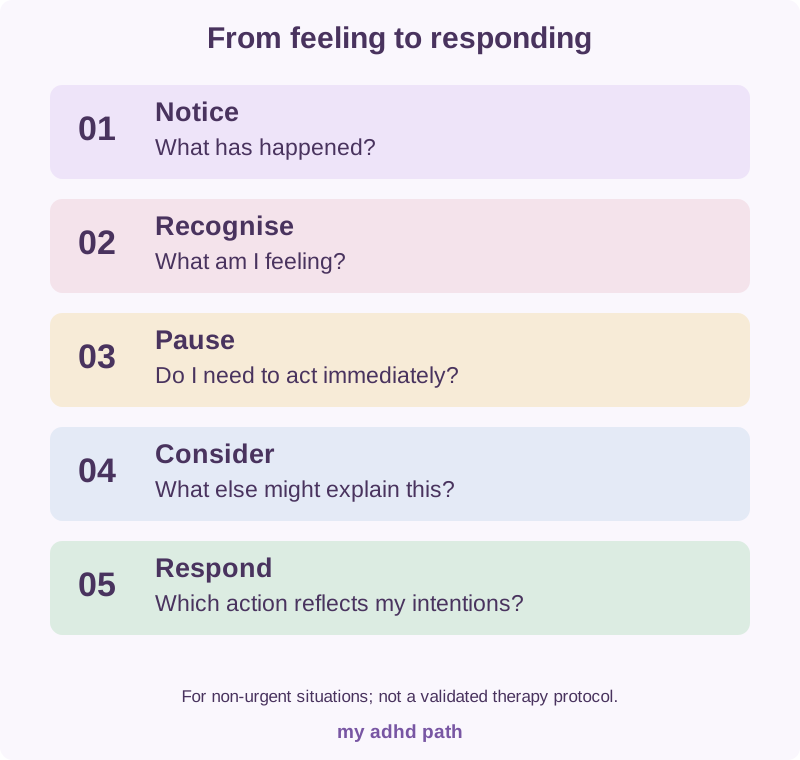
4. Name the emotion more precisely
Instead of describing everything as frustration, try identifying the specific feeling.
Are you disappointed? Embarrassed? Worried? Overwhelmed? Uncertain?
Sometimes, understanding the emotion helps you identify what would actually address it.
Disappointment may need time. Uncertainty may need information. Overwhelm may need reduced demands.
5. Separate facts from interpretations
Write down what actually happened.
Then write down what you think it means.
For example:
Fact: My colleague hasn't responded to my email.
Interpretation: They're unhappy with something I've done.
Other possibilities: They're busy, haven't seen it or need more information before replying.
You don't need to dismiss your initial feeling. Simply recognise that your first interpretation may not be the only one available.
6. Reduce competing sensory demands
If you're already overwhelmed, background conversations, notifications and interruptions may make emotional regulation more difficult.
Where appropriate, move somewhere quieter, turn off unnecessary notifications or ask for one conversation at a time.
Reducing additional demands may help you process the situation more effectively.
7. Experiment with physical movement
A short walk, stretching or another comfortable form of movement may help some people manage restlessness and shift their attention.
You might also find that slow, comfortable breathing helps you settle physically.
These strategies won't work identically for everyone, and they don't replace appropriate treatment.
Explore what genuinely helps you.
8. Avoid important decisions during particularly intense emotions
This applies to excitement as well as frustration.
For decisions involving significant financial commitments, relationships or professional responsibilities, consider whether waiting would allow you to evaluate the situation more clearly.
You can capture your ideas without immediately acting on them.
9. Agree on how to take breaks during difficult conversations
Discuss this with the people involved when everyone is relatively calm.
Agree that either person can request a short break if a conversation becomes overwhelming.
Where possible, establish when you'll return to the discussion.
The aim is to make the conversation safer and more productive for everyone.
10. Create space between demanding activities
A schedule containing back-to-back responsibilities leaves little opportunity to process unexpected experiences.
Where your circumstances allow, introduce short transition periods between activities.
Finish one task, capture anything outstanding and prepare for the next.
Even a small amount of flexibility may reduce accumulating pressure.
11. Practise repairing misunderstandings
Sometimes, despite your best efforts, you'll respond in a way you later regret.
What you could say
"I was frustrated earlier, and the way I responded wasn't helpful. I'd like to explain what was happening and discuss how we can approach it differently next time."
An explanation can provide context, but it should not replace taking responsibility.
Meaningful repair also involves considering what needs to change.
12. Consider ADHD-informed professional support
ADHD medication may improve emotional regulation for some individuals, although responses vary.
Appropriate psychological interventions, including ADHD-informed cognitive behavioural approaches, may also help people develop strategies for managing emotional and behavioural responses.
Discuss your circumstances with a suitably qualified clinician.
You do not need to manage significant emotional difficulties through self-help alone.
Build your own emotional regulation toolkit
The following table provides examples of how different emotional experiences might call for different approaches.
| What I'm experiencing | Something I could try |
|---|---|
| Too many demands at once | Identify one essential priority and reduce unnecessary inputs |
| Frustration after an interruption | Record where I was and create a clear restart point |
| Disappointment | Give myself time to process what happened |
| Uncertainty about someone's meaning | Ask for clarification rather than assume |
| Intense enthusiasm | Record the idea and review the commitment later |
| Physical restlessness | Take an appropriate movement break |
| Difficulty explaining my feelings | Write down the main points before returning to the conversation |
| Exhaustion | Review workload, sleep and opportunities for recovery |
Your toolkit should reflect your own experiences.
A strategy that works brilliantly for somebody else may be considerably less useful for you.
Try a seven-day emotional patterns diary
Understanding recurring emotional patterns can be more useful than analysing one isolated experience.
For a week, choose one significant emotional response each day and record a few details.
| Reflection | Fictional example |
|---|---|
| What happened? | An unexpected change to a meeting |
| What else was happening? | Several deadlines and a poor night's sleep |
| What did I feel? | Frustrated and overwhelmed |
| How intense did it feel? | 4 out of 5 |
| What did I want to do? | Send an immediate complaint |
| What did I actually do? | Asked for clarification and took a short break |
| What might help next time? | More transition time between meetings |
At the end of the week, consider whether particular circumstances appear repeatedly.
Perhaps your strongest reactions happen when plans change unexpectedly.
Perhaps they occur towards the end of demanding working days.
Perhaps you're regularly interpreting ambiguous communication as criticism.
Choose one pattern to explore further.
This diary is a personal reflection exercise, not a validated psychological assessment.
You do not need to record every emotional experience or assign yourself a performance score.
Can AI help you organise your thoughts when emotions feel intense?
An AI assistant may be useful for structuring thoughts, separating facts from assumptions or drafting communication that you can review before sending.
AI prompt
Understanding what happened
"Help me organise my thoughts about the following situation. Separate what actually happened, what I'm assuming, how I'm feeling and what options I have for responding. Don't treat my interpretation as an established fact."
AI prompt
Preparing a constructive response
"Help me draft a calm, respectful response that explains my concern without assigning blame or making assumptions about the other person's intentions."
AI prompt
Identifying recurring patterns
"Help me review these anonymised observations and identify possible recurring triggers, workload pressures and practical adjustments. Don't attempt to diagnose me."
AI cannot determine another person's intentions, reliably assess your mental health or replace professional psychological support.
Check its outputs and avoid sharing other people's confidential information or sensitive personal details with unsuitable services.
What the research says
Research into ADHD and emotional regulation has identified difficulties involving emotional impulsivity, frustration tolerance and the management of emotional responses. A review published in the American Journal of Psychiatry in 2014 examined emotional dysregulation in ADHD and its relationship with clinical impairment, neurobiological processes and treatment. A subsequent meta-analysis published in BMC Psychiatry explored emotion regulation difficulties in adults with ADHD. These studies support the importance of considering emotional experiences alongside the more widely recognised ADHD symptoms. However, researchers use different definitions and measurement approaches when studying emotional regulation. Not every individual with ADHD experiences significant emotional difficulties, and emotional dysregulation can occur in many other conditions. Further research is needed to understand which interventions are most effective for particular individuals and circumstances.
When emotional difficulties need professional support
Consider speaking to your GP or another appropriately qualified healthcare professional if emotional difficulties are:
- Regularly interfering with work or relationships.
- Becoming more intense or frequent.
- Associated with persistent anxiety or low mood.
- Affecting your ability to manage everyday responsibilities.
- Leading to harmful or risky decisions.
- Accompanied by significant changes in sleep, energy or behaviour.
- Causing you or other people to feel unsafe.
Important
If you are experiencing suicidal thoughts or thoughts of self-harm, seek professional support promptly. In the UK, Samaritans can be contacted on 116 123. For urgent medical advice, contact your local urgent healthcare service, including NHS 111 where available. If there is an immediate risk of harm to yourself or someone else, call 999 or seek emergency medical care.
Downloadable resource
My ADHD Emotional Regulation Toolkit
Explore your emotional patterns and develop practical strategies for managing everyday emotional responses.
Download PDFFrequently asked questions
Is emotional dysregulation a symptom of ADHD?
It is a commonly recognised associated feature of ADHD, but it is not currently a core diagnostic criterion. Emotional regulation difficulties can occur with other conditions too.
Why do small things feel like big problems when you have ADHD?
Attention regulation, impulse control, accumulated demands, fatigue and individual circumstances may all contribute to the intensity of emotional responses.
Does emotional dysregulation affect men differently?
There is no separate male form of ADHD emotional dysregulation. Social expectations and individual experiences may influence how someone recognises, expresses and manages emotions.
Can ADHD cause sudden mood changes?
Some people with ADHD experience rapidly changing emotional responses. However, significant or sustained mood changes may have other explanations and should be discussed with a healthcare professional.
Does ADHD medication help emotional regulation?
Some people experience improvements in emotional regulation when receiving ADHD medication. Responses vary, and treatment should be discussed with a qualified prescriber.
Is emotional dysregulation the same as rejection sensitive dysphoria?
No. Emotional dysregulation is a broader description of difficulties managing emotional responses. Rejection sensitive dysphoria is an informal expression relating specifically to intense experiences of perceived rejection or criticism.
Can emotional dysregulation improve?
Many people develop more effective ways of managing emotional responses through appropriate treatment, practical strategies, environmental changes and psychological support.
Why do I feel exhausted after an emotional experience?
An intense emotional experience can involve considerable physical and mental effort. Persistent or significant exhaustion should also be explored with a healthcare professional.
Does emotional dysregulation excuse hurtful behaviour?
No. Understanding what contributes to an emotional response can help someone manage it more effectively, but it does not justify aggression, intimidation, abuse or harm.
Can you have emotional dysregulation without ADHD?
Yes. Emotional regulation difficulties can occur in a range of circumstances and health conditions, and they are not sufficient to establish an ADHD diagnosis.
You don't need to feel less to live differently
Emotional intensity can be part of what makes an experience particularly meaningful.
The enthusiasm you bring to projects.
The excitement of discovering something new.
The satisfaction of achieving something important.
The depth of feeling you experience when something matters to you.
Managing emotions doesn't mean removing those experiences from your life.
It means developing a better understanding of what influences them, recognising when additional support might be useful and creating more opportunities to choose how you respond.
Perhaps the next time something unexpectedly feels huge, you'll be able to recognise that there may be more contributing to the experience than the event itself.
That understanding could help you respond differently.
Not because the emotion doesn't matter.
But because what happens next matters too.
Sources and further reading
- Shaw, P., Stringaris, A., Nigg, J. and Leibenluft, E. (2014). Emotion dysregulation in attention deficit hyperactivity disorder. American Journal of Psychiatry. https://doi.org/10.1176/appi.ajp.2013.13070966
- Beheshti, A., Chavanon, M. L. and Christiansen, H. (2020). Emotion dysregulation in adults with attention deficit hyperactivity disorder: a meta-analysis. BMC Psychiatry. https://doi.org/10.1186/s12888-020-2442-7
- Faraone, S. V. et al. (2021). The World Federation of ADHD International Consensus Statement: 208 Evidence-based conclusions about the disorder. https://doi.org/10.1016/j.neubiorev.2021.01.022
- NICE - Attention deficit hyperactivity disorder: diagnosis and management (NG87). https://www.nice.org.uk/guidance/ng87
- NICE - Bipolar disorder: assessment and management (CG185). https://www.nice.org.uk/guidance/cg185
- NHS - Attention deficit hyperactivity disorder (ADHD). https://www.nhs.uk/conditions/attention-deficit-hyperactivity-disorder-adhd/
- Samaritans. https://www.samaritans.org/
This article provides general educational information and is not a substitute for professional medical advice, diagnosis, psychological support or treatment. The emotional volume dial, emotional stacking concept and reflection diary are illustrative editorial resources rather than validated clinical models or assessment tools.