

Understanding what you're looking for in a substance may help you discover other ways of finding it.
At a glance
- Research identifies an association between ADHD and increased risk of substance use disorders.
- Not everyone with ADHD experiences difficulties with addiction.
- Some individuals use substances in an attempt to manage ADHD-related experiences.
- Appropriately prescribed ADHD medication has not been established to generally increase addiction risk.
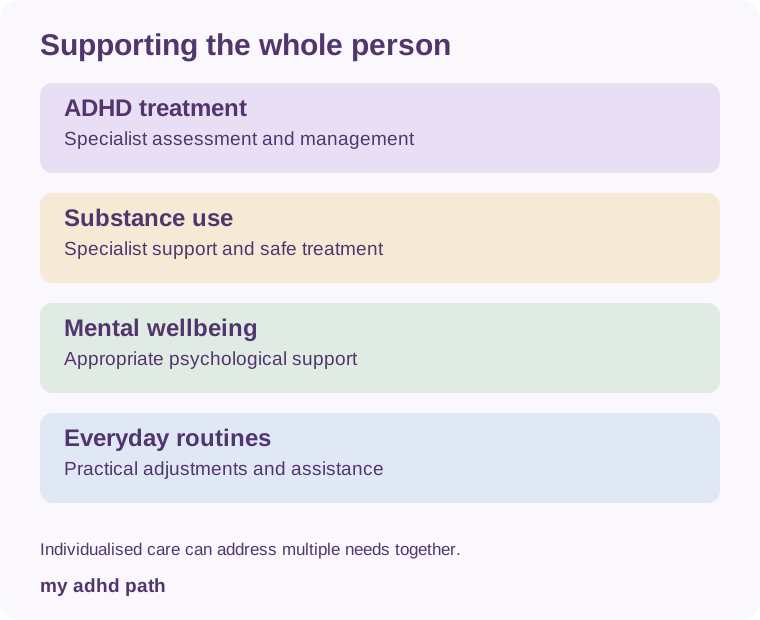
- ADHD and substance use difficulties can benefit from coordinated specialist care.
- Withdrawal from certain substances requires medical supervision.
Perhaps it's the glass of wine that helps you feel as though the working day has finally ended.
The cigarette break that gives you a few minutes away from competing responsibilities.
The cannabis you use because you find switching off particularly difficult.
Or the succession of energy drinks that gets you through a demanding afternoon.
For some adults with ADHD, substances become part of the way they navigate everyday experiences.
Sometimes, these habits begin years before someone understands that they have ADHD.
They may develop gradually, without much consideration of the underlying reasons.
You might recognise that something helps you feel more relaxed, more alert or more comfortable in a social situation, without understanding why that particular experience matters so much to you.
Not everyone with ADHD uses substances, and not everyone who uses substances develops a problem.
However, research has identified an important association between ADHD and an increased risk of substance use disorders.
Understanding that relationship can help us have more informed conversations about prevention, treatment and support.
What is the connection between ADHD and substance use?
ADHD is a neurodevelopmental condition that can affect attention, impulse control, activity levels and executive functioning.
It may also influence emotional regulation, reward processing and how someone responds to everyday demands.
Several of these processes may be relevant to understanding substance use.
Research has found that people with ADHD, as a group, have an increased likelihood of developing difficulties involving substances such as alcohol, nicotine and other drugs.
Some studies have also identified associations with earlier substance use and more complicated patterns of dependence.
However, an increased risk is not a prediction about an individual's future.
Many adults with ADHD never experience problems with substance use.
Others may encounter difficulties influenced by a combination of circumstances, including mental health, genetics, social environments, previous experiences and access to appropriate support.
ADHD is one possible contributing factor within a much wider picture.
Substance use, dependence and addiction
These terms are often used interchangeably, but they describe different experiences.
| Term | What it describes |
|---|---|
| Substance use | Consuming a substance, such as alcohol, nicotine or another drug |
| Harmful substance use | A pattern of use associated with harm to health or wellbeing |
| Physical dependence | Adaptation to a substance that can result in withdrawal symptoms when use is reduced or stopped |
| Substance use disorder | A clinically recognised pattern of problematic substance use causing significant impairment or distress |
| Addiction | A commonly used term describing compulsive engagement with a substance despite harmful consequences |
Physical dependence and addiction are not necessarily the same thing.
For example, someone may develop physical dependence on certain prescribed medications whilst taking them appropriately under medical supervision.
Understanding these distinctions can help reduce unnecessary stigma and encourage more accurate conversations about someone's experiences.
Why might people with ADHD be more vulnerable?
There is no single explanation for the relationship between ADHD and substance use.
Several factors may interact, and their importance varies between individuals.
1. Reward processing and stimulation
Research suggests that some aspects of reward processing differ in people with ADHD.
This may influence motivation, how someone responds to immediate rewards and their willingness to engage with activities that offer delayed benefits.
Substances can produce powerful short-term changes in feelings, alertness or behaviour.
For some individuals, those immediate experiences may be particularly reinforcing.
Common misconception
ADHD is simply a dopamine deficiency. In reality, dopamine is involved in several important brain processes, including motivation, movement, learning and reward. ADHD involves multiple biological and environmental influences and cannot be explained entirely by the amount of one chemical in the brain.
2. Impulsivity
Some adults with ADHD find it difficult to pause before making decisions.
In particular circumstances, this may contribute to drinking more than intended, accepting an unexpected offer of a substance or acting without considering longer-term consequences.
Impulsivity does not automatically lead to problematic substance use.
But it may be relevant when combined with particular environments, emotional experiences or established habits.
3. Emotional regulation
For some people, substances provide a temporary change in how they experience difficult emotions.
Alcohol may initially make someone feel more relaxed.
Nicotine may be associated with a perceived reduction in tension.
Other substances may temporarily alter someone's experience of anxiety, boredom or emotional discomfort.
These effects do not necessarily address the circumstances contributing to those feelings.
Sometimes, substance use introduces additional difficulties that can make emotional regulation more demanding.
4. Difficulty switching off
Some adults with ADHD describe inner restlessness and difficulty disengaging from thoughts or activities.
After a demanding working day, they may struggle to move into a more relaxed state.
A substance can become associated with that transition.
Over time, someone might begin to feel that relaxing, socialising or going to sleep is difficult without it.
Developing additional ways of making those transitions may be an important part of appropriate support.
5. Undiagnosed or inadequately supported ADHD
Someone who doesn't know they have ADHD may spend years looking for ways to manage experiences they find difficult to explain.
Perhaps they struggle with concentration, restlessness, emotional intensity or consistently managing responsibilities.
They may discover that a substance temporarily changes how they feel or function.
This experience is sometimes described as self-medication.
However, the fact that a substance appears to affect someone's concentration or emotional state does not establish that they have ADHD.
Nor does it mean the substance is an appropriate or effective treatment.
6. Coexisting mental health difficulties
ADHD can coexist with anxiety, depression, trauma-related difficulties and other mental health conditions.
These experiences may independently influence someone's relationship with substances.
For example, an individual might use alcohol to feel more comfortable in social situations, whilst also experiencing ADHD-related impulsivity.
Understanding both aspects may be necessary to develop effective support.
7. Social and environmental influences
Substance use is influenced by environments as well as individual characteristics.
Friendship groups, workplace cultures, family experiences, financial pressure and the availability of substances may all play a role.
For some men, drinking may form a significant part of socialising with friends or colleagues.
Others may feel uncomfortable discussing emotional difficulties and develop private ways of managing them.
These patterns are not universal male characteristics.
They are examples of how individual experiences and social expectations may interact.
Understanding self-medication
Self-medication describes using a substance to try to manage symptoms, uncomfortable experiences or perceived difficulties without an appropriately supervised treatment plan.
For example, someone might use a substance because they believe it helps them concentrate, relax, sleep or manage social situations.
Sometimes, the perceived benefit feels sufficiently significant that the person continues the behaviour despite experiencing unwanted consequences.
Consider the following examples.
| What someone may be looking for | Substance they might turn to | Possible longer-term difficulties |
|---|---|---|
| Switching off after work | Alcohol | Disrupted sleep, tolerance, dependence |
| Greater alertness | Nicotine or excessive caffeine | Dependence, anxiety, sleep disruption |
| Relief from restlessness | Cannabis | Memory difficulties, anxiety, dependence |
| More confidence in social situations | Alcohol | Increasing reliance on drinking to socialise |
| Greater energy or focus | Illicit stimulants | Cardiovascular risks, dependence, mental health difficulties |
These examples describe possible motivations, not recommendations or evidence that these substances effectively treat ADHD.
Understanding what someone hopes to achieve through substance use may help identify needs that deserve appropriate attention.
ADHD and alcohol
Alcohol is often associated with socialising, celebrations and relaxation.
For some people, it also becomes a familiar way of marking the end of a demanding day.
An adult with ADHD might describe drinking because they feel unable to switch off, want relief from competing thoughts or find particular social situations easier after consuming alcohol.
Others may experience difficulties limiting how much they drink once they have started.
Although alcohol can initially produce feelings of relaxation, it can also affect inhibition, judgement, memory and emotional regulation.
These effects may create additional challenges for someone already experiencing ADHD-related difficulties.
Alcohol and sleep
Some people drink alcohol because they believe it helps them fall asleep.
Although alcohol may initially make someone feel sleepy, it can disrupt sleep quality and lead to more fragmented sleep later in the night.
Poor sleep can make attention, impulse control and emotional regulation more difficult the following day.
This can contribute to a recurring pattern:
A demanding day leads to drinking in the evening. Drinking affects sleep. Poor sleep makes the next day more difficult. By the following evening, the person is again looking for a way to relax.
Not everyone who drinks experiences this pattern.
However, recognising it may help someone understand how their evening habits influence their daytime experiences.
Recognising when drinking is becoming a concern
It may be useful to seek advice if you notice that:
- You're regularly drinking more than you intended.
- Alcohol is becoming your main way of relaxing.
- You find it difficult to enjoy certain activities without drinking.
- Drinking is affecting your work, finances, health or relationships.
- You need increasingly large amounts to achieve the same perceived effect.
- You experience shaking, sweating, nausea or significant anxiety when you stop drinking.
- You've repeatedly tried to reduce your drinking without managing to do so.
These experiences do not all establish alcohol dependence.
However, they are worth discussing with a healthcare professional.
Good to know
Important: If you may be physically dependent on alcohol, do not suddenly stop drinking without medical advice. Alcohol withdrawal can be dangerous and, in some cases, life-threatening. A healthcare professional or specialist alcohol service can help determine how to reduce or stop drinking safely.
ADHD and nicotine
Research has identified an association between ADHD and an increased likelihood of smoking and nicotine dependence.
Some individuals report that nicotine temporarily changes how alert or focused they feel.
Others associate smoking or vaping with opportunities to take breaks, regulate stress or create structure throughout the day.
Nicotine is highly addictive.
As dependence develops, withdrawal symptoms can include irritability, restlessness and difficulty concentrating.
Relief from these symptoms after consuming nicotine may be interpreted as an improvement in everyday functioning.
This can make the relationship between perceived benefit and dependence particularly complicated.
When the ritual matters as much as the substance
Imagine someone who takes several cigarette breaks throughout their working day.
Those breaks might also provide:
- A reason to step away from their desk.
- A change of environment.
- A predictable pause between responsibilities.
- An opportunity to spend time alone.
- A moment away from competing conversations.
These benefits are not necessarily dependent on smoking.
Understanding the role of the ritual may help someone develop additional routines alongside appropriate stop-smoking support.
NHS stop-smoking services can offer guidance on evidence-based approaches, including suitable medications and nicotine replacement therapy.
Good to know
Nicotine should not be started as a way of managing ADHD. If you are considering stopping smoking or vaping, discuss your ADHD and any concerns about withdrawal with your healthcare professional.
ADHD and cannabis
Cannabis is sometimes discussed within ADHD communities as a way of managing restlessness, sleep difficulties or emotional intensity.
Some individuals report feeling more relaxed after using it.
However, personal experiences are not equivalent to evidence that cannabis effectively treats ADHD.
There is insufficient robust evidence to recommend cannabis as an established treatment for ADHD.
Cannabis containing THC can affect attention, memory, reaction time and judgement.
It may also contribute to anxiety, paranoia and dependence, and can increase the risk of psychosis, particularly in susceptible individuals and with higher-potency or frequent use.
These effects are especially relevant when someone is already experiencing difficulties with attention, emotional regulation or everyday functioning.
Cannabis and sleep
Someone might feel that cannabis helps them settle at night.
However, its effects on sleep can vary, and regular use can lead to dependence and withdrawal-related sleep difficulties.
If you're relying on cannabis to manage sleep, discuss your experiences with a healthcare professional.
There may be underlying ADHD-related difficulties, sleep disorders or other factors that deserve assessment.
Common misconception
Feeling calmer after using cannabis means you have ADHD. In reality, people can experience changes in their emotional state after using substances for many reasons. These responses cannot establish an ADHD diagnosis. A formal assessment considers developmental history, current symptoms, functional impact and other possible explanations.
ADHD and caffeine
Caffeine is a familiar part of everyday life for many adults.
Coffee, tea, energy drinks and some supplements contain caffeine, which can temporarily increase alertness.
Some people with ADHD report that caffeine helps them concentrate or feel more prepared for demanding activities.
Others experience increased anxiety, restlessness or difficulties sleeping.
Caffeine is not an established replacement for ADHD medication.
Regular use can also lead to dependence and withdrawal symptoms, including headaches, fatigue and irritability.
The tiredness and caffeine cycle
Someone who regularly stays up later than intended may wake feeling tired.
They consume caffeine throughout the day to maintain alertness.
Later, they struggle to settle at night.
The following morning, they feel tired again.
Caffeine may be only one factor contributing to that pattern, but reviewing consumption and timing can be useful.
Good to know
If you take ADHD medication, discuss significant caffeine consumption or the use of energy drinks with your clinician or pharmacist. Depending on your treatment and health circumstances, combining stimulatory effects may increase difficulties involving sleep, anxiety, heart rate or blood pressure.
ADHD and illicit stimulants
Some individuals report using illicit stimulants in an attempt to improve concentration, energy or motivation.
Others use them recreationally or in social circumstances.
These substances can carry serious cardiovascular, neurological and mental health risks, alongside a significant potential for dependence.
Illicitly obtained substances may also contain unexpected ingredients or unpredictable concentrations.
Their effects are not equivalent to appropriately prescribed ADHD treatment.
Even when someone reports feeling calmer or more focused after taking an illicit stimulant, this cannot be used to diagnose ADHD.
Good to know
If you're using illicit substances alongside ADHD medication, it's particularly important to discuss this with your prescribing clinician. Potential interactions and overlapping stimulant effects can increase health risks. You deserve access to appropriate medical advice without being judged for disclosing your experiences.
Why some men may find it difficult to discuss substance use
Habits involving alcohol or other substances can become difficult to discuss when they are closely connected to identity, friendships or everyday routines.
Perhaps drinking is an established part of how you socialise.
Perhaps you take pride in managing difficulties independently.
Perhaps you're concerned that acknowledging a problem might change how other people see you.
Some men may also worry that disclosing substance use to an ADHD clinician could affect their access to treatment.
These concerns can make it tempting to provide an incomplete account of what is happening.
However, clinicians need accurate information to assess symptoms, consider medication safety and develop appropriate treatment plans.
Having difficulties with substance use does not automatically mean that someone cannot receive ADHD treatment.
Both aspects of their health deserve appropriate attention.
What does the research say about ADHD and addiction?
Several decades of research have investigated the relationship between ADHD and substance use disorders.
The evidence supports an association, but there remain important questions about the mechanisms involved and how best to support individuals experiencing both conditions.
What the research says
Supporting people with both ADHD and substance use disorders. In 2023, a multidisciplinary expert consensus statement examined the identification and treatment of ADHD in people experiencing substance use difficulties. The publication followed discussions involving professionals with expertise in ADHD, addiction and related areas of healthcare. Its recommendations emphasised the importance of specialist assessment, individualised treatment and better coordination between services. One important message was that the presence of a substance use disorder should not automatically exclude someone from receiving appropriate ADHD treatment. Clinical decisions should consider individual circumstances and safety. Source: Young et al. (2023), World Journal of Psychiatry.
What the research says
Does prescribing ADHD medication increase addiction risk? A 2024 systematic review commissioned by the US Department of Veterans Affairs examined research into ADHD, stimulant medication and substance use disorders in adults. The available evidence did not demonstrate a general increase in subsequent substance use disorders attributable to prescribed stimulant treatment. However, the evidence had limitations, and information about medication misuse and diversion remained incomplete. The researchers highlighted the importance of individualised discussions about treatment benefits and risks. Source: Rieke et al. (2024), ADHD and Substance Use Disorders in Adults: A Systematic Review.
What these findings do not tell us
Research does not establish that:
- Every person with ADHD will experience substance use difficulties.
- Every instance of substance use by someone with ADHD is an attempt at self-medication.
- ADHD medication eliminates the risk of addiction.
- Prescription stimulants cannot be misused.
- One treatment approach is suitable for everyone.
Effective support requires consideration of the individual rather than relying exclusively on population-level findings.
Does ADHD medication cause addiction?
This is an understandable concern, particularly for people who have previous experience of substance dependence.
Some medications used to treat ADHD are stimulants and have recognised potential for misuse.
However, there is an important distinction between taking medication as prescribed, using medication outside the prescribed instructions and consuming illicit substances.
Research does not support the assumption that appropriately prescribed stimulant treatment generally increases the likelihood of developing a substance use disorder.
Some observational research suggests that ADHD treatment may be associated with reduced substance-related risks, although these findings do not establish that medication prevents addiction.
Medication safety
If you have a current or previous substance use disorder, your clinician may consider several factors when developing a treatment plan.
Practical checklist
- Your medical history.
- Current substance use.
- Previous experiences of medication.
- Cardiovascular health.
- Potential medication interactions.
- Risk of misuse or diversion.
- Available support and monitoring.
Depending on your circumstances, treatment might involve stimulant or non-stimulant medication, psychological interventions, practical support or a combination of approaches.
Never share prescribed ADHD medication with another person or take medication that has not been prescribed for you.
Do not independently alter your prescribed dose or medication schedule.
Discuss any concerns with your prescribing clinician.
Can you receive an ADHD diagnosis if you have a substance use problem?
Yes, it is possible to have both ADHD and a substance use disorder.
However, assessment may require additional care.
Substance use, intoxication and withdrawal can affect attention, memory, sleep, mood and behaviour.
These effects may resemble or complicate the assessment of ADHD symptoms.
A qualified clinician may therefore explore:
- Your experiences during childhood.
- Symptoms that existed before substance use began.
- Your functioning during periods of more stable substance use or abstinence.
- Educational and employment history.
- Mental and physical health.
- Other possible explanations for your symptoms.
The timing of assessment depends on individual circumstances.
Acute intoxication or withdrawal may make a reliable assessment inappropriate at that particular time.
This does not mean everyone must achieve complete abstinence before seeking ADHD advice or support.
A clinician experienced in both ADHD and substance use can help determine the most appropriate approach.
Understanding the short-term relief cycle
Imagine someone who regularly experiences difficulty switching off after work.
They discover that drinking alcohol temporarily helps them feel more relaxed.
That relief makes drinking more likely to become part of their evening routine.
Over time, disrupted sleep begins to affect their concentration and emotional regulation.
Working days become more demanding.
By the evening, they increasingly look forward to the temporary relief associated with drinking.
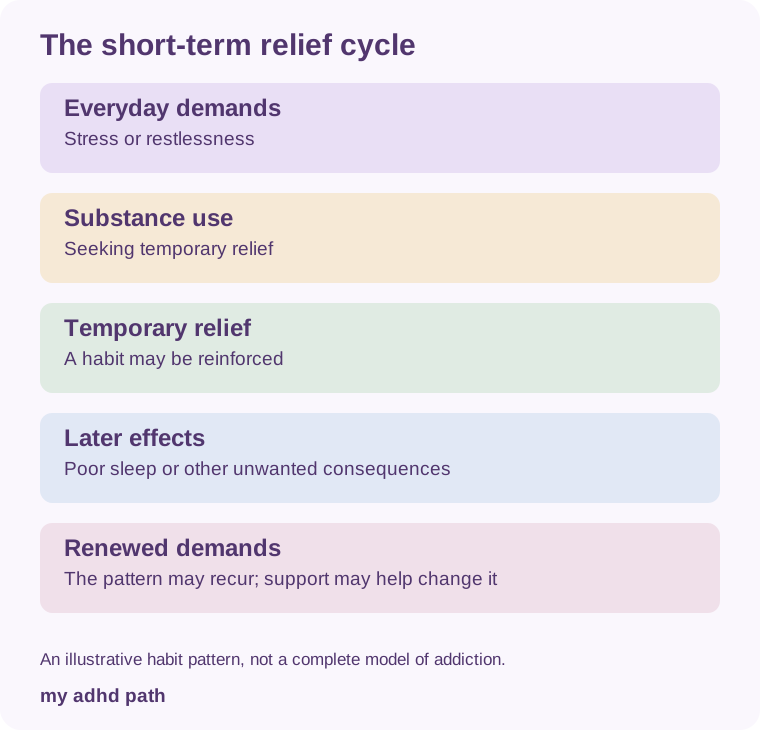
This is an illustrative example of a reinforcing habit pattern.
It is not a universal description of addiction.
Substance use disorders are complex and can involve biological, psychological and social factors that extend far beyond everyday habits.
Nevertheless, understanding recurring patterns may help identify opportunities for appropriate intervention.
Three different experiences of ADHD and substance use
These fictional examples illustrate possible experiences. They are not clinical case studies or predictions about individual outcomes.
Illustrative scenario
Nick, 38 - The difficulty switching off
Nick works in a demanding technical role. He frequently struggles to disengage from work-related thoughts in the evening. Over several years, drinking has become his usual way of relaxing. Following an ADHD diagnosis, he begins discussing his evening habits with his GP. He explores whether his difficulties with sleep and restlessness need additional attention. With appropriate guidance, he develops a plan for reviewing his alcohol use, alongside introducing clearer transitions between work and home. Understanding ADHD helps Nick recognise that relaxing is something he may need support with, rather than something he should automatically find easy.
Illustrative scenario
Tom, 29 - The cigarette breaks
Tom began smoking during his teenage years. As an adult, he associates smoking with periods of concentration and opportunities to step away from a busy working environment. When he decides to stop, he discovers that he particularly misses the structure provided by cigarette breaks. With assistance from a stop-smoking service, Tom develops alternative ways to introduce predictable breaks throughout his working day. He also explores suitable treatment for nicotine dependence. His approach addresses both the physical dependence and the role smoking has played in his daily routine.
Illustrative scenario
Andrew, 47 - Understanding the wider picture
Andrew has experienced difficulties with alcohol for several years. During specialist treatment, he begins discussing long-standing problems with organisation, impulsivity and attention. These difficulties were apparent well before his drinking became problematic. His healthcare team helps him access an appropriate ADHD assessment whilst continuing to support his recovery. Rather than treating the two experiences as entirely separate, his clinicians consider how they may interact. Andrew receives support that takes account of both aspects of his health.
Recognising when a habit is becoming harder to manage
You don't need to wait until a behaviour has reached a particular level of severity before discussing it with someone.
Consider whether your relationship with a substance has changed.
Perhaps you're using it more frequently than you originally intended.
Perhaps activities that previously felt enjoyable without it now seem less appealing.
Perhaps you're concerned about how much money you're spending or how use is affecting your relationships.
Other questions you might consider include:
- Do I regularly think about when I'll next use this substance?
- Am I using it primarily to manage difficult emotions or experiences?
- Has the amount I'm using increased over time?
- Am I experiencing unwanted effects but continuing anyway?
- Do I find reducing my use more difficult than expected?
- Have I become uncomfortable discussing my use with other people?
- Is substance use interfering with things that matter to me?
These are personal reflection questions, not a validated screening questionnaire.
If your answers raise concerns, a healthcare professional or specialist support service can help you explore them further.
Ten practical ways to explore healthier support
The following strategies may be useful alongside appropriate professional advice.
They are not a detoxification plan or a substitute for addiction treatment.
1. Identify what you're hoping the substance will provide
Are you looking for relaxation, stimulation, greater confidence, relief from boredom or a way to disengage from difficult thoughts?
Understanding the experience you're seeking can help identify other needs that deserve attention.
2. Discuss your ADHD treatment and support needs
If you're continuing to experience significant difficulties with concentration, impulsivity, emotional regulation or restlessness, speak to your ADHD clinician.
Your existing management plan may need reviewing.
Try this
If you suspect you have ADHD but haven't been assessed, discuss your experiences with an appropriate healthcare professional. Understanding your ADHD may help you identify what you've been trying to manage.
3. Make transitions between activities more deliberate
Some people develop habits around particular times of day.
Finishing work might become associated with drinking.
Taking a break might become associated with nicotine.
Introducing alternative transition routines may help provide additional options.
Try this
Change your environment, take a walk or complete a short end-of-day routine to create a deliberate transition between work and home.
4. Explore activities that provide meaningful engagement
Boredom and under-stimulation may be relevant to some patterns of substance use.
Consider activities that genuinely capture your interest.
These might include practical projects, exercise, creative activities, social opportunities or learning something new.
The aim is not to replace one compulsive behaviour with another.
It's to create a broader range of enjoyable experiences.
5. Review your sleep routine
Poor sleep can make many aspects of ADHD more difficult to manage.
Consider whether irregular working hours, caffeine consumption, late-night screen use or other factors are affecting your sleep.
Persistent sleep difficulties deserve professional attention.
6. Consider how your social environment influences your habits
If substance use forms a significant part of particular social activities, you may benefit from exploring additional ways to spend time with other people.
This could include walking, sport, shared interests or meeting in environments where drinking is not the main activity.
You don't necessarily need to abandon friendships to introduce different routines.
7. Plan for difficult situations
If you've identified particular circumstances that are associated with unwanted substance use, discuss ways of preparing for them.
For example, someone attending a social event might arrange support from a trusted friend or establish a way of leaving if the environment becomes uncomfortable.
If you are receiving addiction treatment, your specialist team can help develop strategies appropriate to your circumstances.
8. Make professional appointments easier to manage
ADHD-related difficulties with organisation, memory and planning may complicate engagement with treatment.
Try this
Use reminders, written appointment details or practical assistance where appropriate. Ask your treatment provider whether information can be supplied in a format that is easier for you to use.
9. Develop a wider support network
Consider whether trusted friends, family members, peer support groups or specialist professionals could provide appropriate assistance.
Different people may help with different aspects of your experience.
One person does not need to become responsible for managing every difficulty.
10. Seek specialist help when needed
If you suspect you may have developed dependence or a substance use disorder, seek appropriate professional support.
Some forms of withdrawal can be medically dangerous.
Treatment options vary depending on the substance, your health and your individual circumstances.
You do not need to work out how to manage this alone before asking for assistance.
Create a personal needs and habits reflection
Sometimes, identifying the circumstances surrounding a habit can provide useful information for a conversation with a healthcare professional.
| Reflection | Fictional example |
|---|---|
| When does the habit usually occur? | After finishing work |
| What else is happening? | I feel tired but mentally restless |
| What am I hoping to achieve? | I want to feel that the working day has ended |
| What is the immediate experience? | Temporary relaxation |
| Are there unwanted consequences? | I sometimes sleep poorly |
| What additional support could I explore? | Discuss sleep and alcohol use with my GP |
You could record a few observations over the course of a week.
The aim is to better understand your experiences, not to encourage substance use or experiment with changing consumption without appropriate medical guidance.
If recording these experiences feels difficult or distressing, you can discuss them directly with a professional instead.
Can AI help with everyday organisation during recovery?
Recovery and treatment can involve appointments, practical responsibilities and considerable amounts of information.
Some people with ADHD may benefit from tools that reduce the organisational demands involved.
An appropriate AI assistant may help organise questions for appointments, structure daily routines or create reminders.
AI prompt
Preparing for a healthcare appointment
"Help me organise the questions I'd like to discuss with my healthcare professional about ADHD, sleep, emotional regulation and substance use. Create a clear, concise list without offering medical treatment recommendations."
AI prompt
Building a supportive daily routine
"Help me organise a realistic daily routine around work, meals, rest, meaningful activities and my existing treatment appointments. Keep the plan manageable and don't suggest changes to medication or substance consumption."
AI prompt
Turning appointment notes into actions
"Help me organise these anonymised appointment notes into a list of practical actions, questions to clarify and appointments to remember. Do not add medical advice or change my clinician's recommendations."
AI cannot safely supervise withdrawal, assess dependence, determine medication interactions or replace specialist addiction treatment.
Avoid sharing sensitive personal or clinical information with unsuitable services.
Where to access support in the UK
Several organisations and services provide help for people concerned about substance use.
Your GP
Your GP can help assess your circumstances, discuss possible health concerns and advise on appropriate referral options.
If you're receiving ADHD treatment, your prescribing clinician should also be made aware of relevant substance use.
Local alcohol and drug treatment services
These services may provide assessment, psychological support, harm reduction advice, medically supervised treatment and other forms of assistance.
In many areas, people can contact a service directly without first obtaining a GP referral.
Availability and arrangements vary across the UK.
FRANK
FRANK provides information about drugs, their effects and available support.
Website: talktofrank.com
Drinkaware
Drinkaware provides information and tools to help people understand their relationship with alcohol.
Website: drinkaware.co.uk
WithYou
WithYou provides drug, alcohol and mental health support in areas where it operates.
Website: wearewithyou.org.uk
Change Grow Live
Change Grow Live provides a range of drug and alcohol support services.
Website: changegrowlive.org
NHS stop-smoking support
NHS services can provide information about smoking cessation and evidence-based treatment options.
Website: nhs.uk/better-health/quit-smoking
Peer support organisations
Alcoholics Anonymous, Narcotics Anonymous and SMART Recovery offer different forms of peer support.
These approaches vary, and people may find different communities helpful.
Peer support can complement appropriate clinical treatment but should not replace medical supervision where required.
When urgent medical help is needed
Some situations involving substance use require immediate medical attention.
Good to know
Call 999 if someone:
- Cannot be woken or has lost consciousness.
- Is not breathing normally.
- Is having a seizure.
- Has severe breathing difficulties.
- Experiences suspected overdose or severe drug toxicity.
- Develops severe confusion or hallucinations during suspected alcohol withdrawal.
- Is in immediate danger of seriously harming themselves or someone else.
Follow the emergency call handler's instructions. Do not leave an unconscious or seriously unwell person alone. If someone is unconscious but breathing normally, place them in the recovery position if you can do so safely. If they are not breathing normally, follow the call handler's instructions for CPR. If you suspect opioid overdose and naloxone is available, administer it according to its instructions or emergency guidance. Emergency medical care is still necessary.
Good to know
Withdrawal safety. Suddenly stopping alcohol or certain medications, particularly benzodiazepines, after developing physical dependence can cause dangerous withdrawal symptoms. Seek medical advice before attempting to stop or substantially reduce use in these circumstances. Do not use online recommendations or AI-generated instructions to manage a detoxification plan.
Downloadable resource
My ADHD Habits and Wellbeing Reflection Workbook
Explore the experiences behind your everyday habits and prepare for more informed conversations about your wellbeing.
Download PDFUnderstanding the need behind the habit
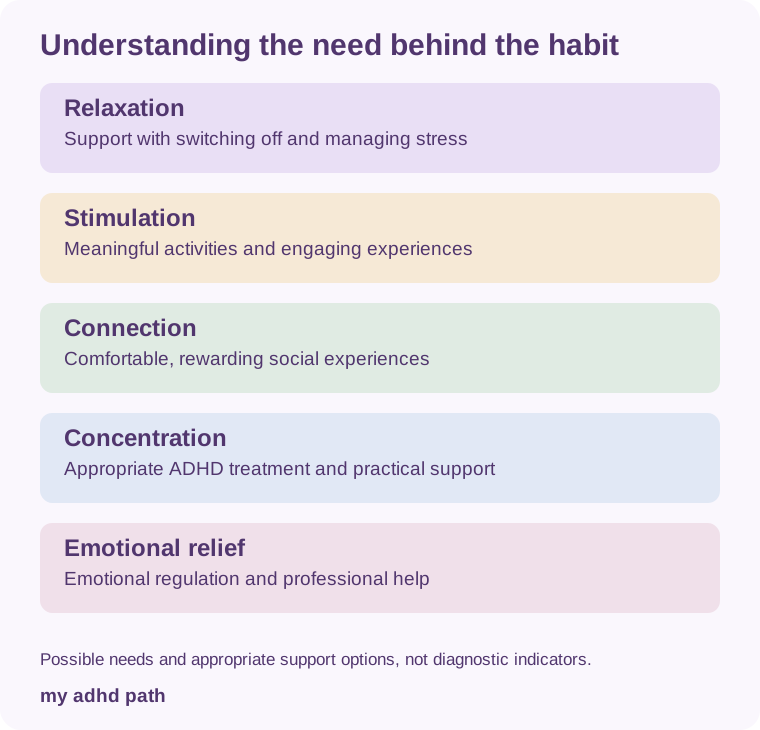
Perhaps you've spent years developing routines that help you navigate demanding experiences.
Perhaps some of those routines are no longer providing the benefits they once appeared to offer.
Understanding your ADHD may help you identify what you've been trying to manage.
The need for rest.
The desire to feel more engaged.
The wish to switch off after a demanding day.
The opportunity to feel comfortable around other people.
These are understandable human needs.
There may be more sustainable ways of addressing them, particularly when you have access to appropriate treatment and support.
Your relationship with a substance does not define your abilities, achievements or personal value.
And asking for assistance does not mean relinquishing your independence.
It may be an important part of developing greater control over the way you want to live.
Frequently asked questions
Are people with ADHD more likely to develop addictions?
Research has identified an increased risk of substance use disorders among people with ADHD. However, this does not mean that any particular person will develop addiction. Individual circumstances and other contributing factors matter.
Why do some people with ADHD self-medicate?
Some individuals use substances in an attempt to manage restlessness, concentration difficulties, emotional discomfort or sleep problems. These perceived benefits do not establish that the substance is an effective ADHD treatment.
Does dopamine explain ADHD and addiction?
Dopamine is involved in reward processing, motivation and several other brain functions. However, neither ADHD nor addiction can be adequately explained by a simple dopamine deficiency or a single biological mechanism.
Does ADHD medication increase addiction risk?
Available research does not establish that appropriately prescribed stimulant treatment generally increases subsequent substance use disorder risk. Medication misuse is nevertheless possible, and treatment requires appropriate monitoring.
Can you take ADHD medication if you have an addiction?
It may be possible. Decisions depend on individual health circumstances, substance use patterns, potential interactions and clinical risk assessment. Coordinated specialist care is particularly important.
Is cannabis an effective ADHD treatment?
There is insufficient robust evidence to recommend cannabis as an established ADHD treatment. Cannabis can also affect memory, attention and mental health, and may lead to dependence.
Why might people with ADHD drink alcohol to relax?
Some individuals experience inner restlessness, emotional intensity or difficulty transitioning away from demanding activities. Alcohol may become associated with temporary relaxation, although it can introduce additional health and sleep difficulties.
Can caffeine replace ADHD medication?
No. Caffeine is not an established replacement for prescribed ADHD treatment and can contribute to sleep disruption, anxiety and other unwanted effects.
Can substance use look like ADHD?
Yes. Intoxication, withdrawal and longer-term effects of substance use can affect attention, memory, sleep and behaviour. Qualified assessment is needed to distinguish between possible explanations.
Can treating ADHD help someone recover from addiction?
Appropriate ADHD treatment may help manage symptoms that complicate everyday functioning or engagement with substance use treatment. Recovery usually requires individualised support, and ADHD treatment alone is not a cure for addiction.
Is gambling addiction connected to ADHD?
Research has identified associations between ADHD and some problematic behavioural patterns, including gambling. Gambling disorder is distinct from substance use disorders, although some risk factors may overlap. Our wider guide to ADHD and money will explore relevant financial behaviours and support.
Where should I start if I'm concerned about my substance use?
Speak to your GP, ADHD clinician or a specialist substance use service. If you may be dependent on alcohol or certain medications, seek medical advice before making substantial changes to your consumption.
Sources and further reading
- Young, S. et al. (2023). Identification and treatment of individuals with attention-deficit/hyperactivity disorder and substance use disorder: An expert consensus statement. World Journal of Psychiatry, 13(3), 84-112. doi.org/10.5498/wjp.v13.i3.84
- Rieke, K., Sereda, Y., Mai, H. J. et al. (2024). ADHD and Substance Use Disorders in Adults: A Systematic Review. US Department of Veterans Affairs. ncbi.nlm.nih.gov/books/NBK616466
- Faraone, S. V. et al. (2021). The World Federation of ADHD International Consensus Statement: 208 Evidence-based conclusions about the disorder. doi.org/10.1016/j.neubiorev.2021.01.022
- NICE - Attention deficit hyperactivity disorder: diagnosis and management (NG87). nice.org.uk/guidance/ng87
- NICE - Alcohol-use disorders: diagnosis, assessment and management of harmful drinking and alcohol dependence (CG115). nice.org.uk/guidance/cg115
- NHS - Alcohol support. nhs.uk/live-well/alcohol-advice/alcohol-support
- NHS - Drug addiction: getting help. nhs.uk/live-well/addiction-support/drug-addiction-getting-help
- FRANK. talktofrank.com
- NHS - Quit smoking. nhs.uk/better-health/quit-smoking
This article provides general educational information and is not a substitute for medical advice, diagnosis, addiction treatment or psychological support. Do not use this information to independently change prescribed medication or undertake withdrawal or detoxification. Seek appropriate professional guidance if you are concerned about substance use or dependence.