

Did you know that you could qualify for government-funded workplace support if you have ADHD? Whether you're employed, self-employed, running a business or waiting for a diagnosis, Access to Work could help.
At a glance
- Access to Work is a government-funded employment support scheme for people with disabilities and health conditions.
- ADHD is explicitly recognised within the scheme's published eligibility guidance.
- You do not need a formal ADHD diagnosis to apply.
- Employed, self-employed, home-based and hybrid workers may all be eligible.
- Support can include specialist software, coaching, equipment and practical assistance.
- Salary, savings and professional success do not determine eligibility for employed applicants.
Living with ADHD can make certain aspects of working life more demanding, even when you're exceptionally good at what you do.
Managing competing deadlines, organising information, remembering instructions, prioritising tasks and switching between responsibilities can all require considerable mental effort.
For many adults with ADHD, these challenges aren't necessarily visible to the people around them.
What many people don't realise is that there is a government-funded scheme designed to help people overcome barriers at work.
It's called Access to Work.
And you don't necessarily need a formal ADHD diagnosis to apply.
What is Access to Work?
Access to Work is a government-funded employment support scheme administered by the Department for Work and Pensions (DWP).
Its purpose is to help people with disabilities and health conditions start work, remain in employment or work more effectively by providing practical support.
ADHD is explicitly recognised within the scheme's published eligibility guidance.
Rather than focusing solely on your diagnosis, Access to Work considers how your condition affects your working life and what additional support might help.
Depending on your individual circumstances, this may include specialist software, equipment, coaching or practical human support.
An approved grant does not normally need to be repaid, although you or your employer may need to pay for agreed support before reclaiming the cost.
Good to know
Access to Work is not a benefit or a loan. It is a government grant designed to cover the additional costs of working with a disability or health condition. For employed applicants, it is assessed on support needs rather than income.
Who can qualify for Access to Work with ADHD?
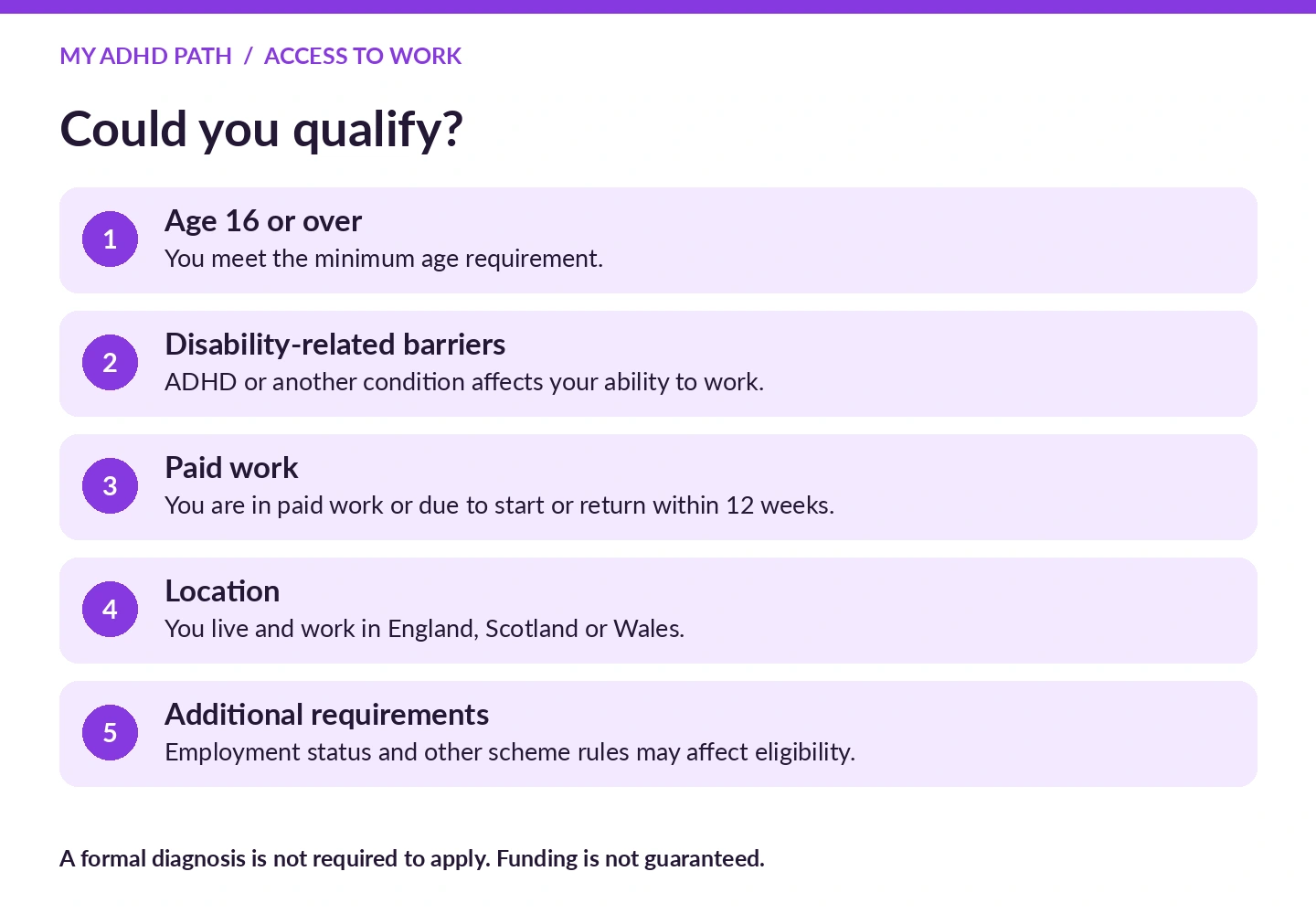
You may be eligible if:
- You are aged 16 or over.
- ADHD or another health condition creates barriers in your working life.
- You are in paid work or expect to start or return to work within 12 weeks.
- You live and work in England, Scotland or Wales.
- You meet any additional requirements that apply to your employment circumstances.
You don't need to be struggling with every aspect of your job.
You may be highly successful in your career while finding particular responsibilities significantly more demanding because of ADHD.
Good to know
Northern Ireland operates a separate Access to Work scheme. If you work in Northern Ireland, contact the local equivalent for information about eligibility and support.
Do you need an ADHD diagnosis to apply?
No.
One of the biggest misconceptions about Access to Work is that you must have a formal diagnosis before you can apply.
The government's eligibility guidance specifically states that a diagnosed condition is not required to submit an application.
Common misconception
"You need a formal ADHD diagnosis before you can apply for Access to Work." In fact, the government's own eligibility guidance states that a diagnosed condition is not required. You can apply while awaiting assessment or exploring whether you have ADHD.
This is particularly important for adults who are:
- Waiting for an NHS ADHD assessment.
- Exploring whether they have ADHD.
- Awaiting a private assessment.
- Experiencing difficulties associated with executive functioning.
You should describe your circumstances accurately, including whether you have a confirmed diagnosis or are awaiting assessment.
The DWP may request additional information to understand your needs. Applying without a diagnosis does not guarantee that funding will be awarded.
However, being on a waiting list does not automatically prevent you from applying.
Can you qualify if you're employed?
Yes. Access to Work can support people across a wide range of professions and employment arrangements.
You could be working in education, healthcare, retail, technology, administration, creative industries or a senior leadership position.
Your job title does not determine whether you need support.
Someone managing a large team may experience difficulties with working memory. A talented designer may struggle with project administration. A teacher may find competing organisational responsibilities particularly demanding.
Access to Work considers the individual barriers you experience, rather than making assumptions based on your profession.
Can you qualify if you're self-employed?
Yes. Being self-employed does not automatically exclude you from Access to Work.
In fact, self-employed people with ADHD may face additional challenges because they are responsible for so many different aspects of their working lives.
Running a business can involve:
- Managing clients and customer communications.
- Keeping track of invoices and financial records.
- Planning projects.
- Managing appointments.
- Marketing and business development.
- Prioritising competing responsibilities.
- Completing administrative tasks.
Good to know
For established self-employed businesses, the published eligibility guidance includes a minimum annual turnover requirement of £6,500. DWP may request business accounts or, for a new business, a suitable business plan to assess its viability.
Company directors can also apply, although their employment status and company registration may affect how their application is assessed.
Access to Work is not a general business start-up grant. Its purpose is to address disability-related barriers to working.
Can you apply if you work from home?

Absolutely.
Working remotely does not mean that you no longer experience ADHD-related workplace barriers.
Many people find home working beneficial because they have more control over their environment. Others experience additional difficulties with structure, distractions, time management and task initiation.
Access to Work can consider support for home-based and hybrid working arrangements.
Your working environment is part of your individual circumstances.
Do you have to be claiming disability benefits?
No.
You do not need to receive Personal Independence Payment (PIP) or another disability benefit before applying.
Access to Work is an employment support scheme, rather than a conventional means-tested benefit.
For employees, salary and personal savings do not determine eligibility.
Some benefit-related restrictions apply, so anyone receiving Employment and Support Allowance or other relevant benefits should check their individual circumstances with the Access to Work team.
What ADHD-related challenges could Access to Work help with?
ADHD affects people differently. Two people doing exactly the same job may need entirely different types of support.

Working memory
Remembering instructions, retaining information and keeping track of responsibilities.

Time management
Estimating task duration, managing deadlines and planning workloads.

Organisation and prioritisation
Structuring information and deciding which tasks need attention first.

Attention and concentration
Managing interruptions, distractions and demanding working environments.

Task initiation
Getting started on complex, repetitive or administrative responsibilities.

Task switching
Moving between projects and recovering focus after interruptions.
Try this
Before applying, spend a few minutes noting which of these six areas affect your working life most. Understanding your specific challenges can help you explain your support needs clearly when you apply.
What support might be available?
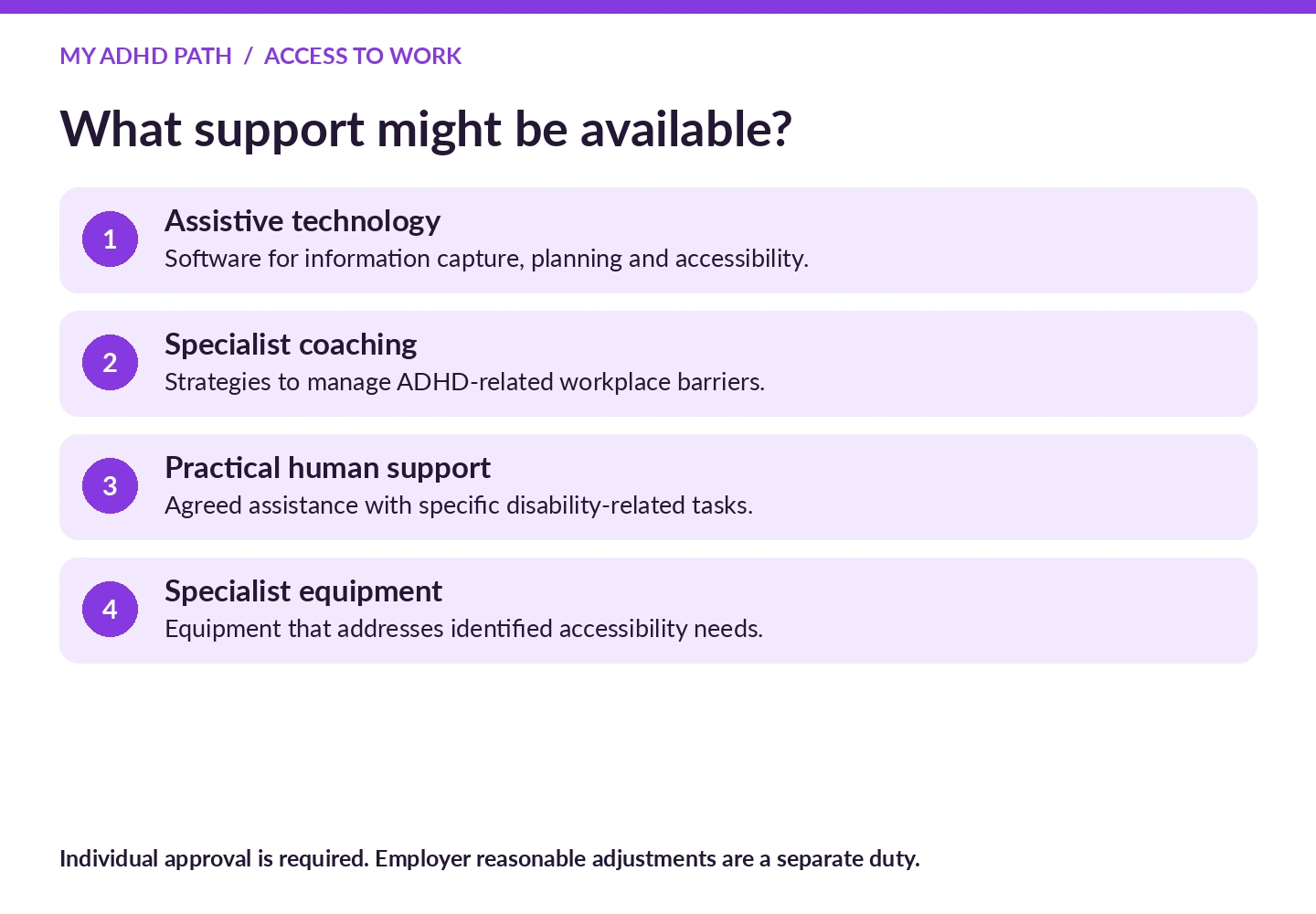
Possible types of support to explore include ADHD workplace coaching, assistive technology, specialist software, practical support workers and equipment that addresses specific accessibility needs.
For example, someone who experiences working memory difficulties might benefit from assistive software that helps them capture, organise and retrieve information.
Another person might benefit from coaching to develop sustainable working routines.
Someone running their own business might need practical disability-related support to manage specific administrative barriers.
These are examples, not an automatically approved list of products or services. Funding decisions are made individually.
Does Access to Work replace reasonable adjustments?
No. Employers have separate legal responsibilities under the Equality Act 2010 where the duty to make reasonable adjustments applies.
Examples of reasonable adjustments might include written instructions, changes to working arrangements or access to a quieter working environment.
Access to Work can help address additional support needs beyond those responsibilities.
The two can work alongside each other.
Good to know
Reasonable adjustments are your employer's legal responsibility under the Equality Act 2010. Access to Work covers additional support beyond what a reasonable adjustment would provide. The two are designed to complement each other.
Can you be successful and still need Access to Work?
This is something that deserves far more attention.
Being capable, ambitious, intelligent or professionally successful does not mean that ADHD has no impact on your working life.
You may have spent years developing strategies that allow you to perform well.
You may work longer hours, build elaborate organisational systems or use considerably more mental energy to manage everyday responsibilities.
Your achievements and your need for support can coexist. Access to Work is about making employment more accessible and sustainable, not questioning your professional ability.
How do you apply for Access to Work?
You can apply directly through the official government website.
Before applying, it may help to identify:
- The responsibilities involved in your job.
- The ways ADHD affects those responsibilities.
- The strategies you currently use.
- The barriers you continue to experience.
- The additional support that could make a meaningful difference.
You don't need to have worked out every possible solution before submitting your application.
An assessment may help identify appropriate support during the application process.
If making or receiving telephone calls presents difficulties, you can also request email communication.
Before you apply
- Note which job responsibilities are most affected by ADHD.
- List the strategies you currently use and where gaps remain.
- Consider whether you have any supporting evidence (GP letter, assessment referral, occupational health report).
- Check whether your employer has already made reasonable adjustments.
- Gather basic employment details (employer name, job title, working hours).
Official Access to Work application
Apply on GOV.UK
Applying directly through GOV.UK is free. You do not need to pay anyone to submit an application on your behalf.
Apply for Access to WorkAccess to Work helpline
0800 121 7479
Monday to Friday, 9am to 5pm
If telephone calls are difficult, you can request email communication instead.
Making working life more sustainable
ADHD support should be about creating an environment in which you can use your abilities effectively.
For some people, that means introducing better technology. For others, it means specialist coaching, practical assistance or a different approach to managing their workload.
Often, it is a combination of several things.
Access to Work provides an opportunity to explore what meaningful support could look like for you.
And knowing that this support exists is an important first step.
Adults with ADHD may qualify for Access to Work if their condition creates barriers to paid work and they meet the scheme's eligibility criteria. A formal ADHD diagnosis is not required to apply.
Frequently asked questions
Is ADHD recognised by Access to Work?
Yes. ADHD is specifically included in the government's eligibility guidance.
Can I apply for Access to Work without an ADHD diagnosis?
Yes. A formal diagnosis is not required to apply, although additional information may be requested.
Can I get Access to Work if I earn a high salary?
Yes. For employed applicants, salary and personal savings do not determine eligibility.
Can I get Access to Work if I run my own business?
Potentially, yes. Self-employed people and company directors can apply, subject to the relevant eligibility requirements.
Can I apply if I work part-time?
Yes. Part-time paid employment can qualify.
Can I get Access to Work if I already receive PIP?
Yes. Receiving PIP does not automatically prevent you from receiving Access to Work.
Can Access to Work pay for ADHD medication or diagnosis?
Access to Work is designed to address employment-related barriers rather than fund medical treatment or diagnostic assessments.
Is Access to Work funding guaranteed if I have ADHD?
No. Applications are assessed on individual circumstances and support needs.
Do I need to pay someone to apply for me?
No. You can apply directly through GOV.UK without paying an application fee.
Official sources
- GOV.UK. Access to Work: get support if you have a disability or health condition. https://www.gov.uk/access-to-work
- GOV.UK. Access to Work: eligibility. https://www.gov.uk/access-to-work/eligibility
- GOV.UK. Access to Work: how to apply. https://www.gov.uk/access-to-work/apply
- Department for Work and Pensions. Access to Work: factsheet for customers. https://www.gov.uk/government/publications/access-to-work-factsheet/access-to-work-factsheet-for-customers
- Department for Work and Pensions. Access to Work: staff guide. https://www.gov.uk/government/publications/access-to-work-staff-guide/access-to-work-staff-guide
My ADHD Path is an independent information and educational resource and is not affiliated with the Department for Work and Pensions. This article provides general information and does not constitute legal, financial or medical advice. Access to Work eligibility, funding and individual awards are determined by the relevant authority. Always refer to current official guidance.