

Applying for Access to Work doesn't need to be overwhelming. From preparing your information to explaining your ADHD-related workplace challenges, this guide breaks the process down into manageable steps.
There is a certain irony in asking someone who experiences difficulties with executive functioning to complete an application explaining their difficulties with executive functioning.
Gathering information, completing forms, remembering details, making telephone calls and following up on an application can involve many of the very skills for which you are seeking support.
But applying for Access to Work doesn't have to become another unfinished task sitting on your to-do list.
You don't need to understand the entire process before you begin. You don't need to have researched every possible piece of technology. And you certainly don't need to have all the answers.
This guide will help you work through the application process, one manageable step at a time.
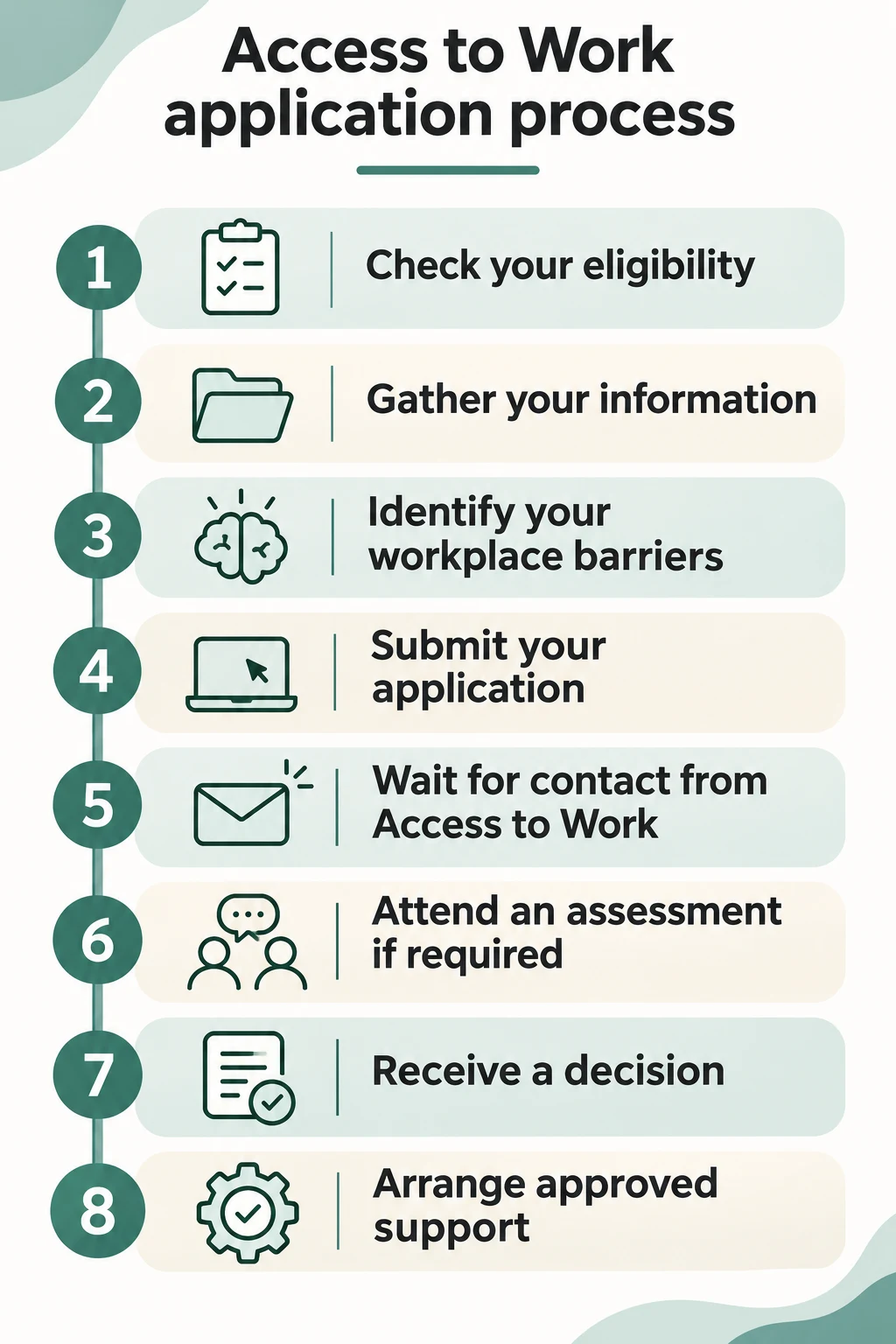
Access to Work: the application process at a glance
The application process
- Step 1: Check your eligibility - understand whether the scheme could support you.
- Step 2: Gather your information - collect your personal and employment details.
- Step 3: Identify your workplace barriers - consider how ADHD affects your working life.
- Step 4: Submit your application - apply directly through the government website.
- Step 5: Wait for contact from Access to Work - provide further information if requested.
- Step 6: Attend an assessment if required - explore your individual support needs.
- Step 7: Receive a decision - review your award and any funding conditions.
- Step 8: Arrange approved support - follow your award instructions and claims process.
Not everyone will experience exactly the same process. Your circumstances and support requirements will determine which steps are necessary.
Step 1: Check whether you're eligible
Access to Work supports eligible people whose disability or health condition affects their ability to work.
ADHD is recognised within the scheme, and you may be able to apply whether you are employed, self-employed or running your own limited company.
You do not need a formal ADHD diagnosis to submit an application.
You also do not need to demonstrate that you are incapable of doing your job.
Access to Work is about identifying barriers and determining what practical support could help you overcome them.
Good to know
If you're unsure whether you qualify, start with our guide: Access to Work for ADHD: Who Qualifies?
Step 2: Gather the information you need
One of the easiest ways to make the application more manageable is to gather your information before opening the form.
Rather than switching between emails, employment records, business documents and browser tabs, create a single document where you can keep everything together.
Depending on your employment circumstances, useful information may include:
- Your personal and contact details.
- Your National Insurance number.
- Your employer or business details.
- Your workplace address and working arrangements.
- Your job title and responsibilities.
- An employer contact, where applicable.
- Information about your ADHD diagnosis or assessment status.
- Examples of workplace difficulties.
- Details of existing support or adjustments.
- Business registration and financial information, if relevant.
You might not need every item on this list for your initial application. Having the information available can make subsequent conversations easier.
Try this
Create a folder on your computer called Access to Work. Keep your application notes, correspondence, supporting documents, funding decisions and receipts together from the beginning. Your future self will thank you.
Step 3: Understand how ADHD affects your work
This is one of the most important parts of your application.
It is not simply about telling someone that you have ADHD. It is about helping them understand how ADHD affects your ability to carry out particular responsibilities.
Many adults with ADHD have developed sophisticated coping strategies over the years. They may not immediately recognise how much additional effort goes into their working day because they have always worked this way.
Consider the following examples.
| Workplace responsibility | Potential ADHD-related barrier |
|---|---|
| Managing emails | Difficulty retaining information or identifying priorities |
| Attending meetings | Difficulty processing verbal information while taking notes |
| Project management | Difficulty sequencing tasks and tracking multiple deadlines |
| Administration | Difficulty initiating repetitive or complex tasks |
| Client communication | Difficulty remembering follow-up actions |
| Managing time | Underestimating how long tasks take |
| Decision-making | Becoming overwhelmed by competing priorities |
| Returning to a task | Difficulty rebuilding focus after interruptions |
You do not need to experience all these challenges.
The most useful examples are those that reflect your own working life.
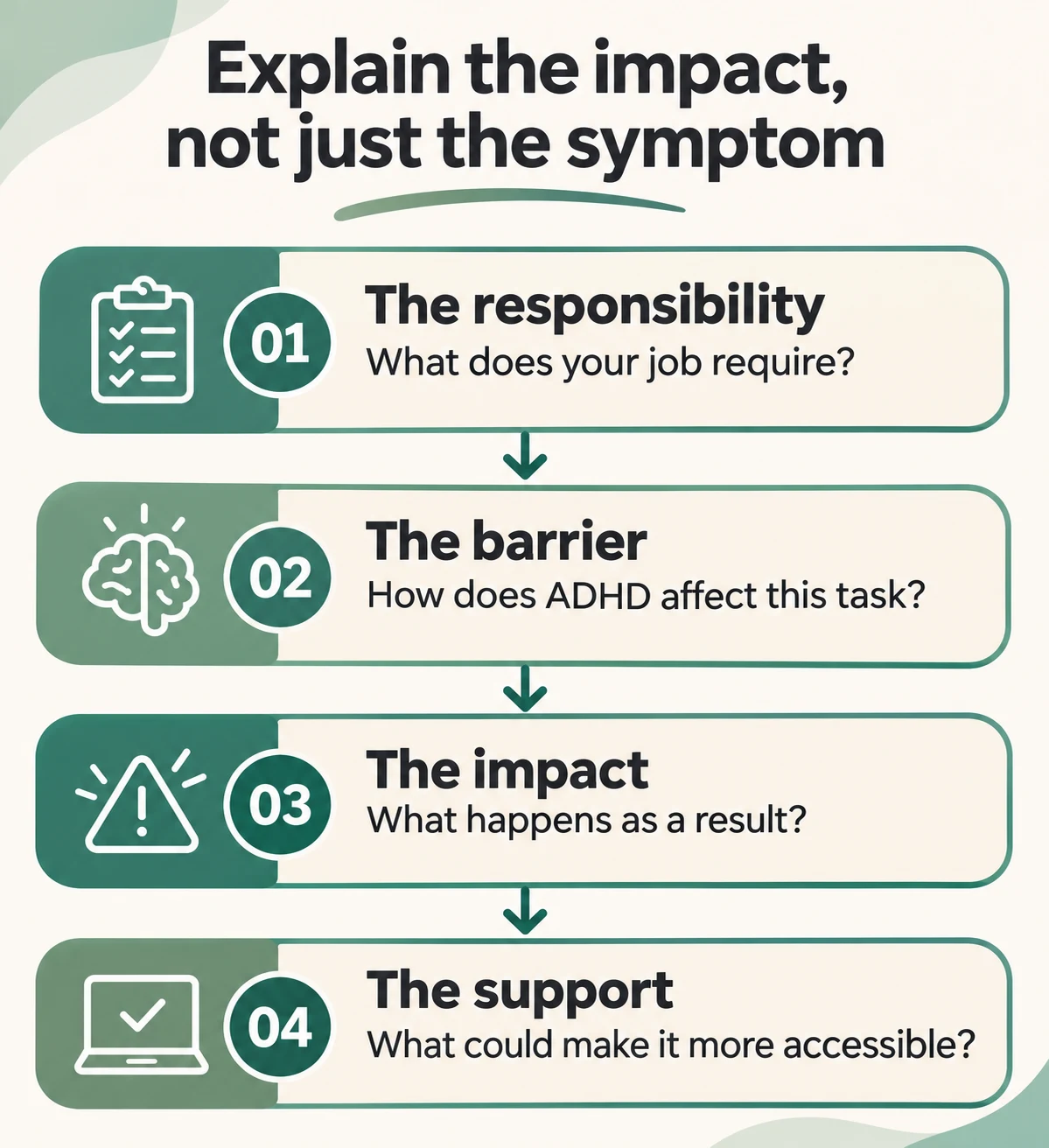
Step 4: Explain the impact, not just the symptom
There is a significant difference between describing an ADHD characteristic and explaining its practical impact at work.
For example, simply saying that you struggle with working memory doesn't explain which aspects of your job are affected.
Try using this four-part approach.
Example application text
Working memory
My role involves managing multiple client projects, attending meetings and completing follow-up actions. My ADHD affects my ability to retain and retrieve information, particularly when switching between responsibilities. This means I spend additional time revisiting emails, meeting notes and previous work to reconstruct information. Assistive technology that helps me capture, organise and retrieve information could reduce this barrier.
Example application text
Executive functioning
My role requires me to manage competing deadlines independently. I experience difficulties with prioritisation, task sequencing and breaking complex projects into manageable actions. Despite using calendars and task lists, I can spend a considerable amount of time determining what to work on next. Structured executive functioning support could help me manage these responsibilities more effectively.
Example application text
Task initiation
I am responsible for completing regular administrative and financial tasks alongside my main professional responsibilities. ADHD-related difficulties with task initiation make it harder to begin and maintain progress with these activities. This can result in administrative work taking considerably longer than expected. Practical support and specialist coaching could help me develop more sustainable ways of managing these responsibilities.
Good to know
These examples are intended to help you articulate your own experiences, not to provide scripts that everyone should copy. Your application should accurately reflect your circumstances.
Step 5: Identify the support that might help you
You do not need to know exactly what support you want before applying.
However, understanding some of the available options can help you have more productive conversations during the assessment process.

Assistive technology
Software that helps with information processing, organisation, accessibility and workplace communication.

Specialist ADHD coaching
Individual support to develop strategies for managing ADHD-related workplace challenges.

Practical human support
A support worker or other agreed assistance to address specific disability-related barriers.

AI and digital accessibility tools
Technology that may help with working memory, task breakdown, prioritisation and information management, subject to individual approval.

Specialist equipment
Equipment that addresses identified disability-related needs in your working environment.
Access to Work does not automatically fund every product or service that might make working easier.
The important distinction is whether the support addresses an identified disability-related workplace barrier.
Step 6: Submit your application
You can apply directly through GOV.UK.
You do not need to pay a third-party organisation to submit an Access to Work application on your behalf.
If completing an online form is difficult, alternative application arrangements may be available.
When completing your application, describe your needs clearly and accurately. Avoid minimising the challenges you experience simply because you have found ways to manage them.
Equally, there is no need to exaggerate your experiences.
The aim is to provide an accurate picture of your working life and the support that could make a difference.
Official Access to Work application
Apply on GOV.UK
Applying directly through GOV.UK is free. You do not need to pay anyone to submit an application on your behalf.
Apply for Access to WorkPrefer to apply by telephone?
0800 121 7479
Monday to Friday, 9am to 5pm
Applications are free. If you are self-employed, you will also need your Unique Taxpayer Reference (UTR). Civil servants should arrange support through their employer instead.
Save a copy of your application
Before submitting your application, save your written answers in a separate document.
Good to know
After submitting, keep a record of your application date, your application reference (if provided), any confirmation correspondence, and the support you have requested. This will save you having to reconstruct information when someone contacts you about your application.
Step 7: Waiting for Access to Work to contact you
Once you have submitted your application, there may be a considerable waiting period.
Unfortunately, waiting for support can be particularly challenging when you are already experiencing difficulties managing your workload.
DWP research published in 2026 identified significant differences in applicants' experiences, with some reporting waits of weeks and others waiting up to a year before progressing to an assessment or receiving contact. These experiences are not a guaranteed or current processing timetable.
While you are waiting, try to keep your application organised without allowing it to become another daily responsibility.
Set a reminder to follow up, maintain a record of correspondence and continue noting relevant workplace challenges.
How do you chase an Access to Work application?
Contact the Access to Work helpline and ask whether there has been any progress.
You may wish to explain if the delay is affecting your ability to continue working or if your employment circumstances have changed.
If you are unhappy with how your application is being handled, you can also raise a complaint.
Example follow-up message
"Hello,
I submitted my Access to Work application on [date] and would appreciate an update on its progress.
My application reference is [reference, if available].
I continue to experience ADHD-related barriers in my working life and would be grateful if you could confirm whether any further information is required from me and advise on the next steps.
Where possible, I would prefer communication by email, as this helps me process information and maintain an accurate record of correspondence.
Kind regards,
[Name]"
Good to know
Our dedicated guide to Access to Work waiting times explores this part of the process in more detail.
Step 8: Preparing for your first conversation
When someone from Access to Work contacts you, they may want to understand more about your work, your condition and the support you require.
You might find it helpful to have written notes available during this conversation.
Think about a typical working day.
Which tasks require additional effort? Where do you lose time? What strategies are you already using? Which responsibilities could become more manageable with appropriate support?
It is easy to forget examples when someone asks you to describe them unexpectedly.
Having notes in front of you can help you communicate your experiences more accurately.
Can you request communication by email?
Yes. If telephone communication presents difficulties, you can ask Access to Work to communicate with you by email instead.
For someone with ADHD, written communication may be helpful because it allows more time to process information, formulate responses and revisit instructions.
You could explain that you experience working memory or information-processing difficulties and that written communication would help you manage the application process.
You can also ask for additional time to provide supporting information if you need it.
Step 9: The workplace assessment
Some applicants may be referred for a workplace assessment.
This is an opportunity to explore your working environment, responsibilities and potential support requirements.
Not everyone needs a separate assessment.
An assessment is not an ADHD diagnostic appointment. Its focus is on your employment-related support needs.
You may find it helpful to prepare examples of situations that occur regularly, rather than trying to remember every difficulty you have ever experienced.
You can also discuss existing strategies and explain why they may not fully address your needs.
Good to know
We will explore assessment preparation in a separate guide within our Access to Work Resource Centre.
Step 10: Receiving your decision
Once your application has been considered, you will receive a decision explaining the outcome.
If funding is awarded, review the details carefully before arranging your support.
Pay particular attention to the approved services, funding amounts, payment instructions and any restrictions.
Do not assume that something you discussed during your assessment has automatically been approved.
If you disagree with the outcome, you can ask Access to Work to reconsider its decision.
There is also a separate complaints process for concerns about the service you have received.
Common mistakes when applying for Access to Work
Minimising your difficulties
Many adults with ADHD are accustomed to finding ways around challenges.
You might successfully manage deadlines because you work additional hours, rely on multiple reminders or repeatedly check information.
Explain the additional effort involved, not simply whether you eventually complete the task.
Focusing only on the support you want
Rather than beginning with a particular product or service, explain the barrier that it could address.
The relationship between your ADHD, your job and your support needs is important.
Waiting until everything is perfectly organised
You do not need to develop a comprehensive report about your ADHD before applying.
Start with the information you have and develop your notes as you go.
Purchasing support before approval
Do not assume that software, coaching sessions or equipment you purchase while waiting will be reimbursed.
Check with Access to Work before committing to costs you expect the scheme to cover.
Comparing your application to someone else's
Two people with ADHD may receive entirely different funding awards.
Different roles, environments and individual needs can lead to different recommendations.
Someone else's award is not a guarantee of what you will receive.
You don't have to do everything today
The application process may feel like a substantial undertaking, particularly when you are already managing a demanding working life.
Break it into smaller tasks.
Today, you might simply gather your employment details. Tomorrow, you could write down three examples of workplace barriers. Then you could complete your application.
You don't have to tackle the entire process in one sitting.
The purpose of applying for Access to Work is to make your working life more accessible, more manageable and ultimately more sustainable. Taking that first step is worthwhile.
My Access to Work application checklist
- Check your eligibility
- Gather personal and contact information
- Gather employment or business details
- Locate your National Insurance number
- Locate your UTR if self-employed
- List your main job responsibilities
- Identify ADHD-related workplace barriers
- Write practical examples of their impact
- List existing strategies and adjustments
- Consider potential support
- Complete the official application
- Save a copy of your answers
- Record your application date
- Save any confirmation or reference
- Set a follow-up reminder
- Organise your correspondence
- Prepare notes for your assessment
- Request accessible communication if needed
- Wait for funding approval before committing to costs
Frequently asked questions
Can I apply for Access to Work myself?
Yes. You can apply directly through the official government website or by telephone.
Does it cost anything to apply?
No. Applying directly is free.
Can I apply while waiting for an ADHD diagnosis?
Yes. You do not need a formal diagnosis to submit an application.
Do I need to know exactly what support I want?
No. Your support requirements can be explored during the application and assessment process.
Will my employer be contacted?
Access to Work may request your permission to contact your employer to obtain relevant information.
Do all applicants need a workplace assessment?
No. Some applications can be assessed without a separate workplace assessment.
How long does an Access to Work application take?
Waiting times vary considerably. Contact Access to Work for information about your individual application.
Can I ask for email communication instead of telephone calls?
Yes. You can request an alternative communication method if telephone calls present difficulties.
Can someone help me prepare my application?
Yes. You may find it helpful to organise your information with a trusted person or specialist. Your application should accurately reflect your own circumstances and support needs.
Can I apply again if my application is unsuccessful?
This will depend on your circumstances. You can request reconsideration of a decision, and you should seek guidance from Access to Work about submitting another application.
Official sources
- GOV.UK. Access to Work: get support if you have a disability or health condition. https://www.gov.uk/access-to-work
- GOV.UK. Access to Work: eligibility. https://www.gov.uk/access-to-work/eligibility
- GOV.UK. Access to Work: how to apply. https://www.gov.uk/access-to-work/apply
- GOV.UK. Access to Work: after you apply. https://www.gov.uk/access-to-work/after-you-apply
- Department for Work and Pensions. Access to Work: factsheet for customers. https://www.gov.uk/government/publications/access-to-work-factsheet/access-to-work-factsheet-for-customers
- Department for Work and Pensions. Access to Work: staff guide. https://www.gov.uk/government/publications/access-to-work-staff-guide/access-to-work-staff-guide
- Department for Work and Pensions. Journeys to Access to Work. https://www.gov.uk/government/publications/journeys-to-access-to-work/journeys-to-access-to-work
My ADHD Path is an independent educational and information resource. We are not affiliated with the Department for Work and Pensions. This guide does not constitute legal, financial or medical advice. Eligibility and funding decisions are determined by the relevant authority. This guide covers England, Scotland and Wales. Northern Ireland operates a separate scheme.