


From specialist ADHD coaching and assistive technology to practical human support, Access to Work can help address a wide range of workplace barriers. Discover what funding could mean for your working life.
At a glance
- Access to Work funding is based on individual circumstances, not a standard ADHD package.
- Support categories include coaching, assistive technology, AI software, support workers, equipment and travel.
- The annual funding cap for 2026/27 is £69,260.
- AI subscriptions such as ChatGPT and Claude may be considered but are not automatically approved.
- Employer contributions may apply depending on company size and other factors.
- Start by identifying your workplace barriers, then explore potential solutions.
Imagine having support that genuinely fits the way your brain works.
Technology that helps you retrieve information without searching through dozens of documents. Someone who helps you structure your workload. Specialist coaching that helps you understand your working patterns. Equipment that makes it easier to concentrate.
For many adults with ADHD, these are not simply workplace luxuries. They can make a meaningful difference to how manageable and sustainable working life feels.
Access to Work can provide funding towards practical support that addresses disability-related barriers to employment.
But what exactly could it fund? And how do you work out what might help you?
What types of support can Access to Work provide?
Access to Work funding is based on individual circumstances. There is no universal ADHD funding package, and having ADHD does not automatically entitle you to particular products or services.
However, there are several categories of support worth exploring.
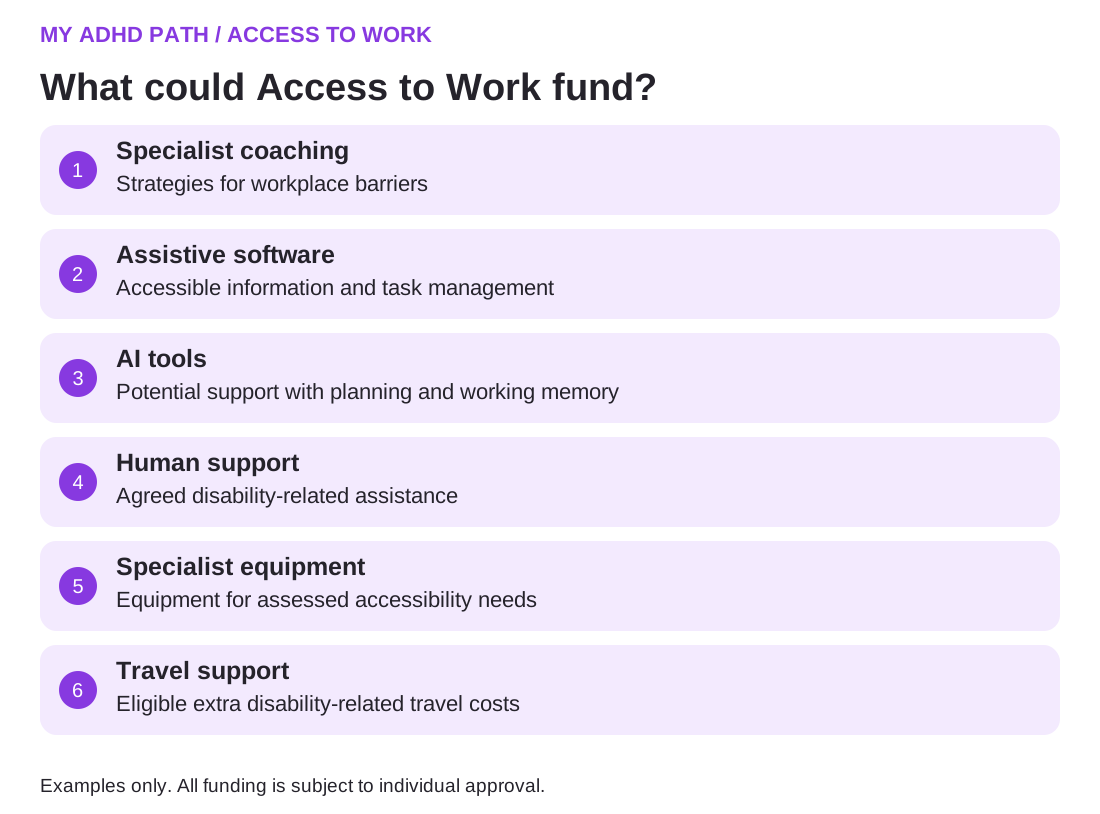

Specialist ADHD coaching
Developing strategies that work for your individual needs.

Assistive technology
Digital tools that make information and tasks more accessible.

AI-powered software
Support with working memory, planning and information processing.

Support workers
Practical human assistance with specific workplace barriers.

Specialist equipment
Equipment that addresses disability-related accessibility needs.

Travel support
Additional disability-related travel costs in eligible circumstances.
The most appropriate support will depend on your job, working environment, existing adjustments and the specific challenges you experience.
1. Specialist ADHD workplace coaching

ADHD coaching can help you develop practical strategies for managing the demands of working life.
Unlike generic business or productivity coaching, specialist ADHD workplace coaching focuses on the relationship between ADHD and your professional responsibilities.
This might include support with:
- Executive functioning.
- Time management and time awareness.
- Task initiation.
- Organisation and prioritisation.
- Managing competing responsibilities.
- Developing sustainable working routines.
- Understanding your energy and attention patterns.
- Managing workplace overwhelm.
A coach may help you identify why existing strategies aren't working and explore alternatives that are better suited to your individual needs.
For example, you may have tried numerous planners, calendars and task management applications but still find it difficult to decide what to work on first.
Rather than simply introducing another organisational tool, a specialist coach might help you develop a practical approach to prioritisation.
Access to Work may fund an agreed programme of workplace coaching where it addresses identified disability-related barriers.
Good to know
Our dedicated guide to ADHD workplace coaching explores how coaching works and what to look for in a provider.
2. Assistive technology and specialist software
Technology can play an important role in making working life more accessible for adults with ADHD.
The right software can reduce the amount of information you need to hold in your working memory, make complex tasks easier to navigate and help you manage competing responsibilities.
However, the most useful technology is not necessarily the most sophisticated or expensive.
It is the technology that addresses your particular workplace needs.
| Workplace challenge | Potential technology solution |
|---|---|
| Remembering information from meetings | Meeting transcription and note-taking software |
| Processing lengthy documents | Text-to-speech or summarisation tools |
| Organising complex information | Mind-mapping and visual planning software |
| Writing reports and emails | Speech-to-text and writing assistance |
| Managing distractions | Distraction management software |
| Keeping track of multiple projects | Specialist planning and organisation tools |
| Remembering deadlines | Accessible scheduling and reminder systems |
| Retrieving previous information | Knowledge management and search tools |
These are examples of potential solutions, not a list of products automatically approved by Access to Work.
Good to know
Software that forms part of the ordinary cost of running a business may not qualify.
3. Can Access to Work fund AI tools such as ChatGPT or Claude?
Artificial intelligence is opening up new possibilities for adults with ADHD.
For some people, AI is far more than a productivity tool. It can provide a practical way to manage information, reduce cognitive demands and navigate responsibilities that rely heavily on executive functioning.
Consider the difference between these two approaches.
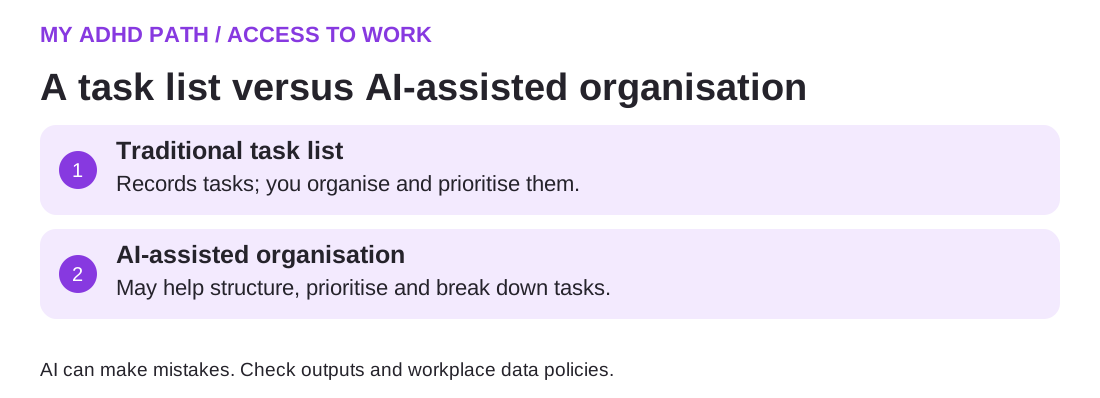
A traditional task list
- Records what needs to be done.
- Requires you to organise and prioritise tasks yourself.
- May become overwhelming as responsibilities accumulate.
AI-assisted organisation
- Can help structure thoughts and information.
- Can suggest priorities and break tasks into smaller steps.
- Can help retrieve context when switching between projects.
For someone who experiences working memory and executive functioning difficulties, this distinction can be significant.
AI tools may help with:
- Turning unstructured thoughts into actionable plans.
- Breaking complex projects into manageable steps.
- Reconstructing the context of previous work.
- Identifying priorities across multiple responsibilities.
- Processing lengthy emails and documents.
- Preparing for meetings.
- Structuring written communication.
- Getting started on demanding tasks.
AI subscriptions may be considered under an individual Access to Work application where there is a demonstrable disability-related need.
However, ChatGPT, Claude and other commercial AI subscriptions are not automatically approved products.
You should explain why the tool is needed, which barriers it addresses and why existing technology or adjustments do not adequately meet those needs.
Important
You should also consider information security, confidentiality and your employer's policies. AI tools can make mistakes, and their outputs should be checked where accuracy matters.
We will explore AI as assistive technology in considerably more detail in a dedicated article.
4. Support workers and practical human assistance
For some adults with ADHD, technology alone is not enough.
There are situations where practical human support can help address workplace barriers that organisational tools cannot fully resolve.
An agreed support worker could potentially help with particular responsibilities affected by ADHD.
Examples might include structuring information, supporting task organisation, helping to maintain agreed systems or providing disability-related assistance with specific administrative processes.
The exact responsibilities would need to be agreed as part of the funding award.
Can Access to Work pay for a virtual assistant?
Potentially, where an assistant is approved to provide specific disability-related support.
However, there is an important distinction between general business assistance and Access to Work support.
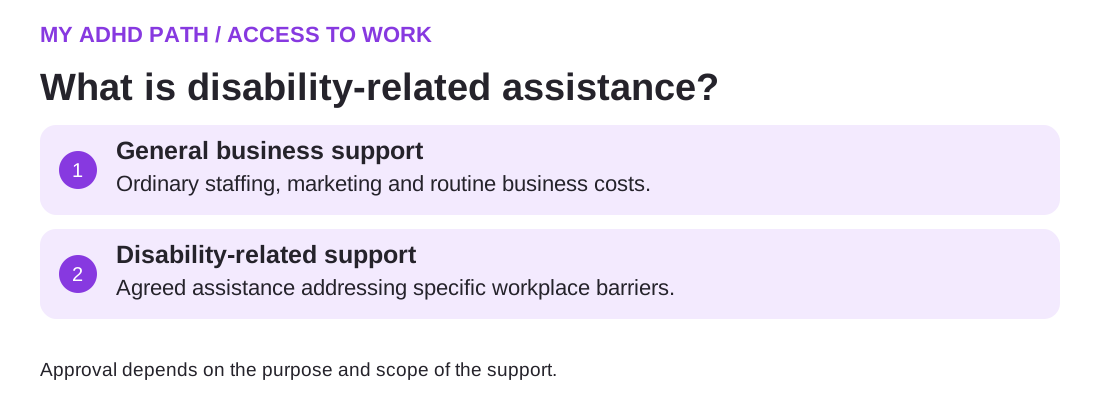
General business assistance
- Routine business administration.
- Marketing and sales activities.
- General business growth support.
- Ordinary staffing requirements.
Disability-related assistance
- Support with information organisation.
- Assistance addressing executive functioning barriers.
- Agreed support with accessible working systems.
- Specific approved workplace assistance.
What matters is the purpose and approved scope of the support, not simply the job title of the person providing it.
Important
Access to Work is not intended to subsidise ordinary business staffing costs or provide someone to take over your substantive job duties.
If you are considering human support, focus on the relationship between your ADHD-related barriers and the assistance you require.
5. Specialist equipment
Your working environment can have a considerable influence on how easily you can manage attention, concentration and information processing.
Depending on your individual needs, equipment might form part of an Access to Work award.
Potential examples include:
- Noise-cancelling headphones.
- Specialist recording equipment.
- Assistive input devices.
- Accessibility-related computer equipment.
- Specialist equipment to reduce distractions.
A recommendation should be connected to a specific workplace barrier.
For example, someone who finds it particularly difficult to filter background conversations in a shared office might benefit from noise-reducing equipment.
Someone who experiences difficulties processing verbal information might benefit from approved recording or transcription technology.
Good to know
Access to Work will not necessarily fund ordinary laptops, monitors, desks or standard office equipment simply because an applicant has ADHD.
6. Travel to work and travel during work
Access to Work can also contribute towards certain additional travel costs where a disability or health condition creates a barrier to travelling.
This could include support for someone who cannot use available public transport because of their condition.
Eligibility depends on the individual's circumstances and the nature of their travel difficulties.
Having ADHD does not automatically qualify someone for funded taxis or other travel arrangements.
Normal commuting costs are generally the individual's responsibility.
7. Mental health support
ADHD can coexist with anxiety, depression and other mental health difficulties.
For some people, the impact of managing ADHD in a demanding working environment can also contribute to periods of significant stress and overwhelm.
Access to Work offers a separate mental health support service for eligible individuals.
This may involve developing practical strategies, identifying workplace adjustments and creating a personalised plan to support someone in employment.
This service is distinct from specialist ADHD coaching and is not a replacement for medical treatment or psychological therapy.
8. Disability awareness training
Sometimes, making working life more accessible involves helping the people around you understand ADHD.
Access to Work may fund disability awareness training for colleagues in appropriate circumstances.
This could help managers and colleagues better understand executive functioning difficulties, communication preferences, working memory and the importance of appropriate workplace adjustments.
The aim is to create a more supportive working environment rather than expecting the individual with ADHD to manage every workplace barrier alone.
How much Access to Work funding can you receive?
Maximum annual grant limit
£69,260
2026/27 financial year
1 April 2026 - 31 March 2027
This is the annual funding cap, not a standard ADHD award or guaranteed personal allowance.
There is no fixed amount of funding specifically allocated to people with ADHD.
Your award will depend on your assessed support requirements, eligible costs and individual employment circumstances.
Someone who needs a small number of specialist software subscriptions may receive a substantially different award from someone who requires regular human support alongside coaching and assistive technology.
Does your employer have to contribute?
In certain circumstances, employers may be required to contribute towards approved equipment or workplace adaptations.
The arrangements depend on factors including the size of the organisation, how long you have been employed and the type of support requested.
Different arrangements may apply to self-employed applicants, support workers and other categories of support.
Ask Access to Work to clarify any contributions that apply to your individual award.
What will Access to Work not normally fund?
Understanding the boundaries of the scheme can help you prepare a more relevant application.
| Potentially eligible support | Not normally covered |
|---|---|
| Specialist assistive software | Ordinary business software |
| Disability-related support workers | General administrative staff |
| Specialist ADHD workplace coaching | General business mentoring |
| Accessibility-related equipment | Standard office equipment |
| Additional disability-related travel | Ordinary commuting expenses |
| Support beyond reasonable adjustments | Adjustments an employer is legally required to make |
Access to Work is also not intended to fund ADHD diagnosis, medication, general medical treatment or ordinary business start-up expenses.
The distinction is often about the purpose of the support rather than the product itself.
How to work out what support you need
It can be tempting to begin by researching what other people with ADHD have received through Access to Work.
While their experiences may introduce you to useful options, their funding awards may not reflect your individual circumstances.
Instead, start by looking at your working life.
Ask yourself:
- Which responsibilities require the most additional mental effort?
- Where do I regularly lose time?
- Which tasks rely heavily on working memory?
- What happens when I become overwhelmed?
- Which strategies have I already tried?
- What additional support could address these barriers?
You can then start identifying potential solutions.
Think about the barrier before the solution
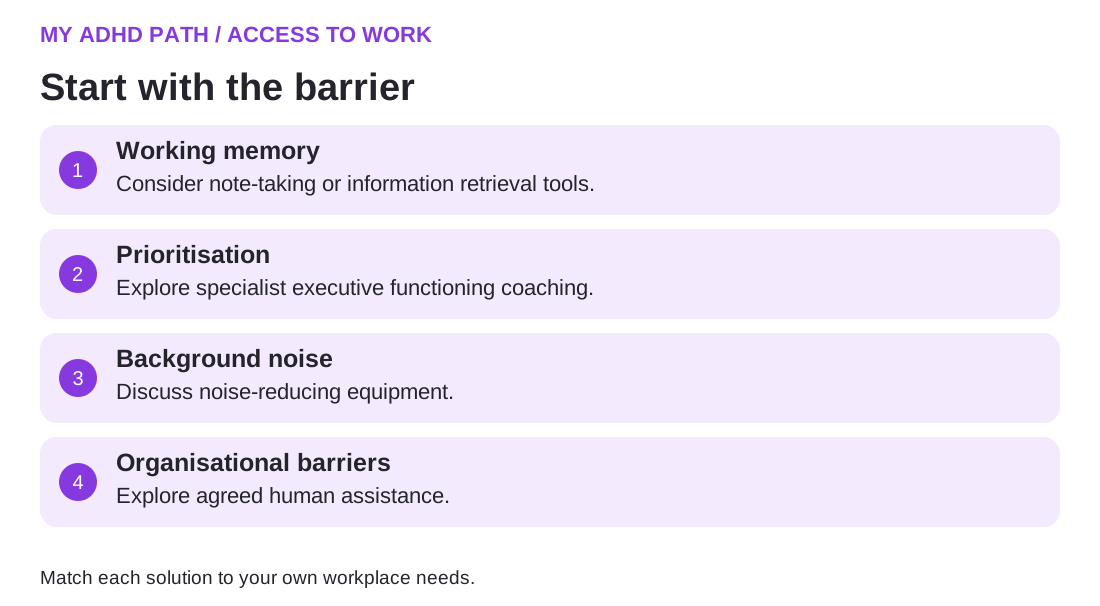
| The barrier | Potential support |
|---|---|
| Losing context when switching between projects | AI-assisted information management |
| Difficulty prioritising competing responsibilities | Executive functioning coaching |
| Difficulty filtering background noise | Noise-cancelling equipment |
| Struggling to retain verbal instructions | Transcription or note-taking support |
| Difficulty maintaining organisational systems | Agreed practical human support |
| Difficulty processing lengthy written documents | Text-to-speech or assistive reading software |
These examples are intended to help you consider what might work for you. They are not funding recommendations or guarantees of approval.
Three examples of how support might work
The following scenarios are fictional examples illustrating potential combinations of support.
The self-employed business owner
Emma
Emma runs a small creative business. She enjoys working with clients and developing new ideas but finds it difficult to manage competing projects, retain information and stay on top of administrative responsibilities.
She already uses calendars and project management software, but these systems still rely heavily on her ability to organise and prioritise information independently.
Potential support to discuss:
- AI-assisted organisation and information retrieval.
- Specialist executive functioning coaching.
- Practical human support to address specific organisational barriers.
The office-based employee
Daniel
Daniel works in a busy open-plan office. He finds background conversations distracting and experiences difficulties retaining verbal instructions during meetings.
He often spends additional time reconstructing information and checking his understanding of tasks.
Potential support to discuss:
- Noise-cancelling headphones.
- Approved meeting transcription software.
- ADHD workplace coaching.
- Written instructions as a possible reasonable adjustment.
The remote-working professional
Priya
Priya works predominantly from home. Although home working reduces distractions, she experiences difficulties creating structure, managing competing deadlines and switching between responsibilities.
Potential support to discuss:
- Specialist planning and information management software.
- Executive functioning coaching.
- Agreed practical support with organisational systems.
In each example, the potential support is connected to a specific workplace barrier.
None represents an actual funding award.
Can you choose your own Access to Work providers?
You may be able to suggest preferred providers or products during the application and assessment process.
However, Access to Work may request quotations, consider alternative suppliers or assess whether the proposed solution represents appropriate value.
Before committing to a provider, check that the service, costs and arrangements have been approved.
If you already work with a particular coach or use assistive technology that you find beneficial, explain why that support is appropriate for your needs.
Can you buy software or equipment before receiving approval?
You should not assume that purchases made before an award will be reimbursed.
If you need to arrange support urgently, speak to Access to Work before committing to expenditure you expect it to cover.
Once you receive your award, check the approved costs, suppliers, payment arrangements and claim requirements.
Keep copies of invoices, receipts and relevant correspondence.
Support should fit the way you work
There is no single piece of software, coaching programme or organisational system that works for everyone with ADHD.
For some people, the greatest benefit comes from technology. Others benefit from human support. Many find that a combination of approaches makes the most meaningful difference.
The goal is not to accumulate as many tools as possible.
It is to identify the support that allows you to use your abilities without having to devote so much additional energy to managing the barriers around them.
Your support should work for you, not become another thing you have to manage.
Free downloadable resource
My ADHD Workplace Support Planner
A free printable worksheet to help you identify workplace barriers and explore potential solutions before your Access to Work assessment. Includes sections for job responsibilities, ADHD-related barriers, existing strategies, potential technology solutions, potential human support and questions for your assessor.
Download the support planner (PDF)Frequently asked questions
Can Access to Work fund ADHD coaching?
Potentially, yes. Specialist workplace coaching may be funded when it addresses identified disability-related employment barriers.
Can Access to Work pay for ChatGPT or Claude?
AI subscriptions may be considered as potential assistive software. Neither product is automatically approved, and applicants should explain their specific accessibility needs.
Can Access to Work pay for a virtual assistant?
Potentially, where the service provides agreed disability-related assistance rather than ordinary business administration.
Can Access to Work pay for a laptop?
Specialist computer equipment may be funded where there is an identified accessibility requirement. Ordinary laptops are not automatically eligible.
Can Access to Work fund noise-cancelling headphones?
Potentially, where they address an assessed disability-related workplace barrier.
Can you receive coaching and assistive technology together?
Yes. An individual award can include multiple types of approved support.
What is the maximum Access to Work grant in 2026/27?
The annual funding cap is £69,260. Individual awards are based on assessed needs and are not automatically set at this amount.
Does Access to Work funding need to be repaid?
An accurately claimed grant used in accordance with its conditions does not normally need to be repaid.
Can Access to Work fund support for self-employed people?
Yes. Eligible self-employed applicants can receive funding towards approved disability-related workplace support.
Can I request additional support after receiving an award?
You can contact Access to Work to discuss changes in circumstances or support needs. Additional funding is subject to consideration and approval.
Official sources
Last reviewed: 19 November 2026
- GOV.UK. Access to Work: get support if you have a disability or health condition. https://www.gov.uk/access-to-work
- Department for Work and Pensions. Access to Work: factsheet for customers. https://www.gov.uk/government/publications/access-to-work-factsheet/access-to-work-factsheet-for-customers
- Department for Work and Pensions. Access to Work: staff guide. https://www.gov.uk/government/publications/access-to-work-staff-guide/access-to-work-staff-guide
- Department for Work and Pensions. Access to Work: employer guide. https://www.gov.uk/government/publications/access-to-work-guide-for-employers/access-to-work-guide-for-employers
- GOV.UK. Employing disabled people and people with health conditions. https://www.gov.uk/government/publications/employing-disabled-people-and-people-with-health-conditions
Editorial maintenance: Review the funding cap each April and update references when scheme guidance changes.
My ADHD Path is an independent educational and information resource and is not affiliated with the Department for Work and Pensions. Examples of products, providers and services are illustrative and do not imply approval or endorsement by Access to Work. All awards are subject to individual assessment and relevant scheme requirements. This information does not constitute legal, medical or financial advice.