

You are not indecisive. You are not lazy. You are attempting to make decisions using a brain that processes options, consequences and priorities in a way that makes choosing genuinely harder than it needs to be.
At a glance
- Decision paralysis is a common experience, not a formal diagnosis.
- ADHD-related difficulties with executive function, working memory and emotional regulation can make decisions harder.
- Small decisions can feel as overwhelming as large ones.
- Decision fatigue may worsen throughout the day.
- Limiting options, using defaults and time-boxing decisions can reduce the effort involved.
- A good-enough decision made now is usually better than a perfect decision made too late.
- Practical strategies can significantly reduce the mental cost of choosing.
What would you like for dinner?
It should be a simple question.
But the moment somebody asks it, your mind does something unhelpful. It opens every possible option simultaneously. Pasta. A takeaway. That recipe you saved three weeks ago. The leftovers that might still be acceptable. Something involving the chicken you bought on Monday, which really does need using today.
Each option generates its own set of sub-decisions. If pasta, which pasta? With what? Do you have everything you need? How long will it take? Will anyone else eat it?
Meanwhile, the person who asked the question is waiting.
And the longer you take, the more you feel that your answer needs to justify the time you've spent thinking about it.
The difficulty isn't that you don't have preferences. It's that your brain presents them all at once, with equal urgency, and no obvious way to choose between them.
If this sounds familiar, you are not alone. Decision paralysis is one of the most commonly reported everyday difficulties among adults with ADHD, and it affects far more than what to have for dinner.
What is decision paralysis?
Decision paralysis describes the experience of becoming stuck when faced with a choice. Rather than moving towards a decision, you remain in a state of deliberation, unable to commit to any single option.
It is not a clinical diagnosis. You will not find it in the diagnostic manuals alongside the formal criteria for ADHD.
But it is a recognisable pattern that many people with ADHD describe, and it has well-established connections to the executive functioning differences associated with the condition.
Good to know
Decision paralysis is sometimes called analysis paralysis, choice overload or decision avoidance. These terms describe overlapping experiences rather than distinct conditions.
The experience can range from mild hesitation to complete avoidance. At the milder end, you might take longer than expected to choose a restaurant or reply to a message. At the more significant end, you might avoid important decisions about your career, finances or health for months or even years.
The common thread is that the mental effort required to make the decision feels disproportionate to the decision itself.
Why decisions can be particularly difficult with ADHD
Making a decision involves several cognitive processes working together. You need to identify your options, hold them in mind whilst evaluating each one, anticipate the likely consequences, rank your priorities and then commit to a course of action.
Each of these steps draws on executive functions that ADHD can affect.
Working memory
Working memory allows you to hold and manipulate information in your mind temporarily. When you are comparing several options, you need to keep the details of each one available whilst assessing them against your criteria.
If your working memory capacity is limited, options can slip away before you have finished evaluating them. You might find yourself going back and forth between the same two choices because you cannot hold both sets of advantages and disadvantages in mind simultaneously.
Prioritisation
Deciding requires knowing what matters most. ADHD can make it difficult to establish a clear hierarchy of priorities, particularly when several factors feel equally important.
Without a reliable sense of which considerations should carry the most weight, every option can appear roughly equivalent, and there is no obvious basis for choosing one over another.
Emotional weight
Decisions are rarely purely logical. They carry emotional significance, and ADHD can amplify the emotional experience of choosing.
The fear of making the wrong choice, the anticipated regret, the worry about disappointing someone, the frustration of not being able to decide more quickly. These feelings are not irrational. They are a genuine part of the experience, and they consume cognitive resources that could otherwise be directed towards the decision itself.
What the research suggests
Executive functions, including working memory, inhibitory control and cognitive flexibility, play a central role in decision-making. Research by Diamond (2013) describes these as foundational capacities that support higher-order processes such as planning, reasoning and problem-solving. Difficulties in these areas, which are well-documented in ADHD, may contribute to the experience of decision paralysis.
Time perception
Making good decisions often requires a sense of how much time is available. ADHD can affect time perception, making it difficult to judge whether you have five minutes to decide or five days.
This can lead to decisions being made either in a last-minute rush or being postponed indefinitely because the deadline does not yet feel real.
Impulsivity and overcorrection
Some people with ADHD describe a pattern of making impulsive decisions and then regretting them. Over time, this can lead to overcorrection, where you become excessively cautious about every choice in an attempt to avoid another mistake.
The result is a kind of internal gridlock. You do not trust your quick judgement, but deliberating carefully feels exhausting. Neither approach feels reliable.
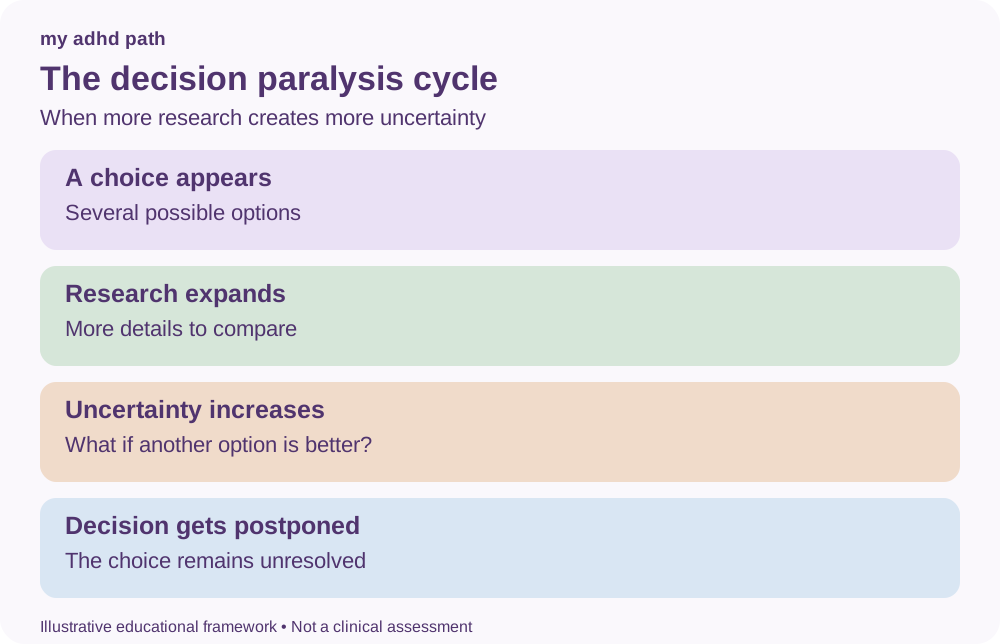
The decision paralysis cycle
Decision paralysis rarely exists as an isolated event. It tends to follow a recognisable cycle that reinforces itself over time.
It often begins when you encounter a decision. It might be small, like choosing what to wear, or significant, like whether to change jobs. Either way, the number of options or the perceived importance of the choice triggers a sense of overwhelm.
Rather than moving towards a resolution, you delay. Sometimes this looks like researching endlessly. Sometimes it looks like avoiding the decision entirely by doing something else. Sometimes it looks like asking multiple people for their opinions and then feeling more confused than before.
As time passes, the pressure builds. What started as a low-stakes choice now carries the additional weight of all the time you have already spent on it. If you have been thinking about which sofa to buy for three months, the eventual decision needs to feel worth three months of deliberation.
Good to know
The pressure to make a decision worthy of the time spent deliberating is sometimes called the sunk cost trap. The more time you invest, the harder it becomes to accept a simple, good-enough outcome.
Eventually, one of two things happens. Either an external deadline forces an emergency decision, often made under stress and without the careful consideration you had intended. Or you avoid the decision altogether, letting the opportunity pass or allowing someone else to choose for you.
Both outcomes tend to generate guilt or frustration, which makes the next decision feel harder.
The cycle does not prove that you are bad at decisions. It demonstrates that the process of deciding is consuming more energy than the decision itself warrants.
Why having a productive day can make decisions harder
You have had an excellent morning. You have cleared your emails, finished a report, attended two meetings and organised your desk.
It is now half past twelve and somebody asks what you would like for lunch.
You cannot answer.
This is not laziness. This is decision fatigue.
Every decision you make during the day uses cognitive resources. Research by Baumeister and Tierney suggests that these resources are finite. The more decisions you make, the less energy is available for the ones that come later.
For people with ADHD, this effect can be more pronounced. If basic executive functions already require additional effort, the available decision-making capacity may deplete faster.
Common misconception
"If you can make complicated decisions at work, you should be able to decide what to have for dinner."
Work decisions often have clearer parameters, external deadlines and professional consequences that provide structure. Everyday decisions tend to have fewer constraints and more options, which can make them harder for someone with ADHD, not easier.
This is why some of the most capable, accomplished people with ADHD describe being unable to choose between two virtually identical options at the end of a long day.
The issue is not the difficulty of the decision. It is the cumulative cost of every decision that preceded it.
When every option feels equally important
One of the most frustrating aspects of decision paralysis is the experience of genuine equivalence. When two or more options seem equally valid, there is no clear basis for choosing between them.
For many people, a minor preference or gut feeling is enough to tip the balance. But ADHD can make it harder to access that intuitive sense, particularly when you are tired or overwhelmed.
The result is what might be called the equal-options trap. You continue comparing because you are waiting for a clear winner to emerge. But if the options are genuinely similar, no amount of additional analysis will produce one.
Try this
When two options seem equal, ask yourself: "If somebody else made this choice for me, would I be relieved?" If the answer is yes, the decision probably does not warrant further deliberation. Pick either option and move on.
This applies to a surprising number of everyday decisions. Which brand of washing-up liquid to buy. Which route to take to work. Whether to reply to a message now or in twenty minutes.
In these cases, the cost of continuing to deliberate almost always exceeds the benefit of making a marginally better choice.
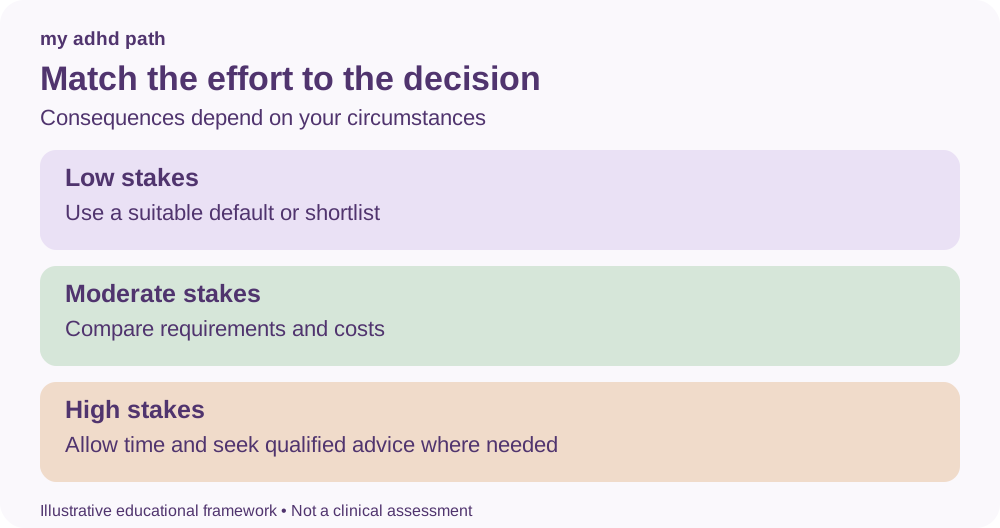
Three levels of decision stakes
Not all decisions deserve the same amount of attention. But when you have ADHD, your brain may not automatically calibrate the effort to the stakes.
A useful starting point is to recognise that decisions generally fall into one of three categories.
| Level | Description | Examples | Suggested approach |
|---|---|---|---|
| Low stakes | Easily reversible or genuinely unimportant | What to eat for lunch, which mug to use, what to watch on television | Use a default, flip a coin, or set a two-minute limit |
| Medium stakes | Matters somewhat but is not life-changing | Which restaurant to book, what to wear to a social event, which gym to join | Limit to three options, use the must-have filter, decide within a day |
| High stakes | Significant consequences, difficult to reverse | Changing careers, moving house, ending a relationship, major financial commitments | Use the five-step reset, seek trusted input, set a decision deadline |
The objective is not to eliminate careful thought from important decisions. It is to stop applying high-stakes deliberation to low-stakes choices.
Good to know
Research by Schwartz (2004) suggests that having more options does not necessarily lead to better decisions. Beyond a certain point, additional choices increase anxiety and decrease satisfaction with the eventual outcome. This is sometimes called the paradox of choice.
The three-option shortlist
When faced with an overwhelming number of options, one of the most effective strategies is to reduce them to three before you begin evaluating.
Three is a manageable number. It is small enough to hold in working memory, large enough to feel like a genuine choice and structured enough to compare without getting lost.
How to create a three-option shortlist
Begin by eliminating anything that is clearly unsuitable. You are not looking for the best option yet. You are removing the ones that obviously do not meet your basic requirements.
From whatever remains, select three options that seem reasonable. They do not need to be perfect. They do not need to represent every possible angle. They just need to be acceptable.
Then compare only those three.
Try this
Apply the three-option shortlist to your next restaurant decision. Instead of scrolling through every option on a delivery app, pick three restaurants you already know you like. Choose between those three. If none of them appeals, replace one and try again.
The power of this approach is that it removes the most exhausting part of decision-making: the open-ended search through unlimited possibilities. You are no longer trying to find the best option in the world. You are choosing from three acceptable ones.
Suggested phrases
"I'm going to pick from three options rather than looking at everything."
"These three all work. I'm choosing between these."
"I don't need the perfect option. I need a good-enough option from a short list."
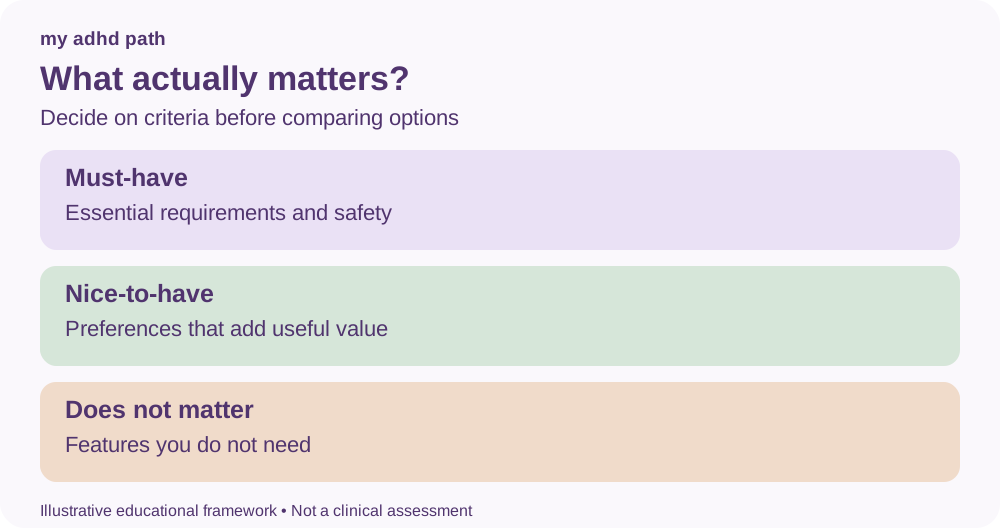
Must-have versus nice-to-have
Another reason decisions become difficult is that every feature or consideration feels like it carries equal weight. When you cannot distinguish between what is essential and what is merely desirable, comparison becomes almost impossible.
The must-have versus nice-to-have filter is a simple way to establish priorities before you begin evaluating options.
| Category | Definition | Example (choosing a flat) |
|---|---|---|
| Must-have | Non-negotiable. If this is missing, the option is eliminated. | Within budget. Allows pets. Has a shower. |
| Nice-to-have | Desirable but not essential. Having it is a bonus, not a requirement. | South-facing garden. Dishwasher. Near a park. |
| Does not matter | Genuinely irrelevant to this decision. | Colour of the front door. Number of plug sockets in the hallway. |
Once you have established your must-haves, any option that does not meet all of them can be eliminated immediately. This often removes a significant number of choices without requiring any detailed comparison.
The remaining options can then be compared on their nice-to-haves, which is a much simpler task when the essential requirements have already been met.
Try this
Before your next significant purchase, write down three must-haves. Cross off anything that does not meet all three. Only then begin comparing the remaining options on their additional features.
Fifteen practical ways to reduce decision difficulty
The following suggestions are not intended to be adopted all at once. Choose one or two that seem relevant to your circumstances and try them for a few days before adding more.
Practical checklist
- 1. Create defaults for recurring decisions. If you eat the same breakfast most days, that is not boring. That is one fewer decision before 9am.
- 2. Use the two-minute rule. If a decision will take less than two minutes to implement, make it now rather than adding it to your mental queue.
- 3. Limit your options deliberately. Use the three-option shortlist for anything that presents more than three choices.
- 4. Separate research from deciding. Gather information at one time and make the decision at a different time, so you are not trying to do both simultaneously.
- 5. Set decision deadlines. Give yourself a specific time by which the decision must be made. When the deadline arrives, choose the best available option.
- 6. Reduce daily decisions the night before. Choose tomorrow's outfit, plan tomorrow's meals and pack your bag before you go to bed.
- 7. Use a decision timer. For low-stakes choices, set a timer for two minutes. When it finishes, go with your current inclination.
- 8. Accept good enough. Perfectionism is the enemy of progress. A satisfactory choice made today is almost always better than an optimal choice made next month.
- 9. Identify your decision-making peak. Notice when during the day you make decisions most comfortably. Schedule important decisions for that time.
- 10. Batch similar decisions together. Plan all your meals for the week in one session rather than deciding each evening.
- 11. Delegate decisions you do not care about. If it genuinely does not matter to you which restaurant your friends choose, say so and let someone else decide.
- 12. Flip a coin for genuinely equal options. If you cannot choose between two equally good options, let chance decide. Notice whether you feel relieved or disappointed. That tells you which option you actually preferred.
- 13. Reduce your exposure to options. Unsubscribe from marketing emails. Use smaller shops with fewer choices. Stop browsing unless you intend to buy.
- 14. Write decisions down. Moving options out of your head and onto paper reduces the load on working memory and makes comparison easier.
- 15. Review your decision history. Look back at decisions that felt agonising at the time. Most of them probably turned out fine. This evidence can reduce the pressure you place on future decisions.
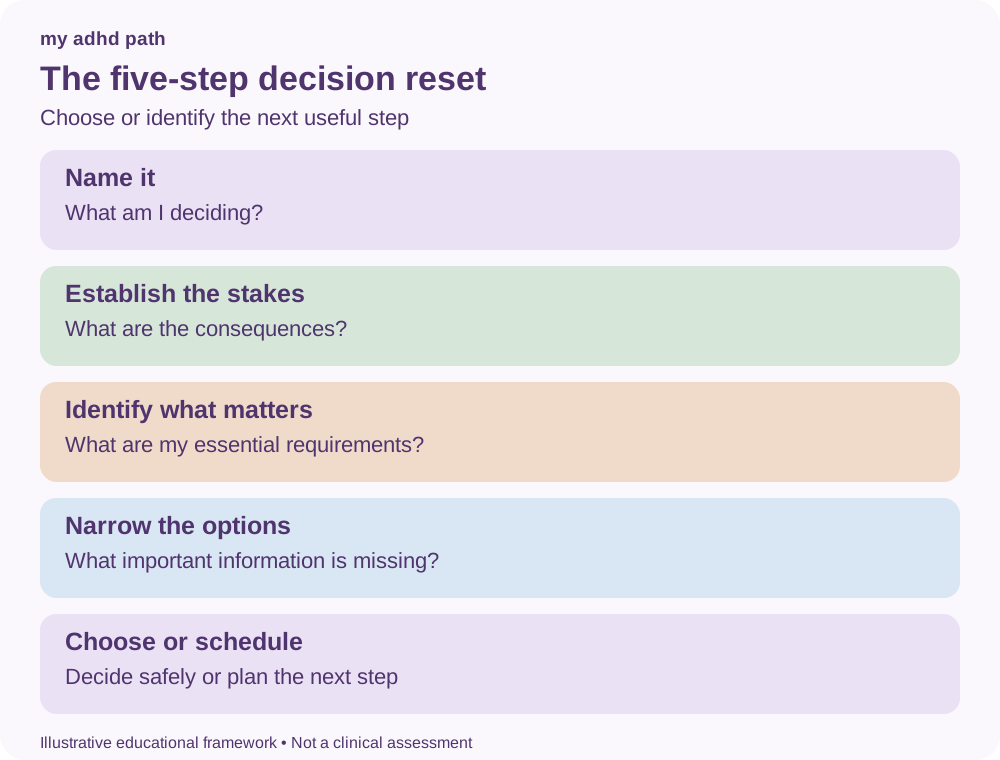
The five-step decision reset
When you find yourself completely stuck on a decision, the following process can help you move forward. It is designed to be used in real time, wherever you are, and takes only a few minutes.
Step one: Pause
Stop trying to decide. The harder you push against decision paralysis, the more entrenched it becomes. Acknowledge that you are stuck, and give yourself permission to take a brief step back.
Step two: Name the decision
State the decision clearly, in one sentence. Not "I need to sort out my career" but "I need to decide whether to apply for the job I saw yesterday." Vague decisions are almost impossible to resolve. Specific decisions are much more manageable.
Step three: Identify what matters most
Ask yourself: what is the single most important factor in this decision? Not the three most important. Not all the factors. Just the one that matters more than anything else.
This is harder than it sounds, but it provides a clear basis for comparison.
Step four: Pick the best available option
Using your single most important factor as the deciding criterion, choose the option that performs best against it. If two options are equal on this factor, choose either one. The decision is effectively a draw, and further deliberation will not change that.
Step five: Set a time limit for action
Decide when you will act on this decision. If the decision is low-stakes, act immediately. If it requires preparation, set a specific time within the next 24 hours. Write it down or set a reminder.
Good to know
The five-step reset is not designed to produce perfect decisions. It is designed to break the paralysis and get you moving. You can always adjust your course later. What matters most is that you are no longer stuck.
Three different experiences
Decision paralysis affects people in different ways depending on the types of decisions involved, their individual circumstances and the other demands on their cognitive resources.
The following examples are fictional illustrations.
Illustrative scenario
Rebecca, 39 - The weight of everyday choices
Rebecca finds that everyday decisions consume an extraordinary amount of energy. What to cook for dinner, which brand to buy at the supermarket, what to pack in her children's lunchboxes. Each decision feels like a small test, and by the evening she has nothing left.
She describes the experience of standing in a supermarket aisle, looking at twelve varieties of pasta sauce, and being completely unable to choose. She knows they are all basically the same. She knows it does not matter. But she still cannot pick one.
After learning about decision fatigue, Rebecca begins creating defaults and shortlists. She develops a rotating menu of seven dinners, buys the same brands each week and packs the same three lunchbox options. She describes the relief as immediate and significant.
Life becomes noticeably easier when she stops expecting herself to optimise every choice and starts accepting that good enough is genuinely good enough.
Illustrative scenario
Daniel, 46 - The decisions that never get made
Daniel's difficulty is with significant decisions. He has been meaning to review his pension for two years. He knows he should probably change careers. His car insurance renewed automatically at a higher rate because he could not face comparing alternatives.
Important opportunities pass while he deliberates. A colleague who applied for the same promotion six months ago is now his manager. Daniel had the same information, the same qualifications and the same interest. He simply could not commit to applying.
He begins using the three-option shortlist for professional decisions and time-boxing his deliberation. He gives himself one week to decide whether to apply for a role, with a specific evening set aside to submit the application. If the deadline passes without action, he accepts that this was not the right opportunity and moves on without guilt.
Accepting that a good-enough choice made now beats a perfect choice made too late changes his relationship with important decisions entirely.
Illustrative scenario
Aisha, 28 - When social decisions drain your energy
Aisha's decision paralysis is most acute in social situations. What to wear when meeting friends. Where to suggest eating. How to respond to a message that could be interpreted several ways. Whether to accept an invitation or politely decline.
Each social decision carries emotional weight because she is acutely aware of how her choices might affect other people's experiences. She has spent forty minutes composing a two-sentence reply to a casual text message.
She introduces simple rules for herself. She has a default outfit for casual social events. When someone asks where to eat, she suggests one of three restaurants she knows and likes. For messages, she allows herself a five-minute response window for casual conversations.
Learning that decision difficulty is ADHD-related rather than a character flaw helps her stop judging herself. She is not overthinking because she is anxious or difficult. Her brain is processing social information with more complexity than the situation requires.
Decisions in relationships and shared living
Decision paralysis does not only affect the person experiencing it. When you share your life with someone, your difficulty making decisions can become a source of tension.
Partners, family members and housemates may interpret your indecision as a lack of interest, a reluctance to commit or a way of forcing them to make all the decisions.
Suggested phrases
"I'm not being difficult. Choosing between options genuinely takes me more effort than it might seem."
"It would help me if you could narrow it down to two or three options rather than asking me to choose from everything."
"Can we take turns being the one who decides? That way neither of us carries all the decision-making weight."
"I find it easier to respond to a suggestion than to generate one from scratch."
If you live with someone who also has ADHD, decision-making can become particularly challenging. Neither person may feel able to take the lead, and decisions may be deferred indefinitely.
Try this
Establish a decision-making rota for recurring choices. One person chooses what to have for dinner on Monday, Wednesday and Friday. The other chooses on Tuesday, Thursday and Saturday. Sunday is a takeaway. The person whose turn it is must decide by 4pm. If they do not, the other person decides instead.
This kind of structure removes the need for negotiation and reduces the number of decisions that require joint deliberation.
Using AI to reduce decision load
AI assistants can be surprisingly useful for reducing the cognitive effort involved in decisions. They are particularly helpful for generating shortlists, structuring comparisons and providing a framework when you feel overwhelmed.
They cannot make personal decisions for you, but they can reduce the amount of mental processing required to reach a decision yourself.
AI prompt
Create a decision shortlist
"I need to decide [describe the decision]. I have ADHD and decision paralysis is making this difficult. Can you help me narrow my options to three? Ask me about my must-haves first, then suggest three options that meet all of them."
AI prompt
Build a comparison table
"I'm trying to choose between these options: [list options]. Can you create a simple comparison table based on these factors: [list factors]? Keep it to one page and highlight the key differences."
AI prompt
Talk me through the five-step decision reset
"I'm stuck on a decision and I need help working through it. Walk me through five steps: help me name the decision in one sentence, identify the single most important factor, evaluate my options against that factor, choose one, and set a deadline for action."
AI prompt
Generate meal plan defaults
"I want to create a rotating weekly meal plan to reduce daily dinner decisions. I like [list preferences], I don't eat [list restrictions], and I need meals that take under 30 minutes. Give me a simple seven-day rotation I can repeat without thinking."
AI prompt
Reduce a decision to its essentials
"I'm overthinking this decision: [describe it]. Help me identify what actually matters and what I can safely ignore. Ask me questions to help me separate the must-haves from the nice-to-haves."
What does the research say?
What the research suggests
The connection between ADHD and decision-making difficulties is supported by several lines of evidence. Barkley (2012) describes executive functioning as the brain's self-management system, encompassing skills such as working memory, emotional regulation, planning and self-monitoring. When these capacities are affected, the processes underlying effective decision-making are disrupted.
What the research suggests
Baumeister and Tierney's research on ego depletion and decision fatigue suggests that self-control and decision-making draw on a shared, limited resource. While the ego depletion model has been debated in recent years, the practical observation that decision quality tends to decline after sustained cognitive effort remains well-supported by everyday experience and clinical observation.
What the research suggests
Faraone et al. (2021), in their international consensus statement, describe ADHD as a condition with wide-ranging effects on executive functioning, emotional regulation and daily functioning. The practical difficulties that many adults with ADHD report with decision-making are consistent with the neurocognitive profile described in this comprehensive review.
It is worth noting that ADHD medication, by supporting executive function and attention regulation, may help some people experience decision-making as less effortful. However, medication effects vary between individuals, and practical strategies remain valuable regardless of whether medication is part of someone's treatment.
Good to know
Perfectionism in decision-making is not unique to ADHD, but research suggests that people with ADHD may be particularly susceptible to it. The combination of past impulsive decisions, heightened emotional responses and difficulty with prioritisation can create a pattern where every decision feels like it needs to be perfect.
Frequently asked questions
Why do I find decisions so difficult with ADHD?
Decision-making draws on executive functions including working memory, prioritisation, emotional regulation and planning. ADHD can affect each of these capacities, making the process of evaluating options and committing to a choice more cognitively demanding.
Is decision paralysis a symptom of ADHD?
Decision paralysis is not a formal diagnostic criterion for ADHD, but it is a commonly reported experience that is consistent with the executive functioning difficulties associated with the condition. Many adults with ADHD describe it as one of their most significant everyday challenges.
Why do small decisions feel as difficult as big ones?
ADHD can make it difficult to calibrate the effort invested in a decision to its actual importance. The brain may apply the same level of deliberation to choosing a sandwich as it does to choosing a career, because the prioritisation system that normally distinguishes between them is working differently.
How can I make decisions faster?
Strategies that can help include limiting your options to three, establishing defaults for recurring decisions, using the must-have filter to eliminate unsuitable options quickly, setting decision deadlines and accepting that good enough is genuinely acceptable.
What is the connection between ADHD and perfectionism in decisions?
Some people with ADHD develop perfectionist decision-making patterns as a response to previous impulsive choices they regretted. The desire to avoid another mistake can lead to excessive deliberation, which paradoxically makes decisions harder rather than better.
Can medication help with decision-making?
ADHD medication may help some people by supporting the executive functions involved in decision-making. Effects vary between individuals, and medication is most effective when combined with practical strategies. Discuss medication questions with your prescribing clinician.
Why do I keep changing my mind?
Changing your mind frequently may reflect difficulty committing to a choice, shifting emotional responses to the same decision, or new information changing your assessment. It can also occur when the original decision was made impulsively and subsequent reflection reveals concerns that were not initially considered.
How do I know when a decision is good enough?
A decision is good enough when it meets your must-have requirements and you would feel relieved if someone else made the same choice for you. If you are still deliberating after meeting your essential criteria, the remaining differences are unlikely to significantly affect the outcome.
Should I make important decisions when I'm hyperfocusing?
Hyperfocus can provide intense concentration, but it may also narrow your perspective and reduce your awareness of factors outside the immediate focus. Consider making the decision during a period of calm, sustained attention rather than during intense absorption.
Why do I avoid decisions entirely?
Avoidance is a common response to the discomfort of decision paralysis. If past decisions have been difficult, stressful or regretted, avoiding future decisions can feel like self-protection. Unfortunately, avoidance tends to increase pressure over time rather than reducing it.
Can decision fatigue make ADHD symptoms worse?
Yes. When cognitive resources are depleted by sustained decision-making, other ADHD-related difficulties such as attention regulation, emotional control and impulse management may become more pronounced. Reducing unnecessary decisions can help preserve resources for the ones that matter.
When should I ask for help with decisions?
Consider seeking support if decision paralysis is significantly affecting your daily life, relationships, career or wellbeing. A healthcare professional familiar with ADHD can help identify whether additional support, therapeutic strategies or adjustments to your treatment plan might be beneficial.
Making decisions doesn't have to be this hard
If you have read this far, you have probably recognised yourself in at least some of what has been described.
The important thing to understand is that decision paralysis is not a personal failing. It is a predictable consequence of the way ADHD affects executive function, working memory and emotional processing.
You do not need to become someone who makes instant decisions without hesitation. That is not the goal, and it would not suit the way your brain works.
What you can do is reduce the number of decisions you face each day, create structures that make choosing easier, accept that good enough is genuinely good enough and stop measuring your competence by how effortlessly you appear to decide.
The best decision is not always the perfect one. Sometimes it is simply the one that gets made.
You have already demonstrated considerable resilience by navigating a world full of choices with a brain that processes them differently. Every default you create, every shortlist you make, every decision you time-box is an act of self-knowledge and practical intelligence.
The goal is not to eliminate difficulty. It is to make the difficulty proportionate to the decision.
And that is entirely within your reach.
Downloadable resource
My ADHD Decision Toolkit
Standalone worksheets for decision simplification, the must-have versus nice-to-have priority filter, the three-option shortlist technique and the five-step decision reset process.
Download PDFSources and further reading
- NICE - Attention deficit hyperactivity disorder: diagnosis and management (NG87). https://www.nice.org.uk/guidance/ng87
- NHS - Attention deficit hyperactivity disorder (ADHD). https://www.nhs.uk/conditions/attention-deficit-hyperactivity-disorder-adhd/
- Faraone, S. V. et al. (2021). The World Federation of ADHD International Consensus Statement: 208 Evidence-based conclusions about the disorder. Neuroscience and Biobehavioral Reviews, 128, 789-818. https://doi.org/10.1016/j.neubiorev.2021.01.022
- Diamond, A. (2013). Executive functions. Annual Review of Psychology, 64, 135-168. https://doi.org/10.1146/annurev-psych-113011-143750
- Barkley, R. A. (2012). Executive Functions: What They Are, How They Work, and Why They Evolved. Guilford Press.
- Baumeister, R. F. and Tierney, J. (2011). Willpower: Rediscovering the Greatest Human Strength. Penguin Books.
- Schwartz, B. (2004). The Paradox of Choice: Why More Is Less. Ecco Press.
- Sonuga-Barke, E. J. S. (2005). Causal models of attention-deficit/hyperactivity disorder: from common simple deficits to multiple developmental pathways. Biological Psychiatry, 57(11), 1231-1238. https://doi.org/10.1016/j.biopsych.2004.09.008
- Toplak, M. E., West, R. F. and Stanovich, K. E. (2013). Practitioner review: Do performance-based measures and ratings of executive function assess the same construct? Journal of Child Psychology and Psychiatry, 54(2), 131-143. https://doi.org/10.1111/jcpp.12001
- Barkley, R. A. and Fischer, M. (2019). Hyperactive Child Syndrome and Estimated Life Expectancy at Young Adult Follow-Up: The Role of ADHD Persistence and Other Potential Predictors. Journal of Attention Disorders, 23(9), 907-923. https://doi.org/10.1177/1087054718816164
This article provides general educational information and is not a substitute for individual medical or psychological advice. All personal scenarios are fictional. The decision-making frameworks and exercises are practical educational tools, not clinically validated diagnostic assessments or ADHD treatments.