

What if you've spent your entire life trying to manage something you experience differently from the people giving you advice about it?
At a glance
- Time blindness is an informal description, not a clinical diagnosis.
- ADHD may affect aspects of time perception, estimation and monitoring.
- Knowing the time and managing time are different skills.
- Waiting mode and intense absorption may create different time-related challenges.
- Preparation and transition time deserve space in your calendar.
- External time cues can reduce reliance on internal estimates.
- Effective strategies should suit the individual's actual experience.
You have forty minutes before you need to leave the house.
Plenty of time.
You decide to quickly answer an email, put something away and make yourself a cup of tea.
You glance at the clock.
You needed to leave seven minutes ago.
What happened to the other forty minutes?
You haven't been sitting doing nothing. You've been busy. You've achieved several things. You were reasonably confident that you knew how much time had passed.
And yet, somehow, your experience of those forty minutes bears very little resemblance to what the clock is telling you.
Then there's the opposite experience.
You have an appointment at three o'clock in the afternoon.
It's only ten in the morning, but you can't quite settle into anything because you have somewhere to be later.
Five hours are available, yet none of them feel particularly usable.
These experiences may sound contradictory. But both can be associated with difficulties managing and perceiving time, sometimes described as time blindness.
For some people with ADHD, time is one of the most complicated aspects of everyday life.
And being repeatedly told to manage it better doesn't necessarily help.
What is time blindness?
Time blindness is an informal term used to describe difficulties experiencing, estimating, monitoring or organising time.
It may involve struggling to judge how long an activity has taken, predict how long something will take or recognise how much time remains before a future event.
Some people also find it difficult to translate an awareness of future responsibilities into actions in the present.
Common misconception
Time blindness is not a medical diagnosis or a standalone diagnostic criterion for ADHD. However, research has identified differences in aspects of time processing among some people with ADHD. These differences may interact with difficulties involving attention, working memory, planning and executive functioning.
Time blindness doesn't mean somebody cannot read a clock.
It means that knowing what time it is and using that information effectively may be two different things.
Knowing what time it is and using that information effectively may be two different things.
Understanding the different ways we experience time
We use time in numerous ways throughout an ordinary day.
Some of these processes happen without us consciously thinking about them.
| Aspect of time | What it involves |
|---|---|
| Time estimation | Judging how long an activity might take |
| Time perception | Experiencing the passage or duration of time |
| Time monitoring | Keeping track of time whilst doing something |
| Time management | Organising activities within the time available |
| Prospective memory | Remembering to carry out an intended action in the future |
| Transitions | Stopping one activity and moving to another |
These processes are related but not identical.
You might be excellent at estimating how long a professional task will take but regularly lose track of time whilst completing it.
You might arrive at every appointment early but find that preparing to do so occupies an unnecessarily large part of your day.
Understanding which aspects of time you find challenging can help you choose more effective support.
Why can ADHD affect time perception?
Research into ADHD has explored several aspects of cognitive functioning that may influence how people experience and manage time.
These include attention regulation, working memory, inhibitory control and the ability to organise actions towards future goals.
If your attention is absorbed in an activity, you may be less aware of external time cues.
If you're managing several competing responsibilities, information about an upcoming commitment may become less prominent.
If switching activities requires considerable effort, knowing that it's time to stop may not automatically translate into stopping.
Researchers have also investigated the roles of brain networks and neurotransmitter systems involved in timing, attention and motivation.
Good to know
The relationship between ADHD and time processing is complex. It would be misleading to suggest that all time-related difficulties can be explained by a single brain region or simply by a lack of dopamine. People with ADHD can experience time differently from one another, and their experiences may change depending on the activity, environment and circumstances.
Why five minutes isn't always five minutes
Think about waiting for a delayed train.
Five minutes might feel considerably longer than you expect.
Now imagine spending five minutes talking to somebody about something you find fascinating.
The time seems to disappear.
These differences in subjective time are ordinary human experiences.
For some people with ADHD, difficulties monitoring or estimating time may make these variations particularly disruptive.
An engaging activity may continue far beyond its intended duration.
A repetitive activity may feel substantially more demanding because time appears to pass slowly.
The clock hasn't changed.
Your experience of what is happening within that period has.
This distinction can be useful when designing strategies for everyday life.
Twelve signs of time blindness you might recognise
1. Regularly underestimating how long something will take
You allow twenty minutes for an activity that routinely takes forty.
Even after several experiences of it taking longer than expected, the original estimate still feels reasonable.
2. Losing track of time during enjoyable activities
You begin reading, working on a project or researching something interesting.
When you next check the time, considerably more of the day has passed than you intended.
3. Becoming surprised by how late it is
The afternoon seems to disappear.
You're suddenly aware that several responsibilities are still outstanding and the shops are about to close.
4. Frequently rushing to leave the house
You knew exactly when the appointment was.
What you hadn't fully accounted for was everything that needed to happen before you could leave.
5. Forgetting transition time
You schedule a meeting to finish at two o'clock and another activity to begin at two o'clock.
Unfortunately, the two activities are in entirely different places.
6. Feeling unable to start anything before an appointment
A commitment several hours away occupies a considerable amount of your attention.
You worry that beginning something else might make you late.
7. Finding future deadlines difficult to engage with
A deadline next month may feel relatively abstract.
As it approaches, the responsibility becomes increasingly prominent and urgent.
8. Struggling to distinguish between quick and substantial tasks
You add several supposedly small jobs to your day.
Collectively, they require far more time than you expected.
9. Overcommitting
Each individual commitment seems achievable when you agree to it.
The difficulty becomes apparent when you consider how they all fit together.
10. Finding it difficult to stop at an appropriate time
You know you need to finish working, go to bed or leave for an appointment.
But moving away from what you're doing feels unexpectedly demanding.
11. Losing track of longer periods
You might feel as though you saw a friend recently, only to discover that several months have passed.
Annual events and renewal dates can arrive with surprising speed.
12. Becoming exceptionally early to avoid being late
Some people develop elaborate strategies to compensate for time-related difficulties.
You might arrive forty minutes early because you're concerned that allowing less time could result in missing the appointment altogether.
These experiences are not unique to ADHD and cannot establish whether somebody has the condition.
They may also occur alongside anxiety, sleep difficulties, stress and other factors.
Now and not now: why the future can feel different
Some people describe their experience of ADHD as dividing responsibilities into two categories.
Now.
And not now.
An activity requiring immediate attention feels tangible.
Something happening several weeks away may be understood intellectually without creating the same sense of immediacy.
This can affect how people prepare for deadlines, save money, organise future commitments or complete responsibilities with several stages.
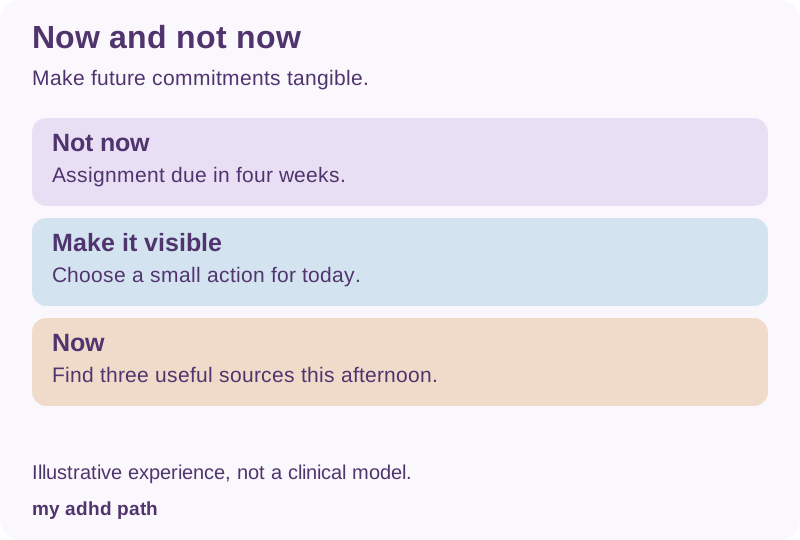
Consider a student with an assignment due in four weeks.
They know exactly when the assignment is due.
They understand that starting early would be sensible.
But the future deadline doesn't necessarily translate into a clear action today.
Three days before the deadline, the situation feels considerably different.
The assignment has become immediate.
There is now a clear reason to act.
Good to know
The phrase "now and not now" is an illustrative description, not a scientific classification of how every ADHD brain processes time. Nevertheless, it suggests a practical approach: instead of relying exclusively on a future deadline, make the next action visible in the present.
"Submit the assignment on Friday" can become "Find three useful sources on Monday afternoon."
The future responsibility hasn't changed.
But there is now something specific to do today.
What is ADHD waiting mode?
Waiting mode is another informal expression commonly used within the ADHD community.
It describes the experience of finding it difficult to engage in other activities whilst anticipating a future commitment.
Perhaps you have a dentist appointment at three o'clock.
You could reasonably complete several useful activities beforehand.
But part of your attention remains occupied by the appointment.
You might repeatedly check the time, worry about becoming distracted or feel reluctant to begin anything that could become difficult to stop.
By the time you leave, you may feel as though you've been waiting for most of the day.
Good to know
Waiting mode is not a recognised clinical diagnosis, and research specifically examining the experience under this name is limited. Several factors may contribute, including difficulties with transitions, prospective memory, uncertainty about how long tasks will take and anxiety about missing commitments.
For some people, avoiding other activities may have developed as a way of compensating for previous experiences of lateness.
Try this
Rather than trying to force yourself into a demanding task, create a reliable departure plan and identify smaller activities that fit comfortably into the available time.
The appointment is at three. When do you actually need to start?
One of the most useful changes you can make to your calendar is distinguishing between the time an event begins and the time you need to start preparing for it.
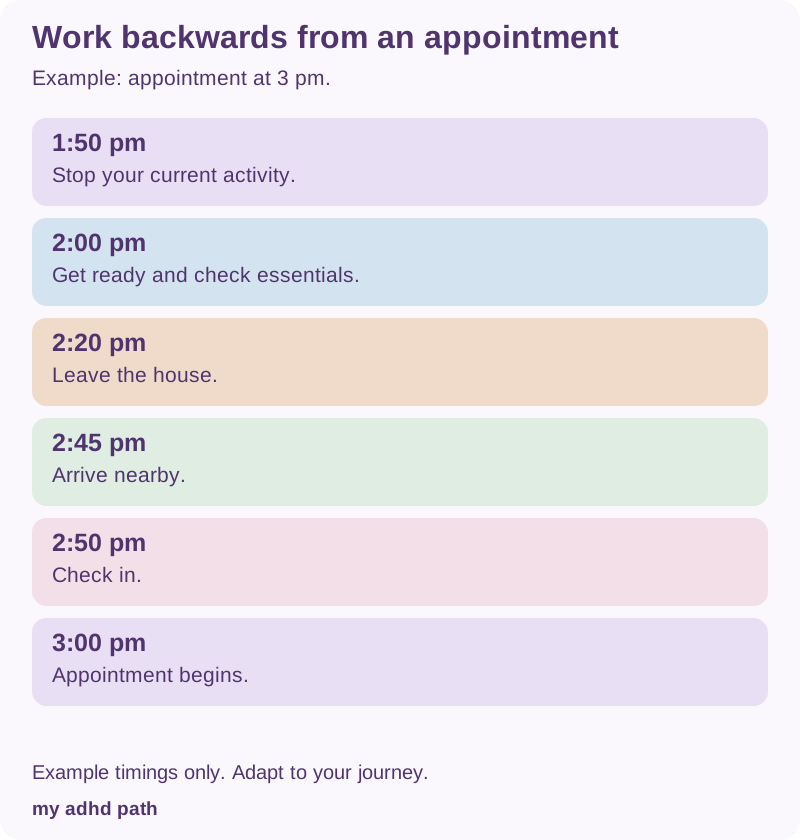
Imagine an appointment at 3 pm.
Your preparation might look something like this:
| Time | Action |
|---|---|
| 1:50 pm | Stop current activity |
| 2:00 pm | Begin getting ready and check essentials |
| 2:20 pm | Leave the house |
| 2:45 pm | Arrive nearby |
| 2:50 pm | Check in |
| 3:00 pm | Appointment begins |
The appointment is at three.
But the first action associated with it needs to happen at ten to two.
The appointment is at three. But the first action associated with it needs to happen at ten to two.
Adding only the appointment time to your calendar leaves you responsible for calculating everything else at the appropriate moment.
Adding preparation and departure reminders provides more useful information.
This example assumes a twenty-five-minute journey and additional preparation and arrival time. Your own timings will depend on your circumstances.
For appointments requiring important preparation, check the instructions separately.
The problem with planning journeys from the appointment time
When considering how long it takes to get somewhere, we often focus on the journey itself.
It takes twenty minutes to drive there.
So we leave twenty minutes before we need to arrive.
But what about finding the car keys?
Walking to the car?
Traffic?
Parking?
Walking from the car park?
Finding the correct building?
Checking in?
These activities are part of the journey too.
Try this
Try estimating the entire process, from stopping what you're currently doing to being ready at your destination. That may provide a more realistic picture of the time you need.
When hyperfocus makes time disappear
Hyperfocus is an informal term commonly used to describe periods of intense absorption in an activity.
Some adults with ADHD report experiences of becoming so engaged in something that other responsibilities or environmental cues receive very little attention.
This can happen whilst working, gaming, researching, creating something or pursuing an interesting project.
Being deeply engaged can be enjoyable and productive.
However, it may also make time monitoring difficult.
You might continue working long after you intended to finish, miss meals or overlook another commitment.
The aim isn't necessarily to prevent periods of concentrated attention.
It is to introduce useful boundaries around them.
Try this
Before beginning an absorbing activity, consider when you need to stop and what could help you make that transition. An external alarm, a scheduled break or a clear stopping point may help. If you regularly dismiss alarms without acting on them, you may need a different type of cue or a more specific transition plan.
Why transitions deserve their own time
Many planning systems treat activities as though they connect seamlessly.
Finish one task.
Start the next.
In reality, there may be several stages between them.
You need to save your work, remember where you reached, gather what is needed for the next activity and redirect your attention.
There may also be physical movement involved.
For some people with ADHD, these transitions require more time and effort than anticipated.
Rather than planning a day in which every activity begins immediately after another finishes, introduce realistic transition periods.
A five-minute note recording where you stopped may make it easier to return to an unfinished task later.
An additional fifteen minutes between meetings might provide time to process information, prepare for the next conversation or attend to basic needs.
The appropriate amount of transition time depends on the activity and the person.
Why being late doesn't necessarily mean you don't care
Persistent lateness can have a significant effect on relationships, education and employment.
It can also become a source of considerable embarrassment.
Some people with ADHD describe being repeatedly criticised for lateness despite making genuine efforts to arrive on time.
Understanding time-related difficulties can help explain why previous strategies haven't worked.
However, the impact of lateness on other people still matters.
A friend waiting outside a restaurant may be inconvenienced regardless of the reason.
Understanding ADHD-related difficulties and acknowledging their consequences are compatible.
You might explain your experience, introduce additional support and communicate promptly when you know you are running late.
The useful question isn't whether somebody cares enough to be punctual.
It's what practical arrangements could make punctuality more achievable.
Fifteen practical ways to manage time blindness
1. Make time visible
If you rely primarily on your internal sense of time, you may benefit from additional external information.
A visible clock, desktop timer or watch can provide useful cues throughout the day.
Choose something you can see or notice whilst engaged in an activity.
2. Use visual countdowns
A visual timer displays how much time remains rather than simply presenting a number.
For some people, seeing a coloured section gradually reduce makes the remaining time easier to understand.
Different timer designs suit different preferences.
3. Schedule departure times
Add the time you need to leave to your calendar alongside the appointment itself.
If preparation is substantial, add a preparation reminder too.
4. Work backwards from the commitment
Begin with the time you need to be ready.
Subtract travel, preparation, check-in and an appropriate allowance for uncertainty.
This can help identify when the first action needs to happen.
5. Measure how long familiar tasks actually take
Choose a few activities that you regularly underestimate.
Time them under reasonably typical conditions.
Getting ready in the morning, preparing lunch or completing routine administration might provide useful information for future planning.
Avoid turning the exercise into a competition to complete everything more quickly.
The purpose is learning, not speed.
6. Include transition time
Allow time to stop, move between activities and get ready for the next thing.
Your calendar should reflect the entire process rather than just the main events.
7. Set more meaningful alarms
An alarm labelled "Meeting" may not tell you what to do.
"Save your work and leave for the meeting" provides a specific action.
Use reminders that communicate the next step.
8. Consider multiple reminders for important events
A preparation reminder followed by a departure reminder and, where useful, a final time check may provide more effective support than a single notification.
Avoid setting so many alarms that you become accustomed to ignoring them.
9. Create smaller deadlines
Break larger responsibilities into manageable stages with their own starting points and completion dates.
Where appropriate, arrange a check-in with somebody else to provide additional structure.
10. Match activities to available time
Before an appointment, choose activities with clear stopping points.
Putting folded clothes away may be more suitable than starting an extensive wardrobe reorganisation.
11. Keep a short-task menu
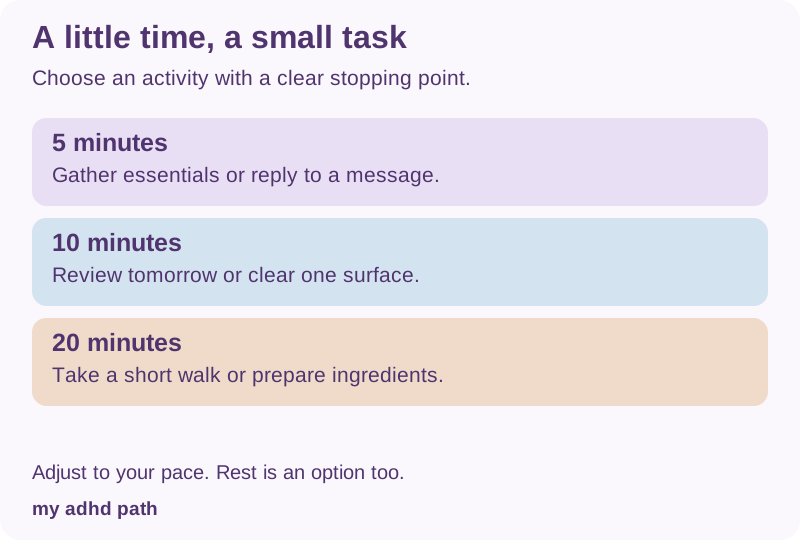
Create a small collection of useful activities that generally fit into five, ten or twenty minutes.
This can reduce the effort involved in deciding what to do when a commitment is approaching.
12. Use stopping cues as well as starting cues
A reminder that tells you to begin is useful.
A reminder that helps you stop can be equally valuable.
Agree on a suitable endpoint before starting an absorbing activity.
13. Plan less into your day
Leave room for delays, unexpected responsibilities and recovery.
A calendar with every available minute allocated may be difficult to maintain even when everything goes reasonably well.
14. Make future plans tangible
Use visible progress markers, intermediate milestones or upcoming-event summaries.
Connecting a future objective to a specific action today can make it easier to engage with.
15. Build a routine for checking your time commitments
Choose a manageable point in the day to review upcoming events and identify when preparation needs to begin.
A brief review after breakfast or before finishing work may help.
If you miss it, resume when you can rather than abandoning the routine.
Build a more accurate personal time library
You may discover that you repeatedly underestimate certain activities.
Rather than relying on a new estimate each time, create a small reference library based on your previous experience.
| Activity | Original estimate | Example actual time |
|---|---|---|
| Getting ready and leaving home | 15 minutes | 28 minutes |
| Returning an online purchase | 10 minutes | 25 minutes |
| Preparing an evening meal | 20 minutes | 38 minutes |
| Weekly grocery shop | 30 minutes | 55 minutes |
| Getting ready for bed | 10 minutes | 22 minutes |
These figures are fictional examples.
Your timings may be considerably different.
Allow for variation rather than assuming an activity will always take exactly the same amount of time.
If something takes between twenty and thirty minutes on most occasions, a range may be more useful than a precise average.
For important commitments, consider the consequences of delays when deciding how much time to allow.
The five, ten and twenty-minute menu
When something is happening later in the day, it may be easier to choose an activity from a prepared selection than to decide what could fit into the available time.
Approximately five minutes
- Respond to a straightforward message.
- Gather the items needed for your next appointment.
- Water a few houseplants.
- Put away a small collection of belongings.
Approximately ten minutes
- Review tomorrow's calendar.
- Put away folded laundry.
- Prepare a simple snack.
- Clear one household surface.
Approximately twenty minutes
- Complete a small, clearly defined administrative task.
- Take a short walk, allowing time to return.
- Prepare ingredients for a later meal.
- Work on one manageable stage of a project.
These durations are suggestions, not standard measurements.
Use your personal time library to build a menu that suits your own pace and circumstances.
Rest is also a perfectly reasonable use of available time.
You are not obliged to make every spare minute productive.
Make a calendar that represents your actual day
A calendar containing three appointments may look relatively empty.
But when preparation, travel, transitions and recovery are included, the day may be considerably fuller.
Imagine a morning containing an appointment and a meeting.
| Activity | Time |
|---|---|
| Prepare for appointment | 8:30 - 9:00 |
| Travel and arrival | 9:00 - 9:40 |
| Appointment | 9:40 - 10:10 |
| Return journey | 10:10 - 10:40 |
| Break and transition | 10:40 - 11:00 |
| Meeting preparation | 11:00 - 11:30 |
| Meeting | 11:30 - 12:00 |
The two main commitments occupy one hour.
The complete activities occupy three and a half hours.
This is information worth having when deciding what else you can reasonably achieve.
A useful calendar represents the time your responsibilities actually require, not just the moments when other people expect you to be somewhere.
Time blindness and sleep
Bedtime requires several transitions.
You need to finish what you're doing, move away from an engaging activity and prepare for sleep.
For somebody who regularly loses track of time in the evening, this can be particularly challenging.
You intend to watch one episode of a television programme.
Or finish one last piece of work.
Or briefly look something up.
Suddenly, it's considerably later than planned.
Try this
Consider introducing a reminder for beginning your evening wind-down rather than setting only a target bedtime. Establish a manageable stopping point for evening activities and allow time for practical preparations.
Good to know
Sleep difficulties may also worsen attention and executive functioning, creating additional challenges the following day. Persistent sleep problems deserve appropriate healthcare support rather than being automatically attributed to ADHD or poor organisation.
Time blindness at work
Time-related difficulties can affect working patterns in different ways.
You may underestimate project durations, become absorbed in one activity or find it difficult to manage competing deadlines.
Useful workplace adjustments might include:
- Visible project timelines.
- Clear intermediate deadlines.
- Calendar reminders for meeting preparation.
- Protected periods of focused work.
- Additional transition time between meetings.
- Regular workload prioritisation discussions.
- Suitable digital planning and reminder tools.
Discuss arrangements that address the particular demands of your role.
Some people may benefit from reasonable adjustments or workplace support through Access to Work, depending on their circumstances and eligibility.
A system that helps you organise your time should also help you communicate realistic commitments to other people.
Time blindness and family life
Family routines often involve coordinating several people, activities and deadlines simultaneously.
School starts at a particular time.
Children need equipment for different activities.
Dinner requires preparation.
Someone needs collecting.
And somebody has just remembered that tomorrow is a school dress-up day.
For parents managing ADHD-related time difficulties, this collection of responsibilities can be particularly demanding.
Shared calendars, visual routines and reminders associated with specific actions may help.
Consider preparing frequently needed items in advance and identifying departure times for family commitments.
These systems should be accessible to the appropriate members of the household rather than relying on one person to manage everybody else's schedule.
Children may also benefit from age-appropriate support understanding how long activities take and what needs to happen before leaving.
Three everyday time blindness experiences
The following examples are fictional illustrations.
Illustrative scenario
Charlotte, 35 - The afternoon appointment
Charlotte finds it difficult to begin work when she has an appointment later in the day. She repeatedly checks the time and worries that becoming absorbed in something will make her late.
She starts adding preparation and departure reminders to her calendar. She also creates a collection of smaller work activities with clear stopping points.
Having a more explicit departure plan gives her additional confidence to use some of the time beforehand.
Illustrative scenario
Michael, 48 - Everything takes twenty minutes
Michael frequently underestimates the time needed for household responsibilities. He begins recording the approximate duration of several familiar activities.
He discovers that tasks he regularly allows twenty minutes for generally take closer to forty.
His weekend plans become more realistic because they reflect his observations rather than his initial estimates.
Illustrative scenario
Leila, 29 - Knowing when to stop
Leila enjoys becoming absorbed in creative projects but frequently continues working beyond the time she intended to finish.
She introduces a stopping reminder followed by a short routine for recording her progress and identifying the next action.
Having a clear way to resume her work makes ending a session feel less disruptive.
Create your personal time support profile
Different experiences of time require different forms of support.
| Question | Illustrative answer |
|---|---|
| Which activities do I underestimate? | Getting ready and household chores |
| When do I lose track of time? | Working on interesting projects |
| What commitments create waiting mode? | Afternoon appointments |
| Which transitions are difficult? | Finishing work and beginning the evening routine |
| What kind of reminders do I notice? | Visible countdowns and labelled alarms |
| What could I measure? | My morning preparation routine |
| Where do I need more flexibility? | Travel and transitions between meetings |
| What would make the biggest difference? | Scheduling departure times |
Choose one difficulty that affects your everyday life regularly.
You don't need to introduce an entirely new approach to time management all at once.
A seven-day time awareness experiment
The objective of this experiment is to understand how you experience time, not to measure how productive you are.
Practical checklist
- Day one: Observe. Notice one occasion when your experience of time differs from the clock.
- Day two: Measure. Record how long a familiar activity takes.
- Day three: Externalise. Try using a visible clock or countdown timer during an activity.
- Day four: Work backwards. Create a preparation and departure plan for an upcoming commitment.
- Day five: Allow for transitions. Introduce a realistic gap between two activities.
- Day six: Make the future visible. Identify one specific action associated with a future deadline.
- Day seven: Review. Consider which changes helped and which added unnecessary complexity.
Adapt the experiment to your circumstances and complete it at your own pace.
It is an educational reflection exercise, not a clinical assessment of time perception.
Using AI to make time easier to manage
AI assistants can help organise commitments, estimate planning requirements and identify steps that might otherwise be overlooked.
They may be especially useful when the difficulty involves translating a collection of responsibilities into a realistic sequence.
AI prompt
Work backwards from an appointment
"Help me work backwards from this appointment time. Include preparation, travel, parking, walking, check-in and a realistic allowance for delays. Ask me for missing information rather than inventing journey times."
AI prompt
Make my day more realistic
"Review these commitments and tasks. Identify where I've overlooked preparation, transitions, breaks or travel time. Help me create a realistic plan without filling every available minute."
AI prompt
Help me with waiting mode
"I have an appointment later today and I'm finding it difficult to start anything beforehand. Help me establish a departure plan and identify a few activities with manageable stopping points."
AI prompt
Break down a future deadline
"Help me turn this deadline into a small number of intermediate milestones. Identify the first practical action I can take today and allow time for review and unexpected delays."
AI prompt
Understand my time estimates
"Compare these estimated and actual task durations. Help me identify patterns and create more realistic time ranges for future planning."
An AI-generated schedule is only as useful as the information it contains.
Check travel estimates, deadlines and calendar commitments independently.
An AI assistant cannot reliably remind you at a future time unless an appropriate reminder or scheduling feature has actually been configured.
Protect personal information when sharing calendars, work commitments and appointment details.
What does the research say about ADHD and time perception?
What the research says
Researchers have investigated several aspects of time processing in people with ADHD, including estimating intervals, reproducing durations and distinguishing between different time periods. Some studies and reviews identify differences in timing performance between groups with and without ADHD. However, findings vary depending on the type of task, the ages of participants, study methods and other factors. Laboratory timing tasks are also different from the complex demands of organising everyday activities. Research showing differences in estimating short time intervals does not automatically explain why an individual misses appointments or experiences difficulties completing a household routine. Further research is needed to understand how different aspects of timing relate to everyday functioning and which forms of practical support are most effective.
Clinical ADHD guidance recognises the potential value of environmental modifications and support tailored to individual needs.
The strategies in this article apply those broad principles to everyday time management.
They should not be interpreted as universally effective or clinically validated treatments for time blindness.
Can ADHD medication help with time blindness?
Effective ADHD treatment may help some people manage symptoms that contribute to time-related difficulties.
For example, improvements in attention regulation or impulse control might make certain activities easier to monitor or organise.
Research has also explored the effects of medication on aspects of timing performance.
However, medication does not guarantee accurate time estimation, punctuality or effective daily planning.
Time-related support strategies may remain useful alongside treatment.
Good to know
Discuss your individual experiences and treatment questions with an appropriate prescribing clinician. Do not change medication or dosing arrangements independently in an attempt to improve time management.
When to seek additional support
Time-related difficulties can substantially affect employment, education, relationships and independent living.
If these experiences are persistent and disruptive, consider discussing them with your GP or another appropriate healthcare professional.
ADHD assessment, treatment or individualised psychological and practical support may be helpful, depending on your circumstances.
Other factors may also contribute to difficulties with time, attention or organisation, including anxiety, depression, sleep disorders and physical health conditions.
Good to know
New or sudden changes in memory, awareness or cognitive functioning deserve medical attention rather than being assumed to reflect ADHD.
You may also benefit from workplace adjustments, educational support or help establishing more accessible everyday routines.
Downloadable resource
My ADHD Time Toolkit
Practical time awareness exercises, appointment countdown planners, realistic scheduling worksheets and strategies for managing transitions.
Download PDFFrequently asked questions
What is ADHD time blindness?
Time blindness is an informal term describing difficulties perceiving, estimating, monitoring or organising time. Some people with ADHD experience these difficulties as part of their everyday lives.
Is time blindness an official ADHD symptom?
Time blindness is not a standalone ADHD diagnostic criterion. However, research has identified differences in aspects of time processing and executive functioning among some people with ADHD.
Can you have time blindness without ADHD?
Yes. Difficulties managing or perceiving time can occur for various reasons and cannot establish an ADHD diagnosis.
Why do people with ADHD sometimes run late?
Underestimating task duration, forgetting preparation time, losing track of time and difficulty switching activities may contribute.
Can people with ADHD be extremely punctual?
Yes. Some people develop effective time management systems or become particularly cautious about allowing sufficient time for commitments.
What is ADHD waiting mode?
Waiting mode is an informal expression describing difficulty engaging in activities before a future commitment. It is not a formal clinical diagnosis.
Why does time disappear when I'm doing something interesting?
Absorption in an activity can reduce attention to external time cues. Some people with ADHD report especially intense periods of engagement.
Are visual timers helpful for ADHD?
They may help some individuals by making the remaining time more visible. Their usefulness depends on personal preferences and the circumstances in which they are used.
How can I stop underestimating how long tasks take?
Try recording the actual duration of familiar activities and use that information to inform future plans. Include preparation and transition time.
Can ADHD medication improve time perception?
Treatment may help some individuals with symptoms that affect time management. Research into specific timing processes is ongoing, and individual responses vary.
Does time blindness get worse with age?
There is no universal pattern. Time-related experiences may change alongside responsibilities, health, sleep, stress and other circumstances. New cognitive changes should be discussed with a healthcare professional.
What is the best way to manage time blindness?
There is no single best method. External time cues, realistic task estimates, departure reminders and manageable planning routines are practical options to explore.
Why don't ordinary planners work for me?
A planner can record what needs doing without necessarily helping you estimate time, remember to start or recognise when to stop. Additional cues and realistic scheduling may make it more useful.
You don't need to become a human clock
Some people appear to possess an extraordinary internal awareness of time.
They know when twenty minutes have passed.
They start preparing at exactly the right moment.
They seem to understand how much can reasonably fit into an afternoon.
If that isn't your experience, spending years trying to develop the same intuitive relationship with time may not be the most useful approach.
You can make time visible.
You can measure the activities you regularly underestimate.
You can create reminders that tell you when to begin, when to leave and when to stop.
You can allow for the fact that moving between activities takes time too.
And you can build a day around what you realistically have the capacity to do.
The objective isn't to spend every waking moment monitoring the clock.
It's to create enough external structure that you can spend more of your time enjoying what you're actually doing.
You don't need to become a human clock.
Sources and further reading
- NICE - Attention deficit hyperactivity disorder: diagnosis and management (NG87). https://www.nice.org.uk/guidance/ng87
- NHS - Attention deficit hyperactivity disorder (ADHD). https://www.nhs.uk/conditions/attention-deficit-hyperactivity-disorder-adhd/
- Noreika, V., Falter, C. M. and Rubia, K. (2013). Timing deficits in attention-deficit/hyperactivity disorder (ADHD): Evidence from neurocognitive and neuroimaging studies. Neuropsychologia, 51(2), 235-266. https://doi.org/10.1016/j.neuropsychologia.2012.09.036
- Faraone, S. V. et al. (2021). The World Federation of ADHD International Consensus Statement: 208 Evidence-based conclusions about the disorder. https://doi.org/10.1016/j.neubiorev.2021.01.022
- Diamond, A. (2013). Executive functions. Annual Review of Psychology. https://doi.org/10.1146/annurev-psych-113011-143750
- Hupfeld, K. E., Abagis, T. R. and Shah, P. (2019). Living "in the zone": Hyperfocus in adult ADHD. Attention Deficit and Hyperactivity Disorders. https://doi.org/10.1007/s12402-018-0272-y
- GOV.UK - Access to Work. https://www.gov.uk/access-to-work
This article provides general educational information and is not a substitute for individual medical or psychological advice. All personal scenarios and example timings are fictional. The planning frameworks and exercises are practical educational tools, not clinically validated diagnostic assessments or ADHD treatments.