

Perhaps the secret to maintaining a routine isn't becoming more consistent. Perhaps it's creating a routine that doesn't fall apart when you're not.
At a glance
- ADHD can make structure valuable whilst also making routines difficult to maintain.
- Routines, habits and schedules serve different purposes.
- Flexible routines can accommodate changes in energy and circumstances.
- Existing activities can provide useful anchors for new behaviours.
- There is no universal timeframe for habit formation.
- External reminders remain valuable even after routines become familiar.
- A successful routine should be easy to restart.
It's Sunday evening.
You've decided that tomorrow marks the beginning of a new, considerably more organised version of your life.
You've planned your morning routine, scheduled some exercise, organised your working hours and decided exactly when you'll go to bed.
There might even be a new notebook involved.
Monday goes beautifully.
Tuesday isn't bad either.
By Thursday, something unexpected has happened, you've missed several parts of the routine and the notebook is somewhere underneath a collection of other things you intended to deal with.
A few weeks later, you decide that what you really need is a better routine.
And so it begins again.
For many people with ADHD, creating routines can be considerably more enjoyable than maintaining them.
The initial planning offers possibilities, novelty and a reassuring sense of direction.
Following the same sequence of activities every day is a rather different experience.
Yet without some form of structure, ordinary responsibilities can become overwhelming.
How do you resolve that contradiction?
Perhaps by reconsidering what a successful routine actually looks like.
Why ADHD brains can benefit from structure but struggle with routines
Routines can reduce the number of decisions we need to make throughout the day.
Instead of repeatedly deciding when to do something, how to begin and what needs to happen next, we can follow a familiar sequence.
This can reduce demands on working memory, planning and decision-making.
For some people with ADHD, that external structure is particularly valuable.
However, establishing and maintaining the routine may involve the very same executive functioning skills that the routine is intended to support.
You need to remember it exists.
You need to initiate the activities.
You need to switch between them.
You need to maintain some degree of consistency, even when the initial enthusiasm disappears.
And you need to remember to return to it when something interrupts your plans.
A routine can therefore be both helpful and demanding.
Recognising this is an important starting point.
Routines, habits and schedules aren't quite the same thing
These terms are often used interchangeably, but distinguishing between them can help when designing support for everyday life.
| Term | What it means | Example |
|---|---|---|
| Habit | A behaviour that becomes increasingly automatic in a familiar context | Putting your keys in the same place when you arrive home |
| Routine | A familiar sequence or collection of activities | Preparing for the following day before bed |
| Schedule | A plan that allocates activities to particular times | Leaving home at 8.15 am |
| Ritual | An activity or sequence with personal meaning | Having a quiet cup of tea before beginning work |
| System | An arrangement that helps you manage a responsibility | Keeping a launch basket by the front door |
Not every routine needs to become automatic.
Not every useful activity needs to happen at exactly the same time.
And sometimes changing your environment is considerably more effective than trying to establish another habit.
Twelve routine difficulties you might recognise
1. Loving the planning more than the doing
You enjoy researching new approaches, creating schedules and imagining how much easier everyday life might become.
Actually following the plan may feel considerably less interesting.
2. Starting with too many changes
Rather than introducing one useful activity, you redesign your entire day.
The amount of effort required to maintain everything quickly becomes substantial.
3. Losing interest once the novelty disappears
A new routine feels exciting because it offers a different experience.
As it becomes familiar, maintaining it may require more deliberate effort.
4. Forgetting the routine exists
You haven't consciously decided to abandon it.
Your attention has shifted towards other responsibilities.
5. Finding the first step surprisingly difficult
You know exactly what needs doing.
Moving from knowing to actually starting can still feel demanding.
6. Struggling to switch between activities
You finish breakfast but become distracted before beginning the next part of your morning routine.
The sequence quietly disappears.
7. Feeling restricted by your own plans
You created the schedule yourself.
Nevertheless, being expected to follow it every day can begin to feel frustrating.
8. Abandoning a routine after missing one day
You were doing well until an unexpected appointment interrupted everything.
Rather than adapting the routine, you feel as though you've broken it.
9. Underestimating the time routines require
Your morning routine looks perfectly achievable on paper.
Unfortunately, you've allocated forty minutes to activities that usually take considerably longer.
10. Struggling when somebody else interrupts
A question, telephone call or unexpected household responsibility can make it difficult to remember where you were in the sequence.
11. Maintaining routines at work but not at home
External expectations, deadlines and familiar structures may make certain professional routines easier to maintain.
At home, considerably more of the organisation may depend on you.
12. Repeatedly searching for a new system
A new planner or app offers the promise of a fresh start.
Sometimes, however, the difficulty isn't the tool itself but the demands you're placing on the system.
These experiences are not universal to ADHD. They can also occur for many other reasons and are not diagnostic.
Why new routines can feel so appealing
Creating a routine offers an opportunity to imagine a different future.
You can picture a calmer morning, a more organised home or a working day in which everything gets completed at a sensible time.
Planning can provide immediate satisfaction.
Maintaining the routine generally offers slower, less visible rewards.
Putting your keys in the correct place today may prevent considerable frustration tomorrow.
But there is nothing particularly exciting about putting your keys in the correct place.
Research into ADHD has explored differences in reward processing, motivation and sensitivity to delayed outcomes.
These findings may help explain some experiences involving repetitive activities, although they cannot account for every individual difficulty.
It would be misleading to suggest that people with ADHD simply need more dopamine or are incapable of developing habits.
The more useful question is whether your routine provides enough support to remain manageable once the initial enthusiasm has passed.
The all-or-nothing routine trap
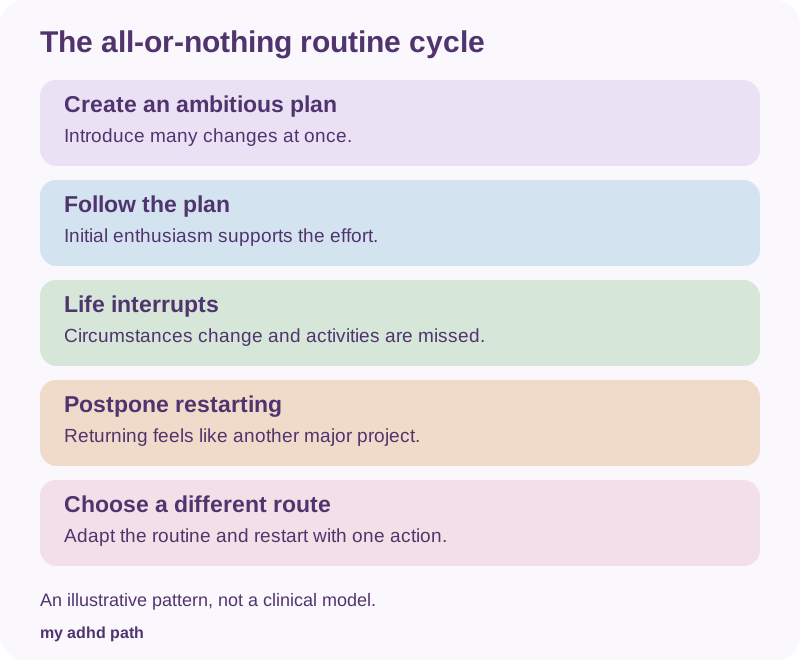
A routine often begins with an ambitious plan.
You introduce several activities at once and maintain them whilst your enthusiasm is high.
Then something changes.
You sleep badly. Work becomes demanding. Somebody in the family is unwell. You go away for a few days.
The original routine becomes more difficult to follow.
Instead of adapting it, you begin to feel as though you are no longer doing it properly.
Eventually, returning to the routine seems like another substantial project.
You decide to start again on Monday.
This is an example of an all-or-nothing pattern that may affect routines.
The problem isn't necessarily that the original activities were unsuitable.
A sustainable routine needs a way to continue when circumstances change.
The problem may be that the system had no provision for ordinary interruptions.
Build a routine that bends rather than breaks
Imagine that your ideal morning involves exercising, showering, preparing breakfast, reviewing your calendar and spending some time outside.
On an ordinary day, that might be achievable.
On a particularly demanding morning, it might not.
Instead of having one definition of what your morning should look like, create different versions.
The routine can then accommodate the time and energy you have available.
You haven't abandoned your morning routine simply because you used a shorter version of it.
You've adapted it.
The three-level routine system
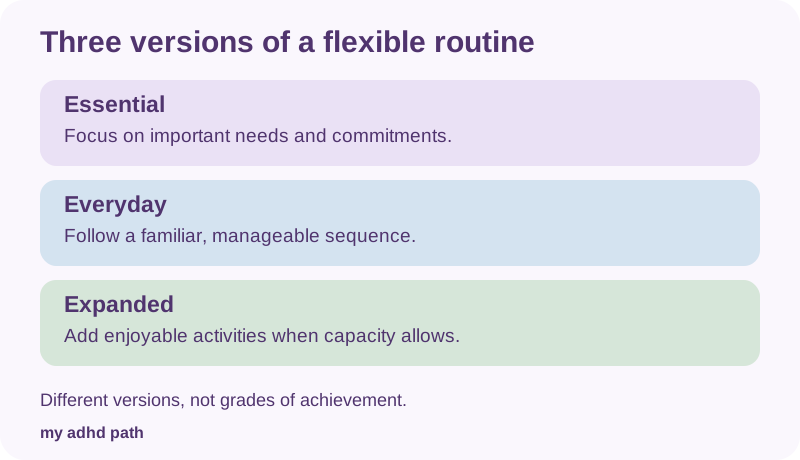
One approach is to create three versions of an everyday routine.
Level one: The essential routine
This is the simplest manageable version.
It focuses on important needs and responsibilities.
For example:
- Attend to essential personal care.
- Follow any prescribed medication instructions.
- Eat and drink according to your needs.
- Check your first important commitment.
The aim is to create an accessible starting point.
Good to know
If you regularly struggle to meet essential needs, additional practical or healthcare support may be appropriate.
Level two: The everyday routine
This is a familiar sequence that suits a reasonably typical day.
It might include:
- Getting washed and dressed.
- Having breakfast.
- Reviewing your calendar.
- Preparing what you need for the day.
- Beginning your first planned activity.
Level three: The expanded routine
This is for occasions when you have additional time, interest or energy.
You might include exercise, reading, preparing lunch in advance or other activities you enjoy.
There is no requirement to achieve level three.
These are different versions of the same routine rather than different levels of personal achievement.
The essential routine is not a failed morning.
It is a useful alternative.
Good to know
This framework is a practical planning suggestion, not a clinically validated ADHD intervention.
Use anchors instead of relying entirely on the clock
A fixed schedule can be useful when activities genuinely need to happen at a particular time.
School starts at a particular time. Appointments have deadlines. Some medicines must be taken according to specific instructions.
But not every everyday activity requires a fixed time.
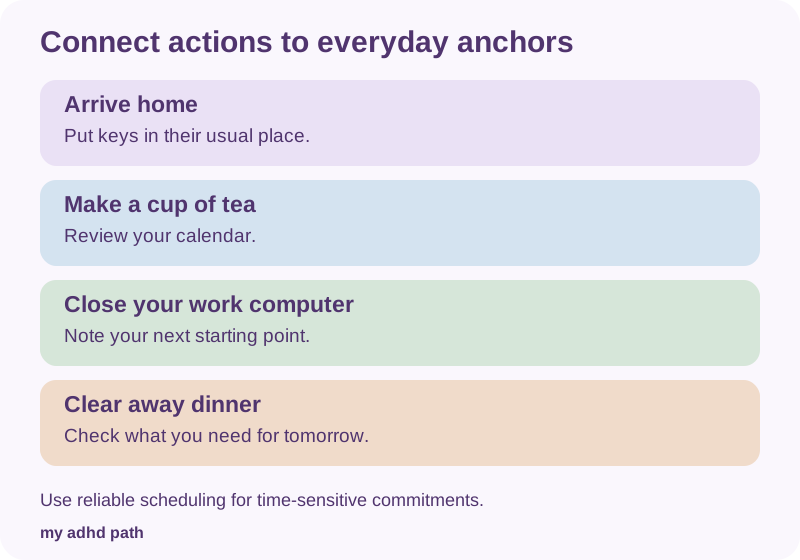
An anchor-based routine connects one activity to something that already happens.
For example:
| Existing anchor | Activity to connect to it |
|---|---|
| Arriving home | Put keys and bag in their usual place |
| Making your first cup of tea | Review your calendar |
| Finishing lunch | Check what you need for the afternoon |
| Closing your work computer | Write down your next starting point |
| Clearing away dinner | Identify anything needed for tomorrow |
The existing activity provides a cue.
You don't necessarily need to remember an entirely separate commitment at a particular time.
Good to know
This approach is related to broader behavioural concepts such as context-dependent habit formation and implementation intentions. Its usefulness depends on whether the anchor is reliable, noticeable and appropriate for the activity. Time-sensitive responsibilities still require suitable reminders and scheduling.
Why habit stacking sometimes works - and sometimes doesn't
Habit stacking involves connecting a new behaviour to an existing activity.
You might decide that after brushing your teeth, you'll prepare the clothes you need for tomorrow.
The existing behaviour creates an opportunity to remember the new one.
However, the idea can become less helpful if you attach numerous activities to a single anchor.
Brushing your teeth becomes the starting point for a twenty-minute sequence involving stretching, journalling, reviewing your goals, organising your wardrobe and preparing breakfast.
What began as a useful cue has become another demanding routine.
Try this
Start with one connection. See whether it is manageable. Introduce something else only if doing so will provide genuine value.
How long does it take to form a habit?
Common misconception
You've probably encountered the claim that it takes twenty-one days to form a habit. Unfortunately, habit formation isn't quite that predictable.
A widely cited 2010 study by Phillippa Lally and colleagues examined how everyday behaviours became more automatic over time.
The researchers reported an estimated median of sixty-six days to approach a plateau in automaticity among participants whose data fitted their model, with considerable individual variation.
The study was not specifically about ADHD.
It doesn't establish that somebody with ADHD needs sixty-six days, or any other fixed duration, to develop a habit.
The complexity of the behaviour, its context, the opportunities to repeat it and individual circumstances all matter.
Some useful routines may never become entirely automatic.
You may continue to benefit from reminders, visual cues or assistance.
That doesn't make the routine less successful.
Reduce the effort required to begin
A routine may become easier to maintain when the first action is clear and accessible.
Consider somebody who wants to take a regular morning walk.
They could begin each morning by deciding where to go, finding suitable clothing, locating their shoes and checking whether they have enough time.
Alternatively, they could keep their walking shoes and jacket in a convenient place and have a familiar route available.
The walk itself hasn't changed.
The amount of organisation required to begin has.
This principle can apply to many everyday activities.
| Activity | Make starting easier |
|---|---|
| Preparing breakfast | Keep familiar ingredients together |
| Beginning work | Leave a note identifying the first task |
| Doing laundry | Keep a hamper where clothes are removed |
| Getting ready to leave | Create a dedicated place for everyday essentials |
| Reading | Keep a book somewhere you regularly sit |
| Paying bills | Use appropriate automatic payments and scheduled checks |
Changing the environment can reduce the number of decisions involved in starting.
You don't have to rely exclusively on motivation.
Fifteen ways to build ADHD-friendly routines
1. Start with a problem rather than an ideal lifestyle
Identify something that regularly makes everyday life more difficult.
A routine that helps you leave the house without searching for your keys may offer more immediate value than an elaborate morning wellness programme.
2. Introduce one change at a time
Begin with a manageable activity.
Allow yourself to discover how it fits into your existing day before adding further responsibilities.
3. Make the first step specific
"Organise the house" is a substantial instruction.
"Put the clean washing into the drawers" provides a clearer starting point.
4. Connect activities to reliable anchors
Use existing events as cues for new activities where appropriate.
Choose anchors that occur regularly enough to provide useful structure.
5. Keep time-sensitive commitments separate
Appointments, medication instructions and important deadlines may require more reliable scheduling than a flexible routine alone.
Use appropriate alarms, calendars and support.
6. Create different versions of your routine
Establish an essential, everyday and expanded version.
Choose the version that suits your circumstances.
7. Make important routines visible
A short note by the front door, a visual checklist or a calendar reminder can reduce the need to remember an entire sequence independently.
Keep cues useful and manageable.
8. Measure the time activities actually take
As we explored in our guide to time blindness, familiar activities may take longer than expected.
Use realistic durations when creating routines.
9. Allow for transitions
Moving between activities takes time and attention.
Include space for putting things away, gathering equipment and preparing to begin something else.
10. Reduce unnecessary friction
Make frequently used items easy to access.
Prepare equipment in advance where useful and reduce unnecessary steps.
11. Introduce enjoyable variations
A routine can have a consistent purpose without looking identical every day.
You might vary your exercise, breakfast choices or walking route whilst maintaining an underlying structure.
12. Recognise the immediate benefits
Notice what a routine makes easier today.
A prepared bag means less searching. A ready-to-use kitchen means less work before dinner.
Useful outcomes can be more meaningful than maintaining an uninterrupted streak.
13. Create a restart plan
Decide how you'll return to a routine after an interruption.
Make the first action manageable enough to begin without extensive preparation.
14. Review routines when circumstances change
A routine that suited your life six months ago may no longer be appropriate.
Changes in work, health, family responsibilities or energy may require a different approach.
15. Keep routines that genuinely help
You don't need a routine for every part of your life.
If a system requires considerable effort but provides very little benefit, consider simplifying it or letting it go.
An ADHD-friendly morning routine
Morning routines receive an extraordinary amount of attention.
There are articles suggesting that successful people wake before sunrise, exercise, meditate, journal, read and prepare an elaborate breakfast before most people have found their slippers.
That might suit some individuals.
It isn't a requirement for having a useful morning.
Start with what your morning actually needs to achieve.
Perhaps you need to:
- Attend to personal care.
- Have something suitable to eat and drink.
- Follow prescribed medication instructions.
- Prepare for work or family responsibilities.
- Know when you need to leave.
Then consider which additional activities genuinely improve your morning.
A quiet cup of tea might be more useful to you than a demanding exercise programme.
Preparing a bag the previous evening might make a greater difference than waking thirty minutes earlier.
A helpful morning routine should reflect your needs rather than somebody else's definition of an impressive start to the day.
The evening routine that helps tomorrow's version of you
An evening routine doesn't need to involve an extensive cleaning session or a detailed review of everything you've achieved.
Sometimes a few practical preparations can make the following day considerably easier.
You might:
- Check your first commitment tomorrow.
- Put everyday essentials in their usual place.
- Prepare suitable clothing or work materials.
- Identify anything that needs additional preparation.
- Begin winding down before your intended bedtime.
Choose a manageable stopping point.
You don't need to resolve every unfinished household responsibility before you're allowed to rest.
Good to know
If you experience persistent difficulties with sleep, seek appropriate healthcare advice rather than assuming an evening routine will address the underlying cause.
Create a launch station
Try this
A launch station is simply a dedicated place for the things you regularly need when leaving home. It might be a shelf, basket, small table or collection of hooks.
Depending on your circumstances, it could contain:
- Keys.
- Your bag.
- Travel cards.
- Work identification.
- Glasses.
- A reminder of anything unusual you need to take.
Choose a location that fits naturally into your existing movements.
There is little value in creating an exquisitely organised storage area in a room you rarely enter.
Keep medicines, sharp objects and other potentially hazardous items stored safely and appropriately.
The aim is to make leaving easier, not to create another area that requires constant organisation.
When you work from home and every day feels different
Working from home can remove some of the external cues that naturally separate different parts of the day.
There may be no commute, formal lunch break or obvious moment when work finishes.
For some people with ADHD, this flexibility can be valuable.
For others, it can make beginning, stopping and switching between responsibilities more demanding.
Consider creating a small opening routine.
You might review your commitments, identify the first meaningful task and prepare the equipment you need.
A closing routine might involve recording unfinished work, checking tomorrow's calendar and putting work materials away.
These activities can help create boundaries without requiring your entire working day to follow a rigid timetable.
They may be particularly useful if you regularly become absorbed in interesting projects and continue working longer than intended.
Routines when you have children
Family life is remarkably effective at disrupting beautifully organised plans.
Somebody needs finding a different pair of shoes.
A school message arrives.
An activity changes location.
And the thing you reminded everybody to bring has somehow remained on the kitchen table.
Family routines need to accommodate several people, different needs and changing circumstances.
Simple shared structures can help.
A visible school preparation checklist, a dedicated place for bags or a family calendar may reduce the amount of information one person needs to remember.
Where appropriate, children can take responsibility for activities suited to their age, abilities and support needs.
The objective is not to create a household in which one person becomes responsible for reminding everybody else to follow the routine.
It is to make important responsibilities more visible and manageable for the people involved.
What happens when an interruption changes everything?
Holidays, illness, school holidays, deadlines and changes in working arrangements can interrupt established routines.
Some people find returning to those routines particularly difficult.
The familiar cues have changed.
Activities that previously occurred in a predictable sequence now require more deliberate organisation.
Rather than expecting yourself to resume everything immediately, identify the most useful starting point.
Returning from a holiday, for example, you might begin by checking upcoming commitments, arranging essential groceries and identifying what you need for the next working day.
The rest of your usual routine can return gradually.
A break in your routine does not erase everything you've previously learnt about what works for you.
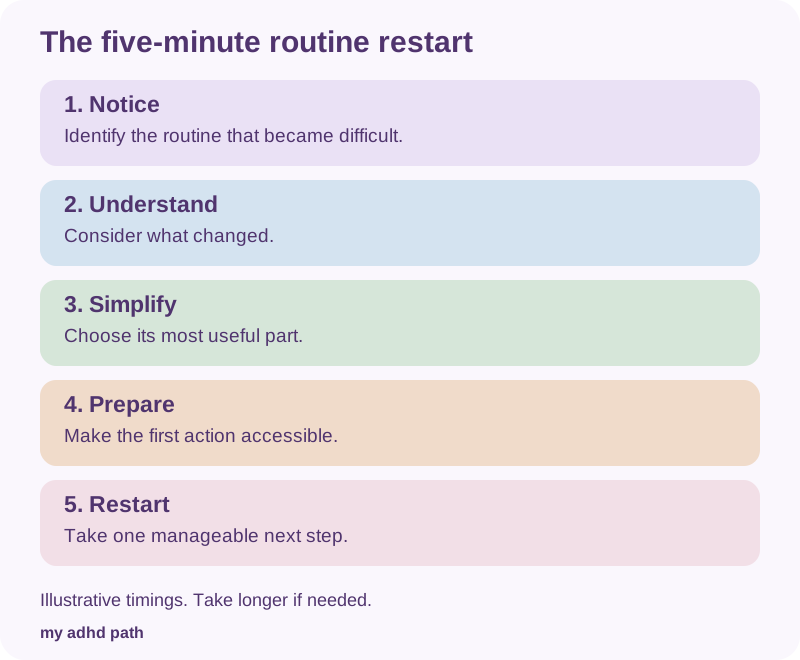
The five-minute routine restart
When a routine has disappeared from your everyday life, restarting needn't involve creating an entirely new system.
Practical checklist
- Minute one: Notice. Identify which routine has become difficult to maintain.
- Minute two: Understand. Consider what changed. Was the routine too demanding, or did circumstances interrupt it?
- Minute three: Simplify. Choose the most useful part of the routine.
- Minute four: Prepare. Make the first action easier by gathering what you need or introducing a suitable cue.
- Minute five: Restart. Complete the first manageable action or identify when it can happen.
The timings are illustrative. Take longer if you need to.
Restarting does not require a new month, a Monday morning or another notebook.
It requires an accessible next step.
Do habit trackers help people with ADHD?
Habit trackers can make repeated activities more visible.
Some people enjoy seeing their progress and find the visual feedback encouraging.
Others find that tracking becomes an additional responsibility.
An uninterrupted streak might feel motivating until the inevitable day when something gets missed.
If you enjoy tracking habits, consider a system that recognises individual occasions rather than consecutive days.
Track what you actually did.
Notice whether it helped.
Allow gaps without treating them as a reason to abandon the system.
You could also track how easy a routine felt or what changed when you used it.
You don't necessarily need to turn every useful behaviour into something measurable.
Sometimes the fact that life becomes a little easier is sufficient evidence that your system is helping.
When routines become another source of pressure
A routine should support your life.
It shouldn't require you to organise every available moment or feel guilty whenever something happens differently.
Some people spend so much effort designing, monitoring and maintaining their productivity systems that very little time remains to enjoy the activities those systems were intended to support.
Good to know
It can be useful to ask: Is this routine addressing a genuine need? Does it reduce effort or create more of it? Can I adapt it when circumstances change? Does it leave space for enjoyable, spontaneous activities? Can I return to it without feeling that I've failed? The answers may reveal that a simpler routine would be more useful.
Rest, flexibility and unplanned time can have an important place in everyday life.
Three different approaches to ADHD-friendly routines
The following examples are fictional illustrations.
Illustrative scenario
Emma, 38 - The disappearing morning routine
Emma regularly creates ambitious morning schedules involving exercise, reading and household organisation. She maintains them for short periods before finding them difficult to sustain. She decides to establish a simpler everyday routine with additional activities available when she has more time. Her mornings become easier to organise without requiring every day to begin identically.
Illustrative scenario
Marcus, 45 - Working without external structure
Marcus works from home and frequently continues working late into the evening. He introduces a closing routine that involves reviewing unfinished tasks, identifying tomorrow's starting point and shutting down his computer. Having a familiar stopping process helps him establish a clearer boundary between work and home life.
Illustrative scenario
Priya, 33 - Starting again after interruptions
Priya finds that holidays regularly disrupt her household routines. Instead of expecting to resume everything immediately, she creates a short return-home checklist. It provides a starting point for essential responsibilities while allowing other routines to return gradually.
Create your personal routine support profile
Rather than copying somebody else's schedule, think about the support your own day requires.
| Question | Illustrative answer |
|---|---|
| Which part of my day feels most difficult? | Leaving the house in the morning |
| What would a useful routine help me achieve? | Leaving without searching for things |
| Which existing activity could provide an anchor? | Clearing away dinner |
| What would make starting easier? | Preparing my bag the night before |
| What usually interrupts my routines? | Unexpected changes to family plans |
| What is my essential version? | Check keys, bag and departure time |
| What could help me restart? | A short checklist by the front door |
| How will I know the routine is helping? | Fewer rushed mornings |
Choose a routine based on the benefit it could provide, rather than how organised it might make you appear.
A seven-day routine experiment
This experiment is about discovering what makes a routine accessible.
It is not a seven-day challenge to establish a permanent habit.
Practical checklist
- Day one: Identify. Choose one everyday difficulty you would like to make easier.
- Day two: Simplify. Identify the smallest useful action associated with it.
- Day three: Anchor. Connect that action to something that already happens, or establish a suitable reminder.
- Day four: Prepare. Change one aspect of your environment to make beginning easier.
- Day five: Adapt. Create a shorter version for particularly demanding days.
- Day six: Plan to restart. Identify how you'll return to the routine after an interruption.
- Day seven: Review. Consider whether the routine reduced effort, improved your day or needs further adjustment.
Complete the experiment at your own pace.
Missing a day is an opportunity to explore how your system accommodates interruptions.
It isn't a reason to begin the entire experiment again.
Using AI to create more manageable routines
AI assistants can help translate everyday responsibilities into simpler sequences.
They can also help identify unnecessary steps and suggest alternative arrangements when circumstances change.
AI prompt
Simplify my morning
"Help me create a realistic morning routine based on these essential responsibilities. Ask me how long activities actually take. Include preparation and transition time without adding unnecessary wellness or productivity activities."
AI prompt
Build three versions of my routine
"Create essential, everyday and expanded versions of this routine. Make sure the essential version addresses important needs rather than simply removing activities arbitrarily."
AI prompt
Find existing anchors
"Review these activities that already happen regularly in my day. Suggest a few appropriate anchors for the behaviours I want to remember. Keep time-sensitive medication and important commitments separate."
AI prompt
Help me restart
"I've stopped following this routine. Help me understand what might have made it difficult to maintain and suggest one manageable action I can take to restart."
AI prompt
Reduce unnecessary effort
"Review this routine and identify steps that could be simplified, combined or supported by changes to my environment. Preserve the important responsibilities and leave room for flexibility."
AI suggestions should be adapted to your circumstances.
Check important timings and commitments independently, protect sensitive personal information and do not rely on AI to provide medication instructions.
If you need reminders, ensure that an appropriate scheduling feature has actually been configured.
What the research says
Research into ADHD has identified group-level differences in aspects of executive functioning, attention and reward processing. These areas may be relevant to establishing, maintaining and returning to everyday routines. Clinical guidance also recognises the importance of environmental modifications and individualised support. Broader behavioural research has examined habits, contextual cues and implementation intentions. These studies suggest that linking actions to identifiable situations and repeating behaviours in familiar contexts can help some behaviours become easier to maintain. However, much of this research is not specifically about people with ADHD. There is limited direct evidence comparing the particular routine frameworks described in this article. The approaches in this guide are practical ways to explore reducing executive functioning demands and making important behaviours more accessible.
Can ADHD treatment make routines easier?
Effective ADHD treatment may help some individuals manage symptoms that affect task initiation, attention and organisation.
This may make certain everyday routines easier to maintain.
Psychological interventions and practical skills-based support may also help some people develop useful strategies.
However, treatment does not guarantee that routines will become effortless or entirely automatic.
External reminders, accessible environments and flexible planning may remain valuable.
Good to know
If existing treatment is not adequately supporting your everyday functioning, discuss your experiences with your healthcare professional. Do not independently alter prescribed medication in an attempt to improve motivation or routine consistency.
When to seek additional support
If everyday routines are consistently difficult to maintain and this affects your health, employment, education or ability to look after yourself, additional support may be appropriate.
A GP or other suitable healthcare professional can help explore contributing factors and appropriate next steps.
ADHD-related difficulties may also coexist with anxiety, depression, sleep problems, physical health conditions, caring demands or exhaustion.
A change in your ability to manage previously familiar responsibilities deserves attention rather than being automatically attributed to ADHD.
Depending on your circumstances, occupational therapy, psychological support, workplace adjustments or practical assistance may be useful.
There is value in creating better systems.
There is also value in recognising when the amount you're being expected to manage requires additional support.
Downloadable resource
My ADHD Routine Toolkit
Adaptable morning and evening planners, everyday anchor worksheets, simple habit trackers and practical strategies for returning to routines after interruptions.
Download My ADHD Routine ToolkitFrequently asked questions
Why are routines so difficult with ADHD?
Routines may require remembering, initiating, switching between and repeating activities. These demands can be particularly challenging for some people with ADHD.
Do people with ADHD need routines?
Some people benefit considerably from predictable structure, while others prefer greater flexibility. Useful routines should reflect individual needs and circumstances.
Why do I get bored with routines?
The initial novelty of a new routine may diminish as activities become familiar. Repetitive activities may then require more deliberate effort. Experiences vary.
Can people with ADHD develop habits?
Yes. People with ADHD can develop habits, although the time and support required may differ between individuals and activities.
How long does it take to build a routine with ADHD?
There is no established universal timeframe. The complexity of the routine, context, opportunities for repetition and individual circumstances all matter.
What is the best morning routine for ADHD?
A useful morning routine addresses important needs, uses realistic timings and remains manageable on different kinds of days. There is no single ideal routine.
What is habit stacking?
Habit stacking involves connecting a new behaviour to an existing activity. The existing activity acts as a cue, although its usefulness depends on the circumstances.
Why do I abandon routines after missing one day?
Some people develop all-or-nothing expectations about consistency. Creating flexible alternatives and a clear restart plan may help reduce this difficulty.
Are visual checklists helpful for ADHD?
They can reduce demands on working memory and make sequences easier to follow. Choose a format that is accessible and does not become an additional burden.
Can I have a routine without a fixed schedule?
Yes. Many activities can be connected to existing events rather than particular times. Important deadlines and time-sensitive responsibilities still need appropriate scheduling.
Can ADHD medication help me maintain routines?
Effective treatment may improve symptoms that affect organisation and attention. Individual responses vary, and practical support may still be useful.
Are habit trackers good for ADHD?
Some people find them helpful, while others find tracking burdensome. Consider whether tracking provides genuine value rather than creating additional pressure.
How do I restart my routine after a holiday?
Identify the most useful part of the routine, prepare what you need and begin with one manageable action. Other activities can return gradually.
Consistency doesn't have to mean doing the same thing every day
You might never become somebody who follows an identical morning routine from Monday to Sunday.
You might continue to enjoy discovering new ways of organising your life.
There may be weeks when your routines work beautifully and weeks when you need to approach things differently.
None of that prevents you from building useful structure.
You can have a familiar place for your keys.
A manageable way to prepare for tomorrow.
A reliable reminder for important commitments.
A shorter routine for demanding days.
And a simple way to begin again when life interrupts your plans.
The measure of a successful routine isn't how many consecutive days you've followed it. It's how much easier it makes your life.
Sources and further reading
- NICE - Attention deficit hyperactivity disorder: diagnosis and management (NG87). https://www.nice.org.uk/guidance/ng87
- NHS - Attention deficit hyperactivity disorder (ADHD). https://www.nhs.uk/conditions/attention-deficit-hyperactivity-disorder-adhd/
- Lally, P., van Jaarsveld, C. H. M., Potts, H. W. W. and Wardle, J. (2010). How are habits formed: Modelling habit formation in the real world. European Journal of Social Psychology. https://doi.org/10.1002/ejsp.674
- Wood, W. and Runger, D. (2016). Psychology of Habit. Annual Review of Psychology. https://doi.org/10.1146/annurev-psych-122414-033417
- Gollwitzer, P. M. (1999). Implementation intentions: Strong effects of simple plans. American Psychologist. https://doi.org/10.1037/0003-066X.54.7.493
- Diamond, A. (2013). Executive functions. Annual Review of Psychology. https://doi.org/10.1146/annurev-psych-113011-143750
- Faraone, S. V. et al. (2021). The World Federation of ADHD International Consensus Statement: 208 Evidence-based conclusions about the disorder. https://doi.org/10.1016/j.neubiorev.2021.01.022
- GOV.UK - Access to Work. https://www.gov.uk/access-to-work
This article provides general educational information, not individual medical or psychological advice. All personal scenarios are fictional. The routine frameworks and exercises are practical educational tools rather than clinically validated ADHD interventions.