

Sometimes the hardest part of making dinner isn't cooking it. It's deciding what it is, remembering to buy it and finding the energy to begin.
At a glance
- Cooking involves considerably more than preparing food.
- Executive functioning difficulties may affect shopping, planning and remembering meals.
- Flexible meal menus can accommodate changing energy and circumstances.
- Convenience ingredients can provide genuine practical value.
- Visible food storage may reduce unnecessary waste.
- Appetite changes associated with medication deserve appropriate monitoring.
- Food safety and individual dietary requirements always take priority.
There is a bag of spinach in your fridge.
You bought it with excellent intentions.
You were going to make something nutritious, possibly involving the salmon you also bought and a recipe you'd seen online.
Unfortunately, the spinach disappeared behind a large pot of yoghurt, the salmon went into the freezer and you've completely forgotten where you saved the recipe.
It's now Wednesday evening, the children are hungry and you're standing in front of a fridge full of ingredients wondering why there's nothing to eat.
There is, of course, plenty to eat.
What there isn't is a readily available decision about what to do with it.
For some people with ADHD, managing food involves considerably more effort than the cooking itself.
And the solution might not be another beautifully organised seven-day meal plan.
It might be a completely different approach to feeding yourself and your family.
Why meal planning can be difficult with ADHD
Preparing an evening meal involves a surprisingly complicated sequence of activities.
You need to decide what to eat, establish which ingredients you already have, identify what you need to buy, remember to buy it and ensure everything is available when you need it.
Then there's the cooking itself.
Managing several timings, following instructions, switching between activities and remembering what you've already done.
And, rather inconveniently, somebody still needs to clean the kitchen afterwards.
These activities draw on several aspects of executive functioning, including working memory, planning, attention regulation and task initiation.
For some people with ADHD, managing all these demands repeatedly can be exhausting.
This doesn't mean they cannot cook.
You might be perfectly capable of producing an impressive three-course meal for friends on a Saturday evening whilst finding an ordinary Tuesday dinner considerably more challenging.
The novelty, motivation, structure and available energy can be very different.
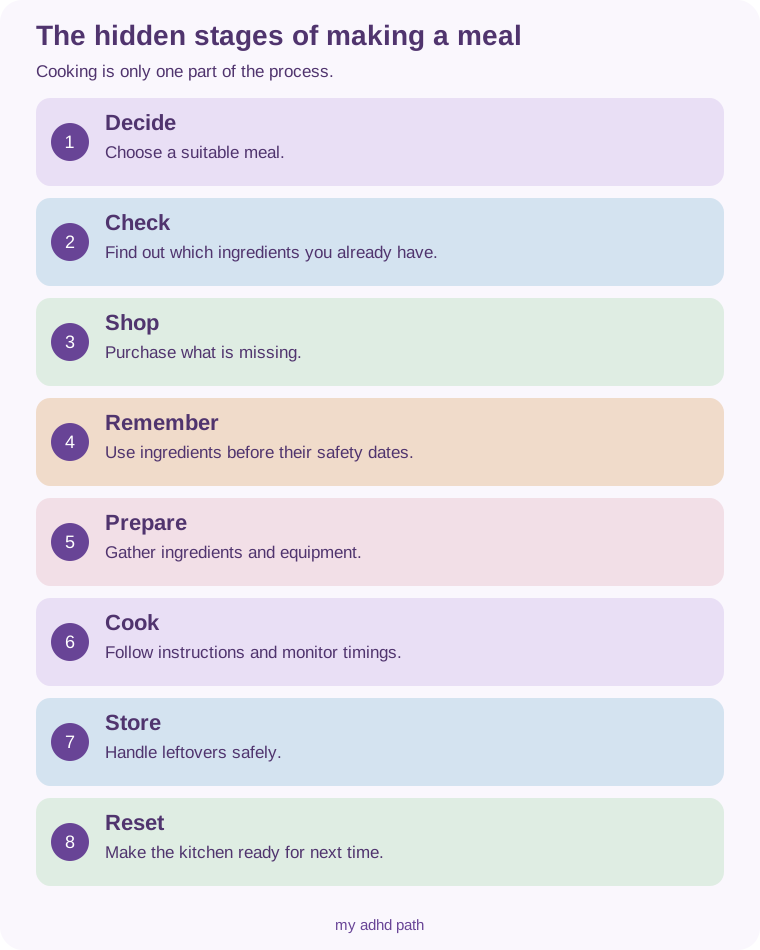
Cooking is only one part of the process
When somebody suggests that you should cook more often, they may be thinking primarily about the time spent preparing food.
But cooking involves a much wider collection of responsibilities.
| Stage | What it requires |
|---|---|
| Decide | Choose a suitable meal |
| Check | Establish which ingredients are available |
| Shop | Purchase what is missing |
| Remember | Use ingredients before they expire |
| Prepare | Gather and organise everything needed |
| Cook | Manage instructions, timings and attention |
| Store | Deal safely with leftovers |
| Reset | Wash up and prepare the kitchen for next time |
If one stage becomes difficult, it can affect everything that follows.
You may not need to improve your cooking skills at all.
You might simply need to make deciding, shopping or remembering considerably easier.
Twelve ADHD kitchen experiences you might recognise
1. Buying ingredients without a particular meal in mind
You return from the supermarket with an impressive selection of food.
Unfortunately, very little of it appears to belong to the same dinner.
2. Forgetting what is in the fridge
Food that disappears behind other items may receive considerably less attention.
You remember buying it when you discover it several days later.
3. Purchasing duplicates
You're fairly certain you've run out of pasta.
The four packets already in the cupboard would suggest otherwise.
4. Forgetting to eat when you're busy
You become absorbed in an activity and overlook the time, your usual mealtime or emerging hunger cues.
Eventually, you realise you haven't eaten for several hours.
5. Finding food decisions overwhelming
Choosing a meal requires considering preferences, ingredients, preparation time, nutritional needs and possibly several other people's opinions.
Sometimes the number of decisions becomes more demanding than the activity itself.
6. Repeatedly eating the same thing
A familiar meal requires fewer decisions and offers a predictable experience.
Eating similar meals regularly isn't inherently problematic, although nutritional variety and individual dietary needs still matter.
7. Losing interest in a previously favourite food
Something you thoroughly enjoyed last week becomes remarkably unappealing this week.
Unfortunately, you bought six portions of it.
8. Underestimating cooking time
The recipe says thirty minutes.
It doesn't necessarily account for finding everything, reading the instructions, chopping ingredients or dealing with interruptions.
9. Starting too many things at once
You begin preparing several components of a meal and find it difficult to monitor everything simultaneously.
Timers and simpler cooking methods may help.
10. Avoiding cooking because of the washing-up
The kitchen already contains items that need putting away.
Before you can begin cooking, there's another task to complete.
11. Becoming overwhelmed in the supermarket
Noise, lighting, numerous choices, crowded aisles and an incomplete shopping list can make food shopping particularly demanding.
Online shopping or quieter shopping periods may be more manageable for some people.
12. Creating ambitious meal plans that quickly disappear
You plan seven different dinners, buy all the ingredients and start the week feeling exceptionally organised.
Then Tuesday happens.
These experiences can occur with or without ADHD. They are illustrative rather than diagnostic.
Why traditional meal planning sometimes doesn't work
Many meal planning systems assume that you'll know on Sunday what you'll want to eat on Thursday.
They also assume that your energy, available time and circumstances will remain reasonably predictable.
But what happens when Thursday involves an unexpectedly difficult day at work, a cancelled arrangement or a child who suddenly needs help with homework?
The meal you've planned may require considerably more effort than you have available.
You could abandon the plan entirely.
Or you could create a plan that already accommodates different kinds of days.
Rather than requiring yourself to follow a particular menu regardless of circumstances, build a collection of suitable options.
This retains the useful structure of meal planning without requiring every decision to be made in advance.
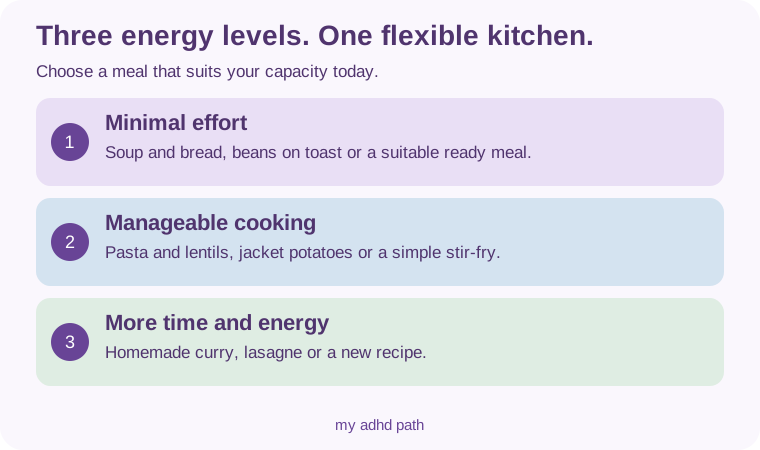
The three-energy-level meal system
One approach is to organise meals according to how much effort they require.
Not how impressive they are.
Not how many ingredients they contain.
And certainly not how much credit you think you deserve for making them.
Level one: Minimal effort
These are meals for days when cooking feels particularly demanding or time is limited.
They might include:
- Beans on toast with tomatoes.
- A suitable ready meal with frozen vegetables.
- Hummus, pitta, cucumber and fruit.
- Microwave rice with tinned beans and a suitable sauce.
- A sandwich or wrap with a nourishing filling.
- Soup with wholemeal bread.
The objective is to make eating accessible without requiring extensive preparation.
Level two: Manageable cooking
These meals require some preparation but use relatively familiar ingredients and straightforward methods.
Examples include:
- Pasta with tomato sauce, lentils and spinach.
- Jacket potatoes with beans and cheese.
- A simple vegetable and chicken stir-fry.
- An omelette with toast and salad.
- Couscous with chickpeas and roasted vegetables.
- A traybake using pre-prepared ingredients.
Level three: Cooking with more time and energy
These are meals you might enjoy preparing when you have greater capacity.
They could include homemade curries, lasagne, shepherd's pie, casseroles or trying a new recipe.
You may also enjoy preparing additional portions for another day.
Level one is not a failed version of level three.
All three levels have a useful place in your kitchen.
Good to know
The examples are flexible meal ideas, not individual nutritional recommendations. Adapt them for allergies, dietary requirements, health conditions, preferences and budgets.
Build a meal menu instead of a rigid meal plan
A meal menu is a collection of options you can choose from throughout the week.
You might select five meals, purchase the appropriate ingredients and decide which meal suits each day as it arrives.
For example:
| Meal option | Effort required |
|---|---|
| Pasta with tomato and lentil sauce | Manageable |
| Jacket potatoes with beans and cheese | Manageable |
| Vegetable and chicken traybake | Manageable |
| Soup and a filled sandwich | Minimal |
| Homemade curry | Higher |
| Frozen meal you enjoy | Minimal |
| Leftovers | Varies |
Recipes containing more perishable ingredients may need prioritising earlier in the week.
Meals relying on cupboard or frozen ingredients offer greater flexibility.
This approach allows you to respond to your circumstances without having to create an entirely new shopping list.
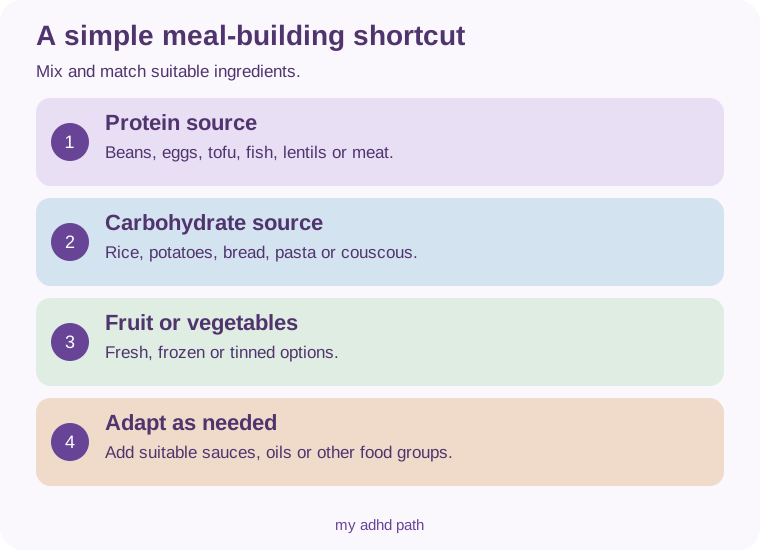
The three-component meal formula
When you haven't planned a particular recipe, it can help to think in terms of simple meal components.
For many everyday meals, you could consider combining:
A protein source: beans, lentils, eggs, tofu, fish, meat or another suitable option.
A carbohydrate source: potatoes, rice, pasta, bread, couscous or another suitable starchy food.
Fruit or vegetables: fresh, frozen or tinned options.
Depending on the meal and your needs, you might add a suitable sauce, oil, seasoning, dairy product or alternative.
Here are some examples.
| Protein source | Carbohydrate | Fruit or vegetables |
|---|---|---|
| Chickpeas | Couscous | Roasted peppers |
| Eggs | Wholemeal toast | Tomatoes |
| Tinned tuna | Jacket potato | Sweetcorn |
| Tofu | Rice | Frozen stir-fry vegetables |
| Lentils | Pasta | Tomato and spinach |
Good to know
This is a meal-building shortcut rather than a complete nutritional model. A balanced diet involves a wider range of nutrients and food groups across the day or week. Individual requirements vary.
Nevertheless, using a few familiar components can make deciding what to eat less demanding.
Create an emergency food shelf
There will be days when your original meal plan simply isn't going to happen.
Instead of relying on those days being unusual, assume they will occasionally occur.
Try this
Create a small collection of accessible foods that can be combined into meals without much preparation.
Your cupboard might contain:
- Tinned beans and lentils.
- Soup.
- Microwave rice.
- Pasta and suitable sauces.
- Tinned vegetables.
- Tinned fish, if you eat it.
- Crackers or other suitable long-life foods.
Your freezer might contain vegetables, bread, prepared meals and safely frozen individual portions of food you enjoy.
Choose things you genuinely like eating.
An emergency food shelf full of worthy ingredients you have no interest in preparing is unlikely to be particularly helpful.
Good to know
Review expiry dates and storage instructions periodically.
Make your fridge work with your memory
A beautifully organised fridge isn't necessarily an accessible fridge.
If the food you need to remember is hidden behind other items, it can be easy to overlook.
Try this
Introduce an "Eat First" area for suitable items that need using soon. You could identify a particular shelf or place a clearly labelled container in an appropriate part of the fridge.
Good to know
Food safety takes priority over visibility. Raw meat and fish should be stored safely in sealed containers on the bottom shelf, away from ready-to-eat foods. Other products should be stored according to their packaging instructions. Use the Eat First area for foods that can safely be stored together, or use a reminder noting items that need attention elsewhere in the fridge.
Other useful changes might include:
- Keeping suitable frequently used ingredients visible.
- Using clear, food-safe containers.
- Labelling safely stored leftovers with dates.
- Keeping similar ingredients together.
- Checking existing food before shopping.
- Maintaining a small inventory of useful freezer meals.
The objective is to reduce the amount of information you need to remember independently.
Use-by dates and best-before dates are different
Good to know
In the UK, a use-by date relates to food safety. Food should not be eaten after its use-by date unless it was appropriately cooked or frozen before that date and subsequently handled according to food safety guidance. Food can contain harmful bacteria even when it looks and smells normal.
A best-before date generally relates to food quality. Food may still be suitable after its best-before date if it has been stored correctly, although its quality may have changed.
Always follow storage instructions and guidance about how quickly food should be consumed once opened. If you're unsure whether something is safe to eat, consult the Food Standards Agency's guidance.
A reminder system should help you use food safely, not encourage you to ignore safety dates.
Is buying pre-prepared food cheating?
Common misconception
There is an extraordinary amount of judgement attached to how people prepare food. Somehow, chopping your own onions has become an achievement in its own right. But the purpose of preparing dinner is to provide something suitable to eat.
Somehow, chopping your own onions has become an achievement in its own right.
If frozen chopped onions, prepared vegetables or microwave rice make that more achievable, they may be useful ingredients in your kitchen.
The same applies to suitable ready meals and other convenience foods.
Good to know
Convenience foods vary in nutritional content, cost and ingredients, so compare options according to your needs.
You might discover that buying slightly more expensive prepared vegetables costs less overall because you actually use them.
As we explored in our guide to ADHD and money, the cheapest option on paper isn't necessarily the cheapest option in practice.
Fifteen ways to make meal planning easier with ADHD
1. Reduce the number of decisions
Build a small collection of familiar meals rather than searching for new recipes every week.
You can introduce variety when you have the interest and energy to do so.
2. Create a reusable shopping list
Keep a master list of foods you regularly purchase.
Review it before shopping and remove anything you don't currently need.
3. Organise your shopping list by supermarket section
Group produce, chilled foods, cupboard ingredients and frozen items.
This may reduce the amount of time spent repeatedly returning to the same aisles.
4. Check your kitchen before you shop
Take a brief look through the fridge, freezer and cupboards.
Identify ingredients you could use in upcoming meals.
A photograph or simple written note can help if you're shopping away from home.
5. Choose ingredients that work in several meals
A bag of frozen vegetables, a packet of rice or a tin of chickpeas can form part of numerous different meals.
Flexible ingredients reduce the consequences of changing your original plan.
6. Keep genuinely easy meals available
Choose meals that require minimal preparation and washing-up.
Having an accessible alternative can reduce the pressure associated with cooking on demanding days.
7. Use frozen ingredients
Frozen fruit, vegetables and other suitable foods can provide flexibility and reduce the pressure to use everything immediately.
Follow storage and preparation instructions.
8. Try flexible meal themes
Rather than deciding exactly what you will cook every day, you might use themes.
Pasta night. Jacket potato night. Traybake night. Something from the freezer.
Themes provide structure whilst retaining choice.
9. Prepare components rather than entire weeks of meals
If you enjoy some food preparation in advance, consider preparing a few ingredients or additional portions rather than cooking seven complete meals.
Follow safe storage guidance and freeze suitable portions when necessary.
10. Make recipes easier to follow
Choose instructions with clear stages and familiar ingredients.
Read through the recipe before starting and gather what you need.
If lengthy recipe pages are difficult to follow, create a simple version that preserves all essential cooking and safety instructions.
11. Use labelled kitchen timers
Instead of setting an alarm without context, label it according to its purpose.
"Check potatoes" or "Check whether chicken is cooked" provides a clearer cue.
Good to know
Timers are reminders, not proof that food has been cooked safely.
12. Reduce the washing-up
One-pot dishes, traybakes and simpler meals can reduce the number of items needing attention afterwards.
Use cooking equipment safely and according to its instructions.
13. Establish a manageable shopping routine
You might prefer one larger weekly shop, several smaller shops or an online grocery order.
Choose the method that suits your circumstances rather than assuming one approach is universally better.
14. Share responsibility where appropriate
If you live with other people, consider how meal decisions, shopping, cooking and cleaning are distributed.
Preparing food is not solely the responsibility of the person who notices that something needs doing.
15. Keep the system easy to restart
If you haven't meal planned for three weeks, you don't need to reconstruct everything you intended to cook.
Choose a few suitable meals for the next couple of days.
Start from what is available now.
The forgotten lunch problem
You begin working at nine o'clock.
You become absorbed in something interesting.
At half past two, you realise that you're unusually irritable, finding it difficult to concentrate and feeling rather hungry.
You haven't eaten lunch.
For some people with ADHD, becoming absorbed in activities can interfere with noticing or responding to hunger and other bodily cues.
Good to know
Some individuals also report differences in interoception, the process of sensing internal bodily signals. However, the relationship between interoception and ADHD is still being researched, and experiences vary.
Practical support might involve making food accessible before beginning a demanding activity.
You could prepare a suitable lunch, establish a regular eating break or set a reminder that clearly identifies what to do.
Keep drinks accessible too, and respond to your own hydration needs.
The aim is to help everyday responsibilities coexist with eating and looking after yourself.
ADHD medication and appetite
Some ADHD medicines can affect appetite.
You may find that you are less interested in eating at certain times of the day or that maintaining regular meals becomes more difficult.
Good to know
NICE guidance recognises appetite and weight-related effects as issues that may require monitoring and individualised support. If you experience persistent appetite changes, unintended weight changes or difficulties eating enough, discuss these with your prescribing clinician. They may advise on appropriate meal timing, medication management or referral for nutritional support. Do not independently change medication, doses or schedules to manage appetite.
Good to know
Children and teenagers taking ADHD medication should receive appropriate growth and weight monitoring through their healthcare team.
Sensory preferences and food
Food involves an enormous variety of sensory experiences.
Texture, smell, temperature, appearance and taste can all influence whether something feels appealing or comfortable to eat.
Some adults and children with ADHD report particular sensory preferences.
These experiences can also occur alongside autism and other conditions, or independently of a diagnosis.
You might prefer foods that have predictable textures.
You might dislike certain foods touching.
You might find a meal difficult to eat because it contains an unexpected ingredient.
For everyday planning, incorporating familiar and acceptable foods can help make eating more accessible.
Good to know
Significantly restricted eating, nutritional difficulties, distress around food or concerns about an eating disorder warrant appropriate professional assessment and support. Avoid using pressure, punishment or shame to address eating difficulties.
ADHD and eating disorders
Good to know
Research has identified associations between ADHD and certain difficulties involving eating behaviour, including an increased prevalence of some eating disorders among people with ADHD. This does not mean that having ADHD inevitably leads to disordered eating. Nor does enjoying a particular food, occasionally overeating or forgetting a meal establish an eating disorder.
Eating disorders are serious conditions that deserve specialist support.
If you experience recurrent loss of control around eating, significant food restriction, distress about eating, compensatory behaviours or persistent concerns about body image, speak to an appropriate healthcare professional.
In the UK, Beat also provides eating disorder information and support.
The strategies in this guide are designed to reduce the practical demands of preparing and accessing food. They are not weight-loss advice or treatment for an eating disorder.
Meal planning for families with ADHD
Feeding a household can involve coordinating several schedules, preferences and dietary needs.
What one child happily ate yesterday may apparently be completely unacceptable today.
One person has football practice.
Somebody else won't be home until seven.
And nobody seems particularly keen to answer the question of what they would like for dinner.
Consider building a collection of familiar family meals that can be adapted without preparing several entirely different dinners.
For example, a meal might involve wraps with separate suitable fillings, jacket potatoes with different toppings or a pasta dish with accompanying vegetables.
Where appropriate, involve children in selecting meals, preparing ingredients and learning simple cooking skills.
Good to know
Supervise children according to their age, abilities and the risks involved. Respect diagnosed allergies, coeliac disease and other dietary requirements. Shared ingredients and equipment may require particular precautions to prevent cross-contact.
Family meal planning should accommodate genuine needs rather than simply insisting everybody eats the same thing.
How safe cooking habits can support an ADHD-friendly kitchen
Good to know
Cooking involves heat, sharp equipment and activities that require ongoing attention. If you regularly become distracted, consider creating routines that make safe cooking easier.
- Stay in the kitchen when frying or grilling food. If you need to leave the kitchen, switch off the hob where appropriate rather than relying on a reminder alone.
- Keep flammable items away from cooking equipment.
- Use appropriate timers and follow appliance instructions.
- Check that food is thoroughly cooked according to relevant safety guidance.
- Ensure smoke alarms are installed, maintained and tested appropriately.
For leftovers, follow Food Standards Agency guidance on cooling, refrigeration, freezing and reheating.
Good to know
Cooked rice requires particular care because harmful bacterial toxins can develop if it is stored incorrectly.
Convenience and simplicity are useful goals, but they should never come at the expense of food or fire safety.
Three different ADHD kitchen experiences
The following examples are fictional illustrations.
Illustrative scenario
Sophie, 41 - The ambitious weekly shop
Sophie purchases ingredients for seven different meals every Sunday. By the end of the week, several meals haven't been made and some ingredients need throwing away. She changes her approach, choosing three fresh meals alongside several options using frozen and cupboard ingredients. Her plans become more flexible, and she finds it easier to use the food she purchases.
Illustrative scenario
Amir, 35 - The forgotten lunch
Amir works from home and frequently becomes absorbed in projects. He doesn't always notice how late it has become until hunger begins affecting his concentration. He starts keeping familiar lunch ingredients available and introduces a dedicated eating break in his working day. The system reduces the amount of organisation needed when he is already hungry.
Illustrative scenario
Helen, 49 - Cooking after a demanding day
Helen enjoys cooking at weekends but finds weekday dinners particularly difficult. Rather than expecting herself to prepare elaborate meals every evening, she creates a collection of minimal-effort and manageable meals. She also freezes suitable portions of food she enjoys making at weekends. Cooking becomes something she can enjoy when she has the capacity, rather than something she needs to approach in the same way every day.
Create your personal kitchen support profile
You don't need to completely reorganise your kitchen.
Begin by identifying the stages of managing food that require the most effort.
| Question | Illustrative answer |
|---|---|
| What do I find most difficult? | Deciding what to cook |
| When do I forget to eat? | During focused working periods |
| Which ingredients regularly go to waste? | Salad leaves and fresh herbs |
| Which meals require minimal effort? | Soup, sandwiches and jacket potatoes |
| What cooking stages overwhelm me? | Managing several timings |
| Which convenience foods help? | Frozen chopped vegetables |
| What food do I want to keep available? | Ingredients for familiar lunches |
| What one change could help this week? | Create an Eat First fridge area |
Your answers may change depending on your circumstances, household and health.
Choose changes that reduce effort without adding unnecessary rules.
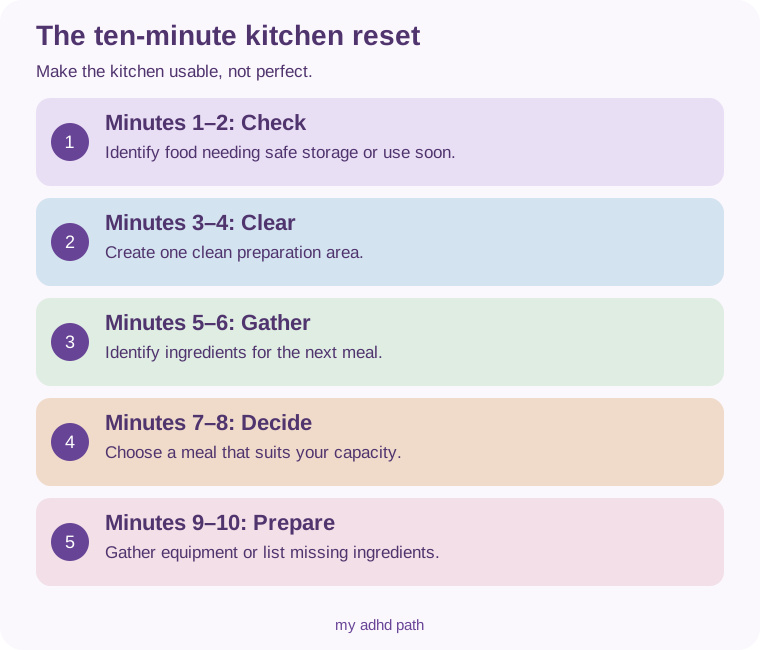
The ten-minute kitchen reset
Sometimes the kitchen feels difficult because there are too many small tasks requiring attention simultaneously.
A short reset may make the next meal easier to prepare.
Practical checklist
- Minutes 1-2: Check. Look for food that needs using soon and identify anything that needs storing safely.
- Minutes 3-4: Clear. Create one clean, usable preparation area.
- Minutes 5-6: Gather. Identify the ingredients for your next meal.
- Minutes 7-8: Decide. Choose a suitable meal based on your available time and energy.
- Minutes 9-10: Prepare. Gather the equipment you need or add missing ingredients to your shopping list.
These timings are illustrative.
Good to know
Any food safety issue should be addressed properly, even if doing so takes longer.
The aim is to make the kitchen usable, not to clean or reorganise the entire room.
A seven-day ADHD kitchen experiment
Try one small change each day, or spread the activities across several weeks.
Practical checklist
- Day one: Write down five familiar meals you genuinely enjoy.
- Day two: Identify three minimal-effort meals you could keep available.
- Day three: Check which foods are regularly overlooked in your fridge or cupboards.
- Day four: Create or update your reusable shopping list.
- Day five: Try one convenience ingredient that could make cooking easier.
- Day six: Identify a useful reminder for meals, shopping or food storage.
- Day seven: Reflect on which changes made managing food more accessible.
You don't need to change how you eat dramatically.
The purpose is to discover which practical arrangements make looking after yourself easier.
Using AI to make meal planning easier
AI assistants can help reduce some of the decisions and organisation involved in managing food.
They can suggest meal ideas, organise shopping lists and help simplify planning.
AI prompt
Help me decide what to cook
"Here are the ingredients I currently have. Suggest three straightforward meals using as many of them as possible. Ask about dietary requirements and don't assume omitted ingredients are available."
AI prompt
Create an energy-based meal menu
"Suggest a flexible selection of meals organised into minimal effort, manageable cooking and meals for days when I have more energy. Include familiar ingredients and minimise washing-up."
AI prompt
Build a reusable shopping list
"Organise these ingredients into a shopping list grouped by supermarket section. Identify ingredients that appear in several meals so I can avoid unnecessary duplicates."
AI prompt
Help me reduce food waste
"Here is a list of ingredients I need to use soon. Suggest suitable meal ideas. Don't assume food is safe based on appearance or smell. Ask me to check use-by dates and storage instructions."
AI prompt
Simplify this recipe
"Rewrite this recipe into clear, numbered preparation and cooking stages. Preserve every essential ingredient, quantity, temperature, cooking instruction and food safety requirement."
Good to know
AI-generated food suggestions can be inaccurate. Always check original recipe instructions, product labels, cooking requirements and food safety guidance. Never rely on an AI-generated recipe or ingredient assessment alone to determine whether food is safe for somebody with an allergy or other medical dietary requirement.
What does the research say about ADHD and managing food?
What the research says
Research into ADHD has examined executive functioning, reward processing, impulsivity and the organisation of everyday activities. These areas may be relevant to the practical demands of purchasing, preparing and remembering to eat food. Research has also explored associations between ADHD and eating behaviour, eating disorders and nutritional outcomes. However, financial circumstances, food availability, medication, sensory preferences, physical health and other factors can substantially influence eating experiences. There is limited direct research comparing everyday ADHD-specific meal planning systems. The three-energy-level meal system, flexible menus and other practical approaches in this guide are educational suggestions based on reducing planning demands and making food more accessible. They are not clinically validated dietary interventions.
When to seek additional support
Consider speaking to your GP, prescribing clinician or a registered dietitian if you experience persistent difficulties eating enough, unintended weight changes, nutritional concerns, significant food restriction or distress around food.
If you are worried about a child's eating habits, growth or medication-related appetite changes, discuss these concerns with their healthcare team.
If the difficulty is financial rather than organisational, practical budgeting advice alone may be insufficient.
Citizens Advice, local councils and community organisations may be able to help identify appropriate food and financial support.
Everyone deserves access to sufficient, suitable food.
Downloadable resource
My ADHD Kitchen Toolkit
Flexible meal planners, mix-and-match meal builders, shopping lists, freezer inventories and practical kitchen organisation worksheets. Less planning. More enjoying food.
Download My ADHD Kitchen ToolkitFrequently asked questions
Why is meal planning so difficult with ADHD?
Meal planning involves numerous decisions and executive functioning demands, including remembering ingredients, organising shopping, planning time and initiating tasks. Some people with ADHD find these processes particularly demanding.
What are ADHD-friendly meals?
There is no medically defined ADHD-friendly meal. The term can describe meals that are accessible, manageable and suitable for an individual's nutritional needs and preferences.
Why do I forget to eat when I have ADHD?
Becoming absorbed in activities, overlooking time or difficulties responding to hunger cues may contribute. Medication and other health factors can also affect appetite.
Is eating the same meal every day a sign of ADHD?
No. Repeatedly choosing familiar meals can happen for many reasons and is not a diagnostic sign. Consider nutritional variety and seek advice if restricted eating causes concern.
Can meal planning help reduce ADHD-related food waste?
Flexible meal options, visible reminders, suitable frozen ingredients and checking existing food before shopping may help. Food must still be stored and used safely.
Do I need to batch cook if I have ADHD?
No. Batch cooking suits some people, but preparing additional portions occasionally or keeping suitable easy meals available may be more manageable for others.
Are ready meals suitable for an ADHD-friendly kitchen?
Suitable ready meals can be a convenient option. Nutritional content, allergens, cost and individual dietary requirements should be considered.
Is there a specific diet that treats ADHD?
No single diet has been established as an effective treatment for everyone with ADHD. NICE recommends a balanced diet, good nutrition and regular exercise. Discuss specialist dietary interventions with an appropriate healthcare professional.
Can ADHD medication affect how much I eat?
Yes, some ADHD medicines can reduce appetite. Persistent appetite or weight concerns should be discussed with your prescribing clinician.
How can I make supermarket shopping easier with ADHD?
A reusable shopping list, shopping by section, choosing quieter times or ordering groceries online may reduce some of the organisational and sensory demands.
Can AI help me plan meals?
AI can help suggest meal combinations and organise shopping lists. Check its suggestions for accuracy, food safety and individual dietary requirements.
What should I do when I have no energy to cook?
Choose a suitable accessible meal that requires minimal preparation. Keeping familiar cupboard or frozen options available can help on demanding days.
Your kitchen doesn't need to be a perfectly organised kitchen
It doesn't need matching glass jars.
It doesn't need fourteen portions of beautifully prepared lunches arranged neatly in the fridge.
And it certainly doesn't need a handwritten menu that makes you feel increasingly disappointed with yourself as the week progresses.
What it needs is food you can access.
Meals you can manage.
Ingredients you can find.
And a little flexibility for the days when life requires more of you than you anticipated.
Sometimes you'll enjoy spending an afternoon making something wonderful.
Sometimes dinner will be beans on toast.
Both can belong in a kitchen that works for you.
Sources and further reading
- NICE - Attention deficit hyperactivity disorder: diagnosis and management (NG87). https://www.nice.org.uk/guidance/ng87
- NHS - Attention deficit hyperactivity disorder (ADHD). https://www.nhs.uk/conditions/attention-deficit-hyperactivity-disorder-adhd/
- NHS - The Eatwell Guide. https://www.nhs.uk/live-well/eat-well/food-guidelines-and-food-labels/the-eatwell-guide/
- Food Standards Agency - Food safety and hygiene. https://www.food.gov.uk/safety-hygiene
- Food Standards Agency - Best before and use-by dates. https://www.food.gov.uk/safety-hygiene/best-before-and-use-by-dates
- Diamond, A. (2013). Executive functions. Annual Review of Psychology. https://doi.org/10.1146/annurev-psych-113011-143750
- Faraone, S. V. et al. (2021). The World Federation of ADHD International Consensus Statement: 208 Evidence-based conclusions about the disorder. https://doi.org/10.1016/j.neubiorev.2021.01.022
- Nazar, B. P. et al. (2016). The risk of eating disorders comorbid with attention-deficit/hyperactivity disorder: a systematic review and meta-analysis. https://doi.org/10.1002/eat.22643
- Beat - Eating disorder information and support. https://www.beateatingdisorders.org.uk/
- Citizens Advice. https://www.citizensadvice.org.uk/
This article provides general educational information, not individual medical, nutritional or dietary advice. Meal suggestions must be adapted to individual needs, allergies and medical requirements. All personal scenarios are fictional. The meal planning frameworks and exercises are practical educational tools rather than clinically validated ADHD interventions.