

ADHD and Money – Budgeting Strategies That Actually Stick
The best budgeting system isn't necessarily the one that makes the most sense on paper. It's the one you'll still be using six months from now.
At a glance
- Money management involves executive functioning skills.
- The ADHD tax describes informal, avoidable additional expenses.
- Support expenses can provide genuine practical and financial value.
- Simple financial systems may reduce repeated decisions and administration.
- Separating essential commitments from available spending can improve visibility.
- Budgeting cannot resolve every financial shortfall.
- Independent financial and debt support is available.
There is something wonderfully satisfying about creating a new budget.
You might colour-code a spreadsheet, download an app, establish spending categories and calculate exactly how much money you could save over the next twelve months.
For a few days, perhaps even a few weeks, everything goes beautifully.
Then life happens.
You forget to record a purchase. A subscription renews unexpectedly. You order dinner because you've forgotten to buy anything to cook.
The spreadsheet becomes slightly inaccurate.
Correcting it feels like a job for another day.
Eventually, the entire budgeting system quietly joins the collection of other excellent ideas you once had every intention of maintaining.
Sound familiar?
Managing money isn't simply about understanding numbers.
It involves remembering future commitments, making decisions, managing impulses, planning ahead and repeatedly completing activities that may offer very little immediate satisfaction.
These are precisely the kinds of demands that some people with ADHD can find particularly challenging.
An ADHD-friendly approach to money management starts by recognising those demands and designing systems that accommodate them.
Why money management can be difficult with ADHD
Most financial advice is based on relatively straightforward principles.
Spend less than you earn. Save regularly. Avoid unnecessary debt. Plan for future expenses.
Understanding these principles isn't necessarily the difficult part. Putting them into practice consistently can be.
Managing money involves several aspects of executive functioning.
These include working memory, planning, impulse control, attention regulation and organising behaviour towards longer-term goals.
Consider the difference between purchasing something today and saving for something you might need next year.
One offers an immediate, tangible outcome.
The other requires you to consider a future possibility, resist an immediate opportunity and maintain a financial commitment over time.
For some people with ADHD, balancing those competing demands requires additional effort.
Financial circumstances, income, health, housing costs and unexpected expenses also play enormously important roles.
ADHD-friendly budgeting cannot resolve every financial difficulty, particularly when somebody simply doesn't have enough money to meet their essential living costs.
Twelve ways ADHD can affect everyday finances
1. Forgetting to pay bills
You know a payment is due. You fully intend to make it.
Unfortunately, remembering at eleven o'clock on a Sunday evening may be somewhat less useful than remembering before the payment deadline.
2. Paying for subscriptions you no longer use
A free trial becomes a paid subscription.
A service you needed for a particular project continues charging you every month.
Several small payments can quietly accumulate without attracting much attention.
3. Making impulsive purchases
You discover something interesting, imagine how useful it could be and make a purchase before fully considering whether you need it.
The enthusiasm may not last quite as long as the financial commitment.
4. Buying equipment for new interests
A new hobby can be genuinely exciting.
You might purchase books, materials, equipment and everything required to pursue it enthusiastically.
Then your interests change, leaving you with a surprisingly comprehensive collection of supplies.
5. Forgetting what you've already bought
You purchase something because you're fairly certain you've run out.
When you get home, you discover that you already have three perfectly adequate versions of it.
6. Paying extra for convenience
Forgotten meal planning, missed transport arrangements and last-minute purchases can result in additional expenses.
Sometimes paying for convenience is also a reasonable way to manage limited time and energy.
The distinction matters.
7. Avoiding financial administration
Opening statements, comparing insurance policies or reviewing pension information may feel demanding.
Postponing these activities can sometimes result in missed opportunities or additional costs.
8. Losing track of smaller purchases
Individual purchases may appear insignificant.
Without an accessible overview, however, it can be difficult to recognise how much those purchases amount to collectively.
9. Underestimating future expenses
Annual renewals, car maintenance, school expenses and seasonal spending may not feature in your thoughts when you're deciding how much money is available today.
10. Finding long-term saving difficult
A savings goal several years away may feel less tangible than something you could enjoy immediately.
Making the goal more visible and breaking it into smaller milestones may help.
11. Alternating between strict budgeting and abandoning the budget
You introduce a highly restrictive spending plan.
An unexpected expense disrupts it.
Rather than adjusting the plan, you become discouraged and stop using it.
12. Feeling uncomfortable about looking at your finances
If managing money has previously been a source of stress, checking your bank balance can become emotionally demanding.
Avoiding the information may provide temporary relief whilst making future decisions more difficult.
None of these experiences is exclusive to ADHD. They are examples of how financial responsibilities and ADHD-related difficulties can sometimes intersect.
What is the ADHD tax?
Common misconception
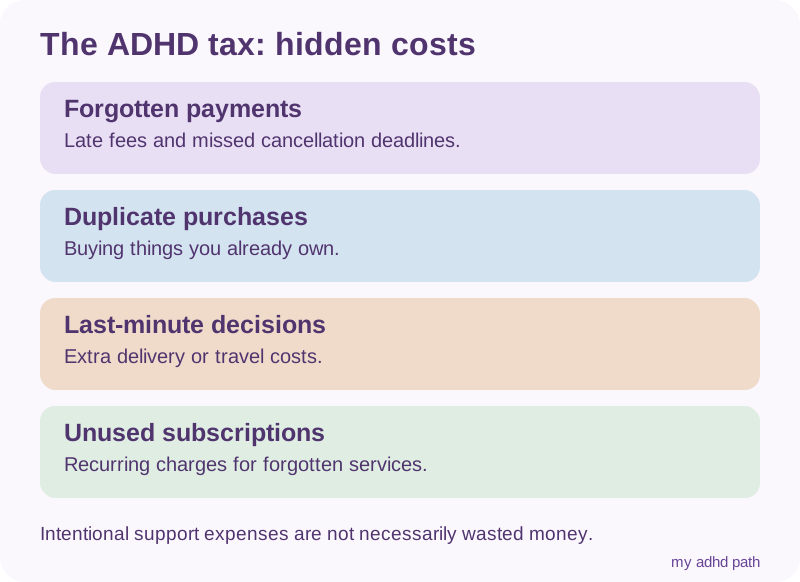
The ADHD tax is sometimes discussed as though it were a formal concept. It is an informal expression used to describe additional costs associated with difficulties that some people experience with ADHD. It isn't an actual tax or a clinical term.
Examples might include:
- Paying a late payment charge.
- Replacing something you've misplaced.
- Forgetting to cancel a subscription.
- Missing a cheaper advance booking opportunity.
- Purchasing duplicate items.
- Paying for express delivery because something was needed sooner than expected.
- Throwing away food that was forgotten at the back of the fridge.
Individually, these expenses may feel relatively minor.
Collectively, they can have a noticeable effect on somebody's finances.
However, it is important not to categorise every expenditure associated with ADHD as a financial mistake.
Paying for grocery delivery, using a cleaner or purchasing an organisation tool might be a deliberate and worthwhile decision.
An expense that helps you work, maintain your wellbeing or manage essential responsibilities can provide genuine value.
The useful distinction is between an avoidable cost and an intentional support expense.
When spending money actually saves money
Imagine that you regularly buy ingredients for seven beautifully planned evening meals.
Unfortunately, by Thursday, you've forgotten what you intended to cook, some of the vegetables need throwing away and you order a takeaway.
An alternative might be purchasing a few conveniently prepared meals alongside ingredients for simpler dishes.
The individual meals might cost slightly more than cooking entirely from scratch.
But if you waste less food and order fewer unexpected takeaways, the overall arrangement could cost less.
The cheapest option on paper isn't always the cheapest option in practice.
This is why financial advice needs to consider the way somebody actually lives.
| Situation | Apparently cheaper option | Alternative worth considering |
|---|---|---|
| Weekly groceries | Buy everything fresh and cook from scratch | Include convenient meals you'll realistically use |
| Household organisation | Rely entirely on remembering where things are | Purchase suitable storage for frequently misplaced items |
| Financial administration | Manually remember every payment | Use appropriate automated payments and reminders |
| Travel | Buy tickets at the last minute | Use advance booking reminders where plans are predictable |
| Work organisation | Manage everything independently | Use affordable tools or eligible workplace support |
These alternatives are not guaranteed to save money. Compare their actual costs and benefits in your own circumstances.
Why traditional budgeting systems sometimes fail
Many budgeting methods require considerable ongoing attention.
They might ask you to record individual transactions, categorise purchases, monitor numerous spending limits and reconcile differences between planned and actual spending.
Some people with ADHD enjoy this level of detail and find it genuinely helpful.
Others find the initial process interesting but struggle to maintain it.
A budgeting system can fail because it requires too many repeated actions rather than because the underlying financial principles are wrong.
Try this
Ask yourself these questions about any budgeting system:
- How often do I need to update this system?
- How many decisions does it require?
- What happens if I forget to use it for a week?
- Can I understand my financial position quickly?
- Does it require me to remember information that's available elsewhere?
A useful budgeting system should be reasonably easy to return to after an interruption.
You shouldn't need to reconstruct three months of financial history before you can start using it again.
The three jobs of an ADHD-friendly budgeting system
Rather than attempting to monitor every aspect of your finances simultaneously, begin with three priorities.
Protect essential expenses.
Make sure necessary payments such as housing, utilities, food and other commitments are accounted for.
Make available spending visible.
Understand what you can reasonably spend until your next income payment.
Prepare for future expenses.
Where your income allows, set money aside for predictable costs and unexpected events.
These priorities can form the foundation of a more detailed financial system if you want one.
But you don't necessarily need twenty-seven spending categories to make useful financial decisions.
A simple four-pot money system
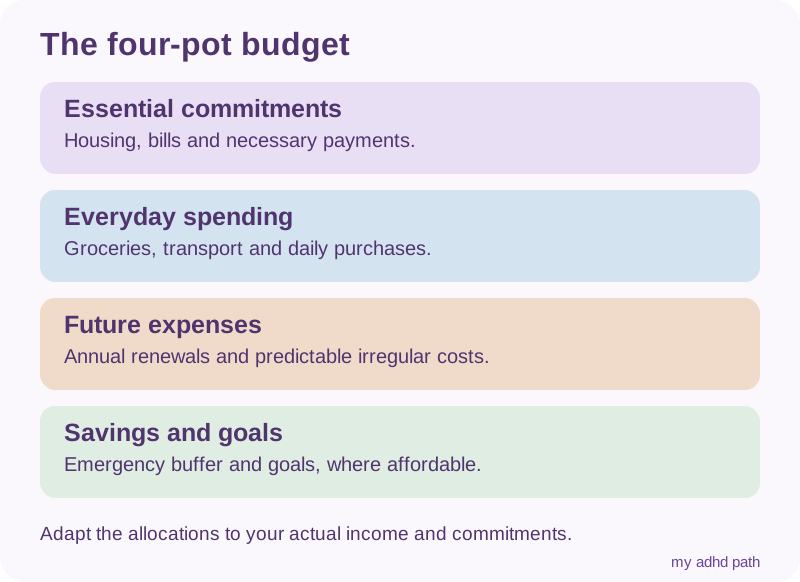
One possible approach is to divide your available income into four broad categories.
These can be separate bank accounts, virtual savings pots or simply categories within your preferred budgeting method.
Pot one: Essential commitments
Money reserved for necessary payments, including housing, household bills and other essential obligations.
Pot two: Everyday spending
Money for groceries, transport, personal purchases and ordinary day-to-day expenses.
Pot three: Future expenses
Money set aside for predictable costs that don't occur every month, such as annual renewals, vehicle maintenance and seasonal expenses.
Pot four: Savings and goals
Money allocated towards an emergency buffer or other savings goals, where affordable.
Not everybody will have enough income to fund every pot.
Essential expenses and appropriate debt repayment arrangements may need to take priority over discretionary savings goals.
There are no universal percentages that work for every household.
What might the four-pot system look like?
Here is a fictional example based on somebody receiving £2,000 in monthly take-home pay.
| Category | Monthly allocation |
|---|---|
| Essential commitments | £1,200 |
| Everyday spending | £500 |
| Future expenses | £180 |
| Savings and goals | £120 |
| Total | £2,000 |
The important feature isn't the particular allocation.
It's that money intended for future commitments is distinguished from money available for spending today.
If this person sees £500 in their everyday spending account at the beginning of the month, they have a clearer idea of what's available without needing to mentally subtract several upcoming bills.
Good to know
This example is illustrative, not a recommended allocation or personal financial advice.
Try a weekly spending allowance
A monthly spending budget can sometimes feel difficult to interpret.
You might know that you have £500 available for everyday expenses but find it difficult to establish how much of that should remain halfway through the month.
A weekly allocation creates shorter planning periods.
For example, £520 per month corresponds to an average of £120 per week across a year.
The calculation uses twelve months of income divided across fifty-two weeks.
Simply dividing a monthly budget by four can overestimate the amount available each week because most months contain more than four weeks.
You could choose to transfer a weekly allocation into a dedicated spending account or use your banking app to monitor it.
Allow for unusually expensive weeks and expenses that don't occur evenly throughout the month.
The objective is visibility, not another inflexible rule to follow.
Automate the things you repeatedly forget
Automation can be particularly useful when financial difficulties involve remembering future intentions.
Depending on your circumstances, you might automate:
- Regular household bill payments.
- Transfers into accounts reserved for essential expenses.
- Contributions towards future expenses.
- Affordable savings transfers.
- Reminders for annual renewals.
- Alerts when an account reaches a particular balance.
Automation should remove unnecessary remembering, not remove awareness of your financial circumstances.
Good to know
Automated payments still need appropriate oversight. Check that sufficient funds are available, review variable payment amounts and monitor changes to recurring costs. If you have irregular income, fixed automatic transfers may need adjusting.
Understanding impulsive spending
An impulsive purchase may occur when the immediate attraction of an item outweighs consideration of its longer-term consequences.
ADHD can involve difficulties with impulse control, and some people report challenges with impulsive purchasing.
But spending decisions are also influenced by advertising, emotional circumstances, social expectations, financial resources and individual preferences.
Not every spontaneous purchase indicates a difficulty.
You are allowed to buy something simply because you like it.
The important question is whether your spending is compatible with your financial circumstances and the things that matter to you.
If purchases repeatedly interfere with essential payments, create debt or cause significant distress, additional support may be appropriate.
Create a little space between wanting and buying
You don't have to eliminate enthusiasm from your purchasing decisions.
Instead, consider introducing a manageable period between discovering something and deciding whether to buy it.
You could save the item to a wish list, close the shopping app or return to the decision the following day.
For more expensive purchases, you might choose a longer consideration period.
Try this
Ask yourself before a non-essential purchase:
- What would I use this for?
- Do I already own something similar?
- Can I afford it without affecting essential commitments?
- Are there ongoing costs associated with it?
- Would I still want it if it weren't currently discounted?
If you still want the item and it fits your budget, purchasing it may be perfectly reasonable.
The purpose of a waiting period is to create an opportunity for consideration, not to make every purchase feel like a moral dilemma.
The new-hobby spending trap
One of the enjoyable things about discovering a new interest is imagining all the possibilities it offers.
You watch tutorials, research equipment and develop increasingly ambitious ideas.
Before you've completed your first photography project, you've somehow become remarkably knowledgeable about professional camera lenses.
There is nothing wrong with enthusiasm.
However, you might find it useful to distinguish between the equipment you need to begin and the equipment you could purchase if the interest develops.
Try this
Try borrowing, renting or buying second-hand equipment where appropriate. Start with a manageable selection of supplies. Allow yourself to discover whether you enjoy doing the activity as much as you enjoy researching it. You can always expand your collection later.
Make your savings goals feel more tangible
Saving for an abstract future expense can feel less engaging than purchasing something that provides an immediate benefit.
Making a savings goal more specific may help.
Rather than naming a savings pot simply "Savings", you might choose a more meaningful description.
"Summer holiday."
"Emergency car repairs."
"Three months of breathing space."
A visual progress indicator may also make the connection between individual contributions and the larger goal easier to recognise.
If saving £600 feels daunting, you could consider six milestones of £100, provided that the goal is affordable.
There is no need to introduce an unnecessarily demanding deadline.
Small contributions can still represent progress.
The subscription problem
Subscriptions are particularly easy to overlook because they continue without requiring a fresh purchasing decision each month.
You might have subscriptions for entertainment, software, fitness, online storage, learning platforms or services you originally intended to use for a short period.
Try this
Review your recurring payments periodically. Identify:
- Services you use regularly.
- Services that provide genuine value even if you use them infrequently.
- Duplicate services.
- Services you no longer need.
- Upcoming renewal dates.
Be aware of contractual commitments, cancellation conditions and any consequences of ending essential services.
Consider adding a reminder when beginning a free trial.
The reminder should occur before the relevant cancellation deadline, with enough time for you to act.
What small recurring expenses actually add up to
Consider these fictional subscriptions.
| Monthly cost | Annual cost |
|---|---|
| £4.99 | £59.88 |
| £7.99 | £95.88 |
| £12.99 | £155.88 |
| £19.99 | £239.88 |
| Total: £45.96 | £551.52 |
Seeing the annual cost may make it easier to decide whether an ongoing payment represents value.
That doesn't mean you should cancel everything.
A subscription that helps you earn money, manage your responsibilities or enjoy your life may be worth keeping.
The aim is to make an informed decision rather than continuing to pay simply because you forgot the subscription existed.
Fifteen ADHD-friendly budgeting strategies
1. Separate essential money from spending money
Where practical, keep money reserved for important commitments visibly distinct from discretionary spending.
This reduces the amount of mental arithmetic involved in everyday decisions.
2. Keep your financial overview simple
Choose a small number of useful categories before introducing additional detail.
Your system should answer the questions you regularly need to ask.
3. Automate predictable commitments
Use appropriate payment arrangements and reminders for responsibilities that occur repeatedly.
Review the arrangements periodically.
4. Plan in shorter periods
A weekly or fortnightly spending allocation may be easier to interpret than a large monthly figure.
Choose a period that suits your income pattern.
5. Make future expenses visible
Maintain a simple overview of upcoming annual and irregular costs.
Where affordable, set aside smaller contributions in advance.
6. Create a manageable financial check-in
Choose a regular opportunity to review balances, upcoming bills and anything requiring action.
A few focused minutes may be more sustainable than an elaborate monthly administration session.
7. Use useful banking notifications
Balance alerts and payment notifications can provide timely information.
Avoid enabling so many notifications that important messages become difficult to distinguish.
8. Introduce a purchase consideration period
For non-essential purchases, give yourself time to decide whether the item offers genuine value.
You can choose different waiting periods for different spending amounts.
9. Remove unnecessary purchasing prompts
Consider unsubscribing from promotional emails, disabling retail notifications or removing stored payment details where appropriate.
Reducing exposure to tempting opportunities may make decisions easier.
10. Budget for things you enjoy
An affordable amount for pleasurable activities can make a spending plan more realistic.
A sustainable budget doesn't need to remove every enjoyable experience.
11. Allow for ADHD-friendly support expenses
Where affordable, recognise tools and services that genuinely help you manage everyday life.
Assess their value over time.
12. Stop trying to reconstruct every past transaction
If you've abandoned your budget for several weeks, consider restarting with your current financial information.
Check existing commitments, outstanding transactions and any missed payments, but don't make perfect historical categorisation a requirement for moving forward.
13. Make financial information easy to locate
Keep relevant documents and renewal dates in an accessible, secure location.
Protect passwords, account details and other sensitive information.
14. Choose sustainable savings commitments
An affordable savings transfer you can maintain may be more useful than an ambitious commitment you repeatedly need to reverse.
Adjust it when your circumstances change.
15. Ask for support before finances become overwhelming
A trusted person, qualified financial adviser or independent debt adviser may be able to help, depending on your circumstances.
You don't have to become an expert in every aspect of personal finance.
Managing money with an irregular income
Good to know
Freelancers, self-employed people and those working variable hours may face additional budgeting demands. Income may arrive at different times, vary considerably between months or need to cover tax and business expenses.
Rather than automatically treating all incoming money as available spending, consider identifying the commitments it needs to cover first.
This may involve maintaining separate business and personal finances, reserving money for tax and planning around a cautious estimate of available income.
Where resources allow, a cash buffer may help manage periods when income is lower.
An accountant or appropriately qualified financial professional can advise on tax responsibilities and business-specific arrangements.
The objective is to establish what money is genuinely available rather than relying on the current account balance alone.
ADHD, money and relationships
Different approaches to money can become a source of tension within relationships.
One person may prefer detailed financial planning.
The other may find frequent financial discussions demanding or enjoy greater flexibility.
Shared expenses, individual spending and financial goals can benefit from clear agreements.
Consider discussing:
- Which expenses are shared.
- How contributions are determined.
- What spending decisions require a joint discussion.
- How savings goals are managed.
- How each person maintains appropriate financial independence.
Financial transparency and consent are important.
ADHD should not be used to justify controlling somebody else's access to money or removing their financial independence.
Good to know
If you experience financial or economic abuse, specialist confidential support is available. Surviving Economic Abuse provides information and support for anyone experiencing economic abuse within a relationship.
Three different approaches to ADHD-friendly finances
Illustrative scenario
Rachel, 39 - Simplifying the monthly budget
Rachel has tried several detailed budgeting systems but struggles to maintain the transaction categories. She creates separate pots for essential bills, everyday spending and future expenses. She reviews her available spending once a week. The system requires less attention whilst providing the information she needs for everyday decisions.
Illustrative scenario
Daniel, 46 - Managing new interests
Daniel regularly develops enthusiastic new hobbies and purchases considerable amounts of equipment. He introduces a personal hobby budget and keeps a list of more expensive items he is considering. He begins new activities with the equipment necessary to get started rather than purchasing everything he might eventually need. He still enjoys discovering new interests, but his financial commitments are more manageable.
Illustrative scenario
Aisha, 34 - Preparing for annual expenses
Aisha finds that annual insurance renewals, vehicle costs and seasonal expenses repeatedly arrive at inconvenient moments. She creates a calendar of predictable future expenses and sets aside affordable monthly contributions. She cannot predict every cost, but the expenses she already knows about become easier to manage.
Create your personal money management profile
Think about your experiences rather than choosing a budgeting system based solely on somebody else's recommendation.
| Question | Illustrative answer |
|---|---|
| What financial tasks do I find difficult? | Remembering annual renewals |
| What information do I need regularly? | Available spending until payday |
| What creates unnecessary expenses? | Forgotten groceries and unused subscriptions |
| What could I automate? | Regular transfers for household bills |
| What helps me avoid impulsive purchases? | Saving items to a wish list |
| What support expenses provide genuine value? | Grocery delivery |
| What is my current priority? | Building an affordable emergency buffer |
| When could I review my finances? | Sunday morning |
Choose one or two changes to begin with.
You can introduce more as those changes become manageable.
The fifteen-minute money reset
If you've been avoiding your finances, an extensive review may feel particularly demanding.
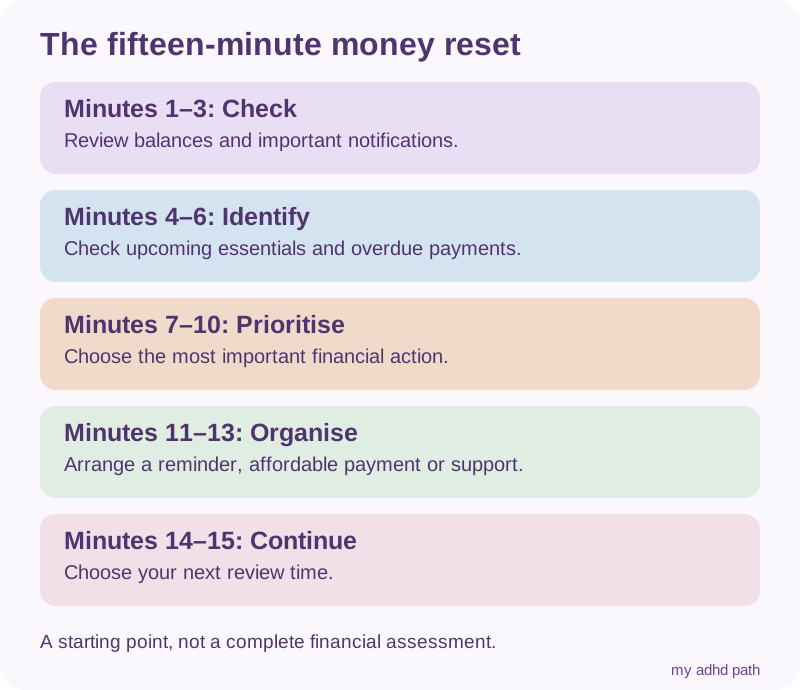
Try establishing a basic picture of your current position.
Practical checklist
- Minutes 1-3: Check. Look at your current balances and any important financial notifications.
- Minutes 4-6: Identify. Check for upcoming essential payments and anything overdue.
- Minutes 7-10: Prioritise. Identify the most important financial action you need to take.
- Minutes 11-13: Organise. Arrange a suitable reminder or payment, where appropriate and affordable, or contact an advice service if you need help.
- Minutes 14-15: Continue. Choose when you will next review your finances.
This exercise is intended to reduce the difficulty of getting started. It is not a substitute for a complete financial assessment, particularly if you are experiencing debt or cannot meet essential expenses.
A seven-day money experiment
You could try one small change each day.
Practical checklist
- Day one: Review your recurring payments.
- Day two: Identify one financial responsibility that could benefit from automation or a reminder.
- Day three: Look at your upcoming irregular expenses.
- Day four: Consider whether your everyday spending is easy to see.
- Day five: Create a wish list for non-essential purchases you're considering.
- Day six: Review one expense that supports your everyday functioning.
- Day seven: Decide which changes you'd like to continue.
The experiment can be completed at your own pace.
The aim is to establish what helps, rather than to achieve a perfect financial record.
Using AI to make money management easier
AI assistants can help organise financial information and reduce some of the planning involved in everyday budgeting.
Good to know
Use anonymised figures and avoid sharing account numbers, banking credentials, unredacted statements or other sensitive information with unsuitable services.
AI prompt
Create a simpler budget
"Help me organise these approximate monthly income and expense figures into essential commitments, everyday spending, future expenses and savings. Identify any shortfall and don't assume I can cut essential costs."
AI prompt
Identify irregular expenses
"Help me create a checklist of predictable annual household expenses that I might forget to include in a monthly budget."
AI prompt
Compare a potential purchase
"Help me think through whether this purchase is compatible with my current spending priorities. Consider ongoing costs, alternatives and whether I already own something similar."
AI prompt
Create a realistic financial routine
"Help me create a simple weekly money check-in that takes approximately fifteen minutes and doesn't require manually categorising every transaction."
AI prompt
Prepare for financial advice
"Help me organise the questions I should ask an independent debt adviser about these anonymised financial circumstances. Don't recommend a debt solution or make assumptions about my eligibility."
Always check calculations independently.
AI can help structure your thinking, but it is not a substitute for regulated financial advice or specialist debt support.
What does the research say about ADHD and finances?
What the research says
Research has explored associations between adult ADHD and financial difficulties, including impulsive buying, financial decision-making and problems managing financial responsibilities. Population-level research has also identified associations between ADHD and adverse financial outcomes, including financial distress. These findings do not mean that everyone with ADHD will experience financial difficulties. They also do not establish that ADHD is the sole cause of those outcomes. Education, income, employment opportunities, mental health and wider economic circumstances can all influence financial wellbeing.
There is limited research comparing specific budgeting methods for adults with ADHD.
The practical approaches in this article draw on broader principles, including reducing executive functioning demands, simplifying decisions and using external reminders.
They are educational strategies rather than proven financial or clinical interventions.
When budgeting isn't enough
Sometimes financial difficulties require considerably more than a new organisation system.
If your income doesn't cover essential expenses, you're falling behind on important payments or borrowing is becoming necessary to meet everyday living costs, seek independent advice.
In the UK, free debt and money guidance is available through organisations including MoneyHelper, StepChange and Citizens Advice.
An independent debt adviser can help you understand your circumstances, identify priority debts and explore appropriate options.
Avoid making important decisions about debt consolidation, insolvency, pension withdrawals or investments solely on the basis of general online information.
If spending feels increasingly difficult to control, or involves gambling, significant emotional distress or sudden changes in behaviour, healthcare or specialist support may also be appropriate.
Good to know
An unusually abrupt increase in spending alongside markedly reduced sleep, elevated mood or other significant behavioural changes warrants prompt medical attention.
Financial difficulties are circumstances that can benefit from practical and professional support. They are not a measure of somebody's character.
Build a financial system around your actual life
You don't need to become somebody who enjoys checking spreadsheets.
You don't need to account for every cup of coffee you've purchased since January.
And you certainly don't need another beautifully organised budgeting system that becomes a forgotten project by February.
What you need is a way of understanding your financial position, protecting important commitments and making decisions with the information available to you.
That might involve automation.
It might involve separate savings pots.
It might involve a fifteen-minute conversation with yourself every Sunday morning.
Or it might involve asking somebody with appropriate expertise to help you establish a manageable starting point.
Financial confidence can develop through small, sustainable changes.
The real achievement isn't creating an impressive budget.
It's creating one that quietly supports the life you want to live.
Downloadable resource
My ADHD Money Toolkit
Practical budgeting worksheets, essential payment trackers, savings planners and manageable financial routines designed to make managing money with ADHD more manageable.
Download My ADHD Money ToolkitFrequently asked questions
Does ADHD affect money management?
It can. Some people experience difficulties with planning, impulse control, remembering financial commitments and organising everyday responsibilities. Experiences vary substantially.
What is the ADHD tax?
The ADHD tax is an informal expression describing avoidable additional expenses that may arise from ADHD-related difficulties, such as forgotten subscriptions or missed payment deadlines.
Does everyone with ADHD spend impulsively?
No. Impulsive spending is not universal to ADHD. Some people are particularly cautious with money or develop effective systems for managing their finances.
What is the best budgeting method for ADHD?
There is no universally effective method. Simple spending categories, automated payments, visible balances and manageable check-ins may be useful starting points.
Are separate bank accounts helpful for ADHD?
Separate accounts or savings pots can help distinguish money reserved for commitments from money available for spending. Consider account fees, terms and your individual circumstances.
Why do I keep forgetting to cancel subscriptions?
Recurring payments require remembering future intentions and acting at the appropriate time. Automated renewal reminders and periodic reviews may help.
Can ADHD medication improve money management?
Effective treatment may help some people manage symptoms that affect financial responsibilities. It is not a direct treatment for debt or a guarantee of improved financial decision-making.
How can I manage impulsive online shopping?
Consider reducing promotional notifications, introducing a purchase consideration period and establishing an affordable discretionary spending allowance. Seek additional support if spending is causing significant harm.
Can I use AI to manage my budget?
AI can help organise anonymised figures, identify planning questions and suggest simple routines. Check calculations and protect sensitive financial information. Use qualified professionals for important financial decisions.
How can I start saving with ADHD?
Choose an affordable goal, make it meaningful and consider manageable regular contributions. Essential commitments and appropriate debt arrangements may need to take priority.
What should I do if I've stopped using my budget?
Restart with your current financial circumstances. Identify essential commitments, available money and anything needing immediate attention rather than requiring yourself to reconstruct every past transaction.
Where can I get help with ADHD and debt?
MoneyHelper, StepChange and Citizens Advice provide access to free UK money or debt guidance. ADHD-related healthcare and psychological support may also help with associated difficulties.
Sources and further reading
- NICE - Attention deficit hyperactivity disorder: diagnosis and management (NG87). https://www.nice.org.uk/guidance/ng87
- NHS - Attention deficit hyperactivity disorder (ADHD). https://www.nhs.uk/conditions/attention-deficit-hyperactivity-disorder-adhd/
- Faraone, S. V. et al. (2021). The World Federation of ADHD International Consensus Statement: 208 Evidence-based conclusions about the disorder. https://doi.org/10.1016/j.neubiorev.2021.01.022
- Beauchaine, T. P., Ben-David, I. and Bos, M. (2020). ADHD, financial distress, and suicide in adulthood: A population study. Science Advances. https://doi.org/10.1126/sciadv.aba1551
- Diamond, A. (2013). Executive functions. Annual Review of Psychology. https://doi.org/10.1146/annurev-psych-113011-143750
- MoneyHelper - Budgeting and money management. https://www.moneyhelper.org.uk/
- StepChange Debt Charity. https://www.stepchange.org/
- Citizens Advice. https://www.citizensadvice.org.uk/
- Surviving Economic Abuse. https://survivingeconomicabuse.org/
This article provides general educational information and is not individual financial, investment, debt, tax or medical advice. All scenarios and financial examples are fictional. The budgeting exercises are practical educational tools rather than clinically validated ADHD interventions.