

Some friendships don't suffer from a lack of affection. They suffer from a lack of calendar reminders.
At a glance
- Caring about friends and remembering to contact them are different things.
- Maintaining friendships involves planning, attention and remembering future intentions.
- ADHD-related forgetfulness should not be confused with object permanence.
- Small moments of communication can help maintain meaningful connections.
- Recurring social arrangements can reduce organisational demands.
- Social preferences, recovery time and personal boundaries matter.
- Friendship should involve mutual consideration.
You've received a lovely message from a friend.
You read it, smile and think about what you'd like to say in response.
You're in the middle of something, though, so you decide to reply properly later.
Three weeks pass.
You suddenly remember the message whilst unloading the dishwasher.
Now you feel that you can't simply reply. You need to acknowledge the delay, explain what's happened, apologise and somehow pick up the original conversation.
What would originally have taken thirty seconds has become an emotionally complicated administrative task.
So you decide to reply properly later.
Again.
If this sounds familiar, you'll know that caring about somebody and consistently remembering to demonstrate it can be two quite different things.
For some adults with ADHD, the practical demands of maintaining friendships can be surprisingly challenging.
Understanding those demands can help you find ways of staying connected that feel natural, manageable and meaningful.
Why friendships involve more organisation than we realise
We tend to think of friendship in terms of affection, shared interests, laughter and companionship.
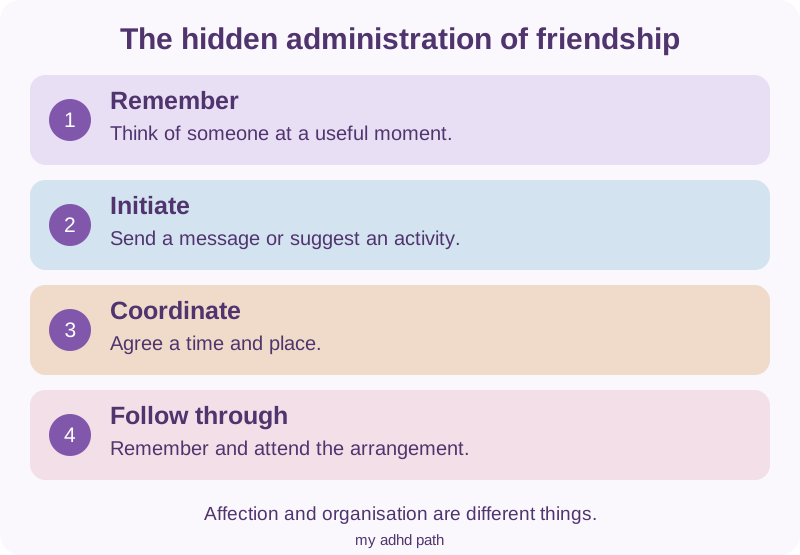
But maintaining a friendship also involves a considerable amount of invisible administration.
You need to remember to get in touch, respond to messages, arrange activities, coordinate diaries, remember important occasions and occasionally initiate conversations.
You need to manage your time, attention and energy alongside everything else happening in your life.
These activities involve skills associated with executive functioning, including planning, working memory and managing attention.
For some people with ADHD, these processes require additional effort.
The affection may be present.
The practical process of maintaining contact may be considerably more difficult.
Being a good friend isn't the same as being good at friendship administration
You might be the person your friends turn to when they need somebody to talk to.
You might remember extraordinarily specific details about a conversation you had together five years ago.
You might be generous, enthusiastic and genuinely delighted whenever you see them.
And yet you might regularly forget birthdays, leave messages unanswered or realise that you haven't contacted somebody for several months.
These experiences can coexist.
However, friendship involves both intention and action.
Other people cannot always know how much they mean to us unless we find ways of communicating it.
The aim isn't to use ADHD as an explanation for every missed commitment, but to identify practical ways of making our affection more visible and our friendships more sustainable.
Caring about somebody and consistently remembering to demonstrate it can be two quite different things.
Why making friends and keeping friends can feel different
Some people with ADHD find meeting new people relatively easy.
A new conversation offers interesting information, unexpected connections and opportunities to share ideas.
A friendship may develop quickly around a shared enthusiasm.
Maintaining that friendship over several years can involve a different set of demands.
There are fewer spontaneous opportunities to meet.
Busy schedules need coordinating.
Conversations require initiating rather than simply happening.
Other people with ADHD may find making friends challenging from the beginning, particularly if social anxiety, previous rejection or difficulties navigating social situations are also present.
There is no single ADHD friendship style.
Understanding which aspects of friendship you personally find demanding is more useful than assuming everyone with ADHD experiences the same difficulties.
Twelve friendship experiences you might recognise
1. Thinking about someone without contacting them
You might think about a friend regularly, remember something funny they said or see an article you know they'd enjoy.
But the thought doesn't always become an action.
Your friend may have no idea how frequently they've crossed your mind.
2. Forgetting to reply after reading a message
Once a message has been opened, its notification may disappear.
Without a visible reminder, the intention to reply may become lost among other responsibilities.
3. Accidentally replying entirely in your head
You've considered your response so thoroughly that you almost feel as though you've already sent it.
Unfortunately, your friend hasn't received the benefit of that particularly thoughtful imaginary conversation.
4. Losing track of how long it's been
You feel as though you saw somebody fairly recently.
Then you realise that the lunch you're remembering happened last February.
Difficulties estimating or monitoring time may contribute to unexpectedly long gaps between conversations.
5. Finding arrangements difficult to organise
Choosing a date, finding a venue and coordinating several people's availability can turn an enjoyable idea into a demanding planning exercise.
Sometimes arranging the activity requires more effort than attending it.
6. Becoming particularly enthusiastic about a new friendship
A shared interest or engaging conversation may occupy a considerable amount of your attention.
As other responsibilities emerge, the frequency of contact may change.
It can help to recognise that friendships don't need to maintain their initial intensity to remain meaningful.
7. Interrupting conversations
You may have something relevant to contribute and find it difficult to wait for an appropriate moment.
Alternatively, you might worry that you'll forget your thought before you have an opportunity to express it.
This can sometimes affect the natural balance of a conversation.
8. Sharing more than you intended
You may become absorbed in a conversation and disclose information you would ordinarily prefer to keep private.
Afterwards, you might spend time reconsidering what you said.
9. Feeling exhausted after social activities
Even enjoyable social experiences can involve significant attention, sensory processing and emotional effort.
You may need quiet recovery time afterwards.
10. Worrying that you've upset somebody
A change in tone, a cancelled arrangement or an unusually short message may lead to considerable reflection.
Some people describe heightened sensitivity to criticism or possible rejection.
However, these experiences are not exclusive to ADHD.
11. Finding group conversations difficult
Following several people speaking, managing background noise and identifying opportunities to contribute can be demanding.
You might find one-to-one conversations considerably more comfortable.
12. Avoiding contact because too much time has passed
You miss somebody and would genuinely like to see them.
But you're concerned that the length of time since your last conversation might require an explanation.
The longer you wait, the more complicated reconnecting begins to feel.
Good to know
These experiences are illustrative rather than diagnostic. They can occur for numerous reasons, with or without ADHD.
Does ADHD cause problems with object permanence?
You may have encountered the phrase ADHD object permanence online.
It is frequently used to describe forgetting about people or activities when they aren't immediately present.
Common misconception
Object permanence has a specific meaning in developmental psychology. It refers to understanding that an object continues to exist even when it cannot be seen. Forgetting to contact a friend is not the same as losing the understanding that they exist. A more useful explanation may involve the demands of prospective memory, working memory, attention and environmental cues.
Prospective memory involves remembering to carry out an intended action in the future.
You know that you want to contact your friend.
The challenge may be remembering to do it at an appropriate moment.
Recognising this distinction helps us choose practical strategies without relying on misleading psychological explanations.
The unanswered message cycle
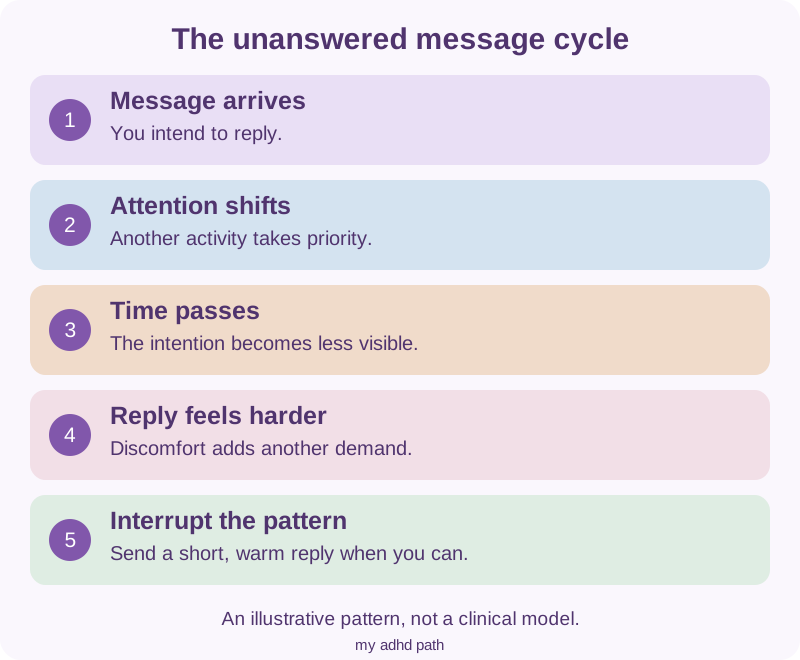
There is a particular pattern that some people recognise in their friendships.
A message arrives.
You intend to respond.
Something else requires your attention.
Time passes.
You begin feeling uncomfortable about the delay.
Replying now feels more demanding than it did originally.
You postpone it again.
The original communication difficulty has acquired an additional emotional component.
Try this
Rather than composing an elaborate explanation, acknowledge the delay and respond to the original message. "Sorry this took me ages to reply to. Lovely to hear from you. How did everything go?" Sometimes the simplest reply is also the most useful one.
This cycle is an illustrative description of an everyday experience, not a validated psychological model.
When friendships lose their natural meeting points
Many childhood and teenage friendships benefit from environments that repeatedly bring people together.
You attend the same school, play for the same sports team or see one another regularly through shared activities.
There is less need to deliberately organise every conversation.
Adult life can gradually remove these natural opportunities.
People change jobs, move house, become parents or take on caring responsibilities.
A friendship that once required very little planning may suddenly require considerable coordination.
For someone who finds planning and remembering future intentions particularly demanding, this change can be significant.
Try this
Recreate some natural structure. A regular walking group, monthly lunch or shared exercise class can provide opportunities for friendship without requiring somebody to organise each meeting from the beginning.
Why some friendships feel effortless
You may have a friend you haven't seen for six months.
Within five minutes of meeting, you're laughing about something that happened ten years ago.
There is no awkward conversation about how long it's been.
You simply enjoy being together.
Some friendships work particularly well with relatively infrequent contact.
Others depend on more regular communication.
Neither type is inherently better.
Difficulties can arise when two people have substantially different expectations but haven't discussed them.
One person may interpret infrequent messages as entirely normal.
The other may experience them as a lack of interest.
Understanding each other's preferences can help establish a pattern of contact that feels comfortable for both people.
Friendship expectations and communication styles
Different people maintain connections in different ways.
| Communication preference | What it might offer |
|---|---|
| Regular text messages | Frequent, low-pressure contact |
| Voice notes | A more conversational way to share updates |
| Telephone calls | Dedicated time to catch up |
| Shared activities | Connection without needing to sustain constant conversation |
| Recurring arrangements | Less repeated planning and coordination |
| Occasional longer meetings | Meaningful connection with less frequent contact |
| Sharing photographs or funny videos | Small moments of connection throughout everyday life |
Different approaches can be combined.
A friendship doesn't have to be maintained through a method that neither person particularly enjoys.
Social masking and friendship exhaustion
Some people with ADHD describe monitoring their behaviour carefully during social interactions.
They may consciously try to avoid interrupting, remember to ask questions, regulate their enthusiasm or keep track of how they're being perceived.
Being considerate of other people is an ordinary part of social interaction.
However, continually monitoring numerous aspects of your behaviour can require substantial effort.
You might enjoy an evening with friends and still feel exhausted afterwards.
You might look forward to an event and then find that you have very little capacity for conversation when it arrives.
Recognising your social needs can help you plan more manageable experiences.
Perhaps you prefer smaller gatherings.
Perhaps you enjoy meeting friends during the day.
Perhaps a walk and a conversation feel considerably easier than several hours in a noisy restaurant.
You can be sociable without enjoying every type of social situation.
When rejection sensitivity affects friendships
An unanswered message, a photograph of friends together or a cancelled invitation may sometimes acquire additional emotional significance.
You might wonder whether you've been deliberately excluded.
You might worry that something you said has changed how somebody feels about you.
Good to know
Some people use the term rejection sensitive dysphoria, or RSD, to describe intense distress associated with actual or perceived rejection. RSD is not a formal clinical diagnosis or ADHD diagnostic criterion. The broader experiences of rejection sensitivity and emotional regulation difficulties can nevertheless deserve appropriate attention.
It may help to distinguish what you know from what remains uncertain.
A friend cancelling lunch tells you that lunch has been cancelled.
It doesn't automatically tell you why.
Equally, if somebody consistently excludes or mistreats you, understanding rejection sensitivity should not require dismissing your own experience.
Friendship involves mutual consideration and respect.
Loneliness and ADHD
It is possible to have friends and still experience loneliness.
You may have people you enjoy spending time with but struggle to arrange opportunities to see them.
You may find yourself surrounded by people whilst feeling that you're continually adapting your behaviour to fit in.
Changes in employment, family circumstances and health can also reduce opportunities for connection.
What the research says
Research has identified social and interpersonal difficulties among some people with ADHD, although experiences vary substantially. Loneliness can affect people with or without ADHD. It deserves support rather than being treated as an inevitable consequence of a diagnosis.
Building social connections may involve finding more accessible ways to participate rather than simply increasing the number of social activities in your diary.
Fifteen ways to maintain friendships with ADHD
1. Make contact when you think of somebody
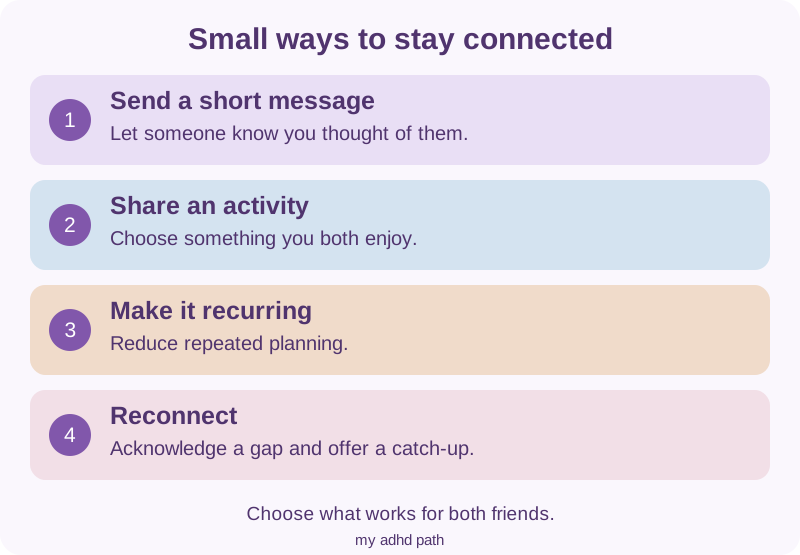
If the moment is appropriate, send a short message when a friend crosses your mind.
You don't need to wait until you have enough time to write a comprehensive update.
"Just thought of you. Hope you're having a lovely week."
Small moments of contact can be meaningful.
2. Make unanswered messages visible
Use unread markers, pinned conversations or another suitable reminder system to identify messages you intend to answer.
Choose one method rather than creating several additional places to check.
3. Try shorter replies
A reply can be friendly and thoughtful without containing six paragraphs.
Reducing the effort involved may make it easier to respond.
4. Use voice notes if you both enjoy them
Speaking may feel more natural than composing a written message.
Check that voice notes are a convenient form of communication for the recipient too.
5. Create recurring arrangements
A monthly coffee, regular walk or weekly sports activity can provide consistent opportunities to meet.
Agreeing on a recurring arrangement reduces the need to repeatedly coordinate diaries.
6. Arrange the next meeting whilst you're together
If you've enjoyed seeing somebody, consider agreeing on another date before you leave.
Put it in your calendar immediately.
You already have the relevant person, the intention and an opportunity to act.
7. Remember important occasions externally
Use a calendar or suitable reminder tool for birthdays and other occasions that matter to you.
Remembering with the help of technology is still remembering.
8. Choose activities that suit your social energy
A friendship doesn't have to involve late evenings, large groups or busy environments.
Find experiences that both people genuinely enjoy.
9. Build in recovery time
Avoid automatically filling every available period with commitments.
Allow time for rest between demanding activities if you need it.
10. Explain your communication preferences
If you regularly forget to reply or find certain communication methods difficult, you might choose to explain this to close friends.
You do not need to disclose your diagnosis unless you want to.
11. Keep plans realistic
Enthusiasm can sometimes lead to agreeing to more commitments than you can comfortably manage.
Consider your existing responsibilities before making another arrangement.
Reliability may improve when promises reflect realistic capacity.
12. Develop a manageable contact routine
You might spend a few minutes each week replying to outstanding personal messages or arranging something with a friend.
Keep it flexible enough that missing one occasion doesn't mean abandoning the system.
13. Practise listening without losing your thoughts
If you're concerned about forgetting something you want to say, make a brief mental or written note where appropriate.
Then return your attention to what the other person is saying.
If you interrupt, a simple acknowledgement can help restore the conversation.
14. Reconnect without writing an autobiography
If a considerable amount of time has passed, acknowledge it and express your interest in reconnecting.
You don't necessarily need to account for every week since your last conversation.
15. Invest in reciprocal friendships
Notice which relationships provide mutual enjoyment, interest and consideration.
Maintaining meaningful friendships doesn't require saying yes to everybody or continually pursuing connections that leave you feeling uncomfortable.
Friendship support without turning friends into tasks
There is something slightly uncomfortable about putting a reminder in your calendar to contact a friend.
It can feel as though you're turning an affectionate relationship into an administrative responsibility.
But a reminder doesn't manufacture affection.
It supports your ability to express affection that already exists.
A reminder doesn't manufacture affection. It supports your ability to express affection that already exists.
We routinely use calendars to remember activities that matter to us.
A birthday reminder doesn't make a birthday message less genuine.
Organising a catch-up in advance doesn't make the pleasure of seeing somebody less spontaneous.
Use systems to create opportunities for connection, then allow the friendship itself to develop naturally.
How to reconnect with somebody after a long gap
If you haven't spoken to somebody for months or years, reaching out may feel uncomfortable.
There are several ways to approach it.
When life has been particularly busy
What you could say
"I can't believe how long it's been since we last caught up. Life seems to have taken over a bit. I'd love to see you if you're free sometime."
When you've forgotten to reply
What you could say
"I'm really sorry I left your message unanswered. I kept meaning to reply and then completely lost track of time. How are you getting on?"
When you've been thinking about an old friend
What you could say
"Something reminded me of you today and made me smile. It's been ages. I hope you're doing well."
When you want to acknowledge a genuine mistake
What you could say
"I realise I've been unreliable about arranging things recently. I'm sorry. I really value our friendship and would like to find a better way of staying in touch."
The other person may be delighted to hear from you.
They may also have their own feelings about the friendship or have moved into a different stage of life.
Reconnecting is an invitation, not an obligation.
What if your friend has ADHD?
If somebody you care about has ADHD, understanding their communication patterns may help you avoid interpreting every delay as a lack of interest.
You could discuss communication methods that suit both of you, suggest specific plans or establish a recurring activity together.
However, understanding ADHD doesn't mean that your own needs become less important.
If you regularly experience cancelled arrangements, unfulfilled commitments or a lack of reciprocity, it's reasonable to discuss how this affects you.
What you could say
"I really enjoy seeing you. When plans change at the last minute, it makes organising my day difficult. Is there a different way we could arrange things?"
Clear, specific feedback may be more useful than a broad judgement about somebody's character.
Both friends deserve consideration.
Making new friends as an adult with ADHD
Making friends as an adult can feel surprisingly difficult.
Unlike school or university, there may be relatively few environments where you regularly encounter the same people without specifically arranging to see them.
Finding a shared activity can create natural opportunities for conversation and repeated contact.
Consider activities that genuinely interest you, such as sport, volunteering, creative workshops, walking groups, book clubs or community projects.
You might also explore appropriately moderated ADHD peer-support communities.
The advantage of a shared activity is that you don't need to create an entire social experience from scratch.
There is already something to talk about and a reason to meet again.
You don't need to become close friends with everybody you encounter.
Allow connections to develop gradually.
Understanding friendship boundaries
Sometimes maintaining a friendship feels difficult because the relationship itself has become demanding.
You may feel obliged to be available whenever somebody contacts you.
You may find yourself agreeing to activities you don't enjoy or taking responsibility for problems you cannot resolve.
You may worry that declining an invitation will affect how somebody feels about you.
A healthy friendship allows both people to have independent lives, different preferences and personal limitations.
You can be generous without being constantly available.
You can care about somebody without taking responsibility for every difficulty they're experiencing.
You can decline an invitation and still value the friendship.
Boundaries can help relationships remain sustainable rather than making them less meaningful.
Three different friendship experiences
The following examples are fictional illustrations.
Illustrative scenario
Lucy, 38 - Remembering to send the message
Lucy regularly thinks about her university friends but finds months passing between conversations. She introduces a simple reminder to make contact with somebody once a week. Rather than writing lengthy updates, she sends short messages or photographs when something reminds her of them. She finds that regular small moments of contact feel much easier than trying to organise a substantial catch-up every time.
Illustrative scenario
Matt, 46 - Making social plans more manageable
Matt enjoys seeing his friends but rarely initiates arrangements. Coordinating several diaries and deciding where to meet frequently becomes overwhelming. He suggests a regular Sunday morning walk with two friends. They agree on a familiar meeting place and a recurring time, with flexibility when somebody cannot attend. The friendship becomes easier to maintain because there is less repeated organisation involved.
Illustrative scenario
Priya, 33 - Finding the right social environment
Priya enjoys meaningful conversations but finds large, noisy gatherings exhausting. She has gradually started declining invitations because she associates social activities with substantial recovery time. She begins suggesting smaller meetings, creative activities and occasional daytime catch-ups. She discovers that she enjoys socialising more when the environment suits her preferences.
Create your personal friendship support profile
You don't need a detailed strategy for every relationship.
Start by understanding what makes connection easier or more demanding for you.
| Question | Illustrative answer |
|---|---|
| How do I enjoy spending time with friends? | Walking or meeting for coffee |
| Which communication method suits me? | Short messages and telephone calls |
| What makes staying in touch difficult? | Remembering to reply after opening messages |
| What type of social environment suits me? | Small groups and relatively quiet places |
| What helps me remember arrangements? | Calendar entries and reminders |
| How much recovery time do I need? | A quiet evening after a busy social day |
| Who would I like to reconnect with? | An old colleague |
| What small action could I take this week? | Send a friendly message |
Your answers may change as your circumstances change.
The purpose is to make connection more accessible, not to measure your performance as a friend.
A seven-day friendship experiment
Try one small activity each day, or spread the suggestions over several weeks.
Practical checklist
- Day one: Think of somebody you enjoy spending time with and send them a short message.
- Day two: Identify your preferred way of communicating.
- Day three: Choose one simple method for remembering unanswered messages.
- Day four: Suggest an activity you would genuinely enjoy doing with a friend.
- Day five: Add an important birthday or arrangement to your calendar.
- Day six: Consider whether your social commitments allow enough time for recovery.
- Day seven: Reflect on which connections feel meaningful, reciprocal and comfortable.
There is no requirement to contact somebody you would prefer not to reconnect with.
Choose activities that feel appropriate for your relationships and circumstances.
Using AI to make staying connected easier
AI assistants can help with some of the organisation surrounding friendships.
They may be particularly useful when you know what you'd like to communicate but find it difficult to organise your thoughts.
AI prompt
Help me reconnect
"Help me write a short, warm message to an old friend I haven't contacted for a while. Acknowledge the gap without making the message unnecessarily apologetic."
AI prompt
Organise a catch-up
"Suggest three simple ways to spend time with a friend that require minimal organisation and suit a limited budget."
AI prompt
Manage my social commitments
"Help me review these social arrangements alongside my other commitments. Leave sufficient time for rest and avoid suggesting that I fill every available period."
AI prompt
Express a boundary
"Help me politely decline this invitation whilst making it clear that I value the friendship."
AI prompt
Separate facts from assumptions
"Help me identify what I know about this social situation, what I'm assuming and what remains uncertain. Don't make claims about the other person's intentions."
AI cannot determine how another person feels about you.
It should not become a substitute for human connection or a source of repeated reassurance about your relationships.
Avoid uploading private conversations or identifying information about friends to unsuitable AI services.
What does the research say about ADHD and friendships?
What the research says
Research into ADHD has identified differences in social functioning and interpersonal experiences among some children and adults. Studies have explored factors including impulsivity, attention, emotional regulation and peer relationships. Research also suggests that difficulties with executive functioning can affect everyday activities requiring planning and remembering intentions. These findings may help explain some of the challenges associated with maintaining social connections.
However, adult friendships are influenced by numerous factors beyond ADHD, including personality, circumstances, mental health, opportunities for social participation and previous experiences.
Research into specific ADHD-friendly friendship maintenance strategies is relatively limited.
There is no established evidence that a particular messaging routine, frequency of contact or friendship planner works for everybody with ADHD.
The practical ideas in this article are intended to help readers explore approaches that suit their individual circumstances.
When to seek additional support
Speak to your GP or another appropriate healthcare professional if persistent loneliness, anxiety, low mood or social avoidance is substantially affecting your everyday life.
Social difficulties may arise from several overlapping experiences, including ADHD, social anxiety, depression, autism, trauma or other circumstances.
Appropriate assessment can help identify individual support needs.
ADHD peer-support groups may also provide opportunities to meet people with similar experiences.
In England, your GP practice may be able to connect you with local social prescribing services, which can help identify suitable community activities and support.
If you are experiencing significant emotional distress, Samaritans can be contacted on 116 123 in the UK and Ireland.
If you or somebody else is in immediate danger, call 999.
Downloadable resource
My ADHD Friendship Toolkit
Practical communication templates, social energy planners and simple strategies for building and maintaining meaningful friendships.
Download PDFFrequently asked questions
Why do people with ADHD sometimes forget to contact their friends?
Difficulties remembering future intentions, managing attention and organising activities may contribute. Forgetting to make contact does not necessarily indicate a lack of affection.
Do people with ADHD have problems with object permanence?
Object permanence is a developmental concept concerning the continued existence of objects when they cannot be seen. Forgetting to contact someone is more appropriately explored through attention, memory and planning.
Can ADHD make maintaining friendships difficult?
Yes, some people with ADHD experience difficulties with communication, remembering arrangements, emotional regulation or organising social activities. These experiences vary considerably.
Why do I find replying to messages overwhelming?
You may find that composing a response, switching attention or managing several conversations requires considerable effort. Anxiety and previous experiences may also contribute.
Can someone with ADHD be a good friend?
Absolutely. ADHD does not determine somebody's capacity for kindness, loyalty or meaningful connection. Practical support may help people express these qualities more consistently.
Why do I enjoy socialising but feel exhausted afterwards?
Social interaction may involve cognitive, emotional and sensory demands. Enjoying an activity does not mean it requires no effort or recovery time.
Can rejection sensitivity affect friendships?
Intense distress around criticism or perceived rejection may affect how some people navigate friendships. Rejection sensitive dysphoria is not a formal clinical diagnosis.
Should I tell my friends that I have ADHD?
This is a personal choice. You may find disclosure helpful in some relationships, but you can also explain your communication preferences without sharing your diagnosis.
Is it normal to have only a few close friends?
People differ greatly in their preferred level of social contact. The quality of your relationships and whether your social needs are being met may matter more than the number of friendships you maintain.
How can I reconnect after not speaking to someone for a long time?
Acknowledge the gap, express genuine interest and offer an opportunity to reconnect. Respect the other person's response and circumstances.
Can ADHD medication improve friendships?
Effective ADHD treatment may help some individuals manage symptoms that affect social functioning. It is not a direct treatment for friendship difficulties or a guarantee of improved relationships. Discuss treatment options with your clinician.
How can I meet other adults with ADHD?
Explore reputable peer-support organisations, local ADHD groups and appropriately moderated online communities. Shared-interest activities can also provide meaningful opportunities for connection.
Friendship doesn't have to be another thing you feel behind on
There are people you will see every week.
People you'll catch up with every few months.
People you'll have known for twenty years and still occasionally forget to reply to.
Some friendships will change as your circumstances change.
Others will continue through different jobs, different homes, different responsibilities and the wonderfully unpredictable business of being an adult.
You don't have to maintain every friendship in exactly the same way.
You can find ways of staying connected that suit your life whilst recognising the needs of the people you care about.
Send the short message.
Suggest the walk.
Put the birthday in your calendar.
And when something makes you think of somebody, consider telling them.
A friendship doesn't need a perfectly organised communication strategy.
Sometimes it just needs an opportunity to continue.
Sources and further reading
- NICE - Attention deficit hyperactivity disorder: diagnosis and management (NG87). https://www.nice.org.uk/guidance/ng87
- NHS - Attention deficit hyperactivity disorder (ADHD). https://www.nhs.uk/conditions/attention-deficit-hyperactivity-disorder-adhd/
- Faraone, S. V. et al. (2021). The World Federation of ADHD International Consensus Statement: 208 Evidence-based conclusions about the disorder. https://doi.org/10.1016/j.neubiorev.2021.01.022
- Diamond, A. (2013). Executive functions. Annual Review of Psychology. https://doi.org/10.1146/annurev-psych-113011-143750
- Shaw, P. et al. (2014). Emotion dysregulation in attention deficit hyperactivity disorder. American Journal of Psychiatry. https://doi.org/10.1176/appi.ajp.2013.13070966
- Downey, G. and Feldman, S. I. (1996). Implications of rejection sensitivity for intimate relationships. https://doi.org/10.1037/0022-3514.70.6.1327
- ADHD UK. https://adhduk.co.uk/
- NHS England - Social prescribing. https://www.england.nhs.uk/personalisedcare/social-prescribing/
- Samaritans. https://www.samaritans.org/
This article provides general educational information and is not a substitute for individual medical or psychological advice. All personal scenarios are fictional. The reflection exercises and friendship strategies are practical educational tools, not clinically validated ADHD interventions.