

Sometimes the most exhausting part of a conversation is the one that continues in your head long after the other person has finished speaking.
At a glance
- Rejection sensitive dysphoria describes experiences of intense emotional distress associated with rejection or criticism.
- RSD is not a formal clinical diagnosis.
- Not everyone with ADHD experiences rejection sensitivity.
- Feelings and interpretations are different.
- Actual rejection and perceived rejection both deserve appropriate consideration.
- Reassurance and personal boundaries can coexist.
- Professional support may help with associated emotional difficulties.
You've sent a message.
You've received a reply.
"Fine."
No kiss. No smiley face. Not even an exclamation mark.
Interesting.
You read your original message again. Perhaps it sounded a little abrupt. Perhaps you should have phrased something differently.
You think about your conversation that morning. Was there something slightly unusual about their tone?
Within twenty minutes, you've mentally reviewed several years of your relationship and identified approximately seventeen possible reasons why somebody might be upset with you.
Meanwhile, your partner is standing in a supermarket queue, trying to decide which pasta to buy.
They really did mean fine.
For some people with ADHD, experiences of criticism, disapproval or possible rejection can generate particularly intense emotional responses.
These experiences are often discussed using the term rejection sensitive dysphoria, or RSD.
Understanding them can help you recognise what's happening emotionally, communicate more effectively and make a little more room for uncertainty.
What is rejection sensitive dysphoria?
Rejection sensitive dysphoria is a term used to describe intense emotional distress associated with actual or perceived rejection, criticism, failure or disapproval.
The word dysphoria refers to a state of significant emotional discomfort or distress.
People who identify with the term often describe emotional reactions that feel immediate, overwhelming and difficult to manage.
These reactions may involve sadness, embarrassment, frustration, anxiety or a powerful urge to withdraw.
Good to know
RSD is not a recognised standalone diagnosis or a formal diagnostic criterion for ADHD. There is currently no universally accepted clinical definition, diagnostic test or established treatment specifically for RSD. The broader concept of rejection sensitivity has been studied in psychological research, and difficulties with emotional regulation are recognised in research into ADHD. These related concepts are not necessarily interchangeable.
Whilst the terminology and research continue to develop, the emotional experiences people describe deserve to be taken seriously.
Why rejection can feel particularly significant
Most people would prefer to feel accepted rather than rejected.
Human relationships provide companionship, reassurance, belonging and emotional security.
When something appears to threaten that connection, an emotional response is entirely understandable.
For some people, however, the response can feel exceptionally intense.
Several factors may contribute, including:
- Difficulties regulating emotional responses.
- Previous experiences of criticism or exclusion.
- Anxiety about how other people perceive them.
- Difficulties shifting attention away from an upsetting experience.
- Low self-esteem or uncertainty within a relationship.
- Previous experiences of bullying, trauma or difficult relationships.
Some of these factors may overlap with experiences associated with ADHD.
Others can occur independently.
It is unlikely that every experience described as RSD has an identical explanation.
Is rejection sensitivity part of ADHD?
What the research says
Research has identified associations between ADHD and difficulties regulating emotions in some adults and children. Emotional regulation involves recognising, understanding and managing emotional responses in ways that suit the circumstances. Some people with ADHD describe emotions that feel particularly intense or difficult to move on from. Impulsivity may also influence how quickly somebody responds before considering alternative explanations.
However, not everyone with ADHD experiences significant rejection sensitivity.
And not everyone who experiences rejection sensitivity has ADHD.
Rejection sensitivity may also occur alongside anxiety, depression, trauma-related difficulties and other psychological experiences.
Common misconception
Rejection sensitivity should not be used as a reliable indicator of whether somebody has ADHD. It is not a diagnostic criterion and can occur for many different reasons.
When the feeling arrives before the explanation
Imagine you're sitting beside your partner.
You ask whether they'd like to go somewhere together at the weekend.
They say they're not sure.
Almost immediately, you feel disappointed.
There might be a physical sensation in your stomach, tension in your chest or an urge to stop talking.
Then your thoughts begin trying to explain the feeling.
Perhaps they don't want to spend time with you.
Perhaps they've become bored with the relationship.
Perhaps you've been asking for too much recently.
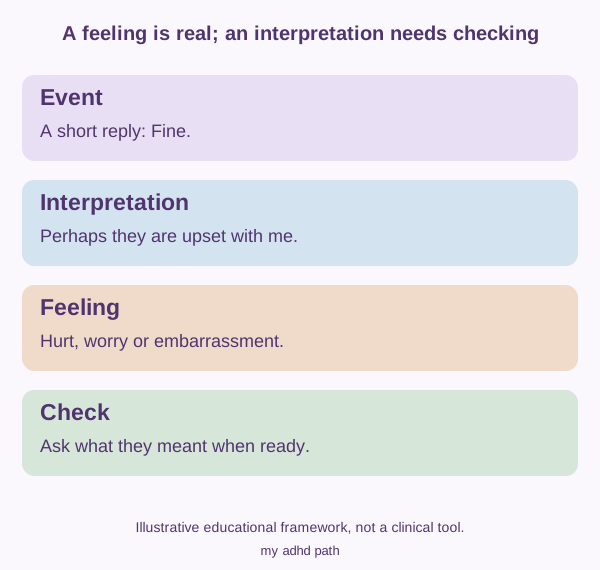
The emotional experience is real.
But the explanation you've attached to it may still be uncertain.
Your partner might simply be trying to remember whether they've already made another arrangement.
Understanding the distinction between an emotion and its interpretation can be particularly useful.
You don't have to dismiss the feeling in order to question the conclusion.
Actual rejection and perceived rejection
The phrase perceived rejection is sometimes misunderstood.
It does not mean that somebody has imagined an entire situation or that their feelings are unreasonable.
It means that their interpretation of what has happened may not yet be confirmed.
There are also occasions when somebody really is being dismissive, critical or unkind.
Not every painful experience is a misunderstanding.
| Situation | Possible interpretation | What remains uncertain |
|---|---|---|
| Your partner hasn't replied | They're ignoring me | Whether they've seen the message |
| A friend cancels a plan | They don't enjoy my company | Why they've cancelled |
| Your partner asks for quiet | They don't want me around | Whether they simply need recovery time |
| Someone criticises a decision | They think badly of me | Whether their concern relates only to that decision |
| Your partner seems distracted | They're losing interest | What else may be occupying their attention |
Checking the context can help you determine whether reassurance, clarification, a practical change or a personal boundary is needed.
Sometimes the conclusion that somebody has treated you poorly is accurate.
Understanding rejection sensitivity should never involve automatically doubting your own judgement.
Twelve ways rejection sensitivity may appear in relationships
1. Analysing changes in tone
A slightly different tone of voice can become the focus of considerable attention.
You may find yourself reviewing what was said and looking for indications that something is wrong.
2. Overthinking text messages
Punctuation, response times and unusually short replies may acquire emotional significance.
Without additional context, written communication leaves considerable room for interpretation.
3. Seeking reassurance repeatedly
You might ask whether somebody is upset with you, receive reassurance and then find yourself needing to ask again.
The reassurance may provide temporary relief without resolving the underlying uncertainty.
4. Apologising before anything has happened
You may apologise for talking too much, asking for something or expressing an opinion, even when nobody has suggested there's a problem.
5. Avoiding difficult conversations
If disagreement feels particularly uncomfortable, raising an important concern may seem risky.
You might postpone the conversation despite knowing that something needs addressing.
6. Trying to keep everybody happy
Agreeing to things you don't really want to do can feel easier than risking somebody's disappointment.
Over time, this may make it difficult to recognise and communicate your own preferences.
7. Reacting strongly to constructive feedback
A suggestion about how to do something differently may feel like a judgement about your overall competence or value.
8. Withdrawing when you feel hurt
You may become quiet, decide against attending an event or stop initiating conversations after an interaction that felt uncomfortable.
9. Becoming defensive
A rapid explanation or strong response may emerge before you've had time to understand what somebody actually meant.
10. Replaying conversations
An ordinary exchange may continue occupying your thoughts long after it has finished.
You might consider alternative things you could have said or search for clues about the other person's intentions.
11. Finding uncertainty particularly difficult
Not knowing whether somebody is upset can sometimes feel more demanding than having a clear answer.
This may create a strong urge to resolve the situation immediately.
12. Holding back from new experiences
You might avoid initiating friendships, suggesting activities or sharing ideas because of concerns about how other people will respond.
Good to know
These experiences are not a diagnostic checklist. Someone may recognise several of them for reasons unrelated to ADHD.
The emotional response: from event to interpretation
One useful way of exploring rejection sensitivity is to separate four aspects of an experience.
The event: What actually happened?
The interpretation: What meaning have I assigned to it?
The emotional response: What am I feeling?
The next action: What would help me respond constructively?
For example:
Your partner replies to a message with "Fine."
You interpret the reply as evidence that they're annoyed.
You feel anxious and embarrassed.
You consider sending several messages asking whether something is wrong.
Recognising these separate elements can help introduce a little flexibility.
You may decide to continue with your afternoon and clarify the meaning later.
Alternatively, you might ask a straightforward question.
The objective isn't to convince yourself that nothing is wrong.
It's to give yourself enough information and time to respond to what is actually happening.
Good to know
This is a practical reflection framework rather than a clinically validated model of RSD.
How previous experiences can shape present reactions
Imagine growing up regularly hearing comments such as:
"You're not listening."
"Why have you forgotten again?"
"You're being too loud."
"Everyone else has managed to finish."
Some people with ADHD experience frequent correction during childhood and adulthood.
These experiences may influence their expectations of how other people will respond to them.
If criticism has frequently accompanied ordinary mistakes, you might become particularly alert to signs that somebody is disappointed.
An adult relationship may provide security, affection and acceptance whilst still occasionally activating familiar emotional responses.
Your partner may have made a perfectly reasonable request.
Yet the request might remind you of previous experiences in which similar comments were accompanied by criticism.
This doesn't mean that every strong emotional response originates in childhood.
It does suggest that personal history may help explain why certain interactions carry more emotional significance than others.
Rejection sensitivity and the need to be liked
Being considerate is a valuable quality.
Taking other people's needs into account can contribute to meaningful relationships.
But there is a difference between caring about somebody else's feelings and organising your entire life around preventing their disappointment.
You might agree to an activity you don't enjoy because declining feels uncomfortable.
You might avoid expressing a different opinion.
You might take on additional responsibilities because you worry that setting a limit will affect how somebody thinks of you.
Eventually, maintaining that level of consideration can become exhausting.
Healthy relationships provide room for different preferences.
You can love somebody and still prefer a different film.
You can value a friendship and occasionally decline an invitation.
You can be a generous person and have limits on what you're able to do.
Allowing other people to experience manageable disappointment is part of establishing sustainable relationships.
The reassurance loop
Reassurance can be an important part of a caring relationship.
Hearing that somebody still loves you, values your company or appreciates your efforts can provide comfort.
But when uncertainty feels particularly uncomfortable, reassurance can sometimes become part of a repeating pattern.
You notice a possible sign of disapproval.
You begin worrying about what it means.
You ask for reassurance.
You receive an answer and feel better.
Later, another detail introduces uncertainty, and the process begins again.
Repeated reassurance may relieve distress temporarily without helping you develop confidence in managing uncertainty.
Good to know
This is a pattern discussed more broadly in psychological approaches to anxiety. It is not exclusive to ADHD or an established model specific to RSD.
Rather than removing reassurance altogether, consider combining it with other approaches.
You might acknowledge the feeling, check the available information and allow yourself some time before asking another question.
If reassurance-seeking is becoming difficult to manage, professional psychological support may be helpful.
When your partner needs space
Your partner has had a particularly demanding day.
They come home, make something to eat and explain that they'd like an hour to themselves.
For them, this may be an entirely ordinary way to recover.
For you, it might feel like a significant change in your connection.
You may wonder whether you've done something wrong.
Both people have legitimate needs.
One may need reassurance.
The other may need time without additional demands.
These needs do not have to compete indefinitely.
It may help to communicate them directly.
What you could say
"I understand you need some quiet time. I'm feeling a little unsettled today. Could we spend some time together later?"
What you could say
"Of course. I'm not upset with you. I just need an hour to myself, and then I'd love to catch up."
Nobody needs to abandon their own needs in order to recognise somebody else's.
When feedback feels personal
A partner might say that they'd appreciate you putting things away after cooking.
A colleague might suggest changing part of a presentation.
A friend might explain that something you said made them uncomfortable.
Each of these comments relates to a particular behaviour or situation.
But you might experience the feedback as a much broader judgement.
Instead of hearing that something needs changing, you hear that you aren't good enough.
Learning to separate your identity from your actions can help.
You can be a thoughtful friend and occasionally say something clumsy.
You can be a capable employee and receive constructive feedback.
You can be a loving partner and make mistakes.
Try this
When you receive feedback, try asking for specific information: "What would you like me to do differently next time?" This moves the conversation towards something practical without requiring you to make a judgement about your entire personality.
Of course, genuinely demeaning criticism is different from constructive feedback.
You are entitled to expect other people to communicate respectfully.
Rejection sensitivity, conflict and emotional overwhelm
When a conversation feels emotionally threatening, concentrating on the actual subject may become more demanding.
You might focus on your partner's expression rather than their words.
You might become increasingly concerned about what the disagreement means for the relationship.
You might feel an urgent need to explain yourself or obtain reassurance.
The original issue may gradually become less visible.
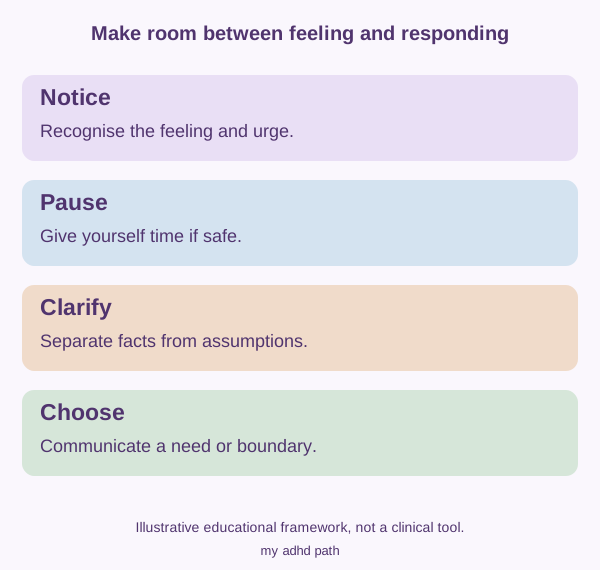
In these circumstances, it can help to identify what you're responding to.
Are you discussing an unpaid bill?
Or are you trying to establish whether your partner still considers you reliable?
Both concerns may matter, but they are different conversations.
Separating them can make each easier to address.
Fifteen practical strategies for navigating rejection sensitivity
1. Recognise your common triggers
Notice which situations frequently produce intense emotional reactions.
Unanswered messages, changes in plans, feedback and particular tones of voice may have different meanings for different people.
Understanding your own patterns is more useful than trying to recognise every possible trigger.
2. Name the emotion
Try describing what you're experiencing.
"I feel embarrassed."
"I feel disappointed."
"I'm worried that I've upset somebody."
Naming the feeling doesn't automatically resolve it, but it may help distinguish the emotion from the conclusions surrounding it.
3. Separate facts from interpretations
Write down what actually happened.
Then identify what you think it means.
This simple distinction may reveal where additional information would help.
4. Consider alternative explanations
There may be several plausible reasons why somebody hasn't replied or appears distracted.
You don't need to decide which one is correct immediately.
Allowing more than one possibility can reduce the pressure to resolve uncertainty straight away.
5. Give yourself time before responding
When an emotional response feels particularly strong, consider whether you need to reply immediately.
A little time may help you organise your thoughts and decide what you genuinely want to communicate.
6. Ask rather than investigate
Reading the same message fourteen times may not reveal any additional information.
A straightforward question can sometimes provide more clarity.
Choose an appropriate moment and avoid treating the answer as already established.
7. Use specific requests for reassurance
Instead of repeatedly asking whether everything is fine, identify what would help.
What you could say
"I've had a difficult day and would really appreciate spending some time together this evening."
This communicates a need without requiring another person to resolve an uncertain interpretation.
8. Practise tolerating manageable uncertainty
Not every unanswered message or ambiguous interaction requires immediate clarification.
Where the situation is safe, experiment with allowing some ordinary uncertainty to remain whilst continuing with your day.
Start with situations that feel manageable.
9. Develop a personal recovery routine
Identify activities that help you settle after an emotionally demanding experience.
Movement, quiet surroundings, a familiar hobby or writing down your thoughts may be useful.
Choose approaches that suit your circumstances.
10. Distinguish behaviour from identity
Forgetting something, receiving feedback or making a mistake is not a comprehensive assessment of your character.
Consider what you could learn or change without turning the experience into a judgement about your overall worth.
11. Keep other sources of connection
Maintaining friendships, interests and activities outside a romantic relationship can provide additional opportunities for belonging, enjoyment and confidence.
One person does not need to meet every emotional and social need.
12. Practise expressing preferences
Begin with decisions that feel relatively low-risk.
Suggest a restaurant you would enjoy.
Choose an activity you prefer.
Decline an invitation when you genuinely need some time to yourself.
Notice how other people respond when you express ordinary preferences.
13. Establish healthy boundaries
Understanding why something feels painful doesn't require accepting disrespectful behaviour.
Identify what you consider appropriate communication and how you would like to be treated.
Your partner is entitled to establish their boundaries too.
14. Discuss your experiences outside difficult moments
A relatively calm conversation may be a better opportunity to explain how rejection sensitivity affects you.
Describe what you find difficult and what support might help.
Encourage your partner to share their experiences as well.
15. Explore professional support
If concerns about rejection are significantly affecting your relationships, work, confidence or emotional wellbeing, speak to an appropriate healthcare professional.
There may be underlying difficulties that deserve individual assessment and support.
Supporting a partner who experiences rejection sensitivity
It can be difficult to know how to respond when somebody you love experiences intense emotional distress in response to an interaction.
You may want to reassure them.
You may also feel confused if their interpretation differs considerably from what you intended.
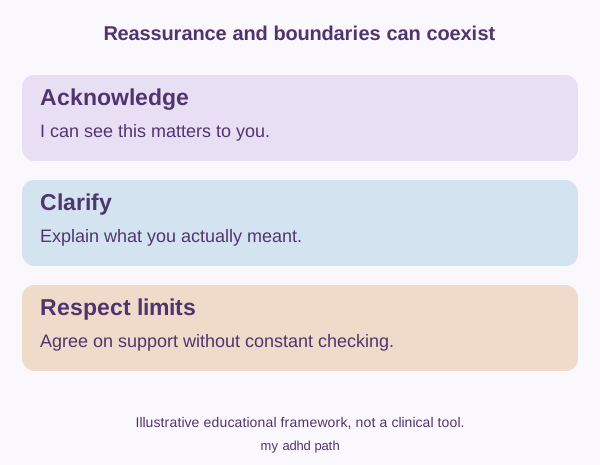
You can recognise their emotional experience without automatically agreeing with every conclusion.
What you could say
"I can see that my message upset you. I wasn't annoyed with you when I sent it, but I understand why it might have sounded abrupt."
This acknowledges the experience whilst providing relevant information.
It may also help to communicate significant changes of plan clearly, explain when you need some time alone and choose suitable moments for difficult conversations.
However, you are not responsible for preventing every uncomfortable feeling your partner experiences.
You should still be able to express concerns, disagree, spend time independently and maintain personal boundaries.
Support works best when it is collaborative.
| Situation | A supportive response |
|---|---|
| Your partner thinks you're upset | Clarify how you're feeling |
| Your partner is hurt by feedback | Acknowledge the feeling and explain the specific concern |
| Your partner asks repeatedly for reassurance | Offer a clear response and discuss what else might help |
| You need time alone | Explain your need and agree when to reconnect, if appropriate |
| You disagree about something | Express your perspective respectfully |
| Your partner tries to control your activities | Maintain your boundaries and seek support if necessary |
Nobody should feel that they have to avoid expressing their needs because of another person's emotional sensitivity.
A healthy relationship needs space for both people's experiences.
Three different experiences of rejection sensitivity
Illustrative scenario
Charlotte, 36 - The unanswered message
Charlotte sends her partner a message during the working day. When she doesn't receive a reply, she begins wondering whether he's upset with her. She frequently finds herself distracted from work whilst waiting for an answer. Charlotte starts noticing the difference between an unanswered message and evidence of rejection. She and her partner discuss their communication preferences during working hours. She also develops a routine for returning her attention to work instead of repeatedly checking her phone.
Illustrative scenario
Ben, 42 - When feedback feels overwhelming
Ben's partner mentions that she would appreciate him taking more responsibility for arranging household repairs. He immediately feels that he's disappointed her. His initial response is to explain all the other responsibilities he's been managing. Over time, Ben practises asking for specific information before responding. He recognises that his partner's concern relates to a particular responsibility, rather than necessarily reflecting her opinion of him as a person. Together, they agree on a clearer household arrangement.
Illustrative scenario
Alex, 29 - Learning to express preferences
Alex frequently agrees to social arrangements despite feeling exhausted. Declining invitations feels uncomfortable because of concerns that friends might stop including them. Alex begins practising expressing preferences in smaller situations. They discover that many of their friends are perfectly comfortable with someone declining an invitation or suggesting another day. Some relationships still require more effort than others, but Alex gradually develops greater confidence in communicating their needs.
Create your personal rejection sensitivity profile
Use these questions to explore your individual experiences.
| Question | Illustrative answer |
|---|---|
| Which situations feel particularly difficult? | Unexpected changes in someone's tone |
| What do I usually think has happened? | I've disappointed them |
| What emotions do I experience? | Worry and embarrassment |
| What happens physically? | Tension and restlessness |
| What do I feel like doing immediately? | Asking for reassurance several times |
| What helps me recover? | Going for a walk and discussing the situation later |
| What information would help? | Knowing whether the person is actually upset |
| What could I communicate differently? | Asking about their meaning rather than assuming it |
You may find it helpful to revisit your answers after several weeks.
The objective is to understand patterns and identify appropriate support, not to monitor every emotional response.
A seven-day rejection sensitivity reflection
This optional exercise introduces one small area of reflection each day.
Practical checklist
- Day one: Notice a situation that feels emotionally significant.
- Day two: Separate what happened from what you think it meant.
- Day three: Identify an activity that helps you recover from emotional overwhelm.
- Day four: Practise expressing a small preference.
- Day five: Reflect on a piece of feedback without turning it into a judgement about your identity.
- Day six: Identify a relationship in which you feel comfortable being yourself.
- Day seven: Consider one change that could help you communicate your needs more confidently.
You can complete these reflections at your own pace.
There is no requirement to revisit upsetting experiences or expose yourself deliberately to rejection.
Using AI to organise your thoughts
AI assistants may be useful when you find yourself trying to make sense of several thoughts and emotions simultaneously.
They can help organise information, identify questions and prepare respectful conversations.
They cannot establish whether another person is angry with you or determine the true meaning of a message from limited context.
AI prompt
Separate facts from interpretations
"Help me organise what happened into observable facts, my interpretations and the things that remain uncertain. Do not assume that my interpretation is either correct or incorrect."
AI prompt
Prepare a clarifying question
"Help me write a short, respectful question that asks for clarification without accusing the other person or unnecessarily apologising."
AI prompt
Express a personal preference
"Help me communicate this preference clearly and kindly without overexplaining or agreeing to something I don't want to do."
AI prompt
Process constructive feedback
"Help me identify the specific actions mentioned in this feedback and separate them from broader judgements I've made about my abilities."
AI may produce incorrect or overly reassuring responses.
Avoid relying on it to repeatedly confirm that somebody likes you or that your relationship is secure.
Respect other people's privacy and don't upload confidential messages or identifying information to unsuitable services.
AI is a planning and reflection tool, not a replacement for psychological support or direct communication.
Can rejection sensitivity improve?
People may find that their responses to criticism, uncertainty and perceived rejection become more manageable over time.
Recognising emotional patterns, developing confidence, improving communication and addressing underlying psychological difficulties may all be helpful.
For people with ADHD, appropriate ADHD treatment may also help with aspects of emotional regulation or impulsivity.
What the research says
There is insufficient evidence to establish a specific medication or psychological intervention as an effective treatment for RSD itself. Some psychological approaches, including cognitive behavioural therapy, may help address related difficulties such as anxiety, unhelpful interpretations or avoidance, depending on individual circumstances.
Speak to an appropriate healthcare professional about suitable options.
Do not start, stop or change ADHD medication independently in an attempt to manage rejection sensitivity.
What does the research say?
What the research says
Rejection sensitivity has been explored in psychological research for several decades. Early research by Geraldine Downey and Scott Feldman examined expectations of rejection and their relevance to interpersonal relationships. Separately, ADHD research has examined difficulties with emotional regulation, impulsivity and everyday functioning. Reviews and meta-analyses have identified associations between ADHD and emotional dysregulation in some individuals. However, these findings do not establish RSD as a distinct ADHD-specific disorder. There remain important unanswered questions about how the experiences described using this term should be defined, measured and differentiated from other psychological difficulties.
Claims circulating online about precise rates of RSD among people with ADHD should therefore be interpreted cautiously.
The strategies and reflection exercises in this article are intended as practical educational approaches, not a validated treatment programme for RSD.
When to seek additional support
Speak to your GP, ADHD clinician or an appropriately qualified psychological professional if concerns about rejection or criticism are substantially affecting your everyday life.
Persistent anxiety, low mood, avoidance, difficulty maintaining relationships or intense emotional distress deserve appropriate attention.
It is also important to recognise the difference between emotional sensitivity and an unsafe relationship.
Repeated humiliation, threats, coercive control or deliberate manipulation should not be dismissed as a misunderstanding caused by ADHD.
Confidential specialist support is available through organisations such as Refuge, Men's Advice Line and Galop.
If emotional distress becomes overwhelming, Samaritans can be contacted on 116 123 in the UK and Ireland.
If you or somebody else is in immediate danger, call 999.
Downloadable resource
My ADHD Rejection Sensitivity Guide
Practical reflection exercises for understanding emotional responses, navigating uncertainty and communicating with confidence.
Download PDFFrequently asked questions
Is rejection sensitive dysphoria an official diagnosis?
No. RSD is a commonly used descriptive term, but it is not currently recognised as a standalone clinical diagnosis or formal ADHD diagnostic criterion.
Does everybody with ADHD experience rejection sensitivity?
No. Emotional experiences and regulation difficulties vary considerably between individuals.
Can you experience rejection sensitivity without ADHD?
Yes. Rejection sensitivity may occur independently of ADHD and alongside various psychological experiences or health conditions.
Why do unanswered messages feel so upsetting?
Uncertainty, expectations of rejection, relationship experiences and emotional regulation may all contribute. An unanswered message can have numerous possible explanations.
Is rejection sensitivity the same as anxiety?
No. There may be considerable overlap, but anxiety is a broader emotional experience and can also form part of recognised clinical conditions.
Can rejection sensitivity make someone avoid relationships?
Some people may avoid social situations or relationships because of concerns about criticism or rejection. Persistent avoidance may benefit from professional support.
How should I reassure a partner who experiences rejection sensitivity?
Communicate clearly, acknowledge their feelings and provide honest information. Maintain your own boundaries and avoid assuming responsibility for every emotional response.
Can ADHD medication treat RSD?
There is insufficient evidence to identify a medication specifically established to treat RSD. ADHD medication may help some people with broader symptoms and functioning. Discuss individual concerns with your clinician.
Can therapy help?
Appropriate psychological support may help address related difficulties, including anxiety, avoidance, low self-esteem and emotional regulation. Treatment should reflect individual needs.
Does experiencing rejection sensitivity mean I've misunderstood a situation?
No. You may have interpreted something accurately or inaccurately. The intensity of your emotional response does not establish which explanation is correct.
Can children and teenagers experience rejection sensitivity?
Yes. Children and teenagers may experience significant distress around criticism, social exclusion or perceived rejection. Persistent difficulties should be considered within their wider developmental and psychological circumstances.
Can I become less sensitive without becoming less caring?
Developing ways to manage emotional responses does not require becoming indifferent to other people. Sensitivity, empathy and personal boundaries can coexist.
You don't need everybody's approval to belong
There will be people who appreciate your enthusiasm.
People who enjoy your wonderfully detailed stories.
People who understand that sometimes you need a little extra information before you feel comfortable with something.
There will also be people whose preferences differ from yours.
People who occasionally disagree with you.
People who can't reply to your messages immediately because they're busy doing perfectly ordinary things.
Learning to live comfortably alongside those differences can take time.
You don't have to become somebody who never feels hurt.
You can develop ways of recognising your feelings, checking your interpretations and communicating what you need.
You can care deeply about somebody without constantly monitoring their approval.
You can be considerate without agreeing to everything.
And you can gradually build relationships in which being yourself feels considerably more comfortable than trying to work out who everybody else would prefer you to be.
Sometimes, fine really does mean fine.
And sometimes, when it doesn't, you can have a conversation about it.
Sources and further reading
- NICE - Attention deficit hyperactivity disorder: diagnosis and management (NG87). https://www.nice.org.uk/guidance/ng87
- NHS - Attention deficit hyperactivity disorder (ADHD). https://www.nhs.uk/conditions/attention-deficit-hyperactivity-disorder-adhd/
- Downey, G. and Feldman, S. I. (1996). Implications of rejection sensitivity for intimate relationships. Journal of Personality and Social Psychology, 70(6), 1327-1343. https://doi.org/10.1037/0022-3514.70.6.1327
- Shaw, P. et al. (2014). Emotion dysregulation in attention deficit hyperactivity disorder. American Journal of Psychiatry. https://doi.org/10.1176/appi.ajp.2013.13070966
- Beheshti, A., Chavanon, M. L. and Christiansen, H. (2020). Emotion dysregulation in adults with attention deficit hyperactivity disorder: a meta-analysis. BMC Psychiatry. https://doi.org/10.1186/s12888-020-2442-7
- Faraone, S. V. et al. (2021). The World Federation of ADHD International Consensus Statement. https://doi.org/10.1016/j.neubiorev.2021.01.022
- Samaritans. https://www.samaritans.org/
- Refuge. https://refuge.org.uk/
- Men's Advice Line. https://mensadviceline.org.uk/
- Galop. https://galop.org.uk/
This article provides general educational information and is not a substitute for individual medical, psychological, relationship or safeguarding advice. RSD is not a formal clinical diagnosis. The examples are fictional, and the reflection frameworks are educational tools rather than clinically validated interventions.