

You can love someone enormously and still forget they asked you to pick up some milk on the way home.
At a glance
- ADHD can influence attention, communication and everyday relationship responsibilities.
- Intention and impact are different, and both matter.
- Shared responsibilities include planning, remembering and following up.
- Both partners deserve appropriate support and personal boundaries.
- External systems can reduce reliance on repeated reminders.
- Deliberately planning time together does not make it less meaningful.
- ADHD may explain certain difficulties but never excuses abusive behaviour.
It's a small thing, really. A carton of milk.
But perhaps it's the third time this week something has been forgotten.
Perhaps one of you is wondering why a simple request seems so difficult to remember, whilst the other is wondering how forgetting something so ordinary has become a conversation about the entire relationship.
Neither of you intended to spend Tuesday evening arguing about dairy products.
And yet, here you are.
ADHD can influence relationships in ways that aren't immediately obvious, particularly when neither partner understands how attention, working memory, emotional regulation and executive functioning can affect everyday interactions.
What looks like a lack of interest might be difficulty maintaining attention.
What feels like reluctance to help might involve difficulty getting started.
What begins as a practical disagreement might develop into something much more emotional.
Understanding these possibilities doesn't mean overlooking the impact of someone's behaviour. Nor does it mean that one partner should take responsibility for managing the other person's ADHD.
It means developing a more accurate understanding of what's happening between you, so you can find better ways of navigating it together.
How does ADHD affect romantic relationships?
ADHD is a neurodevelopmental condition associated with persistent difficulties involving inattention and/or hyperactivity and impulsivity.
For adults, these difficulties can influence many aspects of everyday life, including romantic relationships.
Executive functioning skills help us organise information, initiate tasks, manage time, remember intentions and adjust our responses when circumstances change.
Relationships depend on many of these abilities.
Remembering an important conversation. Arranging a weekend away. Paying a joint bill. Listening whilst someone explains how they're feeling. Finishing a household task. Recognising when a disagreement is becoming increasingly heated.
These are ordinary parts of sharing a life with someone.
But they can involve considerable executive functioning demands.
Good to know
Not everyone with ADHD experiences the same difficulties. And many relationship challenges have nothing to do with ADHD at all. Understanding the distinction is an important starting point.
When intention and impact don't match
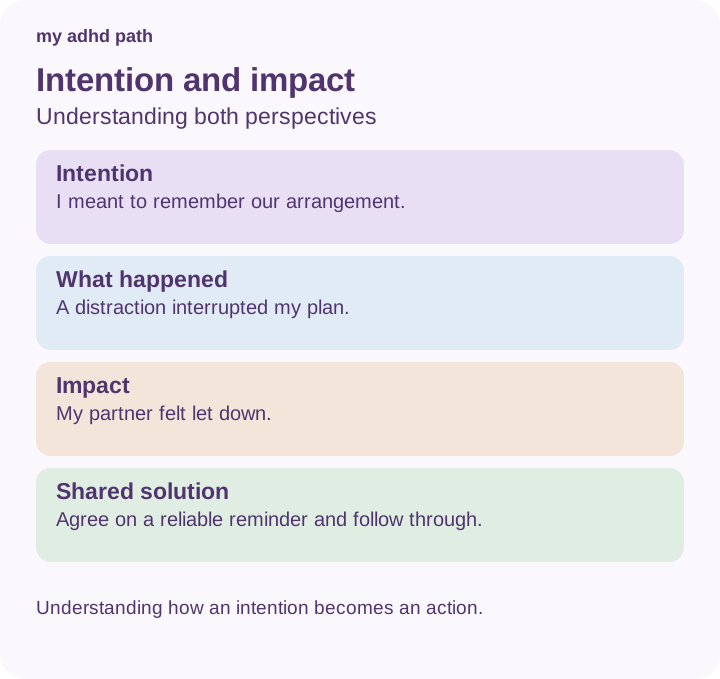
One of the more complicated aspects of ADHD in relationships is the difference between what someone intends to do and what actually happens.
You might genuinely intend to call your partner during the afternoon.
Then something interrupts your day. You become absorbed in another activity and the intention disappears from your immediate awareness.
By the time you remember, your partner has been waiting several hours.
From your perspective, forgetting the call doesn't reflect how much you care.
From their perspective, being repeatedly forgotten may feel hurtful.
Both experiences can be valid.
Understanding the reasons behind a difficulty does not automatically remove its consequences.
But it can help you develop a more constructive response than debating whether somebody cares enough.
Perhaps a reminder would help. Perhaps you need to agree on a more realistic time to call. Perhaps the arrangement itself needs changing.
The important conversation becomes less about proving your intentions and more about finding a way to make those intentions reliable.
Ten ways ADHD can affect relationships
1. Forgetting conversations and commitments
Working memory helps us hold and use information over short periods.
People with ADHD may experience difficulties retaining instructions or remembering intentions, particularly when distracted or managing competing demands.
A partner might interpret a forgotten conversation as evidence that it wasn't important.
Try this
Recording significant arrangements in a shared place may reduce misunderstandings.
2. Becoming distracted during conversations
Your partner is explaining something important, but your attention has been captured by a notification, a passing thought or something happening nearby.
You may still be interested in what they're saying.
Nevertheless, repeatedly losing the thread can leave someone feeling unheard.
Try this
Reducing distractions and choosing an appropriate moment for important conversations may help.
3. Struggling to begin household tasks
Knowing that the dishwasher needs emptying and actually beginning the task involve different processes.
Task initiation difficulties can affect routine responsibilities, particularly when they offer little immediate interest or urgency.
However, the task still exists, and someone still needs to complete it.
Try this
Appropriate reminders, clear arrangements and accessible routines can help translate intentions into action.
4. Experiencing time differently
One partner estimates that getting ready will take fifteen minutes.
The other has learnt from experience that it will probably take forty-five.
Differences in time estimation may contribute to recurring disagreements about lateness, preparation and commitments.
Try this
Visible time cues and realistic buffers can help.
5. Responding impulsively
Interrupting conversations, agreeing to commitments without checking arrangements or making spontaneous purchases can create difficulties within a relationship.
Try this
Developing agreed decision-making strategies may help, particularly where choices affect both partners.
6. Experiencing intense emotions
Some adults with ADHD experience difficulties regulating emotional responses.
Frustration, disappointment and excitement may feel particularly intense.
Learning to recognise emotional escalation and communicate constructively can support both partners.
Good to know
ADHD does not excuse threatening, abusive or controlling behaviour.
7. Becoming deeply absorbed in an activity
Some people with ADHD describe periods of intense concentration, often referred to as hyperfocus.
Becoming absorbed in work, hobbies or other interests may make it difficult to notice time passing or respond to competing demands.
Try this
Agreed stopping points and transition reminders may help protect shared commitments.
8. Finding routine responsibilities difficult to sustain
The early enthusiasm associated with a new household system may gradually disappear.
One partner might find maintaining a routine relatively straightforward, whilst the other finds it increasingly demanding.
Try this
Simple systems that are easy to restart can be particularly useful.
9. Struggling with competing sensory demands
Noise, interruptions, clutter or busy environments may make it more difficult for some people to concentrate or feel comfortable.
Sensory sensitivities are not unique to ADHD, but they can influence everyday experiences and interactions.
Try this
Discussing individual preferences can help both partners find suitable compromises.
10. Finding it difficult to make time for connection
Between work, household responsibilities, children and personal commitments, spending meaningful time together can become something you intend to do rather than something you actually do.
Making space for connection may require a little more deliberate planning.
That doesn't make the connection any less genuine.
What you experience and what your partner experiences
The same situation can look remarkably different depending on which side of it you're standing.
| Situation | One partner's experience | The other partner's experience |
|---|---|---|
| A forgotten commitment | I genuinely intended to remember | I feel I can't rely on our arrangements |
| An interrupted conversation | I'm excited and want to contribute | I haven't been able to finish speaking |
| Becoming absorbed in work | I completely lost track of time | I feel as though I'm not a priority |
| An unfinished household task | I got distracted halfway through | I've had to finish another responsibility |
| A strong emotional reaction | I'm finding this conversation overwhelming | I feel unable to discuss the issue calmly |
| A request for quiet | I need fewer demands for a while | I'm worried you're withdrawing from me |
These are illustrative perspectives, not automatic explanations for someone's behaviour.
The most useful way to understand your partner's experience is to ask them.
ADHD and the early stages of a relationship
The beginning of a relationship often involves novelty, anticipation and discovery.
You have new experiences together. You learn about each other's interests. Conversations can continue for hours.
Some people with ADHD describe becoming intensely focused on a new relationship during this period.
They may spend considerable time communicating, planning activities or thinking about their partner.
Over time, the relationship naturally develops. Everyday responsibilities become more prominent and the initial novelty changes.
If the amount of attention or spontaneity changes significantly, one partner may wonder whether the other's feelings have changed too.
That doesn't necessarily follow.
Good to know
Novelty and interest can influence attention, but ADHD does not provide a single explanation for changing relationship dynamics. If either partner feels neglected, discuss what has changed and what each person needs.
Long-term relationships benefit from continued attention, affection and effort, even when the initial excitement becomes a more familiar form of connection.
Love, attention and remembering are different things
A person's ability to remember birthdays, reply to messages or arrange romantic evenings is not a direct measurement of how much they love someone.
But the behaviours through which we express love still matter.
If remembering important occasions is difficult, use a calendar.
If spontaneous affection is becoming less frequent, talk about what helps you feel connected.
If work regularly absorbs the time you intended to spend together, establish clearer boundaries.
Common misconception
A reminder to buy flowers doesn't make the flowers less meaningful. Planning a date doesn't make it less romantic. Using a tool to help you remember something important can itself be an expression of care.
When one partner starts managing everything
Over time, some couples develop a pattern in which one person becomes responsible for much of the organisation within the relationship.
They remember appointments, monitor household supplies, arrange social commitments, manage bills and remind the other person about unfinished responsibilities.
The other partner may increasingly rely on these reminders.
Eventually, both people can become uncomfortable with the arrangement.
One feels overloaded.
The other feels constantly monitored.
Conversations that once revolved around shared interests become discussions about responsibilities.
This is sometimes described in relationship literature as a parent-child dynamic.
Good to know
The term describes an interaction pattern, not the maturity or value of either adult. Nobody particularly wants to feel like their partner's project manager. And nobody particularly enjoys feeling as though their every movement requires supervision.
The objective is to develop systems that support both adults without automatically transferring responsibility to one person.
Sharing the mental load
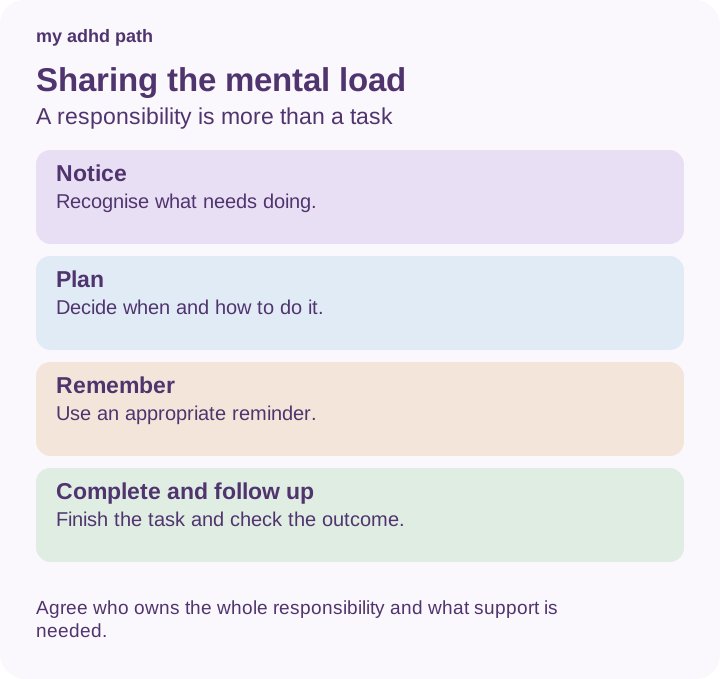
Household work involves considerably more than physically completing tasks.
Take arranging a dentist appointment.
Somebody needs to notice that an appointment is due, contact the practice, check availability, record the date, arrange transport if necessary and remember to attend.
Even if another person ultimately attends the appointment, much of the work may already have been completed on their behalf.
This is part of what people describe as the mental load.
When sharing responsibilities, consider the whole process.
| Responsibility | What complete ownership may involve |
|---|---|
| Grocery shopping | Checking supplies, planning purchases, shopping and putting items away |
| Household bills | Monitoring due dates, arranging payments and checking for problems |
| Social commitments | Making arrangements, recording dates and communicating changes |
| Children's activities | Monitoring schedules, equipment, payments and transport |
| Household maintenance | Identifying problems, arranging repairs and following up |
Complete ownership doesn't mean doing everything without assistance.
It means making clear who is responsible for coordinating the task and which support arrangements are needed.
The aim isn't necessarily a mathematically equal division of every responsibility.
It's an arrangement that both partners consider fair, manageable and sustainable.
When reminders become a source of conflict
One partner says:
"Can you remember to put the bins out?"
Later:
"Have you put the bins out?"
And finally:
"Why do I have to remind you about absolutely everything?"
The other partner may experience each reminder as additional pressure.
The person providing the reminders may feel increasingly frustrated that they can't trust the task to happen without monitoring it.
Both would probably prefer to spend the evening talking about something else.
Instead of continuing the same interaction, discuss how the responsibility might be managed differently.
A recurring reminder, a visible checklist or linking the task to an existing routine may be useful.
Agree on who will maintain the system.
The aim is to reduce the amount of reminding required, not simply create another system for one partner to administer.
Emotional regulation and disagreements
Disagreements are part of relationships.
However, when either partner experiences difficulties managing emotional responses, relatively ordinary disagreements can become more demanding.
A conversation about a forgotten commitment might quickly become a discussion about previous mistakes, feelings of rejection or fears about the relationship.
Strong emotions may make it harder to listen, process information or consider another perspective.
Some people with ADHD also describe heightened sensitivity to criticism or perceived rejection.
Good to know
The term rejection sensitive dysphoria, or RSD, is sometimes used to describe particularly intense experiences of perceived rejection. It is not a formal diagnostic category, and research into the specific construct remains limited.
Understanding emotional sensitivity may help couples communicate more thoughtfully.
It should not mean that important concerns become impossible to discuss.
Both partners deserve to be heard.
Creating space during difficult conversations
When emotions become heightened, it may be helpful to agree on a temporary break.
What you could say
"I want to talk about this properly, but I'm finding it difficult to think clearly at the moment. Can we take twenty minutes and come back to it?"
Agree on a realistic time to return to the conversation.
Use the break to settle, rather than prepare an extensive argument about why you're right.
When you return, focus on the original issue.
Good to know
A temporary pause is different from routinely avoiding difficult conversations or using silence to punish someone. If one partner feels unsafe, the priority is safety, not completing the conversation.
ADHD and intimacy
Intimacy involves more than sexual activity.
It includes affection, emotional closeness, shared experiences, vulnerability and feeling understood.
ADHD may influence these experiences in different ways.
Someone might find it difficult to shift their attention away from work at the end of the day.
Another might feel uncomfortable with certain forms of touch when overstimulated.
Differences in energy, sleep, medication effects, stress or interest in sexual activity may also influence intimacy.
Relationship difficulties, physical health, hormonal changes and other psychological factors can contribute independently of ADHD.
Talk about what helps each person feel comfortable and connected.
There is no universally appropriate frequency of sexual activity or level of affection.
Consent, mutual respect and the ability to communicate preferences are essential.
If difficulties persist or cause distress, consider speaking to an appropriate healthcare professional or qualified relationship or psychosexual therapist.
Good to know
Never change prescribed medication independently because of concerns about intimacy or sexual side effects. Discuss these concerns with your prescriber.
Making room for connection
Couples can become so occupied with managing everyday life that their relationship begins to resemble a small administrative department.
When did you last spend time together without discussing household tasks, children, work or appointments?
Connection doesn't necessarily require elaborate evenings out.
It might involve walking the dog together, watching an episode of something you both enjoy, exploring somewhere new or having a cup of tea without checking your phones.
Choose activities that genuinely suit both of you.
Having deliberately planned the time doesn't make it less meaningful.
When both partners have ADHD
When both people in a relationship have ADHD, there may be a valuable sense of mutual understanding.
You may recognise why certain tasks are difficult for each other.
You may share interests, enjoy spontaneity or appreciate unconventional ways of organising your lives.
However, similar difficulties can also create shared challenges.
Perhaps neither of you remembers appointments consistently.
Perhaps both of you begin household projects enthusiastically but struggle to finish them.
Perhaps you both become absorbed in your own activities and forget to make arrangements together.
Having the same diagnosis doesn't mean having identical needs.
One partner may need quiet whilst the other enjoys background noise.
One might rely extensively on routines whilst the other prefers flexibility.
Try this
Consider designing your shared environment around your combined needs rather than expecting either person to compensate automatically for the other. External systems can be particularly valuable when neither partner finds remembering responsibilities straightforward.
When your partner doesn't have ADHD
A partner without ADHD may need time to understand how it affects everyday life.
They may initially assume that organisation, remembering and switching attention involve similar effort for everyone.
Learning about ADHD can help provide a more accurate understanding of these differences.
However, a partner without ADHD is still entitled to their own needs, preferences and limits.
They may have health difficulties, demanding responsibilities or personal circumstances that affect their capacity too.
Being supportive does not require becoming the sole organiser, emotional regulator or problem-solver within the relationship.
Likewise, having ADHD doesn't mean someone should be treated as less capable of contributing.
Both people can develop approaches that respect each other's circumstances.
What if ADHD is diagnosed later in the relationship?
An adult ADHD diagnosis can change how couples understand experiences they've shared over many years.
A forgotten commitment may suddenly have a different possible explanation.
Previously confusing patterns may begin to make more sense.
There may also be complicated feelings about difficulties that occurred before the diagnosis.
One partner might feel relieved to understand their experiences.
The other might be relieved too, whilst still feeling frustrated about responsibilities they've carried.
A diagnosis can provide new information, but it doesn't automatically resolve established relationship patterns.
Both partners may benefit from exploring what they now understand differently and what they would like to change.
The most useful question may not be whether the relationship would have been different if ADHD had been recognised earlier.
It may be what you can do differently with the information you have now.
15 practical strategies for couples navigating ADHD
1. Understand your individual ADHD experiences
Learn about the specific ways ADHD affects your partner or yourself.
General information is useful, but individual experiences should inform the arrangements you make together.
2. Create one reliable shared calendar
Use an agreed place for commitments that affect both partners.
Include relevant preparation reminders, travel arrangements and changes.
Decide together how the calendar will be maintained.
3. Capture important conversations
If you're discussing something that requires action later, record the agreed next step.
You don't need to document every conversation.
Focus on information that would otherwise need to be remembered.
4. Choose the right moment to talk
Important conversations are often easier when both people have enough time and capacity to participate.
Ask whether now is a suitable moment instead of assuming that physical presence means someone is available to concentrate.
5. Reduce environmental distractions
Turn off the television, put phones aside or move somewhere quieter when discussing something important.
This can help both people remain engaged.
6. Make requests specific
What you could say
"Can we agree who will take responsibility for the laundry?" provides a clearer starting point than "Can you help more around the house?"
Specific requests can help translate concerns into practical arrangements.
7. Share complete responsibilities
Avoid automatically assigning one partner all the planning whilst the other completes individual tasks when instructed.
Discuss ownership, capacity and support systems.
8. Use reminders that don't depend entirely on your partner
Recurring alerts, checklists and calendar notifications can help reduce interpersonal reminding.
Choose tools you are willing and able to maintain.
9. Agree on financial safeguards
Discuss spending limits, shared expenses and purchases that need joint decisions.
Appropriate safeguards should be transparent and mutually agreed.
Good to know
Financial organisation should never become a justification for controlling another person's access to money.
10. Develop an approach to emotional escalation
Identify early signs that either person is becoming overwhelmed.
Agree on how to take a constructive break and return to the issue.
11. Protect individual recovery time
Both partners may need opportunities to rest, enjoy their interests and spend time independently.
Different recovery preferences don't necessarily indicate different levels of commitment to the relationship.
12. Protect shared time
Arrange activities that help you maintain a connection beyond practical responsibilities.
It doesn't matter whether these activities are spontaneous or planned.
13. Acknowledge contributions
Recognise what each person contributes to the relationship.
Practical support, emotional availability, creativity and reliability can appear in different forms.
Appreciation works best when it exists alongside fair expectations.
14. Review systems rather than repeatedly reviewing mistakes
When something repeatedly goes wrong, consider whether the current arrangement is suitable.
An improved system may be more constructive than another conversation about what should have happened.
15. Seek support when you need it
ADHD-informed individual treatment, relationship counselling or other appropriate professional support may help you understand persistent difficulties.
You don't need to wait until the relationship is in crisis to explore support.
Three couples, three different approaches
The following scenarios are fictional illustrations.
Illustrative scenario
Emma and James - Different ways of managing time
Emma likes to prepare well in advance. James, who has ADHD, generally underestimates the amount of time he needs to get ready. Social engagements regularly begin with frustration. They agree on realistic departure times and introduce a reminder well before they need to leave. James takes responsibility for maintaining his own preparation system. Emma no longer needs to monitor every stage of the process. The new arrangement doesn't guarantee that they'll never be late, but it gives them a more practical way to address the recurring difficulty.
Illustrative scenario
Priya and Daniel - Sharing the household mental load
Priya manages much of the family's administration. Daniel, who has ADHD, contributes to household tasks but often relies on Priya to identify what needs doing. They discuss complete areas of responsibility rather than individual chores. Daniel takes ownership of the family's grocery shopping and sports arrangements, using recurring reminders and shared information. Priya retains responsibilities that suit her circumstances. They review the arrangement periodically rather than assuming their needs will always remain the same.
Illustrative scenario
Sophie and Alex - When both partners have ADHD
Sophie and Alex frequently forget plans they've made together. Their home contains several notebooks, calendars and lists, none of which provides a complete picture of their commitments. They simplify their organisation into one shared calendar and a short weekly planning conversation. They also protect one evening each week for an activity they both enjoy. Their goal isn't to become exceptionally organised people. It's to spend less time dealing with avoidable administrative problems and more time enjoying their life together.
Build your relationship support profile
Try completing these questions individually before discussing your answers.
| Question | Illustrative answer |
|---|---|
| When do I feel most connected to my partner? | When we're walking together without distractions |
| What makes everyday organisation difficult? | Remembering verbal requests later |
| What support do I appreciate? | A written reminder for important arrangements |
| What makes me feel overwhelmed? | Several problems being discussed at once |
| How do I prefer to recover? | Some quiet time before talking |
| What responsibility would I like to manage differently? | Arranging household repairs |
| What do I enjoy contributing? | Planning activities and cooking |
| What would improve our shared time? | An evening each week away from work |
Compare your answers with curiosity.
You may discover that some difficulties have relatively straightforward practical solutions.
Others may require more substantial discussions or additional support.
A twenty-minute weekly relationship check-in
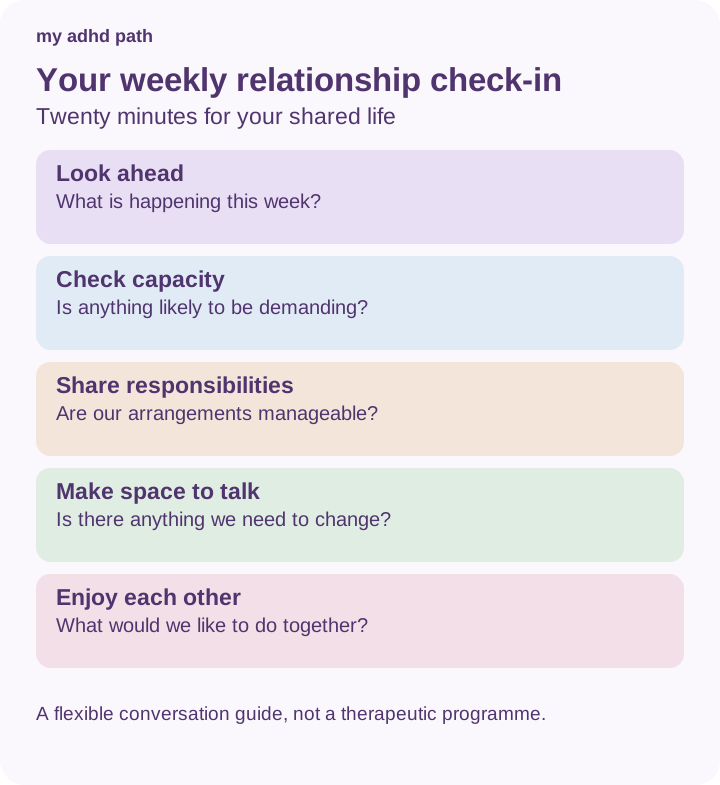
Consider setting aside a short period each week to discuss your shared life.
This doesn't need to feel like a formal business meeting.
Try discussing five things:
Practical checklist
- What is happening in the coming week?
- Is anything likely to become particularly demanding?
- Are our current responsibilities manageable?
- Is there something we need to discuss or change?
- What would we enjoy doing together?
Keep track of important decisions without turning the conversation into an extensive list of obligations.
If a significant disagreement requires more time, arrange a separate conversation.
And remember to talk about things you're looking forward to, not simply things that need managing.
A seven-day relationship reset
Small improvements can be a useful starting point.
| Day | Suggested activity |
|---|---|
| Monday | Identify one recurring difficulty you would both like to address |
| Tuesday | Discuss how each of you experiences that situation |
| Wednesday | Agree on one practical change |
| Thursday | Introduce a reminder or simplify an existing arrangement |
| Friday | Identify something you appreciate about each other |
| Saturday | Spend time together away from practical responsibilities |
| Sunday | Review what helped and decide what to continue |
This is an optional editorial exercise, not a therapeutic programme.
Neither partner should feel pressured to participate.
Using AI to support your relationship organisation
AI assistants may help reduce the administrative and planning demands that contribute to everyday relationship friction.
They can help organise responsibilities, clarify arrangements and prepare ideas for constructive conversations.
They cannot reliably determine someone's intentions, diagnose a partner or establish who is right in a disagreement.
AI prompt
Share household responsibilities
"Help us organise these household responsibilities into clear areas of ownership. Consider the planning, remembering and follow-up involved, not just completing individual tasks. Suggest arrangements we can discuss together."
AI prompt
Simplify our shared calendar
"Turn these commitments into a realistic weekly plan. Identify potential conflicts, preparation tasks and opportunities for us to spend time together."
AI prompt
Explore a recurring difficulty
"Help me think about practical ways to address this recurring household problem. Focus on changes to routines, reminders and responsibilities rather than assigning blame."
AI prompt
Prepare for a conversation
"Help me express this concern clearly and respectfully. Include what happened, how it affected me and a practical change I would like to discuss. Avoid guessing my partner's intentions."
AI prompt
Make time for connection
"Suggest five low-effort activities we could enjoy together during a busy week, taking into account our different energy levels and interests."
Review AI-generated suggestions together where relevant.
Respect your partner's privacy and avoid sharing confidential conversations, medical information or identifying personal details with unsuitable services.
AI is not a substitute for relationship therapy, healthcare or safeguarding support.
ADHD treatment and relationships
Effective ADHD support may help some adults manage symptoms that affect their relationships.
Treatment options can include medication, psychological interventions and adaptations to everyday environments.
Appropriate treatment depends on individual clinical needs and preferences.
Improvement in ADHD symptoms does not necessarily resolve every relationship difficulty.
Established patterns of communication, unequal responsibilities or unrelated relationship concerns may still need attention.
Partners may find it helpful to discuss changes they notice and what additional approaches could support their relationship.
Good to know
Decisions about medication should remain between the person receiving treatment and their prescribing clinician.
What the research says
Research has explored associations between adult ADHD and aspects of relationship functioning, including satisfaction, communication and conflict. Some studies report greater average relationship difficulties among adults with ADHD compared with adults without the condition. However, findings vary between studies, and factors such as other health conditions, socioeconomic circumstances, relationship histories and access to treatment may influence outcomes. Group-level findings do not determine the quality or future of an individual relationship. Research into adult ADHD treatment also supports approaches that address functional difficulties alongside core symptoms. The evidence for particular ADHD-specific couples interventions is less established than the broader evidence for individual ADHD treatment. There is no single scientifically established relationship formula for couples affected by ADHD. The strategies in this article are adaptable practical suggestions informed by broader principles of executive functioning support, constructive communication and shared responsibility.
Understanding ADHD without excusing harmful behaviour
ADHD may help explain why someone forgets commitments, experiences frustration or finds particular responsibilities difficult.
It does not make abusive behaviour acceptable.
Threats, intimidation, coercive control, physical aggression, sexual pressure and financial control are serious concerns regardless of whether someone has ADHD.
Neither partner should be expected to tolerate harmful behaviour because of a diagnosis.
If you are experiencing abuse or feel unsafe, seek confidential specialist support.
Good to know
Joint relationship counselling may not be appropriate when coercive control or abuse is present.
In the UK, Refuge (refuge.org.uk), Men's Advice Line (mensadviceline.org.uk) and Galop (galop.org.uk) provide specialist support for people experiencing domestic abuse.
If you are in immediate danger, call 999.
When to consider relationship counselling
Professional support may be useful if you repeatedly experience the same disagreements without finding a sustainable solution.
You might feel disconnected, increasingly resentful or unable to discuss responsibilities constructively.
An appropriately qualified relationship therapist with knowledge of adult ADHD may help you explore communication patterns and develop approaches that suit both partners.
Relate (relate.org.uk) provides information about relationship support in the UK.
You can also explore individual ADHD support through your GP or treating clinician.
Seeking assistance does not require either partner to accept responsibility for every difficulty within the relationship.
Frequently asked questions
Can someone with ADHD have a happy, healthy relationship?
Yes. ADHD can introduce particular challenges, but it does not determine someone's ability to form or maintain a loving relationship.
Does ADHD make someone forget their partner?
ADHD-related attention and memory difficulties may contribute to forgotten messages, conversations or arrangements. These difficulties do not automatically indicate a lack of affection, although their impact still matters.
Why does my partner with ADHD interrupt me?
Impulsivity, excitement or difficulty retaining a thought may contribute to interruptions. Other explanations are possible. Discuss how interruptions affect you and agree on ways to improve conversations.
Can ADHD cause relationship arguments?
ADHD-related difficulties may contribute to misunderstandings or recurring disagreements. Relationship conflict can also arise from many other factors.
Why was my partner more attentive at the beginning of our relationship?
Novelty and interest may influence attention, but changing relationship dynamics have numerous possible explanations. Discuss changes directly rather than assuming ADHD explains them.
Can ADHD affect intimacy?
Yes, potentially. Attention, stress, emotional regulation, sensory preferences and treatment effects may influence intimacy. Experiences vary considerably.
What happens when both partners have ADHD?
Some couples experience greater mutual understanding alongside shared organisational or emotional challenges. Appropriate external systems and individualised support may be helpful.
Can ADHD medication improve a relationship?
Treatment may improve symptoms and functioning for some people, which may indirectly benefit relationships. Medication is not a substitute for communication or addressing established relationship difficulties.
Does ADHD make someone more likely to be unfaithful?
ADHD does not determine someone's commitment or faithfulness. A diagnosis is not an excuse for violating agreed relationship boundaries.
How do I support my partner without becoming their parent?
Agree on clear responsibilities, encourage appropriate external supports and maintain your own boundaries. Support should be collaborative rather than dependent on one person managing the other.
Is couples counselling useful for ADHD relationships?
It may help some couples, particularly when a therapist understands adult ADHD and individual support needs. Specialist safety advice is important where abuse or coercive control is present.
Should I attribute all our relationship problems to ADHD?
No. ADHD is one part of a person's life. Compatibility, communication, health, circumstances and individual choices can all influence a relationship.
A relationship that works for both of you
There isn't an award for the couple who manages their household without a single reminder.
Nobody is checking how spontaneously you arrange date nights.
And the fact that you need a shared calendar doesn't make your relationship any less meaningful.
Perhaps the most useful change is recognising that you don't necessarily need to approach everyday life in identical ways.
You need to understand each other's experiences.
You need arrangements that respect both people's needs.
You need to take responsibility for your contributions and communicate when something isn't working.
And somewhere amongst the calendars, reminders, household chores and occasionally forgotten cartons of milk, you need opportunities to enjoy being together.
After all, you didn't choose each other because you were looking for somebody to help manage the household administration.
You chose each other for reasons that deserve a little time and attention too.
Sources and further reading
- NICE - Attention deficit hyperactivity disorder: diagnosis and management (NG87). nice.org.uk/guidance/ng87
- NHS - Attention deficit hyperactivity disorder (ADHD). nhs.uk
- Faraone, S. V. et al. (2021). The World Federation of ADHD International Consensus Statement: 208 Evidence-based conclusions about the disorder. doi.org/10.1016/j.neubiorev.2021.01.022
- Kooij, J. J. S. et al. (2019). Updated European Consensus Statement on diagnosis and treatment of adult ADHD. doi.org/10.1016/j.eurpsy.2018.11.001
- Eakin, L. et al. (2004). The marital and family functioning of adults with ADHD and their spouses. Journal of Attention Disorders, 8(1), 1-10.
- Shaw, P. et al. (2014). Emotion dysregulation in attention deficit hyperactivity disorder. American Journal of Psychiatry. doi.org/10.1176/appi.ajp.2013.13070966
- Relate. relate.org.uk
- Refuge. refuge.org.uk
- Men's Advice Line. mensadviceline.org.uk
- Galop. galop.org.uk
This article provides general educational information and is not a substitute for individual medical, psychological, relationship or safeguarding advice. The relationship scenarios are fictional. Suggested routines and exercises are adaptable editorial tools rather than clinically validated couples therapy interventions.