

What if the problem isn't that you're living with somebody who is disorganised, but that you're sharing a home organised around the way only one of you thinks?
At a glance
- Household responsibilities involve several stages of executive functioning.
- Completing a task and owning a responsibility are different.
- Fair household arrangements do not necessarily mean dividing every task equally.
- Visible reminders and clear shared spaces can coexist.
- External reminders can reduce reliance on one partner managing the other.
- Simple, flexible routines may be easier to maintain.
- Both partners deserve opportunities for rest and personal independence.
There is a chair in the bedroom.
It was originally purchased for sitting on.
At some point, however, it acquired an entirely different purpose.
It now accommodates clothes that have been worn but aren't quite ready for washing, two bags, a jumper that needs putting away and something that somebody was definitely going to deal with yesterday.
The chair is no longer furniture.
It's a filing system.
If you're sharing a home with somebody who has ADHD, you may recognise this rather unconventional approach to household organisation.
You may also recognise the conversations about putting things away, remembering appointments, finishing jobs and whose turn it is to empty the dishwasher.
Sharing a home involves hundreds of small responsibilities. Most are relatively straightforward individually, but managing them collectively requires considerable organisation.
When one partner has ADHD, some of those responsibilities may need a different approach.
That doesn't mean accepting an unfair distribution of household work.
Nor does it mean that one person needs to become considerably better at reminding the other.
It means creating a home that works for the people who actually live in it.
Why running a household is such a demanding task
Running a home involves far more than cleaning, cooking and occasionally remembering to put the bins out.
It requires noticing what needs doing, deciding when it should happen, gathering the necessary information, remembering appointments, organising materials and following through.
These activities draw on several aspects of executive functioning.
Good to know
Executive functions are mental processes involved in directing attention, planning, remembering information, managing impulses and organising behaviour towards a goal. Some of these processes can be particularly demanding for people with ADHD.
Consider something as ordinary as doing the washing.
You need to notice that clothes require washing, collect them, sort them, remember whether there's enough detergent, start the machine, return when the cycle has finished, dry everything and eventually put it away.
And then, rather inconveniently, the whole process starts again.
Doing the washing isn't really one task.
It's a collection of tasks distributed across several hours, with interruptions and transitions in between.
Understanding this can make it easier to identify where household responsibilities become difficult.
It's not always the task itself
Somebody with ADHD may be perfectly capable of cleaning a kitchen.
They might even clean it exceptionally well.
The difficulty may involve getting started, remembering when it needs doing or returning to finish something after becoming distracted.
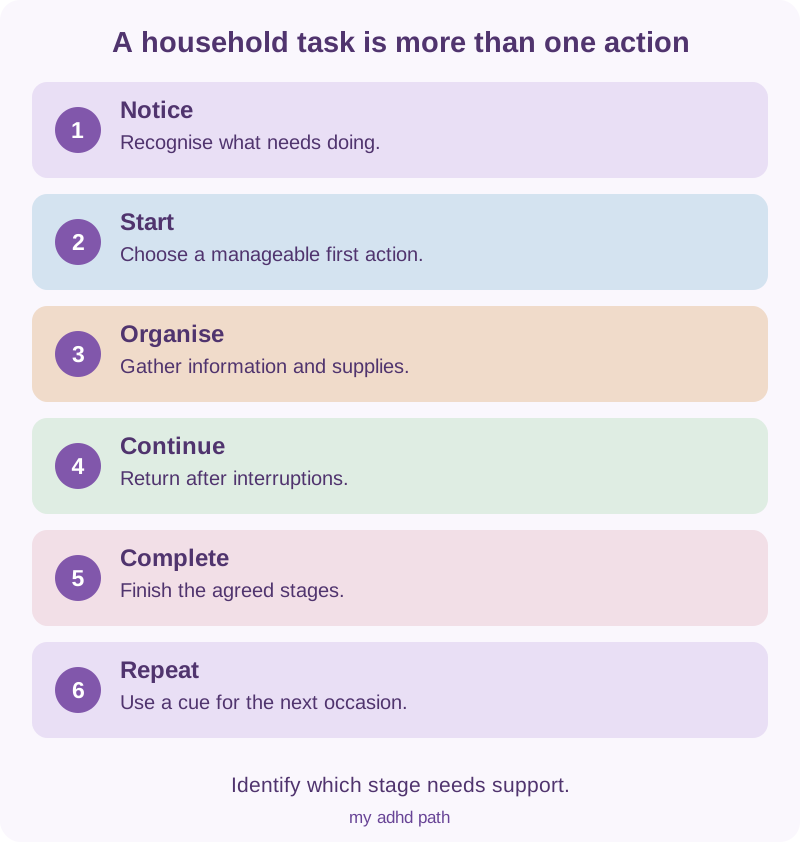
Different stages of a household responsibility can present different challenges.
| Stage | Possible difficulty | Practical support |
|---|---|---|
| Noticing | Overlooking something that needs doing | Visible cues or scheduled checks |
| Starting | Finding it difficult to begin | A small, clearly defined first action |
| Organising | Deciding where to start or what to use | Supplies stored where they're needed |
| Continuing | Becoming distracted during the task | Fewer interruptions or a short timer |
| Completing | Moving on before the final stage | A clear definition of what finished means |
| Repeating | Remembering to do it again | Recurring reminders or a regular routine |
These difficulties aren't universal to ADHD, and people without ADHD can experience them too.
The useful question is which part of the process needs additional support.
Twelve everyday household experiences you might recognise
1. Leaving things somewhere visible
A letter left on the kitchen counter may be an attempt to remember that it needs dealing with.
Putting it in a drawer might make the kitchen look tidier, but it may also make the responsibility easier to forget.
Visible storage and designated action areas can sometimes accommodate both needs.
2. Starting several jobs at once
You begin tidying the bedroom, discover something that belongs in the garage, take it downstairs and notice that a shelf needs repairing.
Forty minutes later, you've made considerable progress on the shelf.
The bedroom, meanwhile, remains exactly as you left it.
3. Finding repetitive chores particularly demanding
Repetitive activities may be difficult to engage with when they offer little interest, novelty or immediate reward.
A task being simple doesn't necessarily make it easy to initiate.
4. Having different definitions of tidy
One person sees a collection of objects that should be put away.
The other sees a perfectly functional arrangement of things they're currently using.
Try this
Agreeing on the purpose of a particular space can help more than debating whose definition of tidy is correct.
5. Forgetting household supplies
You discover that you've run out of dishwasher tablets whilst loading the dishwasher.
By the time you're next in the supermarket, dishwasher tablets are the last thing on your mind.
A shared shopping list that can be updated immediately is one possible solution.
6. Becoming absorbed in an interesting household project
A partner may spend an entire afternoon researching the perfect garden lighting system whilst struggling to begin a ten-minute household chore.
Attention can vary considerably depending on the activity, its demands and the individual's interest.
7. Underestimating how long jobs will take
Something described as a quick trip to the DIY shop might unexpectedly occupy most of the afternoon.
Difficulties estimating time can affect household plans and shared expectations.
8. Accumulating unfinished projects
There may be a half-painted cupboard, a collection of picture frames waiting to be hung and a box containing everything needed to repair a bathroom shelf.
Starting a project and sustaining attention until completion can require different kinds of effort.
9. Finding household decisions overwhelming
Deciding where everything should go, which item to purchase or what needs doing first can become a considerable task in itself.
Simplifying decisions may make practical responsibilities more manageable.
10. Forgetting arrangements made in conversation
An agreement to collect a prescription or book a boiler service might be understood perfectly well when discussed.
Remembering it at the appropriate time is a separate challenge.
11. Working in bursts
Some people achieve a great deal during periods of concentrated activity but struggle to maintain a consistent household routine.
A more flexible distribution of responsibilities may help, provided essential tasks are completed reliably.
12. Needing time to recover after other demands
Managing work, travel, parenting or social responsibilities can be demanding.
By the evening, household tasks may feel substantially more difficult than they would earlier in the day.
Planning around realistic capacity can help both partners develop more sustainable routines.
The invisible work behind a tidy home
Imagine that one partner asks the other to arrange a repair.
The second partner makes the telephone call.
From the outside, it appears that the responsibility has been shared.
But who noticed the problem?
Who decided that it needed repairing?
Who found the appropriate contact details?
Who remembered to ask?
Who will check whether the appointment has been arranged?
Who will follow up if nobody arrives?
Completing an individual action is only one part of managing a responsibility.
The additional planning, remembering, monitoring and coordination are often described as the mental load.
Good to know
If one partner consistently manages the planning, remembering, monitoring and coordination stages, they may be carrying considerably more household work than either person initially recognises. This can happen in relationships with or without ADHD.
Recognising the mental load is an important step towards sharing responsibilities more fairly.
Helping versus owning a responsibility
There is a surprisingly important difference between helping with something and being responsible for it.
Consider the weekly food shop.
| Helping with the food shop | Owning the food shop |
|---|---|
| Going to the supermarket when asked | Recognising when supplies need replenishing |
| Buying items on a prepared list | Maintaining the shopping list |
| Asking what needs buying | Checking what the household already has |
| Following an agreed instruction | Planning and completing the shop |
| Returning with the groceries | Addressing missing items and putting shopping away |
Neither arrangement is inherently wrong.
Some couples deliberately divide responsibilities into different stages because it suits their abilities and preferences.
But if one person believes a responsibility has been transferred whilst the other believes they're only being asked to complete a particular action, misunderstandings are likely.
Try this
Make responsibility explicit. Discuss who owns each task, what that involves and what support will help them manage it.
When one partner becomes the household manager
Many couples gradually develop a system in which one person remembers, organises and delegates household responsibilities.
The other responds to instructions and reminders.
Initially, this arrangement may seem efficient.
Over time, however, both people may find it increasingly frustrating.
One partner feels responsible for remembering everything.
The other feels as though they're constantly being instructed or corrected.
The relationship may begin to revolve around managing responsibilities rather than enjoying each other's company.
Moving away from this pattern requires more than asking somebody to be more organised.
It may involve transferring responsibility alongside the systems and information required to manage it independently.
A recurring reminder, a shared calendar or a clearly established routine can reduce the need for one partner to repeatedly prompt the other.
What you could say
"The aim is not to replace a partner's reminders with absolutely no reminders. It's to make reminders part of the environment rather than part of the relationship."
Fair doesn't always mean fifty-fifty
Couples often have different working hours, health needs, caring responsibilities, interests and abilities.
Dividing every household task equally may not be the most useful arrangement.
One partner may genuinely enjoy cooking.
The other might prefer managing household finances or completing practical repairs.
One person may find planning particularly demanding but be comfortable completing physical tasks.
A fair arrangement considers the overall balance of time, effort, responsibility and opportunities for rest.
It also needs to be agreed rather than assumed.
Both partners should feel able to express concerns if an arrangement becomes unsustainable.
Common misconception
ADHD may influence how responsibilities are managed, but it doesn't automatically transfer those responsibilities to somebody else.
The household responsibility audit
Before introducing another complicated household planner, try understanding what you're already managing.
Practical checklist
- Food shopping and meal planning
- Cooking and kitchen cleaning
- Washing, drying and putting away clothes
- General cleaning and tidying
- Household finances and bills
- Repairs and maintenance
- Appointments and administration
- Children's school and activity arrangements, where applicable
- Pet care, where applicable
- Family events and social arrangements
For each area, identify who currently notices, plans, remembers, completes and follows up.
You may discover that some apparently shared responsibilities are primarily managed by one person.
You may also discover less visible contributions that you've previously overlooked.
The purpose is understanding, not collecting evidence for the next argument.
Once you've established your current arrangements, identify two or three responsibilities that would benefit from clearer ownership.
You don't need to reorganise your entire household in one weekend.
Designing a home around the way you live
A beautiful organisation system is only useful if you can actually use it.
A cupboard containing immaculate, individually labelled boxes may look wonderfully organised.
But if retrieving something requires opening a cupboard, moving three boxes and removing a lid, the system may introduce unnecessary effort.
For some people with ADHD, organisation becomes more manageable when objects are visible, accessible and easy to return.
Think about where objects naturally accumulate.
Where do you leave your keys?
Where do shoes tend to appear?
Where does unopened post usually end up?
Rather than repeatedly trying to persuade yourself to use a completely different location, consider whether suitable storage could be introduced where the objects already accumulate.
Sometimes the most effective solution is simply putting a basket in the right place.
Ten ADHD-friendly household organisation ideas
1. Create a landing area near the entrance
Choose a consistent location for keys, bags, wallets and other everyday essentials.
Use hooks, trays or open compartments depending on your preferences.
The objective is reducing the number of decisions required when leaving or arriving home.
2. Establish a visible action station
Create a designated place for items requiring attention.
This might include post that needs opening, paperwork requiring a response or something that needs returning.
Keep the area manageable and arrange a regular time to review it.
Good to know
A visible action station still needs a process for completing the actions.
3. Store supplies where they're used
Keep suitable cleaning products and equipment close to the rooms where they're needed, where safe to do so.
Reducing the number of steps involved can make starting a task easier.
Always store hazardous products and medicines securely, particularly in homes with children or pets.
4. Use open storage selectively
Open baskets, trays and clear containers can make frequently used items easier to locate.
Closed storage may be preferable for objects that contribute to visual overwhelm.
Different spaces can use different approaches.
5. Give ongoing projects a temporary home
Create a dedicated shelf, box or other area for projects that are currently in progress.
This helps keep shared surfaces available without requiring every unfinished project to disappear from view.
6. Reduce unnecessary organisation categories
A storage system with twenty categories may require more decisions than a system with five.
Simple categories are often easier to maintain.
You can introduce additional detail where it provides a genuine benefit.
7. Make returning things as easy as finding them
Consider how many actions are required to put something away.
If returning an item is considerably more demanding than leaving it on the nearest surface, the arrangement may need adjusting.
8. Use reminders where action can happen
Place a reminder in a location where the relevant task can be completed, or set it for a time when you're available to act.
A reminder to take the bins out is more useful when you're at home than when you're halfway through a meeting.
9. Create a place for clothes that have been worn once
If the bedroom chair has become a permanent clothing repository, consider a dedicated hook, rail or basket for clothes that can be worn again.
Acknowledge the actual category rather than pretending it doesn't exist.
10. Protect a few genuinely clear spaces
Not every surface needs to be completely clear.
However, agreeing on certain shared spaces that remain available for their intended purpose can help the whole household.
The dining table might be one of them.
Particularly if you'd quite like to use it for dinner occasionally.
When one person's visual reminders are another person's clutter
Visible objects can provide useful reminders for some people.
For others, a room containing many visible objects can be distracting or overwhelming.
Both experiences are valid.
This is where thoughtful household design can be more useful than choosing one person's preferred system for every room.
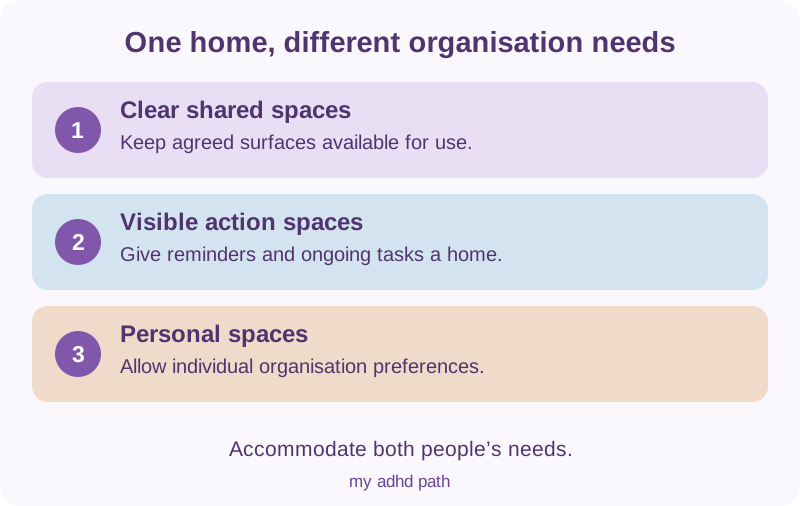
You might create three types of space.
Clear shared spaces: Areas that both people agree should remain relatively uncluttered.
Visible action spaces: Defined locations for reminders, paperwork and ongoing responsibilities.
Personal spaces: Areas where each person can organise possessions according to their preferences, within agreed safety and practical limits.
For example, a shared living room may remain relatively clear whilst a home office contains more visible storage.
A small tray beside the front door may accommodate everyday essentials without turning the entire hallway into an action station.
The aim is accommodating different needs within the same home.
Household routines that don't require constant motivation
Routines can reduce the number of decisions involved in repeated activities.
However, expecting a routine to work simply because it has been written down may be optimistic.
A useful routine needs to be easy to recognise, start and resume when circumstances change.
Try this
Consider attaching a small household action to something that already happens regularly. After breakfast, check the shared calendar. After making an evening drink, check whether the dishwasher needs starting. Before going upstairs, take any belongings that need returning to the bedroom.
These familiar activities can provide cues for other actions.
Not every routine needs to happen at an exact time.
Some people benefit from linking activities to existing events rather than relying on the clock.
If a routine stops working, consider changing the cue, reducing the number of steps or finding a more suitable time.
The usefulness of a routine matters more than maintaining it perfectly.
Try the ten-minute household reset
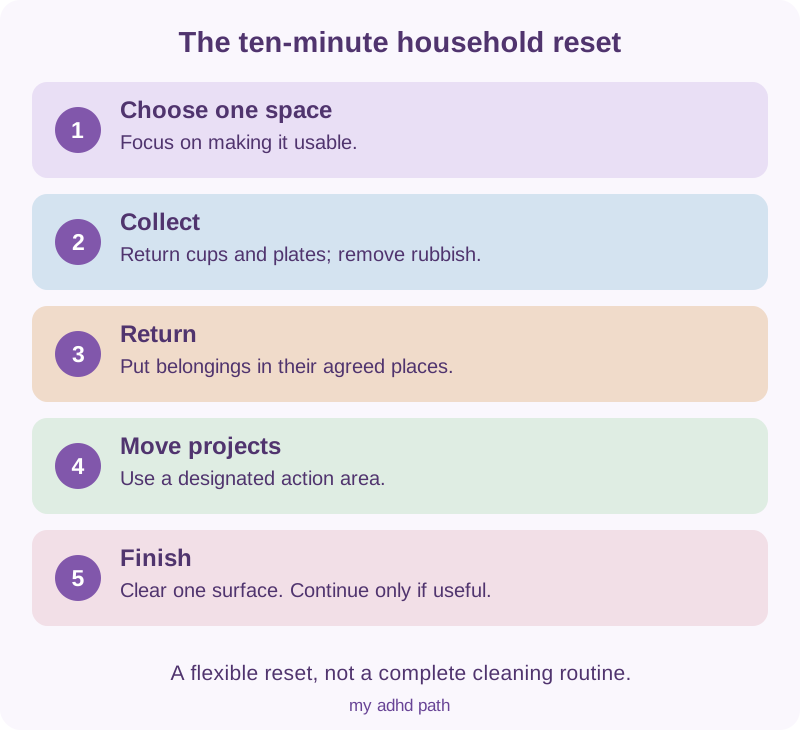
A household reset is a short period dedicated to restoring a shared space to a more usable condition.
It isn't intended to replace necessary cleaning or complete every outstanding responsibility.
Choose one space and agree on a few priorities.
Practical checklist
- Return cups and plates to the kitchen
- Put rubbish in the bin
- Return items to their designated locations
- Move unfinished projects to the action area
- Make one surface available for use
Set a timer for ten minutes if that helps.
Both partners might participate, or the responsibility may be shared through an agreed arrangement.
When the time is up, decide whether you want to continue.
Even a small improvement can make the space easier to use.
You don't have to accidentally spend the entire evening reorganising the cupboard under the stairs.
What does finished actually mean?
Two people can agree that one of them will do the washing whilst having completely different expectations about what that involves.
One considers the task finished when the washing machine has completed its cycle.
The other expects everything to be dried, folded and put away.
Neither interpretation needs to be treated as evidence of bad intentions.
But the disagreement matters.
Clarifying what finished means can reduce uncertainty.
| Responsibility | Example of an agreed finish point |
|---|---|
| Washing | Clothes washed, dried and returned to their storage locations |
| Cooking | Meal prepared and agreed kitchen clean-up completed |
| Household bills | Payment made and any necessary records updated |
| Rubbish | Bins emptied and replacement bags fitted |
| Repairs | Repair completed or appointment arranged and followed up |
| Shopping | Essential items purchased, put away and missing items addressed |
These are illustrative arrangements.
Choose completion criteria that reflect your own household rather than adopting somebody else's standards automatically.
How to manage projects that never quite get finished
Some household projects begin with enormous enthusiasm.
The research is completed.
The materials are purchased.
The first stage is tackled.
Then something happens.
Another responsibility becomes more urgent, the project becomes repetitive or an unexpected complication requires additional decisions.
The project remains visible for several months.
Managing unfinished projects may become easier if you separate active projects from possible future ones.
Practical checklist
- Projects currently receiving attention
- Projects waiting for a specific action or decision
- Projects deliberately postponed
- Projects you no longer intend to complete
For each active project, establish the next action.
"Finish decorating the hallway" is a broad objective.
"Buy a small tin of white satinwood paint" is a more specific starting point.
Consider agreeing on how many disruptive household projects can be active simultaneously.
The appropriate number depends on your space, resources and circumstances.
Some projects are also worth delegating to an appropriate professional, particularly where safety or specialist skills are involved.
Completing a project doesn't necessarily require doing every part of it yourself.
Make a shared calendar genuinely useful
A shared calendar can help with appointments, household administration and family arrangements.
However, entering information is only the first step.
Someone needs to know when to act on it.
For important appointments, include useful information such as the location, preparation required and who is responsible for attending.
If a task needs completing before the appointment, consider scheduling a separate reminder for that task.
Good to know
A reminder about the car's MOT on the day it expires may not leave sufficient time to arrange it.
Agree on which events belong in the shared calendar and which can remain personal.
Keep notifications manageable so that genuinely important reminders don't become lost among dozens of less useful ones.
A shared calendar should reduce conversations about forgotten arrangements, not create another household responsibility that only one partner manages.
Household finances and ADHD
Managing bills, subscriptions, purchases and financial administration can involve sustained attention, planning and numerous repeated actions.
Some people with ADHD experience particular difficulties with these processes.
Where appropriate, automated payments, scheduled financial reviews and clear spending arrangements may help.
Practical checklist
- Setting reminders for renewal dates
- Reviewing recurring subscriptions periodically
- Agreeing on how shared expenses are managed
- Allowing time to consider significant purchases
- Keeping essential financial information accessible to the appropriate people
- Establishing a clear process for dealing with unexpected expenses
Financial arrangements should be consensual and transparent.
One partner having ADHD does not justify removing their access to money, controlling their spending without agreement or restricting their financial independence.
If significant debt or financial difficulties are developing, independent advice may be appropriate.
We'll explore this subject separately in our guide to ADHD and money.
Fifteen ways to make sharing a home easier
1. Design systems together
A system introduced by one partner may make perfect sense to them whilst feeling unnecessarily complicated to the other.
Both people should have opportunities to contribute.
2. Transfer complete responsibilities
Agree on who owns each responsibility and which stages it includes.
Provide the information and resources needed to manage it.
3. Put reminders outside the relationship
Use calendars, alarms, notes or automation where appropriate.
Reduce reliance on one person repeatedly prompting the other.
4. Start with frequently repeated difficulties
A problem occurring every evening may deserve attention before a problem occurring twice a year.
5. Make the first action obvious
Replace broad instructions with specific starting points.
6. Agree on shared standards
Discuss what makes a room comfortable, usable and appropriately clean for both people.
7. Give household objects a convenient home
Choose storage locations based on how items are actually used.
8. Simplify where possible
Reduce unnecessary duplicate possessions, complicated arrangements and avoidable steps.
Make decisions collaboratively rather than disposing of another person's belongings without consent.
9. Plan around realistic capacity
Consider work schedules, health, family responsibilities and energy when agreeing on household routines.
10. Make arrangements easy to see
Use a shared planner, whiteboard or suitable digital tool if it helps both people.
11. Establish a backup plan
Agree on what happens when somebody is unwell, working late or unable to complete an essential responsibility.
12. Include recovery time for both partners
Everybody needs opportunities to rest and enjoy activities unrelated to managing the home.
13. Review commitments without keeping score
Discuss whether the current arrangements feel sustainable rather than maintaining a daily tally of each other's mistakes.
14. Consider appropriate paid support
Where affordable, a cleaner, laundry service, grocery delivery or household maintenance professional may remove some practical demands.
15. Make adjustments as circumstances change
A system that worked six months ago may need updating after a new job, a change in health or an increase in caring responsibilities.
Household arrangements can evolve.
Three homes, three different solutions
Illustrative scenario
Emma and James - The invisible household manager
Emma has ADHD and works in a creative role. James has gradually become responsible for remembering household administration, even though Emma completes a considerable amount of practical work. They review the stages involved in each responsibility and recognise that their existing arrangement has left James managing many of the reminders. Emma takes ownership of several clearly defined responsibilities, supported by recurring digital reminders and a weekly administration period. James continues managing other areas of the household. They review whether the new arrangement works for both of them rather than expecting the first version to be permanent.
Illustrative scenario
Aisha and Tom - Different approaches to clutter
Tom prefers frequently used objects to remain visible. Aisha finds visible clutter distracting and appreciates relatively clear shared rooms. Their disagreements often centre on the dining table and kitchen surfaces. They establish a designated paperwork station and provide accessible storage close to the places where Tom uses his belongings. They also agree that the dining table should be available for meals. Neither person has to completely adopt the other's organisation style.
Illustrative scenario
Sophie and Alex - Finding a manageable routine
Sophie and Alex both have ADHD. Their home tends to alternate between periods of considerable organisation and periods when household tasks accumulate. They introduce a short evening reset, recurring reminders for essential responsibilities and a shared list of tasks requiring attention. They concentrate on maintaining a few important routines rather than constructing a detailed timetable covering every household activity. Their arrangements aren't perfect, but they're easier to return to after demanding weeks.
Create your shared household responsibility planner
Start with a small number of responsibilities.
| Responsibility | Owner | Support system | Completion or frequency |
|---|---|---|---|
| Weekly food shop | Partner A | Shared grocery list | Saturday |
| Household bills | Partner B | Automated payments and calendar | Monthly review |
| Washing | Partner A | Laundry reminders | Complete agreed stages |
| Rubbish and recycling | Partner B | Recurring collection reminder | Collection day |
| Kitchen reset | Shared | Short evening routine | Agreed evenings |
| Repairs | Agreed individually | Project list | Specific next action |
This is an example rather than a suggested division for every household.
Your own version might include different responsibilities, schedules and forms of support.
Make it clear what shared means in practice.
If a job belongs to both people but nobody knows when they're expected to act, ownership may still need clarification.
A seven-day household experiment
You don't need to purchase an entire collection of storage containers or spend a weekend reorganising your home.
Try making one manageable change each day.
Monday - Notice. Identify one area where the same household difficulty occurs repeatedly.
Tuesday - Understand. Work out which part of the process is difficult: noticing, starting, remembering, completing or repeating.
Wednesday - Simplify. Remove one unnecessary step or place useful supplies somewhere more convenient.
Thursday - Agree. Clarify ownership of one household responsibility.
Friday - Externalise. Introduce a suitable reminder that doesn't depend on somebody repeatedly asking.
Saturday - Reset. Spend a short period restoring one shared space to a more usable condition.
Sunday - Review. Discuss what helped, what didn't and which changes you'd like to continue.
The experiment can be completed over several weeks if that suits your circumstances.
It is an educational planning tool, not a clinically validated ADHD intervention.
Using AI to make household organisation easier
An AI assistant can help organise scattered household information into manageable actions.
This can be particularly useful when the difficulty involves deciding where to begin rather than actually completing the work.
AI prompt
Organise our household responsibilities
"Help us organise these household responsibilities into clear categories. Identify the planning, noticing, remembering and follow-up involved in each responsibility. Suggest practical ways to discuss ownership fairly."
AI prompt
Break down a household task
"Break this household task into a small number of practical steps. Identify the easiest starting action and any information or equipment I need before beginning."
AI prompt
Create a realistic weekly routine
"Help me create a flexible weekly household routine based on these commitments. Include essential responsibilities and recovery time. Avoid filling every available period."
AI prompt
Simplify our organisation system
"Help me identify unnecessary steps in this organisation system. Suggest simpler approaches that make items easy to find, use and return."
AI prompt
Manage unfinished projects
"Organise these household projects into active, waiting, postponed and no longer needed. Identify one specific next action for each active project."
AI-generated suggestions will still need reviewing.
An assistant cannot determine whether a division of responsibilities is fair without understanding the experiences of both people.
Avoid sharing sensitive financial information, access credentials or private details about family members with unsuitable services.
Use technology to reduce household administration, not to monitor or control your partner.
What the research says
Research into adult ADHD has identified difficulties in various aspects of everyday functioning, including organisation, planning and managing responsibilities. Executive functioning research provides one way to understand why otherwise straightforward activities can sometimes require considerable effort. Studies examining family and marital functioning have also reported relationship difficulties among some adults with ADHD and their partners. These findings describe patterns across groups of people. They do not establish that every individual with ADHD experiences household difficulties or that particular domestic habits are caused by ADHD. Research into specific home organisation methods is more limited. The strategies in this article are practical applications of broader principles, including environmental adjustments, external reminders and reducing unnecessary demands.
When household difficulties need additional support
Persistent difficulties with household responsibilities may contribute to stress, relationship conflict and emotional exhaustion.
If everyday activities are becoming substantially difficult to manage, discuss your experiences with an appropriate healthcare professional.
ADHD treatment, psychological support or occupational therapy may be helpful depending on individual needs and availability.
Other factors can also affect someone's ability to manage household responsibilities, including depression, anxiety, sleep difficulties, physical illness and caring demands.
It is worth considering the wider context rather than automatically attributing every difficulty to ADHD.
Relationship support may be helpful if disagreements about responsibilities are becoming persistent.
However, coercive control, financial abuse, intimidation and deliberate humiliation should not be treated as ordinary household disagreements.
Confidential specialist support is available through Refuge (0808 2000 247), Men's Advice Line (0808 801 0327) and Galop (0800 999 5428).
If you are in immediate danger, call 999.
Frequently asked questions
Why can household chores be difficult for someone with ADHD?
Chores may involve planning, initiating tasks, remembering several stages and returning to complete activities after interruptions. Some of these processes can be affected by ADHD.
Does ADHD make people messy?
Not necessarily. Organisation habits vary considerably. Some people with ADHD maintain highly organised surroundings, whilst others find aspects of household organisation demanding.
Why does my partner leave things where they can see them?
Visible objects may act as reminders or make frequently used items easier to access. This is an individual preference rather than a universal ADHD characteristic.
Should I remind my partner about household responsibilities?
Occasional reminders are a normal part of many relationships. If one person becomes responsible for repeatedly remembering and prompting, alternative reminder systems and clearer ownership may be worth exploring.
How should couples divide household chores when one person has ADHD?
Consider time, capacity, preferences and the full responsibility associated with each task. Agree on a sustainable arrangement rather than assuming that every task must be divided equally.
Why does my partner begin projects without finishing them?
Changing interest, distractions, difficulties planning subsequent stages or competing demands may contribute. There may also be reasons unrelated to ADHD.
Are cleaning schedules helpful for ADHD?
They can be, especially when they are realistic, accessible and easy to resume after interruptions. A complicated schedule may introduce additional demands.
Can someone with ADHD be extremely tidy?
Yes. Some people prefer clear, organised environments or develop effective systems that help them manage everyday responsibilities.
Should I organise my partner's belongings for them?
Discuss any proposed changes first. An organisation system may depend on where someone expects to find their belongings. Avoid moving, discarding or reorganising personal possessions without consent.
Can medication make household organisation easier?
Effective ADHD treatment may help with symptoms affecting everyday functioning for some individuals. Medication does not automatically establish household routines or resolve disagreements. Discuss treatment questions with an appropriate clinician.
What if both partners have ADHD?
Shared reminders, simplified systems and clear responsibilities may be particularly useful. Both partners can still have very different organisation styles and support needs.
What if I feel exhausted by managing everything?
Your needs deserve consideration. Review how responsibilities are distributed and consider practical or professional support. Sustainable household arrangements should provide both partners with opportunities to rest.
Your home should support your life
A home is where you eat, sleep, recover, laugh, spend time together and occasionally discover something in the freezer that nobody remembers buying.
It isn't an examination of your organisational abilities.
You can have a comfortable home without maintaining perfectly arranged cupboards.
You can have different approaches to tidiness without constantly disagreeing about them.
You can share responsibilities without being equally good at every task.
The most useful household systems are often the ones that quietly accommodate the people using them.
They make things easier to remember.
They reduce unnecessary decisions.
They allow responsibilities to be managed without repeated negotiation.
And they leave considerably more time for the things you actually enjoy doing together.
Because you didn't choose to share your life with somebody so that you could spend most of it discussing the dishwasher.
Downloadable resource
My ADHD Home Toolkit
Practical planners, household routines and organisation strategies for a home that works for everyone.
Download PDFSources and further reading
- NICE - Attention deficit hyperactivity disorder: diagnosis and management (NG87). https://www.nice.org.uk/guidance/ng87
- NHS - Attention deficit hyperactivity disorder (ADHD). https://www.nhs.uk/conditions/attention-deficit-hyperactivity-disorder-adhd/
- Faraone, S. V. et al. (2021). The World Federation of ADHD International Consensus Statement: 208 Evidence-based conclusions about the disorder. https://doi.org/10.1016/j.neubiorev.2021.01.022
- Kooij, J. J. S. et al. (2019). Updated European Consensus Statement on diagnosis and treatment of adult ADHD. https://doi.org/10.1016/j.eurpsy.2018.11.001
- Diamond, A. (2013). Executive functions. Annual Review of Psychology, 64, 135-168. https://doi.org/10.1146/annurev-psych-113011-143750
- Eakin, L. et al. (2004). The marital and family functioning of adults with ADHD and their spouses. Journal of Attention Disorders, 8(1), 1-10.
- MoneyHelper - Free and impartial money guidance. https://www.moneyhelper.org.uk/
- Relate. https://www.relate.org.uk/
- Refuge. https://refuge.org.uk/
- Men's Advice Line. https://mensadviceline.org.uk/
- Galop. https://galop.org.uk/
This article provides general educational information and is not a substitute for individual medical, psychological, financial, relationship or safeguarding advice. All scenarios are fictional. The household planning frameworks and exercises are practical educational resources rather than clinically validated interventions.