

Sometimes, the conversation you're having and the conversation your partner thinks you're having are two entirely different conversations.
At a glance
- Communication involves attention, working memory, interpretation and emotional regulation.
- What somebody says and what another person hears may differ.
- Previous experiences can influence present interpretations.
- Acknowledging impact is different from explaining intention.
- Recognising emotional escalation can help interrupt unproductive conversations.
- Constructive conversation breaks include an agreement to reconnect.
- Both partners are responsible for respectful communication.
"Did you remember to book the car in?"
A perfectly reasonable question.
Except that one person hears a straightforward enquiry about the car, whilst the other hears something considerably more complicated.
Have you forgotten again? Why can't I rely on you? Am I going to have to organise everything myself?
None of those things were actually said.
And yet, within minutes, you're having a disagreement that seems to involve everything except the car.
Communication is a surprisingly complicated process. It requires attention, memory, interpretation, emotional regulation and the ability to respond whilst taking somebody else's perspective into account.
Several of these processes can be affected by ADHD.
Understanding what happens between hearing something and responding to it can help explain why conversations occasionally take such unexpected directions.
More importantly, it can help you find ways to bring them back.
Why communication involves more than listening
When somebody speaks to you, your brain is doing considerably more than recognising words.
You're maintaining attention, retaining information, interpreting meaning, noticing tone, considering context and deciding how to respond.
You may also be managing distractions, remembering something you wanted to say and trying to judge when it's appropriate to contribute.
Much of this happens without conscious consideration.
For someone with ADHD, aspects of the process may require additional effort, particularly during lengthy conversations or emotionally demanding situations.
You can be genuinely interested in what somebody is saying and still lose track of part of the conversation.
You can understand a request perfectly well but forget it shortly afterwards.
You can recognise that an interruption is inappropriate and still find it difficult to resist the impulse to speak.
These experiences aren't universal, and they aren't exclusive to ADHD.
However, recognising the demands involved in communication can help both partners develop more useful approaches.
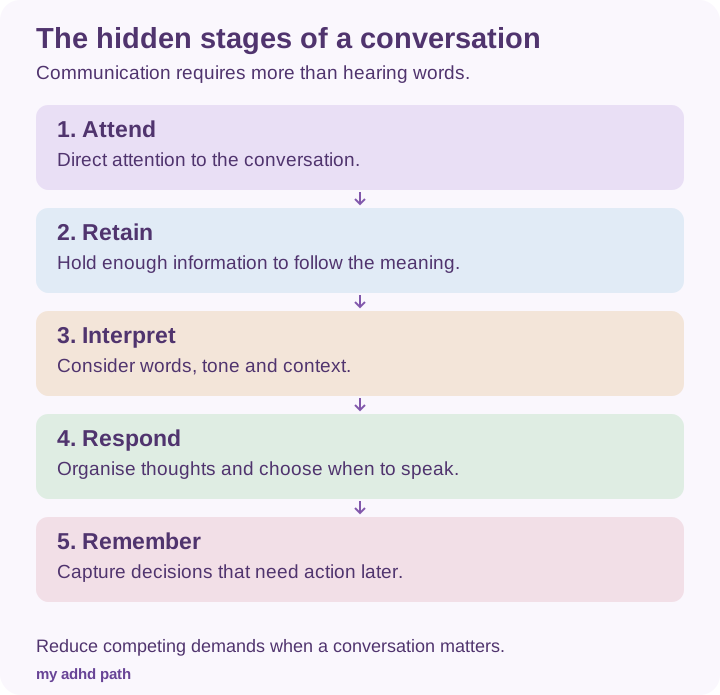
The hidden stages of a conversation
Consider what happens during a relatively ordinary discussion.
Your partner tells you about something that happened at work.
You need to:
- Direct your attention towards the conversation.
- Retain enough information to follow the story.
- Understand the meaning and emotional context.
- Manage competing thoughts and distractions.
- Recognise when and how to respond.
- Remember anything that requires action later.
Now imagine having that conversation whilst preparing dinner, listening to the washing machine, receiving notifications and thinking about a deadline.
The number of competing demands has increased considerably.
If you're already tired or overwhelmed, maintaining attention may become even more demanding.
Sometimes improving communication begins with changing the circumstances in which the conversation happens.
Ten ADHD communication patterns worth understanding
1. Interrupting when you're interested
Some people with ADHD find it difficult to hold a thought in mind whilst waiting for another person to finish speaking.
They may interrupt because they're concerned they'll forget what they wanted to say.
Others interrupt because they're excited about the subject or respond before considering whether the other person has finished.
The intention might be enthusiastic participation.
The impact might be that somebody feels unable to complete a sentence.
Understanding both sides can help you develop a more workable conversation rhythm.
2. Losing the thread halfway through
You were listening.
You genuinely were.
Then something your partner said reminded you of something else, and your attention briefly followed that thought.
By the time you've returned to the conversation, you're not entirely sure how you've arrived at the subject of somebody's new garden fence.
Try this
Asking for clarification may be more useful than pretending you've followed everything. A simple "Sorry, I lost the thread for a moment - can you go back to the part about..." is more respectful than nodding along.
3. Forgetting something that was discussed
Agreeing to an arrangement and remembering it several hours later are different processes.
A conversation might be perfectly clear at the time but difficult to recall when it requires action.
Important arrangements can benefit from being recorded immediately rather than relying exclusively on memory.
4. Answering before processing the question fully
An immediate response may sometimes reflect impulsivity rather than a considered opinion.
Allowing a little time to think can make conversations more accurate and constructive.
5. Providing considerably more information than somebody expected
A simple question can occasionally produce a detailed explanation involving several related stories, two historical references and a piece of information that may or may not be relevant.
Some people with ADHD find it difficult to organise their thoughts whilst speaking.
Try this
Agreeing on the main point first can help when the conversation involves practical decisions. Not every conversation, of course, needs to be efficient. Sometimes a wonderfully meandering story is part of the pleasure of talking to somebody.
6. Interpreting questions as criticism
Previous experiences of being corrected or criticised may influence how someone interprets a question.
An ordinary reminder can carry associations with earlier disagreements.
This doesn't necessarily mean the person asking intended criticism.
It may mean the conversation is being understood through a different emotional context.
7. Becoming defensive very quickly
Someone who feels criticised may begin explaining their actions before fully understanding the concern being raised.
Their partner may then feel that the original issue hasn't been acknowledged.
The conversation becomes increasingly focused on defending intentions rather than addressing impact.
8. Finding it difficult to move on from a disagreement
You may understand that a particular issue has been resolved but find your attention repeatedly returning to it.
Rumination, unresolved emotions and anxiety can contribute to this experience.
These processes are not specific to ADHD, but they may affect some people's ability to recover after a challenging interaction.
9. Becoming quiet when overwhelmed
Sometimes someone stops contributing to a conversation because they're finding it difficult to process information or manage their emotional response.
Their partner may interpret the silence as indifference or deliberate withdrawal.
Communicating the need for a temporary break can make the situation easier to understand.
Good to know
Persistent refusal to engage or silence used to punish somebody is a different concern. A temporary pause because of genuine overwhelm is not the same as routinely withdrawing from conversations to control the other person.
10. Finding written and verbal communication very different
Some people express themselves more clearly in writing because it allows time to organise their thoughts.
Others find written messages difficult to interpret because tone and context are less obvious.
Discuss which forms of communication suit different situations rather than expecting one approach to work for everything.
What was said, what was meant and what was heard
One of the most useful distinctions in any relationship is the difference between the literal words somebody uses, their intended meaning and the meaning another person interprets.
| What is said | Possible intention | Possible interpretation |
|---|---|---|
| Did you remember to send that email? | Checking whether something is complete | You don't trust me to remember |
| Can we talk later? | I need more time to concentrate properly | You don't want to talk to me |
| Let me finish | I want to explain my perspective | You're annoyed with me |
| I need some quiet | I'm finding the environment overwhelming | You don't enjoy spending time with me |
| You've interrupted me again | I'm finding it difficult to finish my thought | You think I'm irritating |
| We need to organise the weekend | Let's agree on our plans | Here comes another list of things I've forgotten |
These are examples of possible interpretations, not assumptions about what people with ADHD or their partners automatically think.
Good to know
The important principle is that an interpretation is not necessarily a fact. Checking what somebody meant can occasionally save an entire evening.
Why past experiences can influence present conversations
Imagine spending years being told that you're careless, forgetful, disorganised or not listening properly.
Even if those comments weren't intended to be particularly hurtful, their cumulative effect may influence how you respond to similar situations later.
A question about an unfinished task might remind you of previous criticism.
A request to pay more attention might bring back memories of being corrected at school.
You may respond to the emotional associations surrounding the comment as much as to the comment itself.
Your partner may also bring their own history to a conversation.
Perhaps they've experienced relationships where their concerns were dismissed.
Perhaps repeatedly forgotten commitments have made them particularly sensitive to uncertainty.
Both people's previous experiences can influence present communication.
Recognising this doesn't mean every conversation needs to become an exploration of childhood.
It simply means that the emotional significance of a comment may extend beyond its literal wording.
How a small disagreement becomes a much bigger one
Arguments rarely begin at their most intense point.
They develop through a series of interactions.
Consider this fictional example.
One partner asks whether a household bill has been paid.
The other realises they've forgotten and immediately feels uncomfortable.
They respond defensively.
The first partner interprets that response as dismissive and becomes more frustrated.
The second partner feels increasingly criticised and begins discussing how much they've had to manage recently.
Their partner brings up another forgotten commitment.
Within a few minutes, the conversation has expanded from a single unpaid bill to several months of accumulated frustration.
Neither person has addressed the original problem.
This is an illustrative escalation cycle.
It isn't a clinically validated model, and not all relationship disagreements follow this pattern.
However, it provides a useful way to identify moments when a conversation might take a different direction.
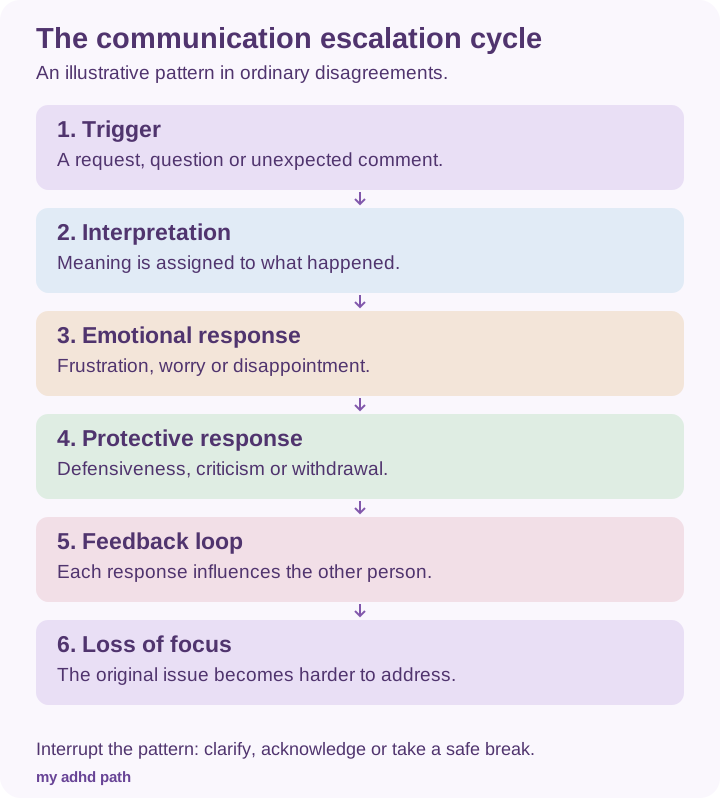
The communication escalation cycle
A disagreement might progress through six stages:
The trigger: A question, request, forgotten commitment or unexpected comment.
The interpretation: One or both people assign meaning to what has happened.
The emotional response: Frustration, embarrassment, worry or disappointment develops.
The protective response: Someone becomes defensive, critical, withdrawn or increasingly urgent.
The feedback loop: Each person's response influences the other's interpretation and emotions.
The loss of focus: The original issue becomes increasingly difficult to address.
There are opportunities to interrupt this pattern at several points.
You can clarify the intention behind a question.
You can acknowledge somebody's disappointment without immediately defending yourself.
You can recognise when the conversation is becoming overwhelming.
You can return to the practical issue after an agreed break.
Noticing the pattern is often more useful than trying to establish which person started it.
Good to know
This approach applies to ordinary relationship conflict. Abuse and coercive control require a different response and should not be treated as a shared communication problem.
Why logical explanations don't always help during arguments
Perhaps you've found yourself explaining, in considerable detail, why something happened.
You want your partner to understand that you didn't deliberately overlook their request.
Your explanation is accurate.
Unfortunately, your partner is becoming increasingly frustrated.
Why?
Possibly because the first thing they needed was acknowledgement of how the situation affected them.
There is a difference between explaining a difficulty and acknowledging its consequences.
Compare these responses:
"I forgot because I had three meetings, somebody called me unexpectedly and I didn't have time to check my reminders."
And:
"I understand why you're disappointed. We agreed I'd do it, and I didn't. I've had a particularly demanding day, but I need to find a better way to remember next time."
Both responses can contain an accurate explanation.
The second also recognises the other person's experience and identifies a responsibility.
Acknowledgement doesn't require agreement with every interpretation somebody has made.
It means recognising that their experience matters.
Listening is not the same as waiting to speak
During a disagreement, it can become surprisingly difficult to listen without simultaneously preparing your response.
You may be gathering evidence, remembering previous examples or thinking about something your partner has misunderstood.
This is a demanding combination of tasks.
If working memory or impulse control is already challenging, retaining your own thoughts whilst attending to somebody else's may be particularly difficult.
One useful approach is to separate listening from responding.
Allow your partner to finish a manageable part of what they're saying.
Then summarise the main point before introducing your perspective.
What you could say
"So the main thing you're upset about is that you didn't know whether I'd remembered our arrangement. Have I understood that properly?"
This gives your partner an opportunity to clarify.
It also reduces the likelihood of responding to something they didn't actually mean.
You don't need to repeat every sentence.
The aim is understanding, not performing a formal listening exercise.
What happens when somebody feels rejected?
Some people with ADHD describe particularly intense emotional responses to criticism, disapproval or perceived rejection.
These experiences are sometimes discussed using the term rejection sensitive dysphoria, or RSD.
Good to know
RSD is not a formal diagnostic category, and there is no universally agreed clinical definition or established diagnostic test. Nevertheless, the emotional experiences people describe can be significant.
A partner's distracted response might be interpreted as disinterest.
A change in tone might be understood as disappointment.
A request for some time alone might feel like rejection.
Sometimes these interpretations are accurate. Sometimes they're not.
It is important to distinguish the intensity of a feeling from the certainty of its explanation.
You can feel genuinely hurt whilst still needing more information about what somebody meant.
Your partner can offer reassurance whilst retaining their own boundaries.
We'll explore this subject in greater depth in our dedicated article on rejection sensitivity and relationships.
Find your early warning signs
It can be difficult to identify when a conversation has become overwhelming if you only recognise the feeling once you're already intensely frustrated.
Try noticing earlier changes.
Early warning signs
- Finding it increasingly difficult to follow what somebody is saying.
- Speaking more quickly or loudly than usual.
- Feeling an urgent need to correct every detail.
- Repeatedly returning to the same point.
- Experiencing tension in your shoulders or jaw.
- Becoming unusually restless.
- Feeling unable to organise your thoughts.
- Wanting to leave the conversation immediately.
These signs can have numerous causes and are not diagnostic indicators of ADHD.
Recognising your personal patterns may help you decide when a conversation needs a different approach.
Your partner can do the same.
You may discover that your warning signs look completely different.
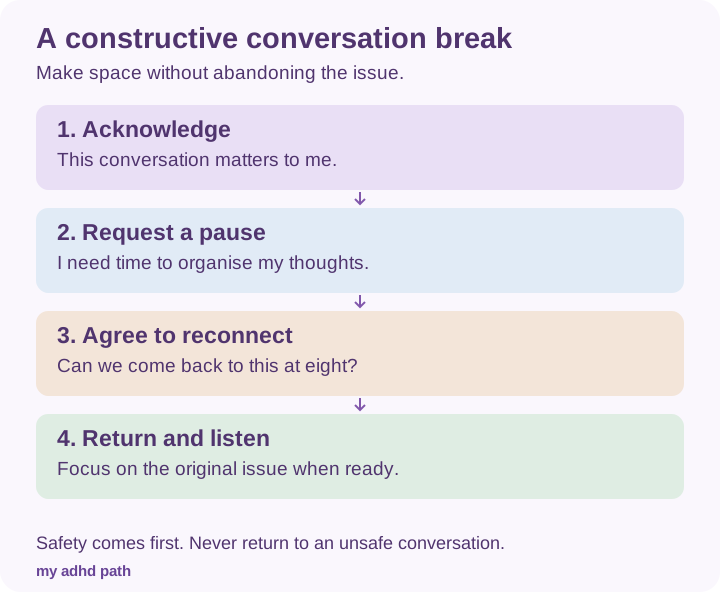
Taking a constructive conversation break
A conversation break can provide an opportunity for emotions to settle and thoughts to become easier to organise.
However, the way you introduce a break matters.
Walking away without explanation may leave your partner feeling dismissed or uncertain.
A clearer approach might be:
What you could say
"I want us to sort this out, but I'm finding it difficult to process everything at the moment. Can we take a break and come back to it at eight?"
A constructive break includes three elements.
First, acknowledge that the conversation matters.
Second, explain that you need some time.
Third, agree on when or how you'll return to the issue.
During the break, choose an activity that genuinely helps you recover.
That might involve going for a short walk, sitting somewhere quiet or writing down the main thing you want to communicate.
Try not to spend the entire break composing a detailed closing argument.
If you need longer than originally agreed, communicate that rather than simply failing to return.
There is no universally appropriate duration for a conversation break.
And nobody should be obliged to return to a conversation that feels unsafe.
Fifteen practical ways to improve ADHD communication
1. Ask whether now is a good time
Your partner might be sitting beside you whilst mentally working through an entirely different problem.
Before beginning an important conversation, check whether they have the capacity to concentrate.
2. Explain the purpose of the conversation
Are you sharing something that happened? Looking for emotional support? Trying to make a decision?
Clarifying the purpose can reduce misunderstandings about what kind of response you're looking for.
3. Discuss one issue at a time
Introducing several unrelated concerns can make it more difficult to retain information and identify a practical resolution.
If another important topic arises, make a note of it and return to it later.
4. Reduce distractions
Put phones aside, pause the television or choose a quieter environment.
This is particularly helpful when a conversation involves important information or complex decisions.
5. Ask before assuming
What you could say
"When you said that, did you mean you were unhappy with what I'd done, or were you just checking?"
Instead of responding to an interpretation as though it is established fact, check it.
6. Give each other time to finish
Agree on a way to signal that somebody hasn't finished speaking.
A brief note may help someone retain a thought without needing to interrupt immediately.
7. Allow processing time
Not everybody can provide a considered answer immediately.
Where possible, allow time to think about a question before expecting a response.
8. Capture important decisions
Record arrangements that require action later.
A shared calendar entry or written confirmation can be more reliable than expecting both people to remember an entire conversation.
9. Acknowledge before explaining
Recognising how something affected your partner can make it easier for them to hear your explanation.
The acknowledgement and the explanation can both be important.
10. Make requests concrete
"Be more considerate" may describe an understandable concern, but it is difficult to translate into a specific action.
"Please let me know if you're going to be more than twenty minutes late" provides a clearer expectation.
11. Recognise individual communication preferences
Some people appreciate direct questions. Others benefit from knowing the context first.
Some prefer discussing difficult subjects in person, whilst others need time to collect their thoughts in writing.
Explore what works for both of you.
12. Develop a shared pause agreement
Decide how either person can request a temporary break during a difficult conversation.
Agree on how you'll reconnect and return to the original issue.
13. Avoid turning specific mistakes into character judgements
There is a difference between saying that somebody forgot an arrangement and saying that they're incapable of being reliable.
Focus on the behaviour, its impact and what could change.
14. Practise constructive repair
If you've interrupted, spoken sharply or misunderstood something, acknowledge it.
A small repair made early can sometimes prevent a much larger disagreement.
15. Review recurring communication problems
If the same argument keeps happening, explore the circumstances surrounding it.
Perhaps the timing is difficult. Perhaps the responsibility is unclear. Perhaps an existing system isn't working.
Or perhaps there is a deeper concern that needs to be addressed with appropriate support.
From familiar phrases to clearer conversations
Sometimes a small change in wording can make a conversation feel considerably different.
| Familiar phrase | An alternative starting point |
|---|---|
| You never listen to me | I don't think I've been able to explain this properly yet |
| Why do I always have to remind you? | Can we find a way to manage this without repeated reminders? |
| You're making a big deal out of nothing | I can see this matters to you. Help me understand why |
| Stop criticising me | I'm interpreting this as criticism. Is that what you meant? |
| Fine, forget it | I'm finding this difficult to discuss right now. Can we return to it later? |
| You should know what I need | I'd really appreciate some time together this evening |
| We've already talked about this | Our previous arrangement doesn't seem to be working. Let's revisit it |
These alternatives aren't scripts that need to be memorised.
Nor is one partner responsible for choosing perfect words to prevent the other from becoming upset.
Both people remain responsible for their behaviour.
Clear communication should make a relationship more accessible, not require someone to constantly monitor everything they say.
How to have a conversation about a recurring problem
Imagine that forgotten household responsibilities have become a regular source of tension.
Instead of raising the issue each time something is missed, arrange a discussion during a relatively manageable period.
Try separating the conversation into four parts.
What happened?
Describe the specific situation without making assumptions about motives.
How did it affect us?
Allow both people to explain their experiences.
What made the situation difficult?
Identify practical barriers, competing demands and differences in expectations.
What will we change?
Agree on a specific action and how you'll know whether it is working.
Try this
An agreement to improve household organisation is fairly broad. An agreement that one person will manage the recycling collection using a recurring reminder is considerably more specific. If the arrangement still doesn't work, review it together.
Understanding difficulties is valuable, but meaningful changes require follow-through.
When one partner wants to talk and the other needs space
Some people prefer resolving disagreements immediately.
Others need time to understand their emotions and organise their thoughts.
This difference can create a difficult pattern.
One partner seeks further conversation because uncertainty feels uncomfortable.
The other becomes increasingly overwhelmed and seeks more space.
Each person's response can inadvertently increase the other's discomfort.
There may be no single correct preference.
A useful compromise can involve offering reassurance that the conversation will continue whilst allowing appropriate recovery time.
You might agree that either person can request a break, provided there is a clear plan for returning to the discussion.
Both people need to respect the agreement.
Someone who needs space shouldn't feel pursued indefinitely.
Someone who needs reassurance shouldn't routinely be left wondering whether their concerns will ever be addressed.
Text messages and the trouble with tone
Written communication can be particularly useful when somebody needs time to process information.
It can also introduce new opportunities for misunderstanding.
Consider the word:
"Okay."
Depending on the context, it could mean agreement, enthusiasm, irritation, uncertainty or simply that somebody has acknowledged your message whilst standing in a supermarket queue.
Without facial expressions, timing and other contextual information, it's easy to assign a tone that wasn't intended.
Try this
If an important exchange begins becoming increasingly complicated over text, consider whether another form of communication would be more suitable. You may benefit from arranging a phone call or discussing the subject in person when both people are ready.
Written communication can still be useful for organising thoughts and recording practical arrangements.
The key is recognising which tasks it handles well and where additional context would help.
Communication when both partners have ADHD
When both partners have ADHD, conversations may be lively, enthusiastic and occasionally involve several subjects simultaneously.
You might interrupt each other whilst sharing an interesting idea.
You might begin discussing dinner and find yourselves researching a holiday destination forty minutes later.
You may appreciate each other's communication styles whilst finding some practical conversations difficult to complete.
Important decisions can benefit from a little structure.
Agree on the immediate question. Capture relevant information. Identify a decision or next action.
Then return to the wonderfully unrelated conversation about whether you could build your own garden office.
There is no need to make every interaction more structured.
Focus on the conversations where misunderstandings or forgotten decisions are causing actual difficulties.
Three couples, three communication challenges
The following scenarios are fictional illustrations.
Illustrative scenario
Hannah and Matt - Interrupting during conversations
Matt often interrupts Hannah when she's telling him about her day. He is interested in what she's saying but regularly thinks of related experiences he wants to share. Hannah feels she rarely gets to finish her stories.
They agree on a simple signal when she hasn't finished speaking. For important conversations, Matt sometimes makes a brief note of something he wants to mention.
They preserve the enthusiasm of their conversations whilst making more room for both people's contributions.
Illustrative scenario
Leila and Sam - When questions sound like criticism
Leila frequently interprets questions about household administration as criticism. Sam becomes frustrated when straightforward enquiries develop into defensive discussions.
They identify previous experiences that may influence how Leila hears certain questions. Leila practises checking her interpretation before responding. Sam makes the purpose of important questions clearer.
They also establish a shared system for household administration, reducing the number of enquiries needed in the first place.
Illustrative scenario
Rob and Chris - Different ways of recovering from arguments
Rob prefers to discuss problems immediately. Chris finds emotionally intense conversations demanding and needs time to organise his thoughts.
Previously, Rob interpreted Chris's withdrawal as disinterest, whilst Chris experienced repeated questions as additional pressure.
They establish an agreed conversation break with a specific time to reconnect. Both take responsibility for respecting the arrangement.
Their disagreements don't disappear, but they develop a clearer process for navigating them.
Create your personal communication profile
Complete these questions individually and discuss them together where it is safe and appropriate to do so.
| Question | Illustrative answer |
|---|---|
| When is it easiest for me to concentrate on a conversation? | After dinner, when I've finished working |
| What makes listening more demanding? | Background noise and several topics at once |
| What happens when I feel criticised? | I immediately start explaining myself |
| How do I recognise emotional overwhelm? | I struggle to organise my thoughts |
| What helps me express myself clearly? | A few minutes to think |
| What makes me feel heard? | Being allowed to finish what I'm saying |
| What kind of reminders work for me? | Written reminders for practical commitments |
| How do I prefer to reconnect after a disagreement? | An agreed time to talk again |
Use the answers to identify one or two changes worth exploring.
You don't need to develop an entirely new communication style.
A seven-day communication experiment
Try introducing one manageable change each day.
| Day | Activity |
|---|---|
| Monday | Notice which circumstances make conversations more difficult |
| Tuesday | Discuss an important subject without competing distractions |
| Wednesday | Check one interpretation before responding |
| Thursday | Record a decision that requires action later |
| Friday | Practise acknowledging a concern before explaining your perspective |
| Saturday | Agree on how to request a constructive conversation break |
| Sunday | Discuss which approach helped and what you'd like to continue |
This is a flexible educational exercise, not a validated psychological intervention.
You can spread the activities across several weeks.
Avoid using the exercise to monitor, grade or criticise your partner.
Using AI to support clearer communication
AI assistants can help organise thoughts before difficult conversations.
They may be useful when you know what you want to express but struggle to arrange your thoughts into a manageable explanation.
However, an AI assistant only knows the information it has been given.
It cannot reliably establish your partner's intentions, assess the full dynamics of your relationship or decide who is right.
AI prompt
Organise my thoughts
"Help me organise these scattered thoughts into the main points I want to communicate. Separate practical concerns, emotional experiences and possible requests."
AI prompt
Separate facts from interpretations
"Help me distinguish what actually happened from the assumptions I've made about why it happened. Suggest respectful questions I could ask to clarify anything uncertain."
AI prompt
Prepare a specific request
"Help me express this concern without turning it into a judgement about the other person's character. Include a specific change I would like to discuss."
AI prompt
Prepare for a weekly check-in
"Help me structure a short conversation about our shared responsibilities. Suggest three practical topics and leave room for both people to contribute their perspectives."
AI prompt
Clarify our agreed actions
"Turn these mutually agreed decisions into a short action plan. Identify the responsibility, the next step and any relevant reminders."
Review all suggestions for accuracy and suitability.
Avoid uploading private messages or confidential information about another person without appropriate permission and privacy safeguards.
AI should support communication, not become an arbitrator in your disagreements.
What the research says
Research into ADHD has identified differences in aspects of executive functioning, attention and response inhibition among groups of people with the condition. These processes have relevance to everyday communication. Research into emotional dysregulation has also found associations between ADHD and difficulties managing emotional responses in some children and adults (Beheshti, Chavanon and Christiansen, 2020). Studies examining adult ADHD and relationships have reported difficulties with relationship functioning in some samples (Eakin et al., 2004). However, the evidence does not establish that every communication pattern discussed in this article is caused by ADHD. Communication is influenced by numerous factors, including personality, previous experiences, relationship quality, mental health, environmental demands and individual circumstances. The communication diagrams, scripts and exercises throughout this article are practical editorial frameworks informed by established concepts. They are not diagnostic tools or clinically validated therapy programmes.
When communication strategies aren't enough
Some couples find that changing their communication arrangements makes everyday life considerably easier.
Others continue experiencing difficulties despite trying several approaches.
Persistent conflict, resentment, emotional distress or difficulty discussing important concerns may benefit from professional support.
An appropriately qualified relationship therapist with knowledge of ADHD may help both partners explore their communication patterns and identify suitable approaches.
Individual ADHD treatment or psychological support may also be helpful.
However, communication difficulties should not be confused with abusive behaviour.
If somebody regularly threatens, humiliates, intimidates or controls their partner, the priority is appropriate safety and specialist support.
Nobody should be expected to communicate more carefully in order to prevent another person from harming them.
Domestic abuse organisations such as Refuge, Men's Advice Line and Galop provide confidential support in the UK.
Joint counselling or relationship exercises may be inappropriate where abuse or coercive control is present.
If you are in immediate danger, call 999.
Frequently asked questions
Does ADHD affect communication skills?
ADHD can influence attention, working memory, impulse control and other processes involved in communication. Individual experiences vary considerably.
Why do people with ADHD sometimes interrupt conversations?
Difficulties with impulse control, retaining a thought or managing enthusiasm may contribute to interruptions. Interrupting can also occur for reasons unrelated to ADHD.
Does forgetting a conversation mean somebody wasn't listening?
Not necessarily. Someone may have listened and understood information but subsequently experienced difficulty remembering it. Recording important arrangements may help.
Can ADHD make someone defensive?
Some people with ADHD experience emotional sensitivity, difficulties regulating responses or previous experiences of frequent criticism that may contribute to defensiveness. It is not a universal ADHD characteristic.
Why do small disagreements sometimes become overwhelming?
Competing demands, emotional intensity, previous experiences and difficulties processing information may contribute. Relationship circumstances and other health factors can also play a role.
Is rejection sensitive dysphoria an official ADHD symptom?
No. RSD is not a formal diagnosis or core diagnostic criterion for ADHD. The emotional experiences associated with perceived rejection may still deserve appropriate support.
Is it better to communicate with someone with ADHD in writing?
Sometimes. Written communication can provide additional processing time and a record of arrangements. Other people may prefer verbal conversations. The most useful approach depends on the individual and the situation.
How can I help my partner listen during important conversations?
Choose a suitable time, reduce distractions and focus on manageable amounts of information. Both partners should contribute to making conversations more accessible.
Is walking away during an argument helpful?
An agreed temporary break can sometimes help people recover from emotional overwhelm. Repeatedly abandoning conversations or using silence to punish somebody is different. Safety always takes priority.
Can ADHD medication improve communication?
Effective treatment may improve symptoms that affect communication for some people. It does not automatically resolve relationship difficulties or replace the development of communication skills.
Can both partners have completely different communication needs?
Yes. Individual preferences, circumstances and support needs may differ, even when both people have ADHD.
Can ADHD explain abusive behaviour?
ADHD does not justify abuse, coercive control or aggression. Seek confidential specialist support if you feel unsafe.
Understanding each other is a skill you can keep developing
There will always be conversations that don't quite go according to plan.
You'll occasionally interrupt each other.
You'll misunderstand a text message.
You'll discover that you've both spent fifteen minutes discussing something whilst having entirely different ideas about what the conversation was supposed to achieve.
That's part of sharing your life with another human being.
But understanding how attention, memory, emotions and interpretation influence those experiences can help you respond differently.
You can clarify rather than assume.
You can acknowledge rather than immediately defend.
You can recognise when a conversation needs more time.
And you can develop practical arrangements that mean fewer discussions about things that neither of you particularly enjoys discussing.
You don't need to agree about everything.
You need to be able to understand each other, express your concerns and find ways forward that respect both people's needs.
And occasionally, you might even manage an entire conversation about booking the car in without discussing anything else.
Sources and further reading
- NICE - Attention deficit hyperactivity disorder: diagnosis and management (NG87). https://www.nice.org.uk/guidance/ng87
- NHS - Attention deficit hyperactivity disorder (ADHD). https://www.nhs.uk/conditions/attention-deficit-hyperactivity-disorder-adhd/
- Faraone, S. V. et al. (2021). The World Federation of ADHD International Consensus Statement: 208 Evidence-based conclusions about the disorder. https://doi.org/10.1016/j.neubiorev.2021.01.022
- Kooij, J. J. S. et al. (2019). Updated European Consensus Statement on diagnosis and treatment of adult ADHD. https://doi.org/10.1016/j.eurpsy.2018.11.001
- Shaw, P. et al. (2014). Emotion dysregulation in attention deficit hyperactivity disorder. American Journal of Psychiatry. https://doi.org/10.1176/appi.ajp.2013.13070966
- Beheshti, A., Chavanon, M. L. and Christiansen, H. (2020). Emotion dysregulation in adults with attention deficit hyperactivity disorder: a meta-analysis. BMC Psychiatry. https://doi.org/10.1186/s12888-020-2442-7
- Eakin, L. et al. (2004). The marital and family functioning of adults with ADHD and their spouses. Journal of Attention Disorders, 8(1), 1-10.
- Relate. https://www.relate.org.uk/
- Refuge. https://refuge.org.uk/
- Men's Advice Line. https://mensadviceline.org.uk/
- Galop. https://galop.org.uk/
This article provides general educational information and is not a substitute for individual medical, psychological, relationship or safeguarding advice. All relationship scenarios are fictional. The communication frameworks and exercises are adaptable editorial tools rather than clinically validated therapeutic interventions.