

You know what finished looks like. You can describe it in considerable detail. And yet somehow, nothing you produce ever quite matches the version in your head. The gap between your standards and your output has become the place where projects go to stall, emails take forty minutes to write and perfectly good work sits in a folder marked 'draft' indefinitely.
At a glance
- Perfectionism is about conditional self-worth, not simply having high standards.
- ADHD and perfectionism can coexist, even though they may appear contradictory.
- The perfectionism-procrastination cycle can keep people stuck between impossibly high standards and avoidance.
- The finish line often moves: what counts as 'done' keeps shifting during the process.
- Distinguishing essential quality from optional refinement can help you decide when to stop.
- A five-question finishing filter provides a practical framework for completing work.
- Professional support may be helpful when perfectionism significantly affects daily life.
You have written and rewritten this email four times.
The first version was fine. Clear, professional and to the point.
But something about the second paragraph didn't sit right, so you adjusted it. Then you noticed the opening felt too abrupt, so you softened it. Then you wondered whether the whole thing sounded too casual, so you restructured it entirely.
Forty minutes have passed. Your colleague would have sent it in three.
The frustrating part is that you know this. You can see that the amount of effort you are investing is disproportionate to the importance of the task. You can recognise that nobody receiving this email will notice the difference between version one and version four.
And yet you cannot quite bring yourself to press send.
Perfectionism with ADHD is not about wanting things to be excellent. It is about not being able to stop improving things that were already good enough.
This article explores why perfectionism and ADHD so often appear together, why the combination can be particularly difficult to manage, and how to maintain genuinely high standards without becoming trapped by them.
What is perfectionism?
Perfectionism is frequently misunderstood as simply wanting to do good work.
It is not.
Wanting to do good work is a preference. It says: I would like this to be as good as I can make it, given the time and circumstances available.
Perfectionism says something different. It says: my value as a person depends on producing something flawless. If this isn't perfect, it reflects a fundamental inadequacy in me.
Common misconception
Perfectionism is not the same as having high standards. Many people with high standards produce excellent work, meet their deadlines and feel reasonably satisfied with the results. Perfectionism involves rigid, often unrealistic standards combined with harsh self-evaluation when those standards are not met. The distinction matters because the strategies for each are quite different.
Researchers have identified several dimensions of perfectionism. Self-oriented perfectionism involves setting excessively high standards for yourself. Socially prescribed perfectionism involves believing that others expect perfection from you. Other-oriented perfectionism involves holding other people to unrealistically high standards.
Clinical perfectionism, as described by Shafran, Cooper and Fairburn (2002), is characterised by the relentless pursuit of demanding standards despite significant negative consequences. The person continues striving for perfection even when doing so causes distress, impairs functioning or damages relationships.
What makes perfectionism particularly difficult is that it looks, from the outside, like conscientiousness. The person working late, revising repeatedly and refusing to submit until everything is exactly right appears dedicated and thorough.
From the inside, the experience is often closer to anxiety.
Good to know
Perfectionism exists on a spectrum. Having some perfectionist tendencies does not necessarily indicate a clinical problem. It becomes concerning when it significantly interferes with productivity, relationships, wellbeing or the ability to complete tasks.
Why perfectionism can coexist with ADHD
At first glance, ADHD and perfectionism appear to be contradictions.
How can somebody who struggles with organisation, loses track of time and leaves tasks incomplete also be a perfectionist?
The answer is that ADHD affects the ability to execute, not the ability to envision. You can hold a vivid, detailed picture of exactly how something should look whilst simultaneously finding it extremely difficult to get there.
In fact, the gap between vision and execution may be precisely what drives perfectionist behaviour in people with ADHD.
| Experience | What it looks like from outside | What it feels like inside |
|---|---|---|
| Spending excessive time on minor details | Overthinking or being slow | Anxiety that any imperfection will be noticed and judged |
| Difficulty starting tasks | Laziness or procrastination | Paralysis caused by the impossibility of doing it perfectly |
| Abandoning projects partway through | Lack of commitment or follow-through | The gap between the vision and the reality becoming unbearable |
| Redoing work that was already acceptable | Inefficiency or poor time management | Genuine distress at submitting something imperfect |
| Avoiding tasks you are skilled at | Paradoxical underperformance | Fear that this time, you won't meet your own expectations |
Several factors may contribute to the development of perfectionist tendencies alongside ADHD.
Compensation. Years of criticism, missed deadlines and inconsistent performance can lead to overcompensation. If you have been told repeatedly that your work is careless, you may develop an intense need to prove otherwise by making everything beyond reproach.
Rejection sensitivity. Many people with ADHD experience heightened emotional responses to perceived criticism or disapproval. Perfectionism can function as a protective strategy: if everything is perfect, there is nothing to criticise.
Inconsistent self-trust. When your performance varies unpredictably, you may lose confidence in your ability to judge whether something is good enough. Without reliable internal feedback, you keep checking, revising and refining because you cannot trust your own assessment.
All-or-nothing thinking. Difficulty with nuance and gradation, which can accompany ADHD, may contribute to binary evaluations: something is either perfect or it is a failure, with very little space in between.
Perfectionism with ADHD is often less about wanting to be the best and more about being terrified of confirming your worst fears about yourself.
What the research says
Research has identified links between ADHD and perfectionist tendencies, particularly socially prescribed perfectionism, where the individual believes others demand flawless performance. Curran and Hill (2019) found that perfectionism has increased significantly across generations, with socially prescribed perfectionism showing the largest rise. People with ADHD, who may already be sensitive to external evaluation, can be particularly affected by these broader cultural pressures.
The perfectionism-procrastination cycle
Perfectionism and procrastination are not opposites. They are collaborators.
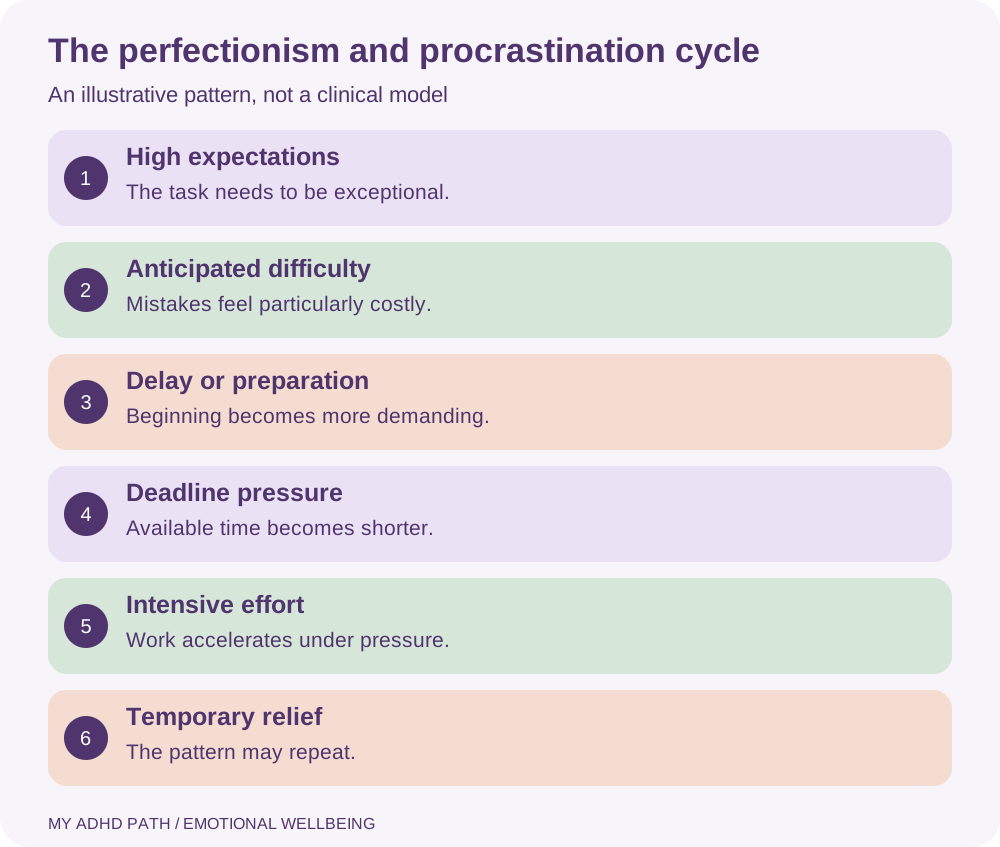
The cycle typically follows six steps, each one feeding into the next.
Step one: set an impossibly high standard. You decide that this piece of work needs to be exceptional. Not good. Not competent. Exceptional. The standard is not based on what the situation requires but on what you feel you need to produce in order to feel acceptable.
Step two: fear of not meeting it. As you contemplate beginning, the gap between where you are and where you need to be feels enormous. The possibility of falling short triggers anxiety, discomfort or dread.
Step three: delay starting. Rather than confronting the anxiety directly, you postpone. You tell yourself you will begin when you have more time, more energy or a better idea of how to approach it. The delay feels like a rational decision rather than avoidance.
Step four: deadline pressure. Eventually, external pressure forces action. The deadline arrives, the client asks for an update, or the consequences of not acting become more uncomfortable than the anxiety of beginning.
Step five: rush or abandon. You either produce the work in a frantic burst, knowing it falls short of your standards, or you abandon it altogether because there is no longer enough time to do it properly.
Step six: self-criticism, then raise standards higher. The outcome confirms your fears. You tell yourself that if you had just tried harder, started earlier or held yourself to a higher standard, the result would have been better. So next time, the bar goes up.
And the cycle begins again.
Good to know
This cycle is not a character flaw. It is a predictable pattern that emerges when high standards interact with executive functioning difficulties, emotional sensitivity and impaired self-regulation. Understanding the pattern is the first step toward interrupting it.
Why perfectionism can make starting difficult
Starting requires accepting imperfection.
Every first draft is rough. Every first attempt is clumsy. Every new project begins with a gap between what exists and what you envision.
For most people, this gap is temporary and tolerable. You begin, you improve, you finish.
For someone with perfectionist tendencies and ADHD, this gap can feel like standing at the edge of a cliff.
The ADHD brain often struggles with task initiation independently of perfectionism. Add the requirement that the first attempt must meet an impossibly high standard, and the barrier to entry becomes genuinely formidable.
Try this
Give yourself explicit permission to begin badly. Write the worst possible opening paragraph. Sketch the ugliest possible layout. Send yourself the most awkward possible first message. The objective is not to produce something terrible. It is to break the connection between starting and needing to be brilliant.
Perfectionism also interferes with the concept of a 'rough draft.' For many people with ADHD and perfectionist tendencies, there is no such thing as a rough draft. Every word, every sentence, every pixel gets the same level of scrutiny from the moment it appears. The idea of writing something imperfect and improving it later feels genuinely uncomfortable.
This means that what should be a quick, loose, exploratory phase becomes painstaking and exhausting. By the time you have perfected the introduction, you have used most of the energy and motivation that should have carried you through the entire piece.
What you might say to yourself
'This is a first pass, not a final submission. I am allowed to produce something that needs improvement. That is what first passes are for.'
The moving finish line
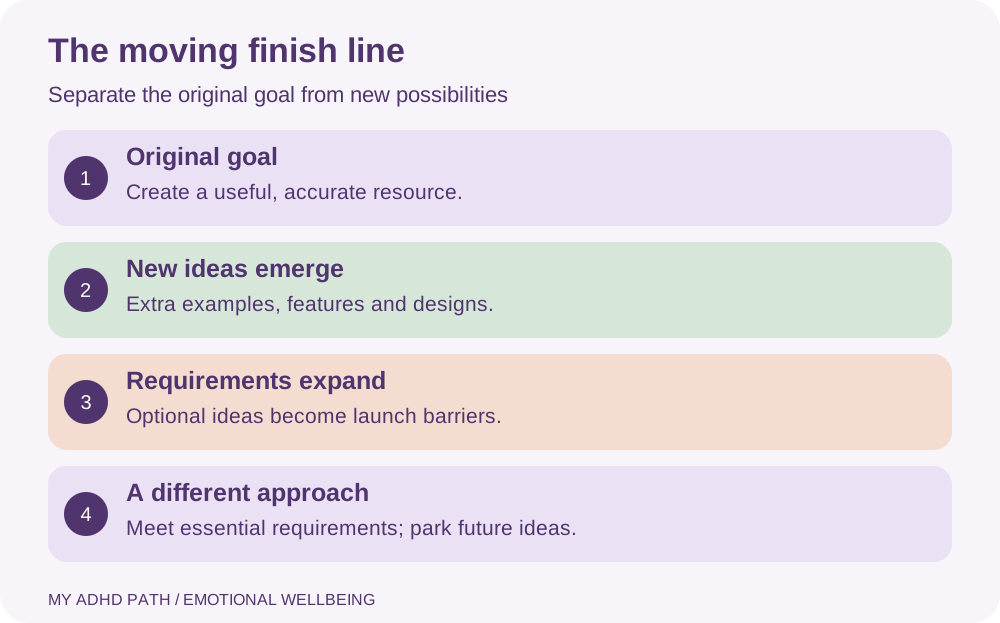
One of the most disorienting aspects of perfectionism is that 'done' keeps changing.
You set out to complete a task. You reach the point where it meets the original requirements. And then, instead of stopping, you notice something else that could be improved.
So you improve it. And then you notice something else. And then something else.
The finish line has moved.
This is not the same as quality control. Quality control involves checking work against established criteria. The moving finish line involves generating new criteria as you go, often without realising you are doing it.
| Stage | Original goal | What actually happens |
|---|---|---|
| Email to a colleague | Confirm the meeting time | Rewrite the email four times, adjust the tone, add context that wasn't requested, worry about whether it sounds too formal or too casual |
| Presentation slides | Summarise three key findings | Redesign the template, add animations, restructure the narrative, research two additional points, start over because the whole approach feels wrong |
| Tidying a room | Clear the visible surfaces | Reorganise the entire bookshelf, clean behind the furniture, research better storage solutions, order new containers, abandon the task halfway through reorganisation |
| Cooking dinner | Make a simple weeknight meal | Decide the recipe needs adjustments, attempt a more complex technique, become frustrated when it doesn't look like the photograph, feel deflated about the result despite it tasting perfectly fine |
| Writing a report | Deliver the first draft by Friday | Revise the structure repeatedly, rewrite the introduction six times, add footnotes nobody asked for, miss the deadline because it still isn't 'ready' |
The moving finish line is particularly problematic with ADHD because executive functioning difficulties can make it harder to maintain awareness of the original objective. You may genuinely lose sight of what you set out to do because the refinements have absorbed all of your attention.
The difference between essential quality and optional improvement
Not all quality is equal.
Some elements of a task genuinely matter. They affect the outcome, the recipient's experience or the integrity of the work. Getting these right is not perfectionism. It is professionalism.
Other elements are improvements that might make the work marginally better but do not meaningfully affect the outcome. Getting these right is optional.
The difficulty, particularly with ADHD, is that everything can feel equally important. The font choice feels as critical as the data accuracy. The email greeting feels as consequential as the email content.
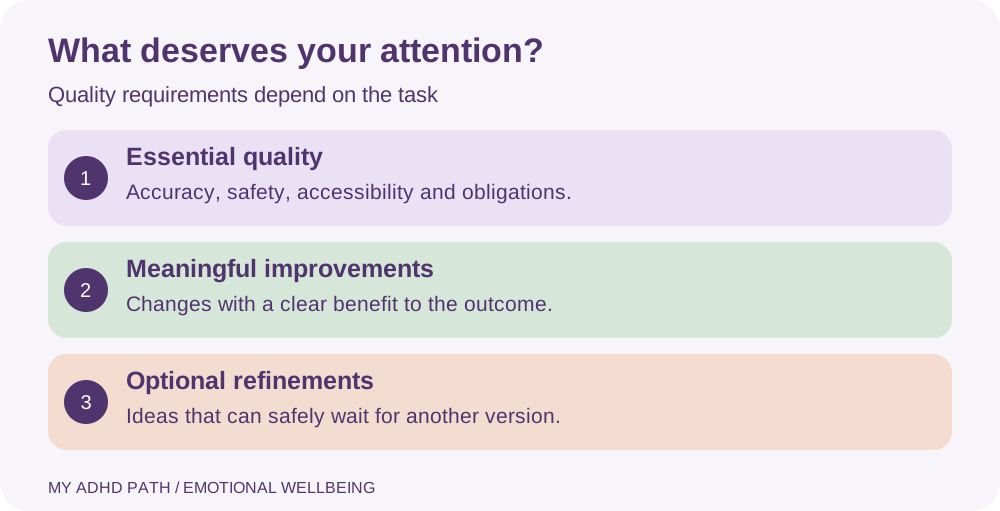
One way to manage this is to categorise quality into three levels before you begin.
| Category | Description | Example |
|---|---|---|
| Essential | Must be correct. Affects the outcome, safety, accuracy or core purpose of the work. | The figures in a financial report are accurate. The medication dosage in a patient letter is correct. The meeting time in a calendar invitation is right. |
| Meaningful | Improves the work noticeably. Worth doing if time permits. | The report includes clear section headings. The email is well structured. The presentation has a logical flow. |
| Optional | Marginally improves the work. Would not be missed if absent. | The font is aesthetically pleasing. The email opening is particularly elegant. The slide transitions are smooth. |
Essential quality deserves your full attention. Meaningful quality deserves reasonable effort. Optional quality deserves whatever time remains after the first two categories are satisfied.
The problem for many perfectionists is that optional quality receives the same attention as essential quality, often at the expense of completing the task at all.
Try this
Before beginning a task, write down the three essential criteria it needs to meet. When you have met those criteria, check whether the task is now complete. If you find yourself continuing to refine beyond those criteria, ask yourself which category the refinement falls into.
When everything feels equally important
ADHD can affect the ability to prioritise.
When executive functioning makes it difficult to evaluate the relative importance of different elements, everything can feel urgent, everything can feel critical, and the idea of deliberately producing something less than perfect in one area in order to complete the whole feels genuinely uncomfortable.
This is not a failure of willpower. It is a difficulty with the cognitive process of prioritisation itself.
The result is often one of two patterns.
Pattern one: excessive detail on early stages. You spend so much time perfecting the beginning of a task that you run out of energy, time or motivation for the rest. The first three slides are immaculate. The remaining twelve are rushed or incomplete.
Pattern two: paralysis from competing demands. You cannot decide which element to focus on because they all feel equally important. So you either jump between them without making meaningful progress on any, or you avoid the task entirely.
Good to know
Difficulty prioritising quality is not the same as not caring about quality. Many people with ADHD care deeply about the quality of their work, which is precisely why the inability to distribute their attention proportionally feels so distressing.
One practical approach is to set time limits for different stages of a task before you begin. If you have two hours for a presentation, you might allocate thirty minutes to content, thirty minutes to structure, thirty minutes to design and thirty minutes to review. When the allocated time for one stage expires, you move on regardless of whether that stage feels 'finished.'
This approach works because it externalises the prioritisation decision. Instead of relying on an internal sense of 'enough,' which may not be available, you rely on the clock.
The five-question finishing filter
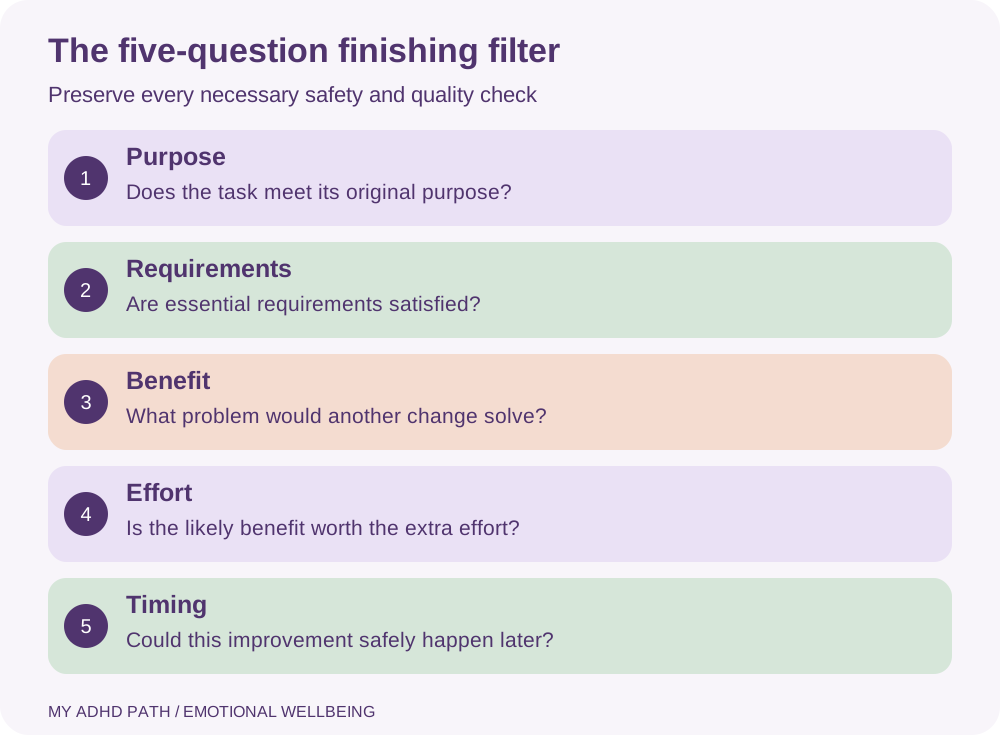
When you are unsure whether something is genuinely finished or whether your perfectionism is telling you it isn't, these five questions can help.
The five-question finishing filter
- Is this good enough for its purpose? Not good enough for every possible purpose. Good enough for the specific purpose it was created to serve.
- Have I met the actual requirements? Not the requirements you have added along the way. The requirements that were specified at the outset.
- Would spending more time meaningfully improve the outcome? Not improve your feelings about it. Meaningfully improve the outcome for the person receiving it.
- What am I sacrificing by continuing? Time, energy, other commitments, sleep, wellbeing. Everything has an opportunity cost.
- What would I advise somebody else to do? If a friend showed you this work and asked whether it was ready, what would you honestly tell them?
If the first two answers are yes, the third is no, the fourth reveals meaningful sacrifices and the fifth suggests submitting, then the work is finished.
The difficulty is not in understanding this intellectually. Most perfectionists can clearly see that their standards are disproportionate. The difficulty is in acting on that understanding when every instinct is saying 'just one more revision.'
Try this
Print or save the five questions somewhere visible. Before submitting any piece of work, run it through the filter. If the filter says it is finished, set a timer for five minutes. If, after five minutes, you still want to revise, make one specific change and then submit. The timer creates a cooling-off period between the impulse and the action.
Perfectionism at work
The workplace can intensify perfectionist tendencies for several reasons.
Your work is visible to others. It may be evaluated formally. It has real consequences. And for many people with ADHD, the workplace is where they have received the most criticism about carelessness, mistakes and inconsistency.
Perfectionism at work often appears in predictable patterns.
Email paralysis. Spending disproportionate time crafting messages because every word feels like it carries professional risk. Rereading sent emails and feeling anxious about how they might be interpreted.
Deadline avoidance. Requesting extensions not because the work is insufficient but because it doesn't meet your internal standard of readiness. Submitting at the last possible moment because you used every available minute for refinement.
Difficulty delegating. Being unable to hand work to others because you don't trust that they will meet your standards. Taking on additional work rather than accepting that someone else might do it differently.
Meeting anxiety. Over-preparing for meetings because spontaneous contributions might not be polished enough. Rehearsing comments in advance and then not making them because they don't sound sufficiently impressive.
Imposter feelings. Despite consistently positive feedback, believing that your work is not as good as it appears and that any slip will reveal your true ability.
Good to know
Perfectionism at work is not always visible to colleagues or managers. Someone who consistently produces excellent work may appear highly competent whilst privately experiencing significant distress about every output. If perfectionism is affecting your wellbeing at work, speaking to your line manager or occupational health service may help.
| Task type | Reasonable time investment | Perfectionist time investment | What to try |
|---|---|---|---|
| Brief internal email | 2-5 minutes | 15-40 minutes | Set a five-minute timer. Send when it expires. |
| Routine status update | 10-15 minutes | 45-90 minutes | Use a template. Fill in the blanks. |
| Presentation for a familiar audience | 1-2 hours | 6-10 hours | Limit yourself to ten slides maximum. No animations. |
| First draft of a report | Proportionate to length | Three times the proportionate time | Write the full draft before editing any section. |
Perfectionism in relationships and home life
Perfectionism does not stay at the office.
At home, it can affect how you manage your living space, how you relate to your partner or family, how you approach parenting and how you spend your leisure time.
The house that is never clean enough. You notice every mark, every item out of place, every surface that could be tidier. You may either spend excessive time cleaning or avoid cleaning altogether because anything less than a thorough deep clean feels pointless.
The meal that doesn't match the recipe. You set out to cook a simple dinner and find yourself unable to accept variations, substitutions or approximations. If you don't have the exact ingredients, you may abandon the plan entirely rather than improvise.
The gift that takes hours to choose. Buying a birthday present becomes an exhausting research project because nothing feels quite right, quite personal or quite special enough.
The relationship where you can never relax. You may hold yourself to unrealistic standards as a partner or parent, feeling that you should always be patient, always be present and always respond perfectly to every situation.
What you might say to yourself
'My family does not need a perfect home. They need a home where people are not exhausted from trying to make everything perfect.'
Perfectionism in home life can be particularly isolating because it is rarely recognised by others. A partner who does not understand perfectionism may interpret the behaviour as being controlling, inflexible or unnecessarily difficult. The perfectionist, meanwhile, may feel unsupported, misunderstood and increasingly unable to explain why they cannot simply 'let it go.'
Try this
Identify one area of home life where your standards consistently cause frustration, either for you or for the people around you. For one week, deliberately lower your standard in that specific area by one level. If your standard is 'spotless,' aim for 'tidy.' If your standard is 'home-cooked from scratch,' aim for 'nutritious and ready in thirty minutes.' Notice whether the feared consequences actually materialise.
Fifteen practical ways to work with perfectionist tendencies
Practical checklist
- 1. Define 'done' before you start. Write down the specific criteria that will make this task complete. Refer back to them when you feel the urge to keep refining.
- 2. Set time limits for different task types. An internal email gets five minutes. A client report gets its allocated time. When the time expires, stop.
- 3. Use the five-question finishing filter. Before continuing to revise, run through the five questions. Let the answers guide your decision.
- 4. Separate creating from editing. Write the full draft before changing anything. Sketch the complete design before refining any element. Creating and editing use different cognitive processes and switching between them constantly is exhausting.
- 5. Give yourself permission to begin badly. The first version exists to be improved. It does not need to be impressive.
- 6. Notice when the finish line moves. If you have met your original criteria but are still working, pause and ask yourself what has changed.
- 7. Practise the concept of 'good enough.' Choose one task each day and deliberately submit it at 'good enough' rather than 'perfect.' Observe what happens.
- 8. Use templates and standard formats. Reduce the number of decisions by using consistent templates for recurring tasks. Fewer choices means less opportunity for perfectionist deliberation.
- 9. Set a revision limit. Allow yourself a specific number of revisions. Three drafts of an important document. Two checks of an email. One review of a tidy room.
- 10. Ask for external feedback early. Share work in progress rather than waiting until it feels ready. Other people's perspectives can help you calibrate whether something needs more work.
- 11. Track your time on tasks. When you notice that a routine task has taken three times longer than it should, that information can help you recalibrate next time.
- 12. Challenge all-or-nothing thinking. When you notice thoughts like 'if it's not perfect it's worthless,' deliberately generate a middle-ground alternative.
- 13. Reward completion, not perfection. Celebrate finishing things, regardless of how polished they are. The habit of completing is more valuable than the habit of perfecting.
- 14. Identify your perfectionism triggers. Notice which situations, tasks or audiences activate your perfectionist tendencies most intensely. Awareness is the foundation of change.
- 15. Be compassionate with yourself. Perfectionism often developed as a response to genuine difficulties. Treating yourself harshly for being a perfectionist is simply another form of the same pattern.
Three different experiences
Perfectionism with ADHD shows up differently depending on the person, the context and the specific demands of their life. These fictional scenarios illustrate some common patterns.
Illustrative scenario
Sophie, 41 - The email that takes forty minutes
Sophie is a marketing manager whose work is consistently praised. What her colleagues don't see is that a brief email to a client can take her forty minutes to write. She drafts it, reads it back, adjusts the tone, reconsiders the opening, worries that it sounds too pushy or too passive, and then reads it once more before sending.
Her work is excellent, but she regularly misses internal deadlines because the time she spends perfecting communications eats into everything else. She has started staying late to compensate, which is affecting her sleep and her relationship with her partner.
Through working with a coach, Sophie learns to distinguish between essential quality and optional refinement. Client-facing proposals deserve careful attention. Internal emails confirming meeting times do not. She begins setting timers for different types of communication: five minutes for routine internal emails, fifteen minutes for client emails, and unlimited time only for formal proposals. The timers feel uncomfortable at first, but she notices that nobody responds differently to her quicker emails.
Illustrative scenario
Marcus, 36 - The projects that never get finished
Marcus is a freelance designer with a folder full of unfinished personal projects. Each one began with tremendous excitement: a new portfolio website, a personal brand identity, a series of illustrations. Each one stalled at roughly the same point, the moment when the gap between his vision and the current state of the work became uncomfortable.
He can articulate exactly what each project should look like. He can describe the colours, the typography, the layout in vivid detail. What he cannot seem to do is tolerate the messy, imperfect process of getting there.
Marcus starts using the five-question finishing filter on his client work first, where the external deadline provides structure. He notices that his clients are consistently happy with work that he would have continued refining indefinitely. Gradually, he applies the same filter to his personal projects. He sets a rule: 'done' is a decision, not a feeling. He finishes his portfolio website in three weeks, accepting that it is good rather than perfect. It is the first personal project he has completed in two years.
Illustrative scenario
Aisha, 29 - The thesis that is never ready
Aisha is a PhD student who cannot submit her thesis chapters. Her supervisor's feedback is consistently positive: the research is thorough, the writing is clear, the arguments are well supported. And yet Aisha remains convinced that each section needs more work.
She keeps finding things to improve. A paragraph that could be tighter. A reference that could be more recent. An argument that could be more nuanced. Each improvement is genuine, but the cumulative effect is that nothing ever gets submitted.
Aisha learns about the moving finish line and recognises the pattern immediately. She starts setting specific submission criteria before she begins writing each chapter: the argument must address these three points, it must include these key references and it must be under this word count. When those criteria are met, she submits, regardless of how she feels about it. Her supervisor continues to provide positive feedback. The chapters that she submitted feeling anxious about are indistinguishable, in quality, from the ones she felt more confident about.
Using AI to manage perfectionism
AI tools can provide a useful external perspective when perfectionist tendencies make it difficult to evaluate your own work objectively. The following prompts may help.
AI prompt
Check whether this is finished
"I've been working on this [document/email/presentation] and I'm struggling to decide whether it's ready. The purpose is [describe the purpose]. The audience is [describe the audience]. Please assess whether it meets its purpose and identify only changes that would meaningfully improve the outcome for the recipient. Tell me honestly if it's ready to submit as it is."
AI prompt
Sort my revisions into essential and optional
"I have a list of changes I want to make to this piece of work. Please sort them into three categories: essential (would genuinely affect quality or accuracy), meaningful (noticeable improvement if time permits) and optional (marginal improvement that most people wouldn't notice). Be honest about which category each change belongs in."
AI prompt
Help me set realistic completion criteria
"I need to complete [describe the task]. I tend to over-invest time in details. Help me define three to five specific, measurable criteria that would make this task genuinely complete. Keep the criteria focused on the actual purpose and audience, not on abstract notions of quality."
AI prompt
Write a quick version of this email
"I need to send an email about [topic] to [recipient]. I tend to overthink email writing. Please draft a clear, professional version that covers the essential points in under 100 words. I can adjust the tone afterwards, but I need a solid starting point that stops me from spending thirty minutes on something straightforward."
AI prompt
Challenge my perfectionist thinking
"I'm telling myself that [describe the perfectionist thought, e.g. 'this presentation needs to be completely rewritten']. Help me evaluate this thought realistically. What evidence supports it? What evidence contradicts it? What would a reasonable, supportive colleague say? What is the most likely consequence of submitting it as it is?"
What does the research say?
What the research says
Research into the relationship between ADHD and perfectionism is growing but remains relatively limited compared to other areas of ADHD research. Curran and Hill's (2019) meta-analysis found significant generational increases in perfectionism across Western societies, with socially prescribed perfectionism, the belief that others demand perfection from you, showing the largest rise. Egan, Wade, Shafran and Antony (2014) have demonstrated that cognitive behavioural approaches can be effective for clinical perfectionism, including techniques such as behavioural experiments, surveys and guided behavioural change. Shafran, Cooper and Fairburn (2002) proposed a cognitive-behavioural model of clinical perfectionism that emphasises the role of self-evaluation that is overly dependent on achievement. Diamond (2013) highlights how executive functioning, including cognitive flexibility and inhibitory control, underpins the ability to shift attention and adjust behaviour, both of which are relevant to managing perfectionist patterns. Faraone et al. (2021) note that emotional dysregulation, which may include difficulty managing the distress associated with imperfect outcomes, is increasingly recognised as a feature of ADHD.
It is worth noting that much of the perfectionism research has been conducted in general populations rather than specifically in people with ADHD. The interaction between perfectionist tendencies and ADHD-related executive functioning difficulties is an area that would benefit from further investigation.
Perfectionism is not about the work. It is about what you believe the work says about you.
Frequently asked questions
Can you have ADHD and be a perfectionist?
Yes. Although ADHD and perfectionism may appear contradictory, they frequently coexist. ADHD affects the ability to execute tasks consistently, whilst perfectionism sets extremely high standards for those tasks. The combination can create significant distress and difficulty completing work.
Is perfectionism a symptom of ADHD?
Perfectionism is not a diagnostic criterion for ADHD. However, it can develop alongside ADHD, often as a compensatory response to years of criticism, inconsistent performance or rejection sensitivity. Many people with ADHD develop perfectionist tendencies as a way of managing anxiety about their own reliability.
Why does perfectionism cause procrastination?
When the standard for a task feels impossibly high, beginning can trigger anxiety about falling short. Delaying the task temporarily relieves that anxiety, creating a cycle where high standards lead to avoidance, which leads to rushed work, which leads to self-criticism, which leads to even higher standards.
How do I know when something is good enough?
Try using the five-question finishing filter: is it good enough for its purpose, have you met the actual requirements, would more time meaningfully improve the outcome, what are you sacrificing by continuing, and what would you advise someone else to do? If the answers suggest it is ready, trust the process rather than the feeling.
Why do I keep starting things but not finishing them?
The beginning of a project is often exciting and full of potential. As the work progresses, the gap between your vision and the current state becomes increasingly visible. For perfectionists, this gap can become so uncomfortable that abandoning the project feels preferable to continuing with something imperfect.
Can perfectionism be a strength?
High standards can certainly be valuable. Attention to detail, thoroughness and commitment to quality are genuinely useful traits. The distinction is whether those standards enhance your work and life or whether they create paralysis, distress and an inability to complete things. Healthy striving is a strength. Rigid perfectionism is usually not.
How is ADHD perfectionism different from OCD?
OCD involves intrusive, unwanted thoughts (obsessions) and repetitive behaviours performed to reduce anxiety (compulsions). Perfectionism in ADHD is typically driven by fear of criticism, conditional self-worth and difficulty calibrating quality, rather than by intrusive thoughts and ritualistic behaviours. However, ADHD and OCD can coexist, and professional assessment may be needed to distinguish between them.
Can medication help with perfectionism?
ADHD medication may help with some of the executive functioning difficulties that contribute to perfectionist patterns, such as difficulty prioritising, sustaining attention proportionally and managing impulsive self-criticism. However, medication alone is unlikely to address deeply held beliefs about self-worth and performance. Psychological approaches such as cognitive behavioural therapy may also be helpful.
Why do I spend too long on unimportant tasks?
ADHD can affect the ability to evaluate the relative importance of different tasks. When combined with perfectionism, this can mean that every task receives the same level of intense scrutiny, regardless of its actual significance. Setting time limits for different task categories can help redistribute your effort more proportionally.
How do I lower my standards without feeling like I am giving up?
Reframe it as redirecting your standards rather than lowering them. Instead of applying maximum effort to everything, you are choosing to apply maximum effort where it matters most and appropriate effort everywhere else. This is not giving up. It is strategic allocation of a finite resource.
Is perfectionism connected to rejection sensitivity?
They frequently co-occur. Rejection sensitivity, the experience of intense emotional responses to perceived criticism or disapproval, can drive perfectionist behaviour as a protective strategy. If everything is perfect, there is nothing to criticise. Understanding this connection can help you address both patterns together.
Why do I avoid tasks I know I can do well?
This is one of the more paradoxical features of perfectionism. If you have succeeded before, the expectation is that you will succeed again. This creates pressure: each new attempt must match or exceed your previous best. Avoidance protects you from the possibility of falling short of your own track record.
When should I seek professional help for perfectionism?
Consider seeking support if perfectionism is significantly affecting your ability to complete tasks, meet deadlines, maintain relationships or enjoy daily life. If you regularly experience intense distress about the quality of your work, avoid tasks you are capable of, or find that your standards are causing more harm than benefit, a psychologist or therapist with experience in perfectionism and ADHD may be able to help.
When good enough really is
Perfectionism tells you a compelling story.
It tells you that your worth depends on what you produce. That other people's opinions of your work are opinions of you. That anything less than flawless is evidence of a fundamental inadequacy.
The story feels true because you have been living inside it for a long time.
But it is still just a story.
The email you agonised over for forty minutes would have been perfectly adequate after five. The presentation you redesigned three times was strong after the first attempt. The project you abandoned because it wasn't good enough was, by any reasonable measure, already good.
Having high standards is not the problem. The problem is when those standards become the only measure of your value.
You are allowed to produce work that is good rather than perfect.
You are allowed to finish things that could, theoretically, be improved.
You are allowed to send the email, submit the report, share the design and move on to the next thing.
Done is not the enemy of good. Done is what allows good to exist in the world rather than endlessly in your head.
The strategies in this article will not eliminate perfectionism overnight. They are not designed to. They are designed to give you a framework for making decisions about when something is complete, so that the decision is based on evidence rather than anxiety.
And if you have read this far and are thinking that you should read it once more to make sure you haven't missed anything important, consider the possibility that you have already absorbed exactly what you need.
Downloadable resource
My ADHD Perfectionism Toolkit
Standalone worksheets for identifying perfectionist patterns, the essential quality vs optional refinement framework, the five-question finishing filter and setting completion criteria before you begin.
Download PDFSources and further reading
- NICE - Attention deficit hyperactivity disorder: diagnosis and management (NG87). https://www.nice.org.uk/guidance/ng87
- NHS - Attention deficit hyperactivity disorder (ADHD). https://www.nhs.uk/conditions/attention-deficit-hyperactivity-disorder-adhd/
- Faraone, S. V. et al. (2021). The World Federation of ADHD International Consensus Statement: 208 Evidence-based conclusions about the disorder. Neuroscience and Biobehavioral Reviews. https://doi.org/10.1016/j.neubiorev.2021.01.022
- Diamond, A. (2013). Executive functions. Annual Review of Psychology, 64, 135-168. https://doi.org/10.1146/annurev-psych-113011-143750
- Curran, T. and Hill, A. P. (2019). Perfectionism is increasing over time: A meta-analysis of birth cohort differences from 1989 to 2016. Psychological Bulletin, 145(4), 410-429. https://doi.org/10.1037/bul0000138
- Egan, S. J., Wade, T. D., Shafran, R. and Antony, M. M. (2014). Cognitive-Behavioral Treatment of Perfectionism. Guilford Press.
- Shafran, R., Cooper, Z. and Fairburn, C. G. (2002). Clinical perfectionism: A cognitive-behavioural analysis. Behaviour Research and Therapy, 40(7), 773-791. https://doi.org/10.1016/S0005-7967(01)00059-6
- Antshel, K. M. (2008). Attention-deficit hyperactivity disorder in the context of a high intellectual quotient/giftedness. Developmental Disabilities Research Reviews, 14(4), 293-299. https://doi.org/10.1002/ddrr.34
- Ramsay, J. R. and Rostain, A. L. (2015). The Adult ADHD Tool Kit: Using CBT to Facilitate Coping Inside and Out. Routledge.
- Dodson, W. (2022). Rejection sensitive dysphoria and ADHD. ADDitude Magazine. https://www.additudemag.com/rejection-sensitive-dysphoria-and-adhd/
- Flett, G. L. and Hewitt, P. L. (2002). Perfectionism: Theory, Research, and Treatment. American Psychological Association. https://doi.org/10.1037/10458-000
- Equality Act 2010 - Reasonable adjustments for workers. GOV.UK. https://www.gov.uk/reasonable-adjustments-for-disabled-workers
This article provides general educational information and is not a substitute for individual medical or psychological advice. All personal scenarios are fictional. The frameworks and exercises described are practical educational tools, not clinically validated diagnostic assessments or treatments for ADHD or perfectionism. If perfectionism is significantly affecting your daily life, consider seeking support from a qualified healthcare professional.