

Your child does not need a diagnosis to receive support at school. They need a parent who knows what to ask for.
At a glance
- Schools have a legal duty to identify and support children with special educational needs, including ADHD.
- A formal diagnosis is not required before a school provides additional support.
- The SENCO (Special Educational Needs Coordinator) is your main point of contact within the school.
- SEN Support follows a cycle of Assess, Plan, Do, Review.
- Under the Equality Act 2010, ADHD can meet the definition of a disability, and schools must make reasonable adjustments.
- Keeping clear records of meetings, concerns and agreed actions strengthens your position.
- Your child's views should be included in decisions about their support.
School can be one of the most demanding environments for a child with ADHD.
Sitting still. Waiting quietly. Following multi-step instructions. Remembering equipment. Transitioning between activities without fuss. Completing work independently. Managing friendships in an unstructured playground.
For many children, these expectations are manageable most of the time.
For a child with ADHD, they can represent a relentless series of demands on exactly the executive functions that are most affected by the condition.
And yet, with the right understanding and appropriate adjustments, school can also be a place where children with ADHD thrive.
This guide is for parents and carers in the UK who want to work effectively with their child's school. It covers what schools are required to do, how to communicate with teachers and SENCOs, what support looks like in practice and what to do when things are not working.
It is not about confrontation. It is about collaboration, preparation and knowing your rights.
Why school is particularly demanding for children with ADHD
ADHD affects executive functioning, which includes working memory, attention regulation, impulse control, emotional regulation and the ability to plan, organise and prioritise.
A typical school day places constant demands on every one of these functions.
Your child may be entirely capable of understanding the work. The difficulty is often in the doing: starting tasks, sustaining attention, switching between activities, managing time, controlling impulses and regulating emotions when things go wrong.
Teachers sometimes interpret these difficulties as laziness, defiance or a lack of effort.
They are rarely any of those things.
| What the teacher sees | What may be happening |
|---|---|
| Not starting work | Difficulty initiating tasks without a clear first step |
| Calling out in class | Impulsivity making it difficult to wait for a turn |
| Fidgeting and moving around | A need for movement to maintain alertness and focus |
| Forgetting equipment or homework | Working memory difficulties |
| Becoming upset or angry quickly | Emotional dysregulation and difficulty managing frustration |
| Daydreaming or appearing distracted | Inattention, particularly when the task is not stimulating |
| Rushing through work carelessly | Difficulty sustaining attention to detail over time |
| Difficulty following instructions | Working memory overload with multi-step directions |
| Poor handwriting or presentation | Fine motor difficulties or processing speed differences |
| Social difficulties at break time | Impulsivity, missing social cues, emotional intensity |
Understanding what sits beneath observable behaviour is the first step toward effective support.
What schools are required to do
A diagnosis is not required
This is one of the most important things for parents to understand.
Schools have a legal duty to identify children who may have special educational needs and to provide appropriate support. This duty exists regardless of whether the child has a formal diagnosis.
Common misconception
"The school says they can't do anything until we have a diagnosis."
This is incorrect. Under the SEND Code of Practice (2015), schools must identify and support children with SEN. A diagnosis may help inform the type of support, but it is not a prerequisite. If your child's difficulties are affecting their ability to learn, the school should be taking action.
The SEND Code of Practice
The Children and Families Act 2014 and the SEND Code of Practice (2015) set out the framework for supporting children with special educational needs and disabilities (SEND) in England.
Schools must:
- Use their best endeavours to make sure a child with SEN gets the support they need.
- Ensure that children with SEN engage in activities alongside children who do not have SEN.
- Designate a teacher to be responsible for coordinating SEN provision (the SENCO).
- Inform parents when they are making special educational provision for a child.
- Publish a SEN information report explaining how the school supports children with SEND.
The Equality Act 2010
ADHD can meet the definition of a disability under the Equality Act 2010 if it has a substantial and long-term adverse effect on a person's ability to carry out normal day-to-day activities.
Where this applies, schools must not discriminate against the child and must make reasonable adjustments to prevent the child being placed at a substantial disadvantage.
Good to know
The reasonable adjustments duty is anticipatory. This means schools should think ahead about what children with disabilities might need, rather than waiting for a specific request. A school that says "nobody has asked for that" may not be meeting its obligations.
The SENCO: your main point of contact
The SENCO (Special Educational Needs Coordinator) is the person within the school who is responsible for coordinating support for children with SEN.
In a primary school, the SENCO may also be a class teacher. In a secondary school, there is often a dedicated SENCO, sometimes supported by a team.
The SENCO's responsibilities include:
- Overseeing day-to-day SEN provision.
- Advising teachers on strategies and interventions.
- Liaising with parents, external professionals and other agencies.
- Maintaining the SEN register.
- Ensuring that records of SEN provision are kept up to date.
- Contributing to the professional development of staff regarding SEN.
Building a constructive relationship with the SENCO is one of the most important things you can do.
They are not the enemy. In most cases, they are working with limited resources and are genuinely trying to support the children in their school.
Your role is to help them understand your child's specific needs and to work together on practical solutions.
Preparing for your first SENCO meeting
Before meeting with the SENCO, it is worth gathering your thoughts and any relevant information.
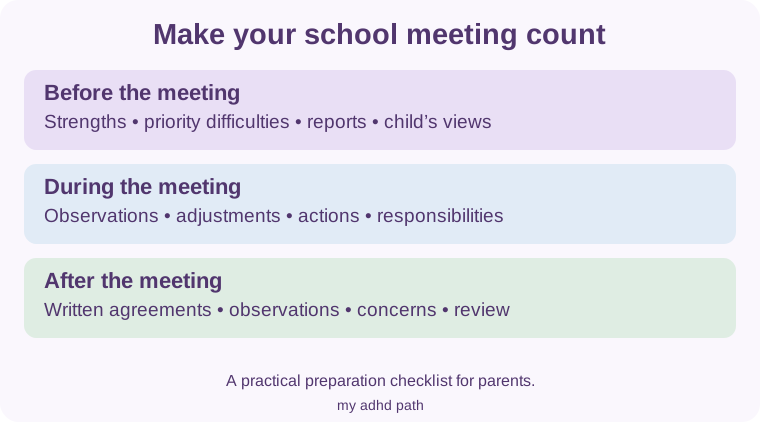
Before the meeting
- Write down your main concerns, with specific examples where possible.
- Note what your child says about school, particularly any recurring difficulties.
- Gather any reports from professionals (educational psychologist, paediatrician, CAMHS).
- Check the school's SEN information report (usually on their website).
- Think about what has helped your child in the past.
- Consider what you would like to happen as a result of the meeting.
- Ask whether you can bring a supportive friend or advocate if that would help.
Making initial contact
If you have not yet spoken to the SENCO, an email is often the best way to introduce your concerns and request a meeting.
Email template
Subject: Meeting request regarding [child's name] - [class/year group]
Dear [SENCO name],
I am writing to request a meeting to discuss some concerns about my child, [name], who is in [class/year group].
[Name] has been experiencing difficulties with [briefly describe 2-3 main areas, e.g. concentration in class, completing written work, managing transitions between activities]. These difficulties are affecting [his/her/their] ability to access the curriculum and [his/her/their] overall wellbeing at school.
[If applicable: [Name] has received a diagnosis of ADHD / is currently being assessed for ADHD / I have concerns that [name] may have ADHD.]
I would be grateful for the opportunity to discuss how the school might support [name] and to share some information about [his/her/their] needs.
I am available [suggest 2-3 times]. Please let me know what works best for you.
Thank you for your time.
Kind regards,
[Your name]
Fifteen questions to ask the SENCO
You do not need to ask all of these at your first meeting. Choose the ones that are most relevant to your child's situation.
Questions for the SENCO
- What have you noticed about my child's learning and behaviour in school?
- Is my child on the SEN register?
- What support is currently in place?
- How are you assessing my child's needs?
- What strategies are being used in the classroom?
- How do you share information about my child's needs with all relevant staff?
- How often will we review my child's progress and support?
- Can you explain how the Assess, Plan, Do, Review cycle works for my child?
- What training have staff received about ADHD?
- Are there any interventions or programmes that might help?
- How is my child managing socially and emotionally?
- What reasonable adjustments are being made?
- How can I support my child's learning at home in a way that complements what you are doing?
- What would trigger a referral for further assessment, such as an educational psychologist?
- At what point would you consider applying for an Education, Health and Care plan?
SEN Support: the graduated approach
When a school identifies that a child has SEN, the first level of support is called SEN Support.
SEN Support follows a four-stage cycle known as the graduated approach: Assess, Plan, Do, Review.
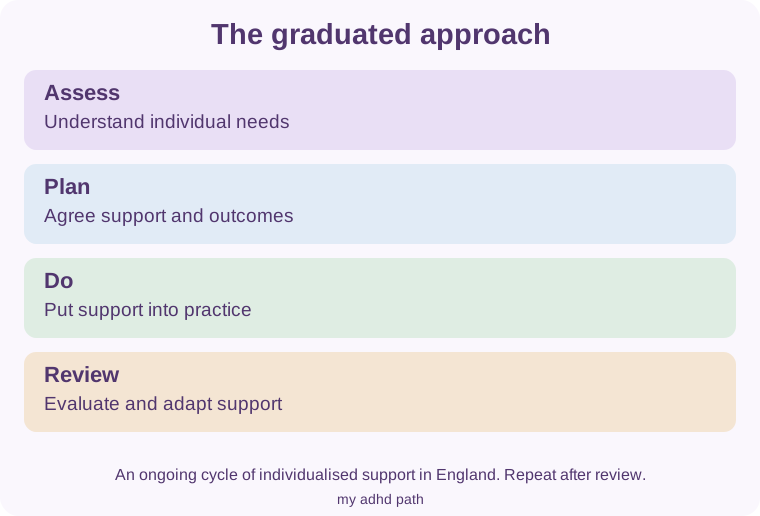
Assess
The school gathers information about your child's strengths and difficulties. This should include the views of the child, the parents, the class teacher and any other professionals involved.
Assessment is not a one-off event. It should be ongoing and should consider all aspects of your child's experience at school, not just their academic progress.
Plan
Based on the assessment, the school, parents and child agree on the outcomes they want to achieve and the support that will be put in place.
This might be recorded in a school support plan (sometimes called an individual education plan, individual provision map or similar).
| Element | What it should include |
|---|---|
| Outcomes | Specific, measurable goals (e.g. "Complete 3 out of 5 written tasks independently within the lesson") |
| Strategies | What the school will do differently (e.g. visual timetable, movement breaks, preferential seating) |
| Support | Any additional adult support, group work or interventions |
| Home strategies | What parents will do to complement school support |
| Review date | When progress will be reviewed (typically termly) |
| Child's views | What the child thinks would help and what they find difficult |
Do
The class teacher remains responsible for your child's education, even when additional support is in place.
Teaching assistants may deliver specific interventions, but the class teacher should be adapting their teaching to meet your child's needs as part of everyday practice.
Review
The impact of the support is reviewed. What has worked? What has not? What needs to change?
Reviews should involve you and your child. They should lead to clear decisions about whether the current support continues, is adjusted or is increased.
If your child is not making progress despite SEN Support, the school should consider whether to request an Education, Health and Care needs assessment.
Fifteen practical classroom adjustments for children with ADHD
Not every child needs every adjustment. The best support is tailored to the individual child. However, the following strategies are commonly helpful and can often be implemented without additional funding or resources.
- Preferential seating - near the teacher, away from windows and high-traffic areas, with a clear view of the board.
- Movement breaks - short, structured opportunities to move (delivering a message, handing out books, standing to work).
- Visual timetable - so the child knows what is coming next and can prepare for transitions.
- Chunked instructions - breaking multi-step directions into single steps, delivered one at a time.
- Written instructions alongside verbal - so the child can refer back without relying on working memory.
- Check-in signals - a discreet, agreed signal between teacher and child to refocus attention without public correction.
- Extra time for transitions - allowing a few minutes' warning before activity changes.
- Reduced copying from the board - providing printed notes or partial notes to complete.
- Fidget tools - a stress ball, resistance band on chair legs or textured object to support concentration.
- Clear start routines - telling the child exactly what to do first, rather than giving open-ended instructions.
- Positive reinforcement - noticing and naming effort and good choices, rather than focusing primarily on difficulties.
- Homework modifications - reduced volume, extended deadlines or alternative formats where appropriate.
- Exam access arrangements - extra time, rest breaks, a separate room or use of a word processor, depending on assessed needs.
- Social skills support - structured lunchtime activities, buddy systems or small group work on social understanding.
- Emotional check-ins - brief daily check-ins to identify how the child is feeling and whether support is needed.
Try this
When discussing adjustments with the school, focus on what your child needs rather than on ADHD as a label. "She finds it difficult to start writing tasks without a clear first step" is more actionable than "She has ADHD and needs help."
Matching difficulties to classroom support
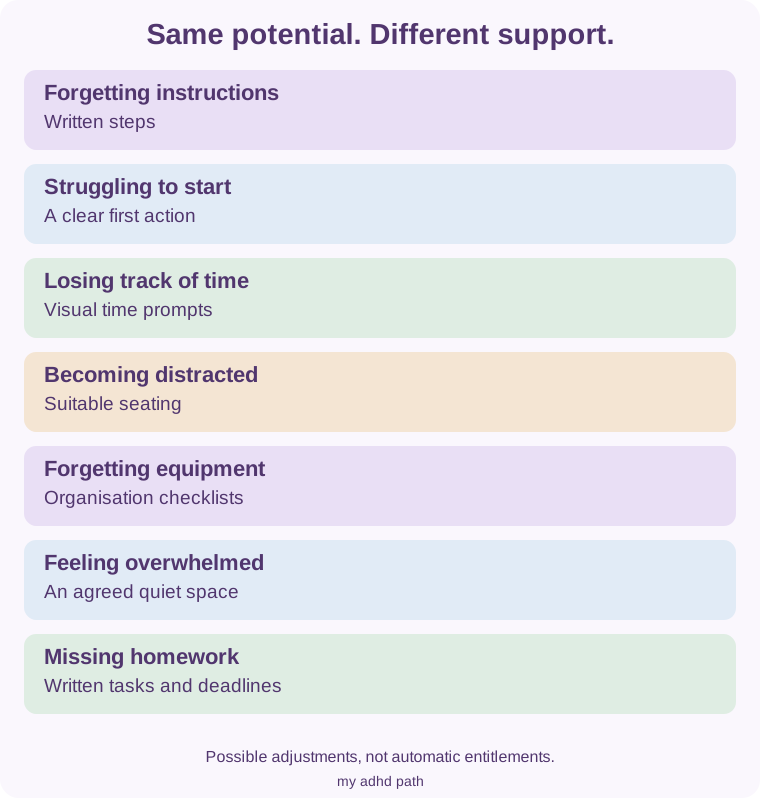
The following table connects common ADHD-related difficulties to practical adjustments. It may be useful to share with your child's teacher.
| Difficulty | Practical adjustment |
|---|---|
| Sustaining attention during lessons | Preferential seating, frequent check-ins, varied task formats, movement breaks |
| Following multi-step instructions | Chunked directions, written instructions, visual prompts |
| Starting written tasks | Clear first step, sentence starters, writing frames, verbal prompt to begin |
| Remembering equipment and homework | Visual checklists, home-school diary, spare equipment available, homework modifications |
| Managing transitions between activities | Advance warnings, visual timetable, named transition buddy |
| Controlling impulses in class | Agreed signal system, structured turn-taking, positive reinforcement for waiting |
| Regulating emotions | Identified safe space, emotional check-ins, calm-down strategies taught explicitly |
| Maintaining friendships | Structured break activities, social skills group, adult-facilitated play |
| Handwriting and presentation | Use of word processor, reduced copying, focus on content over neatness |
| Managing unstructured time | Lunchtime clubs, playground buddy, structured activities available |
Reasonable adjustments
If ADHD is considered a disability under the Equality Act 2010, the school must make reasonable adjustments.
What counts as reasonable depends on the circumstances, but the duty is proactive. Schools should not wait until a child is failing before they act.
Examples of reasonable adjustments might include:
- Modifying behaviour policies so that ADHD-related behaviour is not automatically sanctioned in the same way as deliberate misbehaviour.
- Providing extra time in tests and examinations.
- Allowing the use of a laptop or tablet for written work.
- Adapting homework expectations.
- Providing a quiet space for the child to use when overwhelmed.
- Ensuring consistent communication between home and school.
Reasonable adjustments do not need to be expensive or elaborate. They need to be effective for the individual child.
High-achieving children with ADHD
Some children with ADHD perform well academically, particularly in subjects they find stimulating.
This does not mean they do not need support.
Common misconception
"He's doing well academically, so he doesn't need any additional support."
Academic attainment is only one measure of how a child is managing at school. A child can achieve good results whilst experiencing significant difficulty with organisation, emotional regulation, social relationships, homework completion, self-esteem and overall wellbeing. SEN is not defined solely by academic underperformance.
If your child is achieving well but struggling in other areas, you can still request SEN Support. The school should consider the child's needs holistically, not dismiss concerns because grades are acceptable.
ADHD masking at school
Some children, particularly girls but not exclusively, become skilled at concealing their difficulties in the school environment.
They may:
- Copy what other children are doing rather than following the instructions independently.
- Stay quiet to avoid drawing attention to themselves.
- Use considerable energy to appear compliant and focused.
- Save their emotional reactions for home, where they feel safe.
- Develop anxiety related to maintaining this performance.
If your child is calm and compliant at school but distressed or explosive at home, that contrast itself is significant information.
It does not mean nothing is wrong. It may mean the school environment is so demanding that your child is using all their resources to hold things together during the day.
What you could say
"I understand that [name] seems to manage well in class. What I'm seeing at home suggests that the effort required to maintain that is very significant. I think we need to look at what support could reduce that pressure, even if the difficulties aren't visible in the classroom."
"We don't see any problems here"
This is one of the most frustrating responses a parent can receive, particularly when they are witnessing significant difficulties at home.
If the school does not recognise your concerns:
- Ask what specific observations they are basing this on.
- Share specific examples of what you are seeing at home.
- Explain that ADHD presentations can vary between environments.
- Ask whether the school has used any screening tools or structured observations.
- Request that your concerns are recorded in writing.
- Consider whether an external professional assessment might provide additional evidence.
Schools are required to consider parental concerns. If you feel your concerns are being dismissed, you can put them in writing to the SENCO and the headteacher.
Primary school support
In primary school, your child typically has one main teacher who knows them well. This can make it easier to establish consistent support.
Key considerations at primary level:
- Establishing a good relationship with the class teacher early in each school year.
- Sharing a brief, practical summary of your child's needs at the start of each year.
- Requesting that information is passed on when your child changes class.
- Ensuring that supply teachers and other adults who work with your child are informed.
- Monitoring homework expectations and communicating if they are unmanageable.
- Supporting your child's social development through playdates and structured activities outside school.
Try this
Create a one-page profile for your child: their strengths, their needs, what helps and what makes things harder. Update it each year and share it with new teachers. Keep it positive and practical.
Secondary school support
The transition to secondary school introduces additional challenges for children with ADHD.
Instead of one main teacher, your child now has multiple teachers, each with different expectations. They move between rooms throughout the day. They are expected to manage their own equipment, homework and timetable with increasing independence.
Key considerations at secondary level:
- Identifying one key adult your child can go to when they need help.
- Ensuring all relevant teachers are aware of your child's needs and agreed strategies.
- Requesting a locker to reduce the amount of equipment carried between lessons.
- Using a planner or digital tool to track homework across multiple subjects.
- Monitoring your child's emotional wellbeing, particularly during the first year.
- Maintaining communication with the SENCO, even if your child seems to be managing.
The transition from primary to secondary school
This transition can be particularly significant for children with ADHD.
Planning should begin well in advance. Most schools offer transition visits, but children with ADHD may benefit from additional preparation.
Transition planning
- Visit the secondary school more than once if possible, including a visit when it is quiet.
- Meet the SENCO before your child starts.
- Provide a written summary of your child's needs and effective strategies.
- Ask about the school's approach to SEN and their experience with ADHD.
- Practise the journey to school.
- Familiarise your child with the layout, using a map or photographs.
- Identify where the safe spaces are and who your child can go to for help.
- Establish a home-school communication method.
Homework
Homework can become a significant source of conflict for families affected by ADHD.
Your child has spent the entire day managing the demands of school. By the time they get home, their capacity for sustained attention and self-regulation may be very low.
This does not mean homework is unimportant. But it does mean that the approach may need to be adapted.
- Talk to the school about realistic expectations for homework volume and time.
- Ask whether homework can be modified in terms of length, format or deadline.
- Establish a consistent homework routine, but allow for breaks.
- Prioritise effort and completion over perfection.
- Use a timer to create structured work periods.
- If homework is consistently causing distress, tell the school. This is important information about your child's needs.
What you could say
"We are spending two hours on homework that should take thirty minutes, and it is causing significant distress. Can we discuss a modified approach that allows [name] to demonstrate understanding without the battle at home?"
Behaviour policies and sanctions
Many school behaviour policies are based on a system of rewards and consequences.
For children with ADHD, some consequences can be counterproductive.
Losing break time as a sanction, for example, removes the movement and social opportunity that may be essential for a child with ADHD to function in the afternoon.
Repeatedly sanctioning behaviour that is ADHD-related rather than deliberately defiant can damage self-esteem, increase anxiety and make school avoidance more likely.
Good to know
Schools should consider whether a child's behaviour is related to their SEN before applying sanctions. The DfE's Behaviour in Schools guidance (2024) states that schools should consider whether a pupil's SEND has contributed to the misbehaviour and whether any reasonable adjustments need to be made to the sanction. If your child is being repeatedly sanctioned for ADHD-related behaviour, ask the school to review its approach.
School attendance and emotionally based school avoidance
Some children with ADHD develop significant anxiety about attending school.
This is sometimes called emotionally based school avoidance (EBSA), school refusal or school-related anxiety. It is not the same as truancy.
Signs may include:
- Frequent complaints of illness on school mornings.
- Extreme distress about attending school.
- Increasing lateness or frequent absence.
- Withdrawal from friends and activities.
- Physical symptoms such as stomach aches, headaches or nausea.
If your child is struggling to attend school, it is important to work with the school to understand and address the underlying causes rather than simply focusing on improving attendance figures.
The school should be considering what is making school difficult for your child and what changes could help them feel safe enough to attend.
Suspension and exclusion
Children with ADHD are statistically more likely to receive suspensions (previously called fixed-term exclusions) and permanent exclusions.
Schools must follow the DfE's Suspension and Permanent Exclusion guidance. Key points for parents:
- The headteacher must consider all the relevant facts, including whether the behaviour might be related to SEN or a disability.
- A school should not suspend or exclude a child for behaviour that is a direct consequence of their disability without first considering whether reasonable adjustments have been made.
- Parents have the right to make representations to the governing board.
- For permanent exclusions, the governing board must automatically review the decision.
- Independent review panels are available if parents disagree with a permanent exclusion decision.
If your child is at risk of exclusion, seek advice promptly. IPSEA and SENDIAS services can provide free guidance.
Education, Health and Care Plans
If SEN Support is not sufficient to meet your child's needs, you or the school can request an Education, Health and Care (EHC) needs assessment from the local authority.
An EHC plan is a legally binding document that sets out a child's needs and the provision required to meet them. It covers education, health and social care.
The process involves:
- Requesting an EHC needs assessment.
- The local authority deciding whether to assess (within 6 weeks).
- The assessment itself, gathering evidence from parents, the school, health professionals and others.
- The local authority deciding whether to issue an EHC plan (within 16 weeks of the request).
- The final EHC plan being issued (within 20 weeks of the original request).
An EHC plan is annual reviewed and must be updated to reflect the child's changing needs.
Good to know
You have the right to request an EHC needs assessment yourself. You do not need the school's permission. If the local authority refuses to assess, you can appeal to the SEND Tribunal.
For comprehensive guidance on navigating the EHCP process, including preparing your application, understanding annual reviews and appealing decisions, visit EHCP Expert, our sister site dedicated to helping families secure the right support for their children.
When school support is not working
If you feel that the school is not meeting your child's needs despite your efforts to work collaboratively, you have options.
Steps to take
- Put your concerns in writing to the SENCO and headteacher.
- Request a formal meeting to review the support in place.
- Ask for specific, measurable outcomes and a clear timeline for review.
- Contact your local SENDIASS service for free, impartial advice.
- Consider requesting an EHC needs assessment if SEN Support is insufficient.
- If you believe the school is not meeting its legal obligations, you can make a formal complaint through the school's complaints procedure.
- Seek legal advice from organisations such as IPSEA if you believe your child's rights are not being upheld.
Keeping records
Clear records can make a significant difference if you need to escalate concerns or apply for additional support.
| What to record | Why it matters |
|---|---|
| Dates and summaries of meetings | Creates a timeline of your engagement with the school |
| Agreed actions and who is responsible | Provides accountability |
| Emails and letters sent and received | Written evidence of communication |
| Your child's comments about school | Evidence of the impact on the child |
| Copies of school reports, assessments and support plans | Shows the history of provision |
| Examples of work (before and after support) | Demonstrates the effect of interventions |
| Incidents, sanctions and behaviour records | Identifies patterns and potential discrimination |
| Attendance records | Relevant if school avoidance develops |
Try this
After every meeting or significant phone call with the school, send a brief email summarising what was discussed and agreed. This creates a written record and helps ensure everyone has the same understanding.
Follow-up email after a meeting
Email template
Subject: Summary of meeting on [date] regarding [child's name]
Dear [SENCO name],
Thank you for meeting with me on [date] to discuss [child's name].
I wanted to confirm my understanding of what was discussed and agreed:
[List the key points, agreed actions and who is responsible for each]
We agreed to review progress on [date/timeframe].
Please let me know if I have misunderstood anything or if you would like to add to this summary.
Thank you for your continued support.
Kind regards,
[Your name]
Involving your child
Your child's voice matters.
Children often have clear ideas about what helps them and what makes things harder, even if they cannot always articulate them in formal settings.
Depending on your child's age and understanding, you might:
- Ask them what they find most difficult about school.
- Ask them what helps them concentrate or feel calm.
- Include their views in support plans.
- Help them practise explaining their needs in age-appropriate language.
- Encourage them to identify a trusted adult at school.
What you could say
"The teachers and I want to make school work better for you. Can you tell me which parts of the day feel hardest? And which bits you enjoy? That will help us figure out what might help."
Children who understand their own needs and feel heard are more likely to engage with the support provided.
Three different families navigating school support
Illustrative scenario
Amelia, 8 - Primary school, recently diagnosed
Amelia was diagnosed with ADHD six months ago. She is bright and enthusiastic but struggles to sit still, frequently calls out in class and finds it difficult to complete written work.
Her teacher initially described her as "energetic but disruptive".
Amelia's mum requested a meeting with the SENCO and shared the diagnostic report along with specific examples of what Amelia finds difficult.
Together, they agreed on a support plan: preferential seating, movement breaks every 20 minutes, a visual task checklist on her desk, reduced written output with the option to record answers verbally, and a check-in signal between Amelia and her teacher.
After one term, Amelia's teacher reports that the calling out has reduced significantly and she is completing more work independently. Amelia says she likes the movement breaks and that school feels "less annoying now".
Illustrative scenario
Josh, 12 - Transition to secondary school
Josh managed reasonably well at primary school with an understanding class teacher and consistent routines.
Within the first half term at secondary school, he received three detentions for forgotten homework, was repeatedly told off for fidgeting and had an argument with a supply teacher who did not know about his ADHD.
Josh started saying he felt stupid and did not want to go to school.
His parents contacted the SENCO immediately. They discovered that Josh's SEN information had not been fully communicated to all his teachers.
A meeting was arranged. Josh attended part of it and explained that he found the number of different teachers confusing and did not know who to go to when he was struggling.
The school appointed a learning mentor as Josh's key person, ensured all teachers received his one-page profile, modified the detention policy for ADHD-related incidents and set up a weekly check-in. Josh's homework was recorded in a shared digital system that his parents could also access.
Josh still finds secondary school challenging, but he now has a named adult he trusts and a system that acknowledges his needs rather than punishing them.
Illustrative scenario
Sara, 15 - Preparing for GCSEs with an EHCP
Sara has had an EHCP since Year 7. Her ADHD significantly affects her concentration, working memory and emotional regulation. She also experiences anxiety related to school performance.
As GCSEs approach, Sara's parents are concerned that the pressure is increasing her anxiety and that some of her exam access arrangements have not been finalised.
At the annual review, they raised these concerns and asked for the EHCP to be updated to include specific exam arrangements: 25% extra time, rest breaks, a separate room and permission to use a word processor.
They also requested that the school reduce Sara's homework load in the final revision period and provide a structured revision plan rather than leaving her to organise it independently.
Sara contributed to the review by explaining that she works best in short bursts with breaks and that she needs her revision materials to be colour-coded and organised by topic rather than by date.
The EHCP was updated, the exam arrangements were confirmed and Sara's form tutor now checks in weekly to monitor her wellbeing.
Using AI to support your child's school journey
AI tools can help you prepare for meetings, organise information and draft communications. They should not replace professional advice but can support your preparation.
AI prompt
Preparing for a SENCO meeting
"My child is [age] and has ADHD. They are struggling with [specific difficulties] at school. I have a meeting with the SENCO next week. Help me prepare by organising my concerns into clear points and suggesting specific, practical support I could request."
AI prompt
Drafting a letter to the school
"Help me draft a formal letter to my child's headteacher. I want to express concerns about [specific issue] and request [specific action]. The tone should be collaborative but clear about my expectations. My child is [age] and has ADHD."
AI prompt
Understanding my child's school report
"I have my child's school report. Help me identify which comments might relate to their ADHD rather than deliberate behaviour, and suggest questions I could ask the teacher about support."
AI prompt
Creating a one-page profile
"Help me create a one-page profile for my child's school. Include sections for: strengths, needs, what helps, what makes things harder and important information for teachers. My child is [age], has ADHD and [describe key characteristics]."
Always review AI-generated content before sending it. AI assistants do not know your child or your school, and their suggestions should be adapted to your specific situation.
Independent support and advice
You do not have to navigate this alone. The following organisations provide free, independent advice for families.
| Organisation | What they offer | Website |
|---|---|---|
| SENDIASS (England) | Free, impartial advice on SEN and disability. Every local authority has a service. | kids.org.uk/sendiass |
| IPSEA | Free legal advice on special educational needs in England. | ipsea.org.uk |
| Contact | Support for families of disabled children across the UK. | contact.org.uk |
| EHCP Expert | Specialist guidance on EHCP applications, annual reviews and appeals. | ehcpexpert.co.uk |
| Enquire (Scotland) | Scottish advice service for additional support for learning. | enquire.org.uk |
| SNAP Cymru (Wales) | Advice and support for families in Wales on SEN and disability. | snapcymru.org |
| SENAC (Northern Ireland) | Northern Ireland's SEN advice centre. | senac.co.uk |
UK terminology
Education systems across the UK use different terms. The following table covers the most common ones used in England, with notes where terminology differs.
| Term | What it means |
|---|---|
| SEN / SEND | Special Educational Needs / Special Educational Needs and Disabilities |
| SENCO | Special Educational Needs Coordinator (the named person in a school responsible for SEN provision) |
| SEN Support | The first level of additional support, following the graduated approach (Assess, Plan, Do, Review) |
| EHCP / EHC plan | Education, Health and Care Plan (a legally binding document setting out a child's needs and provision) |
| Local authority (LA) | The council responsible for education, health and care provision in your area |
| SEND Tribunal | An independent body that hears appeals about EHC plans and other SEND decisions |
| Graduated approach | The Assess, Plan, Do, Review cycle used to identify and address SEN |
| Reasonable adjustments | Changes a school must make under the Equality Act 2010 to prevent a disabled child being at a substantial disadvantage |
| SENDIASS | Special Educational Needs and Disabilities Information, Advice and Support Service (free, impartial, in every LA) |
| Annual review | The yearly review of an EHC plan |
| ASL / CSP (Scotland) | Additional Support for Learning / Coordinated Support Plan (Scotland's equivalent framework) |
| IDP (Wales) | Individual Development Plan (Wales's replacement for statements and IEPs under the ALN Act 2018) |
Safeguarding
If your child tells you something that suggests they are being harmed at school, or if you have concerns about their safety, you should report this to the school's designated safeguarding lead.
If you believe your child is in immediate danger, call 999.
Children can also contact Childline on 0800 1111 for confidential support.
Downloadable resource
My Child's School Support Toolkit
A practical pack including a one-page profile template, SENCO meeting preparation checklist, questions to ask, email templates and a record-keeping log.
Download PDFFrequently asked questions
Does my child need an ADHD diagnosis to get help at school?
No. Schools must identify and support children with SEN regardless of whether they have a formal diagnosis. If your child's difficulties are affecting their learning, the school should take action.
What is a SENCO and how do I contact them?
The SENCO is the person responsible for coordinating SEN support in the school. You can usually contact them via the school office or by email. The school's website should name their SENCO.
Can I request that my child is put on the SEN register?
You can raise concerns and request that the school assesses your child's needs. The decision to place a child on the SEN register is the school's, but they must consider parental concerns and should explain their reasoning.
What if the school says my child is just badly behaved?
Ask the school to consider whether the behaviour might be related to SEN or disability. Put your concerns in writing. If you have a diagnosis or assessment, share it. Schools should distinguish between deliberate misbehaviour and behaviour arising from an underlying condition.
Can my child get extra time in exams?
Exam access arrangements, including extra time, are available for children who can demonstrate a need. The school's SENCO applies for these through the relevant exam board, usually supported by evidence from an educational psychologist or specialist assessor.
What is the difference between SEN Support and an EHCP?
SEN Support is provided by the school using its own resources. An EHCP is a legally binding plan issued by the local authority that may include additional funding and provision beyond what the school can offer alone.
Can I apply for an EHCP myself?
Yes. Parents have the right to request an EHC needs assessment from the local authority. You do not need the school's agreement, though their input will be part of the assessment.
What should I do if my child is being excluded?
Ask the school whether they have considered your child's SEN in their decision. Contact SENDIASS or IPSEA for free advice. You have the right to make representations to the governing board and, in the case of permanent exclusion, to request an independent review panel.
How often should my child's support be reviewed?
SEN Support should be reviewed at least termly through the Assess, Plan, Do, Review cycle. EHCPs must be reviewed annually. You can request an additional review if circumstances change significantly.
What if my child masks their difficulties at school?
Explain to the school that masking is a recognised pattern in ADHD, particularly in girls. The contrast between school presentation and home behaviour is itself evidence of the demands the child is managing. Ask the school to look beyond surface compliance.
Does the school have to follow the SEND Code of Practice?
Maintained schools, academies and free schools in England must have regard to the SEND Code of Practice. This means they must follow it unless there is good reason not to in a specific case.
Can I bring someone with me to meetings with the school?
Yes. You can bring a friend, family member, advocate or someone from SENDIASS. Let the school know in advance as a courtesy.
Sources and further reading
- Department for Education and Department of Health (2015). Special educational needs and disability code of practice: 0 to 25 years. https://www.gov.uk/government/publications/send-code-of-practice-0-to-25
- Children and Families Act 2014. https://www.legislation.gov.uk/ukpga/2014/6/contents/enacted
- Equality Act 2010. https://www.legislation.gov.uk/ukpga/2010/15/contents
- Department for Education (2024). Behaviour in Schools: Advice for headteachers and school staff. https://www.gov.uk/government/publications/behaviour-in-schools--2
- Department for Education (2023). Suspension and Permanent Exclusion from maintained schools, academies and pupil referral units in England. https://www.gov.uk/government/publications/school-exclusion
- NICE (2018). Attention deficit hyperactivity disorder: diagnosis and management (NG87). https://www.nice.org.uk/guidance/ng87
- IPSEA - Independent Provider of Special Education Advice. https://www.ipsea.org.uk
- Contact - For families with disabled children. https://contact.org.uk
- Enquire Scotland. https://enquire.org.uk
- SNAP Cymru. https://www.snapcymru.org
- Childline. https://www.childline.org.uk
- Young, S. et al. (2020). Females with ADHD: An expert consensus statement. BMC Psychiatry, 20, 404. https://doi.org/10.1186/s12888-020-02707-9
This article provides general educational information about navigating school support for children with ADHD in the UK. It is not legal advice. The information reflects the position in England unless otherwise stated. Education law and practice differ in Scotland, Wales and Northern Ireland. For advice specific to your circumstances, contact your local SENDIASS service or an organisation such as IPSEA.