

Growing up with ADHD isn't about learning to manage without support. It's about learning what support you need and how to access it yourself.
At a glance
- Increasing responsibilities during adolescence can make ADHD difficulties more noticeable.
- Executive functioning skills develop at different rates.
- Independence does not mean managing without support.
- Responsibilities can be transferred gradually.
- Practical life skills are important alongside academic achievements.
- Teenagers should increasingly participate in decisions about their own support.
- Transition planning for adult healthcare should begin before children's services end.
Yesterday, apparently, you were the most embarrassing person in the world.
Today, you're being asked to find a missing school tie, locate a charger and explain how to use the washing machine.
Tomorrow, you'll probably be informed that your teenager is perfectly capable of managing their own life.
Welcome to parenting a teenager.
It's a fascinating, occasionally exhausting stage of family life. And when your teenager has ADHD, the growing expectation of independence can introduce some additional challenges.
They want more freedom, privacy and responsibility.
Meanwhile, you're wondering whether they'll remember to eat lunch, submit their coursework or charge their phone before leaving the house.
Finding the balance between supporting your teenager and giving them room to develop their own skills isn't always easy.
But independence doesn't have to be an overnight transformation.
It's something you can build together, gradually, through everyday experiences.
Why adolescence can be particularly challenging with ADHD
The teenage years bring considerable changes.
Relationships become more complicated. Schoolwork becomes more demanding. Young people develop stronger opinions, establish their own identities and begin making increasingly important decisions.
At the same time, adults expect them to manage more of their lives independently.
A primary school pupil might have one main classroom teacher, a relatively predictable routine and regular reminders about what they need to bring to school.
By secondary school, they're navigating different classrooms, multiple teachers, changing timetables, online homework platforms and overlapping deadlines.
By sixteen, they may be making decisions about further education, employment and their future.
For teenagers with ADHD, these increasing responsibilities can place additional demands on executive functioning skills.
They may understand what needs doing but experience difficulties organising, remembering or consistently completing those tasks.
Sometimes the gap between what a teenager knows and what they can reliably manage becomes more noticeable during adolescence.
Understanding the developing teenage brain
The brain continues developing throughout adolescence and into adulthood.
During this period, young people are developing abilities involved in planning, decision-making, emotional regulation and evaluating consequences.
ADHD is associated with differences in some of the processes involved in these abilities.
However, development varies considerably between individuals.
Common misconception
You may have heard that children with ADHD are a fixed number of years behind their peers emotionally or developmentally. Although research has identified average differences in aspects of brain development among groups of children with ADHD, there is no reliable formula for calculating an individual teenager's emotional or executive functioning age.
A fifteen-year-old might demonstrate remarkable maturity in a challenging social situation whilst still needing reminders to pack their school bag.
They might understand complex scientific concepts but struggle to organise a week's worth of homework.
Their abilities don't necessarily develop at identical rates.
Understanding this uneven development can help you establish expectations that are both ambitious and realistic.
ADHD during puberty
Puberty brings physical, hormonal, emotional and social changes.
Sleep patterns often change. Friendships and relationships become increasingly important. Young people may become more conscious of how others perceive them.
Some teenagers with ADHD notice changes in the difficulties they experience during this period.
For girls, menstrual cycle-related changes may also influence symptoms or wellbeing, although research into these relationships is still developing.
Good to know
It's important not to attribute every change in mood, behaviour or concentration to ADHD or hormones. Persistent anxiety, low mood, significant sleep difficulties, eating concerns or dramatic changes in behaviour deserve appropriate attention. An ADHD diagnosis is part of your teenager's health picture, not an explanation for everything they experience.
Ten challenges that may become more noticeable during adolescence
1. Managing multiple responsibilities
Schoolwork, extracurricular activities, friendships and family commitments increasingly compete for attention.
Remembering everything independently can become particularly demanding.
2. Planning ahead
Your teenager may enthusiastically agree to several activities without considering how they fit together.
Having commitments visible in one place can help them develop more realistic plans.
3. Estimating time
Ten minutes can become forty-five minutes with remarkable speed, particularly when an activity is enjoyable.
External reminders and realistic time estimates may help.
4. Completing longer assignments
Coursework and revision require young people to manage tasks over days or weeks.
Breaking projects into smaller stages can provide useful structure.
5. Managing emotional reactions
Friendship disagreements, disappointing results and unexpected changes can feel particularly intense for some teenagers.
They may need support recognising emotions and choosing how to respond.
6. Maintaining personal organisation
Bedrooms, school bags, digital files and clothing can all become increasingly complicated to manage.
Functional organisation may be a better objective than immaculate presentation.
7. Managing sleep
Late-night conversations, gaming, homework and changing sleep patterns can affect daytime functioning.
Establishing sustainable sleep habits may require experimentation and cooperation.
8. Navigating friendships
Remembering arrangements, managing interruptions and interpreting social situations may present challenges for some teenagers with ADHD.
Others may find social interaction an area of particular confidence.
9. Making decisions under pressure
Impulsivity, strong emotions and social expectations may influence decisions.
Young people benefit from opportunities to practise evaluating choices and consequences.
10. Asking for help
Teenagers may want to avoid appearing different from their peers.
Learning when and how to request support is an important part of developing independence.
Independence and executive functioning are not the same thing
Your teenager may know perfectly well how to make breakfast, wash their clothes or organise a school assignment.
Doing these things consistently is another matter.
| Skill | Additional demands involved |
|---|---|
| Making breakfast | Remembering to eat and allowing enough time |
| Doing laundry | Noticing it needs doing and completing each stage |
| Completing homework | Recording deadlines, starting and submitting work |
| Travelling independently | Planning the route, checking timings and managing changes |
| Managing money | Monitoring spending and considering future needs |
| Attending appointments | Remembering the date, preparing and arriving on time |
Teaching the practical skill is important.
Teaching your teenager how to manage the surrounding responsibilities is equally valuable.
From managing for them to managing with them
When children are younger, parents naturally organise much of their lives.
You arrange appointments, prepare meals, manage school communications and make sure they have everything they need.
As your child grows older, some of these responsibilities can gradually become shared.
Eventually, your teenager may begin managing certain activities independently, using tools and support when necessary.
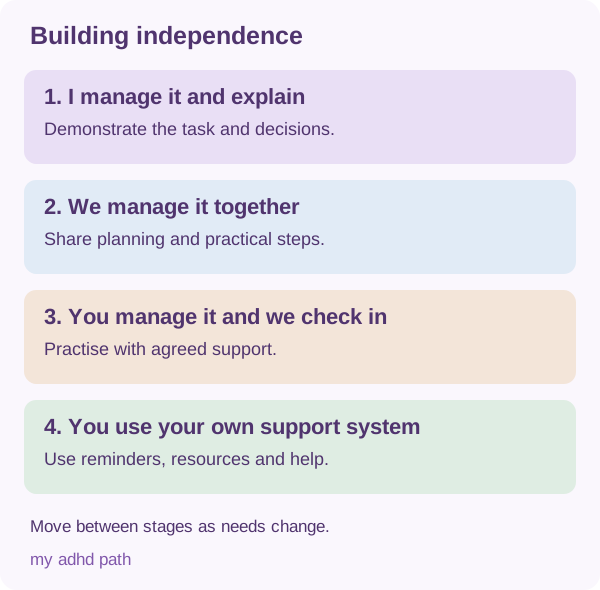
Think of independence as a flexible progression rather than a switch that is suddenly turned on.
Stage one: I manage it and explain how
You demonstrate the task and explain the decisions involved.
Stage two: We manage it together
Your teenager participates in the planning, organisation and practical activity.
Stage three: You manage it and we check in
They take greater responsibility whilst you remain available for assistance.
Stage four: You manage it with your own support system
Your teenager uses appropriate reminders, resources and support arrangements independently.
They may reach stage four with one responsibility whilst still needing stage one support with another.
They may also need additional assistance during examinations, illness or particularly demanding periods.
That flexibility is part of developing a sustainable approach.
15 practical ways to help your teenager build independence
1. Choose one responsibility at a time
Rather than announcing that your teenager is now old enough to manage everything themselves, select one meaningful responsibility.
It might be organising their sports equipment or remembering a weekly commitment.
Establish what support they need and review how things are going before introducing another responsibility.
2. Let them help design their systems
The beautifully organised planner you bought may not be the planner your teenager wants to use.
They might prefer a phone calendar, a whiteboard or a simple handwritten checklist.
Allow them to experiment.
Good to know
A system they willingly use is more valuable than a sophisticated system that remains untouched.
3. Make the hidden steps visible
When teaching a household responsibility, explain the whole process.
Doing the laundry involves more than putting clothes in a washing machine. It also involves checking care labels, choosing an appropriate programme, drying the clothes and putting them away.
Written instructions or a familiar sequence may make it easier to complete every stage.
4. Replace repeated reminders with agreed prompts
Constantly reminding a teenager about unfinished tasks can become frustrating for everyone.
Discuss which reminders they would find useful.
Perhaps a phone notification, a shared calendar event or an agreed check-in would work better than repeated questions.
Some teenagers will still need interpersonal reminders. The aim is to find an approach that supports responsibility without unnecessary conflict.
5. Teach planning through activities they care about
Planning doesn't have to begin with revision timetables.
Your teenager might enjoy organising a day out with friends, preparing for a sports event or working on a creative project.
These activities provide opportunities to practise budgeting, estimating time, gathering information and coordinating arrangements.
Try this
Skills developed through interests may also be useful elsewhere, although transferring them can require additional practice.
6. Agree on realistic consequences
Young people need opportunities to understand how decisions affect outcomes.
If your teenager forgets an optional item, it may sometimes be appropriate for them to manage the inconvenience themselves.
However, avoid withdrawing essential support, medication, food, safe travel or educational accommodations to teach a lesson.
Consider whether the consequence is proportionate, safe and genuinely useful.
There is a difference between allowing a manageable mistake and deliberately setting someone up to struggle.
7. Introduce a weekly planning session
Spend a short, agreed period looking at the coming week.
Discuss school deadlines, appointments, activities and anything that requires preparation.
Try gradually handing over more of the planning process to your teenager.
The session doesn't need to become a detailed inspection of everything they're doing.
8. Help them develop an approach to money
An allowance or appropriate earnings can provide opportunities to practise managing money.
Start with simple categories such as spending, saving and planned purchases.
Discuss subscriptions, online purchases and how quickly small transactions can accumulate.
Encourage your teenager to consider upcoming expenses before making non-essential purchases.
Keep arrangements age-appropriate and introduce additional responsibility gradually.
9. Practise independent travel
Where appropriate, help your teenager develop confidence travelling familiar routes.
Plan the journey together initially.
Discuss what they would do if a bus were cancelled, their phone battery ran out or they became lost.
Agree on suitable safety arrangements and ways to contact a trusted adult.
As their confidence and ability develop, they may be ready for more independent journeys.
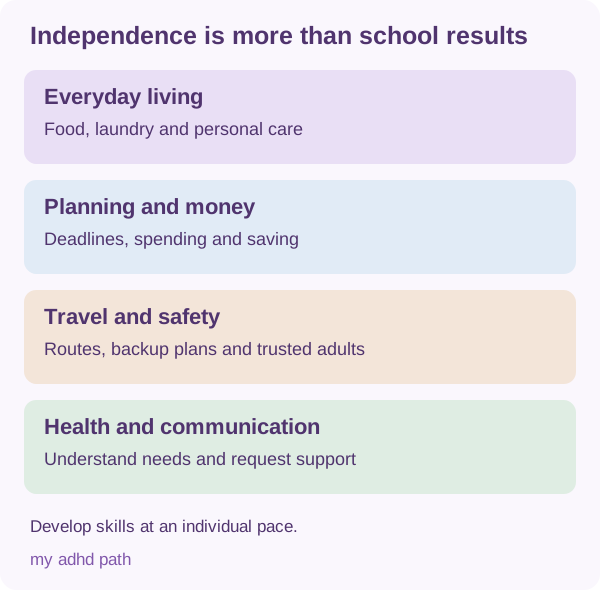
10. Teach practical food and household skills
Learning to prepare a few simple meals can make everyday life more manageable.
Start with meals your teenager enjoys and can prepare safely.
Written recipes, timers and ingredient checklists may help.
Other useful responsibilities might include managing clothing, changing bedding and identifying when household supplies need replacing.
These skills deserve the same attention as academic achievements.
11. Encourage them to communicate their needs
Your teenager may eventually need to explain their ADHD-related support needs to teachers, tutors, employers or healthcare professionals.
Practise identifying what is difficult and which adjustments may help.
What you could say
"I find verbal instructions difficult to remember. Could I have the main steps written down?"
This is a practical skill that develops through experience.
12. Help them understand their own ADHD
Encourage conversations about the ways ADHD affects their everyday life.
What makes concentrating easier? Which environments feel overwhelming? What helps them start a difficult task?
Their understanding of their own needs can inform future decisions about study, work and relationships.
13. Provide opportunities to solve problems
When your teenager encounters a difficulty, resist the temptation to immediately provide every answer.
Where appropriate, ask what options they have considered and what they think might help.
You can still offer guidance.
The objective is to help them practise problem-solving, rather than leave them unsupported.
14. Recognise progress beyond results
Remembering an appointment independently is an achievement.
Asking a teacher for clarification is an achievement.
Recognising that they need a break before becoming overwhelmed is an achievement.
These developments may never appear on a school report, but they matter.
15. Keep support available as independence grows
Your teenager needs to know that developing independence does not mean losing access to your help.
Agree on when and how they can check in with you.
Encourage them to ask for assistance before a manageable difficulty becomes a crisis.
Being able to identify when you need support is an adult life skill.
What if your teenager doesn't want your help?
There may be occasions when your teenager reacts to a perfectly reasonable question as though you've launched a formal investigation.
"Have you finished your homework?"
"YES. STOP ASKING."
Of course, being a teenager involves developing privacy, autonomy and a stronger sense of personal identity.
ADHD may add further complexity if previous conversations about organisation or behaviour have frequently been frustrating.
Instead of trying to establish a new system during a disagreement, find a more neutral time to discuss how you can work together.
What you could say
"I know you want to manage more things yourself. I'd like that too. Can we agree what you'll take responsibility for and how I can help without constantly reminding you?"
Your teenager may have ideas you hadn't considered.
You don't need to agree to every suggestion, particularly where safety or essential responsibilities are involved.
But involving them in decisions can help develop ownership.
Choosing when to step in and when to step back
There is a difference between a responsibility your teenager is ready to practise and one they are not yet able to manage safely.
| Situation | Possible approach |
|---|---|
| Forgetting an optional item for a club | Allow them to manage the inconvenience where appropriate |
| Missing repeated coursework deadlines | Review the planning system and discuss school support |
| Becoming lost on an unfamiliar journey | Provide immediate practical assistance |
| Spending their discretionary allowance too quickly | Discuss budgeting and future purchases |
| Forgetting prescribed medication | Review safe medication arrangements with appropriate adult and clinical support |
| Experiencing serious emotional distress | Offer support and seek professional help as needed |
Think about the risks, the teenager's current abilities and what they might reasonably learn from the experience.
Independence should develop without compromising their safety or wellbeing.
Supporting teenagers with ADHD through GCSEs and other examinations
The examination years introduce a particularly demanding combination of academic work, planning and emotional pressure.
A teenager may understand their subjects but struggle to organise independent revision.
Traditional advice to create a revision timetable can be helpful, but producing a timetable is not the same as following one.
Practical checklist
- A realistic overview of upcoming examinations.
- Clearly defined revision activities.
- Active recall and practice questions.
- Shorter study sessions where appropriate.
- Regular reviews of progress.
- Planned opportunities for rest, movement and social activities.
- Appropriate educational support.
Instead of writing "Revise chemistry" in a planner, identify a specific activity.
"Practise five questions on calculating moles."
"Explain the trend in reactivity of the halogens."
"Complete one past-paper question on electrolysis."
Specific actions reduce the amount of decision-making involved in getting started.
Good to know
Exam access arrangements may be appropriate for some pupils with ADHD, depending on their individual needs, evidence and the applicable examination regulations. A diagnosis alone does not automatically establish entitlement to extra time or other arrangements. Speak to the school's SENCO or examinations team well before examinations.
Thinking beyond school results
Your teenager may be considering sixth form, college, an apprenticeship or employment.
Academic qualifications matter, but they aren't the only factor worth considering.
What subjects genuinely interest them?
Do they enjoy practical activities or theoretical learning?
Would a highly structured environment suit them, or one offering greater flexibility?
Are there opportunities to participate in sport, creative activities or other interests?
What support is available?
Encourage them to explore different educational and career pathways without assuming that ADHD determines which one is suitable.
A young person's interests, abilities, ambitions and support needs are more useful starting points than a generic list of careers supposedly suited to ADHD.
Friendships, relationships and social independence
Friendships can become increasingly important during adolescence.
Young people may be navigating complicated social groups, developing romantic interests and exploring their identity.
Some teenagers with ADHD experience difficulties remembering social arrangements, managing impulsive comments or responding to perceived rejection.
Others may be socially confident but find maintaining friendships more demanding than establishing them.
You can support your teenager by making conversations about relationships feel accessible.
Discuss mutual respect, personal boundaries, consent, online safety and how healthy relationships should feel.
Give them age-appropriate privacy whilst keeping routes to trusted support open.
Avoid dismissing friendship difficulties as trivial simply because they are happening during adolescence.
To your teenager, these relationships may be enormously important.
Phones, gaming and social media
Digital technology can provide opportunities for connection, creativity, entertainment and learning.
It can also introduce difficulties with distraction, sleep, spending and managing transitions.
For a teenager who finds stopping an enjoyable activity particularly demanding, interruptions can become a recurring source of conflict.
Rather than treating technology as universally good or bad, consider how it fits into their wider life.
Are they getting enough sleep?
Are school responsibilities manageable?
Are they maintaining activities and relationships beyond their devices?
Do they understand privacy, online exploitation and financial risks?
Agree on age-appropriate boundaries and expectations.
Where possible, discuss these arrangements in advance rather than introducing them during an argument.
Good to know
Technology can also be an important accessibility tool. Calendars, reminders and educational applications may support your teenager's independence.
Risk-taking, alcohol and other substances
Adolescence is a period when many young people encounter new opportunities and social pressures.
Research has found associations between ADHD and increased risk of certain substance-related difficulties, although individual experiences vary considerably.
This does not mean that a teenager with ADHD will develop a substance use problem.
Open, factual and age-appropriate conversations can help young people understand risks without feeling that they need to conceal difficulties.
Discuss alcohol, vaping, nicotine, cannabis and other substances, including the risks of taking medication prescribed for somebody else.
If your teenager takes ADHD medication, explain why it must never be shared, sold or given to friends.
Encourage them to contact a trusted adult if they find themselves in an unsafe situation.
If you have concerns about substance use, seek appropriate professional advice.
In a suspected overdose or other medical emergency, call 999.
Helping your teenager manage their own healthcare
As teenagers approach adulthood, they may gradually take a more active role in their healthcare.
They can begin learning about their diagnosis, prescribed treatment and the purpose of appointments.
Depending on their maturity and individual circumstances, they may be able to:
Practical checklist
- Prepare questions for their clinician.
- Describe how they are managing at school and home.
- Identify possible medication side effects.
- Understand how to request appropriate healthcare support.
- Learn how their prescriptions are arranged.
- Participate in decisions about their treatment.
Any transfer of responsibility for medication needs to be safe, age-appropriate and discussed with the relevant clinician.
Medication should be taken only as prescribed and stored securely.
Young people should not change doses independently.
Preparing for the transition to adult ADHD services
What the research says
NICE recommends reassessing young people receiving ADHD care at school-leaving age to establish whether ongoing treatment is needed and planning a smooth transition where appropriate. Local arrangements and service age boundaries vary.
Moving from children's healthcare services to adult services can introduce changes in clinicians, referral pathways and treatment arrangements.
Begin discussing the transition with your teenager's clinical team well before they reach the relevant age limit.
Ask who will be responsible for their ongoing care, how referrals will be arranged and how prescriptions and monitoring will continue.
Keep copies of relevant documents securely.
Encourage your teenager to participate in these conversations so that they gradually understand how their healthcare is organised.
Don't assume that ongoing treatment will transfer automatically.
The emotional side of becoming independent
Teenagers increasingly compare themselves with other people.
They may notice that friends appear to manage school deadlines, travel arrangements or everyday responsibilities with less assistance.
Your teenager might wonder why certain activities require so much effort.
Try to avoid measuring their development exclusively against their peers.
Recognise their individual progress and help them identify what makes their responsibilities easier to manage.
There will be things they can do with confidence and things that still require support.
Both can be true at the same time.
If your teenager experiences persistent low mood, anxiety, withdrawal, self-harm or significant changes in behaviour, seek appropriate professional support.
These concerns should not simply be attributed to teenage development or ADHD.
When you disagree: boundaries without constant battles
Teenagers need opportunities to exercise autonomy.
Parents also have responsibilities to maintain appropriate boundaries and protect their children's wellbeing.
These two things can coexist.
Try discussing which decisions are open to negotiation and which requirements are essential.
| Area | Possible flexibility |
|---|---|
| Homework | Choice of timing, location and planning system |
| Household responsibilities | Choice of appropriate tasks or when they are completed |
| Personal style | Age-appropriate freedom of expression |
| Screen use | Agreed timings and suitable boundaries |
| Healthcare | Participation in decisions with appropriate clinical support |
| Safety | Clear, age-appropriate safeguards |
A productive conversation is one where your teenager understands why a boundary exists, even if they don't particularly like it.
And there will certainly be boundaries they don't particularly like.
Three teenagers, three different paths towards independence
The following examples are fictional and illustrate different approaches.
Illustrative scenario
Oliver, 13 - Learning to manage school responsibilities
Oliver frequently forgets homework deadlines and sports equipment. His parents have been checking everything each evening. Together, they introduce a short preparation routine and a designated place for school belongings. Oliver chooses to use reminders on his phone. His parents initially check in each evening before gradually reducing their involvement as the routine becomes more familiar.
Illustrative scenario
Amira, 16 - Finding a way to manage examinations
Amira is academically capable but struggles to organise independent revision. She becomes overwhelmed by extensive timetables. Instead, she develops a weekly overview and identifies two or three specific revision activities on study days. She discusses appropriate educational support with her school and learns to recognise when she needs clarification or additional help. She still benefits from occasional planning support, but increasingly takes ownership of the process.
Illustrative scenario
Jamie, 17 - Preparing for life beyond school
Jamie is interested in an engineering apprenticeship. He is enthusiastic about practical work but finds application deadlines and administrative tasks difficult. His parents help him initially identify the application stages. Jamie takes responsibility for researching opportunities, preparing reminders and keeping track of correspondence. They also practise independent travel and managing everyday expenses. His independence develops through activities that are relevant to his own ambitions.
Create an independence skills profile
Use this exercise together, rather than completing it as an assessment of your teenager without their involvement.
| Responsibility | Questions to explore |
|---|---|
| Personal care | What can I manage comfortably? What helps me remember? |
| Schoolwork | How do I plan deadlines and ask for assistance? |
| Money | Can I keep track of spending and planned purchases? |
| Travel | Which journeys can I manage safely? |
| Food and household tasks | Which practical skills would I like to learn? |
| Healthcare | Do I understand my treatment and how to access help? |
| Emotional wellbeing | How do I recognise when I need support? |
| Communication | Can I explain what I need from other people? |
For each area, identify what your teenager already manages, what they are practising and what still needs support.
Choose one or two priorities together.
The profile should help guide development, rather than become another set of grades.
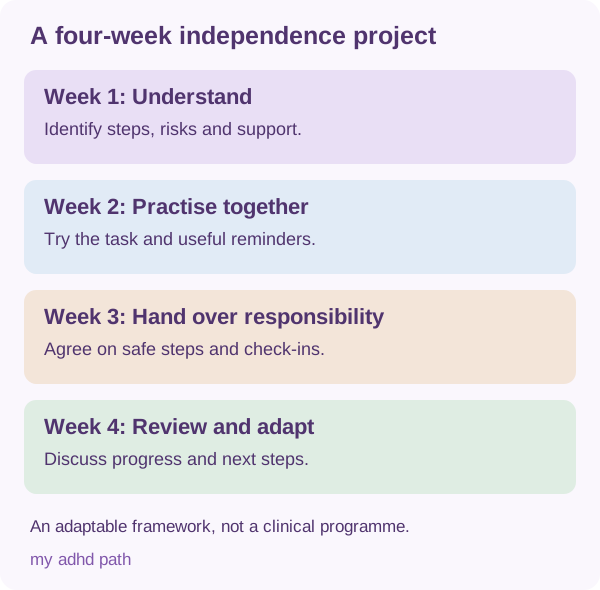
A four-week independence project
Choose a practical responsibility your teenager wants to develop.
It could be preparing a favourite meal, managing their sports commitments or planning a familiar journey.
Week one: Understand
Identify the steps, discuss any risks and establish what support is needed.
Week two: Practise together
Work through the responsibility and introduce useful reminders or written instructions.
Week three: Hand over more responsibility
Allow your teenager to manage appropriate stages, with agreed check-ins.
Week four: Review and adapt
Discuss what felt manageable, where support is still useful and what to try next.
There is no requirement to complete the process within four weeks.
Some skills take longer to develop. Others may be learnt considerably more quickly.
The objective is progress that feels meaningful to your teenager.
Using AI to support teenage independence
AI assistants may help young people organise information, explore ideas and develop practical planning skills.
Parents can also use these tools to prepare resources.
Check the service's age requirements, privacy arrangements and school policies before allowing independent use.
Encourage your teenager to verify information and make their own decisions.
AI prompt
Organise my week
"Help me organise these school deadlines and activities into a realistic weekly plan. Break larger assignments into specific actions and leave enough time for rest."
AI prompt
Learn a practical life skill
"Teach me how to organise a weekly clothes wash. Explain the steps in simple language, including safety considerations and checking clothing care labels."
AI prompt
Prepare for an appointment
"Help me create a list of questions I want to ask my healthcare professional about my ADHD. Organise my thoughts without trying to diagnose me or recommending medication changes."
AI prompt
Explore my future options
"Ask me questions about my interests, favourite subjects and preferred working environments. Help me identify education and career pathways to research without assuming ADHD limits my options."
AI prompt
Solve a planning problem
"Here is a task I keep forgetting. Help me design a simple reminder system. Give me two possible approaches and explain how I could test which works best."
Good to know
AI can provide incorrect or unsuitable information. Avoid entering confidential medical records, school documents or personally identifying information into unsuitable services. AI should support learning and planning, not replace trusted adults, healthcare professionals or appropriate safeguarding arrangements.
What the research says
Research into adolescent ADHD has explored the effects of executive functioning difficulties on education, relationships and everyday responsibilities. Studies of brain development have identified differences in average developmental patterns among groups of young people with ADHD. However, these findings cannot predict an individual teenager's maturity or capabilities. Research into organisational skills and school-based interventions suggests that structured approaches may help some young people develop skills related to planning and managing school responsibilities. Clinical guidance also recognises the importance of involving young people in decisions about ADHD treatment and planning transitions to adult services. The routines, independence stages and four-week project in this article are practical editorial frameworks. They are not clinically validated programmes or fixed developmental milestones.
When to seek additional support
Speak to appropriate professionals if your teenager is experiencing persistent difficulties with education, emotional wellbeing, sleep, relationships or everyday functioning.
Your GP, ADHD clinician, school SENCO, safeguarding team or local young people's services may be able to help.
Young people in the UK can also access information and support through organisations such as YoungMinds and Childline.
Childline can be contacted on 0800 1111 by children and young people under nineteen.
If someone is in immediate danger or experiencing a medical emergency, call 999.
Frequently asked questions
Does ADHD become worse during the teenage years?
Some young people experience changes in symptoms or find their difficulties more noticeable as responsibilities increase. Others develop strategies that improve everyday functioning. Experiences vary.
Are teenagers with ADHD less mature than their peers?
ADHD can affect aspects of executive functioning and emotional regulation, but there is no reliable fixed developmental age difference that applies to every teenager.
How much independence should I give my teenager with ADHD?
Consider their individual abilities, experience, safety and support needs. Introduce responsibilities gradually and review what helps.
Should I stop reminding my teenager about homework?
Not necessarily. Discuss which reminders are useful and explore ways to transfer some responsibility to their own planning systems.
Can a teenager with ADHD succeed academically?
Yes. ADHD does not determine intelligence or academic potential. Appropriate teaching, support and manageable study strategies can make a difference.
Are teenagers with ADHD automatically entitled to extra time in exams?
No. Exam access arrangements depend on individual needs, supporting evidence and applicable regulations. Discuss potential arrangements with the school's SENCO or examinations team.
Can puberty affect ADHD symptoms?
Some teenagers notice changes during puberty. Hormones, sleep, environmental demands and emotional wellbeing may all play a role, and research into specific hormonal effects remains developing.
Should my teenager manage their own medication?
Responsibility should be introduced according to individual maturity, safety and clinical advice. Appropriate adult oversight may still be necessary.
Can my teenager drive if they have ADHD?
Many people with ADHD can drive. Individual fitness to drive matters. In Great Britain, ADHD must be reported to the DVLA if it affects the ability to drive safely. Discuss concerns with a healthcare professional and consult current licensing guidance.
Should I tell my teenager's future college or employer about their ADHD?
Involve your teenager in the decision, respecting their growing autonomy and relevant legal requirements. Appropriate disclosure may help them access support and adjustments.
Will my teenager grow out of ADHD?
ADHD can persist into adulthood. Individual symptoms and support needs may change over time. Treatment and follow-up should reflect their circumstances.
What happens when my teenager turns eighteen?
Healthcare arrangements may change as they move into adult services. Discuss transition planning with their clinical team well before the relevant service age boundary.
Independence is something you build, not something you demand
One day, your teenager will probably have their own collection of household responsibilities, appointments, deadlines and decisions.
They might still use multiple calendars.
They might own an impressive collection of reminders.
They might occasionally ring you to ask how long something needs to go in the oven.
None of those things necessarily diminish their independence.
What matters is that they understand themselves, have opportunities to develop practical skills and know how to access the support they need.
Your role will gradually change.
Less organising everything on their behalf.
More helping them discover approaches that work for them.
And eventually, more conversations where they tell you what they've decided to do, rather than asking you to decide for them.
Watching your teenager build a life that reflects their own interests, ambitions and abilities is one of the lovely privileges of parenting.
Even if they still occasionally need you to find their school tie.
Sources and further reading
- NICE - Attention deficit hyperactivity disorder: diagnosis and management (NG87). https://www.nice.org.uk/guidance/ng87
- NHS - Attention deficit hyperactivity disorder (ADHD). https://www.nhs.uk/conditions/attention-deficit-hyperactivity-disorder-adhd/
- Faraone, S. V. et al. (2021). The World Federation of ADHD International Consensus Statement: 208 Evidence-based conclusions about the disorder. https://doi.org/10.1016/j.neubiorev.2021.01.022
- Shaw, P. et al. (2007). Attention-deficit/hyperactivity disorder is characterized by a delay in cortical maturation. Proceedings of the National Academy of Sciences. https://doi.org/10.1073/pnas.0707741104
- Bikic, A. et al. (2017). Meta-analysis of organizational skills interventions for children and adolescents with attention-deficit/hyperactivity disorder. Clinical Psychology Review, 52, 108-123.
- Joint Council for Qualifications - Access arrangements and reasonable adjustments. https://www.jcq.org.uk/
- GOV.UK - ADHD and driving. https://www.gov.uk/adhd-and-driving
- YoungMinds. https://www.youngminds.org.uk/
- Childline. https://www.childline.org.uk/
- FRANK - Drug information and support. https://www.talktofrank.com/
This article provides general educational information and is not a substitute for individual medical, psychological, educational, legal or safeguarding advice. The examples are fictional, and practical frameworks are adaptable educational tools rather than clinically validated interventions.