

It's considerably harder to teach someone how to remember their PE kit when you've just discovered your own car keys in the fridge.
At a glance
- ADHD has a substantial genetic component and frequently runs in families.
- Parents and children with ADHD may have very different support needs.
- External systems can reduce executive functioning demands for everyone.
- Family routines should be flexible and easy to restart.
- Emotional regulation support matters for both parents and children.
- Household responsibilities benefit from clear ownership.
- Parents deserve appropriate support for their own ADHD.
There are plenty of parenting books that recommend consistency.
Establish a morning routine. Plan meals in advance. Maintain a family calendar. Remember school deadlines. Stay calm when your child becomes frustrated.
All perfectly sensible suggestions.
Until you're the parent who's forgotten to update the calendar, hasn't defrosted anything for dinner and is discovering at eight o'clock on Sunday evening that tomorrow is World Book Day.
When you have ADHD and your child has ADHD too, everyday parenting advice can sometimes feel as though it's been written for an entirely different household.
You're helping someone develop skills that you may still find difficult yourself.
You're providing structure whilst needing structure.
You're helping your child manage their emotions whilst managing your own.
But you may also bring something particularly valuable to your child's experience: an understanding of what it feels like to navigate the world with ADHD.
The challenge is building a family life that makes room for both your needs.
Why ADHD often runs in families
ADHD has a substantial genetic component.
Research involving families, twins and genetic studies has consistently identified inherited influences on the likelihood of developing ADHD.
What the research says
A widely cited review published in Molecular Psychiatry in 2019 estimated ADHD heritability at approximately 74% across twin studies. Heritability is frequently misunderstood. It doesn't mean that a parent with ADHD has a 74% chance of having a child with ADHD. Nor does it mean that 74% of an individual's ADHD is caused by their genes. It describes the proportion of variation in susceptibility within a studied population that is associated with genetic differences.
ADHD is complex. Numerous genetic variants and other developmental influences may contribute.
Parenting style does not cause ADHD.
Your child may inherit a predisposition towards ADHD, but the way you support them can influence their experiences, development and wellbeing.
Discovering your own ADHD through your child
For some adults, their child's ADHD assessment becomes the beginning of their own journey.
You read the assessment questionnaires and recognise experiences you've had throughout your life.
You listen to a clinician describe difficulties with working memory and suddenly understand why you've always needed several reminders for an appointment.
You discover that your child's tendency to become absorbed in an interesting activity whilst forgetting everything else feels remarkably familiar.
Perhaps you've spent decades developing ways to manage difficulties that you're only now beginning to understand.
Receiving your own diagnosis whilst parenting a newly diagnosed child can bring a complicated mixture of recognition, relief, questions and uncertainty.
You might find yourself reconsidering your own childhood whilst trying to make your child's experience different.
Good to know
Give yourself permission to explore your own support needs alongside theirs. Your own wellbeing matters in its own right, not simply because you're a parent.
Having ADHD doesn't mean you both experience it in the same way
A parent and child can share an ADHD diagnosis whilst having very different needs.
You might require complete silence to concentrate, whilst your child prefers background noise.
You might struggle with starting tasks, whilst your child starts enthusiastically but finds finishing difficult.
You might become quiet when overwhelmed. Your child might become increasingly expressive.
Your experiences can provide insight, but they aren't necessarily an exact guide to your child's.
Be curious about the differences as well as the similarities.
| Area | One family member might | Another might |
|---|---|---|
| Attention | Need a quiet environment | Prefer some background activity |
| Organisation | Use extensive lists | Find visual reminders more accessible |
| Emotional regulation | Need time alone | Prefer reassurance and company |
| Task initiation | Benefit from a countdown | Benefit from someone working nearby |
| Routines | Prefer predictable schedules | Need more flexibility |
| Movement | Enjoy sitting quietly | Need frequent movement opportunities |
Understanding your individual preferences can help prevent a useful strategy for one person becoming an additional difficulty for another.
The invisible executive functioning demands of parenting
Parenting involves an extraordinary amount of information management.
There are appointments, school communications, medication arrangements, friendships, household responsibilities, extracurricular activities and seemingly endless things that need washing.
Much of the work involves remembering something today that needs to happen tomorrow.
Or next Tuesday.
Or on the second Friday of next month, when your child needs to arrive at school dressed as a historical figure.
Consider a relatively ordinary school morning.
You need to wake up, get dressed, prepare breakfast, ensure your child is ready, remember their equipment, check the day's arrangements and leave on time.
Your child needs to manage many of those same tasks.
If both of you experience difficulties with remembering instructions, estimating time and moving between activities, the morning can become considerably more complicated.
A helpful approach is to reduce the number of things either of you needs to remember independently.
Ten everyday challenges in an ADHD household
1. Everyone is waiting for someone else to remember
You assume your child will tell you when their school project is due.
Your child assumes you'll remind them.
Neither of you remembers until the evening before.
Shared reminders and clear responsibility can reduce these situations.
2. Time seems to disappear
You thought getting ready would take twenty minutes.
Your child thought they had plenty of time.
Suddenly, you're both looking for shoes with three minutes remaining before you need to leave.
Making departure times and intermediate steps visible may help.
3. Important objects keep moving
Keys, shoes, water bottles, school planners and chargers appear to have developed independent travel arrangements.
Giving frequently used items an obvious, accessible home can reduce time spent searching.
4. Everyone has a different idea of what counts as tidy
Your child believes their bedroom is organised because they know roughly where everything is.
You have an equally sophisticated system involving several piles of paperwork.
Practical organisation may be a more useful objective than visual perfection.
5. School communications become overwhelming
Emails, messaging apps, letters, homework platforms and online payment systems all require separate attention.
Collecting important actions in one place can reduce the risk of overlooking them.
6. Emotional reactions happen simultaneously
Your child becomes frustrated because they can't find something.
You become frustrated because you're already running late.
Each person's reaction can affect the other.
Recognising these patterns creates opportunities to respond differently.
7. Routines work brilliantly until something changes
The family develops a successful routine.
Then half-term arrives, someone becomes unwell or a sports club changes its schedule.
Instead of expecting perfect consistency, build in ways to restart routines after interruptions.
8. Everyone finds transitions difficult
Leaving the house, stopping a game, beginning homework and getting ready for bed may all require additional effort.
Advance notice and a clear next action may make transitions more manageable.
9. Interesting projects are easier to begin than household administration
You can spend an afternoon helping your child build an impressive science project.
Remembering to submit the permission slip is another matter entirely.
Separate reminders for routine administrative tasks may help.
10. Rest keeps disappearing from the schedule
There is always something else to organise, finish or remember.
But parents and children both need opportunities to recover.
Rest deserves a place in the family routine.
Build systems that work for both of you
Traditional organisation advice often focuses on becoming more disciplined.
An alternative is to make the environment do more of the work.
Instead of expecting everyone to remember where things belong, make their storage places obvious.
Instead of expecting everyone to remember tomorrow's commitments, put them somewhere visible.
Instead of relying on verbal instructions, create short checklists.
Instead of expecting a complicated routine to survive every disruption, make it easy to restart.
A family system should be designed around the people using it.
Not around the people you imagine would be better at using it.
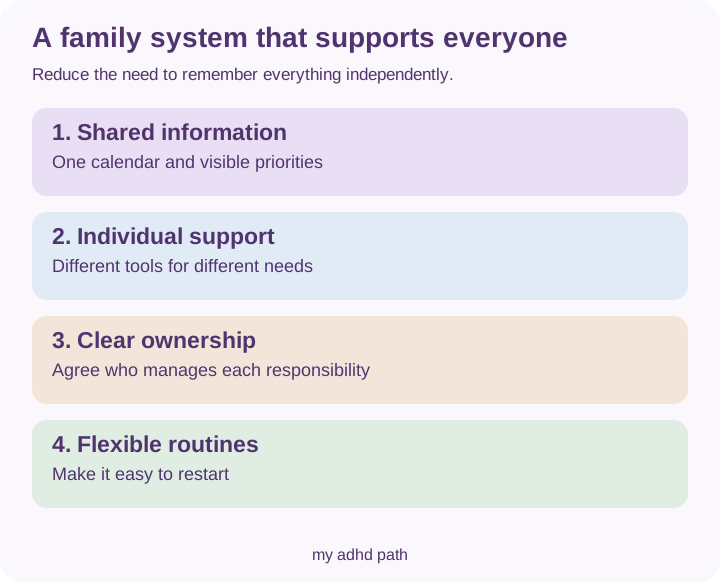
15 practical strategies for ADHD families
1. Create one family information centre
Choose one reliable place for important family information.
It might be a whiteboard in the kitchen, a shared digital calendar or a combination of the two.
Include upcoming commitments, school events and anything requiring preparation.
If you use both physical and digital systems, decide how information will be kept consistent.
The aim is to reduce the number of places you need to check.
2. Give every responsibility a clear owner
When everyone is responsible for something, it can become surprisingly easy for nobody to do it.
Agree who is responsible for particular tasks.
For younger children, adults may retain most of the responsibility. Older children can gradually take ownership of age-appropriate activities.
Clear ownership should include appropriate reminders and support rather than simply transferring the expectation to remember.
3. Establish a launch pad by the door
A launch pad is a designated place for things you regularly need when leaving the house.
It might contain school bags, keys, shoes, sports equipment and anything that needs returning.
Choose a location that is convenient and visible.
Preparing items in advance removes several decisions from the morning.
4. Design mornings backwards
Start with the time you need to leave.
Work backwards to identify the main stages of the morning.
Allow realistic time for getting dressed, eating breakfast and finding equipment.
Include some flexibility for unexpected delays.
Visible intermediate times may be more useful than one alarm announcing that you're already late.
5. Reduce repeated verbal reminders
Repeated instructions can become tiring for both parent and child.
Try replacing some reminders with visual prompts.
Practical checklist
- Get dressed.
- Eat breakfast.
- Brush teeth.
- Check school bag.
- Put on shoes.
Adapt it to your child's age and individual needs.
Adults can use their own version too.
6. Use shared reset sessions
Rather than spending an entire afternoon attempting to organise the house, try a short family reset.
Everyone works on an agreed task for a manageable period.
One person clears the kitchen table. Another returns belongings to their storage places. Someone else prepares school equipment.
You can work alongside one another without expecting every room to become perfectly organised.
7. Simplify household storage
The easier something is to put away, the more likely it may be to reach its intended home.
Consider open baskets, accessible hooks, clearly labelled drawers and visible storage for frequently used items.
Keep potentially dangerous items, medicines and confidential documents securely stored regardless of convenience.
Organisation should support safe, functional family life.
8. Create a weekly planning habit
Choose a short time each week to look ahead.
Identify appointments, school commitments, activities and anything that needs preparing.
Older children can contribute their own deadlines.
You don't need to plan every detail of the coming week.
Focus on the things most likely to cause difficulties if they're forgotten.
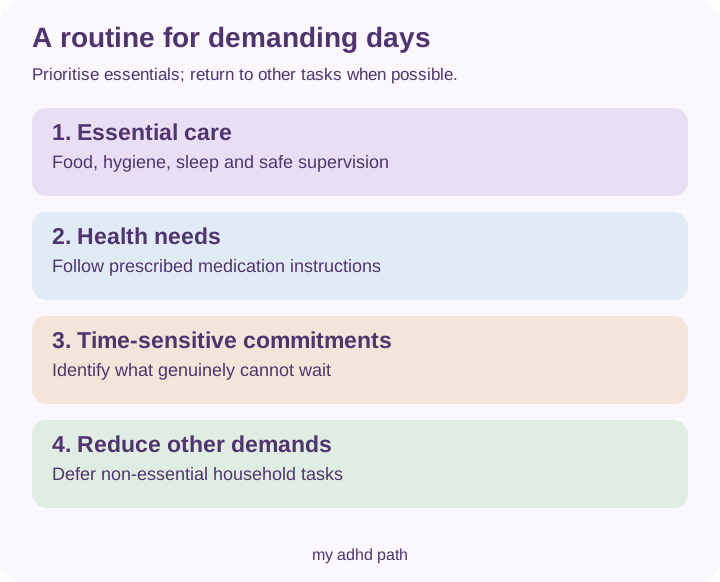
9. Have a minimum-viable routine
Some days are particularly demanding.
Perhaps you've slept badly, work has been unexpectedly busy or your child is struggling emotionally.
A simplified routine can help maintain essential activities without expecting the same level of productivity as a more manageable day.
Practical checklist
- Prioritise basic care, safety, essential medication according to prescribed instructions, food, sleep and genuinely time-sensitive commitments.
- Less important household tasks can sometimes wait.
10. Reduce unnecessary choices
Making repeated decisions can become tiring.
Consider a rotating selection of familiar meals, designated homework times or predictable places for commonly used items.
Your family can still enjoy variety.
The objective is to reduce decisions that don't particularly benefit from being made repeatedly.
11. Make transitions predictable
Give advance notice when an activity is coming to an end.
What you could say
"We'll need to leave in fifteen minutes. When you've finished that activity, the next thing is to put your shoes on."
Adults can benefit from transition reminders too.
A calendar notification before an appointment may be more useful than one arriving at the appointment's starting time.
12. Build in opportunities for movement and quiet
Different family members may need different ways to unwind.
One might benefit from cycling, playing football or walking the dog.
Another might prefer reading, drawing or sitting somewhere quiet.
Make room for individual recovery preferences rather than assuming everyone needs the same activity.
13. Automate what you reasonably can
Recurring calendar events, automatic reminders and repeat shopping lists can reduce administrative demands.
Where appropriate, automated bill payments or online ordering may also help.
Review automated arrangements periodically, particularly those involving money, subscriptions or important responsibilities.
Technology should reduce the amount you need to monitor, not create an entirely new administrative system.
14. Ask for support before you're overwhelmed
You may benefit from sharing responsibilities with a partner, co-parent, relative or trusted friend.
Practical help could involve school collections, appointment reminders, preparing meals or providing opportunities for you to rest.
Professional ADHD support may also help you develop approaches suited to your own needs.
Consider what would make an actual difference rather than feeling obliged to manage every responsibility independently.
15. Design a way to restart
Every family routine will occasionally be disrupted.
Instead of treating disruption as the end of a successful system, create a simple restart process.
Practical checklist
- Check the calendar.
- Identify the next essential commitment.
- Prepare what is needed.
- Return to one familiar routine.
You can rebuild the remaining structure gradually.
A system that is easy to restart may be more useful than one that depends on perfect consistency.
A realistic ADHD family morning
Imagine a household that needs to leave at 8.15 am.
Rather than relying on repeated reminders, the family builds a visible sequence.
| Time | Activity |
|---|---|
| Previous evening | Prepare bags, clothes and essential equipment |
| 7.00 am | Wake up and begin getting ready |
| 7.20 am | Breakfast |
| 7.40 am | Finish dressing and personal care |
| 7.55 am | Check bags and today's relevant reminders |
| 8.05 am | Shoes, coats and final preparation |
| 8.15 am | Leave |
These timings are purely illustrative.
Some households need substantially more preparation time. Others have different work and school arrangements.
The principle is to make the sequence visible and reduce the number of decisions that need making during the morning.
Even with a carefully designed system, there will occasionally be a missing shoe.
That's why the system includes some spare time.
When your child's emotions and your emotions collide
One of the more complicated aspects of parenting with ADHD can be managing emotionally demanding situations whilst experiencing your own frustration.
Your child refuses to stop playing a game.
You've already asked several times.
Dinner is getting cold.
You've had a demanding day and there are still several things you need to finish.
What began as an ordinary request can quickly become a much bigger interaction.
Emotional regulation difficulties are associated with ADHD in some people, although they are not a universal experience or a core diagnostic criterion.
Understanding how emotional reactions influence each other can help families identify opportunities to interrupt escalating situations.
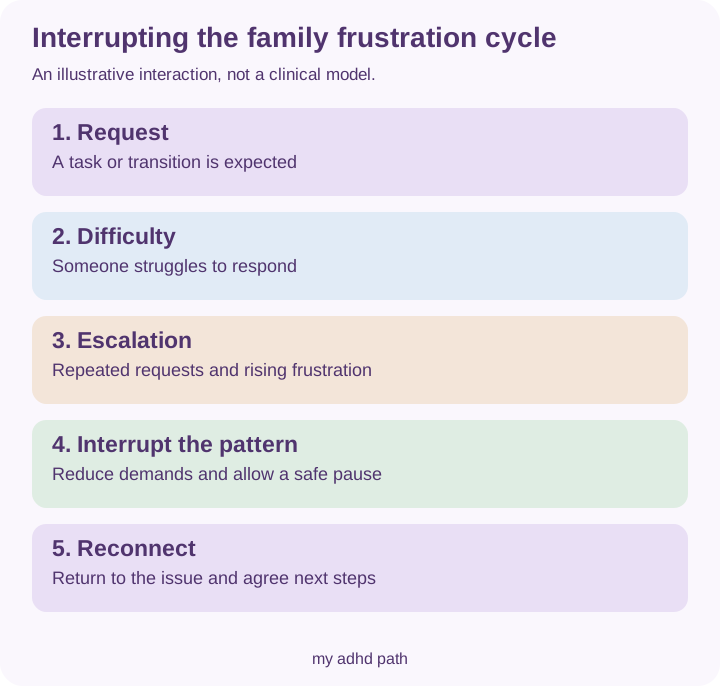
Recognising the family frustration cycle
A typical interaction might develop like this:
Someone makes a request.
The other person struggles to respond or change activity.
The request is repeated more urgently.
Both people become increasingly frustrated.
Communication becomes more difficult.
The original task remains unfinished.
Understanding this pattern does not mean a child's responsibilities disappear.
It means there may be a more effective moment or way to address them.
Reduce competing demands
If several things need doing simultaneously, identify the immediate priority.
If your child needs to leave for school, a discussion about yesterday's untidy bedroom can probably wait.
Use fewer words
When emotions are heightened, lengthy explanations may be particularly difficult to process.
A short, clear instruction can be more useful.
Create a safe pause
If appropriate, allow time for emotions to settle.
Ensure younger children remain safely supervised and that a pause does not become a withdrawal of care or affection.
Return to the original issue
Once everyone is able to engage, discuss what happened and what needs to happen next.
Boundaries and responsibilities can still be maintained.
What co-regulation means in everyday family life
Children gradually develop the skills involved in managing their emotions.
Adults can support this development through responsive relationships, predictable environments and appropriate guidance.
This is often described as co-regulation.
It doesn't require parents to remain perfectly calm at every moment.
It might involve lowering your voice, acknowledging frustration, reducing distractions or helping your child identify a manageable next action.
When you have ADHD, you may need to develop forms of support that help you regulate your own emotions as well.
Perhaps you benefit from a quieter environment.
Perhaps you need a brief break before discussing a difficult issue.
Perhaps another adult can take over temporarily when you're particularly overwhelmed.
Your needs matter within the process too.
Repairing difficult moments
There will be occasions when you respond in a way you would prefer to have handled differently.
What happens afterwards matters.
What you could say
"I was frustrated this morning and I spoke much more sharply than I wanted to. I'm sorry. We still needed to leave for school, but I could have handled that differently. Shall we work out what would make tomorrow morning easier?"
An apology does not remove expectations or boundaries.
It demonstrates responsibility and provides an opportunity to approach the situation differently.
Avoid making your child responsible for managing your feelings or reassuring you after a difficult interaction.
Good to know
ADHD can help explain some difficulties, but it does not justify threatening, humiliating or physically harming a child. If you are concerned about your reactions or your family's safety, seek professional support promptly.
Consistency without perfection
Parents are frequently told that children need consistency.
But consistency doesn't have to mean identical routines operating flawlessly every day.
It can mean knowing that certain expectations remain broadly predictable.
It can mean understanding how responsibilities are shared.
It can mean knowing that when an arrangement stops working, the family will find a way to return to it.
You might have a reliable school-night bedtime routine whilst allowing greater flexibility during weekends.
You might review homework deadlines on Sundays but move the session to Monday when necessary.
You might maintain the same expectations whilst changing the level of support provided.
Predictability and flexibility can coexist.
Supporting your child without taking over
You may recognise your child's difficulties so clearly that you automatically step in.
You remember their equipment.
You check their homework deadlines.
You search for everything they've lost.
You anticipate the challenges they haven't yet encountered.
Some of that support may be necessary and developmentally appropriate.
But providing every reminder indefinitely can also become exhausting for you and limit opportunities for your child to develop their own strategies.
Try this
Consider teaching your child how to use the same external supports that help you. If you rely on a calendar, show them how to use one. If you keep your keys beside the door, help them establish a similar place for their belongings. If you break large tasks into stages, demonstrate how they can approach a school assignment.
You don't need to have mastered these skills yourself before you can explore them together.
When siblings have different needs
Not every child in an ADHD household will have ADHD.
Even when several family members share a diagnosis, their support requirements may differ.
One child might need substantial help preparing for school.
Another may be comfortable organising their own belongings but need a quieter environment.
Siblings may occasionally wonder why expectations or arrangements differ.
Explain, in an age-appropriate way, that people sometimes need different types of support to manage similar responsibilities.
Make time for each child's interests and experiences.
Avoid expecting a sibling to become responsible for managing another child's ADHD or compensating for an adult's difficulties.
Fairness doesn't necessarily mean everyone receives identical support.
Sharing the mental load with a partner or co-parent
Household responsibilities involve more than completing individual tasks.
They also involve recognising that something needs doing, planning it, remembering it and checking that it has happened.
For example, organising a child's school trip might involve reading the email, checking the date, providing consent, arranging payment, preparing equipment and remembering the departure time.
If one person carries all the planning and remembering, dividing the final practical tasks may not divide the responsibility equally.
Consider discussing complete areas of ownership.
| Responsibility | What ownership might include |
|---|---|
| School administration | Reading communications, recording dates and arranging responses |
| Sports activities | Checking schedules, organising equipment and travel |
| Meals | Planning, shopping and coordinating preparation |
| Appointments | Booking, reminders, travel and follow-up |
| Household supplies | Monitoring essentials and arranging replacements |
These arrangements may need to reflect each adult's capacity, working commitments and support needs.
When both adults have ADHD, shared systems and clearly assigned responsibilities may be particularly useful.
Single parents may benefit from identifying which tasks can be simplified, automated or shared with their wider support network.
The parenting guilt that can accompany ADHD
Perhaps you've forgotten something important.
Perhaps you intended to be more organised this term.
Perhaps you compare yourself with parents who appear to remember every school event, maintain immaculate homes and arrive everywhere ten minutes early.
You're comparing the visible parts of someone else's life with the full complexity of your own.
Rather than asking why you aren't managing family life in the same way as someone else, consider which aspects of your household require a different approach.
There may also be genuine mistakes that need addressing.
A forgotten commitment might require an apology. A missed school deadline might need a conversation with the teacher.
Taking responsibility for a mistake and judging your entire ability as a parent are different things.
The strengths you may bring to parenting
ADHD doesn't guarantee particular personality traits or special abilities.
Nevertheless, your personal experiences may help you develop valuable approaches to parenting.
You might recognise when your child understands a task but finds it difficult to begin.
You might be more willing to experiment with unconventional learning methods.
You may understand how much effort it takes to participate in activities that other people consider straightforward.
You might share enthusiastic interests, creative projects or adventurous experiences with your child.
And you can demonstrate what it looks like to use tools, ask for help and continue learning as an adult.
Your child can benefit from seeing that adults develop strategies too.
Looking after your own ADHD
Supporting your child's ADHD should not mean indefinitely postponing your own care.
If you suspect you have ADHD but haven't been assessed, speak to an appropriate healthcare professional about your experiences and available assessment pathways.
If you have a diagnosis, consider whether your current support is meeting your needs.
This might involve reviewing treatment with your clinician, exploring psychological support, adapting your working environment or reconsidering the systems you use at home.
Medication decisions should always be made with the relevant prescribing clinician.
Common misconception
Never share medication between family members, even when you have the same diagnosis. Store medicines securely and follow the instructions provided by your pharmacist or clinician.
Your own wellbeing is important in its own right, not simply because you're a parent.
Can ADHD parent training help if the parent also has ADHD?
Parent training and behavioural parenting programmes can help families develop practical strategies for supporting children's behaviour and everyday functioning.
These programmes may explore positive reinforcement, predictable expectations, communication and environmental changes.
Having ADHD yourself may influence how easy it is to remember and implement particular strategies consistently.
If you're exploring parent training, ask whether the programme can accommodate your own needs.
Practical checklist
- Written summaries of important strategies.
- Recorded or repeatable learning materials where available.
- Appointment reminders.
- Opportunities to practise one approach at a time.
- Individualised support.
- Clear follow-up arrangements.
What the research says
NICE guidance emphasises that offering ADHD-focused support or parent training does not imply poor parenting. It recognises the additional demands that can arise when supporting a child with ADHD.
Three ADHD families, three different approaches
The following scenarios are fictional illustrations.
Illustrative scenario
Rachel, 39, and her daughter Evie, 9 - Managing the morning
Rachel and Evie frequently struggle to leave the house on time. Rachel forgets which activities are taking place after school, whilst Evie regularly loses track of what she needs to do before leaving. They introduce a family whiteboard and prepare bags beside the front door each evening. Evie has a short visual morning checklist, and Rachel sets reminders for the evening preparation routine. Neither is expected to remember the entire process independently.
Illustrative scenario
Tom, 44, and his son Ben, 13 - Creating boundaries
Tom finds interruptions particularly frustrating when working from home. Ben regularly approaches him for homework assistance whilst he's concentrating. They agree on an after-school recovery period and a predictable time when Tom will be available to help. Ben records questions he wants to discuss rather than needing immediate answers to each one. They also agree on how to handle urgent concerns.
Illustrative scenario
Aisha, 36, and her two children - Building a sustainable system
Aisha is raising two children, one of whom has ADHD. Managing school communications, meals and appointments alongside work has become increasingly demanding. She simplifies the family's meal planning, creates a weekly calendar review and arranges occasional practical help with a trusted relative. Her children contribute age-appropriate household responsibilities. The aim is to create a sustainable system rather than an exceptionally organised household.
Create your ADHD family support profile
Understanding individual needs can help the whole household develop more appropriate routines.
Complete this exercise separately for each family member, adapting it to children's ages.
| Question | Illustrative answer |
|---|---|
| When do I find everyday tasks easiest? | After breakfast |
| What makes concentrating difficult? | Several people talking at once |
| What helps me remember things? | Visible written reminders |
| What makes transitions easier? | Advance notice |
| How do I recognise overwhelm? | I become unusually impatient |
| What helps me recover? | A quiet walk |
| What support do I appreciate? | Clear instructions without repeated questioning |
| What do I enjoy contributing? | Cooking and practical projects |
Use the answers to identify compatible routines and areas where family members need different arrangements.
You may discover that everyone benefits from the same visual calendar but needs a different way to recover after a demanding day.
A seven-day family reset
You don't need to redesign your entire household in one weekend.
Try introducing one manageable improvement each day.
| Day | Activity |
|---|---|
| Monday | Identify the family's most demanding daily routine |
| Tuesday | Create a home for frequently misplaced belongings |
| Wednesday | Establish one shared source of important dates |
| Thursday | Introduce a short visual checklist |
| Friday | Discuss everyone's preferred ways to recover |
| Saturday | Review how household responsibilities are shared |
| Sunday | Identify what helped and choose one priority for next week |
These activities can be completed in a different order or spread across several weeks.
The experiment is intended to reduce demands, not create seven more obligations.
Using AI to support an ADHD household
AI assistants can be particularly useful when family life requires more information management than you can comfortably maintain.
They can help organise information, reduce the number of decisions involved in planning and turn scattered thoughts into manageable actions.
The objective is to support executive functioning, rather than simply generate another long list of tasks.
AI prompt
Organise the school week
"Help me turn these school commitments, appointments and activities into a realistic weekly family plan. Identify what needs preparing in advance, potential scheduling conflicts and the three most important actions."
AI prompt
Reduce the mental load
"Here are the household responsibilities I'm currently managing. Help me identify which tasks can be simplified, automated, shared or completed less frequently. Don't assume I have unlimited time or energy."
AI prompt
Create a realistic morning routine
"We need to leave home at 8.15 am. Help me work backwards to create a manageable morning routine for a parent and child with ADHD. Include preparation the evening before and allow extra time for transitions."
AI prompt
Make sense of an overwhelming day
"I'm finding it difficult to decide what needs doing first. Help me separate essential tasks, time-sensitive commitments and things that can wait. Ask me one question at a time if you need more information."
AI prompt
Prepare for a family conversation
"Help me prepare a calm, constructive conversation with my teenager about sharing household responsibilities. Include clear expectations, possible support tools and opportunities for them to contribute their own ideas."
Check AI-generated plans for errors and feasibility.
Avoid uploading identifiable children's medical, educational or personal information to unsuitable services.
AI should not replace appropriate healthcare, safeguarding or professional parenting support.
What does the research say?
What the research says
Research has explored how parental ADHD symptoms may influence aspects of family functioning and the implementation of behavioural parenting strategies. A review published in Clinical Child and Family Psychology Review in 2017 examined parental ADHD in relation to parenting and treatment outcomes. It highlighted the importance of considering parents' own ADHD symptoms when developing support for families. Research into behavioural parenting interventions also suggests that these approaches can benefit several aspects of children's behaviour and family functioning. However, research findings describe patterns across studied groups. They do not determine the experiences or parenting abilities of any particular individual.
There is no scientifically established ideal ADHD household routine.
The practical strategies described throughout this article are intended as adaptable starting points, informed by broader principles of ADHD support and reducing executive functioning demands.
When the whole family needs additional support
Consider seeking professional help if family difficulties are becoming persistent or increasingly difficult to manage.
This might include significant relationship conflict, recurring emotional distress, problems maintaining essential care routines, substantial sleep disruption or concerns about a child's educational or emotional wellbeing.
Your GP, ADHD clinician, child's school or local family support services may be able to help identify appropriate options.
In the UK, Family Lives offers parenting information and support. ADHD charities may also provide peer groups and family resources.
Good to know
If you are concerned that you may harm your child or that anyone in the household is unsafe, seek urgent help and arrange safe adult supervision where possible. In an emergency, call 999.
Frequently asked questions
Is ADHD hereditary?
ADHD has a substantial genetic component. Having a close relative with ADHD increases the likelihood of having ADHD, but inheritance is complex and does not guarantee that a child will develop it.
Can my child's ADHD diagnosis help me recognise my own ADHD?
Yes. Some parents recognise longstanding difficulties during their child's assessment. However, recognising similarities does not establish a diagnosis. An appropriate adult assessment is needed.
Can someone with ADHD be an effective parent?
Yes. ADHD can affect particular aspects of parenting, but it does not determine your ability to provide a supportive, caring home. Individual circumstances, resources and support are important.
Why do my child and I have such different ADHD symptoms?
ADHD affects people differently. Age, developmental stage, individual characteristics, other health conditions and environmental demands can influence how difficulties appear.
How can I maintain routines when I struggle with routines myself?
Keep routines simple, use external reminders and make important steps visible. Include a way to restart when the routine is disrupted.
What if my child's behaviour makes me feel overwhelmed?
Identify recurring triggers and explore ways to reduce competing demands. Seek appropriate support for both your child's needs and your own emotional regulation if difficulties persist.
Can I attend ADHD parent training if I also have ADHD?
Yes. Ask providers about adaptations that may make participation and implementing strategies easier for you.
Should I tell my child I have ADHD?
An age-appropriate conversation can help some children understand shared experiences. Decide what to disclose based on your circumstances and avoid making your child responsible for your support needs.
Can we share ADHD medication if we have the same diagnosis?
No. Medication is prescribed according to individual clinical needs. Never share prescription medication, change doses independently or use another person's prescription.
What if my partner doesn't have ADHD?
Clear communication, appropriate support and fair distribution of responsibilities can help. A partner should not automatically become responsible for managing every aspect of family organisation.
Is it normal for ADHD family routines to stop working?
Routines may become less effective when circumstances change. Review the system and adapt it rather than assuming the entire approach needs replacing.
Can AI help me manage family life?
AI can assist with planning, organising information, generating reminders and reducing decision-making demands. Check its outputs carefully and protect sensitive family information.
A family that works in its own way
Your household may have more calendars than most.
You might keep spare school socks somewhere near the front door and have an unusually comprehensive collection of labelled storage baskets.
You might occasionally discover an entire school event that everyone has forgotten about.
But your family may also share an understanding of how difficult some everyday responsibilities can be.
You can experiment together.
You can celebrate the strategies that work.
You can show your child that using support is a perfectly reasonable part of becoming independent.
And you can create a household where people are encouraged to recognise their individual needs whilst contributing in ways that are appropriate for them.
Parenting with ADHD can introduce additional challenges.
It can also provide opportunities for understanding that you might not have had during your own childhood.
You don't need to demonstrate how to manage everything effortlessly.
You can demonstrate how to find ways of managing things that genuinely work.
Sources and further reading
- NICE - Attention deficit hyperactivity disorder: diagnosis and management (NG87). https://www.nice.org.uk/guidance/ng87
- NHS - Attention deficit hyperactivity disorder (ADHD). https://www.nhs.uk/conditions/attention-deficit-hyperactivity-disorder-adhd/
- Faraone, S. V. and Larsson, H. (2019). Genetics of attention deficit hyperactivity disorder. Molecular Psychiatry, 24, 562-575. https://doi.org/10.1038/s41380-018-0070-0
- Chronis-Tuscano, A. et al. (2017). Parenting and parent ADHD: review of the literature and implications for treatment. Clinical Child and Family Psychology Review.
- Daley, D. et al. (2014). Behavioral interventions in attention-deficit/hyperactivity disorder: a meta-analysis of randomized controlled trials across multiple outcome domains. https://doi.org/10.1016/j.jaac.2014.05.013
- Faraone, S. V. et al. (2021). The World Federation of ADHD International Consensus Statement: 208 Evidence-based conclusions about the disorder. https://doi.org/10.1016/j.neubiorev.2021.01.022
- Family Lives. https://www.familylives.org.uk/
- ADHD UK. https://adhduk.co.uk/
This article provides general educational information and is not a substitute for individual medical, psychological, safeguarding or professional parenting advice. The family examples are fictional. Suggested routines and family exercises are adaptable editorial tools rather than clinically validated interventions.