

Your child is still exactly the same wonderful person they were before their diagnosis. You simply know a little more about how to support them.
At a glance
- Your child's diagnosis provides a better understanding of their individual needs.
- Obtain the assessment report and clarify ongoing clinical care.
- Explain ADHD in an age-appropriate and positive way.
- Work with your child's school to identify appropriate support.
- Explore individualised treatment and practical adjustments.
- Involve your child in decisions about their support.
- Introduce manageable changes rather than attempting everything at once.
You have waited for this moment.
Perhaps for months. Perhaps for considerably longer.
You may have spent years noticing things that other people seemed to dismiss. The school mornings that never quite went to plan. The homework battles that left everyone exhausted. The friendships that seemed to shift without warning. The sense that your child was working twice as hard as their peers for half the recognition.
Now there is a diagnosis.
And the question that follows is almost always the same.
What do we do now?
This guide is designed to help you answer that question. It covers what an ADHD diagnosis means, how to explain it to your child, what happens at school, what treatment options are available and how to make practical changes at home.
It is written for parents and carers of children and young people who have recently received a diagnosis. It is not a clinical protocol or a substitute for professional advice. It is a starting point, written in plain language, to help you feel more confident about the steps ahead.
You don't need to work everything out immediately
A diagnosis can bring relief, clarity and a sense of validation.
It can also bring worry, guilt, uncertainty and an overwhelming volume of information.
Some parents describe feeling all of these things simultaneously.
That is entirely normal.
You do not need to reorganise your child's life overnight. You do not need to have read every book, joined every support group or overhauled every routine before Monday morning.
What you need, in the first instance, is a reasonable understanding of what the diagnosis means and a manageable plan for the next few weeks.
Everything else can follow at a pace that works for your family.
Good to know
Many parents describe a period of adjustment after their child's diagnosis. It is common to revisit past experiences through a new lens, to feel emotional about things you may have misunderstood at the time, or to wonder whether you should have sought help sooner. These feelings are understandable. A diagnosis is not a reflection of your parenting.
What does an ADHD diagnosis actually mean?
ADHD stands for Attention Deficit Hyperactivity Disorder.
It is a neurodevelopmental condition, which means it relates to how the brain develops and functions. ADHD is not caused by poor parenting, too much screen time, sugar or a lack of discipline.
Children with ADHD may experience difficulties with attention, impulsivity and hyperactivity, but the specific pattern varies from person to person.
Your child's diagnosis does not define who they are. It describes a particular pattern of strengths and challenges that can be supported.
Three ADHD presentations
ADHD is typically described using one of three presentations, based on the pattern of symptoms that was most prominent during assessment.
| Presentation | Key characteristics | What you might notice |
|---|---|---|
| Predominantly inattentive | Difficulties with sustained attention, organisation and following through on tasks | Loses belongings, appears to daydream, struggles with multi-step instructions, misses details |
| Predominantly hyperactive-impulsive | Difficulties with sitting still, waiting and managing impulses | Fidgets constantly, talks excessively, interrupts others, struggles to wait their turn |
| Combined | Significant features of both inattention and hyperactivity-impulsivity | A mixture of the characteristics described above |
These presentations are not fixed categories. Your child's profile may change over time, and many children display characteristics from more than one presentation depending on the situation.
Good to know
The name 'Attention Deficit Hyperactivity Disorder' is widely considered misleading. Many clinicians and researchers describe ADHD as a difficulty with attention regulation rather than a simple deficit. Children with ADHD can often sustain intense focus on activities they find interesting, whilst struggling with tasks that feel less engaging. This inconsistency is a feature of the condition, not a choice.
Your first ten steps
These steps are not urgent actions that must be completed immediately. They are a suggested sequence to help you move forward with confidence over the coming weeks.
1. Obtain and read the assessment report
Your child's assessment report is the most important document you will receive. It should explain the basis for the diagnosis, the evidence that was considered and any recommendations for support.
What the report should include
- Confirmation of the diagnosis and the ADHD presentation identified
- A summary of the information gathered during assessment
- Details of any questionnaires, observations or cognitive assessments completed
- Whether any co-occurring conditions were identified or suggested for further investigation
- Recommendations for support, treatment and next steps
- Details of who will provide ongoing clinical care
If you have not received a written report, request one. You are entitled to a clear written record of your child's diagnosis.
2. Clarify ongoing clinical care
Find out who will be responsible for your child's ongoing ADHD care. In many areas, this will be a community paediatric team, a Child and Adolescent Mental Health Service (CAMHS) or a specialist ADHD clinic.
If your child was assessed privately or through Right to Choose, clarify whether ongoing prescribing and monitoring will transfer to the NHS, remain with the private provider or involve a shared care arrangement with your GP.
3. Tell the school
Your child's school needs to know about the diagnosis so that appropriate support can be identified. Contact the school's Special Educational Needs Coordinator (SENCO) and request a meeting to discuss your child's needs.
You do not need to share the full assessment report if you would rather not, but providing key recommendations can help the school respond appropriately.
4. Talk to your child
How and when you explain the diagnosis depends on your child's age, maturity and understanding. We cover this in detail in the next section.
5. Learn about ADHD from reliable sources
There is an enormous amount of information about ADHD available online, and not all of it is accurate or helpful.
Focus on reputable sources such as the NHS, NICE guidelines, ADHD UK, the ADHD Foundation and evidence-based organisations. Be cautious of content that presents ADHD as either a superpower or a catastrophe. The reality is more nuanced than either narrative suggests.
6. Connect with other parents
Speaking to other parents who understand what you are experiencing can be enormously helpful. Local support groups, national organisations and online communities can provide practical advice, emotional support and a reassuring sense of shared experience.
7. Consider your child's strengths
A diagnosis naturally focuses attention on difficulties, but your child also has considerable strengths.
Many children with ADHD are creative, enthusiastic, determined, perceptive and capable of extraordinary focus when engaged. Understanding their strengths alongside their challenges provides a more complete and more helpful picture.
8. Begin making practical adjustments
Small, manageable changes at home and at school can make a significant difference. These do not need to be dramatic or expensive. We cover specific suggestions later in this guide.
9. Explore treatment options
Treatment for ADHD in children may include environmental modifications, behavioural strategies, parent training programmes, medication and psychological support. The right combination depends on your child's age, presentation and individual circumstances. We cover these options in detail below.
10. Look after yourself
Supporting a child with ADHD can be demanding. Your own wellbeing matters, and you will be better placed to help your child if you are also taking care of yourself.
Try this
Keep a small notebook or use the notes app on your phone to record questions as they occur to you. When you have an appointment with your child's clinician, school or GP, you will have a ready-made list rather than trying to remember everything under pressure.
How to explain ADHD to your child
Telling your child about their diagnosis is one of the most important conversations you will have.
The way you frame ADHD will influence how your child understands themselves for years to come. This is not about delivering a clinical lecture. It is about helping your child make sense of their experiences in a way that feels honest, supportive and empowering.
There is no single correct way to have this conversation. The right approach depends on your child's age, their level of understanding and what they already know about why they were assessed.
For younger children (approximately 5 to 7)
Keep the language simple. Focus on how their brain works, rather than on a medical label.
What you could say
"You know how sometimes your body wants to move around when other people are sitting still? Or how sometimes it's really hard to listen when someone is talking for a long time? That's because your brain works in a special way. It's called ADHD. It means your brain is really good at some things and finds other things a bit harder. We're going to learn more about it together, and there are people who can help."
For primary school children (approximately 8 to 11)
Children of this age can understand more about what ADHD means and may already have noticed differences between themselves and their peers.
What you could say
"The doctor has told us that you have something called ADHD. It stands for Attention Deficit Hyperactivity Disorder, but that name doesn't tell the whole story. It means your brain is wired a bit differently to some other people's. That's why you might find it hard to concentrate on things that feel boring, but you can focus for ages on things you really enjoy. It's also why sitting still can feel really difficult sometimes. Lots of people have ADHD, including some very successful adults. Now that we know, we can find better ways to help."
For teenagers (approximately 12 and above)
Teenagers often appreciate a more direct and honest conversation. They may already have their own theories about why they were assessed, and some may have researched ADHD independently.
What you could say
"Your assessment has confirmed that you have ADHD. It's a neurodevelopmental condition, which means it's about how your brain is wired, not about intelligence or effort. It can explain some of the things you've found difficult, like organisation, focus and managing your emotions. It doesn't define you, and it doesn't limit what you can achieve. But understanding it can help us find better strategies and support. I'd really like us to work this out together."
Good to know
Your child may not react the way you expect. Some children feel relieved. Others feel upset, anxious or indifferent. Some need time to process the information before they are ready to talk about it. All of these responses are normal. Leave the door open for future conversations rather than trying to cover everything at once.
What not to assume
When you first learn about ADHD, it is natural to look for simple explanations and clear predictions.
But ADHD is not a uniform condition, and the way it presents in one child may be very different from another.
Try not to assume that your child will follow the same path as another child with ADHD, that every difficulty they experience is caused by ADHD, or that ADHD will inevitably hold them back.
Common misconception
ADHD is a superpower. Whilst it is important to recognise the genuine strengths that many people with ADHD possess, describing the condition as a superpower can minimise the real difficulties that children and their families experience. Your child's strengths are their own. ADHD is part of who they are, but it is not the whole story, and presenting it as an unqualified advantage can make it harder for them to ask for help when they need it.
Understanding ability versus access to ability
One of the most confusing aspects of ADHD for parents and teachers is inconsistency.
Your child may be able to concentrate for hours on a video game, a creative project or a topic they find fascinating, but struggle to maintain focus for ten minutes on homework.
This is not laziness, defiance or a lack of effort.
It reflects the difference between what your child knows how to do and whether they can reliably access that ability at any given moment.
Their capacity to focus, organise and regulate their behaviour fluctuates depending on factors including fatigue, task interest, the environment, the complexity of instructions, time of day and their current emotional state.
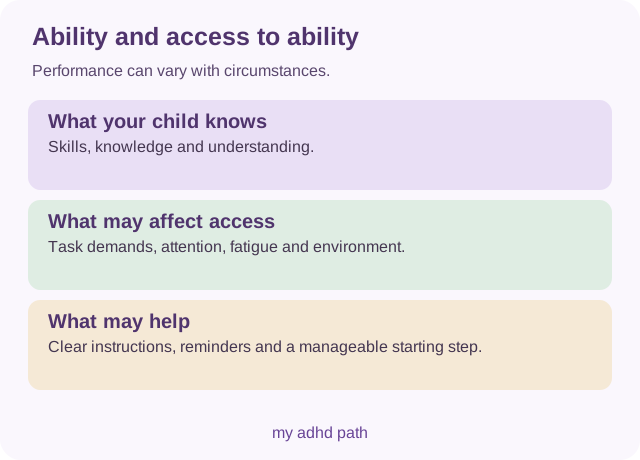
This concept, sometimes described as the difference between ability and access to ability, helps explain why a child with ADHD can appear capable one day and struggling the next.
What you could say
"I know you can do this. I'm not asking whether you know how. I'm asking what would make it easier for you to do it right now."
Reframing the question from "Why won't you do this?" to "What would help you do this today?" can transform conversations with your child and reduce frustration on both sides.
What you could say
"It's not about trying harder. It's about finding what helps."
What treatment options are available?
ADHD treatment for children is not a single intervention. It is typically a combination of strategies tailored to your child's individual needs, age and circumstances.
The National Institute for Health and Care Excellence (NICE) recommends a stepped approach, beginning with environmental modifications and parent training, with medication considered where these alone are insufficient.
Environmental modifications
These are changes to your child's physical environment, routines and daily structure that can help manage ADHD-related difficulties.
Examples include reducing distractions during homework, establishing consistent routines, breaking tasks into smaller steps, using visual timetables and providing regular movement breaks.
Environmental modifications are recommended as a first step for all children with ADHD, regardless of age or severity.
Parent training programmes
Structured parent training programmes, such as those based on the Triple P or Incredible Years models, can help you develop strategies for managing your child's behaviour, improving communication and reducing conflict.
These programmes are not about teaching you how to parent. They are about understanding how ADHD influences behaviour and learning specific techniques that can help.
NICE recommends parent training as a first-line treatment for children under five and as part of a broader treatment plan for older children.
Medication
ADHD medication can be an effective part of treatment for many children. The most commonly prescribed medications in the UK are stimulant medications, including methylphenidate (such as Ritalin, Concerta or Equasym) and lisdexamfetamine (Elvanse).
Non-stimulant options, including atomoxetine (Strattera) and guanfacine (Intuniv), may be considered where stimulant medication is unsuitable or ineffective.
Medication does not cure ADHD. It can help manage specific symptoms, particularly difficulties with attention, impulsivity and hyperactivity, making it easier for your child to engage with learning, relationships and daily life.
The decision to try medication is always yours to make in consultation with your child's clinician. It is not compulsory, and you can change your mind at any point.
Does every child with ADHD need medication?
No.
Some children manage well with environmental modifications, behavioural strategies and school support alone. Others benefit significantly from medication. The right approach depends on your child's individual needs, the severity of their difficulties and how those difficulties affect their daily life.
Good to know
NICE recommends that medication should not be offered as a first-line treatment for children under five. For this age group, parent training and environmental modifications are recommended first. Medication may be considered for children aged five and above when non-pharmacological approaches alone have not been sufficient.
Psychological support
Some children with ADHD benefit from psychological support, including cognitive behavioural therapy (CBT), social skills groups or emotional regulation interventions.
These approaches can help children develop coping strategies, build confidence and manage specific difficulties such as anxiety, low self-esteem or social challenges that may accompany ADHD.
Access to psychological support varies across the UK. Ask your child's clinician or SENCO about what is available locally.
Understanding medication titration
If medication is recommended, your child will typically undergo a process called titration.
Titration involves starting on a low dose and gradually increasing it whilst monitoring for both benefits and side effects. The aim is to find the most effective dose with the fewest side effects.
During titration, you and your child's school will usually be asked to provide feedback on how your child is responding. The clinician will monitor several areas.
- Attention and concentration in different settings
- Impulsivity and hyperactivity levels
- Appetite and eating patterns
- Sleep quality and duration
- Mood and emotional responses
- Any physical side effects such as headaches or stomach aches
- Overall wellbeing and quality of life
Titration can take several weeks. It requires patience and careful observation.
Good to know
Never adjust your child's medication dose independently. If you are concerned about side effects or feel the medication is not working as expected, contact your child's prescribing clinician. Changes should always be made under clinical supervision.
Questions to ask your child's ADHD clinician
It can be difficult to remember everything you want to ask during a clinical appointment. The following questions may be helpful.
| Topic | Questions to consider |
|---|---|
| Diagnosis | Can you explain my child's specific ADHD presentation? Were any co-occurring conditions identified or suspected? |
| Treatment | What treatment options do you recommend for my child? What should we try first? |
| Medication | If medication is recommended, what are the expected benefits and possible side effects? How will titration work? |
| Monitoring | How often will my child be reviewed? What should I do if I have concerns between appointments? |
| School | What information should I share with my child's school? Can you provide a letter for the SENCO? |
| Daily life | What practical changes can we make at home? Are there specific strategies you recommend for our situation? |
| Prognosis | What should we expect as my child grows? Will their needs change over time? |
| Other support | Are there parent training programmes, support groups or other services available locally? |
Try this
Take a printed copy of your questions to the appointment, along with a notebook. Write down the answers during the meeting rather than relying on memory. If your child is old enough, involve them in preparing questions too.
What happens at school?
School is often where ADHD-related difficulties are most visible. The structured environment, sustained attention demands and social expectations of a classroom can be particularly challenging for children with ADHD.
However, the right support can make an enormous difference.
Contacting the SENCO
Every school in England has a Special Educational Needs Coordinator (SENCO). This is the person responsible for coordinating support for children with additional needs, including ADHD.
Contact the SENCO as soon as possible after your child's diagnosis to arrange a meeting.
SENCO meeting agenda
- Share the diagnosis and key recommendations from the assessment report
- Discuss your child's specific strengths and difficulties
- Identify what support is already in place and what might be added
- Agree on reasonable adjustments for the classroom
- Discuss whether a formal SEN support plan is appropriate
- Agree on how information will be shared with class teachers
- Set a date to review progress
SEN support
Most children with ADHD will receive support through the SEN support stage, which does not require a formal statutory plan. This may include classroom adjustments, additional adult support, access to interventions and regular reviews of progress.
The school should create an individual plan (sometimes called an IEP, provision map or support plan) that records your child's needs, the support being provided and the expected outcomes.
What teachers need to know
Not all teachers have received detailed training in ADHD. Sharing clear, practical information about your child's needs can help their teachers provide more effective support.
Focus on what helps your child rather than providing a general overview of ADHD. Specific information, such as "she concentrates better when seated near the front" or "he needs instructions broken into single steps", is more useful than a diagnosis label alone.
Practical school adjustments
The following adjustments have been shown to help many children with ADHD in the classroom. Not all will be appropriate for your child, and the school should work with you to identify the most relevant ones.
| Area | Adjustment | Why it helps |
|---|---|---|
| Seating | Near the front, away from windows and high-traffic areas | Reduces visual and auditory distractions |
| Instructions | Broken into single steps, delivered clearly and checked for understanding | Supports working memory difficulties |
| Transitions | Advance warning before changes of activity | Allows time to prepare and reduces anxiety |
| Movement | Planned movement breaks, fidget tools, standing desk option | Provides a legitimate outlet for physical restlessness |
| Organisation | Colour-coded folders, written homework planners, visual timetables | Provides external structure for executive function difficulties |
| Task length | Longer tasks broken into smaller sections with check-in points | Makes sustained attention more manageable |
| Feedback | Frequent, specific positive feedback | Reinforces desired behaviour and builds confidence |
| Exams | Extra time, rest breaks, separate room if needed | Reduces the impact of attention difficulties on performance |
| Homework | Reduced volume, clear written instructions, flexibility on deadlines | Accounts for the additional effort required after a full school day |
| Communication | Regular home-school communication (diary, email or app) | Keeps parents informed and enables consistent support |
Does my child need an EHCP?
An Education, Health and Care Plan (EHCP) is a legal document that describes a child's special educational needs and the support required to meet them. It is more detailed and more legally binding than SEN support.
Not every child with ADHD will need an EHCP. Many children's needs can be met through SEN support alone.
However, if your child's needs are significant and the school is unable to meet them through its own resources, you may wish to request an Education, Health and Care needs assessment from your local authority.
The process can be lengthy and sometimes requires persistence. You have the right to request an assessment, and you have the right to appeal if a request is refused.
Good to know
SENDIASS (Special Educational Needs and Disabilities Information, Advice and Support Service) provides free, impartial advice to parents about SEN and disability matters, including EHCPs. Every local authority in England has a SENDIASS service. In Wales, the equivalent process uses Individual Development Plans (IDPs). In Scotland, support is provided through Additional Support for Learning plans. In Northern Ireland, the system uses Statements of Special Educational Need.
Eight practical changes at home
You do not need to transform your household. Small, consistent adjustments can make a meaningful difference to your child's daily experience.
1. Establish consistent routines
Children with ADHD often thrive with predictable routines. Morning routines, after-school routines and bedtime routines provide structure that reduces the number of decisions your child needs to make independently.
Try this
Create a visual routine chart for mornings and evenings. Use pictures for younger children and a simple written list for older children. Place it where your child can see it without needing to ask what comes next.
2. Break tasks into smaller steps
Instead of saying "tidy your room", try breaking the task into specific, manageable steps: "Put your dirty clothes in the basket. Then put the books on the shelf. Then I'll come and check."
Giving one instruction at a time and waiting for it to be completed before adding the next reduces the demand on working memory.
3. Use timers and visual cues
Children with ADHD often have difficulty perceiving the passage of time. A visual timer (such as a Time Timer or a sand timer) can help them understand how long they have left for a task or how long they need to wait.
Try this
Use a visual countdown timer during homework. Set it for 15 to 20 minutes and agree that your child can take a movement break when the time is up. Gradually extend the period as they build stamina.
4. Create a homework station
A dedicated, low-distraction space for homework can help your child focus. Remove unnecessary items from the desk, ensure good lighting and keep the materials they need within reach.
Some children concentrate better with background white noise or instrumental music. Others need complete silence. Experiment to find what works for your child.
5. Build in movement
Many children with ADHD need regular physical activity to help regulate their energy and attention.
Build movement into the daily routine. A walk, a bike ride, a trampoline session or time in the garden before homework can help your child settle and focus.
6. Use positive reinforcement
Children with ADHD often receive more negative feedback than their peers. Making a deliberate effort to notice and acknowledge what your child does well can help build their confidence and motivation.
Be specific. "You sat really well during dinner tonight" is more helpful than "good job".
Try this
Try to maintain a ratio of at least three positive comments for every corrective one. This is not about ignoring difficulties. It is about ensuring your child's experience of feedback is not overwhelmingly negative.
7. Reduce decision fatigue
Too many choices can be overwhelming for children with ADHD. Simplify decisions where possible. Lay out two outfit options rather than opening a full wardrobe. Offer a choice between two snacks rather than asking what they want.
8. Plan ahead for transitions
Transitions between activities can be particularly difficult. Give advance warning before changes: "In five minutes, we're going to turn the television off and start getting ready for bed."
Using a countdown or a consistent transition phrase can help your child prepare mentally for the change.
A different approach to difficult behaviour
When your child is struggling, it can be tempting to respond with consequences, warnings or frustration.
But many behaviours that look like defiance, laziness or deliberate provocation are actually the result of executive function difficulties, emotional dysregulation or sensory overload.
Before responding to difficult behaviour, try asking yourself four questions.
Before you respond
- Is my child unable to do what I'm asking, rather than unwilling?
- Is there something about the environment that is making this harder?
- Is my child already dysregulated, and does the situation need to calm down before we can problem-solve?
- What would help them succeed next time?
This does not mean that there are no boundaries or expectations. It means that understanding why a behaviour is happening puts you in a much better position to address it effectively.
Supporting emotional regulation
Many children with ADHD experience emotions more intensely than their peers. They may become overwhelmed more quickly, take longer to calm down and struggle to identify or articulate what they are feeling.
You can support your child's emotional regulation by helping them develop a vocabulary for their feelings, validating their experiences, modelling calm responses and working together on strategies for managing big emotions.
What you could say
"I can see you're feeling really frustrated right now. That makes sense. Let's take a few minutes to calm down, and then we can work out what to do about it together."
Avoid trying to reason with your child during a moment of intense emotion. Wait until they have calmed down before discussing what happened and what might help next time.
What if your child holds everything together at school but falls apart at home?
This is an extremely common experience for families of children with ADHD.
Your child may appear to cope well at school, following rules, completing tasks and managing their behaviour. But the moment they walk through the door at home, the wheels come off.
This phenomenon, sometimes described as after-school restraint collapse, happens because your child has been using enormous amounts of mental energy to hold things together during the school day. Home is where they feel safe enough to release that pressure.
It can be exhausting and dispiriting for parents, particularly if the school reports that your child is "fine in class".
Your child is not behaving differently at home to be difficult. They are decompressing after a day of sustained effort. Building in quiet, low-demand time after school before expecting homework, chores or structured activities can help.
ADHD, sleep and everyday wellbeing
Sleep difficulties are common in children with ADHD. These may include difficulty falling asleep, restless sleep, difficulty waking up and inconsistent sleep patterns.
Poor sleep can worsen ADHD symptoms, creating a cycle that is difficult to break.
Practical steps that may help include the following.
- Establish a consistent bedtime routine
- Reduce screen time for at least one hour before bed
- Keep the bedroom cool, dark and quiet
- Avoid caffeine, particularly in the afternoon and evening
- Ensure regular physical activity during the day
- Consider whether medication timing may be affecting sleep
- Speak to your child's clinician if sleep difficulties are persistent or severe
Good to know
If your child is taking stimulant medication and experiencing difficulty falling asleep, discuss the timing and formulation of their medication with the prescribing clinician. Adjustments to the dose or the time it is taken may help.
Does diet affect ADHD?
The relationship between diet and ADHD has been widely studied, and the evidence is mixed.
There is no specific ADHD diet that has been shown to reliably improve symptoms for all children. However, a balanced diet that provides regular meals, adequate protein, omega-3 fatty acids and limited processed sugar is likely to support your child's overall wellbeing and cognitive function.
Some parents report that specific foods or additives appear to affect their child's behaviour, and there may be individual sensitivities worth exploring. But wholesale dietary overhauls are not supported by the current evidence as a primary ADHD treatment.
Common misconception
There is a universal ADHD diet that will significantly reduce symptoms. In reality, no single dietary approach has been shown to reliably improve ADHD symptoms across all children. A balanced, nutritious diet supports overall health and may contribute to better attention and mood regulation, but it is not a substitute for evidence-based treatment.
Helping your child explain ADHD to others
Your child may encounter situations where they want or need to explain their ADHD to friends, relatives or other adults.
Help them develop a simple, confident explanation that they feel comfortable with.
What you could say
"If someone asks you about ADHD, you can say something like: 'My brain works a bit differently to some other people's. It means I'm really good at some things and find other things harder. It's just how I am.'"
Encourage your child to decide how much they want to share and with whom. The diagnosis belongs to them, and they should feel in control of who knows about it.
What you could say
"You don't have to tell anyone about your ADHD unless you want to. It's your information, and you get to choose who knows."
Supporting siblings
If your child has brothers or sisters, their ADHD diagnosis may affect the whole family.
Siblings may feel confused about why their brother or sister behaves differently, frustrated by the amount of parental attention that ADHD-related difficulties require, or worried about the diagnosis and what it means.
Open, age-appropriate conversations can help. Acknowledge that things are not always fair, and make time for each child individually.
What you could say
"Your brother's ADHD means his brain works differently, which is why some things are harder for him. That doesn't mean he gets different rules because he's special and you're not. It means we try to help each of you in the way that works best for you."
Could you receive financial or practical support?
Depending on the severity of your child's difficulties and the impact on daily life, you may be eligible for financial support.
Disability Living Allowance (DLA)
DLA is a benefit for children under 16 who need extra help with personal care or have difficulty walking. ADHD can qualify, particularly where the condition significantly affects your child's daily functioning, supervision needs or safety.
The application form is detailed and can feel daunting. Focus on describing your child's worst days and the level of support they need compared to a child of the same age without ADHD.
Contact the Disability Living Allowance helpline on 0800 121 4600 for guidance, or ask a local advice service (such as Citizens Advice) for help completing the form.
Carer support
If you are spending a significant amount of time supporting your child because of their ADHD, you may be eligible for Carer's Allowance or other carer-related benefits. This depends on the number of hours of care you provide and your income.
Contact your local Citizens Advice or the Carers UK helpline on 0808 808 7777 for information about what you may be entitled to.
What if your child's diagnosis makes you wonder about yourself?
It is very common for parents to recognise ADHD traits in themselves after their child is diagnosed.
You may find yourself thinking "that sounds like me" as you read about attention difficulties, impulsivity, disorganisation or emotional regulation challenges.
If you suspect that you may have ADHD, speak to your GP about an assessment. Understanding your own needs can help you support your child more effectively, and it can explain patterns in your own life that may have been confusing or frustrating for years.
You are not being dramatic or attention-seeking. ADHD has a strong genetic component, and it is entirely plausible that a parent who recognises their child's difficulties does so because they share them.
Three families, three experiences
Illustrative scenario
Oliver, 7 - Understanding at home
Oliver was diagnosed with ADHD (combined presentation) after his Year 2 teacher raised concerns about his concentration, impulsivity and difficulty following classroom instructions. His parents, Emma and James, initially felt overwhelmed by the amount of information they received. They focused on three immediate changes: creating a visual morning routine chart, reducing the number of after-school activities to allow more downtime, and meeting with the SENCO to discuss classroom adjustments. Within a few weeks, mornings became less stressful. Oliver responded well to knowing what came next, and Emma noticed that giving him one instruction at a time rather than a list of three made a significant difference. They decided to try a parent training programme recommended by the paediatric team, which gave them practical strategies for managing Oliver's impulsivity without relying on repeated warnings. Medication was discussed but deferred until the non-pharmacological approaches had been given time to take effect.
Illustrative scenario
Maya, 10 - Building school support
Maya was diagnosed with ADHD (predominantly inattentive presentation) after years of academic underperformance that her parents felt was inconsistent with her obvious intelligence. She was quiet in class, never disruptive, but consistently struggled to complete tasks, lost belongings regularly and appeared to daydream during lessons. Her parents worked closely with the SENCO to develop a support plan that included preferential seating, written rather than verbal instructions, additional time for tests and a home-school communication diary. Maya's class teacher began checking in with her individually at the start of each task, and the school provided access to a learning mentor for weekly sessions. Maya also started working with a child psychologist to develop strategies for organisation and self-monitoring. After six months, her parents noticed a gradual improvement in her confidence and her willingness to attempt tasks she would previously have avoided. She described the sessions as "someone finally understanding how my brain works".
Illustrative scenario
Ethan, 14 - Navigating adolescence
Ethan was diagnosed with ADHD (combined presentation) at fourteen, after difficulties with homework, friendships and emotional outbursts escalated during the transition to secondary school. He initially resisted the diagnosis, saying he didn't want to be "labelled" or treated differently. His parents gave him time and space, sharing information gradually rather than trying to explain everything at once. After several weeks, Ethan began asking questions and eventually agreed to try medication on a trial basis. The titration process took six weeks, with adjustments to the dose and timing before an effective balance was found. The school provided extra time for exams and assigned a key worker who Ethan could check in with when he felt overwhelmed. His parents found that the most effective approach was involving Ethan in decisions about his own support, treating him as a partner in the process rather than someone things were being done to. Ethan later said that understanding ADHD helped him stop blaming himself for things he had always found difficult.
Your child's first 90 days after diagnosis
The following roadmap provides a flexible framework for the weeks after your child's diagnosis. It is not a clinical protocol. Adjust the timing to suit your family's circumstances.
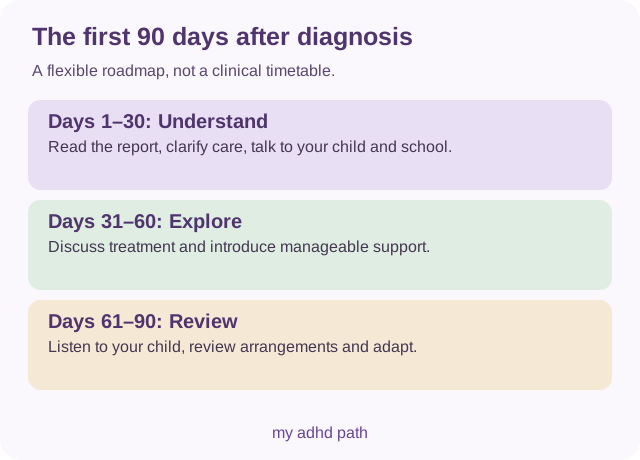
Days 1 to 30: Understand
- Read and understand the assessment report
- Clarify who is providing ongoing clinical care
- Talk to your child about the diagnosis
- Contact the school SENCO and arrange a meeting
- Begin learning about ADHD from reliable sources
Days 31 to 60: Explore
- Discuss treatment options with your child's clinician
- Work with the school to implement classroom adjustments
- Begin introducing practical changes at home
- Explore parent support groups and training programmes
- Connect with other families
Days 61 to 90: Review and adapt
- Reflect on what has helped and what has not
- Listen to your child's feedback about the changes
- Review school support with the SENCO
- Adjust strategies based on what you have observed
- Plan the next review with your child's clinician
Create a one-page profile for your child
A one-page profile is a simple document that summarises your child's strengths, needs and what helps. It can be shared with teachers, tutors, childminders, relatives and anyone else involved in your child's care.
| Section | What to include |
|---|---|
| What people like and admire about me | Your child's strengths, interests and positive qualities |
| What is important to me | What matters to your child, what motivates them, what makes them feel safe |
| How best to support me | Specific strategies, adjustments and approaches that help |
| What doesn't work for me | Approaches, environments or situations that make things harder |
| My goals | What your child is currently working towards |
Involve your child in creating this document. It should reflect their voice and their priorities, not just yours.
AI prompts for parents of children with ADHD
These prompts can be used with AI tools such as ChatGPT to generate personalised information and practical support.
AI prompt
Understanding your child's ADHD presentation
"My child has recently been diagnosed with ADHD [insert presentation: predominantly inattentive, predominantly hyperactive-impulsive, or combined]. They are [age] years old and in [year group]. Can you explain what this presentation means in practical terms, including what I might notice at home and at school, and suggest three initial adjustments we could try?"
AI prompt
Preparing for a SENCO meeting
"I have a meeting with my child's SENCO to discuss their ADHD diagnosis. My child is [age] and their main difficulties are [list 2-3 specific difficulties]. Can you help me prepare by suggesting key points to raise, reasonable adjustments to request, and questions to ask about the school's SEN support process?"
AI prompt
Explaining ADHD to your child
"I need to explain ADHD to my [age]-year-old child. They have been diagnosed with [presentation]. They are [describe personality: e.g. sensitive, curious, anxious about being different]. Can you suggest a script I could use that is age-appropriate, positive and honest? Include what to say if they ask 'Will it go away?' or 'Is something wrong with me?'"
AI prompt
Building a home routine
"My child is [age] and has ADHD. Our mornings and evenings are chaotic. Our biggest challenges are [list 2-3 specific challenges, e.g. getting dressed on time, homework battles, bedtime resistance]. Can you suggest a structured daily routine with visual schedule ideas, transition strategies and practical tips for reducing conflict?"
What the research says
What the research says
A 2023 meta-analysis published in The Lancet Psychiatry examined the effectiveness of ADHD interventions in children and adolescents. The review, which included data from over 10,000 participants across multiple randomised controlled trials, found that combined treatment approaches (medication alongside behavioural and educational interventions) were more effective than any single approach alone. The authors concluded that individualised, multimodal treatment plans offer the best outcomes for children with ADHD, and that parent and teacher involvement is a critical component of effective support.
When to seek additional professional support
Most families find a manageable path forward after diagnosis. However, there are situations where additional professional support is important.
- Your child's difficulties are significantly affecting their mental health, including persistent low mood, anxiety or self-harm
- Your child is refusing to attend school
- Family relationships are under severe strain
- You are concerned about your child's safety or the safety of others
- Your child's medication is not working as expected or is causing significant side effects
- You suspect a co-occurring condition such as autism, anxiety, depression or a learning difficulty
- Your child is experiencing bullying related to their ADHD
Good to know
If your child is in immediate danger or you are concerned about their safety, call 999. If your child needs to talk to someone confidentially, Childline is available on 0800 1111, 24 hours a day, 7 days a week. These services are free and confidential.
A note about safeguarding
Children with ADHD may be at increased risk of certain safeguarding concerns, including exploitation, bullying and online vulnerability. Their impulsivity and desire for social acceptance can make them more susceptible to risky situations.
Maintain open conversations about friendships, online activity and situations where they feel uncomfortable. Help them develop the confidence to say no, to leave situations that don't feel right and to tell a trusted adult when something happens that concerns them.
Downloadable resource
My Child's ADHD Diagnosis - Parent Starter Pack
A comprehensive guide covering your first steps after diagnosis, how to explain ADHD to your child, questions for clinicians and schools, practical home adjustments, a one-page child profile template, and a 90-day roadmap. Designed to be printed and kept as a reference.
Download PDFYou are already doing this
If you have read this far, you are already doing something important for your child.
You are learning. You are asking questions. You are looking for ways to help.
Your child does not need a perfect parent. They need a parent who understands them, advocates for them and supports them to develop the skills and confidence they need to thrive.
Some days will be difficult. Some adjustments will not work as planned. Some conversations will need to happen more than once.
But you know your child better than anyone. That knowledge, combined with the right information and support, is an extraordinary foundation.
Your child's diagnosis is not the end of anything. It is the beginning of understanding.
Frequently asked questions
Will my child grow out of ADHD?
ADHD is a lifelong neurodevelopmental condition. Some symptoms, particularly hyperactivity, may become less prominent with age, but the underlying differences in attention regulation, impulsivity and executive function typically persist into adulthood. With appropriate support, most children with ADHD develop effective coping strategies and lead fulfilling lives.
Should I tell the school about my child's diagnosis?
Yes. Sharing the diagnosis with the school allows the SENCO and class teachers to put appropriate support in place. You do not need to share the full assessment report if you would rather not, but providing the diagnosis and key recommendations helps the school respond to your child's needs.
Is ADHD medication safe for children?
ADHD medications prescribed in the UK have been extensively studied and are considered safe when prescribed and monitored by a qualified clinician. Like all medications, they can have side effects, which is why the titration process involves careful monitoring. Discuss any concerns with your child's prescribing clinician.
Can my child still play sports and do activities?
Absolutely. Physical activity is beneficial for children with ADHD and can help with attention, mood and overall wellbeing. Many children with ADHD thrive in sports, creative activities and other extracurricular pursuits. Find activities that match your child's interests and energy levels.
Will ADHD affect my child's academic achievement?
ADHD does not determine academic potential. With the right support, many children with ADHD achieve excellent academic results. The key is ensuring that the learning environment is adapted to their needs and that any additional difficulties, such as specific learning differences, are identified and addressed.
What if my child refuses to take medication?
It is important to involve your child in discussions about their treatment. If they are reluctant, try to understand their concerns. Some children worry about side effects, being different from their peers, or the idea of needing medication. Address their specific worries honestly. Some children are more willing to try medication on a trial basis with the understanding that they can stop if they want to.
How do I manage homework battles?
Homework is one of the most common sources of conflict for families of children with ADHD. Try keeping sessions short with regular breaks, using a timer, reducing distractions, and speaking to the school about adjusting homework expectations. Some schools will reduce the volume or allow flexibility on deadlines when they understand the impact of ADHD.
Can diet changes help my child's ADHD?
There is no evidence that a specific diet reliably improves ADHD symptoms across all children. A balanced diet supports overall health and may help with concentration and mood regulation. Some parents notice that certain foods or additives appear to affect their child's behaviour. If you suspect a specific sensitivity, discuss it with your child's clinician or a registered dietitian.
How do I explain ADHD to grandparents or other family members?
Older generations may have different understandings of ADHD or may not recognise it as a legitimate condition. Share straightforward information from reliable sources. Explain what ADHD means for your child specifically, rather than discussing the condition in general terms. Focus on what helps and how family members can support your child.
Is ADHD hereditary?
ADHD has a strong genetic component. Research suggests that if a parent has ADHD, there is approximately a 50% chance that their child will also have the condition. Many parents recognise ADHD traits in themselves after their child is diagnosed. If you suspect you may have ADHD, speak to your GP about an assessment.
What if the school is not providing adequate support?
Start by raising your concerns with the SENCO and asking for a review meeting. If the school's response remains inadequate, contact SENDIASS for free, impartial advice about your rights and options. In some cases, it may be appropriate to request an Education, Health and Care needs assessment or to escalate your concerns through the school's formal complaints procedure.
Can my child with ADHD still have a happy, successful life?
Yes. ADHD is a part of your child's neurological profile, not a limitation on their potential. With understanding, appropriate support and the right environment, children with ADHD grow up to lead fulfilling, successful and happy lives. Many adults with ADHD describe their diagnosis as the beginning of understanding themselves better, not as a barrier to achievement.
Sources and further reading
- National Institute for Health and Care Excellence (NICE). Attention deficit hyperactivity disorder: diagnosis and management. NICE guideline NG87. https://www.nice.org.uk/guidance/ng87
- NHS. Attention deficit hyperactivity disorder (ADHD). https://www.nhs.uk/conditions/attention-deficit-hyperactivity-disorder-adhd/
- Faraone, S.V. et al. (2021). The World Federation of ADHD International Consensus Statement. Neuroscience and Biobehavioural Reviews, 128, 789-818. https://doi.org/10.1016/j.neubiorev.2021.01.022
- Cortese, S. et al. (2018). Comparative efficacy and tolerability of medications for attention-deficit hyperactivity disorder in children, adolescents, and adults. The Lancet Psychiatry, 5(9), 727-738. https://doi.org/10.1016/S2215-0366(18)30269-4
- Barkley, R.A. (2015). Attention-Deficit Hyperactivity Disorder: A Handbook for Diagnosis and Treatment (4th ed.). Guilford Press.
- ADHD Foundation. Supporting children with ADHD. https://www.adhdfoundation.org.uk/
- ADHD UK. Information and support. https://www.adhduk.co.uk/
- IPSEA. EHC needs assessments and plans. https://www.ipsea.org.uk/
- Contact (for families with disabled children). https://contact.org.uk/
- Young Minds. ADHD information for parents. https://www.youngminds.org.uk/
- Childline. https://www.childline.org.uk/ (0800 1111)
- Carers UK. https://www.carersuk.org/ (0808 808 7777)
This article provides general educational information and is not a substitute for professional medical advice, diagnosis or treatment. The scenarios, roadmaps and profiles are illustrative editorial resources, not clinically validated assessment tools. Consult your child's healthcare provider for advice specific to their individual needs. If you are concerned about your child's safety or mental health, contact your GP, call 999 in an emergency, or call Childline on 0800 1111.