

Sometimes, the information you need hasn't disappeared from your memory. You're simply finding it difficult to keep hold of it at the precise moment you need it.
At a glance
- Working memory helps us temporarily hold and use information.
- It is different from long-term memory.
- Working memory difficulties are associated with ADHD, although not everyone with ADHD experiences them.
- Attention, distractions, stress, fatigue and the demands of a task can influence working memory performance.
- Intelligence and working memory are not interchangeable.
- External tools can reduce the amount of information you need to hold in your mind.
- Effective learning strategies can help support the formation of longer-lasting memories.
You've just read an entire page.
Every single word.
You know this because your eyes have travelled diligently from the top of the page to the bottom.
And yet, if somebody asked you what it was about, you wouldn't have the faintest idea.
So you read it again.
This time, you make a conscious effort to concentrate.
Halfway through, you remember that you need to reply to an email.
You wonder what time the supermarket closes.
You briefly consider what you're having for dinner.
And then you reach the bottom of the page.
Again.
For many people with ADHD, this is a remarkably familiar experience.
It can happen when reading a textbook, following instructions, participating in a conversation or attempting to complete a calculation in your head.
Meanwhile, you might be able to recall extraordinary amounts of information about a subject that fascinated you twenty years ago.
How can somebody have such an impressive memory for certain things and struggle to remember what somebody told them thirty seconds earlier?
Part of the explanation may lie in something called working memory.
What is working memory?
Working memory is a cognitive system that allows us to temporarily hold and work with information while completing an activity.
Think of it as your brain's temporary workspace.
Imagine you're assembling a piece of furniture.
You look at the instructions, identify the next few steps, select the correct pieces and begin putting them together.
You need to retain relevant information while simultaneously doing something with it.
That's working memory in action.
It helps you:
- Follow instructions.
- Carry out mental calculations.
- Understand sentences.
- Participate in conversations.
- Compare different pieces of information.
- Solve problems.
- Organise your thoughts.
- Keep track of what you're doing.
Working memory is involved in an extraordinary number of everyday activities.
Much of the time, we use it without consciously recognising that we're doing so.
The mental whiteboard analogy
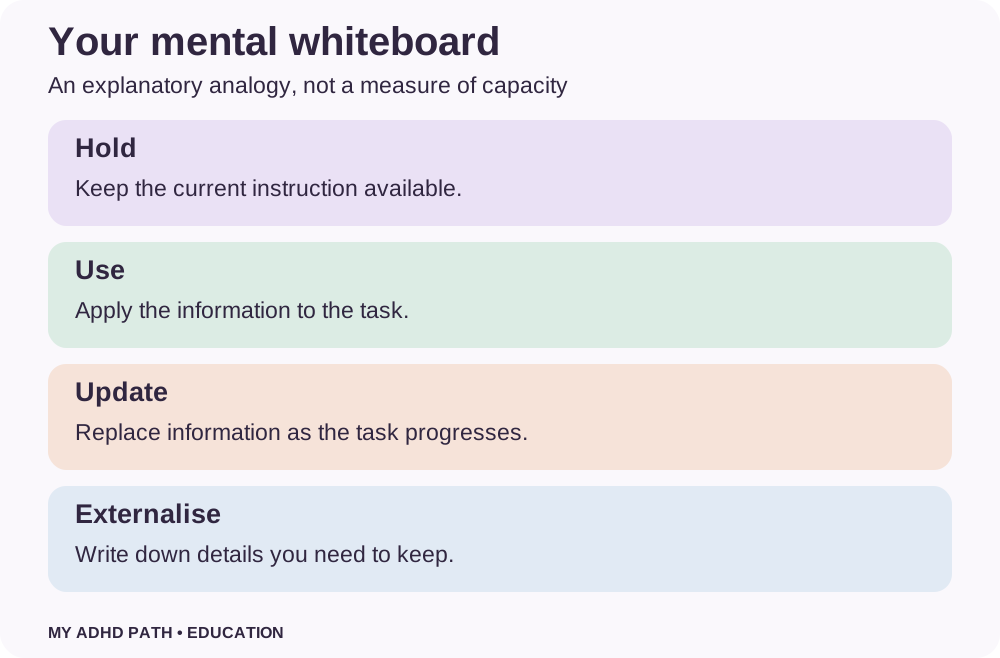
Imagine that your brain has a small whiteboard.
Whenever you begin an activity, the information you need is written on that board.
If you're making dinner, it might contain the next ingredients you need.
If you're solving a maths problem, it might contain the numbers you're currently working with.
If you're having a conversation, it might contain what the other person has just said and the point you intend to make.
The information is available while you need it.
As you move through the activity, some information is removed and replaced with something else.
Now imagine that several new pieces of information arrive unexpectedly.
A notification appears.
Somebody asks you a question.
You remember an unfinished task.
You notice something that requires your attention.
Suddenly, the information you were using becomes harder to keep track of.
The mental whiteboard analogy is a simplified way of understanding working memory.
There isn't a literal whiteboard in your brain, and working memory involves several interacting cognitive processes.
But the analogy can help explain why an interruption can sometimes make it remarkably difficult to remember what you were doing.
Working memory versus short-term and long-term memory
These terms are often used interchangeably, but they describe related, distinct aspects of memory.
| Type of memory | What it helps you do | Everyday example |
|---|---|---|
| Short-term memory | Temporarily retain information | Remember a number long enough to type it |
| Working memory | Hold and actively use information | Remember several numbers while calculating their total |
| Long-term memory | Retain information over extended periods | Recall knowledge, experiences or familiar skills |
| Prospective memory | Remember to carry out a future intention | Remember to send an email tomorrow |
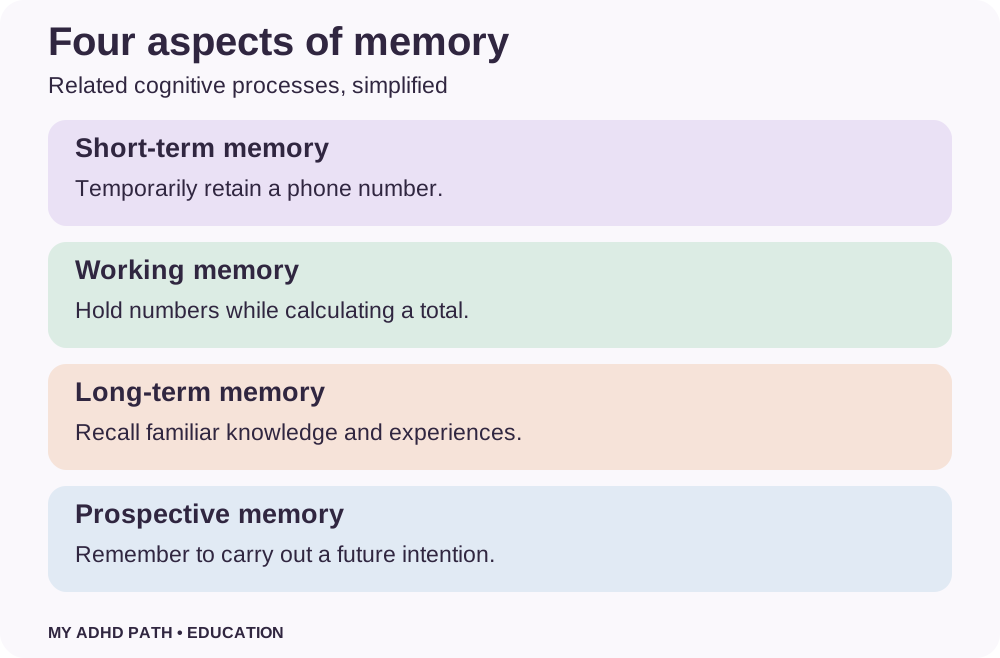
The scientific distinctions between these systems are more nuanced than a simple table can capture.
However, understanding their different roles can help explain why being forgetful in one situation doesn't necessarily mean you have difficulties across every aspect of memory.
You might remember the names of every character in a television series you watched fifteen years ago.
But forget the second half of a question somebody has just asked you.
Those experiences involve different cognitive demands.
How does ADHD affect working memory?
Research has identified working memory difficulties in many children and adults with ADHD.
However, working memory impairment is not experienced by everyone with ADHD, nor is it unique to ADHD.
ADHD can affect processes involved in maintaining attention, managing distractions and regulating goal-directed behaviour.
These processes interact with working memory.
For example, if your attention moves towards something else while you're following instructions, it may become more difficult to retain the information needed to complete the original activity.
Similarly, a complicated task may require you to hold several pieces of information in mind while suppressing irrelevant distractions.
For some people with ADHD, that combination can be particularly demanding.
Working memory difficulties are therefore one possible part of the broader executive functioning profile associated with ADHD.
They are not a standalone way of diagnosing the condition.
Good to know
Working memory difficulties are associated with ADHD but are not experienced by everyone with the condition. They are one possible part of the broader executive functioning profile, not a standalone diagnostic criterion.
Is working memory the same as attention?
No, although the two are closely connected.
Attention helps you select and focus on relevant information.
Working memory helps you maintain and use information while completing a task.
Imagine somebody gives you directions.
If you were distracted when they explained which road to take, you may not have registered that information properly.
Alternatively, you might have listened carefully but found it difficult to retain all the instructions while navigating.
From the outside, both situations might look like forgetfulness.
But the underlying difficulties may be different.
Understanding where the problem occurs can help you choose more useful strategies.
Sometimes the support you need is a quieter environment.
Sometimes it's written instructions.
Sometimes it's an opportunity to process information before receiving the next piece.
Why can you remember interesting things but forget ordinary information?
This is one of the most confusing aspects of the ADHD experience.
You might be able to explain the complicated rules of a favourite game, remember hundreds of facts about wildlife or recall the precise specifications of a computer you researched several years ago.
Meanwhile, remembering three things you need from the supermarket appears to be a considerably more ambitious undertaking.
Memory performance is influenced by several factors, including attention, prior knowledge, motivation, emotional significance, repetition and opportunities to retrieve information.
Information connected to a favourite subject may be encountered repeatedly.
It may fit into an existing network of knowledge.
You may engage with it more deeply and spend more time thinking about it.
By contrast, an unfamiliar instruction might be presented once, while you're doing something else, without any obvious connection to information you already know.
These are very different learning conditions.
Interest can support engagement, but it does not guarantee effective memory.
Nor does finding something uninteresting mean it is impossible to learn.
Understanding the conditions that help you engage with information can make it easier to develop useful learning strategies.
Twelve everyday signs of working memory difficulties
The following experiences may involve working memory, attention or other executive functions. None is exclusive to ADHD.
1. Forgetting what you just read
You've completed a paragraph but cannot explain its main point.
2. Losing track of a conversation
You remember the beginning of somebody's explanation but struggle to connect it with what they're saying now.
3. Forgetting instructions halfway through
You begin the first part of an activity but cannot recall the remaining steps.
4. Losing your place in calculations
You understand the mathematical method but forget an intermediate result while completing the next operation.
5. Walking into a room and forgetting why
Your attention shifts during the transition, and the original intention becomes difficult to retrieve.
6. Forgetting what you were about to say
You had a point ready to make, but something interrupted your train of thought.
7. Difficulty listening and taking notes simultaneously
Concentrating on writing down information makes it harder to follow the next part of the explanation.
8. Finding mental arithmetic particularly demanding
Keeping numbers available while carrying out operations requires substantial effort.
9. Repeatedly checking information
You look at a number, address or reference several times while trying to transfer it somewhere else.
10. Losing track of activities after interruptions
When somebody asks you a question halfway through a task, you struggle to resume from the correct point.
11. Difficulty following complicated explanations
Each individual sentence makes sense, but holding the earlier information in mind becomes difficult as the explanation continues.
12. Struggling to organise your thoughts into writing
You have numerous relevant ideas but find it difficult to retain, organise and express them simultaneously.
Recognising these patterns can help you identify where additional support might be useful.
Why reading with ADHD can be particularly challenging
Reading involves considerably more than recognising words.
You need to connect information across sentences, interpret meaning, retain relevant details and relate new ideas to existing knowledge.
Consider the following passage:
The river became shallower as sediment accumulated along its banks. During periods of heavy rainfall, the reduced capacity of the channel contributed to an increased risk of flooding.
To understand this explanation, you need to retain the earlier information about sediment and channel depth while interpreting the relationship with flooding.
Now imagine that the passage continues for another six paragraphs.
If you've lost track of the original explanation, understanding the later material may become more difficult.
Reading comprehension draws on several abilities, including language skills, background knowledge, attention and working memory.
For some students with ADHD, the demands of maintaining information across a lengthy or complex text can be particularly challenging.
Coexisting difficulties such as dyslexia may also affect reading.
Identifying the nature of the difficulty matters because different barriers require different forms of support.
Reading information is not the same as learning it
Many students measure revision by how much material they've read.
They complete ten pages of a textbook.
They highlight important sentences.
They reread their notes.
The activity feels productive because they've spent time looking at information.
Being familiar with information is different from being able to retrieve it independently.
Try reading a short section of study material.
Then close the book.
Without looking, explain:
- What was the main idea?
- What supporting information do you remember?
- How does it connect to something you already know?
- Which parts are still unclear?
This gives you a more useful indication of what you've understood than simply counting the number of pages you've read.
Retrieval practice can support longer-term learning.
It does not directly remove working memory difficulties, but it can help build accessible knowledge that supports future learning.
Working memory and cognitive load
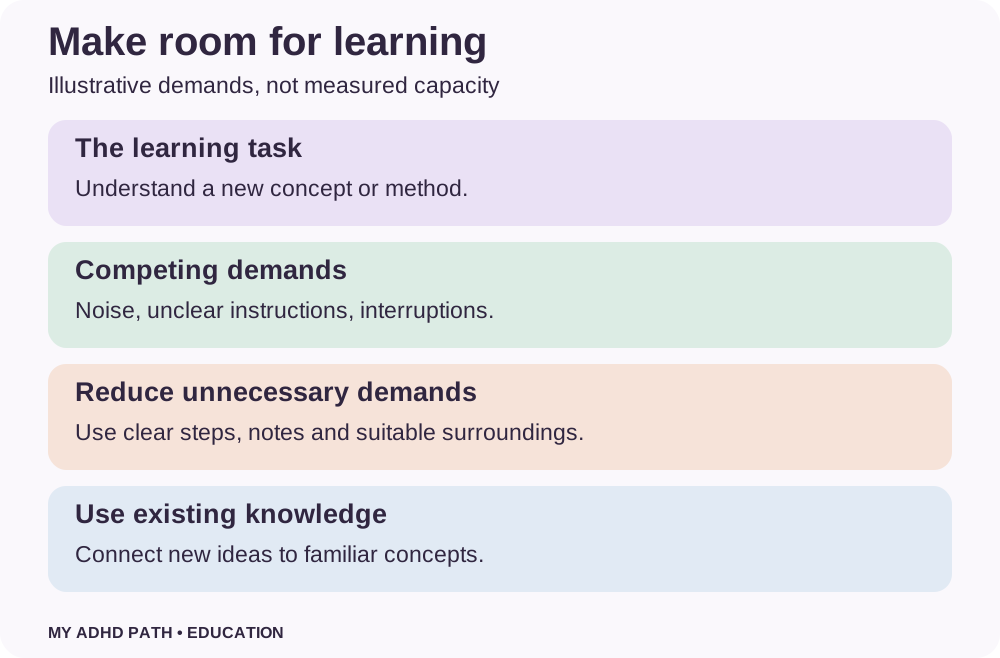
Cognitive load describes the mental demands placed on us during a learning activity or task.
Imagine you're learning how to solve a mathematical equation.
You need to understand the symbols, remember the relevant rules, apply the correct operations and monitor your calculations.
If you're unfamiliar with the method, each step requires considerable attention.
As the method becomes more familiar, some of those operations may require less conscious effort.
This allows you to devote more attention to other aspects of the problem.
Learning can become considerably harder when too many unfamiliar demands are introduced simultaneously.
For example:
- Complex written instructions.
- An unfamiliar calculation method.
- A distracting environment.
- Pressure to finish quickly.
- Several additional requirements to remember.
Reducing unnecessary demands can make it easier to concentrate on the material you're actually trying to learn.
This is one reason why clear explanations, worked examples and well-organised learning materials can be particularly helpful.
Why expertise can make information easier to manage
Imagine two students looking at the same list of chemical reactions.
One has never studied the subject before.
The other understands the reactivity series, bonding and common reaction patterns.
The second student can organise the information using knowledge they already possess.
They don't necessarily need to treat every symbol as an entirely new piece of information.
Existing knowledge provides a structure into which new information can fit.
This can reduce the working memory demands of familiar tasks.
It also explains why building a solid understanding of foundational concepts can make more advanced learning easier.
For students who find working memory particularly demanding, strengthening foundational knowledge may be more effective than repeatedly attempting complex questions without sufficient preparation.
Fifteen practical strategies to support working memory
The objective is not to remember absolutely everything independently.
It's to create conditions in which you can use your cognitive resources for the activities that matter.
Strategy 1: Get information out of your head
If something is important, give it somewhere reliable to live.
Write instructions down.
Record intermediate calculations.
Use a calendar.
Keep a checklist.
Create a brief note before moving away from a task.
Externalising information means you don't have to continuously maintain it mentally while concentrating on something else.
This is sometimes described as cognitive offloading.
It isn't a substitute for understanding.
It's a way of reducing unnecessary memory demands.
Strategy 2: Break information into meaningful chunks
A long list of disconnected information can be difficult to retain.
Organising it into meaningful groups may make it more manageable.
Imagine you're preparing for a geography examination.
Rather than trying to remember twelve unrelated facts about coastal erosion, organise them into categories:
- Processes.
- Landforms.
- Influencing factors.
- Case study evidence.
Each category provides a structure for related information.
Chunking is particularly useful when the groups have meaning to you.
Simply dividing information into arbitrary sets of three will not necessarily produce the same benefit.
Strategy 3: Ask for instructions one stage at a time
If somebody gives you a lengthy verbal instruction, ask whether it can be divided into smaller stages.
What you could say
"Could we go through the first part, and then check I've understood it before moving on?"
Alternatively, request a written version of the complete instructions.
The most appropriate approach depends on the task.
Some people benefit from seeing the whole process in advance, while working through individual stages separately.
Strategy 4: Repeat instructions in your own words
After receiving an explanation, briefly restate what you've understood.
What you could say
"So I need to complete the graph, calculate the gradient and then explain what it represents?"
This helps identify misunderstandings and provides another opportunity to process the information.
In educational settings, asking students to explain instructions in their own words may be more informative than asking whether they understand.
A student can genuinely believe they understand an instruction without having retained every part.
Strategy 5: Write down the intermediate steps
This is particularly useful for mathematics, chemistry and other subjects involving multistage processes.
Instead of completing multiple operations mentally, record each stage.
For example:
Calculate 15% of 240.
First, calculate 10%:
240 ÷ 10 = 24
Then calculate 5%:
24 ÷ 2 = 12
Add the results:
24 + 12 = 36
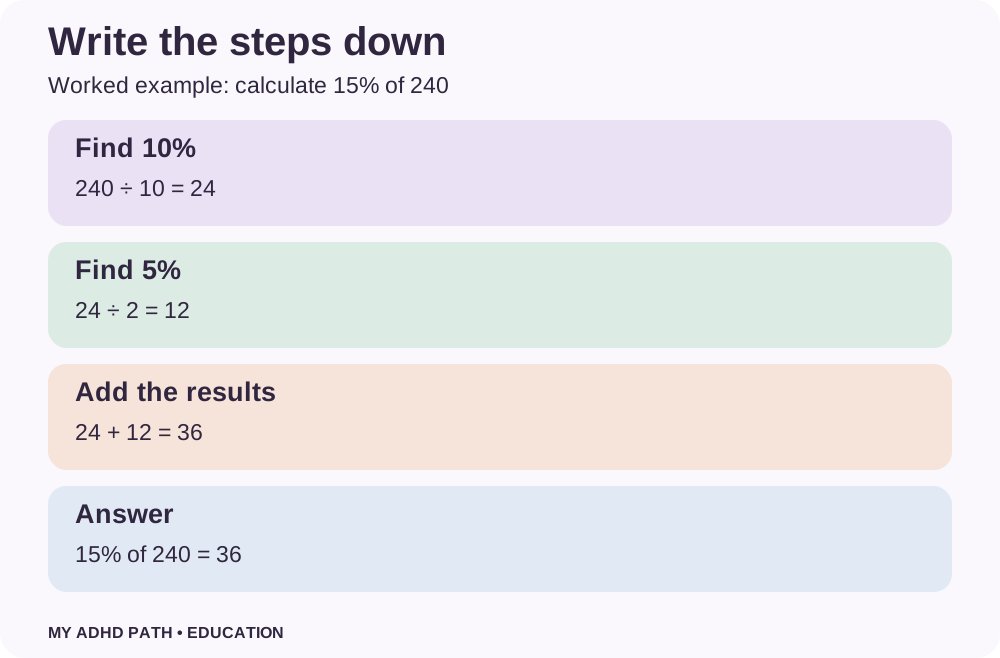
Writing the stages down reduces the need to retain intermediate values while completing subsequent operations.
It can also make it easier to identify mistakes.
The same approach works for algebra, equations, scientific calculations and complex everyday decisions.
Strategy 6: Read in shorter sections
Instead of attempting an entire chapter in one continuous session, divide the reading into meaningful sections.
After each section, briefly summarise the central idea.
You might use one sentence, a diagram or a short explanation spoken aloud.
If you cannot explain what you've read, return to the specific section that needs attention rather than automatically rereading everything.
The appropriate section length depends on the complexity of the material.
A single paragraph may be enough when you're encountering an unfamiliar concept.
Strategy 7: Use retrieval practice
Retrieval practice involves attempting to recall information rather than repeatedly looking at it.
Close your notes and answer a question.
Explain a concept without consulting your textbook.
Reproduce a labelled diagram.
Complete a practice problem.
Then check your answer.
This process can strengthen learning and help identify gaps in understanding.
The feedback element matters.
Repeatedly recalling an incorrect answer without correcting it is not the objective.
Strategy 8: Revisit learning over time
Rather than concentrating all revision into one extended session, return to the material on several occasions.
This is known as spaced or distributed practice.
You might revisit a topic the following day, several days later and again the following week.
Those intervals are illustrative rather than an optimal schedule for every subject.
The important principle is to create repeated opportunities to retrieve information over time.
Our revision strategies guide explains how to use this approach in more detail.
Strategy 9: Reduce unnecessary distractions
Some distractions are difficult to avoid.
Others can be reduced before you begin an activity.
Try this
Try closing irrelevant browser tabs, disabling nonessential notifications or choosing a quieter place to study.
When you're following instructions, temporarily stop other activities where possible.
Different people prefer different environments.
Some find background sound helpful, while others concentrate most comfortably in silence.
Observe what helps you retain and use information effectively, rather than assuming every person with ADHD needs the same conditions.
Strategy 10: Use visual supports where they genuinely help
A timeline, diagram, checklist or annotated example can make relationships between pieces of information easier to see.
For instance, when studying the heart, a labelled diagram can help you follow the direction of blood flow without having to hold every stage mentally.
Visual supports should clarify information rather than add unnecessary decoration.
They are not evidence that somebody belongs to a fixed visual learning style.
The usefulness of a format depends on the material, the individual and the activity.
Strategy 11: Leave yourself a restart note
Before answering a message, attending a meeting or moving to another activity, record where you've reached.
For example:
What you could say
"Completed questions 1-4. Question 5: calculate the number of moles before using the molar ratio."
When you return, you have a clear starting point.
You don't need to reconstruct the entire activity from memory.
This is particularly useful when working on complicated projects, academic assignments or tasks that are regularly interrupted.
Strategy 12: Separate listening from recording information
Listening to a detailed explanation while simultaneously producing comprehensive notes can place considerable demands on attention and working memory.
Where appropriate, try recording only key concepts and questions.
Ask for presentation materials in advance.
Use agreed note-taking support.
Review notes after the session.
Audio recording or transcription may be helpful in some circumstances, provided that it is permitted and respects privacy and confidentiality requirements.
Different learning environments may require different approaches.
Strategy 13: Use consistent templates
A familiar structure can reduce the number of decisions you need to make each time you begin an activity.
For example, an essay planning template might contain:
- Question.
- Central argument.
- Supporting point.
- Evidence.
- Explanation.
- Link to the question.
A science practical template might contain the aim, variables, method, observations and conclusion.
The template holds the structure externally.
You can concentrate on the content rather than repeatedly remembering how to organise it.
Strategy 14: Protect the conditions that support memory
Sleep, physical health, nutrition, stress and emotional wellbeing can all influence cognitive performance.
If you're exhausted, extremely hungry or dealing with several immediate concerns, learning may become more difficult.
Taking appropriate breaks and maintaining everyday health routines can support your ability to engage with tasks.
These are not cures for ADHD.
Persistent sleep problems, appetite difficulties or significant changes in memory deserve appropriate professional attention.
Strategy 15: Choose fewer simultaneous demands
You don't necessarily need to complete activities in an entirely uninterrupted environment.
But when a task involves complex reasoning or unfamiliar information, it may help to temporarily reduce competing demands.
Instead of drafting an assignment while monitoring several conversations and researching an unrelated idea, establish what you want your attention to be doing.
You might spend twenty minutes on one aspect of the assignment before moving elsewhere.
The intention isn't to enforce rigid concentration.
It's to make the demands on your working memory more manageable.
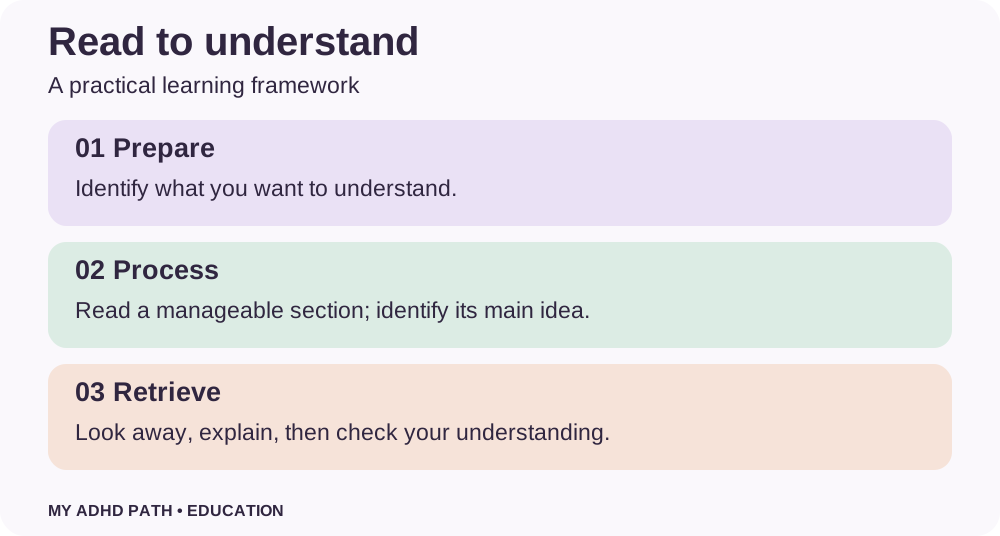
The three-stage reading method
If reading frequently feels frustrating, try separating the activity into three stages.
Stage one: Prepare
Before reading, identify what you want to understand.
Look at the heading, relevant questions or learning objectives.
Activate any existing knowledge about the subject.
Stage two: Process
Read a manageable section.
Identify its main idea.
Notice how new information relates to previous information.
Record a brief note if necessary.
Stage three: Retrieve
Look away from the material.
Explain the central idea.
Check what you've remembered.
Clarify anything you've misunderstood.
For example, if you're reading about photosynthesis, begin with a specific question:
Why do plants need light?
Read the relevant section.
Then attempt to explain the role of light independently.
You now have a purpose for reading, an opportunity to process information and a way to check your understanding.
It's a relatively small change, but it can make reading a more active learning experience.
Working memory and mathematics
Mathematics can place substantial demands on working memory, particularly when students are learning unfamiliar methods.
A student solving an equation may need to retain the original expression, select an appropriate operation, calculate an intermediate result and remember what the next stage requires.
If they lose track of one value, the rest of their calculation may become incorrect even though they understand the underlying method.
This can create apparently inconsistent performance.
A student might solve a difficult problem successfully and then make an error on a much simpler calculation.
Useful strategies include:
- Writing each operation on a separate line.
- Keeping equals signs aligned.
- Drawing and labelling diagrams.
- Referring to worked examples during learning.
- Highlighting relevant information in a question.
- Checking signs, units and intermediate results.
- Practising foundational skills until they become more familiar.
These strategies are particularly relevant to learning and revision.
Equipment and support used during formal assessments must comply with the applicable examination rules.
Working memory and writing
Producing an extended piece of writing involves several simultaneous processes.
You need to think of ideas, organise them, select vocabulary, construct sentences, monitor grammar and ensure that the writing addresses its purpose.
For some people with ADHD, managing all these demands at once can be difficult.
One approach is to separate writing into stages.
Capture
Write down the ideas you want to include without worrying about their order.
Organise
Group related ideas and establish a sequence.
Draft
Turn the ideas into paragraphs.
Review
Check whether the writing answers the question and communicates the intended argument.
Edit
Address spelling, punctuation, grammar and other details.
You may move between these stages as the writing develops.
The benefit comes from not expecting yourself to manage every aspect of writing perfectly at the same moment.
Helping children with working memory difficulties
Children may not have the language to explain that they're struggling to keep information available while using it.
A parent might ask a child to go upstairs, find their PE kit, bring down a water bottle and put their dirty washing in the basket.
Several minutes later, the child returns with the water bottle.
The other responsibilities appear to have vanished completely.
From an adult's perspective, the instruction seemed straightforward.
From the child's perspective, it involved several separate intentions, a change of environment and numerous potential distractions.
Practical support might include:
- Giving shorter verbal instructions.
- Providing a simple written checklist.
- Asking the child to repeat the next step.
- Establishing predictable places for important belongings.
- Demonstrating unfamiliar activities.
- Allowing appropriate processing time.
- Gradually reducing prompts as the child develops an effective system.
The aim is not to remove every responsibility.
It's to create opportunities for the child to learn how to manage responsibilities successfully.
How teachers can support working memory in the classroom
Teachers may notice that a student starts work enthusiastically but becomes uncertain about what the activity requires.
The student may repeatedly ask questions that appear to have already been answered.
They may copy information accurately without understanding how to use it.
Classroom approaches worth considering include:
| Potential barrier | Support to explore |
|---|---|
| Lengthy verbal instructions | Written steps alongside the verbal explanation |
| Complex unfamiliar tasks | Worked examples and gradual introduction |
| Copying while listening | Accessible lesson materials |
| Losing track of a process | Numbered stages and visual prompts |
| Difficulty recalling earlier learning | Low-pressure retrieval activities |
| Unclear task requirements | Explicit success criteria |
| Becoming distracted mid-task | Brief, appropriate reminders and restart cues |
These approaches can benefit a wide range of learners.
Individual support should reflect the student's needs, educational context and any agreed provision.
Working memory difficulties do not automatically establish eligibility for a particular formal examination adjustment.
Our examination access arrangements guide explores that process separately.
Working memory at work
The same challenges can continue into adult employment.
A manager might give several instructions during a brief conversation.
A meeting might move rapidly between topics.
An email may require action across multiple systems.
A colleague may interrupt you while you're completing a complicated task.
Practical workplace support might include:
- Written meeting actions.
- Clear priorities and deadlines.
- Shared task management systems.
- Standard operating procedures.
- Meeting agendas.
- Protected time for demanding work.
- Agreed methods for recording information.
Rather than relying on remembering an entire conversation, you might finish a meeting by confirming:
What you could say
"Just to check, I'm completing the initial draft by Wednesday, and we'll review the final version on Friday?"
This makes the expected outcome clearer and provides an opportunity to correct misunderstandings.
Where appropriate, reasonable workplace adjustments or Access to Work support may also be worth exploring.
When forgetfulness affects conversations and relationships
Forgetting information somebody has shared can sometimes be interpreted as a lack of interest.
You may genuinely care about what the other person is saying while finding it difficult to retain several details at once.
It can help to explain what makes communication more accessible for you.
For example:
What you could say
"I'm listening, but I need to write down the dates we're discussing so I don't mix them up."
Or:
What you could say
"Can I finish this first? I want to be able to give you my attention properly."
Understanding the role of memory can provide useful context, but the impact of forgotten commitments still matters.
Agreeing a reliable way to record shared plans can be more helpful than repeatedly expecting either person to remember everything.
Can working memory be improved through brain training?
There are numerous products designed to improve memory through repeated cognitive exercises.
Research suggests that people can improve performance on certain trained working memory tasks.
However, improvements on a particular exercise do not necessarily transfer to broader academic performance, everyday functioning or reduced ADHD symptoms.
This distinction is often described as near transfer versus far transfer.
Near transfer means improvement on tasks similar to those practised.
Far transfer means improvement in more substantially different activities.
Evidence for broad, lasting improvements through working memory training is much less convincing than evidence for improvement on trained tasks.
This does not mean that practising cognitive activities has no value.
But it is important to distinguish improvements in a game or exercise from meaningful changes in everyday life.
Common misconception
Brain training apps and games can permanently increase your working memory capacity. In reality, while performance on trained tasks can improve, evidence for broad, lasting improvements across unrelated everyday activities is limited. Practical environmental changes, learning strategies and appropriate support offer a more directly relevant starting point.
Be cautious about products claiming to permanently increase working memory capacity, cure ADHD or produce guaranteed academic improvements.
For many people, practical environmental changes, learning strategies and appropriate clinical or educational support offer a more directly relevant starting point.
Does ADHD medication improve working memory?
ADHD medication can help some people manage core ADHD symptoms, including difficulties with attention.
Research also suggests that certain medications may improve performance on some cognitive tasks for some individuals.
However, the effects vary according to the person, medication and activity being measured.
Medication does not guarantee that working memory difficulties will disappear.
Some people continue to benefit from written instructions, checklists, structured learning and other supports while receiving treatment.
If you have questions about the effects of your medication, discuss them with your prescribing clinician.
Do not alter your medication independently in an attempt to improve memory or examination performance.
Good to know
ADHD medication may help some individuals with certain cognitive processes, but its effects on working memory vary. Many people continue to benefit from practical strategies alongside medication. Always discuss treatment questions with your prescribing clinician.
Three different working memory experiences
The following scenarios are fictional illustrations.
Illustrative scenario
Oliver, 15 - Understanding the maths but losing the numbers
Oliver understands the mathematical methods taught in class.
However, he frequently makes mistakes when trying to complete several stages mentally.
His teacher encourages him to record intermediate calculations and use a consistent layout.
He begins to distinguish between mistakes caused by misunderstanding a method and mistakes made while trying to retain several numbers simultaneously.
Writing more of the process down helps him focus on applying his mathematical knowledge.
Illustrative scenario
Amira, 20 - Reading without remembering
Amira is studying history at university.
She spends hours reading academic material but struggles to explain the arguments afterwards.
She experiments with reading shorter sections, recording their key ideas and retrieving the information before continuing.
Rather than measuring her progress by the number of pages completed, she begins checking what she can explain independently.
Illustrative scenario
Rachel, 43 - The interrupted working day
Rachel manages several projects and frequently moves between meetings, emails and complex activities.
When something interrupts her, she struggles to remember where she reached.
She introduces a simple restart note at the end of each work session.
She also begins recording meeting actions in one reliable location.
These changes reduce the number of unfinished activities she needs to keep mentally available.
Create your personal working memory support profile
Everyone's experiences are different.
Use the following questions to explore your own patterns.
| Question | Illustrative answer |
|---|---|
| When do I most frequently lose track of information? | During lengthy verbal explanations |
| What makes it particularly difficult? | Background conversations and interruptions |
| Which information do I find easier to retain? | Information connected to familiar subjects |
| What helps me understand new material? | Worked examples and discussion |
| What do I frequently need to check again? | Dates, instructions and intermediate calculations |
| Which tools already help me? | Written notes and calendar reminders |
| What could I change about my environment? | Close unnecessary browser tabs |
| What support could I request? | Written instructions after meetings |
The purpose is to identify practical changes rather than assess or score your memory.
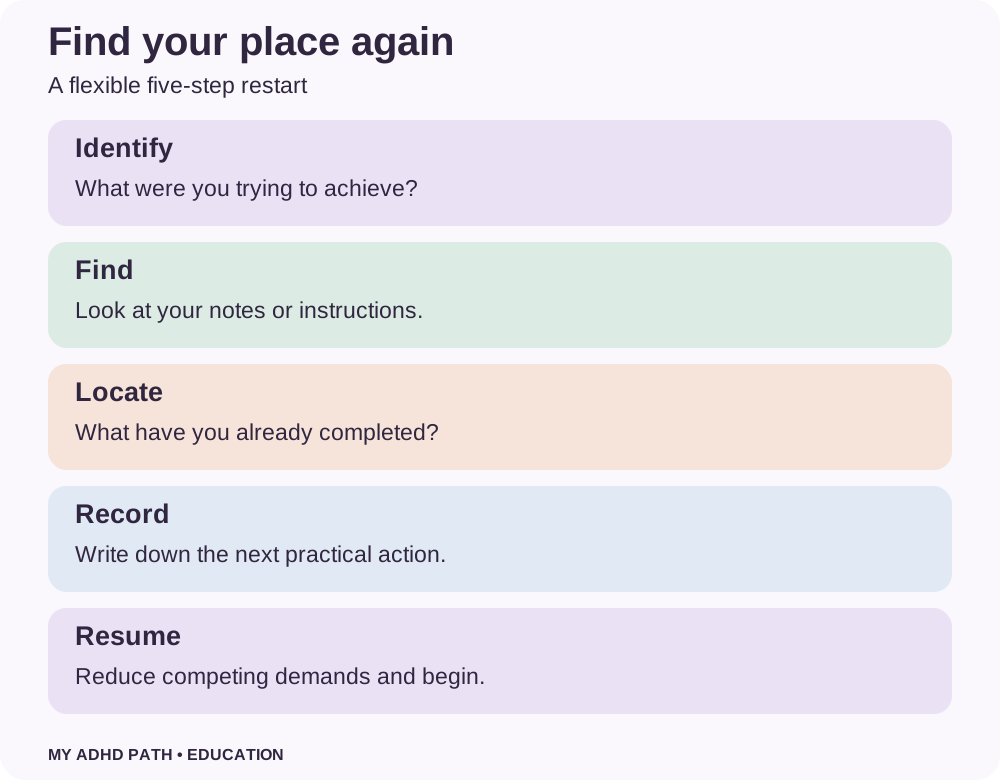
The five-minute working memory reset
When you lose track of an activity, trying harder to remember everything can create additional frustration.
Try this
Try this simple reset instead.
Step one: Identify the activity.
What were you trying to achieve?
Step two: Find what remains.
Look at your notes, instructions or partially completed work.
Step three: Identify your current position.
What have you already completed?
Step four: Record the next action.
What is the next manageable step?
Step five: Resume with fewer competing demands.
Temporarily reduce unnecessary distractions and focus on that action.
You can adapt the reset to take more or less time.
It is a practical planning aid rather than a clinical intervention.
A seven-day working memory experiment
You don't need to introduce fifteen new strategies simultaneously.
Choose one area where working memory difficulties frequently affect your experience.
Day one: Notice the pattern
Identify a situation in which you regularly lose track of information.
Day two: Externalise
Write down information you would normally attempt to remember.
Day three: Simplify
Divide a complicated activity into clearer stages.
Day four: Change the environment
Notice whether reducing distractions helps.
Day five: Retrieve
Try recalling learning independently before checking your notes.
Day six: Create a restart cue
Leave yourself a brief note before interrupting a task.
Day seven: Review
Which changes made the activity easier?
Which felt unnecessary?
Which would you like to continue using?
This experiment is designed to help you discover useful supports.
It is not a test of cognitive ability or a method of diagnosing working memory impairment.
Using AI to reduce working memory demands
AI tools can help externalise, structure and reorganise information.
Their potential usefulness is not necessarily about remembering things on your behalf.
It can also involve reducing the number of cognitive steps needed to understand what to do next.
AI prompt
Simplify instructions
"Break these instructions into clear, numbered steps. Preserve every important requirement and flag anything that is unclear."
AI prompt
Create a worked example
"Explain this mathematical method one stage at a time. Show each intermediate calculation and explain why each operation is needed."
AI prompt
Support reading comprehension
"Divide this passage into meaningful sections. Ask me one question after each section and wait for my answer before continuing."
AI prompt
Practise retrieval
"Quiz me on this material without showing me the answers in advance. After each response, explain anything I've misunderstood."
AI prompt
Create a restart note
"Using these notes, identify what I've completed, what remains and the next practical action. Don't invent progress."
AI prompt
Organise meeting information
"Turn these meeting notes into decisions, responsibilities, deadlines and questions that still need answering. Flag missing information."
AI can introduce errors, omit important qualifications or produce misleading explanations.
Check its outputs against the original material.
Follow school, university and workplace rules concerning AI use.
Avoid uploading sensitive medical information, confidential records or restricted work documents without appropriate permission.
What the research says
Research has repeatedly identified differences in working memory performance between groups of people with ADHD and comparison groups. However, group-level differences do not predict the precise cognitive profile of every individual. ADHD is heterogeneous. Some people experience significant working memory difficulties, while others perform within expected ranges on formal working memory assessments despite encountering executive functioning difficulties elsewhere. Research into learning has identified evidence supporting techniques such as retrieval practice and distributed practice, and these findings apply across a range of learners rather than being exclusive to ADHD.
What does the research say?
Research has repeatedly identified differences in working memory performance between groups of people with ADHD and comparison groups.
However, group-level differences do not predict the precise cognitive profile of every individual.
ADHD is heterogeneous.
Some people experience significant working memory difficulties.
Others perform within expected ranges on formal working memory assessments despite encountering executive functioning difficulties elsewhere.
Formal assessments also occur under particular conditions.
A structured, quiet testing environment may place different demands on an individual from a busy classroom or an unpredictable working day.
Research into learning has identified evidence supporting techniques such as retrieval practice and distributed practice.
These findings apply across a range of learners, rather than being exclusive to ADHD.
Research into working memory training suggests that improvement on closely related tasks is possible, but broad transfer to general academic or everyday abilities remains uncertain.
Taken together, these findings support an individualised approach that considers both the person and the conditions under which they're learning or working.
When should you seek additional support?
Working memory difficulties can have several causes.
Attention, stress, sleep problems, anxiety, depression, medication effects, learning difficulties and other health conditions may all influence how effectively somebody retains and uses information.
Seek professional advice if:
- Memory difficulties are significantly affecting everyday life.
- A child is struggling to access learning despite appropriate support.
- Difficulties have recently appeared or are becoming noticeably worse.
- Forgetfulness is affecting safety or essential responsibilities.
- You are concerned about medication effects.
- You experience other significant changes in cognitive functioning.
A GP, appropriately qualified educational professional or relevant specialist can help identify suitable next steps.
Sudden confusion or abrupt changes in cognitive functioning can require urgent medical assessment.
It is important not to assume that every memory difficulty is caused by ADHD.
Frequently asked questions
Does everyone with ADHD have poor working memory?
No. Working memory difficulties are associated with ADHD, but individual cognitive profiles vary considerably.
Is working memory the same as short-term memory?
They are closely related. Short-term memory generally refers to temporary retention, while working memory also involves actively using and manipulating information.
Why do I forget what I've just read?
Several factors may contribute, including attention, working memory demands, unfamiliar vocabulary, reading difficulties and fatigue.
Can you have ADHD and an excellent memory?
Yes. Somebody may have strong long-term memory or other memory abilities alongside difficulties maintaining information during particular tasks.
Does poor working memory mean low intelligence?
No. Intelligence and working memory are related but distinct concepts. Working memory difficulties do not establish somebody's overall intellectual ability.
Is working memory difficulty an official ADHD diagnostic criterion?
No. It is an associated cognitive difficulty rather than a standalone diagnostic criterion.
Can working memory difficulties affect mathematics?
Yes. Multistage calculations can require students to retain and manipulate several pieces of information simultaneously.
Can working memory difficulties affect reading comprehension?
Potentially. Understanding connected information across sentences and paragraphs can place demands on working memory alongside attention, language and other skills.
Can children grow out of working memory difficulties?
Cognitive abilities develop with age, and individual experiences can change. Some difficulties persist into adulthood, while others become more manageable through development, strategies and support.
Can working memory be trained?
Performance on particular memory exercises can improve with practice. Evidence that training produces broad, lasting improvements across unrelated activities is limited.
Does ADHD medication improve memory?
It may help some individuals with certain cognitive processes, but effects vary. Discuss treatment questions with your prescribing clinician.
Can sleep affect working memory?
Yes. Insufficient or disrupted sleep can affect attention, memory and other cognitive functions.
Can I receive extra time in examinations because of working memory difficulties?
Potentially, where the relevant criteria and evidence requirements are met. Working memory difficulties alone do not automatically establish eligibility.
Is writing everything down bad for your memory?
Using appropriate external supports can reduce unnecessary cognitive demands. If your goal is to learn information for independent recall, combine those supports with suitable retrieval practice.
Can anxiety make working memory worse?
Anxiety and stress can influence attention and cognitive performance. Their effects vary according to the individual and circumstances.
Can working memory difficulties be assessed?
Yes. Appropriately qualified professionals can use standardised assessments as part of a wider evaluation. An isolated result should not be used to diagnose ADHD.
What is the best way to study with working memory difficulties?
There is no single best method. Clear learning objectives, manageable sections, worked examples, retrieval practice and reduced unnecessary distractions are useful approaches to explore.
Give your brain somewhere to put things
Give your brain somewhere to put things.
Imagine trying to prepare dinner in a kitchen with no available worktop space.
Every ingredient has to be balanced somewhere.
Every new utensil requires you to move something else.
Preparing a relatively straightforward meal becomes considerably more complicated than it needs to be.
Working memory can sometimes feel rather similar.
You may know exactly what you're doing, understand the task perfectly well and possess all the abilities required to complete it.
You simply need somewhere to put the information while you're working.
That might be a notebook.
A diagram.
A calculator during permitted activities.
A written explanation.
A checklist.
Or a digital tool that keeps track of where you've reached.
You don't need to make remembering everything independently the measure of your capabilities.
Understanding how you learn, recognising what places unnecessary demands on your attention and creating appropriate support can give you more space for the things your brain does well.
Downloadable resource
My ADHD Working Memory Support Sheet
A printable worksheet to help you capture your current activity, the information you need to keep available, steps completed, questions to clarify and your next action.
Download PDFSources and further reading
Working memory and executive functioning
- Baddeley, A. (2012). Working memory: Theories, models, and controversies. Annual Review of Psychology. https://doi.org/10.1146/annurev-psych-120710-100422
- Diamond, A. (2013). Executive functions. Annual Review of Psychology. https://doi.org/10.1146/annurev-psych-113011-143750
- Martinussen, R., Hayden, J., Hogg-Johnson, S. and Tannock, R. (2005). A meta-analysis of working memory impairments in children with attention-deficit/hyperactivity disorder. Journal of the American Academy of Child & Adolescent Psychiatry. https://doi.org/10.1097/01.chi.0000153228.72591.73
- Alderson, R. M., Kasper, L. J., Hudec, K. L. and Patros, C. H. G. (2013). Attention-deficit/hyperactivity disorder and working memory in adults: A meta-analytic review. Neuropsychology.
- Faraone, S. V. et al. (2021). The World Federation of ADHD International Consensus Statement: 208 evidence-based conclusions about the disorder. https://doi.org/10.1016/j.neubiorev.2021.01.022
Learning and cognitive support
- Sweller, J. (1988). Cognitive load during problem solving: Effects on learning. Cognitive Science. https://doi.org/10.1207/s15516709cog1202_4
- Dunlosky, J. et al. (2013). Improving students' learning with effective learning techniques. Psychological Science in the Public Interest. https://doi.org/10.1177/1529100612453266
- Roediger, H. L. and Karpicke, J. D. (2006). Test-enhanced learning: Taking memory tests improves long-term retention. Psychological Science. https://doi.org/10.1111/j.1467-9280.2006.01693.x
- Risko, E. F. and Gilbert, S. J. (2016). Cognitive offloading. Trends in Cognitive Sciences. https://doi.org/10.1016/j.tics.2016.07.002
Working memory training
- Melby-Lervag, M., Redick, T. S. and Hulme, C. (2016). Working memory training does not improve performance on measures of intelligence or other measures of far transfer. Perspectives on Psychological Science. https://doi.org/10.1177/1745691616635612
- Cortese, S. et al. (2015). Cognitive training for attention-deficit/hyperactivity disorder: Meta-analysis of clinical and neuropsychological outcomes from randomized controlled trials. Journal of the American Academy of Child & Adolescent Psychiatry.
Clinical and educational guidance
- NICE - Attention deficit hyperactivity disorder: diagnosis and management (NG87). https://www.nice.org.uk/guidance/ng87
- NHS - ADHD. https://www.nhs.uk/conditions/adhd/
- NHS - Memory loss. https://www.nhs.uk/conditions/memory-loss/
This article provides general educational information and does not constitute medical advice, a cognitive assessment or a diagnostic tool. All personal scenarios are fictional. Individual memory difficulties should be considered in their wider educational, psychological and medical context.