

The most effective revision method isn’t necessarily the one that keeps you at your desk the longest. It’s the one that helps you remember what you’ve learnt when you actually need it.
At a glance
- Recognising material is different from retrieving it independently.
- Active recall and spaced repetition are well-supported learning approaches.
- Specific revision activities can reduce unnecessary decisions.
- Worked examples help introduce unfamiliar methods.
- Reviewing mistakes helps identify future learning priorities.
- Revision sessions can accommodate variable concentration and capacity.
- Appropriate educational and practical support can help students use their abilities.
You’ve bought the revision guides.
You’ve downloaded the past papers.
You’ve acquired a rather impressive collection of highlighters.
You’ve even spent Sunday afternoon creating a beautifully colour-coded revision timetable.
Monday arrives.
According to your timetable, you’re supposed to be revising biology.
You open your revision guide, read several pages and realise that you’ve been thinking about something completely different.
You start again.
This time, you highlight the important information.
Then you realise you’ve highlighted almost everything.
Eventually, you decide that perhaps watching a video would be more helpful.
Forty minutes later, you know considerably more about the person presenting the video than you do about photosynthesis.
Sound familiar?
For students with ADHD, revision can sometimes involve an enormous amount of effort without producing the results they’d hoped for.
The good news is that there are ways to approach revision that make more effective use of that effort.
And surprisingly few of them require additional highlighters.
Why revision can be particularly challenging with ADHD
Revision requires much more than understanding information.
It involves deciding what to study, organising materials, starting at an appropriate time, maintaining attention, recognising gaps in knowledge and remembering to revisit information later.
These activities place demands on several aspects of executive functioning.
Executive functions are mental processes that help us manage attention, hold information in mind, plan activities, regulate behaviour and adapt to changing circumstances.
Some students with ADHD experience difficulties in several of these areas.
You might understand a complicated chemistry concept but struggle to organise a revision session.
You might remember fascinating details from a lesson but forget the information you intended to revise yesterday.
You might be capable of producing an excellent essay while finding it difficult to begin writing one.
Understanding a subject and independently organising the process of learning it are different skills.
Recognising that distinction is particularly important for parents, teachers and students themselves.
Why being good at a subject doesn’t always translate into good revision
Imagine a student who thoroughly enjoys chemistry.
During lessons, they ask thoughtful questions, understand unfamiliar concepts quickly and make interesting connections between different topics.
At home, however, independent revision is a completely different experience.
There is no teacher establishing the sequence of activities.
Nobody is explaining which concepts are particularly important.
There are no immediate questions to answer.
The student must create the structure of the learning experience themselves.
For some students with ADHD, that additional responsibility can make revising considerably more difficult than participating in a lesson.
The underlying academic ability hasn’t disappeared.
The conditions under which the student is expected to use it have changed.
Twelve common revision experiences for students with ADHD
ADHD affects individuals differently, but you may recognise some of these experiences.
1. Reading without processing
You reach the bottom of a page and realise you cannot explain what you’ve just read.
2. Spending more time planning than revising
Creating the timetable feels considerably more manageable than following it.
3. Not knowing where to begin
You have several subjects, dozens of topics and numerous resources competing for your attention.
4. Revising the subjects you already enjoy
The subjects that require the most attention are often the ones you find least appealing.
5. Underestimating how long revision will take
A topic you expected to complete in twenty minutes turns into an entire afternoon.
6. Becoming distracted by interesting information
You start researching the causes of the First World War and somehow end up learning about the history of tanks.
7. Forgetting what you learnt previously
Information makes sense during the revision session but becomes difficult to retrieve several days later.
8. Creating notes without testing yourself
Your notebook looks impressive, but answering a question without referring to it is considerably more difficult.
9. Waiting until examinations feel urgent
Starting becomes easier when the consequences feel immediate, leaving considerably less time to revisit information.
10. Revising intensely without taking breaks
You become absorbed in one subject and struggle to recognise when you need to stop.
11. Avoiding difficult questions
You repeatedly practise familiar material because it feels reassuring, leaving important knowledge gaps unexplored.
12. Giving up when the timetable goes wrong
Missing one revision session makes the entire plan feel as though it needs to be started again.
None of these experiences is unique to ADHD, and they aren’t diagnostic criteria.
They are examples of challenges that different revision strategies may help address.
Understanding the difference between recognition and recall
Open your revision guide and read a definition you’ve seen several times.
It looks familiar.
You understand it.
You feel reasonably confident that you know it.
Now close the revision guide and try explaining the definition without looking.
That may be a considerably different experience.
Recognition involves identifying information when you encounter it.
Recall involves retrieving information from memory.
Both are useful, but recognising something in a textbook does not necessarily mean you’ll be able to retrieve it during an examination.
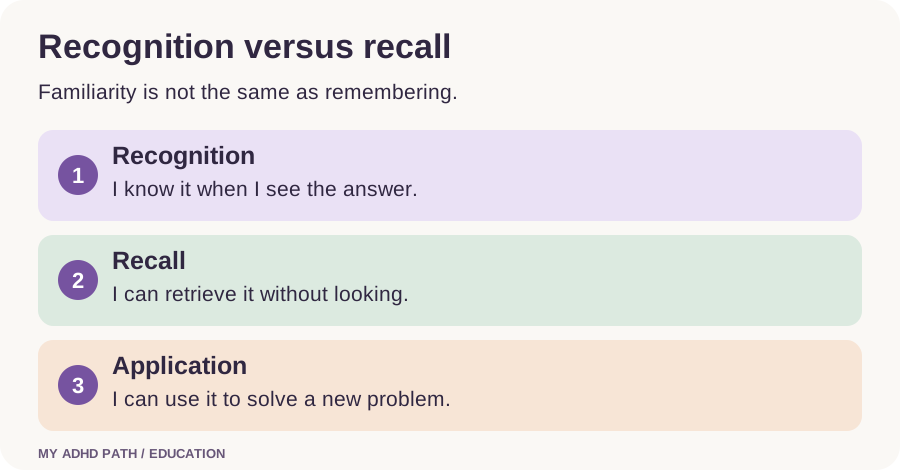
This is one reason why repeatedly reading familiar material can create an impression of learning that isn’t always reflected in examination performance.
Recognising something in a textbook does not necessarily mean you’ll be able to retrieve it during an examination.
A useful revision question is therefore not simply:
“Do I understand this when I read it?”
It is also:
“Can I explain or use this information when the answer isn’t in front of me?”
What makes revision effective?
Research into learning and memory has identified several techniques that can improve longer-term retention.
Two particularly well-supported approaches are retrieval practice and distributed practice, commonly called spaced repetition.
Retrieval practice involves attempting to recall previously learnt information.
Distributed practice involves revisiting learning over time rather than concentrating all your studying into one session.
Other useful approaches include explaining concepts, practising applying knowledge, receiving corrective feedback and using worked examples when learning unfamiliar material.
What the research says
Research involving general student populations supports both retrieval practice and distributed practice as effective learning techniques. However, there is not equally strong ADHD-specific evidence for every revision technique described in this article. Some approaches are established learning techniques; others are practical adaptations intended to make those techniques accessible.
Importantly, much of this research involves general student populations rather than students with ADHD specifically.
The underlying learning principles are relevant, but individual students may need additional practical support to use them consistently.
Effective ADHD-friendly revision therefore involves two considerations:
- Choosing techniques that support learning.
- Creating conditions that make those techniques accessible and manageable.
You need both.
Strategy 1: Use active recall
Active recall involves attempting to retrieve information without immediately looking at the answer.
Instead of repeatedly reading your notes, turn the information into something you need to remember.
For example, rather than reading a description of photosynthesis five times, close your notes and answer:
- What are the reactants in photosynthesis?
- What are the products?
- Where does photosynthesis take place?
- Why might light intensity affect the rate?
Then check your answers.
Identify what you’ve remembered accurately, what you’ve partially understood and what needs further attention.
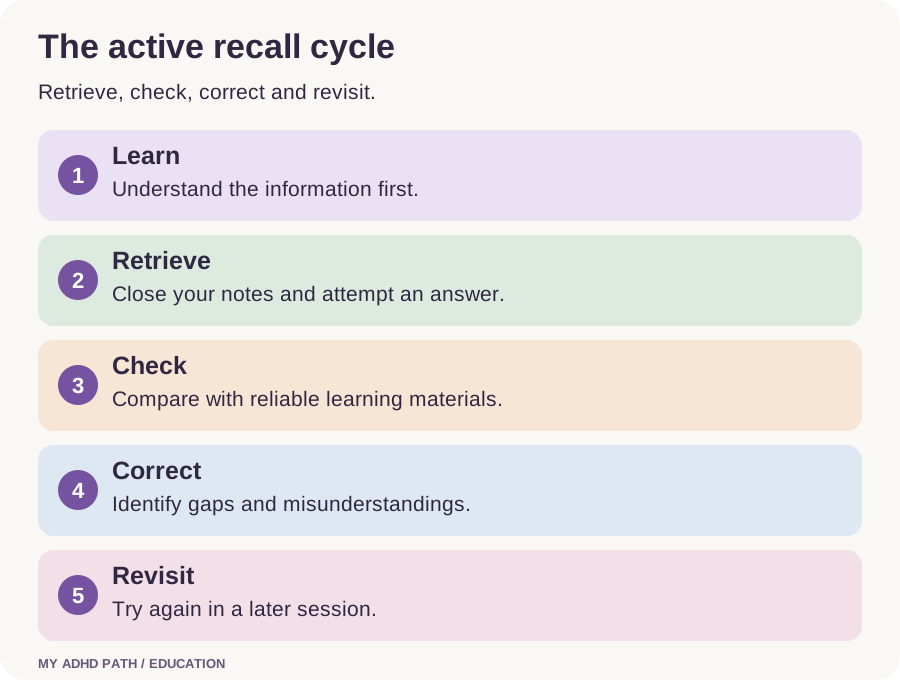
There are numerous ways to practise active recall:
- Answering questions.
- Using flashcards.
- Drawing a diagram from memory.
- Explaining a topic aloud.
- Writing an essay plan without notes.
- Completing a calculation independently.
You don’t need to turn every piece of information into a flashcard.
The important part is attempting to retrieve the information yourself.
Strategy 2: Revisit information using spaced repetition
Learning something successfully today doesn’t guarantee that you’ll remember it next week.
Spaced repetition involves deliberately returning to material across several sessions.
For example, you might learn a chemistry topic on Monday and revisit it on Tuesday, Thursday, Sunday and the following week.
| Session | Activity |
|---|---|
| Monday | Understand the concept and practise examples |
| Tuesday | Retrieve key information without notes |
| Thursday | Complete several related questions |
| Sunday | Review mistakes and attempt an exam question |
| Following week | Include the topic in a mixed revision session |
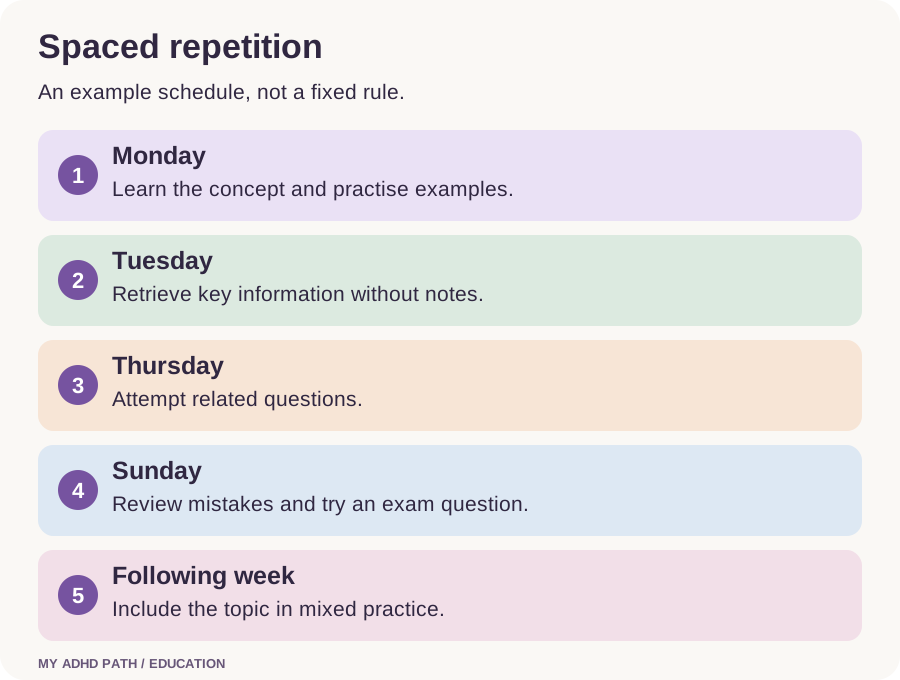
This is an illustrative schedule rather than a scientifically optimal interval for everybody.
The appropriate spacing depends on the material, how well you know it and when you’ll need to remember it.
If you repeatedly struggle to retrieve something, you may need to revisit it sooner.
If you can retrieve and apply it accurately, you may be able to leave a longer gap.
Spaced repetition is particularly useful when examinations are several weeks or months away.
You don’t need to relearn an entire topic each time.
Sometimes a few well-chosen questions are sufficient to establish what you remember.
Strategy 3: Make every revision session specific
“Revise maths” sounds like a reasonable timetable entry.
Unfortunately, it leaves numerous decisions unresolved.
Which topic?
Which resource?
How many questions?
What should you do if you get stuck?
When have you finished?
Compare it with:
“Complete five questions on solving simultaneous equations. Mark them and redo any incorrect answers.”
Suddenly, the session has a clear starting point and a recognisable outcome.
| Vague revision task | Specific revision activity |
|---|---|
| Revise biology | Draw and label a plant cell from memory |
| Revise chemistry | Complete five mole calculation questions |
| Revise maths | Solve four quadratic equations |
| Revise English | Write one comparative paragraph about two poems |
| Revise geography | Explain three causes of river flooding |
| Revise history | Create a timeline of six key events without notes |
| Revise physics | Practise five calculations using the density equation |
The more decisions you make during preparation, the fewer you’ll need to make when it’s time to start.
Strategy 4: Experiment with shorter learning sessions
Some students with ADHD find extended revision sessions particularly demanding.
Rather than expecting yourself to concentrate continuously for two hours, consider working in shorter sections with appropriate breaks.
You could experiment with:
- Ten minutes of revision followed by a short break.
- Twenty minutes of revision followed by five minutes away from your desk.
- Thirty minutes of revision followed by ten minutes of recovery.
There is no universally correct session length for ADHD.
The popular Pomodoro technique typically uses 25-minute work periods, but this is not a medically established ADHD attention limit.
You may concentrate comfortably for considerably longer when studying something interesting.
You may need shorter activities when you’re learning something particularly demanding.
The objective is effective learning, not remaining seated until a timer announces that you’ve worked hard enough.
Strategy 5: Create an achievable session structure
A useful revision session might contain four different activities:
- Retrieve previous learning.
- Understand or revisit a concept.
- Practise applying it.
- Check your understanding.
For example, a 30-minute GCSE chemistry session could look like this:
| Time | Activity |
|---|---|
| 5 minutes | Recall the equation connecting mass, moles and relative formula mass |
| 7 minutes | Review a worked example |
| 13 minutes | Attempt several calculation questions independently |
| 5 minutes | Mark answers and identify what needs revisiting |
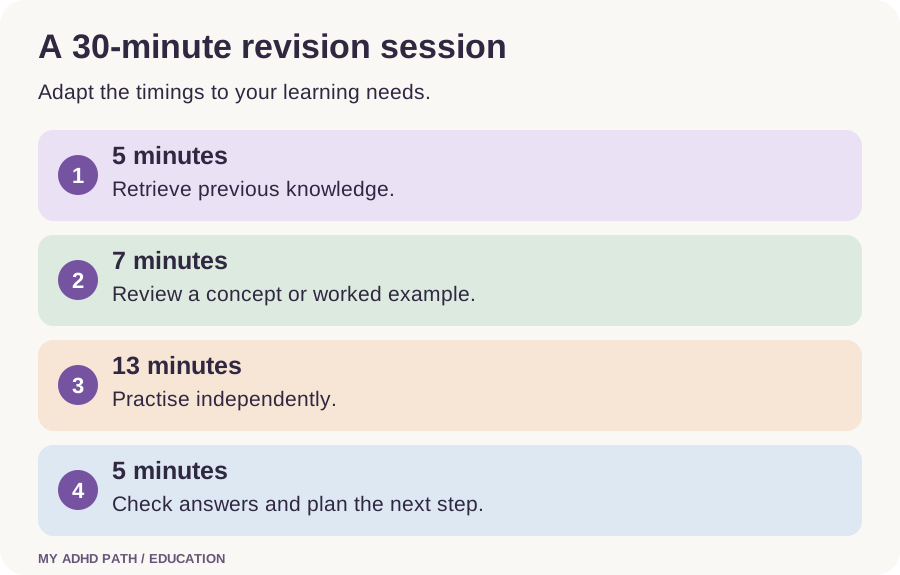
The timings are flexible.
If you discover that you haven’t properly understood the underlying concept, additional explanation may be more useful than attempting further questions immediately.
A revision session should adapt to what you’re actually learning.
Strategy 6: Explain information as though you’re teaching somebody
Being able to explain something clearly can help reveal whether you understand it.
Choose a topic and attempt to explain it without relying heavily on technical notes.
Imagine you’re teaching somebody who has never encountered it before.
For example:
“Why does the reactivity of the halogens decrease as you go down Group 7?”
You might initially remember the trend but struggle to explain why it occurs.
That identifies a specific gap in your understanding.
Return to your revision materials, clarify the concept and attempt the explanation again.
This approach is sometimes associated with the Feynman technique, although teaching-style revision is not a single standardised intervention.
You could explain topics to a parent, friend, sibling or even an empty room.
The person listening doesn’t necessarily need to understand the subject beforehand.
Their questions may help you identify details you haven’t explained clearly.
Good to know
Always check your explanation against reliable learning materials. Teaching-style revision helps identify gaps in understanding, but the explanation itself needs to be accurate.
Strategy 7: Try blurting, but make it useful
Blurting is a popular revision technique involving writing down everything you can remember about a topic without referring to your notes.
For example, write “The heart and circulatory system” at the top of a page.
Then record the structures, processes and explanations you can remember.
Afterwards, check your revision materials.
Add missing information and correct inaccuracies using a different colour if that helps.
The useful element of blurting is retrieval practice followed by feedback.
However, simply filling several pages with remembered information isn’t necessarily enough.
You also need to understand relationships between concepts and practise applying knowledge to different questions.
Try this
Keep blurting sessions focused on manageable topics. Trying to write everything you know about an entire science specification may become another source of overwhelm.
Strategy 8: Use worked examples before independent practice
If you haven’t properly understood a concept, repeatedly testing yourself may be frustrating and unproductive.
Sometimes you need to learn how something works before attempting to retrieve or apply it independently.
Worked examples can be particularly useful for subjects such as maths, chemistry and physics.
Consider a question asking you to calculate the number of moles in 36 grams of water.
A worked example would show:
Number of moles = mass ÷ relative formula mass
Relative formula mass of water = (2 × 1) + 16 = 18
Number of moles = 36 ÷ 18
Answer = 2 mol
Once you’ve understood the process, attempt a similar question using different numbers without looking at the example.
Then gradually move towards questions requiring additional steps.
This approach reduces the need to work out both the method and the answer simultaneously when you’re learning something unfamiliar.
As your understanding improves, reduce your reliance on the worked examples.
Strategy 9: Create an exam mistakes notebook
Incorrect answers can provide some of the most useful information in a revision session.
The difficulty is that many students mark their work, acknowledge the mistakes and immediately move on.
A mistakes notebook helps you identify what actually went wrong.
| Question or topic | What went wrong? | What I’ll practise |
|---|---|---|
| Moles calculation | Used multiplication instead of division | Choosing the correct equation |
| Quadratic inequality | Selected the wrong region of the graph | Interpreting where the curve is above zero |
| Biology explanation | Remembered the process but omitted key terminology | Explaining the process precisely |
| English comparison | Discussed both poems separately | Making direct comparisons |
| Geography case study | Confused two statistics | Retrieving location-specific evidence |
You don’t need to copy every incorrect question into a notebook.
Focus on recurring mistakes and substantial gaps in understanding.
Reattempt those questions later without looking at the original answer.
The objective is not to create a collection of everything you’ve ever got wrong. It’s to turn mistakes into useful evidence about what to study next.
Downloadable resource
My ADHD Revision Mistakes Tracker
A printable worksheet to help you record mistakes, identify what went wrong and plan what to practise next.
Download PDFStrategy 10: Practise exam questions before you feel completely ready
Some students postpone past papers until they’ve finished revising the entire subject.
Unfortunately, this may leave very little time to develop examination skills.
Topic-specific exam questions can help you identify:
- How knowledge is assessed.
- Which concepts need further attention.
- How much detail an answer requires.
- Whether you understand the command words.
- Where your calculations or explanations become unclear.
Begin with individual questions or manageable sections.
Use official mark schemes and examiner reports where available.
When you’re more familiar with the content, gradually introduce timed practice and complete papers.
Good to know
Make sure you’re using the correct examination board, qualification, specification and tier. A question from a different specification may still be educationally useful, but it might not accurately reflect what you’re expected to know for your examination.
Strategy 11: Mix related question types
Practising twenty questions that all require exactly the same method can help you become familiar with that method.
However, examinations often require you to work out which method to use.
Interleaving involves mixing different topics or problem types during practice.
For example, after learning several maths techniques, you might complete a mixed set containing:
- A simultaneous equations question.
- A quadratic equation.
- A trigonometry problem.
- A vectors question.
- An inequality.
This requires you to recognise which mathematical approach is appropriate.
Research suggests that interleaving can be helpful in some learning contexts, particularly where distinguishing between related problem types is important.
However, it isn’t necessarily the best way to introduce entirely unfamiliar material.
Learn individual methods first, then experiment with mixing them.
Good to know
Interleaving doesn’t mean continuously switching between unrelated subjects whenever you become distracted. The changes are planned and have a learning purpose.
Strategy 12: Use visual information to support understanding
Diagrams, timelines, graphs and organised visual summaries can be extremely useful when they help explain information.
For example:
- A diagram showing the structure of the heart.
- A flowchart explaining a chemical process.
- A timeline connecting historical events.
- A graph illustrating an economic relationship.
- A labelled drawing of a river landform.
Try recreating diagrams from memory rather than simply copying them.
Explain the relationships represented by arrows, labels and shapes.
Combining relevant visual and verbal information can support learning in suitable contexts.
Common misconception
You don’t need to identify yourself as a fixed visual, auditory or kinaesthetic learner. Research does not provide convincing support for the idea that students learn more effectively simply because teaching matches a supposed learning style. Choose the format that helps you understand the particular material you’re studying.
Strategy 13: Make revision interactive
For some students with ADHD, quietly reading information for an extended period can be particularly difficult.
Introducing a greater level of participation may make revision easier to engage with.
Try:
- Asking somebody to quiz you.
- Answering questions aloud.
- Using a whiteboard to explain calculations.
- Discussing interpretations of a poem.
- Predicting the next step in a scientific process.
- Creating your own examination questions.
- Comparing answers with a study partner.
The activity should still involve meaningful learning.
An exciting quiz app may be enjoyable, but if the questions are too easy or rely entirely on recognition, it might not provide sufficient examination preparation.
Choose activities that require you to retrieve, explain or apply information.
Strategy 14: Reduce the friction involved in starting
Sometimes beginning a revision session requires more organisation than the session itself.
You need to find your notes.
Remember your login details.
Locate a working pen.
Decide which topic to study.
Find suitable questions.
And establish how long you’re supposed to work.
Each additional decision creates another opportunity for the session to be delayed.
Practical checklist
- Leave the correct revision guide on your desk.
- Bookmark the official past paper website.
- Place your calculator and other materials somewhere accessible.
- Write tomorrow’s first question at the end of today’s session.
You might also experiment with studying alongside somebody else, sometimes described as body doubling.
Some people find the quiet presence of another person helpful for getting started and remaining engaged, although direct research on body doubling as an ADHD-specific intervention remains limited.
Making revision easier to begin can be just as important as deciding how to revise.
Strategy 15: Finish by preparing your next session
At the end of revision, spend a moment identifying what you need to do next.
You might write:
“Next chemistry session: redo questions 3 and 5, then practise limiting reactants.”
Or:
“Next English session: learn three quotations and write a comparison paragraph.”
This means you won’t need to reconstruct the entire learning plan when you return.
It also helps you maintain some continuity between sessions.
If you miss your next planned session, you still know where to begin.
You don’t need to redesign your timetable or start the subject again.
Which revision methods are most useful?
Different activities serve different purposes.
| Revision method | Best used for |
|---|---|
| Active recall | Retrieving facts, vocabulary, concepts and explanations |
| Spaced repetition | Maintaining knowledge over time |
| Worked examples | Learning unfamiliar methods |
| Independent practice | Developing and demonstrating understanding |
| Exam questions | Applying knowledge in assessment contexts |
| Interleaving | Distinguishing between related problem types |
| Teaching-style explanations | Identifying gaps in conceptual understanding |
| Diagrams and timelines | Understanding structures, processes and relationships |
| Rereading | Initial familiarisation or clarifying misunderstood information |
| Highlighting | Identifying key information for further study |
No single technique is suitable for every subject or purpose.
Rereading and highlighting can be useful components of revision.
The problem arises when they are the only activities you use.
Effective revision normally requires some opportunity to check what you can remember and do independently.
How to create a revision timetable you might actually use
A revision timetable needs to work around your ordinary life.
School.
Travel.
Homework.
Activities.
Meals.
Sleep.
Time with friends.
And the occasional afternoon when everything takes considerably longer than you expected.
Instead of initially allocating every available hour, identify a manageable number of realistic study opportunities.
Then decide what each session is intended to achieve.
Here’s an illustrative GCSE revision week.
| Day | Main session | Short retrieval session |
|---|---|---|
| Monday | Maths: quadratic equations | Biology key terms |
| Tuesday | Chemistry: mole calculations | Maths mistakes |
| Wednesday | English: poetry comparison | Chemistry equations |
| Thursday | Geography: river processes | English quotations |
| Friday | Rest or catch-up | Optional review |
| Saturday | Physics: electricity questions | Mixed science recall |
| Sunday | Maths: mixed exam questions | Plan next week’s priorities |
This example assumes the student already attends lessons and has other commitments.
It is not a recommended minimum number of study hours.
Students will need different arrangements depending on their subjects, examinations, existing knowledge, available support and wellbeing.
Leave room for missed sessions.
If Wednesday doesn’t go according to plan, you don’t need to move every remaining session forward by one day.
Choose the most relevant outstanding activity and continue from there.
The three levels of revision
Not every revision day will feel the same.
Creating different versions of a session can help maintain flexibility.
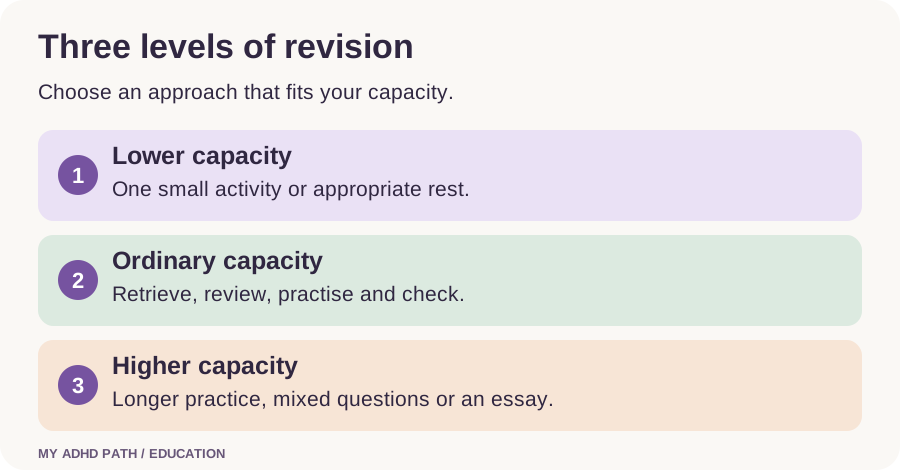
Lower-capacity revision
Choose one small activity.
- Recall five key terms.
- Attempt one calculation.
- Review one previous mistake.
- Explain one concept aloud.
Ordinary-capacity revision
Complete a structured learning session.
- Retrieve previous knowledge.
- Review or learn a concept.
- Attempt several questions.
- Check your answers.
Higher-capacity revision
If you have the time and energy, undertake a more demanding activity.
- Complete a longer exam practice section.
- Write an essay.
- Work through mixed problem types.
- Review feedback in greater detail.
These aren’t productivity targets.
Sometimes adequate rest will be more appropriate than any revision session.
The framework simply provides alternatives to the idea that revision must always happen in exactly the same way.
Prioritise topics using a traffic light system
A topic tracker can help you decide what to revise without repeatedly reviewing your entire specification.
Use three labels:
Red: I need to learn or substantially revisit this topic.
Amber: I understand some of it but need further retrieval or application practice.
Green: I can retrieve and apply the relevant knowledge independently.
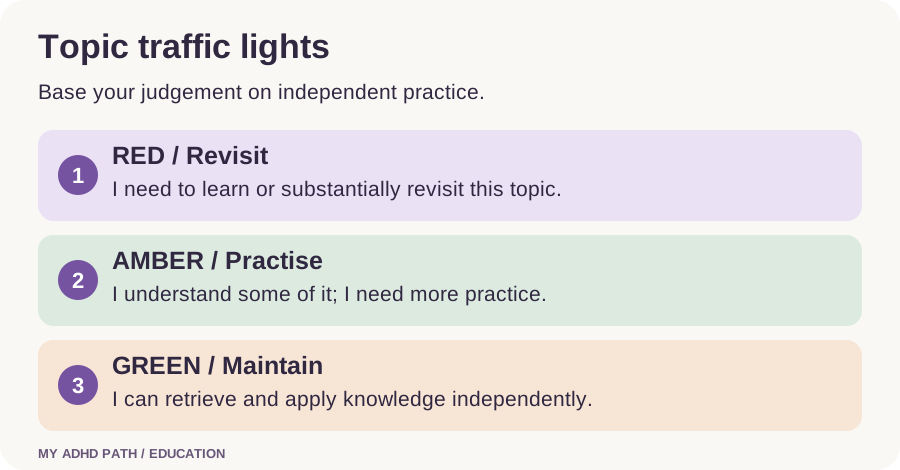
Avoid allocating colours based entirely on how familiar a topic looks.
Test yourself first.
For example, you may feel confident about the structure of the heart until you’re asked to explain the direction of blood flow without a diagram.
The purpose of the tracker is to support decisions about revision.
It isn’t a permanent judgement of your ability.
Green topics still need occasional review, and red topics do not need to remain red forever.
How to revise different subjects with ADHD
The best revision activity depends partly on what the subject requires you to know and do.
Maths
Maths revision should involve solving problems independently.
Useful approaches include:
- Studying worked examples.
- Practising specific methods.
- Explaining why each step is necessary.
- Reviewing incorrect answers.
- Completing mixed questions.
- Practising interpreting unfamiliar problems.
Watching somebody successfully solve a question can help you understand the method.
But you also need opportunities to solve it yourself.
Biology
Biology involves remembering terminology, understanding processes and applying knowledge to unfamiliar situations.
Try drawing diagrams from memory, explaining processes step by step and answering questions requiring precise scientific language.
For example, don’t simply memorise that guard cells control stomata.
Practise explaining how changes in their turgidity affect the opening and closing of stomata.
Chemistry
Chemistry often requires combining knowledge, mathematical methods and explanations.
Useful activities include:
- Balancing equations.
- Retrieving ion charges.
- Practising calculations.
- Explaining trends in the periodic table.
- Predicting reaction products.
- Applying knowledge of practical experiments.
Learn the underlying principles before relying on memorised answers.
Physics
Physics revision can involve understanding concepts, selecting equations and applying mathematical methods.
Practise identifying the information provided in a question, choosing an appropriate equation and using consistent units.
Where equation sheets are provided, become familiar with the correct version for your qualification and examination series.
Having access to an equation doesn’t necessarily mean you’ll know when or how to use it.
English literature
Try retrieving quotations from memory, exploring their meanings and practising analytical paragraphs.
Compare texts directly rather than writing completely separate explanations.
Practise interpreting unfamiliar extracts and poetry, not just reproducing prepared analysis.
English language
Focus on practical reading and writing tasks.
Use timed paragraphs, analyse model answers and practise responding to the different demands of your specification.
Review feedback to identify what would make your next answer stronger.
History
Create timelines from memory and explain connections between events.
Practise distinguishing causes, consequences, significance and interpretations.
Use relevant historical evidence rather than simply memorising isolated dates.
Geography
Practise explaining processes, applying knowledge to unfamiliar material and using case study evidence.
Draw diagrams, interpret maps and graphs, and use questions that require evaluation rather than simply describing geographical features.
Languages
Regular shorter sessions may help you maintain vocabulary and grammatical knowledge.
Practise retrieving words, creating sentences, speaking aloud and understanding language in context.
Include listening, reading, writing and speaking activities appropriate to your qualification.
How to approach extended exam answers
Some students with ADHD understand a topic thoroughly but struggle to organise that knowledge into a longer answer.
They may include several excellent observations without clearly addressing the actual question.
Before writing, consider a short planning routine.
Read: Identify exactly what the question is asking.
Select: Choose relevant knowledge, arguments or evidence.
Organise: Establish the order in which you’ll present it.
Write: Develop your answer.
Check: Where time allows, ensure you’ve addressed the question and included the necessary detail.
The appropriate structure depends on the subject, qualification and question.
An English literature essay requires a different approach from an extended biology explanation or geography evaluation.
Use your teacher’s guidance, official assessment materials and relevant mark schemes.
Avoid assuming that one memorised paragraph structure will work for every examination question.
Revising when you feel completely unmotivated
Sometimes you simply don’t feel particularly interested in the subject you need to study.
Waiting until you feel enthusiastic may lead to a rather lengthy delay.
Instead, identify an activity small enough to begin without requiring substantial motivation.
Open the question.
Write down the equation.
Read one paragraph and explain it.
Ask somebody to test you on five definitions.
Starting may make continuing easier, although it won’t always do so.
It’s also important to recognise that persistent difficulty engaging with revision may involve exhaustion, anxiety, gaps in understanding or an unsuitable learning environment.
If a subject feels impossible to approach, ask what specifically is making it difficult.
Perhaps you need somebody to explain the concept again.
Perhaps the resource you’re using is unnecessarily complicated.
Perhaps you already understand the content but are worried about making mistakes.
Addressing the actual barrier may be more useful than seeking additional motivation.
How parents can help without becoming revision police
Supporting a teenager with ADHD during examination season can become a delicate balancing act.
You want them to achieve outcomes that reflect their abilities.
You also want them to develop independence.
And preferably, you’d like to continue speaking to one another by the end of June.
Repeated reminders may be necessary in some circumstances, but they don’t always provide the practical support a student needs.
What you could say
Instead of asking “Have you done your revision?”, consider: “Which topic are you planning to work on?”, “Would it help if we worked out what needs practising first?”, “Would you like me to test you on what you’ve learnt?”, “Is there anything you haven’t understood properly in lessons?” or “Would you prefer some company while you get started?”
Support should gradually give young people more opportunities to manage their own learning, with appropriate assistance.
A student can work independently while still using reminders, structured materials, tutoring or other support.
Independence does not have to mean managing everything without help.
Creating revision sessions at home
Parents don’t necessarily need to be specialists in every GCSE or A Level subject to support effective revision.
You can help by:
- Asking questions from reliable materials.
- Listening to explanations.
- Helping organise study priorities.
- Providing a reasonably quiet environment.
- Supporting regular meals and sleep.
- Encouraging students to check their answers.
- Helping them identify when further teaching is needed.
If your child asks you to explain a concept you don’t understand, it’s perfectly reasonable to say that you’re not sure.
Find an appropriate worked example or ask their teacher for clarification.
The purpose is to support learning rather than provide perfectly accurate answers to every possible examination question immediately.
Is tutoring helpful for students with ADHD?
Some students benefit from individual or small-group tutoring.
A tutor may provide opportunities to clarify misunderstandings, practise specific skills and establish a more structured learning experience.
However, the usefulness of tutoring depends on the student’s needs, the suitability of the tutor and the approaches used.
A particularly helpful tutoring session may involve:
- Identifying a specific learning objective.
- Explaining a difficult concept.
- Demonstrating a worked example.
- Supporting the student’s independent attempt.
- Providing clear feedback.
- Identifying appropriate follow-up practice.
Tutoring is not a requirement for academic success, and it may not be financially accessible to every family.
School-based support, teacher guidance, free learning resources and peer study opportunities may also be valuable.
Sleep, breaks and examination preparation
It can be tempting to sacrifice sleep when examinations are approaching.
However, sleep plays an important role in attention, learning and memory.
Extending a revision session late into the night may not provide the benefit you expect if it leaves you struggling to concentrate the following day.
Allow appropriate time for sleep, meals, movement and enjoyable activities.
Breaks do not always need to involve screens.
You could walk around, make a drink, stretch, go outside or have a brief conversation.
Choose something that helps you return to the next activity when you intend to.
If you regularly struggle with sleep, significant daytime exhaustion or medication-related appetite and sleep changes, seek appropriate healthcare advice.
What to do in the final week before an examination
The final week is unlikely to be the most appropriate time to completely redesign your revision system.
Focus on identifying significant remaining gaps and maintaining knowledge you’ve already developed.
Establish your priorities
Review the relevant specification and identify topics that require attention.
Retrieve rather than simply reread
Use questions, explanations, calculations and other active learning activities.
Practise examination skills
Review common question formats, command words and the requirements of longer answers.
Revisit previous mistakes
Concentrate on recurring misunderstandings and methods you’ve previously found difficult.
Prepare practical arrangements
Check the examination date, location, start time, permitted equipment and any agreed access arrangements.
Protect adequate sleep
Avoid creating a revision plan that relies on consistently staying awake late into the night.
You may not have covered everything as thoroughly as you originally intended.
Use the remaining time in a way that provides the greatest realistic benefit.
What if you’ve left revision until the last minute?
An examination is tomorrow.
You haven’t revised nearly as much as you planned.
This probably isn’t the most useful moment to investigate why your timetable didn’t work.
Identify the information and skills that you can realistically revisit.
Use your specification, previous feedback and reliable assessment materials to establish priorities.
Avoid assuming you can accurately predict which topics will appear.
Work through a manageable selection of important concepts and questions.
Prepare what you need for the following day.
And allow yourself appropriate sleep.
Last-minute revision is generally less suitable for long-term retention than learning distributed over time.
But a limited amount of preparation can still be more useful than giving up entirely.
Three different approaches to ADHD revision
The following scenarios are fictional illustrations.
Illustrative scenario
Oliver, 15 - The enthusiastic science student
Oliver understands scientific concepts well but struggles to organise independent revision.
His original timetable contains broad instructions such as “revise chemistry”.
With support, he replaces them with specific activities: five mole calculations, three questions about periodic table trends and one explanation of a required practical.
He begins using a mistakes notebook to identify which activities should appear in subsequent sessions.
His revision becomes more closely connected to his actual learning needs.
Illustrative scenario
Amara, 17 - The perfectionist reviser
Amara spends considerable time producing carefully organised notes.
She feels uncomfortable attempting examination questions until she’s confident that her notes are complete.
Her teacher encourages her to alternate note preparation with retrieval practice and topic-specific questions.
She begins recognising that incomplete knowledge provides useful information about what to study next.
Her revision materials become more functional rather than necessarily more attractive.
Illustrative scenario
James, 19 - Learning to study independently
James is undertaking further education and finds the unstructured time between taught sessions difficult to manage.
He begins preparing specific study activities immediately after lessons.
He uses a regular study location and schedules short retrieval sessions throughout the week.
Where necessary, he seeks clarification from teaching staff instead of repeatedly rereading unfamiliar material.
He develops a study system that combines independent learning with appropriate external structure.
Create your personal revision profile
Consider what you’ve noticed about your learning habits.
| Question | Illustrative answer |
|---|---|
| When do I usually concentrate most comfortably? | Early evening after a break from school |
| Which subjects do I naturally gravitate towards? | Biology and chemistry |
| Which subjects do I tend to postpone? | English literature |
| What makes starting difficult? | Not knowing which activity to choose |
| Which techniques help me remember information? | Answering questions aloud and drawing diagrams |
| Which environments help me concentrate? | A quiet room with minimal interruptions |
| What do I do when I get stuck? | Check one worked example or ask for clarification |
| What support helps? | Somebody testing me and helping establish priorities |
| How do I know I’ve learnt something? | I can answer a suitable question independently |
Your answers may change as you develop new skills or encounter different subjects.
You don’t need to commit to one revision method permanently.
A seven-day ADHD revision experiment
Use this optional exercise to explore how different approaches affect your learning.
Day one: Identify
Choose three topics that require attention. Test your current knowledge rather than relying entirely on how familiar they feel.
Day two: Retrieve
Try answering questions without referring to your notes.
Day three: Explain
Teach somebody a concept you’ve previously revised.
Day four: Practise
Complete several topic-specific examination questions and check your answers.
Day five: Revisit
Return to information from earlier in the week.
Day six: Mix
Try a short set containing different question types or closely related topics.
Day seven: Reflect
Identify which activities helped you remember information, understand concepts or get started more comfortably.
The aim isn’t to achieve seven consecutive perfect revision days.
It’s to discover approaches worth continuing.
Using AI as a revision partner
AI assistants can provide opportunities to practise questions, request explanations and organise study activities.
They can be particularly useful when you’d like an interactive learning experience rather than another page of information to read.
Good to know
AI can produce incorrect answers, invented quotations, unsuitable examination questions and inaccurate descriptions of mark schemes. Use it alongside reliable educational materials rather than as your only source.
AI prompt
Teach me a difficult topic
“I’m studying GCSE Higher Tier chemistry. Teach me how to calculate the number of moles from mass and relative formula mass. Begin with one worked example, explain each step, then give me three increasingly difficult questions without showing the answers.”
AI prompt
Test my understanding
“Ask me ten questions about photosynthesis, one at a time. Wait for my answer before providing feedback. Include knowledge, explanation and application questions.”
AI prompt
Help me find out where I went wrong
“Here is my answer and the original maths question. Identify the first step where my method became incorrect. Explain that step simply, then give me another question that uses the same skill.”
AI prompt
Help me practise extended answers
“Give me a practice English literature comparison question. Ask me to write a paragraph, then provide specific feedback on my analysis, comparisons and use of evidence. Don’t rewrite the entire answer unless I ask.”
AI prompt
Create a manageable revision session
“I have thirty minutes and need to revise GCSE biology. Create one focused session based on these topics. Include retrieval practice and an opportunity to apply my knowledge. Show me the first activity rather than the entire session at once.”
AI prompt
Revisit previous learning
“These are the topics I revised over the last week. Create a short mixed retrieval quiz. Focus on the areas where I previously made mistakes and wait for my answers.”
AI prompt
Help me use my official assessment materials
“Using the mark scheme and question I provide, explain what the answer requires. Distinguish the official marking points from your own suggestions. Tell me if anything cannot be established from the materials.”
Avoid uploading unnecessary personal information, confidential school materials or content you’re not permitted to share.
Check school policies and age requirements.
AI should help you develop your own understanding, not complete assessed work on your behalf.
Free and reliable revision resources
Students in the UK have access to a range of useful learning materials.
Depending on your qualification, these may include:
- BBC Bitesize.
- Oak National Academy.
- Official examination board specifications.
- Official past papers and mark schemes.
- Examiner reports.
- School-provided resources.
- Maths Genie for relevant mathematics practice.
- Free science explanations from established educational providers.
Always check whether the material matches your examination board, qualification, specification and tier.
Not every useful-looking revision resource is appropriate for the examination you’re preparing for.
Official assessment materials should take precedence when you’re establishing what your particular qualification requires.
What about ADHD medication and revision?
Appropriate ADHD treatment may help some students manage attention or other symptoms that affect learning.
However, medication does not replace understanding subject content, developing effective learning strategies or accessing appropriate educational support.
Some students may also experience side effects or notice changes in how they feel at different points during the day.
If you have concerns about how medication affects revision, sleep, appetite or examination preparation, discuss them with your prescribing clinician.
Do not independently increase, reduce or change the timing of medication to accommodate revision or examinations.
What about exam access arrangements?
Some students with ADHD may qualify for examination access arrangements where they meet the relevant criteria.
Depending on the student’s individual needs and applicable regulations, these may include supervised rest breaks, extra time or alternative rooming arrangements.
An ADHD diagnosis alone does not automatically establish entitlement to a particular arrangement.
Schools and examination centres need to follow the relevant rules, gather appropriate evidence and consider the student’s normal way of working where required.
If you believe you or your child need examination support, discuss this with the school’s SENCO or examinations staff well in advance.
Our dedicated guide to examination access arrangements explores this process in more detail.
What does the research say about effective revision?
The study of learning and memory provides substantial evidence for several revision approaches.
Retrieval practice
Research has found that attempting to retrieve previously learnt information can improve longer-term retention compared with some forms of repeated study.
Retrieval practice can also reveal gaps in understanding.
Its effectiveness depends partly on appropriate task design, feedback and the type of learning being assessed.
Distributed practice
Research supports distributing learning across multiple sessions rather than relying entirely on concentrated study.
The most appropriate interval varies according to the material, previous learning and the intended retention period.
Interleaving
Research indicates that interleaving can be helpful for certain kinds of learning, including distinguishing between related concepts or problem types.
Its usefulness varies across subjects and tasks.
Worked examples
Worked examples can support learners who are developing unfamiliar problem-solving skills.
As expertise develops, learners generally need opportunities for increasingly independent practice.
ADHD and executive functioning
Research has identified differences in some aspects of executive functioning among people with ADHD.
This may help explain why independently organising learning activities can be particularly demanding for some students.
Research into organisational skills interventions also supports the usefulness of structured assistance for some children and adolescents with ADHD.
However, there is not equally strong ADHD-specific evidence for every revision technique described in this article.
The distinction matters.
Some of these approaches are established learning techniques.
Others are practical adaptations intended to make those techniques easier to use.
Individual students should have opportunities to explore what supports their learning.
When revision difficulties need additional support
Many students experience difficulties during examination preparation.
However, additional support may be appropriate if:
- You’re struggling to understand material despite repeated explanations.
- You find organising independent learning consistently difficult.
- Examination anxiety substantially affects your wellbeing.
- You’re experiencing persistent exhaustion or sleep difficulties.
- You regularly feel unable to attend or engage with school.
- You suspect additional learning needs, such as dyslexia or dyscalculia.
- You’re becoming increasingly distressed about academic expectations.
- You have concerns about medication or other health-related difficulties.
Speak to a trusted teacher, SENCO, parent, college support team or appropriate healthcare professional.
Revision difficulties may reflect several overlapping needs.
An appropriate assessment can help establish what support would be most useful.
Young people in the UK can contact Childline on 0800 1111 for confidential support.
If somebody is in immediate danger, call 999.
Frequently asked questions
What is the best way to revise with ADHD?
Active recall, spaced repetition, specific learning activities and appropriate practice are useful starting points. The best combination depends on the student, subject and available support.
How long should someone with ADHD revise for?
There is no universal ADHD-specific revision session length. Experiment with manageable study periods and breaks, focusing on learning rather than time spent sitting at a desk.
Is active recall good for ADHD students?
Active recall is supported by general learning research and can provide a purposeful, interactive revision activity. Some students with ADHD may need additional structure to use it consistently.
Does spaced repetition work for ADHD?
Spaced repetition supports longer-term learning in general student populations. Reminders, scheduling tools and structured support may help students with ADHD revisit information consistently.
Why do I forget everything I’ve revised?
Recognising familiar material is different from retrieving it independently. Returning to information over time and regularly testing your understanding may help.
Is making revision notes a waste of time?
No. Notes can help organise and understand information. However, they are usually more useful when combined with retrieval practice, feedback and independent application.
Should students with ADHD use flashcards?
Flashcards can support retrieval practice for suitable material. They work best when the student attempts an answer before revealing it and revisits difficult cards appropriately.
Can you revise effectively for GCSEs with ADHD?
Yes. Students with ADHD have different abilities and support needs. Appropriate teaching, structured revision and suitable educational support can help them prepare effectively.
Is studying with music better for ADHD?
Preferences and responses vary. Music may help some students engage with an activity while distracting others, particularly during language-heavy tasks. Experiment with different conditions.
Can AI help me revise?
AI can provide explanations, practice questions and interactive learning opportunities. Its output should be checked against reliable materials, and it should not complete assessed work on your behalf.
Should parents supervise revision?
Some students benefit from practical assistance, shared study sessions or help establishing priorities. The appropriate level of support depends on the student’s age, preferences and needs.
Can ADHD students get extra time in GCSE exams?
Some students may qualify for additional time or other arrangements if they meet the applicable criteria. A diagnosis alone does not automatically determine entitlement.
Is revising the night before an exam effective?
Limited last-minute revision may provide some benefit, but distributed learning over time is generally more effective for longer-term retention. Adequate sleep remains important.
How do I revise a subject I really dislike?
Begin with specific, manageable activities and identify whether difficulties with understanding, resources or confidence are making the subject harder to approach.
Can students with ADHD achieve top grades?
Yes. ADHD does not determine intelligence or set an upper limit on academic achievement. Outcomes depend on numerous individual, educational and environmental factors.
Revision is about learning, not looking busy
Perhaps your revision doesn’t look like everybody else’s.
You might explain biology concepts whilst walking around your bedroom.
Solve maths questions on a whiteboard.
Ask somebody to quiz you during dinner.
Use shorter sessions.
Or spend more time answering questions than producing notes.
What matters is whether your approach helps you understand, retrieve and apply the information you’re studying.
You don’t need to create the world’s most impressive revision timetable.
You don’t need to spend every spare hour at your desk.
And you definitely don’t need seventeen different colours of highlighter.
You need appropriate learning techniques, manageable starting points and support that helps you use your abilities.
A good revision session doesn’t have to look particularly impressive.
Sometimes it consists of getting one question wrong, understanding why and being able to answer a similar question correctly the next time. That’s learning.
And that’s what you’re there to do.
Sources and further reading
- Dunlosky, J. et al. (2013). Improving students’ learning with effective learning techniques: Promising directions from cognitive and educational psychology. Psychological Science in the Public Interest. https://doi.org/10.1177/1529100612453266
- Roediger, H. L. and Karpicke, J. D. (2006). Test-enhanced learning: Taking memory tests improves long-term retention. Psychological Science. https://doi.org/10.1111/j.1467-9280.2006.01693.x
- Cepeda, N. J. et al. (2006). Distributed practice in verbal recall tasks: A review and quantitative synthesis. Psychological Bulletin. https://doi.org/10.1037/0033-2909.132.3.354
- Adesope, O. O. et al. (2017). Rethinking the use of tests: A meta-analysis of practice testing. Review of Educational Research. https://doi.org/10.3102/0034654316689306
- Brunmair, M. and Richter, T. (2019). Similarity matters: A meta-analysis of interleaved learning and its moderators. Psychological Bulletin. https://doi.org/10.1037/bul0000209
- Atkinson, R. K. et al. (2000). Learning from examples: Instructional principles from the worked examples research. Review of Educational Research.
- Pashler, H. et al. (2008). Learning styles: Concepts and evidence. Psychological Science in the Public Interest.
- Diamond, A. (2013). Executive functions. Annual Review of Psychology. https://doi.org/10.1146/annurev-psych-113011-143750
- Willcutt, E. G. et al. (2005). Validity of the executive function theory of attention-deficit/hyperactivity disorder: A meta-analytic review. Biological Psychiatry. https://doi.org/10.1016/j.biopsych.2005.02.006
- Bikic, A. et al. (2017). Meta-analysis of organizational skills interventions for children and adolescents with attention-deficit/hyperactivity disorder. Clinical Psychology Review.
- Rasch, B. and Born, J. (2013). About sleep’s role in memory. Physiological Reviews. https://doi.org/10.1152/physrev.00032.2012
- NICE - Attention deficit hyperactivity disorder: diagnosis and management (NG87). https://www.nice.org.uk/guidance/ng87
- Education Endowment Foundation - Teaching and Learning Toolkit. https://educationendowmentfoundation.org.uk/
- Joint Council for Qualifications. https://www.jcq.org.uk/
- BBC Bitesize. https://www.bbc.co.uk/bitesize
- Oak National Academy. https://www.thenational.academy/
- Maths Genie. https://www.mathsgenie.co.uk/
- Childline. https://www.childline.org.uk/
This article provides general educational information rather than individual medical or psychological advice. All personal scenarios are fictional. The suggested revision frameworks are flexible educational tools, not clinically validated ADHD interventions. Examination requirements and access arrangement rules should be checked for the relevant qualification and examination series.