

University isnt just about learning your chosen subject. Its about learning how to live, work and look after yourself in an environment where youre increasingly responsible for creating your own structure.
There is something rather wonderful about the idea of going to university.
Studying something youve chosen.
Meeting people who share your interests.
Having greater independence.
Deciding how to spend your time.
Nobody telling you to tidy your bedroom.
Although, as it turns out, that last one can have some fairly significant consequences.
For students with ADHD, university can offer an environment in which they genuinely flourish. It can also introduce a collection of responsibilities that theyve never previously had to manage simultaneously.
Nobody necessarily checks whether youve attended your lecture.
Your assignments might not be due for several weeks.
Your washing doesnt mysteriously make its way back into your wardrobe.
And discovering that you havent eaten anything since breakfast becomes considerably more inconvenient when youre also responsible for buying the food.
University is a transition in both education and everyday life.
Understanding how ADHD might affect that transition can help you prepare for it, access appropriate support and make the most of the opportunities ahead.
At a glance
- ADHD does not determine your academic potential.
- University introduces greater demands on independent organisation and time management.
- Disabled Students Allowance may help fund disability-related study support.
- Universities can provide reasonable adjustments independently of financial support.
- Establishing healthcare arrangements before moving is particularly important.
- Flexible routines can support both academic and everyday responsibilities.
- You can request additional help at any point during your studies.
Can you succeed at university with ADHD?
Absolutely.
Students with ADHD undertake degrees across an enormous range of subjects, from engineering and medicine to literature, business, psychology and the creative arts.
There is no single type of degree that suits everyone with ADHD.
Nor is there a particular level of academic achievement beyond which students with ADHD cannot progress.
Some people find university more accessible than school.
They enjoy specialising in subjects that genuinely interest them, having greater control over their time and exploring topics in considerable depth.
Others find the reduction in external structure particularly challenging.
Many experience a combination of both.
The important question isnt whether somebody with ADHD is capable of attending university.
Its what conditions will help that individual make effective use of their abilities.
Why university can feel so different from school
At school, much of the structure of your day is established for you.
Lessons happen at predictable times.
Teachers remind you about homework.
Parents may organise appointments, meals and aspects of your everyday routine.
There are numerous reminders built into the environment.
At university, some of that structure disappears.
| At school | At university |
|---|---|
| A largely structured school day | Lectures, seminars and independent study |
| Regular homework reminders | Greater responsibility for monitoring deadlines |
| Familiar teachers | Different academic staff across modules |
| Frequent opportunities to check understanding | More independent reading and research |
| Established household routines | Potential responsibility for meals, laundry and cleaning |
| Existing healthcare arrangements | Possible relocation and changes to healthcare provision |
| Familiar friendship groups | Opportunities to develop new social connections |
Not every university or course operates in the same way.
Some degrees have highly structured timetables, compulsory practical sessions or professional placements.
Others provide relatively few scheduled teaching hours and expect substantial independent work.
Students may find that the structure of their course matters just as much as its academic content.
The structure of your course matters just as much as its academic content.
The hidden workload of university life
Imagine a student who has three lectures on Monday.
That sounds reasonably manageable.
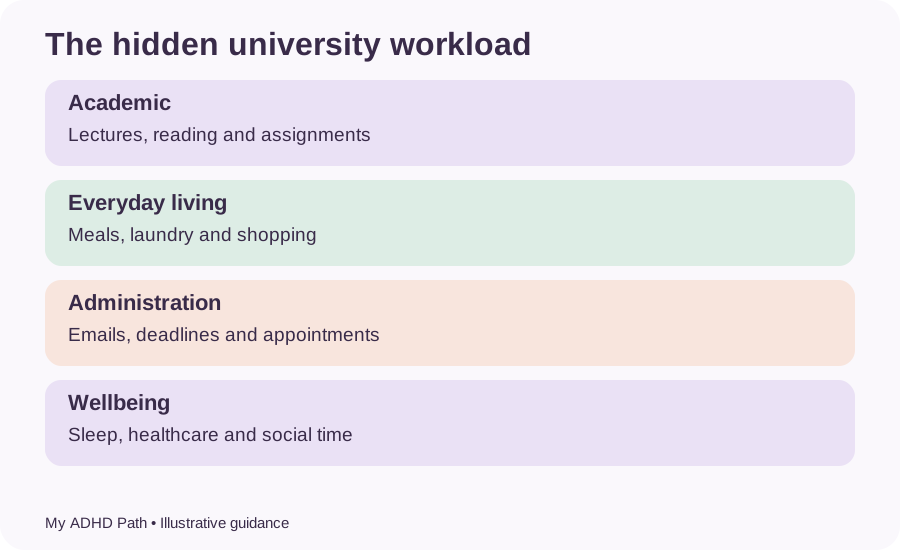
But attending those lectures is only one part of their day.
They also need to remember where each lecture takes place, prepare the necessary materials, monitor emails, complete assigned reading, arrange meals, manage travel and keep track of other responsibilities.
Meanwhile, an assignment is due next week, their prescription needs renewing and theyve agreed to attend a society event that evening.
Their academic timetable captures only a small proportion of what they need to manage.
Your academic timetable captures only a small proportion of what you need to manage.
For some students with ADHD, this hidden workload places considerable demands on executive functioning.
Executive functions help us organise behaviour, manage attention, hold information in mind, prioritise activities and regulate our responses to changing circumstances.
When numerous responsibilities compete for attention, even familiar activities can become more difficult to organise.
Understanding the hidden workload can help you create a more realistic picture of university life.
Twelve common university experiences for students with ADHD
ADHD affects individuals differently, but some students may recognise the following experiences.
1. Finding independent study difficult to organise
You understand the subject but struggle to decide what to study when nobody has provided a specific activity.
2. Underestimating assignment deadlines
An essay that isn't due for another month feels comfortably distant until suddenly it isn't.
3. Missing lectures despite intending to attend
You misjudge the time, overlook an alarm or become distracted while getting ready.
4. Struggling to concentrate during lectures
You can follow particularly interesting explanations but find maintaining attention across longer sessions more difficult.
5. Taking extensive notes without processing them
You focus so much on recording information that you miss the explanation itself.
6. Spending hours researching an interesting topic
You become absorbed in one aspect of your subject while overlooking the original assignment requirements.
7. Finding academic reading particularly demanding
You reach the end of a journal article and realise you cannot explain its main argument.
8. Forgetting administrative responsibilities
Emails, registration requirements, appointments and application deadlines can accumulate.
9. Managing an inconsistent sleep pattern
Social activities, study demands and difficulty disengaging from stimulating activities can affect bedtime routines.
10. Struggling with everyday household responsibilities
Washing, shopping and cleaning compete with more immediate or interesting activities.
11. Spending more money than intended
Convenience purchases, societies, subscriptions and spontaneous social plans can make budgeting difficult.
12. Feeling overwhelmed by everything happening at once
Academic work, friendships, independent living and personal wellbeing can all require attention simultaneously.
These experiences are not diagnostic indicators unique to ADHD.
They are examples of challenges for which appropriate support and practical strategies may be useful.
Choosing an ADHD-friendly university
When comparing universities, students often focus on rankings, entry requirements, facilities and graduate employment prospects.
Those are important considerations.
However, it can also be useful to explore how comfortably youll be able to access the learning experience.
An internationally prestigious university isnt necessarily the best individual fit if its teaching arrangements, accommodation or support provision are unsuitable for your needs.
Consider the following areas.
Course structure
How much scheduled teaching is provided?
How much independent study is expected?
Are there regular practical sessions, tutorials or seminars?
Would you benefit from greater external structure or more flexibility?
Assessment methods
Is the course assessed primarily through examinations, coursework, presentations, practical activities or a combination?
What reasonable adjustments may be available?
Academic support
How accessible are tutors and lecturers?
Are there opportunities to discuss assignments before submission?
Does the university provide academic skills support?
Disability services
How do students register for disability support?
What evidence is required?
What support might be available while applications for external funding are being processed?
Accommodation
Would you prefer a smaller residence, an en-suite room, accommodation close to teaching facilities or a quieter living environment?
Are disability-related accommodation requests considered?
Location
How manageable will travel be?
Would living at home provide a helpful level of stability?
Would moving away offer greater opportunities for independence?
Wellbeing and healthcare
What student health and wellbeing services are available?
How straightforward might it be to arrange ongoing healthcare?
Social opportunities
Are there societies, sports clubs and activities that genuinely interest you?
Does the university offer different ways to participate beyond traditional nightlife?
There isnt a universally ADHD-friendly university.
There are universities whose particular characteristics may be a better fit for your individual needs.
There isnt a universally ADHD-friendly university.
Should you disclose ADHD when applying to university?
Disclosure is generally a personal decision.
UCAS provides opportunities for applicants to share information about disabilities and other support needs.
Sharing information can help universities identify appropriate support and begin relevant conversations before a student arrives.
You may worry that disclosing ADHD could affect your application.
Universities have legal responsibilities relating to disability discrimination, although particular professional courses may involve additional health, safety or competence requirements.
Ask how the university handles disability information, who can access it and how it is used.
You can also contact disability services separately if you prefer to discuss your circumstances directly.
If you decide not to disclose ADHD during your application, that does not necessarily prevent you from requesting support later.
Understanding your disability rights at university
In Great Britain, ADHD can meet the definition of disability under the Equality Act 2010 where the relevant legal criteria are satisfied.
Universities have duties to avoid disability discrimination and make reasonable adjustments where required.
Northern Ireland has a separate disability discrimination framework.
A reasonable adjustment might involve changes to teaching arrangements, assessment conditions, access to learning materials or other aspects of university provision.
Universities do not have to remove genuine competence standards where the law permits those standards.
However, adjustments to the way a student demonstrates competence may still be possible.
This distinction can be particularly relevant to professional courses, laboratory work and placements.
The appropriate adjustments depend on individual circumstances.
If you need advice about a specific legal dispute, seek specialist guidance.
What is Disabled Students Allowance?
Disabled Students Allowance, commonly known as DSA, is financial support intended to address additional study costs associated with a disability or qualifying health condition.
ADHD is among the conditions that may establish eligibility where its effects, the students course and other funding criteria meet the applicable requirements.
DSA is different from an ordinary maintenance loan.
It is not assessed according to household income and does not normally have to be repaid.
The support is determined by individual study-related needs rather than a diagnosis alone.
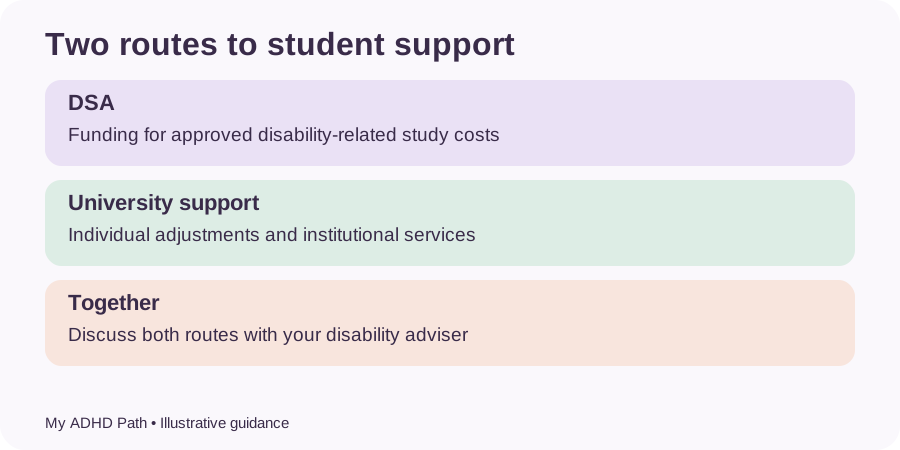
Importantly, DSA and university reasonable adjustments are separate processes.
A university may be able to provide appropriate adjustments even where a student has not applied for DSA.
Good to know
The detailed DSA information in this guide focuses on Student Finance England. Students ordinarily funded through Wales, Scotland or Northern Ireland should consult their respective student finance organisations. Some NHS-funded students and students undertaking other specialised programmes may have different funding routes. The universitys disability service can help you identify which process applies.
How much Disabled Students Allowance could you receive?
For the 2026/27 academic year, the published maximum under the standard Student Finance England DSA scheme is £27,783.
This is a funding limit, not an amount automatically awarded to each eligible student.
Your actual support depends on assessed needs and approved costs.
You should not expect the maximum allowance to be transferred into your personal bank account.
Much of the funding is paid directly to providers supplying approved support.
Funding rules and limits can change, so check the official guidance for your academic year.
What can DSA help pay for?
Depending on the students assessed needs, funding may contribute towards specialist equipment, appropriate software, non-medical support and other additional study-related costs.
Examples worth discussing during a needs assessment include assistive technology that makes academic reading more accessible, specialist study skills support and relevant help with organising or accessing learning.
Where a new computer is approved through the standard Student Finance England scheme, students normally contribute the first £200 towards its cost.
Good to know
Do not purchase equipment or arrange paid support on the assumption that DSA will subsequently reimburse you. Wait for confirmation of what has been approved.
DSA is not general funding for ordinary living expenses, rent, food or the usual costs of being a student.
DSA versus university support
| Disabled Students Allowance | University disability support |
|---|---|
| External funding for eligible additional study costs | Adjustments and services provided by the institution |
| Requires an appropriate application and evidence | Usually begins by contacting university disability services |
| May involve a needs assessment | May involve an individual support discussion |
| Can fund approved specialist resources and assistance | May include teaching and assessment adjustments |
| Funding rules vary by scheme | Provision depends on needs and applicable duties |
You may benefit from both.
The university disability team can help you understand how the different forms of support fit together.
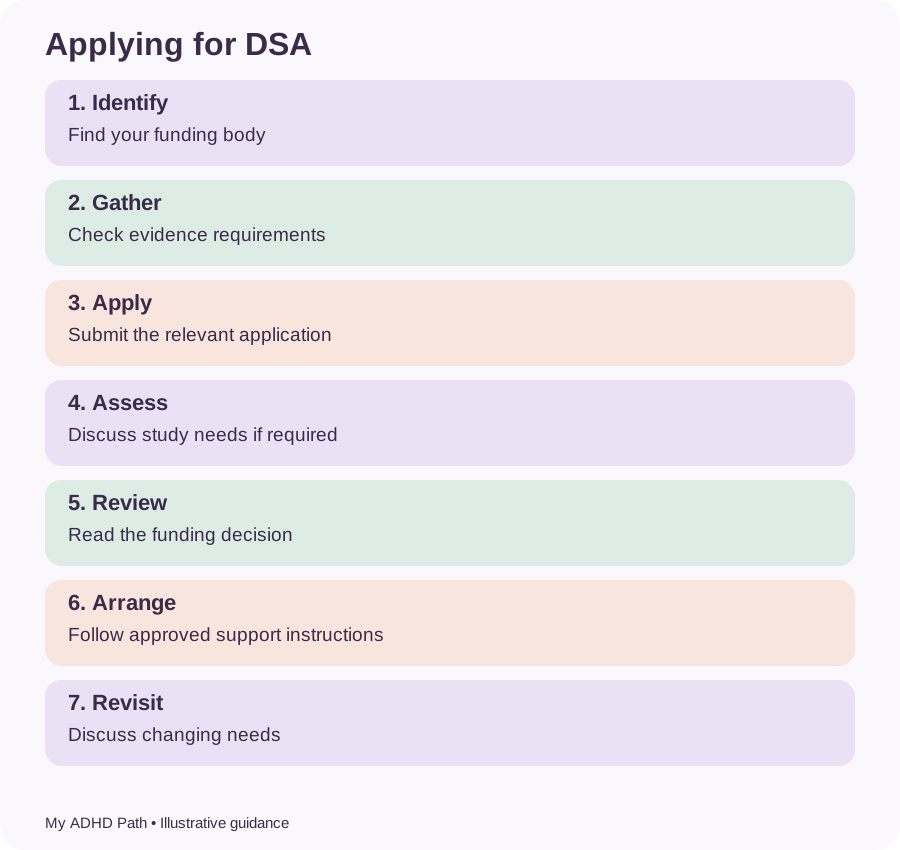
How to apply for Disabled Students Allowance
Step one: Identify the relevant funding body
Establish which student finance scheme applies to your course and circumstances.
For students funded through Student Finance England, application routes depend partly on when the course starts and its type.
Courses starting on or after 1 January 2027 are subject to new application arrangements through the Lifelong Learning Entitlement.
Step two: Gather appropriate evidence
Check the documentation your funding body requires.
You may need a diagnostic report, relevant medical evidence or an accepted alternative.
Ask for clarification if you are uncertain.
Do not assume that an existing school support document will satisfy every evidence requirement.
Step three: Complete the application
Follow the instructions provided by your funding organisation.
You may be able to begin the application alongside your other student finance arrangements.
Step four: Attend a needs assessment
If required, participate in a discussion about the way your disability affects your studies and the support that may be appropriate.
This is not an academic examination or a new ADHD diagnostic assessment.
Step five: Review the outcome
Read your recommendations and funding confirmation carefully.
Check what has been approved, whether you need to contribute towards any costs and how support will be arranged.
Step six: Arrange your support
Follow the instructions provided by the relevant organisation.
Ask about training where specialist technology is involved.
Step seven: Review your needs
If your circumstances or course demands change, contact the relevant disability or funding team to discuss whether a review is appropriate.
The application process can take time.
Begin as early as reasonably possible rather than waiting until assignments have already started accumulating.
Preparing for your DSA needs assessment
Some students find it difficult to explain what they need because theyve become accustomed to managing particular difficulties.
They may not recognise how much additional effort ordinary study activities require.
Before your assessment, consider which situations are particularly demanding.
| Study activity | Difficulty you might describe | Support worth discussing |
|---|---|---|
| Academic reading | Repeatedly rereading material without retaining it | Appropriate reading tools or strategies |
| Lectures | Difficulty listening and taking notes simultaneously | Accessible note-taking arrangements |
| Assignments | Difficulty organising long projects | Specialist study skills support |
| Deadlines | Struggling to monitor multiple submission dates | Appropriate planning strategies or technology |
| Research | Losing track of relevant sources | Information organisation tools |
| Independent learning | Difficulty establishing a manageable study structure | Relevant specialist support |
These are discussion examples, not approved funding categories or guaranteed awards.
Be honest about your experiences.
You dont need to exaggerate your difficulties.
Equally, you do not need to minimise them because youve previously found ways to compensate.
What if youre waiting for an ADHD diagnosis?
You may be starting university while waiting for an assessment.
Contact the disability service and explain your circumstances.
Formal funding and some specialist arrangements may require particular evidence, but universities may have other support that can be accessed while you are waiting.
Academic skills workshops, wellbeing services and some general learning resources may also be available independently of a diagnosis.
Ask what support can be considered now, what documentation is required and how your arrangements might be reviewed later.
Avoid assuming that you have to manage every difficulty independently until your assessment is complete.
What reasonable adjustments might universities provide?
Depending on the individual, course and applicable requirements, adjustments might include:
- Access to teaching materials in advance.
- Permitted lecture recording.
- Accessible formats for learning materials.
- Appropriate examination timing adjustments.
- Rest breaks during assessments.
- An alternative examination environment.
- Agreed approaches to coursework extensions.
- Accessible arrangements for presentations.
- Adjusted methods of communication.
- Appropriate support during placements.
- Individual arrangements relating to attendance or study patterns.
These are possibilities rather than automatic entitlements.
Some adjustments require advance agreement and may be restricted by particular circumstances.
For example, recording a lecture may involve privacy, confidentiality or intellectual property considerations.
Access to an extension may involve an established request process rather than permission to submit any assignment late.
Make sure you understand how your own arrangements work.
What happens to your GCSE and A Level access arrangements?
Support provided during school examinations does not necessarily transfer automatically to university assessments.
Universities operate under their own assessment procedures and institutional policies.
Previous arrangements may provide valuable information about your needs.
However, you may need to register separately with university disability services, provide relevant evidence and discuss how those arrangements translate to your new course.
If you received extra time, supervised rest breaks or other adjustments at school, ask whether you can obtain relevant documentation before leaving.
Our guide to examination access arrangements explains the school-based process in more detail.
Email template: contacting university disability services
What you could say
Subject: ADHD support and preparation for university
Dear Disability Support Team,
I am planning to begin studying [course name] at [university name] in [month and year].
I have ADHD and would like to discuss the support that may be appropriate for my studies.
In particular, I experience difficulties with [briefly describe relevant study or assessment barriers].
Could you please explain how I can register with your service, what documentation is required and whether there are any steps I should take before starting my course?
I would also be grateful for information about reasonable adjustments and any support available with the Disabled Students Allowance process.
Many thanks,
[Name]
If youre awaiting an ADHD assessment, adapt the introductory paragraph to accurately reflect your circumstances.
Avoid sending sensitive medical documents through an unsecured channel unless the university has instructed you to use an appropriate submission method.
Fifteen practical strategies for university life
Accessing formal support is important.
However, there are also everyday changes that can help make academic and independent living responsibilities more manageable.
Strategy 1: Create one reliable calendar
University information can arrive through several different systems.
Your academic timetable may be available through an app.
Assignment deadlines might appear in module handbooks.
Society events arrive through group chats.
Healthcare appointments come through emails or text messages.
Where possible, bring your most important commitments together into one calendar.
Include lectures, seminars, submission deadlines, appointments and relevant personal commitments.
You can retain separate calendars within the same application if that helps you distinguish different responsibilities.
The objective is to have one place where you can see what your day requires.
Strategy 2: Treat independent study as an actual appointment
A two-hour gap between lectures can appear to be free time.
Sometimes it is.
Sometimes its an opportunity to complete the reading or research your course expects.
Instead of relying on an intention to study later, allocate a specific activity to a manageable period.
For example:
Tuesday, 11am: Read the introduction and discussion sections of the assigned psychology paper and write three key points.
Something as simple as specifying the location and first action may make starting easier.
Allow appropriate breaks and genuinely unallocated time too.
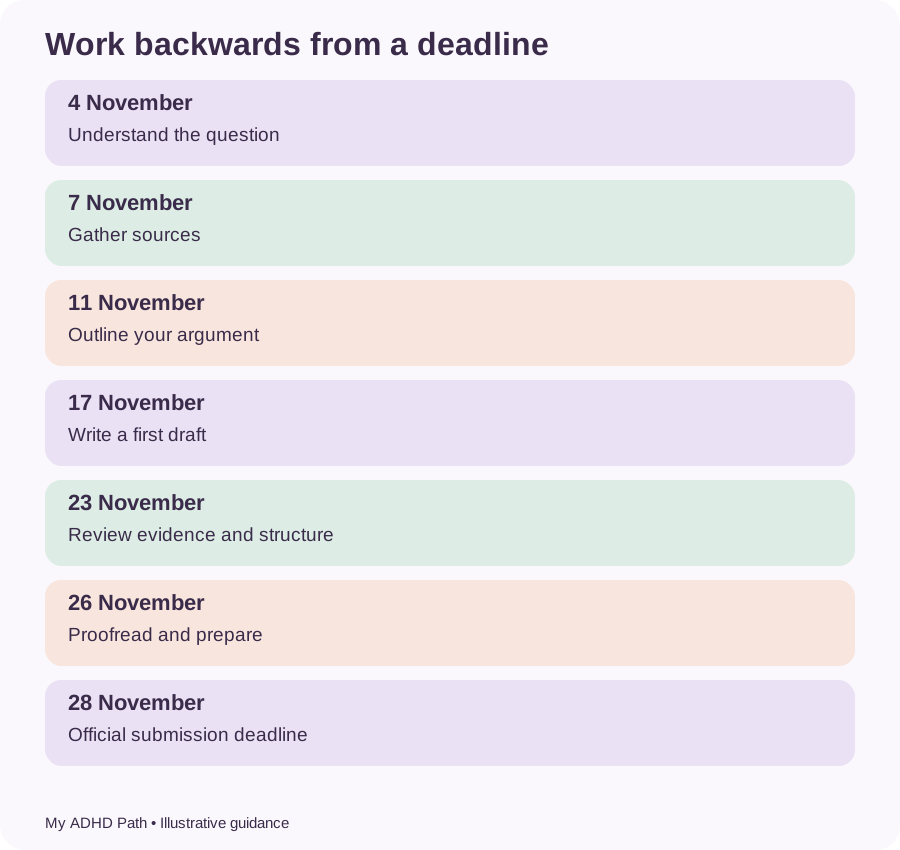
Strategy 3: Work backwards from assignment deadlines
An essay due in four weeks doesnt initially feel particularly urgent.
Breaking it into stages can make its demands more visible.
Imagine a 2,000-word sociology essay due on 28 November.
| Illustrative date | Activity |
|---|---|
| 4 November | Read the question and identify requirements |
| 7 November | Gather relevant academic sources |
| 11 November | Create an initial argument and outline |
| 17 November | Produce a first draft |
| 23 November | Review structure, evidence and citations |
| 26 November | Proofread and prepare submission |
| 28 November | Official deadline |
The timetable is illustrative, not a fixed recommended duration.
Different assignments require different amounts of preparation.
When possible, establish a realistic personal submission target before the official deadline.
That provides some room for unexpected difficulties.
Strategy 4: Turn lectures into questions
Attempting to record everything a lecturer says can make it difficult to process the explanation.
Instead, identify the main questions that the session is helping you answer.
For example, during a lecture about cell biology:
- How do substances cross cell membranes?
- What determines which transport mechanism is used?
- How does active transport differ from facilitated diffusion?
Afterwards, try answering those questions without referring to your notes.
Check your understanding and identify gaps.
This transforms lecture notes into opportunities for retrieval practice rather than simply creating an archive of information.
Strategy 5: Create a reading routine
Academic articles can be dense, lengthy and difficult to approach.
Before reading every paragraph, establish what youre trying to discover.
Where appropriate, begin with the title, abstract, headings and conclusion to develop an overview.
Then read the relevant sections more carefully.
Record the main argument, supporting evidence, limitations and relevance to your assignment.
Different disciplines require different reading approaches.
A law judgment, mathematical proof or philosophical argument may need close sequential reading.
Use your course guidance to establish what is appropriate.
Strategy 6: Keep research organised from the beginning
Finding a useful quotation and subsequently forgetting where it came from is an unnecessarily frustrating experience.
Record reference information as soon as you use a source.
A consistent system might include the author, publication year, title, relevant page numbers, DOI or URL and your own notes.
Reference management software such as Zotero may help organise academic sources.
Always check generated citations against the referencing style required by your department.
Clearly distinguish direct quotations from paraphrased ideas and your own observations.
Strategy 7: Choose a regular study location
Deciding where to study creates another choice that must be made before learning begins.
You might designate a particular library area, an available study room or a familiar desk as your default location.
Keep alternatives for circumstances when that environment is unavailable.
Some students concentrate most comfortably in silence.
Others prefer a moderate amount of background activity.
Experiment with different conditions and observe which help you actually engage with the work.
An attractive study environment isnt necessarily an effective one.
Strategy 8: Give university administration its own time
Administrative tasks are often individually manageable but collectively overwhelming.
Try allocating a regular period to activities such as checking university emails, updating deadlines, completing forms, arranging appointments and responding to accommodation messages.
Twenty minutes twice a week might be a useful starting experiment.
Urgent or time-sensitive communications may require more immediate attention.
Having a regular opportunity to address administration can reduce the number of unresolved tasks competing for your attention during academic work.
Strategy 9: Make food an uncomplicated part of your day
Meal preparation can become surprisingly demanding when your attention is occupied by everything else.
Establish several simple meals you know how to prepare.
Keep suitable ingredients available.
Consider portable snacks or lunches if your timetable involves long periods away from home.
Make food shopping a predictable part of your week.
If ADHD medication affects your appetite, discuss persistent difficulties with your prescribing clinician.
Adequate food is part of supporting your everyday health, not something you need to earn by completing your coursework first.
Strategy 10: Establish a realistic money system
A maintenance loan payment can arrive as a substantial lump sum.
Unfortunately, it may need to last considerably longer than the enthusiasm it initially generates.
A maintenance loan payment can arrive as a substantial lump sum. Unfortunately, it may need to last considerably longer than the enthusiasm it initially generates.
Identify essential costs first.
Then establish what remains for everyday expenditure and activities.
Consider keeping rent and bills separate from money available for ordinary spending.
A weekly spending amount may be easier to monitor than a single term-long balance.
If your income is insufficient to meet essential costs, contact your universitys student money advice team.
Budgeting tools cannot resolve a genuine shortfall in available income.
Strategy 11: Build flexible household routines
Living independently involves numerous recurring responsibilities.
Try establishing simple anchors rather than relying on remembering each activity separately.
For example:
- Start a load of washing after Saturday breakfast.
- Check food supplies before your weekly shop.
- Empty your bag and prepare tomorrows essentials before bed.
- Keep a designated place for your keys and student ID.
The specific routines should reflect your accommodation, timetable and preferences.
They dont need to resemble anybody elses version of independent living.
Strategy 12: Protect sleep and recovery time
University offers plenty of opportunities to stay awake considerably later than originally intended.
Occasional late nights may be part of your experience.
Persistent sleep difficulties, however, can affect concentration, memory, emotional wellbeing and everyday functioning.
Where possible, establish a reasonably consistent sleep routine.
Allow time to disengage from studying and social activities.
If you have ongoing sleep difficulties or concerns about medication, seek appropriate healthcare advice.
Strategy 13: Develop a sustainable social life
Joining clubs and societies can provide opportunities to meet people, explore interests and develop a sense of belonging.
During the first few weeks, it may be tempting to join absolutely everything.
You are allowed to explore without committing to every available activity.
Choose a manageable number of regular commitments.
Give yourself opportunities to rest between demanding events.
You dont need to reproduce somebody elses university social experience to have a good one of your own.
Strategy 14: Ask for help before a problem becomes urgent
When assignments are difficult, some students wait until they have exhausted every possible independent solution before contacting a tutor.
By that point, the deadline may be approaching rapidly.
Learning to ask helpful questions earlier can be valuable.
Instead of saying, "I dont understand the essay," you might explain:
"Ive identified two possible arguments, but Im struggling to work out which addresses the question more directly. Could we discuss the assignment requirements?"
You do not need to have completely resolved the problem before asking for support.
Strategy 15: Create a way to restart after a difficult week
Your calendar will occasionally stop working.
You may miss a lecture, fall behind with reading or spend several days managing unexpected circumstances.
Rather than redesigning your entire life, identify the next useful action.
Check which deadlines are genuinely urgent.
Establish what needs communicating.
Choose one manageable academic task.
Restore essential everyday routines.
And contact appropriate support if difficulties are becoming persistent.
An effective system needs to accommodate interruptions.
University rarely progresses in an uninterrupted sequence of perfectly organised weeks.
How to structure independent study
Independent learning is one of the biggest adjustments for many students entering higher education.
The instruction "complete independent study" can feel rather vague.
Instead, establish a purpose for each session.
You might use four stages.
Prepare: Identify the question or activity youre working on.
Learn: Read, listen, explore or review appropriate materials.
Practise: Explain, retrieve, analyse or apply the information.
Check: Identify what you understand and what requires further attention.
For example, a 45-minute academic reading session might involve:
| Time | Activity |
|---|---|
| 5 minutes | Establish the purpose of reading |
| 20 minutes | Read relevant sections |
| 10 minutes | Summarise the central argument and evidence |
| 10 minutes | Check interpretation and record the reference |
There is no universal ADHD study duration.
Adjust the activity and timings according to the material and your needs.
Our revision strategies guide explores retrieval practice, spaced repetition and other learning techniques in more detail.
Managing several assignments simultaneously
University assignments frequently overlap.
You may have an essay, a laboratory report and a presentation all progressing at the same time.
Rather than maintaining separate plans that compete for attention, create one overview.
| Assignment | Deadline | Current stage | Next action |
|---|---|---|---|
| Psychology essay | 28 November | Research | Read two relevant papers |
| Statistics report | 2 December | Analysis | Check assumptions for the selected test |
| Group presentation | 5 December | Planning | Confirm responsibilities with the group |
The important column is often the last one.
Knowing that an assignment exists is different from knowing what to do about it.
Knowing that an assignment exists is different from knowing what to do about it.
When you have a specific next action, you can begin without reconstructing the entire project each time.
Managing group projects with ADHD
Group assignments introduce additional demands.
There are shared deadlines, discussions, messages and expectations about who completes which responsibilities.
Misunderstandings can arise when tasks have not been clearly allocated.
At the beginning of a project, establish:
- Who is responsible for each activity.
- When each contribution is expected.
- Where shared documents will be stored.
- How the group will communicate.
- When progress will be reviewed.
Keep important agreements somewhere everyone can access them.
If you are struggling with an allocated responsibility, communicate early rather than allowing uncertainty to build.
You do not necessarily need to disclose your diagnosis to group members to ask for clear communication and agreed deadlines.
Practical courses, laboratories and placements
Students undertaking laboratory-based, engineering, healthcare, teaching or other professional courses may have additional responsibilities.
These environments can involve detailed procedures, safety requirements and expectations about professional competence.
Discuss relevant support before beginning a placement or practical activity.
Possible approaches might include accessible written instructions, approved checklists, appropriate supervision and environmental adjustments.
Any arrangements must remain compatible with safety, confidentiality and professional requirements.
Do not introduce personal electronic devices, recording tools or AI systems into restricted environments without permission.
The disability service and placement coordinator can help establish how support might operate.
Choosing your accommodation
Where you live can have a considerable effect on your everyday experience.
Some students benefit from having teaching facilities, shops and public transport within easy reach.
Some prefer quieter accommodation.
Others find shared living helpful because it provides regular social interaction and informal structure.
Before making a decision, consider:
- Travel time to teaching facilities.
- Noise levels and building layout.
- Kitchen and bathroom arrangements.
- Laundry facilities.
- Storage space.
- Available study environments.
- Total cost.
- Contract requirements.
- Accessibility and relevant support options.
Ask whether the university considers disability-related accommodation requests and what evidence is needed.
Do not assume that particular room types, reduced charges or guaranteed accommodation are automatically available.
Living with housemates
Shared accommodation brings together people with very different expectations about cleaning, noise, food and personal space.
A conversation about everyday arrangements can prevent surprisingly large disagreements about surprisingly small things.
Discuss how shared spaces will be maintained.
Establish which purchases are communal.
Agree how bills will be paid if relevant.
Communicate preferences around visitors and quiet periods.
You do not need to explain every aspect of ADHD to establish reasonable household arrangements.
However, if you feel comfortable disclosing your diagnosis, it may help others understand why certain systems are useful to you.
Responsibility for shared commitments still matters.
The objective is to establish a way of managing those commitments that works for everyone.
Making friends without exhausting yourself
University can involve an extraordinary number of social opportunities.
There are introductory events, societies, course activities, group chats, parties and countless conversations with people youll almost certainly forget youve already met.
Socialising can be enjoyable while also requiring significant energy.
Some students find themselves agreeing to plans because they are genuinely interested.
Others worry that declining an invitation means missing an opportunity to establish friendships.
Remember that regular, smaller interactions can also help friendships develop.
You might see somebody at a weekly sports session, study with a coursemate or attend a society that meets regularly.
You dont need to attend every event during your first fortnight to create meaningful connections over the next three years.
Alcohol, substances and university life
University social activities sometimes involve alcohol or other substances.
Research indicates that ADHD is associated with an increased risk of certain substance-related difficulties at a population level.
That does not mean every person with ADHD will experience these problems.
You can choose social activities that do not involve drinking.
If you take prescribed medication, discuss potential interactions with alcohol or other substances with your clinician or pharmacist.
Never share prescribed ADHD medication with another student or use medication prescribed to somebody else.
If you become concerned about your own substance use, contact an appropriate healthcare professional or student support service.
Seeking help early can make it easier to address emerging difficulties.
Managing ADHD medication when you move to university
If youre receiving ADHD treatment, establish a plan for continued care before moving.
Moving to a different area does not necessarily mean that prescribing or specialist care arrangements will automatically transfer.
Contact your current ADHD service and GP.
Ask how ongoing prescriptions, monitoring and specialist reviews will be managed.
If you plan to register with a new GP, clarify whether your prescribing arrangements can continue and whether any additional steps are required.
Shared care arrangements can vary, and a new practice may not automatically accept an existing arrangement.
Consider the following questions:
- Who will remain responsible for prescribing?
- Where will prescriptions be collected?
- How will repeat prescriptions be requested?
- When is the next medication review?
- What monitoring is required?
- Who should be contacted if difficulties arise?
Keep medication securely stored and follow the prescribed instructions.
Do not adjust doses independently to accommodate late-night studying, examinations or social activities.
If you experience appetite changes, sleep difficulties or other concerns, discuss them with your prescribing clinician.
What about going to university without medication?
Some people with ADHD do not take medication.
Others are awaiting treatment, have chosen a different approach or have previously found particular medications unsuitable.
University support should consider your individual needs.
Practical adjustments, academic support and accessible study strategies may be helpful whether or not you take medication.
Decisions about treatment should be made with an appropriately qualified healthcare professional.
There is no requirement to organise your university life around somebody elses treatment choices.
Managing money throughout a university term
University finance can be challenging because substantial costs often need to be covered over extended periods.
Consider a fictional student who has £3,600 available for a twelve-week period after setting aside money for other commitments.
| Category | Amount |
|---|---|
| Rent | £2,040 |
| Essential bills and fixed costs | £240 |
| Groceries | £420 |
| Transport | £180 |
| Social and personal spending | £480 |
| Emergency reserve | £240 |
| Total | £3,600 |
After reserving rent, bills and emergency savings, this student has £1,080 remaining for groceries, transport and social spending.
Over twelve weeks, thats an illustrative £90 per week.
These figures are not an estimate of typical university costs or recommended student spending.
Actual costs vary considerably according to accommodation, location and individual circumstances.
Students who cannot meet essential costs should contact their universitys money advice or hardship support team.
Our ADHD and Money guide explores practical budgeting techniques in greater detail.
Working alongside your degree
Many students undertake paid work during university.
Working can provide additional income, experience and a useful source of routine.
It can also create another collection of deadlines, shifts and travel commitments.
Consider how work might fit around your course requirements.
Some degrees have particularly demanding timetables or full-time placements.
International students may also be subject to restrictions on permitted working hours.
If youre considering part-time employment, explore roles whose hours and working conditions are compatible with your studies.
You may also be able to discuss reasonable workplace adjustments or investigate Access to Work where appropriate.
Employment support and Disabled Students Allowance have different purposes and eligibility requirements.
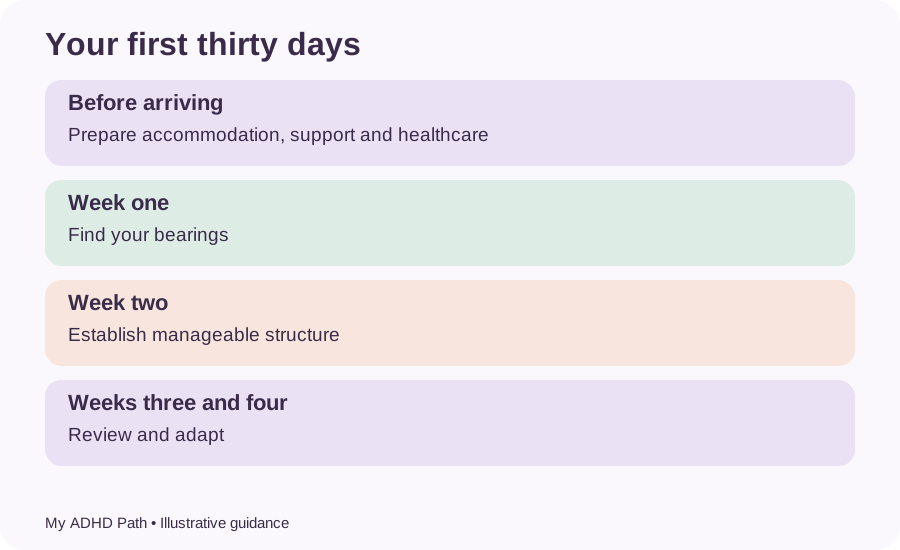
The first thirty days
You dont need to establish every aspect of university life during freshers week.
It may be more manageable to think of the first month as a period of exploration and adjustment.
Before arriving: Prepare
Confirm accommodation and registration arrangements.
Contact disability services.
Review healthcare and financial arrangements.
Identify any outstanding DSA application steps.
Week one: Find your bearings
Locate teaching buildings and essential facilities.
Understand your timetable.
Explore food shopping, transport and accommodation arrangements.
Meet people at a pace that suits you.
Week two: Establish structure
Begin monitoring assignment deadlines.
Identify a suitable study environment.
Create manageable household routines.
Check whether agreed support is being implemented.
Weeks three and four: Review
Notice which activities are becoming difficult to manage.
Discuss concerns with relevant staff.
Adjust your routines and study practices.
Choose social commitments you genuinely want to continue.
This is a flexible transition framework rather than a compulsory schedule.
Some arrangements may take longer, and some students will need additional support before or after these stages.
When university life becomes overwhelming
There may come a point when everything seems to require your attention at once.
Youve missed several lectures.
An assignment is due.
You havent replied to an important email.
Your accommodation needs cleaning.
And youre struggling to remember the last time you had a particularly good nights sleep.
Trying to resolve every problem simultaneously may create further overwhelm.
Instead, begin by reducing the demands competing for your attention.
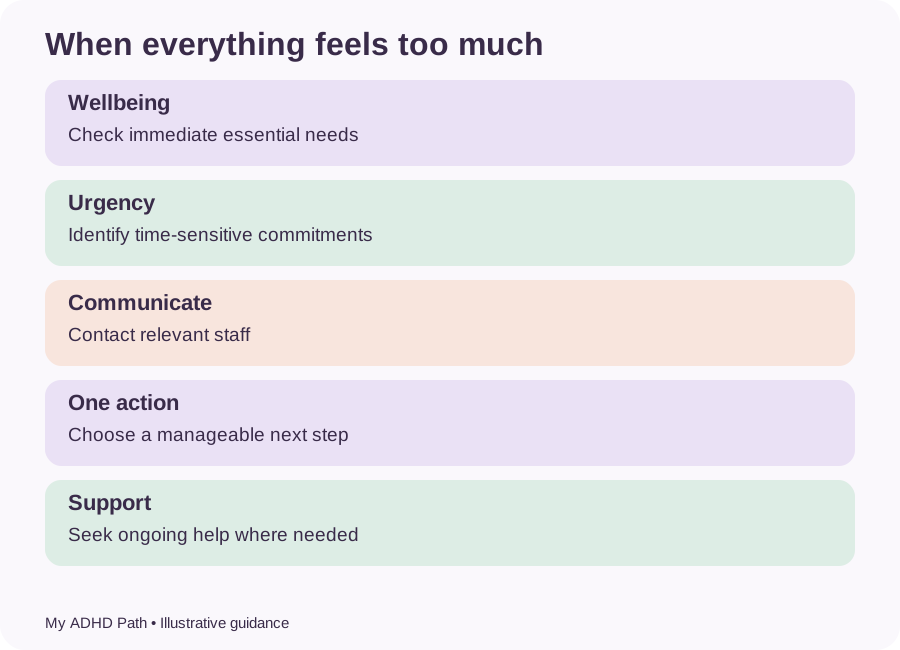
First: Consider immediate wellbeing
Are you able to meet essential needs such as food, sleep, safety and healthcare?
Second: Identify urgent responsibilities
Which commitments have genuinely immediate consequences?
Third: Communicate
If a deadline, attendance requirement or other responsibility is becoming difficult to meet, contact the appropriate staff member.
Fourth: Choose one manageable action
This might involve arranging an appointment, opening an assignment brief or replying to an important message.
Fifth: Seek ongoing support
If difficulties continue, arrange a discussion about academic, disability or wellbeing support.
Sometimes reducing study demands temporarily or exploring an interruption to studies may be appropriate.
Check the academic, financial, accommodation and immigration implications before making significant changes to your course.
What if youre considering dropping out?
There are many reasons somebody might decide university is no longer right for them.
Their interests may have changed.
Financial circumstances may have become difficult.
The course may not be what they expected.
Or their current support arrangements may be inadequate.
Before making a major decision during a particularly difficult period, consider discussing your circumstances with an academic adviser, disability service or students union advice team.
Possible options may include changing course, adjusting your study pattern, taking an authorised interruption or accessing additional support.
The availability and consequences of each option vary.
Leaving university is not inherently a failure.
Neither is choosing to continue with additional help.
The important thing is to make an informed decision about what is appropriate for your circumstances and future.
Three different university experiences
The following scenarios are fictional illustrations.
Illustrative scenario
Sam, 19 - The unstructured timetable
Sam begins studying computer science.
He enjoys programming but finds the gaps between teaching sessions difficult to organise.
He regularly spends hours exploring interesting coding problems while overlooking assignments that feel less immediately engaging.
With support, he establishes a regular library session, records specific next actions for each assignment and begins using an external reminder system.
He discovers that independent study becomes more manageable when he creates some of the structure previously provided by school.
Illustrative scenario
Leila, 21 - Managing academic work and everyday life
Leila starts university after spending time working and travelling.
She adjusts well to the academic demands but finds cooking, budgeting and household responsibilities particularly exhausting.
She establishes a regular shopping routine, simplifies her meals and creates a designated period for household administration.
Reducing the number of unresolved everyday decisions helps her create more time and capacity for studying.
Illustrative scenario
Ben, 24 - Discovering ADHD during postgraduate study
Ben has always achieved academically but experiences increasing difficulty managing a substantial independent research project.
After seeking professional advice, he receives an ADHD diagnosis.
He contacts his university disability service and discusses relevant adjustments, study support and possible funding.
He begins developing research routines that help him organise information and monitor his progress.
His diagnosis provides another way of understanding his experiences and identifying appropriate support.
Create your personal university support profile
You might find it helpful to identify your own preferences and needs before starting university.
| Question | Illustrative answer |
|---|---|
| What helps me concentrate? | A quiet library space |
| What makes starting assignments difficult? | Unclear instructions and large tasks |
| How do I remember commitments? | Calendar alerts |
| Which learning methods help me? | Discussion and independent practice |
| What support did I use at school? | Extra time and access to written instructions |
| Which everyday responsibilities are difficult? | Shopping and remembering appointments |
| What helps me maintain wellbeing? | Regular meals, exercise and adequate sleep |
| Who can I contact for support? | Disability adviser, tutor and GP |
You can update your profile as you learn more about your university environment.
You do not need to anticipate every possible difficulty in advance.
Using AI as a university study assistant
AI can help organise information, explore unfamiliar concepts and create more manageable starting points for academic activities.
It may also support some of the administrative demands of university life.
However, universities have different policies governing AI use.
An approach permitted for private revision may not be permitted for assessed coursework.
Always check your institutions academic integrity requirements.
AI prompt
Break down an assignment
"Here is my assignment brief. Help me identify the stages involved and create a realistic sequence of activities. Don't write the assessed content for me."
AI prompt
Understand academic reading
"Explain these concepts in straightforward language. Distinguish the information I've supplied from additional explanations and flag anything uncertain."
AI prompt
Prepare a study session
"I have forty-five minutes before my next lecture. Help me create a manageable study activity for this topic, including a way to check my understanding."
AI prompt
Organise overlapping deadlines
"Here are my deadlines and current progress. Help me identify which activities require attention first and suggest the next practical action for each."
AI prompt
Practise explaining a concept
"Ask me questions about this topic one at a time. Wait for my answer and help me identify gaps in my understanding."
AI prompt
Prepare for a meeting
"Help me organise my concerns into a clear agenda for a meeting with my academic tutor. Don't invent circumstances or make unsupported claims."
AI prompt
Restart after falling behind
"Here are the commitments I've missed and the activities currently outstanding. Help me identify urgent communications and create a manageable plan for today."
AI can invent academic references, misinterpret research and produce inaccurate calculations.
Verify information against original sources.
Do not upload confidential research, placement records, patient information or other restricted material.
Use AI to support your learning and organisation, not to misrepresent somebody elses work as your own.
How parents can support university students with ADHD
When a young person moves to university, the relationship between parents and children often begins to change.
You may have spent years helping them remember appointments, manage homework or organise everyday responsibilities.
Suddenly, youre receiving messages asking how long chicken lasts in the fridge.
And occasionally nothing else for several days.
Supporting increasing independence can involve finding a new balance.
Discuss how frequently your child would like to communicate.
Offer help with preparing for unfamiliar responsibilities.
Encourage them to contact appropriate university services.
Help them explore systems they can manage themselves.
Avoid expecting immediate independence across every area of university life.
Adult students ordinarily control their own personal and educational information, subject to relevant exceptions and safeguarding responsibilities.
Universities may not be able to discuss an adult students circumstances with parents without appropriate permission.
Agree in advance how your child would like you to support them if difficulties arise.
Independence can include knowing when and how to ask for help.
What does the research say about ADHD at university?
What the research says
Research into ADHD and higher education has identified associations with difficulties involving academic organisation, time management, educational attainment and psychological wellbeing.
However, university students with ADHD are a diverse population.
Their experiences are influenced by numerous factors, including symptom profiles, academic preparation, financial circumstances, other health conditions and available support.
Research into general learning strategies provides evidence supporting retrieval practice, distributed learning and other approaches discussed in our revision guide.
Research into ADHD-specific interventions for university students is developing.
Some structured programmes combining cognitive behavioural approaches and organisational skills support have produced encouraging results.
However, there is no single intervention that guarantees academic success for every student with ADHD.
Formal support and practical adjustments should be considered according to individual needs.
When to seek additional professional support
University life can be demanding, particularly during periods of transition.
Seek appropriate support if you experience:
- Persistent difficulty attending or engaging with your course.
- Repeated missed deadlines despite attempts to manage them.
- Significant changes in sleep, appetite or everyday functioning.
- Increasing anxiety or low mood.
- Persistent feelings of isolation.
- Difficulties obtaining or managing prescribed medication.
- Financial hardship affecting essential needs.
- Concerns about alcohol or other substance use.
- Thoughts of harming yourself.
Your university may provide disability support, counselling, mental health services, academic advice and financial guidance.
Your GP and other appropriate healthcare professionals can also help assess your needs.
Student Space, provided by Student Minds, offers information and resources relating to student wellbeing.
In the UK, Samaritans can be contacted free on 116 123.
If you or somebody else is in immediate danger, call 999 or attend A&E.
Frequently asked questions
Can you go to university with ADHD?
Yes. ADHD does not determine intelligence or prevent somebody from undertaking higher education. Appropriate support can help address individual barriers.
Can students with ADHD receive Disabled Students' Allowance?
Potentially, yes. Eligibility depends on the effect of ADHD on studying, appropriate evidence and the applicable funding criteria.
How much DSA do students with ADHD receive?
There is no standard ADHD-specific award. Approved support depends on assessed needs and the relevant funding arrangements.
Does DSA need to be repaid?
Ordinary approved DSA support does not normally need to be repaid, unlike a student loan.
Can I get a laptop through DSA?
Potentially, if equipment is approved because of disability-related study needs. Check the relevant funding conditions and any required contribution.
Can I receive specialist ADHD study support?
Specialist support may be available through external funding or university provision, depending on your assessed needs and applicable arrangements.
Do I have to disclose ADHD when applying to university?
Disclosure is generally a personal decision. Sharing information can help you access appropriate support and prepare for your course.
Can I get support without a formal ADHD diagnosis?
Some university services and adjustments may be available based on individual needs. Particular funding or specialist arrangements can require formal evidence.
Will my school examination arrangements continue automatically?
No. Universities have their own procedures, and previous arrangements may need to be reviewed.
Can university students with ADHD get extra time?
Potentially, where additional time is an appropriate adjustment under the university's procedures.
Can I get coursework deadline extensions?
Some students may receive agreed flexibility or access to extension processes. Confirm how arrangements operate at your institution.
Is it better to live at home or move away?
Neither option is universally better for students with ADHD. Consider your support needs, finances, independence, travel and preferred living environment.
Can I change GP when I move to university?
Generally, students can register with an appropriate GP practice near their university. Discuss ongoing specialist care and prescribing arrangements before transferring.
Can I apply for DSA after starting university?
Yes, applications can generally be made during eligible studies. Check the relevant funding body's procedures.
What if I receive an ADHD diagnosis during my degree?
Contact your university disability service to discuss appropriate support and whether you may qualify for relevant funding.
Can students with ADHD study medicine, engineering or law?
Yes. Students with ADHD pursue a wide variety of degrees. Professional courses may involve specific competence, safety and other requirements, with appropriate adjustments considered individually.
Can I take a break from university if I'm struggling?
An authorised interruption may be possible. Discuss the university's procedures and potential academic and financial consequences before making a decision.
Is university harder for people with ADHD?
Experiences vary considerably. Some students find independent organisation difficult, while others thrive with greater freedom and the opportunity to specialise in subjects they enjoy.
Making university your own
University doesnt have to be three years of perfectly organised mornings, meticulously maintained lecture notes and consistently clean kitchens.
That sounds rather exhausting, quite apart from being an unlikely description of most student households.
What matters is developing an approach that supports your learning, wellbeing and enjoyment of the experience.
You may discover that you concentrate best in a quiet corner of the library.
That weekly planning helps you manage deadlines.
That you enjoy playing sport more than going out every evening.
Or that asking for support makes it possible to enjoy a subject youve always loved.
Some of these discoveries will happen through preparation.
Others will happen as you go along.
You dont need to arrive at university already knowing how to manage everything.
You dont need to arrive at university already knowing how to manage everything.
Part of the experience is learning what works for you.
And that can be an education every bit as valuable as the one described in your course handbook.
Sources and further reading
- GOV.UK - Disabled Students Allowance. https://www.gov.uk/disabled-students-allowance-dsa
- GOV.UK - Disabled Students Allowance eligibility. https://www.gov.uk/disabled-students-allowance-dsa/eligibility
- GOV.UK - How to apply for Disabled Students Allowance. https://www.gov.uk/disabled-students-allowance-dsa/how-to-claim
- Student Finance Wales. https://www.studentfinancewales.co.uk/
- Student Awards Agency Scotland. https://www.saas.gov.uk/
- Student Finance Northern Ireland. https://www.studentfinanceni.co.uk/
- UCAS. https://www.ucas.com/
- Equality Act 2010. https://www.legislation.gov.uk/ukpga/2010/15/contents
- DuPaul, G. J., Weyandt, L. L., ODell, S. M. and Varejao, M. (2009). College students with ADHD: Current status and future directions. Journal of Attention Disorders.
- Anastopoulos, A. D. et al. (2021). A randomised controlled trial examining CBT for college students with ADHD. Journal of Consulting and Clinical Psychology.
- Dunlosky, J. et al. (2013). Improving students learning with effective learning techniques. Psychological Science in the Public Interest. https://doi.org/10.1177/1529100612453266
- Diamond, A. (2013). Executive functions. Annual Review of Psychology. https://doi.org/10.1146/annurev-psych-113011-143750
- Faraone, S. V. et al. (2021). The World Federation of ADHD International Consensus Statement: 208 evidence-based conclusions about the disorder. Neuroscience & Biobehavioral Reviews. https://doi.org/10.1016/j.neubiorev.2021.01.022
- NICE - Attention deficit hyperactivity disorder: diagnosis and management (NG87). https://www.nice.org.uk/guidance/ng87
- Student Minds. https://www.studentminds.org.uk/
- Student Space. https://studentspace.org.uk/
- MoneyHelper. https://www.moneyhelper.org.uk/
- Samaritans. https://www.samaritans.org/
Student Finance England DSA guidance checked on 18 November 2026. Funding requirements, application procedures and university policies are subject to change. This article provides general educational information rather than individual medical, legal or financial advice. All personal scenarios, budgets and planning schedules are illustrative.