

An examination should assess what a student knows and understands, rather than how successfully they can manage the barriers that stand between them and demonstrating it.
At a glance
- ADHD does not automatically qualify students for a particular examination adjustment.
- Individual needs and relevant evidence determine eligibility.
- Additional working time and supervised rest breaks serve different purposes.
- Educational support can be discussed before a formal ADHD diagnosis.
- An EHCP is not a universal requirement.
- Parents should discuss potential arrangements early.
- Different qualifications and jurisdictions may use different rules.
Good to know
This article focuses primarily on GCSEs and A Levels covered by Joint Council for Qualifications (JCQ) access arrangement regulations. The regulatory information has been reviewed against the March 2026 amended guidance, which JCQ states continues to apply during the 2026/27 academic year. Different rules may apply to other qualifications, Scottish examinations, university assessments and international examination systems.
Your child comes home from a maths mock examination.
You ask how it went.
"Fine. I knew most of it."
Excellent.
Except, as the conversation continues, you discover they didn't answer the last six questions.
They spent too long on one problem.
Lost their place several times.
Forgot to return to a question they'd skipped.
And became increasingly distracted by somebody repeatedly clicking a pen.
When they eventually receive their results, the grade doesn't seem to reflect the knowledge they've demonstrated at home.
As a parent, it's frustrating.
You know what your child is capable of.
Their teachers may know what they're capable of too.
But somehow, under examination conditions, that ability isn't being fully reflected in their performance.
For some students with ADHD, this is where examination access arrangements can make a considerable difference.
Unfortunately, understanding what support is available, how eligibility works and who is responsible for arranging it can feel like another examination entirely.
This guide is designed to make that process easier.
A note about the current examination regulations
This article focuses primarily on GCSEs and A Levels covered by Joint Council for Qualifications (JCQ) access arrangement regulations.
The regulatory information has been reviewed against the March 2026 amended guidance, which JCQ states continues to apply during the 2026/27 academic year.
Different rules may apply to other qualifications, Scottish examinations, university assessments and international examination systems.
Always check which regulations apply to your child's particular qualifications and examination series.
What are examination access arrangements?
Access arrangements are adjustments that enable eligible students to access examinations and assessments more fairly.
They are designed to address barriers associated with a disability, learning difficulty, medical condition or other qualifying need.
They might involve how an examination is timed, where it takes place, how a student records their answers or what assistance is available during the assessment.
The purpose is not to make the examination academically easier.
Students are still assessed against the relevant qualification requirements.
The purpose is to reduce barriers that might otherwise prevent them from demonstrating their knowledge, understanding and skills.
Why ADHD can affect examination performance
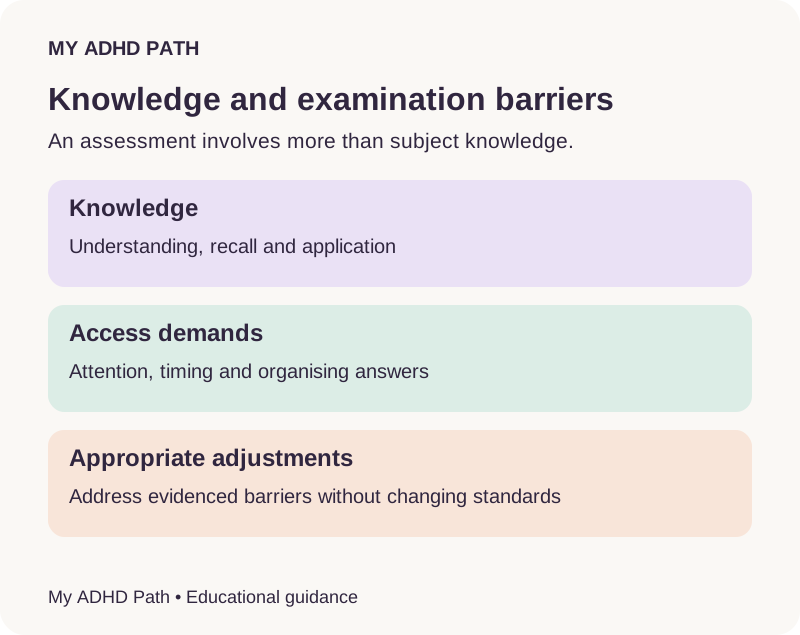
An examination requires considerably more than knowing the subject.
Students must also manage a collection of simultaneous cognitive demands.
They need to:
- Read and interpret instructions.
- Allocate time appropriately.
- Retain information while completing questions.
- Move between different topics.
- Maintain attention.
- Ignore irrelevant distractions.
- Retrieve previously learnt information.
- Organise written answers.
- Monitor their progress.
- Check their work.
For some students with ADHD, several of these activities require additional effort.
A student may understand a complicated scientific concept but struggle to maintain attention throughout a lengthy examination.
Another may have excellent mathematical understanding but repeatedly lose their place in multistep calculations.
Another may be able to produce insightful literary analysis during lessons but find organising their thoughts under timed conditions particularly difficult.
These difficulties do not necessarily reflect a lack of academic ability or preparation.
They may reflect barriers associated with the conditions in which the student is being assessed.
What an examination result can and cannot tell you
Imagine two students taking the same examination.
Both understand the subject equally well.
One comfortably manages the time available, moves between questions and maintains concentration.
The other repeatedly loses their place, becomes distracted and struggles to return to unfinished questions.
The second student may complete considerably less of the examination.
Their final marks may therefore reflect a combination of subject knowledge and the difficulties they experienced accessing the assessment.
Access arrangements aim to address appropriate disability-related barriers while preserving the skills the examination is intended to assess.
They cannot remove every difficulty associated with examinations.
They can, however, provide a more accessible opportunity for eligible students to demonstrate what they know.
Understanding a subject and managing the conditions under which you're assessed are different skills.
Does an ADHD diagnosis automatically qualify a student for extra time?
No.
This is probably the most important distinction for parents to understand.
An ADHD diagnosis does not automatically entitle a student to 25% extra time, a separate examination room or any other specific adjustment.
Eligibility depends on individual needs, the effect of those needs on assessments, the evidence available and the applicable regulations.
Two students with ADHD may experience entirely different examination difficulties.
One may need additional working time.
Another may benefit more from rest breaks.
Another may need support managing distractions.
Some may not require any formal examination adjustments.
The question isn't simply whether a student has ADHD. It's what barriers they experience.
The question isn't simply whether a student has ADHD.
It's what barriers they experience and which arrangements would appropriately address them.
ADHD and the Equality Act
In Great Britain, ADHD can meet the definition of disability under the Equality Act 2010.
Broadly, the Act considers whether a physical or mental impairment has a substantial and long-term adverse effect on someone's ability to carry out normal day-to-day activities.
Whether an individual with ADHD meets this definition depends on their circumstances.
Educational institutions and relevant qualifications bodies have duties relating to disability discrimination and reasonable adjustments.
However, the duty to make reasonable adjustments does not mean that every requested arrangement must automatically be provided.
The adjustment needs to be appropriate to the circumstances, taking account of the relevant legal duties and assessment requirements.
Northern Ireland has a separate disability discrimination framework.
Parents who require advice about a particular legal dispute should seek appropriate specialist guidance.
Access arrangements and reasonable adjustments: what's the difference?
You will often encounter these terms together.
A reasonable adjustment is a measure intended to address a disability-related disadvantage under the applicable legal framework.
Access arrangements are the mechanisms through which many assessment adjustments are organised and implemented.
Some access arrangements can also address temporary injuries or other circumstances.
For a parent, the practical starting point is usually the same: identifying the student's difficulty and discussing what support the examination centre can appropriately provide.
Twelve signs your child may need examination support
Not every student will recognise these experiences, and none establishes automatic eligibility.
However, they may provide useful starting points for a conversation.
1. They regularly leave papers unfinished
Despite understanding the material, they frequently run out of time before completing all the questions.
2. They repeatedly lose their place
They struggle to resume reading, writing or calculating after their attention shifts.
3. They spend disproportionately long on individual questions
They find it difficult to disengage from a problem and continue with the rest of the paper.
4. Background distractions significantly affect performance
Ordinary examination room sounds or movements repeatedly interrupt their concentration.
5. Concentration deteriorates during longer examinations
Their ability to engage with questions becomes noticeably more difficult as an assessment continues.
6. They repeatedly reread instructions
They find it difficult to retain and act upon information presented in questions.
7. They forget to return to unfinished questions
Even when they deliberately intend to revisit a question, they may overlook it entirely.
8. They struggle to organise extended answers
They have the relevant knowledge but find structuring and recording it under timed conditions particularly challenging.
9. They experience significant physical restlessness
Remaining in the same position throughout a lengthy examination becomes particularly difficult.
10. They miss important information in questions
They overlook instructions, relevant figures, negative wording or sections of multistep questions.
11. Their timed and untimed performance differs considerably
They demonstrate substantially different capabilities depending on the assessment conditions.
12. Existing classroom support makes a meaningful difference
Adjustments already used during lessons and internal assessments appear to help them access learning more effectively.
These difficulties can have several explanations.
Teachers and support professionals should explore the pattern rather than assume that every experience is attributable to ADHD.
What examination arrangements might be available?
The following table provides an introductory overview.
| Arrangement | What it may help address |
|---|---|
| Additional working time | Disability-related difficulties completing assessment tasks within the standard duration |
| Supervised rest breaks | Difficulties sustaining attention or managing fatigue and distress |
| Alternative rooming | Significant difficulties accessing assessments in the usual examination environment |
| Prompter | Difficulty maintaining or redirecting attention |
| Word processor | Appropriate needs affecting the production of written responses |
| Reader or computer reader | Qualifying barriers to accessing written examination material |
| Scribe or speech recognition | Qualifying difficulties recording answers independently |
| Other permitted adjustments | Specific disability-related barriers requiring an individual approach |
Each arrangement has its own criteria and restrictions.
Schools cannot simply introduce any preferred accommodation without considering the rules of the relevant assessment.
Understanding 25% extra time
Additional time is probably the most widely discussed examination access arrangement.
If a student receives 25% extra time, they have an additional quarter of the standard working duration available to complete the assessment.
Here are some examples.
| Standard examination duration | Additional time | Total working time |
|---|---|---|
| 1 hour | 15 minutes | 1 hour 15 minutes |
| 1 hour 15 minutes | 18 minutes 45 seconds | 1 hour 33 minutes 45 seconds |
| 1 hour 30 minutes | 22 minutes 30 seconds | 1 hour 52 minutes 30 seconds |
| 1 hour 45 minutes | 26 minutes 15 seconds | 2 hours 11 minutes 15 seconds |
| 2 hours | 30 minutes | 2 hours 30 minutes |
| 2 hours 30 minutes | 37 minutes 30 seconds | 3 hours 7 minutes 30 seconds |
| 3 hours | 45 minutes | 3 hours 45 minutes |
These are mathematical illustrations. Examination centres manage official timings in accordance with the applicable instructions.
Additional working time may help a student who needs longer to process questions, organise responses or complete tasks because of an evidenced impairment.
It might also provide more opportunities to review incomplete answers.
However, it doesn't automatically address every ADHD-related examination difficulty.
For a student who finds sustaining attention particularly demanding, making an examination substantially longer may not resolve their main difficulty.
This is why identifying the nature of the barrier matters.
Understanding supervised rest breaks
Supervised rest breaks provide an opportunity to pause an examination under controlled conditions.
The working-time clock is stopped during an approved break, and the student cannot continue using their examination materials while resting.
For some students with ADHD, this may provide a useful opportunity to manage fatigue, restlessness or difficulties sustaining attention.
The school needs to establish appropriate arrangements for the individual student.
For example, a short supervised break may be more helpful for one student than expecting them to remain focused continuously throughout an extended examination.
Rest breaks are not an opportunity to access revision notes, communicate with other students or continue working on the examination.
Extra time versus supervised rest breaks
These two arrangements are sometimes confused.
They serve different purposes.
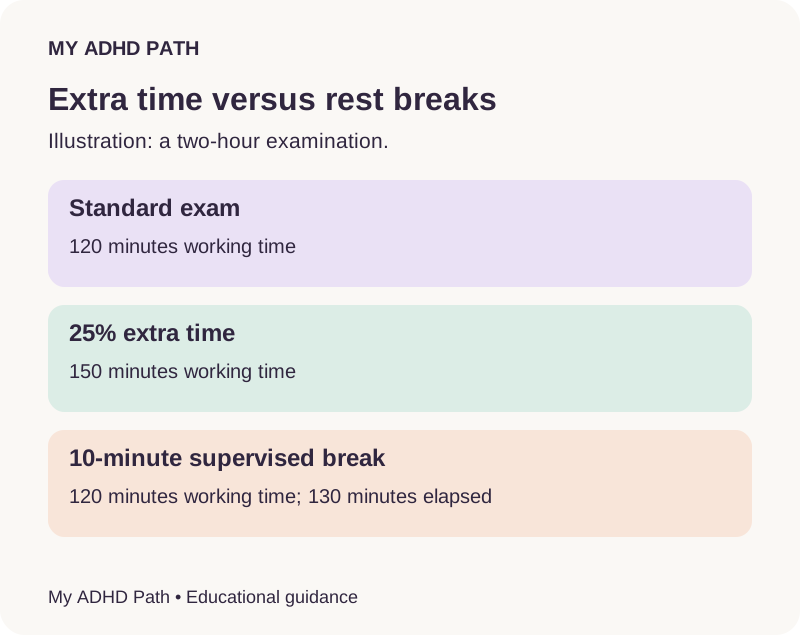
Imagine an examination with a standard working duration of two hours.
A student with 25% additional time would have two hours and thirty minutes available to work.
A student taking an approved ten-minute supervised rest break would still have two hours of working time, but the elapsed duration would be approximately two hours and ten minutes.
The distinction is important.
One arrangement increases the time available to complete assessment tasks.
The other provides an interruption to the demands of the assessment.
Some students may benefit from both.
An important change to the JCQ guidance
Good to know
The March 2026 amendment clarifies that SENCOs should consider rest breaks before applying for extra time for relevant candidates, while recognising that exhaustive trials may be inappropriate in some circumstances. Schools do not necessarily have to exhaust supervised rest breaks before considering extra time.
Earlier versions of the guidance caused considerable discussion about whether students needed to try every possible rest-break arrangement before additional time could be considered.
The March 2026 amendment clarifies that SENCOs should consider rest breaks before applying for extra time for relevant candidates, while recognising that exhaustive trials may be inappropriate in some circumstances.
The decision should be informed by the individual student's needs and appropriate professional judgement.
A family should therefore feel able to ask why a particular arrangement is considered suitable for their child.
The objective should be to identify effective support, not to impose the same adjustment on every student with ADHD.
What about a smaller examination room?
Large examination halls can be challenging environments for some students.
There may be numerous sources of movement, background noise and other distractions.
Students may also experience significant anxiety or sensory difficulties.
Alternative rooming arrangements may be appropriate for some eligible candidates.
However, there is a distinction between taking an examination in a smaller group and sitting an examination completely alone.
Individual invigilation is subject to particular considerations, and a preference for working alone does not automatically establish entitlement to a private examination room.
If your child regularly experiences substantial difficulties in the main examination environment, ask the school how those difficulties could be addressed.
Where appropriate, exploring a familiar alternative environment during internal assessments may help establish what makes a meaningful difference.
What is a prompter?
Some students experience considerable difficulty recognising when their attention has moved away from the examination.
A permitted prompter may provide an appropriate reminder to redirect attention.
This might involve an agreed signal or another permitted form of prompting.
A prompter cannot explain questions, suggest answers or guide the student towards correct academic content.
The arrangement is intended to address attention-related barriers, not provide assistance with the assessed knowledge or skills.
For a student who repeatedly loses track of what they're doing, this may be worth discussing with the SENCO.
Can a student with ADHD use a laptop in examinations?
A word processor may be appropriate for some students whose individual needs affect their ability to produce handwritten examination responses.
However, regularly using a computer at home does not automatically establish eligibility.
The examination centre must consider the student's established needs, applicable policy and qualification requirements.
An approved examination word processor is also subject to security restrictions.
Students should not expect access to ordinary internet browsing, personal files, AI assistants or unrestricted software during an examination.
If typing would appear to reduce a significant barrier for your child, discuss the possibility with their school well before examinations begin.
Can a student use headphones, a timer or a fidget aid?
These are reasonable questions.
Many students use various practical tools during everyday learning.
However, an examination involves additional requirements relating to assessment security, permitted equipment and the needs of other candidates.
Some tools may be permitted under particular circumstances.
Others may require specific approval or suitable alternatives.
Ordinary classroom use does not necessarily mean that an item can be brought into an examination.
If your child relies on a particular aid, ask the examinations team in advance.
Do not assume that a student can independently introduce equipment on the day.
Can students receive several arrangements?
In some circumstances, yes.
Different arrangements may address different barriers.
A student may, for example, qualify for additional working time and supervised rest breaks.
Another may require an appropriate rooming arrangement alongside a permitted aid.
The appropriate combination depends on individual needs, supporting evidence and the assessment requirements.
More arrangements do not necessarily produce a better outcome.
The most useful combination is the one that effectively addresses the barriers the student actually experiences.
Why the phrase 'normal way of working' matters
When discussing examination access arrangements, you will almost certainly encounter the phrase normal way of working.
Broadly, this concerns established support that reflects how a student ordinarily accesses relevant learning and assessment activities.
The importance of established practice is understandable.
Introducing an unfamiliar adjustment for the first time during an important examination may not provide meaningful support.
It may even introduce additional difficulties.
Consider a student who is offered a word processor during their GCSE examinations.
If they have never practised completing timed examination answers using that equipment, they may find the change difficult to manage.
Similarly, a student who has never used supervised rest breaks may be uncertain about when to request one and how to resume their work afterwards.
Appropriate opportunities to become familiar with arrangements can be valuable.
Normal way of working should not be misinterpreted as a requirement for every classroom activity to involve exactly the same adjustment.
Different subjects and assessments may create different demands.
Ask your school how it establishes and records the student's relevant support needs.
What evidence might be required?
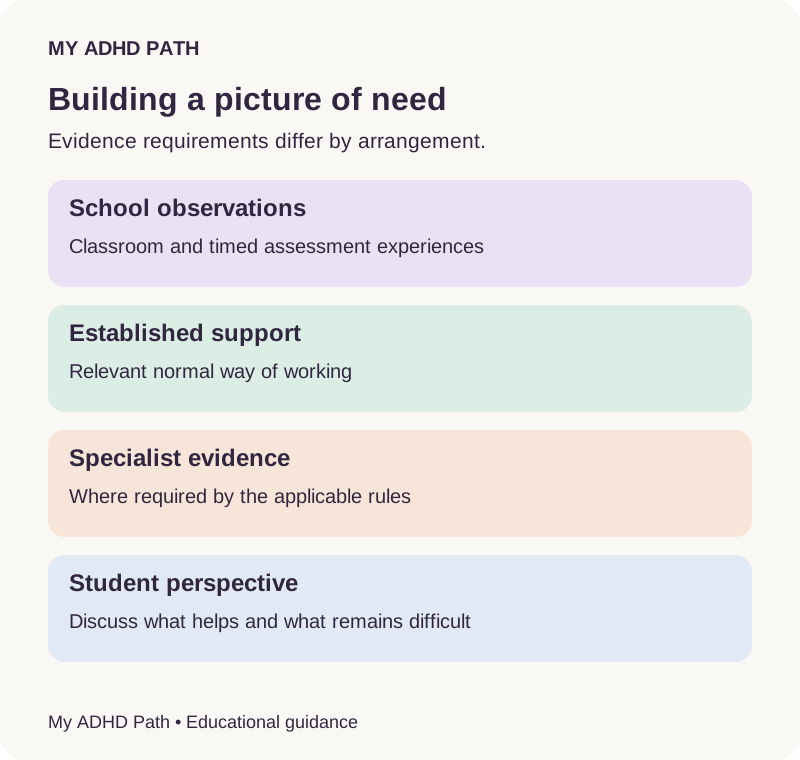
Evidence requirements depend on the arrangement and the route through which it is considered.
A useful starting point is understanding how the student's difficulties appear in everyday education and timed assessments.
Relevant material may include:
- Observations from subject teachers.
- Support records.
- Internal assessment results.
- Samples of unfinished examination papers.
- Evidence of existing adjustments.
- Relevant specialist reports.
- The student's account of their difficulties.
- Information about coexisting learning or health needs.
Not every item is required in every case.
The school should establish which documentation applies under the relevant regulations.
Parents can contribute useful background information, but their observations do not replace the formal evidence the centre is required to maintain.
Do students with ADHD have to take a processing speed test?
Not necessarily.
There are different evidence pathways for examination arrangements.
A student whose difficulties involve an identified learning difficulty may require an appropriate assessment of relevant skills.
A student whose needs arise from a medical or neurodevelopmental condition may be considered through a different evidence pathway.
Some students have several overlapping needs, including ADHD and dyslexia.
The correct approach depends on the individual circumstances and applicable regulations.
Ask the SENCO which evidence route is being used and why.
Do not assume that every student with ADHD must obtain a particular processing speed score before appropriate support can be considered.
Understanding Form 8 and Form 9
Parents sometimes encounter references to Form 8 or Form 9 without being entirely sure what they mean.
They are JCQ documentation used in relevant access arrangement processes.
Form 8 is associated with assessment evidence for qualifying learning difficulties.
Form 9 is used in relevant circumstances involving other qualifying disabilities or needs.
The distinction matters because evidence requirements differ.
These are professional and administrative documents rather than forms that parents ordinarily complete themselves.
You can ask the SENCO which documentation applies to your child, whether further evidence is needed and how the process is progressing.
Will an ADHD diagnostic report be enough?
A diagnostic report can be useful evidence.
It may confirm the student's condition and provide valuable information about their experiences and support needs.
However, establishing a diagnosis is not necessarily the same as establishing a need for a particular examination arrangement.
A specialist might recommend additional time, but the examination centre must still assess the student's needs against the applicable requirements.
If you have a diagnostic report, share the relevant information with the school securely.
Ask whether it meets the evidence requirements for the proposed arrangements.
If additional evidence is needed, ask for clarification before paying for private assessments or further reports.
What if your child is waiting for an ADHD assessment?
Many families experience lengthy waits for an assessment.
During that period, children may continue experiencing significant difficulties at school.
You do not need to postpone every conversation about educational support until a formal diagnosis arrives.
Schools can consider classroom support and investigate examination barriers based on the difficulties the student is already experiencing.
Some examination arrangements have specific formal evidence requirements, while others follow different processes.
The absence of a completed diagnosis does not automatically answer every question about potential support.
Speak to the SENCO about what can appropriately be considered now and what additional documentation might be needed later.
Do you need an EHCP to receive examination arrangements?
No.
In England, an Education, Health and Care Plan is not a universal prerequisite for examination access arrangements.
Many students receive appropriate educational and examination support without an EHCP.
An existing plan may provide relevant evidence in some cases.
However, the presence or absence of an EHCP does not independently establish which examination arrangement a student should receive.
The student's individual needs remain central to the process.
Can academically successful students qualify?
Yes, potentially.
High attainment does not automatically mean that a student experiences no disability-related disadvantage.
A student may achieve good grades whilst experiencing significant difficulties with the conditions under which they are assessed.
For example, they may repeatedly leave questions unanswered despite understanding the material.
They may require considerable additional effort to manage the same assessment demands as their peers.
However, academic potential or a difference between predicted and actual grades is not sufficient evidence on its own.
The school needs to establish relevant barriers and the suitability of the proposed adjustment.
Access arrangements should not be restricted to students who are already failing.
When should parents start discussing access arrangements?
As early as reasonably possible.
You don't necessarily need to wait until your child is in Year 11.
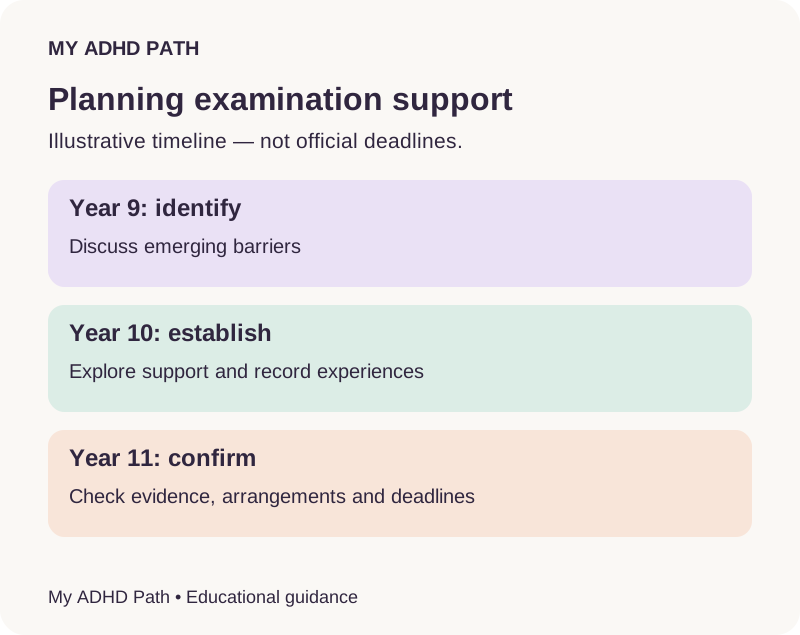
If difficulties are already evident in Year 9 or Year 10, that may be an appropriate time to begin discussing support and how it could be established.
Starting earlier provides more opportunities to understand the student's needs, explore appropriate arrangements and gather relevant evidence.
Year 9: Identify
Discuss emerging difficulties and established classroom support.
Year 10: Establish
Review timed assessment experiences and explore potentially appropriate adjustments.
Year 11: Confirm
Clarify evidence requirements, application progress, mock examination arrangements and final examination preparations.
This is an illustrative planning timeline, not an official set of deadlines.
Actual deadlines depend on the examination series, qualification and arrangement.
Ask your school's SENCO or examinations officer for the relevant dates.
Who is responsible for arranging examination support?
Several members of staff may be involved.
The SENCO
The Special Educational Needs Coordinator is often a central point of contact for families.
They may coordinate information about the student's needs, appropriate support and access arrangement evidence.
Subject teachers
Teachers can provide valuable insight into how the student manages learning and timed assessment activities.
The examinations officer
The examinations officer helps manage the practical and administrative arrangements associated with examinations.
The head of centre
The head of centre has responsibilities relating to compliance with applicable examination regulations.
Specialist assessors and healthcare professionals
Where required, appropriately qualified professionals may provide assessments, reports or other relevant evidence.
The student
The student's own experiences are particularly valuable.
They may be able to explain which parts of examinations they find difficult and which forms of support they find helpful.
Parents and carers
Parents can share relevant observations, provide existing documentation, ask questions and help their child communicate their needs.
The process is most useful when these different perspectives contribute to an accurate understanding of the student.
How to request examination access arrangements
If you're concerned about your child's examination experience, consider the following approach.
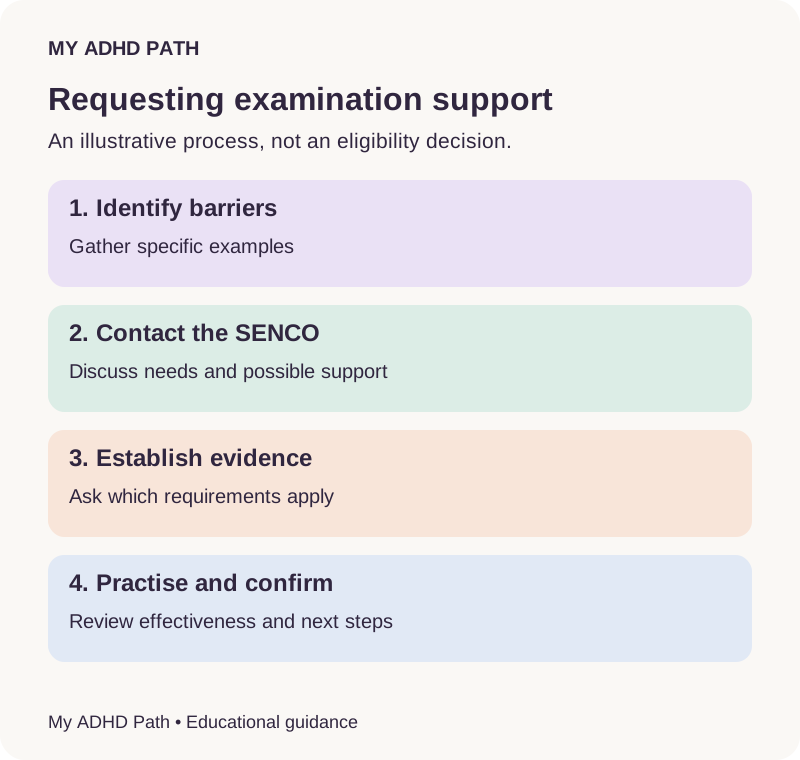
Step one: Identify the actual difficulties
Write down specific examples rather than beginning with a particular requested adjustment.
For example:
What you could say
"My child frequently leaves several questions unanswered in timed mathematics assessments despite being able to solve similar questions independently at home."
Step two: Gather existing information
Locate relevant reports, school correspondence and assessment feedback.
You do not need to assemble an enormous dossier before contacting the school.
Start with the information you already have.
Step three: Contact the SENCO
Ask for a discussion about your child's examination barriers and potentially appropriate support.
Step four: Clarify the evidence process
Ask what information the school needs and how suitability will be established.
Step five: Discuss opportunities to practise
Where appropriate, explore how agreed or proposed adjustments can be used during suitable internal assessments.
Step six: Request written confirmation
Ask the school to confirm arrangements, outstanding evidence requirements and relevant timescales.
Step seven: Review effectiveness
Discuss whether the arrangements are actually helping your child and whether any further review is appropriate.
Email template: requesting a meeting with the SENCO
Try this
Use this template as a starting point for contacting your school's SENCO. Adapt it to your child's circumstances, including whether they have a confirmed diagnosis or are awaiting assessment.
Subject: Examination access arrangements - [Student's name]
Dear [SENCO's name],
I would welcome an opportunity to discuss the examination support that may be appropriate for [student's name].
They have ADHD and have been experiencing difficulties with [briefly describe relevant difficulties].
We are particularly concerned about [specific examples from recent timed assessments, lessons or mock examinations].
We would be grateful to understand how the school is assessing these difficulties, whether any access arrangements may be appropriate and what evidence is needed under the current examination regulations.
Could we also discuss opportunities for [student's name] to become familiar with suitable adjustments before their formal examinations?
Please let me know a convenient time to discuss this and whether there is any additional information we can provide beforehand.
Many thanks,
[Parent or carer's name]
Fifteen useful questions to ask your SENCO
You may find it helpful to take a short list of questions to your meeting.
Practical checklist
- What examination-related difficulties have teachers observed?
- What support is my child currently receiving?
- Have their difficulties been documented during timed assessments?
- Which examination arrangements might be appropriate?
- Would supervised rest breaks address their particular difficulties?
- Is additional working time worth considering?
- Would an alternative examination environment be appropriate?
- Which evidence requirements apply to my child?
- Does their diagnostic report provide suitable information?
- Is any further assessment required?
- How will my child practise using any suitable arrangements?
- Will arrangements differ between subjects?
- What are the relevant application deadlines?
- When can we expect confirmation of the outcome?
- How will my child know what to do during the actual examinations?
You do not need to ask every question in one meeting.
Choose those most relevant to the current situation.
What if the school says no?
Receiving an unexpected refusal can be frustrating, particularly when you've seen your child experience considerable difficulties.
However, it is worth clarifying exactly what has been refused and why.
A decision that one specific arrangement is unsuitable is not necessarily a decision that no examination support is available.
A decision that one specific arrangement is unsuitable is not necessarily a decision that no examination support is available.
Ask whether the refusal relates to:
- The evidence currently available.
- The student's established needs.
- The specific arrangement requested.
- The relevant assessment requirements.
- An application decision.
- A need for further investigation.
Request a clear written explanation and ask which regulations or criteria have been applied.
There may be opportunities to provide additional evidence, discuss alternative support or request an appropriate review.
If concerns remain unresolved, follow the relevant school or examination centre complaints process.
Independent specialist advice may be useful where you believe disability-related needs have not been appropriately considered.
What if you're told your child hasn't used their arrangement?
This can become particularly complicated for students with ADHD.
A student may have an arrangement available but feel uncomfortable using it.
They may forget to request a rest break.
They may be embarrassed about receiving support in front of their peers.
They may misunderstand what they are permitted to do.
Or they may genuinely find the arrangement unnecessary.
These are different situations.
Ask your child about their experiences.
Discuss them with the SENCO so the school can determine whether the arrangement remains appropriate and whether additional familiarisation would help.
Do not encourage a student to use an arrangement unnecessarily just to create evidence of need.
The aim is to understand what support genuinely helps.
What if a diagnosis arrives shortly before examinations?
A late diagnosis or newly identified difficulty can create uncertainty.
Contact the school promptly.
Explain the circumstances and provide relevant documentation through an appropriate channel.
Ask what options remain available for the particular examination series and whether exceptional or late application procedures are relevant.
It may not be possible to establish every proposed arrangement at short notice.
However, families should not assume that nothing can be considered simply because examinations are approaching.
The centre needs to determine what can appropriately be done under the applicable rules.
What happens when your child moves to sixth form?
Moving to a new school or college can involve considerable changes in learning demands and examination arrangements.
Support previously received at GCSE should not simply be assumed to continue automatically.
The receiving institution needs appropriate information about the student's needs and established support.
It may need to review existing evidence or complete additional administrative steps.
Before your child moves, consider requesting copies of relevant support documentation where appropriate.
Ask the new sixth form or college how it reviews previous arrangements and what information it requires.
This can form part of a wider conversation about transition support.
What about home-educated students and private candidates?
Students who are entered for examinations through an external examination centre may also be eligible for appropriate arrangements.
However, establishing the evidence and practical provision can require additional coordination because the examination centre may have limited previous contact with the student.
Contact potential examination centres well in advance.
Ask whether they can accommodate the relevant needs, which evidence they require and whether any assessments or administrative processes need to be completed.
Do not assume that every centre offers the same facilities or support.
JCQ provides dedicated guidance for centres supporting private candidates.
Families should consult this alongside the general regulations.
Access arrangements versus special consideration
These are not interchangeable processes.
Access arrangements generally concern adjustments organised to help a candidate access an assessment.
Special consideration concerns relevant adverse circumstances affecting an assessment, such as certain illnesses, injuries or other qualifying events, under the applicable rules.
For example, a student might have established access arrangements relating to ADHD and subsequently experience an unrelated acute illness during their examination period.
These circumstances may need to be considered separately.
Special consideration is not a general mechanism for increasing grades because a student found an examination difficult.
Speak to the examinations officer promptly if circumstances arise that may be relevant.
Preparing to use extra time effectively
If additional time has been approved, it can be useful to practise how to use it.
Some students naturally continue working until the examination ends.
Others benefit from a more structured approach.
Consider the following options during appropriate practice assessments.
Establish time checkpoints
Allocate approximate periods to different sections, allowing flexibility for individual questions.
Practise moving on
If a question is taking considerably longer than expected, mark it appropriately and return later.
Review unfinished responses
Use remaining working time to identify questions that require further attention.
Check instructions
Look again at command words, units, requested explanations and any overlooked sections.
Review recurring mistakes
If you frequently omit units, overlook signs in calculations or miss part of a question, build those specific checks into your examination routine.
Extra time should remain available to address the student's needs throughout the assessment.
It does not have to be reserved entirely for checking at the end.
Preparing to use supervised rest breaks
If supervised rest breaks have been agreed, your child may find it helpful to understand how to request and use them.
Discuss the practical process with the school.
Questions worth clarifying include:
- How should the student indicate that they need a break?
- What will happen to the examination materials?
- Where will the break take place?
- What activities are permitted?
- How will the student know when to resume?
- What happens if they need further assistance?
Appropriate practice can help reduce uncertainty.
The break should remain a break from assessment activity.
It should not become an opportunity to continue answering questions mentally or consult learning materials.
Exam-day preparation for students with ADHD
Even when arrangements have been confirmed, examination day can involve numerous practical demands.
A straightforward preparation checklist can help.
Practical checklist
- The evening before: Confirm the examination subject, venue and start time. Check permitted equipment. Prepare clothing and transport arrangements. Review any agreed examination support. Allow appropriate time for sleep.
- Before leaving home: Check that you have everything required. Eat and drink according to your usual needs. Follow prescribed medication instructions. Allow enough time to reach the examination centre.
- Before the examination begins: Listen to the instructions. Ask the invigilator if you're uncertain about the practical operation of an agreed arrangement.
- During the examination: Check instructions carefully. Use your established strategies. Follow the approved process for any support you need.
- After the examination: Leave time to recover. If an agreed arrangement was not provided or something went wrong, report it promptly to the relevant member of staff. You do not need to immediately conduct a detailed investigation of every answer you gave.
Three students, three different support needs
The following examples are fictional illustrations rather than eligibility decisions.
Illustrative scenario
Ethan, 15 - Knowledge without enough working time
Ethan understands mathematics and science well but frequently leaves questions unanswered in timed assessments.
His teachers notice persistent difficulties organising multistep tasks and completing work under time pressure.
The SENCO reviews his educational history, specialist evidence and assessment experiences.
Appropriate additional working time is considered alongside other relevant options.
The decision focuses on his evidenced difficulties rather than simply his ADHD diagnosis.
Illustrative scenario
Maya, 16 - Concentration across longer examinations
Maya usually works at an appropriate pace but finds maintaining attention across lengthy assessments particularly demanding.
Her performance becomes more inconsistent as examinations continue.
She discusses potential supervised rest breaks with the school and explores how an agreed break might help her resume working.
The emphasis is on managing the duration of sustained effort rather than automatically extending her working time.
Illustrative scenario
Lucas, 17 - The examination environment
Lucas finds busy examination spaces particularly distracting.
He reports repeatedly losing track of written questions when there is movement around him.
His teachers and support staff review the circumstances in which he concentrates more effectively.
They consider an appropriate assessment environment and whether other adjustments are needed.
The focus remains on identifying a suitable response to his particular difficulties.
Create your child's examination support profile
Before meeting the SENCO, it may be useful to prepare a short document.
| Question | Illustrative answer |
|---|---|
| Which subjects or assessment types are particularly difficult? | Longer written examinations |
| What happens during timed assessments? | Loses their place and leaves questions unfinished |
| What difficulties have teachers observed? | Inconsistent attention and difficulty organising extended responses |
| Which circumstances make things harder? | Background noise and lengthy periods of uninterrupted work |
| What currently helps? | Clear time checkpoints and a quieter environment |
| What does the student say they need? | A way to regain concentration when distracted |
| What relevant professional evidence exists? | ADHD diagnostic report |
| What needs discussing with the school? | Appropriate support and evidence requirements |
Where possible, include your child's own perspective.
This profile is a conversation aid, not an official eligibility assessment.
Helping your child understand their support
Some young people feel uncomfortable about examination arrangements.
They may worry that other students will think they're being given an advantage.
They may feel embarrassed about having different arrangements.
Or they may believe they should manage without support.
It can be helpful to explain why appropriate adjustments exist.
A student who uses an approved word processor still needs to produce the answer.
A student who receives additional time still needs to demonstrate their knowledge.
A student who takes a supervised rest break still needs to complete the assessment independently.
Support changes relevant access conditions. It does not award academic marks.
Support changes relevant access conditions.
It does not award academic marks.
Encouraging a young person to understand and appropriately use their support can be an important part of helping them develop independence.
What happens if an agreed arrangement isn't provided?
Mistakes and misunderstandings can sometimes occur.
If your child reports that an agreed arrangement was unavailable or incorrectly implemented, contact the examinations team promptly.
Record:
- The examination and date.
- The arrangement that had been agreed.
- What happened.
- The circumstances in which the issue was identified.
- Any relevant effect on the student's ability to access the assessment.
- Who has already been informed.
Ask the centre to investigate and explain the available next steps.
Where applicable, it may need to notify the awarding organisation.
Avoid assuming that a particular grade adjustment or other outcome will automatically follow.
The appropriate response depends on the circumstances and relevant procedures.
Examination arrangements and ADHD medication
Students taking prescribed ADHD medication may have questions about examination schedules.
An examination may occur earlier or later than their usual lessons.
They may be concerned about how long their medication remains effective or whether side effects could affect their performance.
These questions should be discussed with their prescribing clinician.
Common misconception
Some families consider independently changing ADHD medication doses or timing before examinations. Do not independently change the dose or timing of medication, introduce additional medication or use somebody else's prescription to prepare for examinations. Medication changes should always be discussed with the prescribing clinician.
Effective examination support should consider the student's established needs and healthcare arrangements.
If medication or a medical device is required during examinations, discuss the practical arrangements with the centre in advance.
Using AI to prepare for an access arrangements meeting
AI can help families organise information and prepare clear questions.
However, it should not be relied upon to determine examination eligibility or interpret regulatory requirements without verification.
AI prompt
Organise my child's experiences
"Help me organise these observations into a clear summary of my child's difficulties during timed assessments. Separate the examples we've observed from possible explanations. Don't invent any evidence."
AI prompt
Prepare questions for the SENCO
"Help me prepare ten constructive questions for a meeting about ADHD examination support. Focus on observed barriers, appropriate adjustments, evidence requirements and next steps."
AI prompt
Understand examination regulations
"Explain the official JCQ guidance I provide in plain English. Identify the relevant sections and distinguish requirements from recommendations. Flag anything that cannot be established from the document."
AI prompt
Draft a follow-up email
"Draft a polite email summarising these meeting notes and asking the school to confirm the proposed arrangements, evidence requirements and next steps. Don't make claims about automatic entitlement."
AI prompt
Prepare my child for examination day
"Create a short examination-day checklist based on these confirmed arrangements. Don't suggest equipment or support that hasn't been approved."
Avoid uploading full diagnostic reports, identifying information or confidential school records unnecessarily.
An AI-generated summary should accurately reflect the original information and should always be checked before sharing.
Where to find independent information and advice
The following organisations provide useful starting points.
Joint Council for Qualifications (JCQ)
The primary source for current access arrangement regulations covering relevant qualifications.
Your examination board
The appropriate awarding organisation can provide qualification-specific information and guidance.
SENDIASS
Local Special Educational Needs and Disabilities Information, Advice and Support Services provide information and advice to families in England.
IPSEA
Provides information and advice relating to special educational needs and disability law in England.
Equality Advisory and Support Service
Provides information relating to discrimination and equality rights in Great Britain.
Enquire
Provides information and advice about additional support for learning in Scotland.
Qualifications Scotland
Consult the relevant Scottish qualifications authority's current assessment arrangements guidance for Scottish examinations.
SNAP Cymru
Provides information and support relating to additional learning needs in Wales.
Equality Commission for Northern Ireland
Provides information about the applicable equality and disability discrimination framework in Northern Ireland.
The appropriate organisation depends on where you live, which qualifications your child is undertaking and the nature of your concern.
Frequently asked questions
Does ADHD automatically qualify you for 25% extra time?
No. The student's individual needs and relevant evidence must satisfy the applicable requirements.
Can ADHD students receive supervised rest breaks?
Potentially, yes. Rest breaks may be suitable for some students who experience relevant attention-related, medical or other disability-related barriers.
Must a student exhaust rest breaks before extra time can be considered?
Not necessarily. The March 2026 JCQ amendment clarifies that consideration of rest breaks does not require exhaustive trials in every circumstance.
Can students receive both extra time and rest breaks?
Yes, where both arrangements are appropriate and the applicable criteria are met.
Does my child need an EHCP?
No. An EHCP is not universally required for examination access arrangements in England.
Does a private ADHD diagnosis count?
Evidence from an appropriately qualified private specialist may be acceptable under relevant rules. Ask your school whether the specific report meets the applicable requirements.
Can a student receive support while awaiting diagnosis?
Some support can be considered based on established needs. Formal examination arrangements have differing evidence requirements, so discuss the student's circumstances with the school.
Do students with ADHD need processing speed tests?
Not in every case. The required assessment and documentation depend on the applicable evidence pathway.
Can students who achieve high grades qualify?
Potentially. High attainment does not automatically rule out disability-related disadvantage or a need for appropriate adjustments.
Can my child take GCSE examinations in a separate room?
Alternative rooming may be appropriate in some circumstances. A private room with individual invigilation is not an automatic entitlement.
Can examination arrangements differ between subjects?
Yes. Different assessments may involve different demands and restrictions.
When should I approach the SENCO?
As soon as relevant difficulties become apparent. Early discussions can provide more opportunities to establish suitable support.
Are GCSE arrangements automatically transferred to A Levels?
No. The receiving institution may need to review the student's needs, documentation and administrative arrangements.
Can home-educated students receive access arrangements?
Potentially, yes. Private candidates should discuss their needs and evidence requirements with their examination centre in advance.
What should I do if the school refuses an arrangement?
Ask for the reasons and relevant criteria in writing. Discuss alternatives, outstanding evidence and available review or complaints procedures. Seek specialist advice where appropriate.
Do access arrangements appear on GCSE certificates?
Ordinary access arrangements are not normally identified on qualification certificates. Ask the relevant awarding organisation if you have concerns about a particular situation.
Can examination arrangements guarantee better grades?
No. Their purpose is to address relevant barriers, not guarantee academic outcomes.
Giving students a fair opportunity
Examination season can be demanding for any family.
There are revision timetables, teenage emotions, numerous deadlines and an extraordinary number of conversations about whether anybody has seen the calculator.
For families navigating ADHD, there may also be questions about support that are considerably more complicated than they first appear.
You don't need to become an examination regulations specialist overnight.
Start by understanding the barriers your child experiences.
Listen to their perspective.
Ask the school clear questions.
Find out what evidence is needed.
And ensure that the support being considered is connected to the difficulties your child actually encounters.
The purpose of examination access arrangements is not to create an easier qualification.
It is to provide an appropriate opportunity for students to demonstrate their abilities.
Every student deserves to have their individual needs properly considered.
Every student deserves to have their individual needs properly considered.
Sources and further reading
Regulatory reference checked: 18 November 2026.
- JCQ - Access Arrangements and Reasonable Adjustments. March 2026 amended guidance, applicable during the 2026/27 academic year. jcq.org.uk
- JCQ - Supplementary guidance: Access Arrangements and Reasonable Adjustments. jcq.org.uk
- JCQ - Access Arrangements, Reasonable Adjustments and Special Consideration. jcq.org.uk
- JCQ - Overview of the access arrangements process for centres accepting private candidates. jcq.org.uk
- Equality Act 2010. legislation.gov.uk
- GOV.UK - Definition of disability under the Equality Act 2010. gov.uk
- NICE - Attention deficit hyperactivity disorder: diagnosis and management (NG87). nice.org.uk
- IPSEA. ipsea.org.uk
- Equality Advisory and Support Service. equalityadvisoryservice.com
- Enquire. enquire.org.uk
- SNAP Cymru. snapcymru.org
- Equality Commission for Northern Ireland. equalityni.org
This article provides general educational information, not individual legal, medical or professional examination eligibility advice. My ADHD Path is independent of JCQ, examination boards and educational authorities. Eligibility and evidence requirements vary between arrangements, qualifications and individual circumstances. Always consult the applicable official regulations and your examination centre. All personal scenarios are fictional.