

The best place to study isn't necessarily the quietest, tidiest or most beautifully organised room. It's the place where you can actually engage with what you're trying to learn.
At a glance
- Your surroundings can influence attention, working memory and task initiation.
- People with ADHD do not all benefit from the same study conditions.
- Silence may help some people, while others prefer manageable background stimulation.
- Different activities may require different environments.
- Reducing unnecessary decisions can make starting easier.
- An effective study space does not require expensive equipment.
- Environmental changes can complement, but do not replace, appropriate ADHD treatment and educational support.
You've cleared your desk.
Bought some lovely new stationery.
Organised your highlighters into colour order.
Found a rather impressive desk lamp.
You've even watched three videos about how to create the perfect study environment.
Everything is ready.
Except, apparently, your ability to study.
An hour later, you've reorganised a drawer, researched ergonomic chairs and discovered that somebody on the internet has an extraordinarily attractive collection of notebooks.
Your revision remains untouched.
Creating an effective study environment can be particularly helpful for people with ADHD.
There's an important difference between creating a space that looks conducive to studying and creating one that genuinely supports learning.
One makes for a lovely photograph.
The other helps you get on with your work.
And they aren't necessarily the same thing.
Why your study environment matters
Studying requires you to direct your attention towards a particular activity, maintain relevant information, manage interruptions and return to the task when your attention shifts.
These processes involve executive functioning.
For some people with ADHD, managing competing demands on attention can require considerable effort.
Imagine trying to understand an unfamiliar mathematical method while somebody is talking nearby, your phone is receiving notifications and you are sitting in a room that feels uncomfortably warm.
You aren't simply learning mathematics.
You're also managing several environmental demands.
Changing those conditions may reduce some of the effort involved in engaging with the original activity.
An ADHD-friendly environment isn't about eliminating every possible distraction.
It's about identifying which conditions make the task more accessible to you.
Why conventional study advice doesn't work for everyone
Traditional study advice often recommends:
- Sitting at a desk.
- Working in silence.
- Remaining seated.
- Removing everything unrelated to studying.
- Following a fixed timetable.
- Completing work in uninterrupted sessions.
These approaches can be helpful.
For some people, they are precisely what makes studying easier.
For others, remaining in a completely silent room for an extended period can feel particularly difficult.
Some students concentrate more effectively when opportunities for movement are built into their study sessions.
Others find that working alongside somebody else helps them begin.
The objective is not to reject traditional advice simply because you have ADHD.
It's to establish which parts are helpful for you.
Good to know
There is no requirement to enjoy background music, use colourful stationery or adopt an unconventional study routine because somebody has described those approaches as ADHD-friendly. Your preferences matter.
The six dimensions of an ADHD-friendly study environment
When evaluating a study space, consider six different aspects.
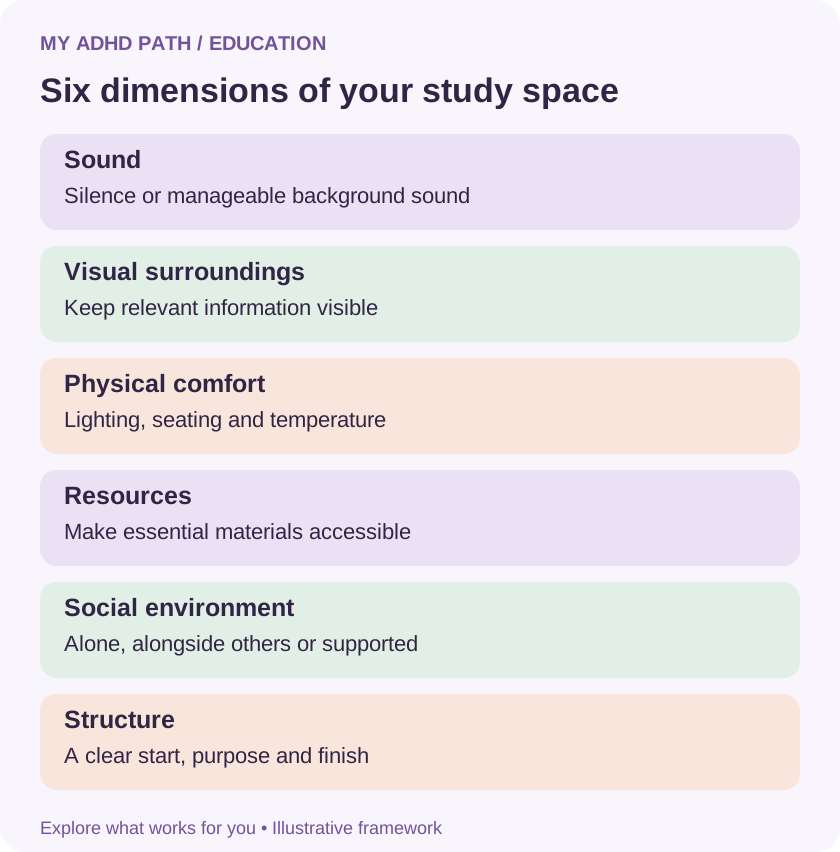
1. Sound
What can you hear, and how does it affect your ability to engage with the material?
2. Visual surroundings
Are there objects, movement or screens that continually draw your attention away?
3. Physical comfort
Does the lighting, temperature, seating and desk arrangement support comfortable working?
4. Access to resources
Can you find everything you need without repeatedly interrupting your work?
5. Social environment
Do you work more comfortably alone, alongside others or with occasional support?
6. Structure
Does the environment help you know what to do, when to begin and when to finish?
These six dimensions provide a practical way to explore your surroundings.
They are not a validated clinical assessment or a measurement of ADHD severity.
You can use them to identify relatively small changes that may make studying more manageable.
Twelve signs your study environment might need adjusting
You may recognise some of these experiences.
1. You spend more time preparing than studying
Organising your materials repeatedly becomes an activity in its own right.
2. You continually leave your desk
You need a charger, a drink, a different notebook or something else you didn't have available when you started.
3. Every conversation captures your attention
Even when nobody is speaking directly to you, following their conversation begins to compete with your own work.
4. You repeatedly check your phone
A visible device becomes an invitation to switch activities.
5. You feel uncomfortable but cannot identify why
Lighting, temperature, clothing or seating may be making the environment less comfortable.
6. You study more effectively somewhere else
The same activity feels more manageable in the library than in your bedroom, or vice versa.
7. You find it difficult to begin when you're alone
Having somebody nearby appears to make starting easier.
8. You become distracted by other people's activities
A shared environment continually introduces new things to notice.
9. Your workspace reminds you of unfinished tasks
Visible belongings, paperwork or household responsibilities compete for attention.
10. You cannot tell when a study session is supposed to finish
Without a clear boundary, beginning the activity feels like committing to an indefinite amount of work.
11. Your resources are spread across several locations
Finding the relevant information becomes a separate challenge before learning can begin.
12. You feel increasingly exhausted despite completing very little
Managing the conditions around you may be consuming effort that could otherwise support the activity itself.
These experiences are not specific to ADHD.
They are useful prompts for reviewing the relationship between your surroundings and your ability to study.
Silence versus background noise
One of the most common questions about studying with ADHD concerns sound.
Is silence better?
Should you listen to music?
Would white noise help?
The answer depends on the individual and the activity.
Studying in silence
Some people concentrate most comfortably when auditory distractions are minimised.
Silence may be particularly useful when reading complex material, developing an argument or working through unfamiliar information.
If you prefer silence, there is no reason to introduce background noise simply because other people with ADHD find it useful.
Studying with background music
Some people find familiar music helps them settle into routine activities or makes studying feel more approachable.
Others find that music competes with their attention.
Lyrics may be particularly distracting during tasks involving reading, writing or verbal information.
Enjoying music while studying does not necessarily mean it improves learning.
The most useful question is whether you can understand, retain and apply the material effectively.
White noise, pink noise and other continuous sounds
Some research has explored whether continuous background noise influences cognitive performance in people with ADHD or elevated attention difficulties.
Certain studies have reported modest benefits under particular experimental conditions.
However, findings do not establish that white noise helps everybody with ADHD or that it improves every type of learning.
The effects can vary according to the person, activity, sound level and experimental conditions.
If you choose to experiment with continuous sound, keep it at a comfortable, safe volume.
You do not need to tolerate an unpleasant sound because somebody has described it as beneficial.
Everyday background activity
A cafe, library or shared workspace may provide a level of background activity that some people find helpful.
For others, unpredictable speech and movement can make concentrating more difficult.
Try this
Try comparing environments using similar learning activities rather than relying exclusively on how enjoyable each space feels.
When sounds become particularly distracting
There is a difference between noticing sound and finding it difficult to disengage from it.
You might be trying to read a paragraph while somebody nearby is having an interesting conversation.
Although you're looking at the page, part of your attention continues following the conversation.
Meaningful speech can be particularly distracting during language-based activities.
Possible changes include:
- Moving away from conversations.
- Studying during quieter periods.
- Closing a door.
- Using appropriate earplugs.
- Using noise-reducing headphones.
- Requesting access to a quieter study area.
Noise-cancelling headphones tend to be more effective against certain continuous sounds than against every form of speech or sudden noise.
They are not a complete guarantee of silence.
There is also no requirement to purchase expensive headphones if simpler changes are effective.
Good to know
Maintain awareness of relevant alarms, instructions and safety requirements when using hearing protection or headphones.
Visual distractions and the competing reminders around you
Imagine sitting at a desk surrounded by objects associated with other responsibilities.
An unopened letter.
A pile of washing.
A half-completed project.
A shopping list.
A phone.
Three textbooks for subjects you're not currently studying.
Each object may remind you of something else you need to do.
Some people find these visible reminders particularly distracting.
Others benefit from keeping important information visible because it helps them remember their responsibilities.
Removing everything is therefore not necessarily the solution.
A useful distinction is between information that supports the current activity and information that introduces unrelated demands.
An effective study surface might contain:
- Materials for the current activity.
- Relevant instructions.
- Necessary equipment.
- A drink.
- A way to record unrelated thoughts that arise.
Other belongings can remain nearby without occupying your immediate working area.
You don't need a completely minimalist room.
Creating a manageable amount of clear worktop space may be enough.
The three-zone study space
Instead of attempting to create a perfectly organised room, consider dividing your study area into three simple zones.
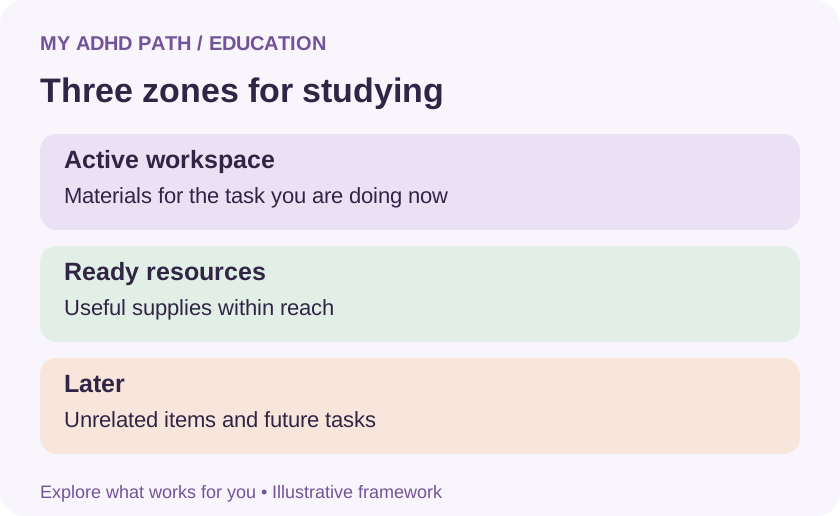
Zone one: Active workspace
This contains what you need for the activity you're currently completing.
For example, your maths textbook, calculator, exercise book and pen.
Zone two: Ready resources
This contains materials you may need during the session or later in the day.
Reference books, chargers, spare stationery and other useful items can remain accessible without taking up your immediate working area.
Zone three: Later
This contains items associated with unrelated responsibilities or future activities.
A tray or basket may be sufficient.
You can deal with these items when you're no longer trying to study.
The boundaries are flexible.
The purpose is to make it easier to distinguish what requires your attention now from what can wait.
Is a tidy desk always better for ADHD?
Not necessarily.
Some people find that a visually clear desk reduces distractions.
Others rely on visible materials to remember important activities.
There is a difference between a workspace that supports your own methods and one that simply meets somebody else's expectations of tidiness.
Ask yourself:
Can I find what I need?
Can I work comfortably?
Can I see the information relevant to my current task?
Does the arrangement introduce unnecessary distractions?
If your workspace meets those needs, it may be effective even if it wouldn't feature in an interior design magazine.
Equally, if you regularly lose materials or spend considerable time moving objects around, simplifying the arrangement may help.
The objective is functionality.
Lighting, temperature and physical comfort
Physical discomfort can create additional demands on attention.
Some students find overhead lighting uncomfortable.
Others struggle to stay engaged when a room is too warm.
A chair that causes discomfort may make longer periods of seated work difficult.
Consider:
- Whether you can comfortably read the material.
- Whether there is glare on your screen.
- Whether you need to adjust the temperature or ventilation.
- Whether your seating supports comfortable posture changes.
- Whether your feet and arms can rest comfortably.
- Whether you can access drinking water.
You do not need to invest in specialist equipment before making simple adjustments.
Moving a lamp, changing your seating position or opening a window when appropriate may be useful.
Good to know
Persistent headaches, visual difficulties, pain or significant sensory discomfort should be discussed with an appropriate healthcare professional.
Movement and studying
Studying is often associated with sitting still.
Sitting still and paying attention are not the same activity.
Some people find that brief opportunities for movement help them return to a task more comfortably.
Others prefer to remain seated when they are concentrating effectively.
Possible approaches include:
- Standing while reviewing flashcards.
- Walking while practising explanations aloud.
- Taking short movement breaks.
- Changing sitting position.
- Using a suitable standing workspace.
- Alternating between written and verbal revision activities.
Movement should support the learning activity rather than create another competing demand.
Walking while recalling familiar vocabulary may be manageable.
Walking while trying to interpret a complicated diagram may not be.
Choose an approach appropriate to the task and your surroundings.
What the research says
Research into movement and attention in ADHD is developing, and particular forms of movement are not guaranteed to improve cognitive performance.
Studying alone versus studying with other people
Some people work particularly effectively alone.
They enjoy controlling the environment, organising their own schedule and avoiding social distractions.
Others find starting and continuing an activity easier when another person is nearby.
These preferences can also change according to the task.
You may prefer working alone when writing an essay but benefit from practising examination questions with a friend.
Understanding the role other people play in your learning can help you choose appropriate study arrangements.
What is body doubling?
Body doubling is an informal term for completing an activity while another person is present, physically or virtually.
That person might be working on their own task.
They do not necessarily teach, supervise or participate in what you're doing.
For example, two students might meet at a library, agree to work independently for forty minutes and briefly discuss their progress afterwards.
Some people report that this helps them initiate tasks, maintain a sense of structure or remain engaged.
Possible reasons include social accountability, a shared starting point and the presence of external cues.
What the research says
Direct research into body doubling as a specific ADHD intervention remains limited. It should be regarded as a practical strategy to explore rather than a clinically established treatment.
If working beside somebody makes you more distracted, it may not be the right approach for that activity.
Choosing between home, library, school and other environments
Different locations offer different advantages.
| Environment | Potential advantages | Potential challenges |
|---|---|---|
| Bedroom | Familiarity, privacy and control | Associations with sleep, entertainment or household activities |
| Shared family space | Access to support and company | Conversations, interruptions and movement |
| School study room | Familiar resources and educational structure | Limited access times or other students |
| Library | Designated study atmosphere and resources | Travel, availability and variable noise levels |
| Cafe | Background activity and a change of scenery | Cost, unpredictable noise and limited facilities |
| Online study session | Shared structure without travelling | Screen distractions and technical interruptions |
| Outdoor study area | Fresh air and opportunities for movement | Weather, noise and suitability for particular tasks |
None of these locations is inherently the best.
A useful study environment is one that meets the requirements of the activity while remaining realistic and accessible.
Match the environment to the activity
You don't necessarily need one perfect study space.
You might benefit from having several environments for different types of work.
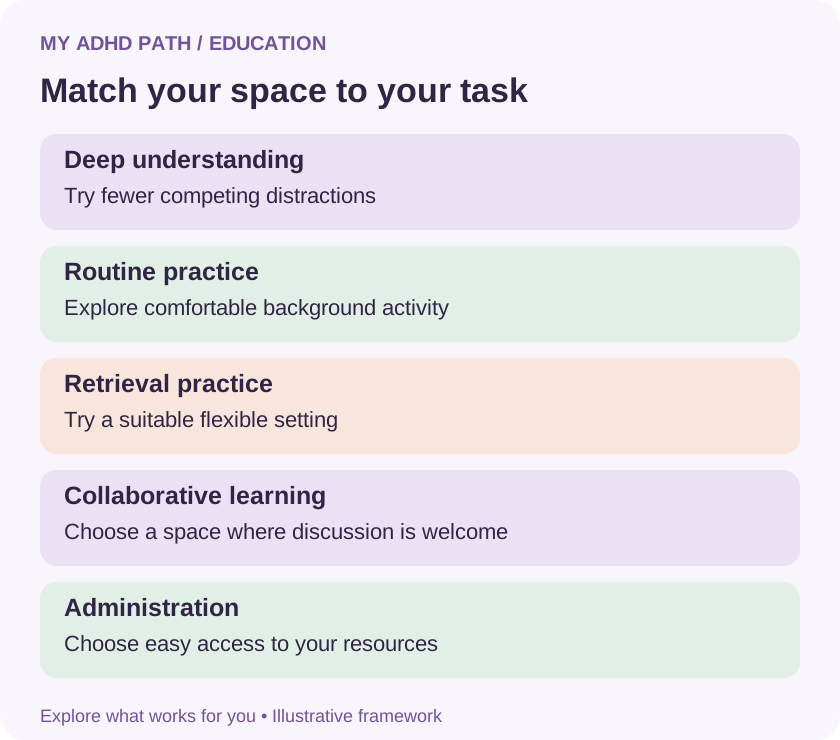
Deep understanding
When learning unfamiliar concepts or analysing complex information, a comfortable environment with fewer competing distractions may be useful.
Routine practice
When completing familiar activities, you might prefer a slightly more stimulating environment.
Retrieval practice
Flashcards, verbal explanations and short recall exercises may work well in a variety of settings.
Collaborative learning
Discussing concepts, practising presentations and completing group activities may require a space where conversation is appropriate.
Administrative tasks
Organising notes, planning revision and checking deadlines may be manageable in locations unsuitable for complex academic reading.
This approach encourages you to consider what the activity needs rather than expecting every task to fit the same environment.
Fifteen practical ways to create an ADHD-friendly study environment
Strategy 1: Establish a default study location
Having a familiar place to begin can reduce the number of decisions required before studying.
It might be a particular desk at home, a library table or an available school study room.
Keep an alternative for circumstances when your preferred location is unavailable.
Strategy 2: Create a two-minute setup routine
Before starting, collect the relevant materials, open the correct page or document, adjust your surroundings and identify your first action.
The setup should be straightforward.
It is not an invitation to reorganise your entire bedroom before every revision session.
Strategy 3: Keep only relevant materials in your active workspace
If you're revising chemistry, you probably don't need your English literature notes directly in front of you.
Keep other materials accessible but separate.
This may reduce competing visual reminders and create more physical space for the task.
Strategy 4: Choose your sound environment deliberately
Rather than automatically playing music or working in silence, consider what you're trying to achieve.
Experiment with different conditions during comparable activities.
Notice whether the sound affects your understanding, accuracy or ability to remember the information afterwards.
Strategy 5: Make the first action visible
A sign saying "Revise biology" may not provide enough information to begin.
A note saying "Complete questions 1-3 on cell division" provides a specific starting point.
Make the first action easy to identify when you arrive at your study space.
Strategy 6: Keep your phone outside your immediate attention
Depending on the activity, you might place your phone out of sight, use focus settings or temporarily disable nonessential notifications.
If you require your phone for accessibility, authentication, healthcare or learning, adapt the approach accordingly.
The aim is to reduce unnecessary interruptions without removing important support.
Strategy 7: Use a visible time boundary
Some students find starting easier when they know how long they're planning to work.
A clock, timer or calendar appointment can make the boundary more visible.
Choose a duration appropriate to the activity.
You do not need to follow a fixed twenty-five-minute study method if a different arrangement works better for you.
Strategy 8: Create a place for unrelated thoughts
Keep a small notepad or digital document for ideas that arise while you're studying.
If you suddenly remember an appointment, another assignment or something you need to buy, record it briefly and return to the current activity.
You now have somewhere to keep the reminder without immediately acting on it.
Strategy 9: Prepare essential supplies in advance
Keep the materials you regularly need in a familiar place.
This might include spare pens, your charger, calculator, paper and relevant textbooks.
A small portable study kit can be useful if you regularly move between home, school and the library.
Strategy 10: Make movement available
Consider how you can change position or take a short movement break without completely abandoning the activity.
A brief walk, stretch or change of seating may be sufficient.
Adapt movement to your physical needs and the environment.
Strategy 11: Establish an agreement about interruptions
If you study in a shared home, explain when you're planning to complete a particular activity.
What you could say
"I'm working on a practice paper until half past four. Can we discuss the shopping afterwards?"
Not every interruption can be avoided.
But clear communication may reduce unnecessary ones.
Strategy 12: Experiment with body doubling
If starting alone feels difficult, try working independently alongside another person.
Agree what you're each going to do and when you'll briefly check in.
If the session becomes an extended social conversation, reconsider whether that arrangement suits the activity.
Strategy 13: Create a distraction-reduced digital workspace
Close irrelevant browser tabs.
Use separate browser profiles or desktop spaces if helpful.
Keep study documents in predictable locations.
Make commonly used resources easy to access.
Digital organisation doesn't have to be elaborate.
It simply needs to support the activity you're completing.
Strategy 14: Have a low-energy study option
Some days, your usual study environment or planned session may feel particularly demanding.
Create an alternative involving a manageable activity.
You might review a small set of flashcards, organise one topic or complete a single worked example.
If you're unwell or exhausted, rest may be more appropriate.
A flexible option should support wellbeing rather than create pressure to remain productive at all times.
Strategy 15: Leave the space ready for next time
At the end of a session, record where you've reached.
Return relevant materials to a familiar location.
Identify your next action.
A short closing routine can reduce some of the preparation required when you return.
You are making the next study session easier to begin.
The digital study environment
A physical workspace can be beautifully organised while its digital equivalent resembles an archaeological excavation.
There are forty-seven open browser tabs.
Several versions of the same assignment.
Downloads with mysterious filenames.
And a document you were absolutely certain you'd saved somewhere.
Digital environments create many of the same demands as physical ones.
Information competes for attention.
Resources need to be located.
Unrelated activities remain immediately accessible.
Consider organising your digital space around the task rather than the software.
For example, create a clearly named folder for each subject.
Within it, keep relevant notes, practice questions, assignments and feedback.
Use meaningful filenames and a consistent approach to saving work.
When beginning a study session, open the resources relevant to the current activity.
Close or minimise unrelated applications.
There is no need to redesign your entire digital filing system before completing an essay.
Start with the materials you actually need.
Should you study in your bedroom?
For many students, the bedroom is the only practical place to study.
Advice suggesting you must have a separate office is therefore unlikely to be particularly helpful.
Instead, explore whether you can establish a distinction between studying and resting.
This might involve:
- Using a particular part of the room for study.
- Changing the lighting when working.
- Keeping study materials in a designated location.
- Putting work away at the end of a session.
- Avoiding working in bed if it affects concentration or sleep.
A small desk is not essential.
A suitable shared table or portable study kit may be more realistic.
If working elsewhere is possible, compare whether the change of environment is helpful.
The size of your home should not determine whether you have access to useful study strategies.
Creating a study space without spending much money
ADHD-friendly study advice can occasionally become remarkably expensive.
Specialist lamps.
Premium headphones.
Electric desks.
Elaborate planners.
Various electronic devices that promise to transform your concentration.
Some equipment may be genuinely useful.
But effective adjustments do not necessarily involve purchasing anything.
Try starting with what you already have.
A cardboard box can hold unrelated materials.
A spare notebook can capture distractions.
A kitchen timer can establish a study boundary.
An existing lamp can be repositioned.
A library can provide an alternative environment.
A friend can offer a shared study session.
Try this
Before buying additional equipment, identify the specific barrier you're trying to address. If you struggle to concentrate because of conversations in the room, buying a more attractive desk organiser is unlikely to make much difference. Spend money where it addresses a genuine need.
Working in a busy household
Not every student can control their surroundings.
There may be younger siblings, shared rooms, caring responsibilities or limited access to quiet spaces.
It is important to recognise these practical circumstances rather than treating them as a failure to create an effective study environment.
Possible approaches include agreeing short protected study periods, using school facilities when available, arranging access to local libraries or preparing portable materials.
Teachers and educational support staff may be able to help identify alternatives.
Parents can also help by discussing which household interruptions are necessary and which can wait.
Even a relatively short period with fewer competing demands can be useful.
Supporting younger children at home
Children may find it difficult to identify which features of an environment are affecting their ability to concentrate.
A child might describe homework as boring or impossible when part of the difficulty involves noise, unclear instructions or a lack of suitable materials.
Observe what happens before and during the activity.
Does your child understand how to begin?
Are they able to access the resources they need?
Is the activity appropriate to their current understanding?
Are there distractions they find difficult to manage?
Do they benefit from somebody being nearby initially?
Try changing one feature at a time where practical.
Ask your child how the change affects their experience.
The aim is not to create a space where they can remain seated for the maximum possible duration.
It is to make learning more accessible and sustainable.
Supporting teenagers without controlling their entire environment
Teenagers may have strong preferences about where and how they study.
Some prefer silence.
Some enjoy working alongside a friend.
Others want to revise independently without somebody continually checking their progress.
Parents can help by making resources available, discussing household arrangements and encouraging teenagers to evaluate their own strategies.
Rather than insisting that a particular method is best, explore questions such as:
- Where do you find it easiest to start?
- When do you remember the most information?
- Which distractions are particularly difficult to ignore?
- What could we change about the room?
- Would you like help getting started or would you prefer to work independently?
Teenagers increasingly need opportunities to understand and manage their own learning conditions.
Support can help them develop that knowledge.
Study environments at school and university
Educational institutions may be able to provide support related to the learning environment.
Depending on individual needs and available arrangements, this might involve:
- Access to quieter independent study areas.
- Appropriate seating arrangements.
- Written task instructions.
- Accessible learning materials.
- Agreed opportunities for movement.
- Suitable assistive technology.
- Appropriate assessment arrangements.
These examples are not automatic entitlements.
Discuss specific barriers with teachers, the SENCO, university disability services or other relevant staff.
Explain which features of the environment are affecting access to learning and what changes may be helpful.
Formal examination arrangements are subject to separate rules and evidence requirements.
Our guides to examination access arrangements and university support provide further information.
Can sensory tools help with studying?
Some people use sensory tools to support comfort or regulation.
These might include small fidget items, earplugs, textured objects or alternative seating arrangements.
Individual responses vary.
A particular fidget item might help somebody remain engaged while listening, while distracting another person from the explanation.
What the research says
Research does not establish that generic sensory products improve learning for everybody with ADHD.
When exploring a tool, consider:
- What barrier is it intended to address?
- Does it make the activity more comfortable?
- Does it interfere with the task?
- Does it affect other people nearby?
- Is it appropriate and permitted in the environment?
- Does it help participation or learning in a meaningful way?
Choose safe, suitable products and observe their actual effects.
Persistent sensory difficulties may warrant discussion with an appropriate professional.
How to know whether an environment is really helping
An environment may feel enjoyable without producing particularly effective learning.
You might love studying in a busy cafe because there's always something happening.
But if you struggle to remember what you've read, it may not be suitable for complex academic reading.
Similarly, a silent library might feel less exciting but help you understand unfamiliar material.
Consider evaluating your study conditions using four questions.
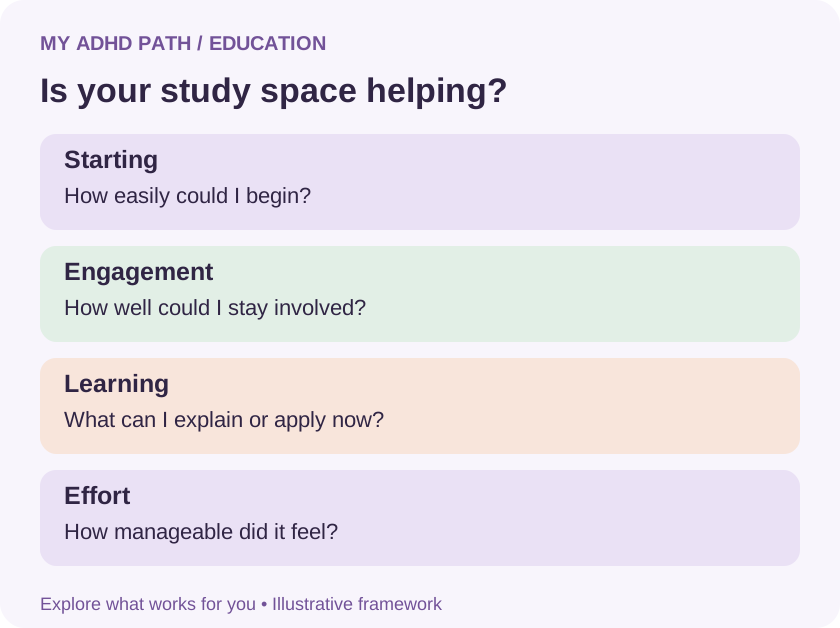
Starting: How easily was I able to begin?
Engagement: How effectively could I stay involved with the activity?
Learning: What can I now explain, recall or apply?
Effort: How manageable did the session feel?
These questions provide a broader picture than simply measuring the amount of time spent studying.
The objective is not to score your performance or compare yourself with other people.
It's to identify which conditions support your own learning.
A practical study environment comparison
Imagine a student comparing three different study settings.
They complete comparable biology activities during separate sessions.
| Environment | Getting started | Understanding afterwards | Experience |
|---|---|---|---|
| Bedroom with music | Easy | Remembered some information but missed important details | Enjoyable but distracting |
| Quiet library | Took longer to settle | Explained most key concepts | Focused and manageable |
| Shared kitchen table | Started easily with a parent nearby | Understood the main idea but was interrupted | Helpful company, variable concentration |
These are fictional observations, not research findings.
They illustrate how a student might discover that one setting suits independent reading while another is better for practising short questions.
There is no need to select a single location for every learning activity.
Three different study environment experiences
The following scenarios are fictional illustrations.
Illustrative scenario
Oliver, 16 - Discovering the value of silence
Oliver assumes that background music is essential because several of his friends use it while revising. He creates playlists, buys headphones and spends considerable time choosing what to listen to. When preparing for a chemistry assessment, he experiments with completing practice questions in silence. He discovers that eliminating the music makes it easier to retain intermediate calculations. He still enjoys listening to music while organising his notes, but chooses silence for demanding problem-solving activities.
Illustrative scenario
Maya, 19 - Creating structure through company
Maya finds it difficult to begin university assignments when working alone in her accommodation. She regularly intends to study but becomes occupied with other activities. She begins meeting a coursemate at the library. They agree on their individual tasks and work separately before taking a break together. For Maya, the shared starting point makes the session easier to begin. She still completes some activities independently, particularly when she needs uninterrupted time to write.
Illustrative scenario
Daniel, 42 - Learning in a busy home
Daniel is studying for a professional qualification while working and supporting his family. His home does not have a separate study room. Instead, he creates a portable study kit and agrees several short periods when the dining table can be used for uninterrupted work. He also uses the local library when he needs to complete more demanding reading. Rather than waiting for ideal circumstances, Daniel creates several realistic ways to access learning.
Create your personal study environment profile
Use the following questions to identify your preferences.
| Question | Illustrative answer |
|---|---|
| Where do I find it easiest to begin? | A familiar library table |
| Which sounds are most distracting? | Nearby conversations |
| Which visual distractions affect me? | Unrelated paperwork and my phone |
| What physical conditions help? | Natural light and a comfortable chair |
| Do I prefer working alone or with others? | Alone for reading, with others for practice |
| What helps me understand the task? | Written instructions and a worked example |
| How do I know when I've finished? | A specific learning objective |
| What is my alternative location? | The dining table during a quiet period |
Your preferences may change according to your circumstances.
You can update your profile as you discover new approaches.
It is a personal planning aid rather than a cognitive assessment.
Downloadable resource
My ADHD Study Environment Audit
A printable worksheet to help you assess your current study environment, identify barriers and plan practical changes.
Download PDFThe five-minute study space reset
When your study environment becomes overwhelming, the solution does not necessarily involve a comprehensive reorganisation.
Try five simple steps.
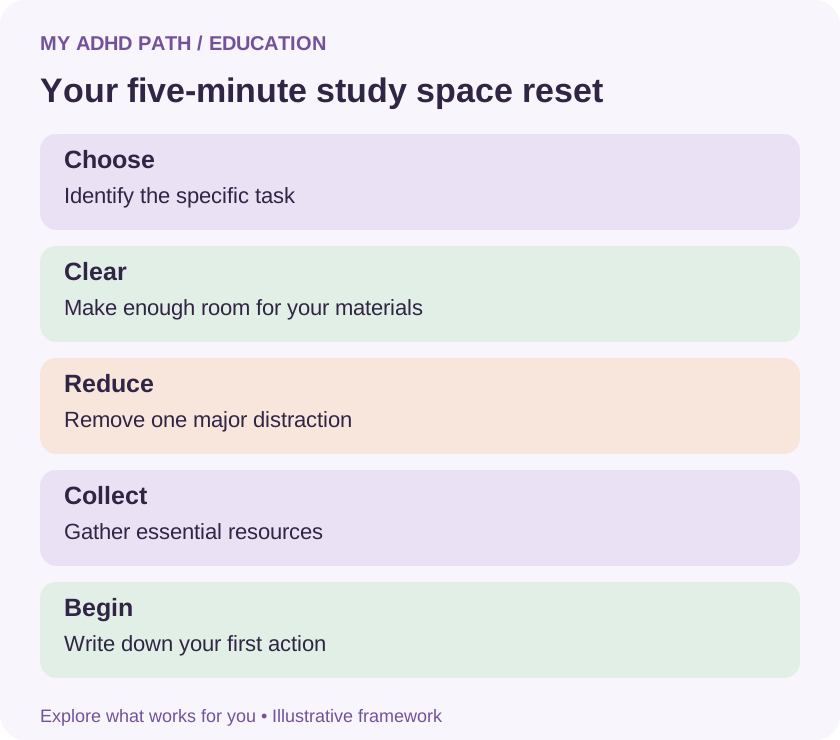
Step one: Choose the activity
Identify the specific work you want to complete.
Step two: Clear enough space
Create room for the materials relevant to that activity.
Step three: Reduce one major distraction
Choose the interruption or environmental feature that is most likely to affect you.
Step four: Collect what you need
Make the essential resources accessible.
Step five: Establish a starting point
Write down the first action and begin.
The reset is intended to take approximately five minutes, but the timing is flexible.
You don't need to create a perfect environment before learning can happen.
A seven-day study environment experiment
Choose a subject or activity you regularly study.
Where possible, use comparable material when testing different conditions.
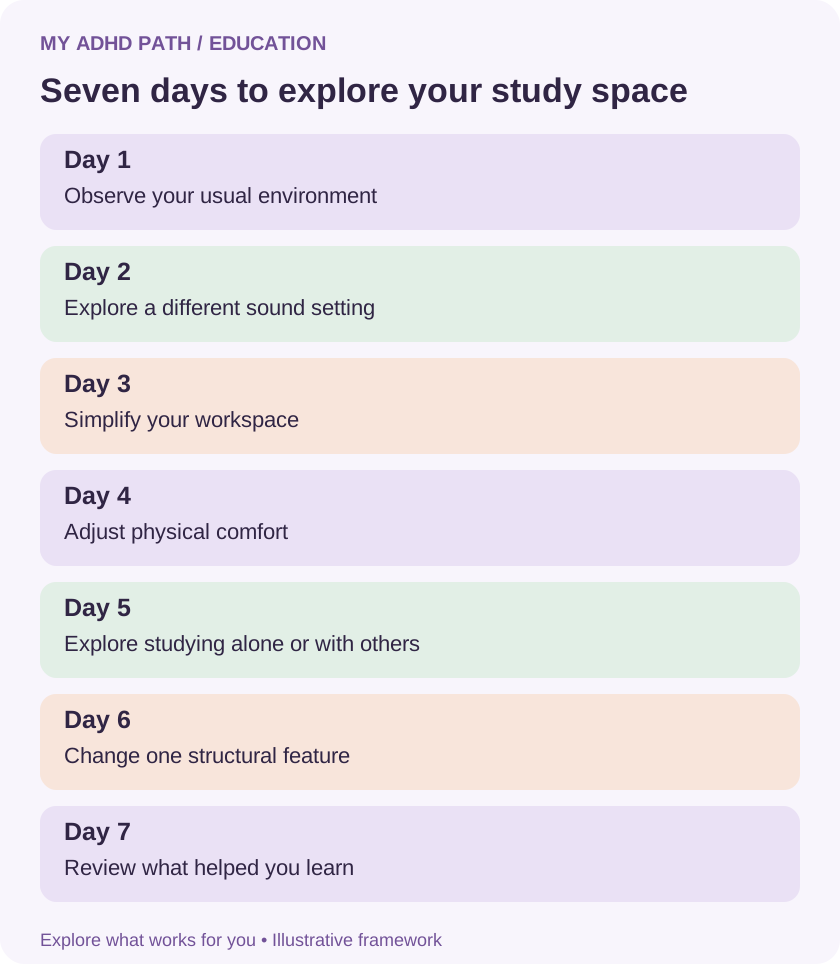
Day one: Observe your usual environment
Notice what helps and what interrupts your attention.
Day two: Explore sound
Try a different comfortable sound environment.
Day three: Simplify your workspace
Keep relevant materials visible and move unrelated items elsewhere.
Day four: Adjust physical comfort
Review lighting, seating, temperature or access to movement.
Day five: Explore the social environment
Compare studying independently with working alongside somebody if practical.
Day six: Change one structural feature
Try clearer starting instructions, a visible time boundary or an alternative location.
Day seven: Review what helped
Consider your ability to start, participate, understand the material and manage the effort involved.
Good to know
This is an informal experiment. Differences in sleep, task difficulty, mood and prior knowledge may affect your observations. Avoid treating a single session as definitive evidence that a particular strategy always works.
Using AI to support your study environment
AI cannot physically remove distractions or create comfortable surroundings.
However, it may help reduce some of the planning and organisational demands involved in studying.
It can help turn broad intentions into specific activities, organise resources and provide a clear starting point.
AI prompt
Identify my study barriers
"Ask me questions about where and how I study. Help me identify practical environmental changes I could experiment with. Don't assume everyone with ADHD has the same preferences."
AI prompt
Prepare my study session
"I want to learn this topic in the next forty minutes. Identify the materials I need, a clear first action and a way to check my understanding."
AI prompt
Match tasks to environments
"Here are my revision activities and the study locations available to me. Help me consider which environment might suit each activity and explain why."
AI prompt
Reduce digital distractions
"Help me design a simple digital workspace for these subjects. Use the fewest possible folders and tools while keeping everything easy to find."
AI prompt
Create a portable study kit
"Here are the activities I complete at school, home and the library. Help me identify the essential items I need to carry."
AI prompt
Review my experiment
"Here are my observations from several study sessions. Help me identify possible patterns, distinguish observations from assumptions and suggest one useful change to test next."
Check AI-generated information for accuracy.
Follow educational policies relating to AI use and academic integrity.
Avoid sharing confidential records or personal information unnecessarily.
AI should support your ability to engage with learning, not replace the learning itself.
What does the research say?
What the research says
Research into ADHD has identified differences in attention, executive functioning and other cognitive processes at a group level. Environmental demands can influence the way these difficulties are experienced.
Evidence from research into learning supports approaches that reduce unnecessary cognitive load, present information clearly and provide appropriate opportunities for practice.
Research into auditory stimulation, including white and pink noise, has reported potentially beneficial effects for some people with ADHD or elevated attention difficulties under particular conditions.
However, the findings are not universal, and much of the research involves relatively specific activities or experimental settings.
Evidence for particular commercial sensory products, body doubling and many popular ADHD-specific study techniques remains limited.
It is important to distinguish an approach that somebody finds personally helpful from an intervention with established clinical evidence.
Clinical guidance, including NICE recommendations, recognises the role of environmental modifications in ADHD management.
These may involve changes to surroundings, communication and the way activities are organised.
The most appropriate modifications depend on individual needs.
Taken together, the research supports exploring accessible learning conditions without assuming that one environment is appropriate for everyone.
When changing your environment isn't enough
An effective study environment can reduce unnecessary demands.
However, it cannot resolve every barrier to learning.
You may need additional teaching, assessment for a learning difficulty, appropriate ADHD treatment, educational adjustments or support for your wellbeing.
Seek further advice if:
- You consistently struggle to access learning despite practical changes.
- Reading, writing or mathematics remain particularly difficult.
- Your concentration difficulties significantly affect everyday functioning.
- Sensory discomfort prevents participation in ordinary environments.
- Sleep difficulties or exhaustion persist.
- Studying regularly causes significant distress.
- You are concerned about ADHD medication or other health issues.
Speak to an appropriate teacher, educational support professional, disability adviser or healthcare professional.
For children and young people, parents and carers can help communicate concerns and explore appropriate assessment or support.
Changing your surroundings is one possible part of a wider approach.
Frequently asked questions
Frequently asked questions
What is the best study environment for ADHD?
There is no universal best environment. Consider the activity, your sensory preferences, the level of available structure and how effectively you can engage with the material.
Is silence better for studying with ADHD?
For some people, yes. Others prefer manageable background stimulation. Compare learning outcomes as well as how comfortable the environment feels.
Does white noise help with ADHD?
Some research suggests possible benefits for certain individuals and tasks. It is not an established universal ADHD treatment or guaranteed learning aid.
Should I listen to music while revising?
You can experiment with music if you find it helpful. Consider whether it interferes with understanding or retaining information, particularly during language-based tasks.
Are noise-cancelling headphones useful?
They may reduce certain environmental sounds. Their suitability depends on your preferences, the type of noise and relevant safety requirements.
Can a cluttered desk make ADHD symptoms worse?
Visible clutter may increase distractions or make resources more difficult to locate for some people. Others benefit from keeping relevant materials visible.
Should people with ADHD study in a library?
Libraries can provide useful structure, resources and quieter study areas. They are not necessarily suitable for everybody or every activity.
Is studying with another person effective?
Some people find shared study sessions helpful for initiation or accountability. Others become distracted. Evidence for body doubling specifically remains limited.
Can movement help students with ADHD concentrate?
Some students find movement opportunities helpful. Effects depend on the individual, activity and type of movement.
Are fidget toys good for studying?
They may help some individuals manage comfort or engagement but can distract others. They are not universally effective learning aids.
How long should an ADHD study session last?
There is no fixed ideal duration. Match the session to your learning objective, energy, attention and the complexity of the material.
Should I remove my phone when studying?
Reducing unnecessary access or notifications may be helpful. Retain any functions you need for learning, accessibility, health or safety.
Can I create an ADHD-friendly study space on a small budget?
Yes. Clear instructions, accessible materials, supportive household arrangements and reduced distractions often require little or no expenditure.
Can I request a quieter examination room?
Potentially, where appropriate under the relevant examination arrangements and evidence requirements. Discuss your needs with educational staff.
Should parents sit with children while they study?
Some children benefit from initial support or company. Others need greater independence. Adjust the level of support according to the child's needs and development.
Do I need a completely separate room to study?
No. A designated area, portable study kit or access to shared facilities may provide an effective alternative.
Can changing my environment replace ADHD medication?
Environmental modifications may support ADHD management, but they do not automatically replace prescribed treatment. Discuss treatment decisions with your clinician.
What if no study environment seems to help?
Consider seeking additional educational or healthcare support. The difficulty may involve learning needs, wellbeing, ADHD symptoms or other factors beyond the environment itself.
Find the conditions that help you learn
Throughout this collection, we've explored many different aspects of living with ADHD.
Education.
Work.
Relationships.
Parenting.
Emotional wellbeing.
The ordinary responsibilities that make up everyday life.
And there is a principle that connects almost all of them.
Understanding the conditions under which you function most comfortably can help you make more effective use of your abilities.
Perhaps you need greater structure.
Perhaps you need fewer interruptions.
Perhaps you learn more effectively by discussing ideas, working through examples or taking information at a different pace.
Perhaps you simply need somebody to explain the first step rather than giving you fifteen instructions at once.
There is room for individual differences.
There is room to experiment.
There is room to change your approach as your circumstances change.
Your study environment does not need to look like anybody else's.
Your routines do not need to resemble somebody else's routines.
Your way of learning can be your own.
Living well with ADHD is not about discovering one perfect system that solves absolutely everything.
It's about gradually discovering the things that work for you.
And giving yourself the opportunity to use them.
Sources and further reading
ADHD and environmental support
- NICE - Attention deficit hyperactivity disorder: diagnosis and management (NG87). https://www.nice.org.uk/guidance/ng87
- NHS - ADHD. https://www.nhs.uk/conditions/adhd/
- Faraone, S. V. et al. (2021). The World Federation of ADHD International Consensus Statement: 208 evidence-based conclusions about the disorder. Neuroscience & Biobehavioral Reviews. https://doi.org/10.1016/j.neubiorev.2021.01.022
- Diamond, A. (2013). Executive functions. Annual Review of Psychology. https://doi.org/10.1146/annurev-psych-113011-143750
Learning environments and cognitive demands
- Sweller, J. (1988). Cognitive load during problem solving: Effects on learning. Cognitive Science. https://doi.org/10.1207/s15516709cog1202_4
- Dunlosky, J. et al. (2013). Improving students' learning with effective learning techniques. Psychological Science in the Public Interest. https://doi.org/10.1177/1529100612453266
- Risko, E. F. and Gilbert, S. J. (2016). Cognitive offloading. Trends in Cognitive Sciences. https://doi.org/10.1016/j.tics.2016.07.002
- Soderlund, G., Sikstrom, S. and Smart, A. (2007). Listen to the noise: Noise is beneficial for cognitive performance in ADHD. Journal of Child Psychology and Psychiatry.
- Systematic review and meta-analysis of white and pink noise for attention-deficit/hyperactivity disorder and elevated attention problems. Journal of the American Academy of Child & Adolescent Psychiatry. Published online in 2024.
Educational support
- GOV.UK - Children with special educational needs and disabilities. https://www.gov.uk/children-with-special-educational-needs
- GOV.UK - Disabled Students' Allowance. https://www.gov.uk/disabled-students-allowance-dsa
- Student Space. https://studentspace.org.uk/
This article provides general educational information rather than individual medical advice or a clinical assessment. All personal scenarios, study comparisons and planning frameworks are illustrative. Environmental modifications should reflect individual circumstances and relevant educational requirements.