

Sometimes, the hardest part of homework has absolutely nothing to do with the homework itself.
At a glance
- Homework involves executive functioning skills as well as academic knowledge.
- After-school fatigue can affect concentration and emotional regulation.
- Identifying individual barriers helps parents choose appropriate strategies.
- Smaller starting actions, written instructions and predictable routines may help.
- Independence can develop gradually through appropriate support.
- Persistent homework difficulties may require educational adjustments.
- Homework should not routinely come at the expense of children's wellbeing.
It's six o'clock.
Dinner needs making. There's a washing machine that needs emptying. Someone has forgotten they need a clean PE kit for tomorrow.
And the maths homework that was supposed to take twenty minutes is approaching its second hour.
You've explained the question. You've found a pencil. You've found another pencil because apparently the first one wasn't quite right. You've watched your child investigate a tiny mark on the kitchen table with considerably more enthusiasm than they've shown for algebra.
And somehow, you're still on question three.
If homework regularly takes over your family's evenings, you're certainly not the only parent experiencing it.
For children with ADHD, completing homework can involve a complicated combination of attention, working memory, organisation, emotional regulation and task initiation.
Understanding those demands can help you approach homework differently.
Not by spending even more time supervising it, but by finding ways to make it more manageable for everyone involved.
Why is homework so difficult for children with ADHD?
By the time your child sits down to complete their homework, they may have already spent six or seven hours managing the demands of school.
They've been listening, concentrating, remembering instructions, navigating friendships, moving between activities and managing their behaviour.
For some children, much of that requires considerable mental effort.
Homework arrives at the point in the day when they may have fewer resources available to manage another demanding activity.
And unlike school, home may not provide the same external structure.
There isn't necessarily a teacher explaining what happens next, a lesson timetable determining when an activity finishes or a classroom full of pupils doing the same thing.
Your child is being asked to recreate some of that structure independently.
That can be particularly challenging when the skills involved are among those affected by ADHD.
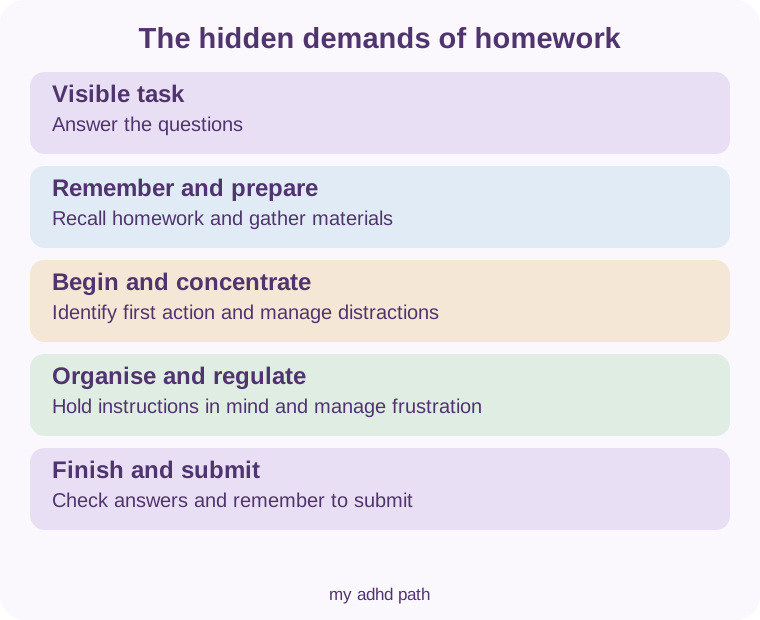
Homework is actually several different tasks
Imagine your child has been asked to complete ten questions about fractions.
It sounds straightforward.
But before they answer a single question, they may need to:
- Remember that the homework exists.
- Find out when it is due.
- Locate their exercise book.
- Find the correct worksheet.
- Gather their equipment.
- Remember the method they learnt in class.
- Decide where to begin.
- Manage distractions.
- Monitor how much time has passed.
- Check their answers.
- Remember to return or submit the completed work.
Completing the fractions is only one part of the activity.
This distinction helps explain why a child who understands the subject perfectly well might still struggle to complete their homework.
The academic task and the executive functioning demands surrounding it are different things.
Both deserve attention.
Seven hidden barriers to getting homework done
1. Task initiation
Your child knows what they need to do.
They know when it is due.
They may even want to get it finished.
Yet they struggle to begin.
Task initiation involves moving from knowing that something needs doing to actually taking the first action.
For some children with ADHD, this transition requires additional structure or support.
Repeatedly telling them to start doesn't necessarily provide that missing structure.
2. Working memory
Working memory allows us to temporarily hold and use information whilst completing an activity.
Your child might read a question, begin working it out and then forget part of what the question asked.
They may lose track of a calculation or forget an instruction you've just explained.
Written reminders, worked examples and manageable steps can reduce the amount of information they need to hold in mind simultaneously.
3. Attention regulation
A child with ADHD may concentrate for extended periods on an activity they enjoy but struggle to sustain attention on something less engaging.
This variability can be confusing.
However, concentrating on a favourite game or creative project does not necessarily mean they can access the same level of concentration on demand.
The conditions surrounding an activity can influence how easily attention is maintained.
4. Time perception
Some children find it difficult to estimate how long homework will take or recognise how much time has passed.
A task that feels endless before they begin might actually take fifteen minutes.
Alternatively, they may underestimate a substantial assignment and leave it until shortly before the deadline.
External time reminders can help make these demands more visible.
5. Emotional regulation
A difficult question, an unexpected correction or a forgotten method can lead to considerable frustration.
Once a child becomes emotionally overwhelmed, continuing with the academic task may become much harder.
Addressing the immediate frustration can sometimes be more productive than continuing to explain the work.
6. Cognitive flexibility
Moving from one subject to another, trying an unfamiliar method or accepting that an answer needs correcting can require mental flexibility.
Some children find these transitions particularly demanding.
They may benefit from clear explanations, predictable sequences and opportunities to adjust to changes.
7. Fatigue and competing demands
Hunger, poor sleep, anxiety, noise and a demanding school day can all affect a child's ability to engage with homework.
ADHD isn't necessarily the only factor involved.
Considering the wider circumstances can help you identify what needs to change.
Establish what is actually going wrong
Before introducing a new homework system, try identifying the main difficulty.
| What you're observing | What you could explore |
|---|---|
| Your child repeatedly delays starting | Task initiation, uncertainty or anxiety |
| They keep leaving their seat | Movement needs, distractions or discomfort |
| They frequently forget instructions | Working memory or unclear explanations |
| They become upset when corrected | Frustration, perfectionism or fear of mistakes |
| Homework takes much longer than expected | Task demands, concentration or learning difficulties |
| They complete work but forget to submit it | Organisation and follow-through |
| They struggle more after particularly busy days | Fatigue and cumulative demands |
| They say they don't understand anything | Gaps in learning, unclear instructions or overwhelm |
These are possibilities to investigate, not diagnoses.
Once you have a better idea of the barrier, choosing an appropriate strategy becomes easier.
15 practical ADHD homework strategies
1. Allow recovery time after school
Some children benefit from completing homework shortly after arriving home.
Others need an opportunity to recover from the school day first.
A snack, some outdoor activity, a conversation or time to enjoy a preferred interest might help.
Experiment with different timings and observe what works.
A child who needs forty minutes to decompress before completing twenty minutes of homework may have a more manageable evening than a child who spends an hour struggling to concentrate immediately after arriving home.
2. Establish a predictable homework window
Rather than negotiating when homework will happen every single evening, agree on a reasonably consistent time.
For example:
- Arrive home and have a snack.
- Enjoy some free time.
- Complete an agreed homework session.
- Have dinner and continue with the evening.
Predictability can reduce the number of decisions involved.
However, a routine needs enough flexibility to accommodate sports, clubs, appointments and particularly demanding days.
The routine should support family life, not become another source of conflict.
3. Create a homework-ready environment
There is no universally ideal homework space.
Some children prefer a quiet bedroom.
Others work more effectively at the kitchen table with a parent nearby.
Some concentrate better when there is a small amount of background activity. Others find even minor sounds distracting.
Consider lighting, seating, noise, temperature and access to equipment.
Keep frequently used materials together so that your child doesn't need to organise an entire collection of stationery before beginning.
Ask them what makes it easier to work.
4. Make the first action ridiculously simple
Try this
"Go and do your homework" is actually quite a substantial instruction. Try making the first action more specific: "Open your maths book." "Find the English assignment." "Write today's date." "Read the first question." Once your child has begun, the next action may become easier to identify. You aren't reducing the academic expectations. You're reducing the effort involved in getting started.
5. Try a five-minute start
Sometimes, the thought of completing an entire assignment feels more demanding than the assignment itself.
Agree to work for five minutes and then review how things are going.
Your child might discover that continuing feels manageable once they've started.
Alternatively, the first five minutes may reveal that they genuinely don't understand the work and need assistance.
This isn't a trick to make them work indefinitely.
The agreement should be genuine.
6. Break assignments into visible sections
A worksheet containing thirty questions can feel daunting.
Try dividing it into three sections of ten questions, or smaller sections if appropriate.
For a written assignment, you might identify separate stages:
- Read the question.
- Identify the main ideas.
- Create a brief plan.
- Write the introduction.
- Work through each paragraph.
- Review the completed answer.
The child can then focus on the current stage without continually thinking about everything remaining.
7. Use short, flexible focus sessions
Some children benefit from alternating periods of focused activity with short breaks.
A younger child might begin with five to ten minutes of work.
An older child might prefer fifteen to twenty-five minutes.
These are starting suggestions rather than clinically established time limits for ADHD.
If your child is concentrating comfortably, there may be no reason to interrupt them simply because a timer has sounded.
Equally, if they are struggling considerably, a shorter session may be more appropriate.
8. Make time visible
A visual timer or clock can help your child understand how much time remains.
For example:
"We're going to spend fifteen minutes on science, then have a short break."
This provides a clearer sense of the activity's boundaries.
Avoid using timers as threats or creating unnecessary pressure to complete a fixed quantity of work.
Some children find countdown timers stressful. If that happens, try a different approach.
9. Explore body doubling
Body doubling involves working whilst another person is present, often completing their own activity.
You might sit at the kitchen table answering emails whilst your child works on their homework.
You're available, but you're not continuously directing every action.
For some children, having another person nearby may provide useful structure and reassurance.
What the research says
Direct research into body doubling as an ADHD intervention remains limited. Treat it as an informal strategy to experiment with rather than an evidence-based treatment. It won't suit every child.
10. Make breaks genuinely restorative
A break should provide an opportunity to recover.
Depending on your child, this might involve stretching, walking around the garden, getting a drink, having a snack or sitting somewhere quiet.
Some activities make it particularly difficult to return to homework.
For example, starting an online multiplayer game during a five-minute break may create another demanding transition.
Discuss suitable break activities with your child beforehand.
11. Reduce unnecessary working memory demands
Keep important information available rather than expecting your child to remember everything.
Useful supports might include formula sheets where permitted, written instructions, vocabulary lists, worked examples and rough paper.
For a multi-stage maths question, encourage your child to write down intermediate calculations.
For an English assignment, keep the question visible whilst they write.
The aim is to support the learning process, not complete the academic thinking on their behalf.
12. Offer meaningful choices
Children may engage more readily when they have some control over how they approach a task.
You could ask:
"Would you prefer to start with maths or geography?"
"Would you like to work here or at your desk?"
"Would you rather do fifteen minutes now or after your snack?"
Keep the choices manageable.
Too many options can introduce another set of decisions.
13. Decide what happens when your child gets stuck
Agree on a simple process for difficult questions.
For example:
When you get stuck
- Read the question again.
- Check an example or relevant class notes.
- Identify the part that is unclear.
- Ask for help or mark the question to return to later.
This can help children distinguish between a problem they can approach independently and one requiring additional explanation.
They don't need to spend forty minutes struggling with the same question to demonstrate commitment.
14. Create a finishing routine
Homework isn't necessarily finished when the last answer has been written.
There may still be several actions involved.
Encourage your child to use a simple finishing checklist:
Homework finishing checklist
- Check the work.
- Confirm their name is included where required.
- Submit the assignment if it is online.
- Put physical work in the correct folder.
- Pack the equipment needed for tomorrow.
- Check the next deadline.
This is particularly useful for children who complete their work but regularly forget to submit it.
15. Know when to finish for the evening
Good to know
Homework should not routinely consume an entire evening at the expense of sleep, family relationships or other important activities. If your child has made a reasonable effort and is becoming increasingly distressed, continuing may not be productive. Agree with the school, where possible, how to handle assignments that exceed their expected duration. Stopping an unproductive session isn't the same as abandoning educational expectations. It's recognising that the current approach may need reviewing.
You may need to explain which work was attempted, how long it took and what difficulties arose.
The ADHD-friendly homework routine
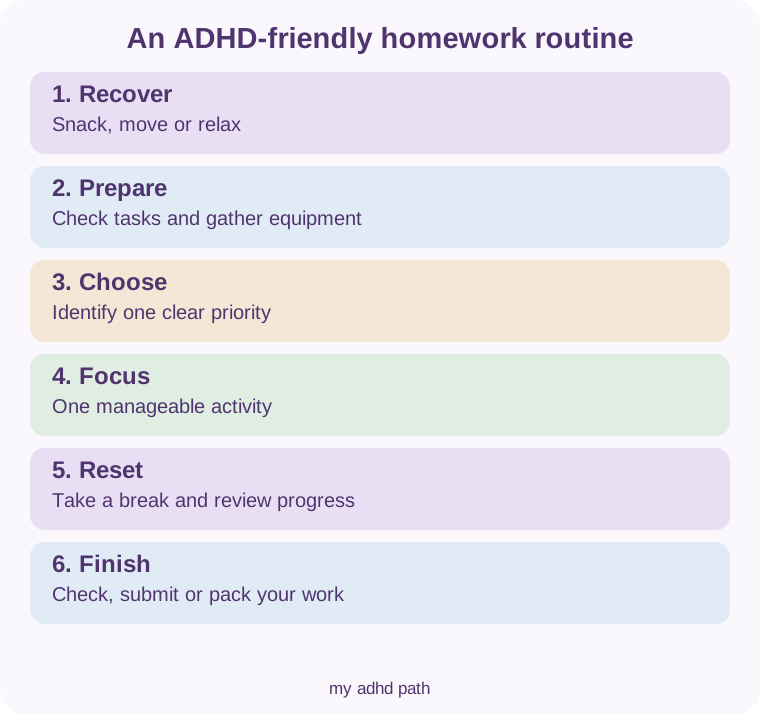
A useful routine could contain six stages.
Stage one: Recover
Allow an opportunity to eat, drink, move or relax after school.
Stage two: Prepare
Check the homework platform or planner, gather equipment and identify what needs completing.
Stage three: Choose
Select a manageable priority based on deadlines, task difficulty and available energy.
Stage four: Focus
Work on one clearly defined activity for an appropriate period.
Stage five: Reset
Take a planned break if needed, review progress and decide on the next action.
Stage six: Finish
Check, submit or pack completed work and prepare for tomorrow.
Some evenings might involve several focus-and-reset cycles.
Others may require only one short activity.
The routine is a framework, not a requirement to follow identical timings every day.
What should an ADHD-friendly homework session look like?
The following schedules are illustrative examples, not prescribed daily homework allowances.
Example: A primary school child
| Time | Activity |
|---|---|
| 3.45 pm | Arrive home, snack and free time |
| 4.30 pm | Check homework and gather equipment |
| 4.35 pm | First ten-minute focus session |
| 4.45 pm | Short movement break |
| 4.50 pm | Second ten-minute session, if needed |
| 5.00 pm | Pack completed work and finish |
Example: A secondary school pupil
| Time | Activity |
|---|---|
| 4.00 pm | Arrive home and recover |
| 4.45 pm | Check deadlines and select priorities |
| 4.50 pm | Twenty-minute maths session |
| 5.10 pm | Five-minute break |
| 5.15 pm | Twenty-five-minute English session |
| 5.40 pm | Review progress and remaining work |
| 5.45 pm | Submit completed tasks or plan further work |
Older pupils may need substantially more study time, particularly around examinations or coursework deadlines.
The objective is to create manageable periods of work without assuming that every child should follow the same schedule.
Should your child start with the easiest or hardest homework?
There are advantages to both approaches.
Starting with an easier activity can help build momentum.
Your child experiences an early success and becomes more familiar with the process of working.
Starting with a demanding activity can make sense when they have sufficient energy and concentration available.
A third approach involves beginning with a small section of the more demanding task.
| Current situation | Possible starting approach |
|---|---|
| Struggling to get started | Begin with a short, familiar task |
| Feeling alert and focused | Prioritise the more demanding assignment |
| Worried about a difficult subject | Attempt one manageable question |
| Facing several deadlines | Identify the most time-sensitive task |
| Feeling exhausted | Assess what is realistic and whether support is needed |
There isn't a single correct answer.
Learning to choose an approach based on the circumstances is itself a useful executive functioning skill.
When homework turns into an emotional battle
You explain the question.
Your child tells you they don't understand.
You explain it again.
They become frustrated.
You become frustrated.
Before long, the conversation is no longer about fractions, Shakespeare or the structure of a plant cell.
Both of you are trying to manage increasingly difficult emotions.
At that point, another explanation may not be what either of you needs.
Recognise the early signs
Your child might begin:
- Erasing answers repeatedly.
- Becoming unusually restless.
- Speaking more sharply.
- Saying they can't do anything.
- Losing track of familiar methods.
- Becoming tearful or withdrawn.
- Rushing through questions to escape the task.
You might notice your own patience becoming shorter.
Recognising those early signs can help you intervene before frustration becomes overwhelming.
Pause the academic demand
Where appropriate, stop working temporarily.
A short break can provide an opportunity to recover.
What you could say
"This is becoming really frustrating for both of us. Let's leave this question for a few minutes and then see what would help."
Identify the actual difficulty
Once your child is able to engage, establish whether they understand the question, remember the method or know how to begin.
Sometimes they may require additional teaching rather than another concentration strategy.
Decide whether to return to the task
If your child is ready, try a small starting action.
If they remain distressed or exhausted, consider finishing the session and discussing the difficulty with their school.
A useful homework session doesn't have to end with every box ticked.
Changing the language around homework
The words we use can shape how a child understands their difficulties.
That doesn't mean parents need to communicate perfectly at all times.
Family life is busy, and frustration is understandable.
However, small changes in language may make homework conversations more constructive.
| Instead of | You could try |
|---|---|
| "Just concentrate." | "What's making it difficult to concentrate?" |
| "You've done this before." | "Let's find an example of how you did it last time." |
| "Why haven't you started?" | "What's the first thing you need to do?" |
| "You're taking forever." | "Let's see which part is taking the most time." |
| "This is easy." | "Which bit would you like me to explain?" |
| "You're not even trying." | "Show me where you've got stuck." |
| "Get it all finished." | "Let's decide what needs doing first." |
These questions help identify the obstacle.
They also allow you to maintain expectations whilst recognising that your child may need additional support.
What if your child refuses to do homework?
Homework refusal can have several explanations.
A child might be avoiding an activity because they expect it to be difficult, because they're exhausted or because they don't understand what is required.
They might also prefer another activity, dislike the subject or be testing a family boundary.
ADHD does not explain every refusal.
Try to establish whether the main barrier involves ability, understanding, organisation, emotional wellbeing, motivation or another factor.
What you could say
"Is it that you don't know how to do it, you don't know where to begin, or you really don't feel ready to do it right now?"
Their answer may help you choose the next step.
Maintain clear, age-appropriate expectations, but consider whether those expectations are achievable under the current circumstances.
Persistent homework refusal, particularly when accompanied by distress or broader difficulties at school, may warrant a discussion with teachers or healthcare professionals.
Is your child spending too long on homework?
Parents sometimes become so accustomed to supporting homework that they lose sight of how much additional effort is involved.
Perhaps an assignment expected to take twenty minutes regularly takes an hour.
Perhaps a child requires continuous parental prompting to complete every section.
Perhaps they finish their work but have little energy remaining for anything else.
The completed assignment may look perfectly ordinary when it arrives at school.
The teacher may not know what happened beforehand.
Try this
A short homework diary can help communicate the difference between the finished work and the effort required to produce it. Record the subject and assignment, the expected duration (if known), the actual working time, the amount of adult support, any significant difficulties, and strategies that appeared to help. You don't need to record every evening indefinitely. A week or two of representative observations may provide a useful starting point for a conversation.
Supporting homework without doing it for your child
There is an important distinction between helping your child access an academic task and completing the task for them.
Helpful support might involve:
- Clarifying instructions.
- Helping gather materials.
- Breaking an assignment into sections.
- Explaining an unfamiliar concept.
- Demonstrating a similar example.
- Providing reminders.
- Encouraging your child to check their own work.
Completing answers, rewriting assignments or excessively correcting work may conceal the child's actual learning and support needs.
Teachers need an accurate understanding of what pupils can do.
Children also benefit from opportunities to develop their own approaches to problem-solving.
Good to know
Try asking yourself: "Am I helping my child access the task, or am I taking over the task?" The distinction won't always be perfectly clear, but it's a useful question to consider.
Moving from parental support towards independence
Independence doesn't have to arrive all at once.
A child who needs considerable support today may gradually learn to manage parts of the homework process themselves.
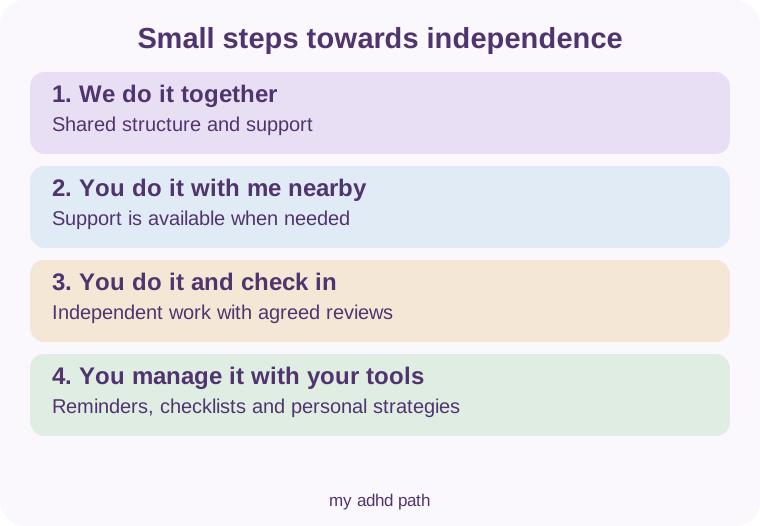
Think of it as a flexible progression.
Level one: We do it together
You provide structure, help organise materials and work through the steps alongside your child.
Level two: You do it with me nearby
Your child completes more of the work while you remain available for reminders or questions.
Level three: You do it and check in
Your child works independently for an agreed period, then checks their progress with you.
Level four: You manage it with your own tools
Your child uses their planner, reminders, written instructions and other agreed supports to complete the process more independently.
Moving between these levels is normal.
A child may manage everyday maths homework independently whilst needing considerable support with a new coursework assignment.
Independence does not mean completing everything without tools or assistance.
It means developing the ability to recognise and access appropriate support.
ADHD homework strategies for teenagers
Homework becomes increasingly complicated during secondary school.
There are multiple subjects, overlapping deadlines, online learning platforms and longer assignments.
Teenagers may also be balancing friendships, extracurricular activities, examinations and a growing desire for independence.
Constant parental reminders can become a source of tension.
Rather than supervising every assignment, try creating a shared structure that your teenager helps design.
Introduce a weekly overview
Choose a short, agreed time each week to review upcoming deadlines, revision requirements and other commitments.
The aim is to identify potential conflicts before they become emergencies.
Separate homework from revision
Homework involves completing assigned tasks.
Revision involves revisiting knowledge and practising retrieval over time.
Your teenager may need different systems for each activity.
Work backwards from larger deadlines
For coursework or extended assignments, help identify intermediate stages and realistic deadlines.
A project due in three weeks is easier to plan when the individual actions are visible.
Encourage ownership of reminders
Digital calendars, task apps, school planners and visual boards may all be useful.
The best system is one your teenager understands and is willing to use.
Maintain agreed check-ins
Rather than repeatedly asking whether homework has been completed, agree on when progress will be discussed.
This provides an opportunity for support whilst respecting developing independence.
Homework when your child takes ADHD medication
Good to know
Some children taking ADHD medication experience changes in symptom control at different times of day. Parents may notice that concentration or emotional regulation becomes more difficult later in the afternoon or evening. There can be several explanations, including medication duration, accumulated fatigue, appetite changes and the demands of the school day. If you notice a consistent pattern, record your observations and discuss them with your child's prescribing clinician. Do not independently change medication doses, introduce additional doses or alter medication timings to accommodate homework. Your child's treatment should consider their wider wellbeing and functioning, not simply their ability to complete schoolwork. A clinician can help determine whether changes to the treatment plan are appropriate.
What if you have ADHD too?
Supporting a child's homework can introduce an additional layer of complexity when you also experience difficulties with attention, organisation or emotional regulation.
You may have every intention of maintaining a consistent homework routine.
Then an unexpected work commitment, a forgotten appointment or a particularly demanding afternoon disrupts everything.
Try this
Design routines that support both of you. Keep the homework equipment in one place. Use shared reminders. Make deadlines visible. Reduce the number of decisions required each evening. Consider working alongside your child on one of your own administrative tasks. Create a simple finishing checklist so neither of you has to remember everything independently. A useful family system should reflect the needs of the people using it. It doesn't need to resemble somebody else's perfectly organised household.
When to ask the school for homework adjustments
If homework consistently creates significant barriers, arrange a conversation with your child's teacher or SENCO.
Useful questions include:
- How long is this assignment expected to take?
- What level of independent work is expected?
- Can instructions be provided more clearly?
- Could longer assignments be divided into stages?
- Is additional explanation available at school?
- Can homework be recorded consistently across subjects?
- What should we do when a task takes substantially longer than expected?
- Could supervised homework support be appropriate?
Depending on your child's individual needs, relevant school policies and applicable legal duties, adjustments may be appropriate.
They might involve changes to how homework is organised, communicated or completed.
An ADHD diagnosis does not automatically exempt a child from homework or establish entitlement to a reduced workload.
However, recurring difficulties deserve consideration.
Example email to your child's school
Email template
Subject: Reviewing homework support for [child's name]
Dear [teacher or SENCO's name],
I would appreciate an opportunity to discuss some recurring difficulties [child's name] is experiencing with homework.
Although they are making an effort to complete the work, assignments are frequently taking considerably longer than anticipated and require substantial support at home.
We have tried several strategies, including shorter work sessions, written reminders and breaking assignments into manageable sections.
It would be helpful to discuss the school's expectations, any additional barriers you have noticed and whether adjustments could make homework more accessible.
Could we agree an approach to trial and review its effectiveness after an appropriate period?
Thank you for your support.
Kind regards,
[Parent or carer's name]
Three families, three different homework approaches
These fictional examples illustrate how homework support might be adapted to individual circumstances.
Illustrative scenario
Noah, 8 - Getting started
Noah frequently spends twenty minutes avoiding his reading homework. His parents initially respond with repeated reminders, which usually lead to frustration. They introduce a predictable reading time after his snack and agree to begin by reading one page together. On some evenings, Noah continues reading independently. On others, he needs additional support. Starting becomes less demanding because the first action is familiar and manageable.
Illustrative scenario
Sophie, 11 - Making homework manageable
Sophie understands her schoolwork but loses track of instructions and becomes overwhelmed by longer assignments. Her family works with her teacher to ensure homework instructions are available in writing. At home, Sophie divides activities into manageable sections and uses a checklist to remember when work needs submitting. She still requires occasional reminders, but she has a clearer way of organising the process.
Illustrative scenario
Lucas, 15 - Building ownership
Lucas has several GCSE subjects and regularly leaves assignments until the evening before they're due. His parents find themselves managing his deadlines and repeatedly checking his homework platform. Together, they introduce a short Sunday planning session. Lucas identifies upcoming deadlines, divides larger tasks into stages and chooses how to record reminders. His parents remain available for support but reduce the frequency of their daily reminders. The system develops gradually as Lucas learns which approaches help him.
A seven-day homework experiment
Rather than attempting fifteen changes simultaneously, choose one difficulty to investigate.
| Day | Focus |
|---|---|
| Monday | Observe the existing homework routine |
| Tuesday | Identify the main barrier |
| Wednesday | Introduce one practical change |
| Thursday | Continue and record observations |
| Friday | Ask your child what felt different |
| Saturday | Review the week's experiences |
| Sunday | Decide what to maintain or adapt |
If your child doesn't have homework on particular days, move the stages around.
The experiment is designed to encourage observation, not create another set of responsibilities.
You might discover that changing the homework environment makes little difference, but having written instructions is enormously helpful.
Or that your child's concentration improves when homework takes place after some outdoor activity.
There is value in discovering what doesn't help as well as what does.
Using AI as an educational support tool
AI assistants can be useful for explaining concepts, organising assignments and producing additional practice questions.
However, they should support your child's learning rather than replace it.
Consider your child's age, the service's minimum age requirements, its privacy arrangements and the school's policies on AI.
Parents can use AI themselves to prepare educational materials where appropriate.
AI prompt
Explain a difficult concept
"Explain equivalent fractions to a child aged eleven. Use a simple example and explain one step at a time. Include three practice questions without showing the answers immediately."
AI prompt
Break down an assignment
"Break this homework instruction into manageable stages. Do not write the assignment or provide the final answers. Help the student understand what they need to do independently."
AI prompt
Create revision questions
"Create five GCSE biology practice questions about photosynthesis, increasing gradually in difficulty. Provide the answers separately so the student can attempt the questions first."
AI prompt
Help identify a mistake
"Review this anonymised maths calculation. Explain where the reasoning went wrong without completing the remaining questions. Provide a similar example for independent practice."
AI prompt
Plan the evening
"Help me organise these homework tasks into a realistic evening schedule. Include deadlines, manageable work periods, opportunities for breaks and a clear finishing time."
Good to know
AI-generated explanations and answers can be incorrect. Check materials against appropriate textbooks, examination specifications or reliable educational sources. Avoid uploading identifiable children's information or confidential school records to unsuitable services. Children should follow their school's academic integrity requirements.
What does the research say?
What the research says
Research has established that ADHD can affect several aspects of executive functioning, although the nature and extent of these difficulties vary considerably between individuals. Organisational skills interventions have also been studied in children and adolescents with ADHD. These interventions may involve planning, managing school materials, recording assignments and developing structured routines. A 2017 meta-analysis published in Clinical Psychology Review examined organisational skills interventions for children and adolescents with ADHD. It reported improvements in organisational skills and some related outcomes, although effects varied depending on the outcome and person providing the assessment. Research supports the broader value of appropriate behavioural and educational interventions. However, it does not establish one ideal homework timetable, one universally effective workspace or a particular number of minutes every child with ADHD should concentrate. The practical examples throughout this article are strategies to explore and adapt, rather than guaranteed treatments.
When homework difficulties may need further assessment
ADHD may contribute to homework difficulties, but it may not explain everything.
Seek appropriate support if your child regularly:
- Struggles to understand material that has been repeatedly taught.
- Experiences significant reading or spelling difficulties.
- Finds mathematical concepts unusually difficult.
- Develops persistent anxiety around schoolwork.
- Becomes distressed during most homework sessions.
- Experiences substantial sleep disruption.
- Avoids school because of academic demands.
- Shows a marked change in educational performance or emotional wellbeing.
Other learning difficulties, mental health concerns, sleep problems or gaps in understanding may require additional assessment.
Your child's teacher, SENCO and healthcare professionals can help determine appropriate next steps.
Frequently asked questions
Why does my child with ADHD take so long to complete homework?
Homework requires several executive functioning skills in addition to subject knowledge. Difficulties with attention, working memory, organisation, time management or task initiation may increase the time and support required.
Should my child do homework immediately after school?
It depends on the child. Some benefit from completing work before other activities. Others need time to recover. Experiment with different timings and observe which approach is most manageable.
How long can a child with ADHD concentrate?
There is no fixed attention span that applies to all children with ADHD. Concentration varies according to age, interest, environment, fatigue, task demands and individual circumstances.
Does listening to music help with homework?
Some children find suitable background sound helpful, whilst others concentrate better in silence. Music containing lyrics may interfere with reading or writing for some pupils. Allow your child to explore different conditions.
Should I sit with my child whilst they do homework?
Being nearby may provide useful structure and reassurance. However, the level of involvement should reflect your child's needs and gradually encourage appropriate independence.
Can my child have a homework break to play video games?
Some children manage this comfortably. Others find stopping a game and returning to schoolwork particularly difficult. Choose break activities based on how easily your child can transition back to the task.
Should I reward my child for completing homework?
Specific encouragement and age-appropriate positive reinforcement may be useful. Avoid relying exclusively on rewards when a child lacks the skills or understanding required to complete the work.
Can a school reduce homework for a child with ADHD?
Potential adjustments depend on individual needs, the school's arrangements and relevant legal responsibilities. Discuss the purpose, volume and accessibility of homework with your child's teachers or SENCO.
Can ADHD medication improve homework concentration?
Appropriate medication may help some children manage ADHD symptoms. Responses vary, and homework is also influenced by other factors. Discuss medication-related concerns with the prescribing clinician.
What if homework causes a meltdown every evening?
Consider whether homework expectations, timing, task demands or unmet support needs are contributing. Discuss recurring distress with the school and seek appropriate professional support where needed.
Is body doubling effective for ADHD homework?
Some people find working alongside another person useful. Direct research into body doubling remains limited, so it is best approached as an informal strategy rather than an established clinical intervention.
Can AI help children with ADHD complete homework?
AI can help explain concepts, divide tasks into stages and provide practice questions. It should not complete assignments on the student's behalf or replace appropriate educational support.
Homework is part of childhood. It shouldn't become all of it.
Your child has a life beyond their school assignments.
There are friendships to develop, interests to explore, sports to enjoy and evenings when they simply need an opportunity to relax.
There are also family conversations that deserve to be about something other than missing worksheets and tomorrow's deadlines.
Educational progress matters.
So does learning how to manage responsibilities, approach challenges and develop independence.
But these skills can be supported without allowing homework to become the defining experience of every evening.
Start with understanding why a particular task is difficult.
Make the first action clearer.
Reduce unnecessary demands.
Introduce a routine that works for your family.
And recognise when a difficulty requires additional support from school rather than another hour at the kitchen table.
Some evenings will still involve a missing pencil, a forgotten deadline and an enthusiastic investigation of absolutely anything other than the task in front of your child.
That's family life.
The aim isn't to create perfect homework sessions.
It's to create more opportunities for your child to learn, develop confidence and finish the evening with enough energy left to enjoy being a child.
Sources and further reading
- NICE - Attention deficit hyperactivity disorder: diagnosis and management (NG87). https://www.nice.org.uk/guidance/ng87
- NHS - Attention deficit hyperactivity disorder (ADHD). https://www.nhs.uk/conditions/attention-deficit-hyperactivity-disorder-adhd/
- Faraone, S. V. et al. (2021). The World Federation of ADHD International Consensus Statement: 208 Evidence-based conclusions about the disorder. https://doi.org/10.1016/j.neubiorev.2021.01.022
- Bikic, A. et al. (2017). Meta-analysis of organizational skills interventions for children and adolescents with attention-deficit/hyperactivity disorder. Clinical Psychology Review, 52, 108-123.
- Daley, D. et al. (2014). Behavioral interventions in attention-deficit/hyperactivity disorder: a meta-analysis of randomized controlled trials across multiple outcome domains. https://doi.org/10.1016/j.jaac.2014.05.013
- Willcutt, E. G. et al. (2005). Validity of the executive function theory of attention-deficit/hyperactivity disorder: a meta-analytic review. https://doi.org/10.1016/j.biopsych.2005.02.006
- Department for Education - SEND Code of Practice: 0 to 25 years. https://www.gov.uk/government/publications/send-code-of-practice-0-to-25
- Education Endowment Foundation - Teaching and Learning Toolkit: Homework. https://educationendowmentfoundation.org.uk/
- IPSEA - Independent Provider of Special Education Advice. https://www.ipsea.org.uk/
This article provides general educational information and is not a substitute for individual medical, educational or legal advice. The example routines, homework experiment and suggested focus periods are flexible editorial tools, not clinically validated intervention protocols. Always discuss medication-related concerns with your child's prescribing clinician.