

Sometimes the day you achieve the least is the day your brain has been working the hardest.
At a glance
- Overwhelm occurs when demands feel greater than available capacity.
- ADHD-related executive functioning and emotional regulation difficulties may contribute.
- ADHD shutdown is an informal term rather than a medical diagnosis.
- Hidden cognitive, emotional, sensory and physical demands can accumulate.
- Recognising early warning signs may help identify opportunities to reduce demands.
- Practical support can be more useful than another extensive task list.
- Recovery does not require immediately catching up on every unfinished responsibility.
- Recurring or significant episodes deserve appropriate professional assessment.
Good to know
Feeling overwhelmed right now? Jump to the five-step overwhelm reset.
It's Tuesday morning.
There are seventeen unread emails that actually need your attention, a parcel you were supposed to return last week, a dentist appointment you need to arrange and a piece of work you promised somebody would be finished by Thursday.
The washing machine has just finished.
Your phone is ringing.
Somebody has sent you a message asking a perfectly reasonable question that requires you to make another decision.
You sit down at your desk.
You open your emails.
You close your emails.
You make a cup of tea.
You look at your list of things to do and decide that what you probably need is a better list.
An hour later, you've reorganised your entire task management system, researched a new calendar app and achieved precisely none of the things you originally intended to do.
Or perhaps you've done nothing at all.
You've sat in the same place, thinking about everything that needs your attention but finding yourself unable to begin.
The desire to get things done hasn't disappeared.
If anything, you're thinking about your responsibilities more intensely than usual.
Yet the ability to translate those thoughts into action seems to have temporarily become unavailable.
For many people with ADHD, this experience is remarkably familiar.
Understanding how overwhelm develops, recognising your own warning signs and discovering what helps you recover can make these experiences considerably easier to navigate.
What is ADHD overwhelm?
Overwhelm describes an experience in which the demands you're facing feel greater than your current capacity to manage them.
Those demands might be practical, emotional, cognitive, social or sensory.
They might involve numerous responsibilities competing for your attention.
An emotionally difficult conversation.
An unfamiliar environment.
A series of interruptions.
Or simply more decisions than you feel able to make at that particular moment.
Everybody can experience overwhelm.
However, some of the difficulties associated with ADHD, including managing attention, organising information, regulating emotions and initiating tasks, may make certain situations particularly demanding.
Overwhelm is not always related to how much you're doing.
It can also be related to how much you're simultaneously trying to remember, process, anticipate and organise.
You might have relatively little physical work to complete and still experience considerable mental overload.
What is ADHD shutdown?
ADHD shutdown is an informal term used by some people with ADHD to describe periods when overwhelm becomes so significant that engaging with responsibilities, conversations or activities becomes particularly difficult.
Some people describe feeling mentally blank.
Others feel that they have numerous thoughts but cannot organise them sufficiently to take action.
Some withdraw from conversations, become unusually quiet or find making ordinary decisions exhausting.
Others remain physically active but find themselves unable to engage with the responsibilities that are causing distress.
Good to know
ADHD shutdown is not a formally recognised medical diagnosis or a separate diagnostic symptom of ADHD. There is no universally accepted clinical definition, assessment or established duration. The experience can also overlap with anxiety, exhaustion, depression, autistic shutdown, trauma-related responses and other difficulties. Throughout this article, we use the term shutdown descriptively rather than as a clinical explanation for every instance of reduced functioning.
Overwhelm, task paralysis, shutdown and burnout
These terms frequently appear together in ADHD discussions.
Although they can overlap, distinguishing between them may help you understand what kind of support you need.
| Experience | What it broadly describes | Everyday example |
|---|---|---|
| Overwhelm | Demands feel difficult to manage with your available capacity | Too many competing responsibilities require your attention |
| Task paralysis | Difficulty initiating or choosing an action, despite wanting or needing to act | Sitting in front of your work without knowing how to begin |
| Shutdown | An informal description of substantially reduced engagement or functioning | Finding conversation, decisions and ordinary activities particularly difficult |
| Burnout | Prolonged exhaustion associated with sustained demands; the term has different meanings in different contexts | Finding everyday responsibilities increasingly difficult over an extended period |
These are not formal stages of a single medical condition.
You might experience task initiation difficulties without feeling overwhelmed.
You might experience significant overwhelm without withdrawing.
And you might experience prolonged exhaustion that requires a much broader assessment of your health and circumstances.
The purpose of recognising these differences is to identify appropriate support, not to diagnose yourself.
Why ADHD can make overwhelm more likely
Several aspects of ADHD may contribute to experiences of overwhelm.
The combination varies considerably between individuals.
Working memory demands
Working memory helps us temporarily hold and use information.
When you're preparing dinner, remembering an appointment, responding to a question and trying not to forget an email, you're managing several pieces of information at once.
For some people with ADHD, keeping track of these competing demands can require considerable effort.
Even if none of the individual responsibilities is especially difficult, managing them simultaneously may be.
Difficulty prioritising
When numerous things need attention, establishing which one should come first can become a task in itself.
You may understand the importance of every responsibility without being able to organise them into a manageable sequence.
Everything appears relevant. Several things seem urgent.
And choosing one means temporarily accepting that the others won't be addressed.
Task initiation
Knowing what you need to do and being able to begin doing it are different processes.
Some people with ADHD experience difficulty initiating tasks, particularly when they involve several steps, uncertain outcomes or considerable organisational demands.
Adding pressure doesn't necessarily make starting easier.
Switching between activities
Moving from one responsibility to another can involve disengaging from the previous activity, remembering what comes next and gathering the information needed to begin.
Repeated interruptions may increase these demands.
An afternoon filled with numerous small responsibilities can sometimes feel more exhausting than several hours spent concentrating on one meaningful activity.
Emotional regulation
Some people with ADHD experience difficulties managing emotional responses.
Frustration, disappointment, criticism or uncertainty may require attention alongside practical responsibilities.
An emotionally demanding morning might therefore influence how much capacity you have available for an otherwise straightforward afternoon.
Sensory demands
Busy environments, background conversations, uncomfortable clothing, bright lighting and other sensory experiences may be distracting or distressing for some individuals.
Sensory sensitivity is not unique to ADHD and does not affect everybody with ADHD in the same way.
However, reducing unnecessary sensory demands may help some people manage their wider workload.
Physical and environmental factors
Poor sleep, illness, hunger, pain, caring responsibilities and uncertainty can all influence how much you feel able to manage.
Medication effects and coexisting health conditions may also be relevant.
Overwhelm should not automatically be attributed to ADHD without considering these other possibilities.
The invisible workload
Imagine somebody asks you to arrange a birthday dinner.
It sounds like one responsibility.
In reality, it may involve:
- Choosing a suitable date.
- Establishing who is available.
- Finding a restaurant.
- Checking dietary requirements.
- Comparing prices.
- Making a reservation.
- Communicating arrangements.
- Remembering who has confirmed.
- Organising transport.
- Responding when somebody changes their plans.
Suddenly, one item on your list contains ten different responsibilities.
Now imagine that several other items on your list involve similar hidden demands.
This is one reason why simply counting how many tasks somebody has completed may provide very little information about their actual workload.
The mental effort involved in anticipating, remembering, sequencing and coordinating responsibilities matters too.
When you're feeling overwhelmed, it may be useful to ask whether you're managing five tasks or five tasks containing fifty smaller decisions.
The four types of load
One practical way to understand overwhelm is to identify the different kinds of demands competing for your available capacity.
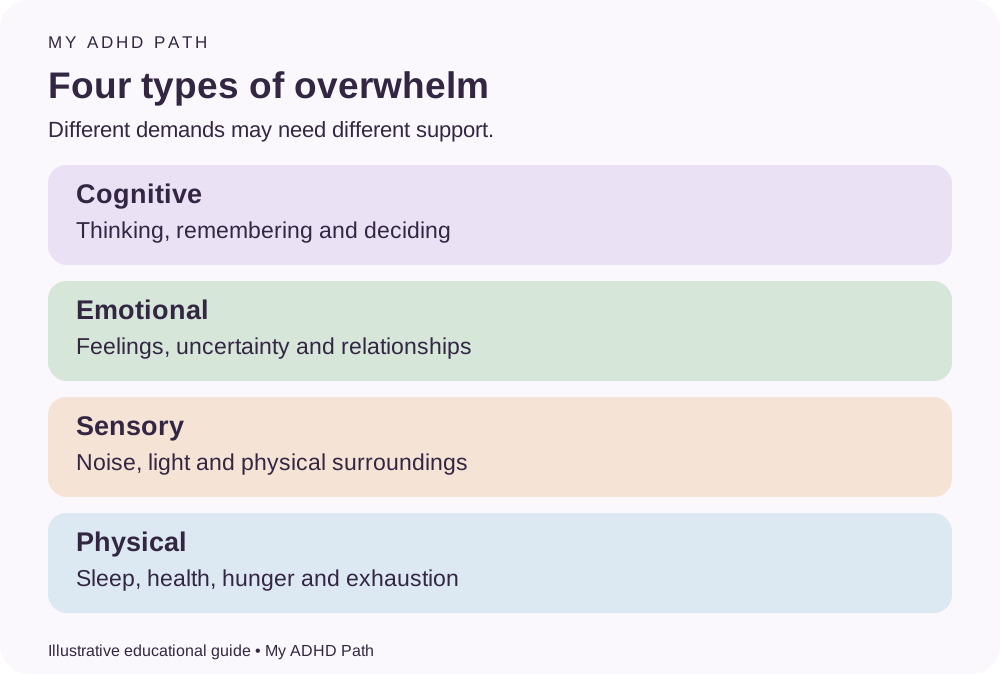
Cognitive load
The thinking, remembering, planning and decision-making required by a situation.
Examples include managing several deadlines, processing complicated information and keeping track of unfinished responsibilities.
Emotional load
The emotional experiences you're navigating alongside practical demands.
Examples include family concerns, difficult feedback, uncertainty and significant life events.
Sensory load
The sounds, sights, physical sensations and other environmental experiences requiring your attention.
Examples include background noise, crowded environments and uncomfortable surroundings.
Physical load
The demands associated with your body's current needs and circumstances.
Examples include poor sleep, illness, pain, hunger and physical exhaustion.
Good to know
These categories are an educational reflection framework rather than a validated clinical model. They can overlap and influence one another. The value of separating them is that different kinds of overwhelm may require different responses. A better task list might help with cognitive overload. It may do very little for somebody who is physically exhausted, emotionally distressed or struggling with persistent background noise.
When small things become the thing that tips everything over
You've managed most of the day reasonably well.
There have been interruptions.
A difficult email.
An unexpected change of plans.
A conversation that remained on your mind.
You've forgotten to eat lunch.
You come home and somebody asks what you're having for dinner.
And suddenly, the question feels extraordinarily difficult to answer.
Not because deciding what to have for dinner is inherently complicated.
But because it's another decision at the end of a day that has already required considerable mental effort.
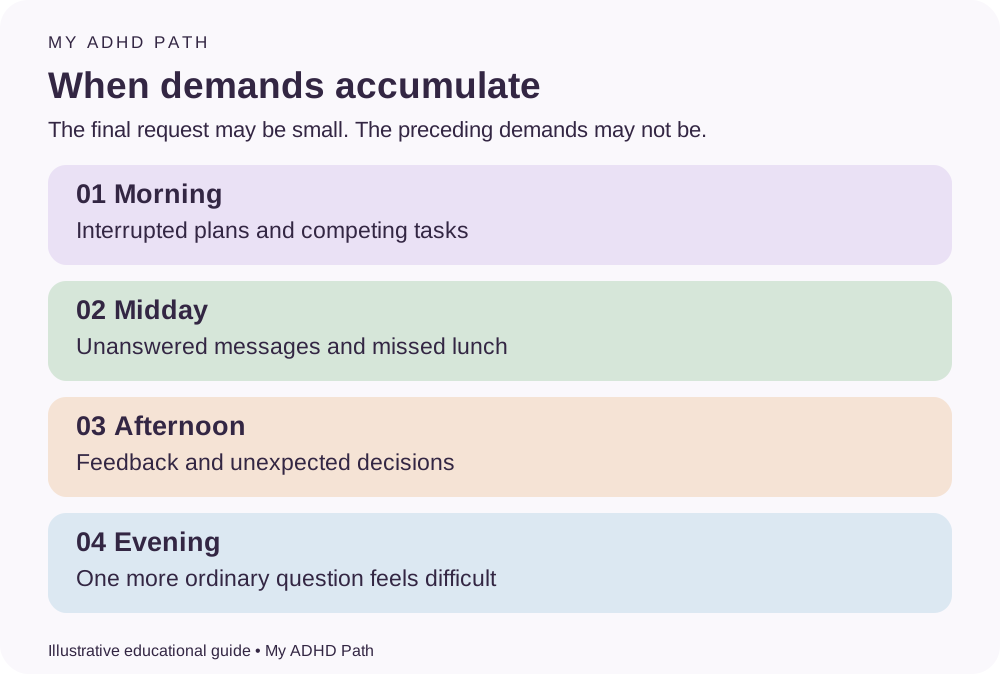
Think of demands accumulating throughout the day.
Each individual experience may be manageable.
Together, they may become considerably more difficult.
This can help explain why an emotional response sometimes appears disproportionate to the immediate situation.
The final request might have been relatively small.
The demands preceding it may not have been.
Understanding your capacity
We often plan our days as though the amount we can manage remains broadly consistent.
In reality, capacity varies.
There may be days when you feel comfortable attending meetings, completing work and dealing with numerous small responsibilities.
On another day, similar demands feel considerably harder to manage.
The difference might involve sleep, health, emotional circumstances, environmental conditions or the cumulative demands of previous days.
Recognising variable capacity doesn't mean abandoning your responsibilities whenever something feels difficult.
It means acknowledging that an effective plan needs to reflect the circumstances in which it will be carried out.
A schedule that works wonderfully on your most productive day may be unsuitable as an everyday expectation.
Leaving room for interruptions, transitions, rest and unexpected demands can make plans more sustainable.
Fifteen early signs of approaching overwhelm
Learning to recognise your own patterns may provide opportunities to adjust demands before everything becomes particularly difficult.
1. Ordinary decisions feel unusually complicated
Choosing lunch, deciding which email to answer or selecting what to wear requires more effort than usual.
2. You repeatedly move between responsibilities
You open several documents, applications or tasks without finding yourself able to engage properly with any of them.
3. You become unusually sensitive to interruptions
A notification or additional question feels more disruptive than it ordinarily would.
4. You struggle to retain information
You reread an instruction, forget what somebody has just said or repeatedly lose your place.
5. You notice increased irritability
Relatively minor frustrations begin to feel more demanding.
6. You find yourself reorganising instead of beginning
Creating a new planning system feels more manageable than deciding which existing task needs attention.
7. Everything starts feeling urgent
You struggle to distinguish between something that genuinely requires immediate action and something that could reasonably wait.
8. You become more sensitive to your surroundings
Sounds, lighting, conversations or physical sensations feel particularly distracting or uncomfortable.
9. You repeatedly check your phone
You seek a temporary change of attention without necessarily enjoying what you're doing.
10. You lose track of basic needs
You realise you've forgotten to eat, drink, move around or take an ordinary break.
11. You find communication increasingly difficult
Composing a message, answering a question or explaining what you need requires unusual effort.
12. You notice physical tension or discomfort
You may experience tight shoulders, restlessness, headaches or other physical sensations.
New, severe or concerning physical symptoms require appropriate medical attention.
13. You begin withdrawing from responsibilities
Even relatively straightforward activities start feeling difficult to approach.
14. You struggle to recognise what would help
You know you're uncomfortable but cannot easily determine whether you need rest, food, information, reassurance or practical assistance.
15. You feel mentally blank or unusually disengaged
You've reached a point where processing additional information feels particularly demanding.
These experiences are not diagnostic criteria.
They are possible indicators that your current circumstances deserve attention.
Your personal overwhelm traffic lights
It can be useful to recognise three broad levels of experience.
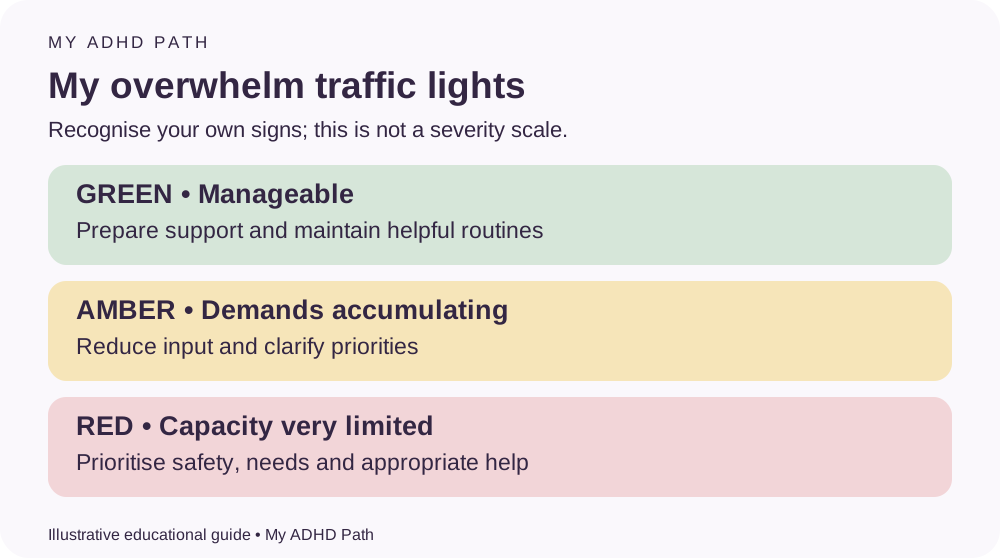
Green: Things feel manageable
You can make ordinary decisions.
Engage with responsibilities.
Communicate relatively comfortably.
And recognise when you need a change of activity or a break.
This might be a useful time to prepare practical support for more demanding days.
Amber: Demands are accumulating
You're finding it harder to concentrate, prioritise or manage interruptions.
Ordinary decisions require additional effort.
You may notice irritability, restlessness or increased sensitivity to your surroundings.
This might be a useful time to reduce unnecessary demands and review what actually needs your attention.
Red: Capacity feels extremely limited
You find processing information, communicating or initiating activities particularly difficult.
You may feel mentally blank, exhausted, distressed or unable to engage with ordinary responsibilities.
At this point, reducing immediate demands, ensuring safety and accessing appropriate support may be more useful than attempting to increase productivity.
These levels are illustrative.
They are not a clinical severity scale, and experiences do not necessarily progress through them in order.
You may move between them throughout the day.
Understanding your own indicators is more important than allocating yourself to a particular category.
What happens during shutdown?
People describe shutdown in different ways.
Some experience a sense of mental emptiness.
Some describe numerous competing thoughts without an ability to organise them.
Others find that conversation and decision-making become particularly demanding.
Some withdraw into familiar activities because those activities require fewer decisions.
Others feel physically exhausted or need a quieter environment.
Common misconception
Online explanations sometimes describe shutdown as the brain switching off, entering a universal freeze state or running out of dopamine. These descriptions may feel relatable as metaphors, but they should not be treated as established biological explanations. The brain has not literally stopped working. And it is not possible to determine the cause of reduced functioning from the experience alone. There is no established neurological mechanism that explains every experience described as ADHD shutdown.
If you experience episodes of significant confusion, altered consciousness, sudden difficulty speaking or other unusual neurological symptoms, seek urgent medical assessment.
Why you might be unable to start even when you know exactly what needs doing
You know that responding to a particular email would take approximately five minutes.
You've been thinking about it for three days.
You've mentally composed the response several times.
And yet you haven't sent it.
The difficulty may involve much more than typing a few sentences.
Perhaps you need to establish the appropriate tone.
Retrieve information from several previous conversations.
Make a decision about what you're willing to offer.
Anticipate how the recipient might respond.
Or deal with the discomfort associated with replying later than you intended.
Something that appears straightforward may contain several hidden cognitive and emotional demands.
Instead of asking yourself why you cannot manage a five-minute task, consider identifying what the task actually involves.
Removing one hidden difficulty may make beginning considerably easier.
Why another list isn't always the answer
Lists can be extremely useful for externalising information.
They can reduce the number of responsibilities you need to hold in your memory.
But a list containing forty-seven items is not necessarily a useful plan for somebody who is already struggling to decide what to do.
There is a considerable difference between recording responsibilities and organising them into something manageable.
You may need help identifying:
- Which responsibilities genuinely require attention today.
- Which are waiting for information or action from somebody else.
- Which can be postponed.
- Which can be delegated.
- Which can be simplified.
- Which no longer need doing at all.
If you already know everything that needs doing but cannot establish where to begin, creating a more detailed list may introduce another layer of work.
The next useful step may be reducing the number of decisions required.
The overwhelm and pressure cycle
Overwhelm can sometimes develop into a repeating pattern.
You have several competing responsibilities.
You find it difficult to choose or begin.
Tasks remain unfinished.
You become increasingly concerned about the consequences.
That concern adds to the demands already competing for your attention.
Beginning feels even more difficult.
This is an illustrative pattern rather than a universal model of ADHD.
It can nevertheless explain why repeatedly reminding yourself how much you should have accomplished doesn't always help.
At various points, it may be possible to interrupt the pattern.
You might clarify one deadline.
Ask somebody to take responsibility for a task.
Break a complicated job into a more manageable action.
Or recognise that your immediate needs deserve attention before returning to work.
The objective is not necessarily to complete everything.
It may simply be to reduce the conditions that are making action difficult.
Reducing a responsibility may be more useful than finding a faster way to complete it.
What to do when you're already overwhelmed
If you're currently feeling overwhelmed, you don't need to undertake an extensive investigation of why it happened.
You don't need to download another planner.
And you certainly don't need to read every strategy in this article before trying something.
Consider the following five steps.
Step one: Reduce immediate input
Where safe and practical, silence unnecessary notifications, move away from distracting surroundings or put aside information that doesn't require immediate attention.
If other people depend on you, ensure their safety and essential needs are addressed.
Step two: Check what you need
Have you eaten recently?
Would a drink, a quieter space or a comfortable change of position be helpful?
Are you physically unwell?
Do you need assistance from another person?
You don't have to address everything at once.
Step three: Remove one demand
Identify something that can safely wait, be simplified or be handled by somebody else.
Reducing a responsibility may be more useful than finding a faster way to complete it.
Step four: Choose one next action
Consider identifying a single, concrete action rather than an entire project.
For example:
"Open the document."
"Find the appointment number."
"Send a message asking for another day."
"Put something easy to eat on a plate."
If you aren't ready to engage with responsibilities, the next action might simply involve attending to an immediate need or arranging support.
Step five: Review your capacity
After a little while, consider how you're feeling.
You might be ready to attempt something else.
You might need more time.
Or you might recognise that professional or practical support would be valuable.
There is no requirement to complete these steps within a particular timeframe.
A ten-minute overwhelm reset
This optional exercise is designed for occasions when you're experiencing manageable overwhelm and feel able to undertake a short reset.
It is not a promise that significant distress or shutdown can be resolved in ten minutes.
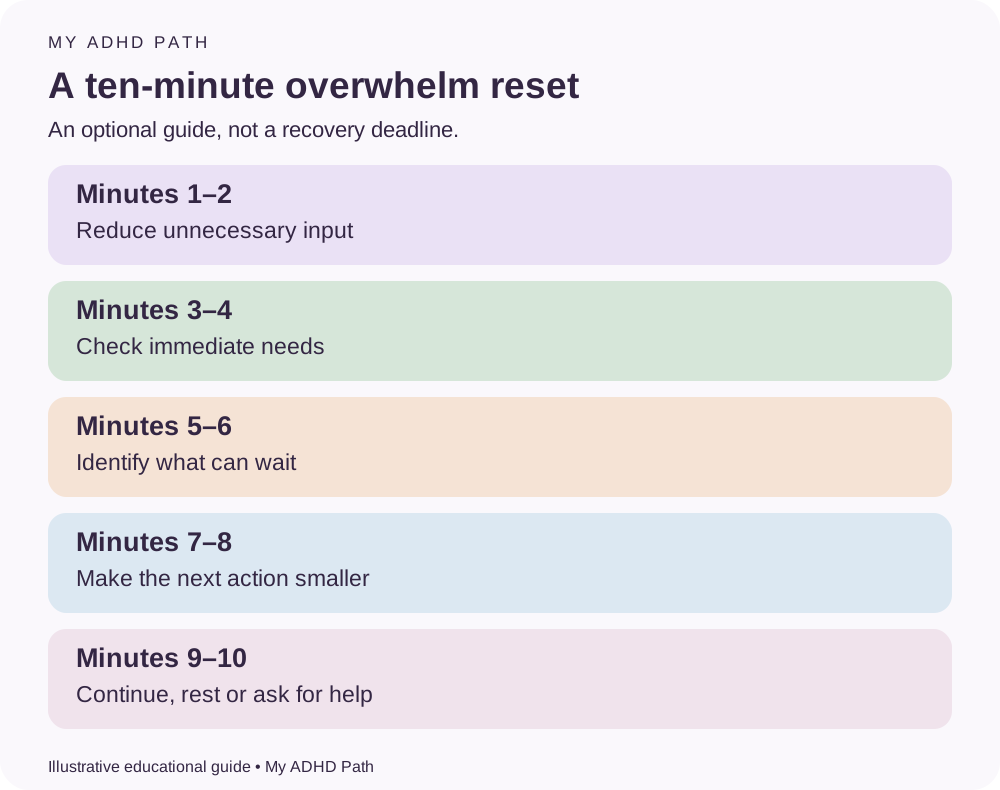
Minutes one and two: Reduce input.
Put aside irrelevant information and unnecessary notifications.
Minutes three and four: Check your immediate needs.
Consider food, water, comfort, medication as prescribed and your surroundings.
Minutes five and six: Reduce your list.
Identify one responsibility that genuinely deserves attention and one that can wait.
Minutes seven and eight: Make the next action smaller.
Convert a vague responsibility into an action you can recognise and begin.
Minutes nine and ten: Decide what would help now.
Continue with that action, take additional recovery time or ask for assistance.
Good to know
If even this feels demanding, you can ignore the timings and choose one helpful step. The reset exists to support you. It isn't another responsibility you need to complete successfully.
Create a minimum viable day
Some days simply require a more flexible approach.
Instead of measuring the day against everything you would ordinarily like to achieve, consider what actually needs to happen for essential responsibilities and wellbeing to be maintained.
This might include:
- Supporting your own basic physical needs.
- Following your prescribed treatment arrangements.
- Ensuring children, dependants and pets are safe and appropriately cared for.
- Addressing genuinely urgent responsibilities.
- Communicating about commitments that need to change.
- Making space for appropriate rest and recovery.
Your minimum viable day will depend on your circumstances.
For some people, there may be responsibilities that cannot safely be postponed.
Support from other people, employers, schools, healthcare services or community organisations may be important.
A minimum viable day is not about achieving the least possible.
It's about recognising that a sustainable approach sometimes requires a different definition of what matters most.
Three levels of everyday planning
Rather than creating a single plan that assumes consistent capacity, you might find it helpful to prepare three flexible versions of an ordinary day.
| Lower-capacity day | Ordinary-capacity day | Higher-capacity day |
|---|---|---|
| Essential personal and household needs | Essential needs plus ordinary responsibilities | Ordinary responsibilities plus optional projects |
| Simple meals | Usual meal arrangements | More involved preparation if enjoyable |
| Time-sensitive communication | Planned communication and administration | Additional non-urgent tasks |
| Appropriate rest and support | Regular breaks | Additional activity where sustainable |
These categories are not fixed.
A higher-capacity day is not an invitation to complete everything you've been unable to do recently.
And a lower-capacity day is not a personal failure.
The purpose is to create plans that accommodate changing circumstances without requiring you to redesign your entire life every time something unexpected happens.
How to come back after shutdown
Once you begin feeling more able to engage with your surroundings, the temptation may be to make up for everything you haven't done.
You might open all your emails.
Review every outstanding responsibility.
Create an ambitious schedule for tomorrow.
And attempt to resolve several days' worth of difficulties immediately.
Unfortunately, this may recreate some of the conditions that contributed to your overwhelm.
Consider a more gradual return.
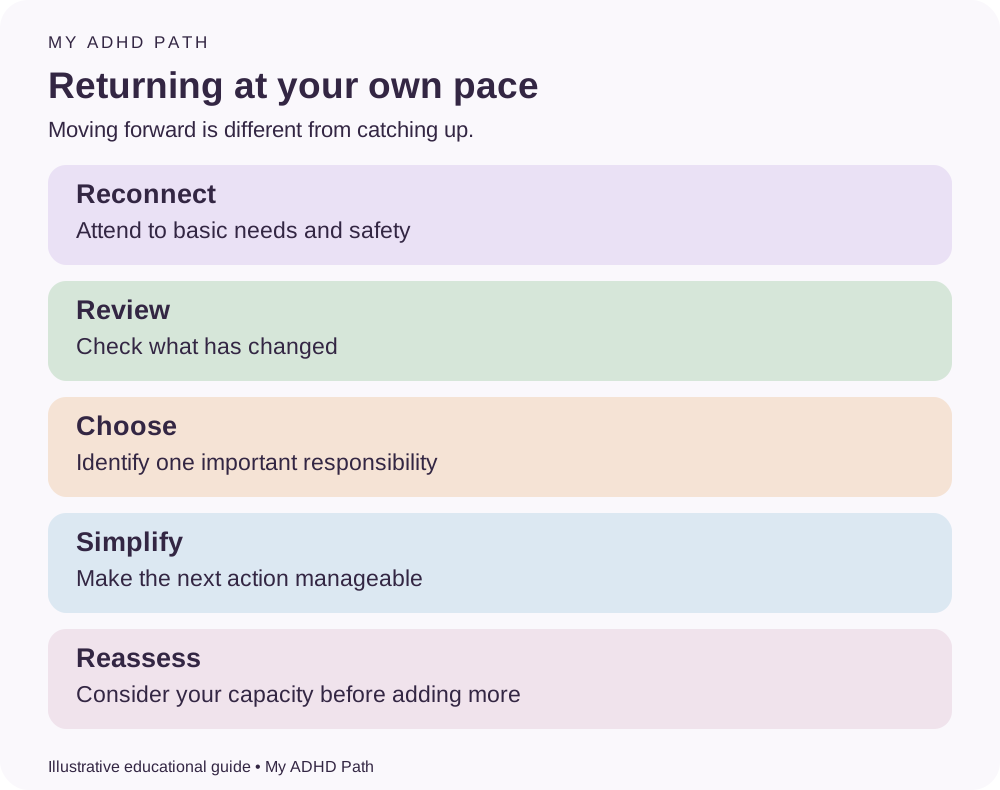
Reconnect with ordinary needs
Make sure your basic physical needs and essential responsibilities are receiving appropriate attention.
Establish what has changed
Have any deadlines passed?
Does somebody need an update?
Are there responsibilities that have become less relevant?
You don't necessarily need to review everything in one sitting.
Identify one important responsibility
Choose something that would meaningfully improve your situation or prevent an avoidable problem.
Make the next action manageable
Consider sending an update, retrieving some information or asking for help rather than immediately completing an entire project.
Reassess before adding more
Notice whether engaging with one responsibility feels manageable before introducing several others.
Recovery doesn't necessarily need to be followed by a period of exceptionally high productivity.
You can return to everyday life without attempting to compensate for every difficult moment.
Fifteen practical ways to reduce recurring overwhelm
Practical checklist
- 1. Use one main place to capture responsibilities. Reduce the number of places you need to remember to check. Choose a system that is accessible and appropriate for your circumstances.
- 2. Separate capture from prioritisation. Writing down a responsibility is not the same as deciding when it needs attention. Make these separate activities where that helps.
- 3. Reduce simultaneous commitments. Consider limiting how many projects or significant responsibilities you're actively progressing at once.
- 4. Define what finished actually means. Clear completion criteria can reduce unnecessary decisions and prevent responsibilities from continually expanding.
- 5. Create visible next actions. Replace vague tasks such as "sort finances" with specific actions such as "find the latest bank statement".
- 6. Leave space between demanding activities. Transitions, preparation and recovery can require time. Avoid planning every available minute around another responsibility.
- 7. Reduce unnecessary notifications. Choose which sources of information genuinely need immediate access to your attention.
- 8. Prepare useful defaults. Familiar meal choices, recurring shopping arrangements and straightforward household routines can reduce repeated decisions.
- 9. Make your surroundings more supportive. Consider whether lighting, background noise, interruptions or visual distractions are adding unnecessary demands.
- 10. Communicate before a commitment becomes unmanageable. Where possible, ask for clarification, revised priorities or appropriate assistance before a deadline becomes particularly difficult to meet.
- 11. Use practical external support. Calendars, reminders, written instructions, assistive technology and appropriate human support may reduce some of the demands on memory and organisation.
- 12. Protect your physical needs. Sleep, appropriate nutrition, hydration and healthcare deserve attention alongside your responsibilities.
- 13. Recognise emotional demands. A difficult conversation or significant life event may influence what you're able to manage elsewhere. Allow your plans to reflect that possibility.
- 14. Schedule less than your maximum capacity. Leave room for interruptions, changes of plans and the ordinary unpredictability of everyday life.
- 15. Review recurring patterns rather than individual difficult days. If similar situations repeatedly lead to overwhelm, consider whether the environment, workload or available support needs to change. The most sustainable solution may involve reducing or redistributing demands rather than becoming more efficient at managing them.
Overwhelm at work
Workplace overwhelm can develop when several people require your attention, deadlines compete and priorities remain unclear.
You might spend considerable time responding to messages while struggling to find an uninterrupted period for meaningful work.
Or you might receive several assignments without knowing which should take precedence.
Consider requesting greater clarity.
What you could say
"Which of these responsibilities is the highest priority?"
"If this new project needs completing today, which existing deadline should move?"
"Could we agree the specific outcome you need from this piece of work?"
"Would it be possible to have a period of uninterrupted working time?"
These questions help clarify demands rather than requiring you to independently resolve competing expectations.
Appropriate workplace adjustments may also make certain responsibilities more manageable.
Our ADHD at Work hub includes guidance on disclosure, workplace adjustments and Access to Work.
Overwhelm when you're self-employed
When you're running your own business, there isn't always somebody else establishing priorities.
You may be responsible for generating ideas, delivering work, managing customers, keeping records, marketing your services and planning what happens next.
Every responsibility appears to belong to you.
And every new idea can feel like another potential opportunity that deserves attention.
One useful approach is to separate your responsibilities into four groups:
Active: Work you're currently progressing.
Waiting: Work that depends on information or action from somebody else.
Scheduled: Work you've deliberately chosen to address later.
Not pursuing: Ideas or responsibilities you've decided not to continue.
A list of fifty business ideas and projects does not need to become a list of fifty active responsibilities.
External support, appropriate technology, clear processes and realistic client commitments may be especially valuable when you're responsible for establishing your own workload.
Overwhelm when you're parenting
Parenting can involve a particularly unpredictable collection of cognitive, physical, emotional and sensory demands.
Children require attention.
Household responsibilities accumulate.
Plans change.
Conversations happen whilst you're trying to complete something else.
And periods of uninterrupted time may be difficult to find.
If you have ADHD, some parenting responsibilities may require significant additional organisational effort.
Consider identifying which demands can be made more predictable.
Shared family calendars, familiar meal choices, accessible school information and clearly allocated household responsibilities may help.
However, organisation alone cannot always address an exceptionally demanding set of circumstances.
Practical help, shared responsibility, respite and appropriate professional support may also be needed.
Where you feel overwhelmed around children, prioritise their safety and seek help from a trusted adult if necessary.
Young children should never be left without suitable supervision.
It is reasonable to communicate that you need support rather than waiting until everything becomes particularly difficult.
Helping children and teenagers manage overwhelm
Young people may not always have the language to describe what they're experiencing.
Overwhelm might appear as frustration, withdrawal, difficulty following instructions or reluctance to begin schoolwork.
A teenager might sit in front of their revision materials without being able to decide which subject to study.
A younger child might become upset when several instructions are given together.
Rather than immediately adding further demands, consider whether the situation can be simplified.
Try this
Offer one clear instruction at a time. Make information available in a written or visual format where appropriate. Provide a quieter environment if that helps. Allow suitable time for transitions. And consider whether physical or emotional needs require attention.
What you could say
Instead of asking: "Why haven't you finished all your homework yet?"
You might say: "Let's work out which piece needs doing first and what you need to get started."
This doesn't mean removing every expectation.
It means making expectations easier to understand and act upon.
Persistent withdrawal, school avoidance, substantial changes in behaviour or significant distress warrant appropriate professional assessment.
How other people can help when you're overwhelmed
Somebody who cares about you may genuinely want to help but struggle to identify what would be useful.
They might ask:
"What can I do?"
A perfectly reasonable question.
But answering it requires you to identify a need, consider the available help and communicate a decision.
At a particularly difficult moment, that may be an additional demand.
More specific offers can sometimes be easier to respond to.
What you could say
"Would you like me to sort dinner?"
"Do you want me to write down those appointments?"
"Would a quieter room be helpful?"
"Would you prefer company or some time on your own?"
The aim is not for another person to take control of your life.
Support works best when it respects your preferences, consent and independence.
Discuss what helps during a relatively manageable period, rather than trying to establish entirely new arrangements during an episode of significant distress.
Helpful phrases when you need fewer demands
Sometimes communicating your needs requires more effort than you currently have available.
Having a few familiar phrases can help.
When you're receiving too much information
What you could say
"Could you give me one thing at a time, please?"
When priorities are unclear
What you could say
"I need to establish what matters most before taking on anything else."
When somebody asks you to make a decision
What you could say
"Can I come back to you about that later?"
When you need a quieter environment
What you could say
"I'm finding it difficult to concentrate here. I'd like to move somewhere quieter."
When a commitment needs changing
What you could say
"I'm not going to be able to meet the original deadline. Can we agree an alternative?"
When you need practical assistance
What you could say
"I know what needs doing, but I'm struggling to organise it. Could you help me work out where to start?"
When you need time before continuing a conversation
What you could say
"I want to continue this properly, but I need a little time first."
You can adapt these phrases to your own communication preferences and circumstances.
Three different experiences of overwhelm
The following scenarios are fictional illustrations.
Illustrative scenario
Rachel, 39 - Everything is competing for attention
Rachel works from home and manages a demanding family schedule.
She uses several lists, calendars and messaging applications.
Although most responsibilities are recorded somewhere, she spends considerable time trying to establish what requires attention.
She begins using one main place to capture responsibilities and creates a short daily plan containing only genuinely relevant tasks.
She also discusses how household responsibilities can be more clearly shared.
Instead of increasing the detail in her planning system, she reduces the number of decisions required to use it.
Illustrative scenario
Daniel, 46 - The interrupted working day
Daniel enjoys his technical work but finds his office increasingly demanding.
Frequent conversations, notifications and unexpected requests make it difficult to maintain concentration.
By the afternoon, he often feels irritable and struggles to begin assignments.
He discusses protected working periods and clearer priorities with his manager.
He also explores whether a quieter working environment would help.
His approach involves changing some of the conditions contributing to overwhelm rather than concentrating solely on managing his reactions.
Illustrative scenario
Amira, 17 - Revision without a starting point
Amira wants to prepare thoroughly for her examinations.
She has several revision books, online resources and a comprehensive timetable.
However, choosing which materials to use and deciding what to revise often occupies much of her available study time.
With support, she simplifies her plan into individual topics and specific practice activities.
Instead of writing "revise chemistry", she identifies the next concrete action, such as completing five questions on balancing equations.
She retains flexibility and discusses additional support with her school where needed.
Create your personal overwhelm profile
Understanding your own patterns can make it easier to identify useful support.
| Question | Illustrative answer |
|---|---|
| Which situations create the most overwhelm? | Several deadlines and frequent interruptions |
| What are my earliest signs? | Repeatedly switching tasks and becoming irritable |
| What kinds of demands affect me most? | Unclear priorities and background noise |
| What makes overwhelm more difficult? | Missing meals and insufficient sleep |
| What helps reduce immediate demands? | Quiet surroundings and fewer decisions |
| What kind of practical help is useful? | Somebody helping me identify the next important action |
| What usually makes things worse? | Being given several more suggestions at once |
| How do I recognise that I'm ready to continue? | Ordinary decisions begin feeling more manageable |
| When might I need professional support? | When episodes become frequent or interfere significantly with daily life |
Your profile can be as short or detailed as you find useful.
You might share relevant parts with somebody you trust.
There are no diagnostic scores or required answers.
Prepare an overwhelm support card
A support card can provide a small collection of reminders for moments when processing additional information feels difficult.
You could keep it on your phone, in your bag or somewhere accessible at home.
For example:

When everything feels like too much:
- Reduce unnecessary input.
- Check my immediate needs and safety.
- Let one responsibility wait.
- Choose one manageable action or ask for help.
- Return gradually when I feel able.
You could also include a trusted person's contact details, helpful surroundings and communication preferences.
Keep personal information secure.
The card should be straightforward enough to use without requiring you to read extensive instructions.
A seven-day overwhelm awareness experiment
This optional exercise is intended for relatively manageable periods.
The aim is to notice patterns and identify useful adjustments, not deliberately create overwhelming situations.
Day one: Notice your demands
Identify the different cognitive, emotional, physical and sensory demands currently affecting your day.
Day two: Recognise your early signs
Notice one indicator that you're approaching your current capacity.
Day three: Remove unnecessary input
Experiment with reducing a source of distraction or unnecessary information.
Day four: Simplify a responsibility
Choose one task that contains several hidden decisions and identify its next concrete action.
Day five: Create a useful default
Prepare a straightforward decision in advance, such as a familiar meal or ordinary household arrangement.
Day six: Explore support
Identify one responsibility where practical assistance, clearer information or a change of surroundings might help.
Day seven: Reflect
Consider what changes were helpful and whether recurring circumstances require further attention.
You don't need to complete every day.
Avoid turning this exercise into another source of pressure.
Using AI to help reduce overwhelm
AI can be particularly useful when you don't need more information but do need help organising the information you already have.
An assistant can help separate responsibilities, identify dependencies, draft communications and turn complicated projects into manageable actions.
The important distinction is between asking AI to generate another enormous list and asking it to reduce the decisions you need to make.
AI prompt
Organise everything I'm carrying
"I'm going to describe everything that's competing for my attention. Organise it into essential, scheduled, waiting for someone else and optional responsibilities. Don't add new tasks unless genuinely necessary."
AI prompt
Decide what matters today
"Help me identify the single most important action for today based on the deadlines, consequences and capacity I describe. Explain your choice briefly and flag anything genuinely urgent."
AI prompt
Make this easier to begin
"Break this responsibility into a small number of clear actions. Show me only the first action initially. Don't overwhelm me with the entire plan."
AI prompt
Help me create a lower-capacity day
"Help me create a realistic plan based on having very limited capacity today. Prioritise essential needs, dependants and genuinely time-sensitive responsibilities. Remove unnecessary decisions."
AI prompt
Help me return after overwhelm
"Help me review these outstanding responsibilities without assuming I need to complete everything immediately. Identify anything that requires communication or attention first, and create a manageable return plan."
AI can misunderstand priorities, deadlines and safety-related responsibilities.
Verify its suggestions before acting, particularly when they involve children, healthcare, employment or financial commitments.
Avoid unnecessarily sharing confidential or identifying information.
AI can help organise practical demands, but it cannot diagnose shutdown, assess your health or replace appropriate human support.
What does the research say about ADHD overwhelm and shutdown?
What the research says
There is no established clinical condition specifically defined as ADHD shutdown. Much of the discussion draws on research into related aspects of ADHD and everyday functioning.
Executive functioning
Research has identified differences in aspects of executive functioning in some people with ADHD.
Executive functions include processes involved in working memory, inhibitory control, planning and flexible attention.
These processes can be relevant when considering why situations involving numerous competing demands become difficult.
However, not everybody with ADHD experiences the same executive functioning difficulties.
Emotional regulation
Research has also identified associations between ADHD and difficulties with emotional regulation in some populations.
Emotional experiences may therefore be relevant when understanding how individuals respond to demanding circumstances.
This does not establish a specific biological pathway from emotional overload to shutdown.
Stress and cognitive functioning
Broader research has examined relationships between stress and cognitive functioning, including attention and working memory.
These findings can provide context for why demanding circumstances may influence everyday performance.
However, general stress research should not be presented as direct evidence for a specific ADHD shutdown mechanism.
Environmental support
Clinical ADHD guidance recognises the potential value of environmental modifications, appropriate psychological support and individualised treatment.
Reducing distractions, structuring information and addressing relevant support needs may help some individuals manage everyday demands.
The specific frameworks and exercises in this article are educational tools informed by these broader principles.
They are not clinically validated treatments for ADHD shutdown.
Is shutdown the same as autistic shutdown?
Some autistic people use the term shutdown to describe periods of reduced communication, engagement or functioning, sometimes associated with overwhelming demands or sensory experiences.
People with ADHD may describe experiences that appear similar.
ADHD and autism can also coexist.
However, similarities in how an experience is described do not establish that its underlying causes are identical.
Neither ADHD nor autism should be diagnosed solely on the basis of shutdown experiences.
If sensory difficulties, social communication differences or other longstanding experiences raise questions about autism, an appropriate professional assessment may be helpful.
Support should consider the individual's needs rather than require them to establish a particular diagnostic explanation before making suitable adjustments.
Can ADHD medication help with overwhelm?
Effective ADHD treatment may help some people manage symptoms that contribute to everyday overwhelm.
For example, improvements in attention or other aspects of ADHD functioning may make certain responsibilities easier to manage.
However, medication is not a specific established treatment for ADHD shutdown.
It cannot remove every environmental demand, resolve all emotional difficulties or replace adequate sleep and appropriate support.
Some people may also experience medication side effects or notice changes in their symptoms as medication effects vary throughout the day.
Discuss recurring experiences and treatment concerns with your prescribing clinician.
Do not change your medication dose, timing or treatment independently.
When overwhelm needs professional support
Occasional overwhelm is a common human experience.
However, recurrent or significant episodes of reduced functioning should not automatically be attributed to ADHD.
Consider speaking to your GP or another qualified healthcare professional if:
- Episodes are becoming more frequent or severe.
- You're struggling to manage essential everyday needs.
- Difficulties persist despite rest or reduced demands.
- You experience persistent exhaustion, low mood or anxiety.
- Episodes regularly interfere with employment, education or relationships.
- You're finding it difficult to care safely for yourself or your dependants.
- You notice significant changes in sleep, appetite or behaviour.
- You have concerns about medication effects.
- You're experiencing thoughts of self-harm or suicide.
Other physical or mental health conditions may require assessment.
Sudden confusion, loss of consciousness, new difficulty speaking, one-sided weakness or other serious neurological symptoms require emergency medical attention.
For urgent mental health advice in England, call NHS 111 and select the mental health option.
If you or somebody else is in immediate danger, call 999 or attend A&E.
Samaritans offers confidential listening support on 116 123 in the UK and Ireland.
Frequently asked questions
What is ADHD overwhelm?
ADHD overwhelm is an informal description of situations where cognitive, emotional, sensory or practical demands feel particularly difficult to manage. ADHD-related difficulties may contribute to the experience.
What is an ADHD shutdown?
ADHD shutdown is a community-used term describing periods of considerably reduced engagement or functioning, often associated with overwhelming demands. It is not a formally recognised medical diagnosis.
Is ADHD shutdown the same as task paralysis?
Not necessarily. Task paralysis generally describes difficulty initiating or choosing an action, whereas shutdown is often used to describe a broader experience of reduced engagement.
Why do I feel overwhelmed when I don't have much to do?
Visible responsibilities may represent only part of your workload. Thinking, remembering, anticipating, emotional experiences and physical circumstances can all influence your available capacity.
Can small tasks trigger significant overwhelm?
Yes. A relatively small additional demand can become difficult when you're already managing numerous other demands.
Why do I scroll on my phone when I'm overwhelmed?
Using your phone may provide a familiar activity or a temporary change of attention. Phone use can have several explanations and does not necessarily provide restorative rest.
How long does ADHD shutdown last?
There is no established duration. Experiences vary considerably. Persistent, unusual or significant difficulties warrant appropriate assessment.
Is ADHD shutdown the same as burnout?
No. Shutdown is generally used informally to describe periods of reduced functioning, whereas burnout commonly refers to prolonged exhaustion associated with sustained demands.
Can sensory overload contribute to overwhelm?
Yes, for some people. Background noise, lighting, crowded environments and other sensory experiences may increase demands or discomfort.
Can you prevent every experience of overwhelm?
No. Everyday circumstances are unpredictable. Recognising patterns, arranging suitable support and reducing unnecessary demands may make some experiences easier to manage.
Should I force myself to work through shutdown?
That depends on your circumstances and needs. Increasing pressure is not always helpful. Prioritise safety, essential responsibilities and appropriate support before considering a manageable return to activity.
How can I help somebody who is overwhelmed?
Respect their preferences, reduce unnecessary demands where possible and offer specific forms of practical help rather than repeatedly asking them to make additional decisions.
Can AI help with ADHD overwhelm?
AI may help organise information, clarify priorities and reduce decision-making demands. It should not replace appropriate healthcare, human support or safety-related judgement.
Can ADHD medication prevent shutdown?
ADHD treatment may help manage symptoms that contribute to overwhelm, but there is no established medication specifically for ADHD shutdown.
When should I speak to a healthcare professional?
Seek appropriate advice if experiences are recurrent, severe, persistent, unusual or substantially affecting daily functioning, physical health or your ability to meet essential needs.
You don't have to return to everything at once
There will be occasions when you have a wonderful, productive day.
Things make sense.
You know where you're going.
Your ideas are flowing.
And the responsibilities that once felt complicated seem remarkably manageable.
There will also be occasions when very little comes together.
And that's when your systems, surroundings and support matter particularly.
You deserve practical arrangements that work on ordinary days, not just exceptionally good ones.
Sometimes the most useful thing you can do is remove something from your list.
Sometimes it's ask somebody for help.
Sometimes it's recognise that the work you intended to complete today will need to happen another time.
And sometimes it's simply decide what to have for lunch before trying to solve everything else.
You don't need to respond to a difficult day by creating an impossible tomorrow.
There is a difference between moving forward and catching up.
Moving forward begins wherever you happen to be.
Sources and further reading
- NICE - Attention deficit hyperactivity disorder: diagnosis and management (NG87). https://www.nice.org.uk/guidance/ng87
- NHS - Attention deficit hyperactivity disorder (ADHD). https://www.nhs.uk/conditions/attention-deficit-hyperactivity-disorder-adhd/
- Diamond, A. (2013). Executive functions. Annual Review of Psychology. https://doi.org/10.1146/annurev-psych-113011-143750
- Willcutt, E. G. et al. (2005). Validity of the executive function theory of attention-deficit/hyperactivity disorder: A meta-analytic review. Biological Psychiatry. https://doi.org/10.1016/j.biopsych.2005.02.006
- Shaw, P. et al. (2014). Emotion dysregulation in attention deficit hyperactivity disorder. American Journal of Psychiatry. https://doi.org/10.1176/appi.ajp.2013.13070966
- Beheshti, A., Chavanon, M. L. and Christiansen, H. (2020). Emotion dysregulation in adults with attention deficit hyperactivity disorder: A meta-analysis. BMC Psychiatry. https://doi.org/10.1186/s12888-020-2442-7
- Shields, G. S., Sazma, M. A. and Yonelinas, A. P. (2016). The effects of acute stress on core executive functions: A meta-analysis and comparison with cortisol. Neuroscience & Biobehavioral Reviews. https://doi.org/10.1016/j.neubiorev.2016.06.038
- Faraone, S. V. et al. (2021). The World Federation of ADHD International Consensus Statement: 208 Evidence-based conclusions about the disorder. https://doi.org/10.1016/j.neubiorev.2021.01.022
- NHS - Get help with stress. https://www.nhs.uk/mental-health/feelings-symptoms-behaviours/feelings-and-symptoms/stress/
- National Autistic Society. https://www.autism.org.uk/
- GOV.UK - Access to Work. https://www.gov.uk/access-to-work
- Acas - Reasonable adjustments. https://www.acas.org.uk/reasonable-adjustments
- Samaritans. https://www.samaritans.org/
This article provides general educational information, not individual medical or psychological advice. ADHD shutdown and task paralysis are used descriptively rather than as formal medical diagnoses. All personal scenarios are fictional. The practical exercises and diagrams are educational tools rather than clinically validated assessments or treatments.