

Having the ideas has never been the problem. It's managing everything that needs to happen between having an idea and turning it into a successful business.
You've had another brilliant business idea.
Unfortunately, you've had it while working on three of your previous brilliant business ideas.
There's a website that needs finishing, a proposal you haven't sent, an invoice that needs chasing and a marketing campaign you were supposed to launch last week.
You've also just purchased a domain name.
Again.
You can see the potential in all of these opportunities. You know what you're capable of creating. You might even have a remarkably clear vision of where you want everything to go.
But getting there involves a rather different collection of skills.
Prioritising.
Planning.
Organising.
Remembering.
Making decisions.
Following through.
And doing all of that while actually running the business.
For some entrepreneurs with ADHD, this is where the experience of self-employment becomes particularly demanding.
Artificial intelligence offers an opportunity to approach some of those demands differently.
Not simply by helping you write emails more quickly or generate more content, but by providing practical support with the thinking, organisation and continuity that running a business requires.
At a glance
- Entrepreneurship can offer flexibility, autonomy and opportunities to explore individual strengths.
- Running a business also introduces significant executive functioning demands.
- AI may help organise ideas, manage projects, establish priorities and preserve important business context.
- Generating more business ideas is not necessarily the most useful application of AI.
- Business owners should distinguish productive activity from commercially meaningful progress.
- AI-generated research, financial information and legal content require appropriate verification.
- Business and customer information must be handled securely.
- Self-employed people with ADHD may be eligible for Access to Work support in Great Britain.
- AI should support your independence and business sustainability, not become another source of overwhelm.
ADHD and entrepreneurship
For some people with ADHD, entrepreneurship offers an appealing alternative to traditional employment.
It may provide greater flexibility over working hours, environments, projects and methods of working.
Business owners may have opportunities to pursue their interests, develop new ideas and build services around their individual abilities.
Research has explored associations between ADHD characteristics and entrepreneurial intentions and activities.
However, this does not mean that ADHD automatically makes somebody a successful entrepreneur.
Nor does it mean that self-employment is necessarily easier than employment.
The opportunities associated with greater independence also introduce considerable responsibility.
When you run your own business, there may be nobody else establishing your priorities, monitoring deadlines or reminding you that a particular project needs finishing.
The freedom to decide what you work on can be both an advantage and a challenge.
The difference between creating a business and running one
Creating a business can involve activities that are exciting and intellectually engaging.
Developing a concept.
Designing a brand.
Solving a customer problem.
Exploring new technology.
Building a product.
Identifying opportunities.
Running that business involves another collection of responsibilities.
Managing enquiries.
Maintaining records.
Sending invoices.
Delivering services.
Marketing consistently.
Meeting contractual obligations.
Reviewing financial performance.
Maintaining systems.
These activities may require different skills and levels of engagement.
An entrepreneur might be exceptionally capable of developing innovative products while finding recurring administration particularly demanding.
AI offers potential support across both aspects of entrepreneurship.
But its greatest value may sometimes lie in supporting the less exciting activities that keep the business functioning.
The eight hidden roles of a business owner
Large organisations often distribute responsibilities across specialist departments.
A small business owner may be responsible for many of those same activities personally.
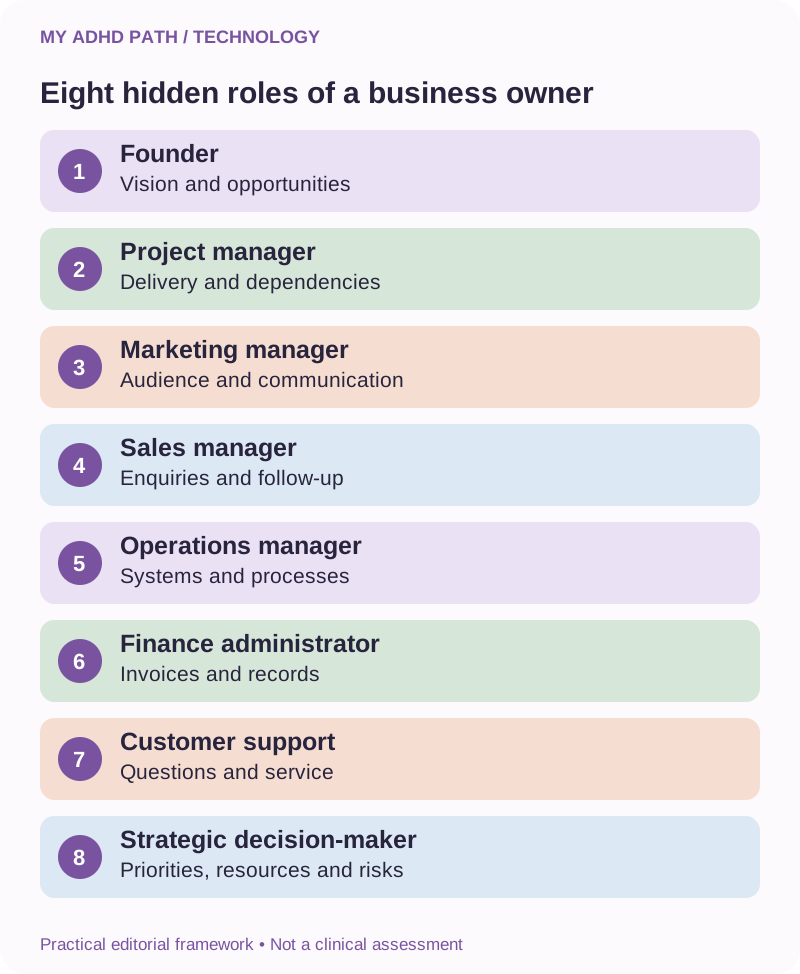
The following My ADHD Path framework illustrates eight roles that can exist within a single business.
1. Founder
Developing the vision, direction and opportunities for the business.
2. Project manager
Coordinating tasks, deadlines, dependencies and delivery.
3. Marketing manager
Communicating the value of products and services to potential customers.
4. Sales manager
Managing enquiries, proposals, follow-ups and customer acquisition.
5. Operations manager
Maintaining the systems and processes that keep the business functioning.
6. Finance administrator
Managing financial records, invoicing, payments and relevant deadlines.
7. Customer support manager
Responding to questions and supporting existing customers.
8. Strategic decision-maker
Evaluating priorities, risks, resources and the long-term direction of the business.
Not every business requires all eight roles in the same way.
Some responsibilities may be shared with employees, contractors or professional advisers.
Nevertheless, recognising these different demands can help explain why running even a relatively small business may feel mentally complicated.
Why another productivity app may not solve the problem
Many entrepreneurs have tried numerous organisational systems.
Project management software.
Digital notebooks.
Task managers.
Spreadsheets.
Business dashboards.
Calendars.
Sometimes these systems are genuinely useful.
But they often rely on the business owner already knowing how the information should be organised.
You need to establish the priorities before entering them.
You need to identify the project stages before creating the tasks.
You need to remember which responsibilities belong in which system.
An AI assistant may provide support at an earlier stage.
You can explain what is happening in the business without first having to organise every detail.
The assistant may help establish which activities are connected, what information is missing and what needs attention.
This is potentially useful because it supports the process of organising work rather than simply providing another place to record it.
AI as an executive functioning assistant for your business
One way to approach AI is to think of it as an additional source of practical cognitive support.
Depending on the tools available, it may help you:
- Process unstructured information.
- Clarify priorities.
- Identify project dependencies.
- Prepare decisions.
- Structure complex tasks.
- Maintain project summaries.
- Draft communications.
- Review progress.
- Prepare for meetings.
- Create repeatable workflows.
These capabilities do not make AI an independent business executive.
The assistant may misunderstand information, overlook important risks or produce inaccurate output.
It requires appropriate instructions, reliable context and human oversight.
Its purpose is to support the activities involved in running your business, not take responsibility for the business itself.
The five areas of AI-supported entrepreneurship
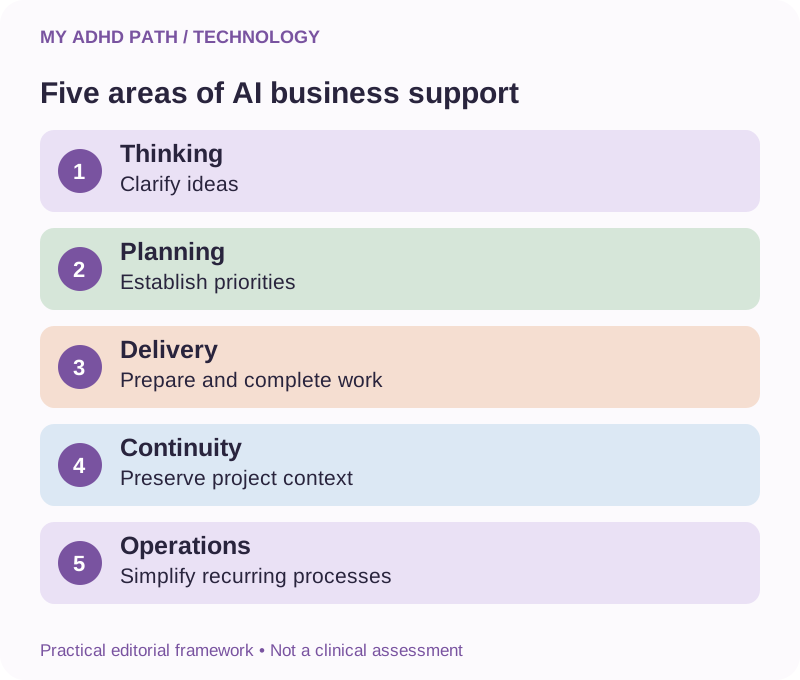
A useful way to organise potential applications is to distinguish five areas.
Thinking
Exploring ideas, solving problems and clarifying opportunities.
Planning
Establishing goals, priorities, timelines and project stages.
Delivery
Supporting the preparation and completion of business activities.
Continuity
Preserving important information and helping you resume unfinished work.
Operations
Reducing repetitive administrative demands through appropriate tools and processes.
You don't need AI to support all five areas immediately.
Begin with the activities that create the greatest friction in your existing working life.
Twenty ways entrepreneurs with ADHD can use AI
1. Turn your business brain dump into a working plan
Explain everything occupying your attention.
Include unfinished projects, new ideas, outstanding responsibilities and concerns.
Ask AI to organise those thoughts into distinct categories.
Review the resulting overview before establishing priorities.
2. Establish what actually matters today
A long list of activities does not necessarily provide meaningful prioritisation.
Ask AI to consider confirmed deadlines, customer commitments, revenue-related activities, dependencies and available time.
Ensure it understands which consequences are real rather than assumed.
3. Break complex projects into manageable stages
A task such as "launch the website" may represent dozens of separate activities.
AI can help identify the stages involved, establish dependencies and create a more manageable starting point.
4. Preserve your place in unfinished projects
Before switching activities, create a short project handover note.
Record what has been completed, decisions that have been made, outstanding issues and the next useful action.
Keep the note somewhere you can reliably find it.
5. Create an idea parking area
New ideas do not always need immediate attention.
Ask AI to capture the idea, identify its potential purpose and record why it might be worth exploring later.
This allows you to preserve the opportunity without automatically interrupting existing work.
6. Challenge your business ideas
Instead of asking AI whether an idea is brilliant, ask it to examine the assumptions behind it.
What evidence supports customer demand?
What would delivery involve?
What could make the idea commercially unsuitable?
What would a small validation exercise look like?
AI should help you investigate possibilities, not simply reinforce your enthusiasm.
7. Prepare for customer meetings
Ask for help organising the meeting's intended outcome, relevant background and outstanding questions.
Create a concise preparation document instead of repeatedly reviewing several sources of information.
8. Process meeting notes
AI may help identify decisions, agreed actions, deadlines and responsibilities from notes or an appropriately obtained transcript.
Check accuracy and ensure recording, transcription and data processing arrangements are appropriate.
9. Draft customer communications
Prepare proposals, follow-ups, responses and other routine communications.
Review all wording, commitments and factual statements before sending.
10. Organise your marketing
Ask AI to help create a manageable content plan based on your audience, existing materials and business objectives.
Avoid generating more content than you have the capacity to review and publish.
11. Repurpose existing content
A useful article may provide the basis for a newsletter, social media posts, educational graphics and customer resources.
AI can help prepare alternative formats without requiring you to start from the beginning each time.
Check facts, tone, permissions and originality.
12. Develop repeatable business processes
When you complete a recurring activity, ask AI to help document the process.
A clear procedure may reduce the need to reconstruct the steps the next time it is required.
13. Prepare invoices and payment follow-ups
AI can help draft reminder emails and organise information about outstanding payments.
Use verified accounting records for amounts, payment status and due dates.
Do not treat generated information as an accounting record.
14. Review recurring business subscriptions
Gather the verified costs and purposes of your subscriptions.
Ask AI to identify potential duplication, underused services and questions to consider before cancelling.
Check contractual terms and any dependencies before making changes.
15. Prepare financial scenarios
AI may help explain financial concepts, organise assumptions and illustrate possible outcomes.
Verify calculations and seek appropriate professional advice for consequential financial decisions.
An illustrative forecast is not a guarantee of future revenue.
16. Organise research
An assistant may help summarise information, identify gaps and compare relevant sources.
Current market information should be verified against reliable evidence.
AI-generated citations and competitor claims can be incorrect.
17. Prepare your own business documentation
AI may help structure internal procedures, onboarding documents and product descriptions.
Legal, contractual, regulatory and safety-related documents may require professional review.
18. Create a realistic working day
Explain your available time, fixed commitments and current capacity.
Ask for a manageable plan that includes interruptions, transitions and realistic allowances for unexpected activities.
19. Decide whether to continue a project
Ask AI to help distinguish the work already invested from the potential future value of continuing.
Consider customer demand, remaining costs, risks and alternative uses of your resources.
Previous investment alone does not establish whether further investment is worthwhile.
20. Conduct a weekly business review
Review completed activities, unresolved issues, financial priorities and upcoming commitments.
Ask AI to help identify where your attention would be most useful next week.
Keep confirmed decisions in your own business records.
Generating more business ideas is not necessarily the most useful application of AI.
The problem isn't always a shortage of ideas
AI makes it relatively easy to explore possibilities.
You can investigate a business concept, generate a brand name, prepare a website structure and develop a marketing strategy within a comparatively short period.
For an entrepreneurial person who enjoys developing new ideas, this can be enormously appealing.
But it introduces an interesting challenge.
The ability to create more possibilities does not necessarily improve your ability to deliver them.
You may find yourself developing several new projects while existing ones remain unfinished.
The business administrator still needs attention.
The customers still need responses.
The existing products still need marketing.
AI may increase the speed at which ideas become possible without increasing the time available to manage them.
That is why it can be useful to establish clear boundaries between exploring ideas and committing resources.
The ability to create more possibilities does not necessarily improve your ability to deliver them.
Three modes of entrepreneurial thinking
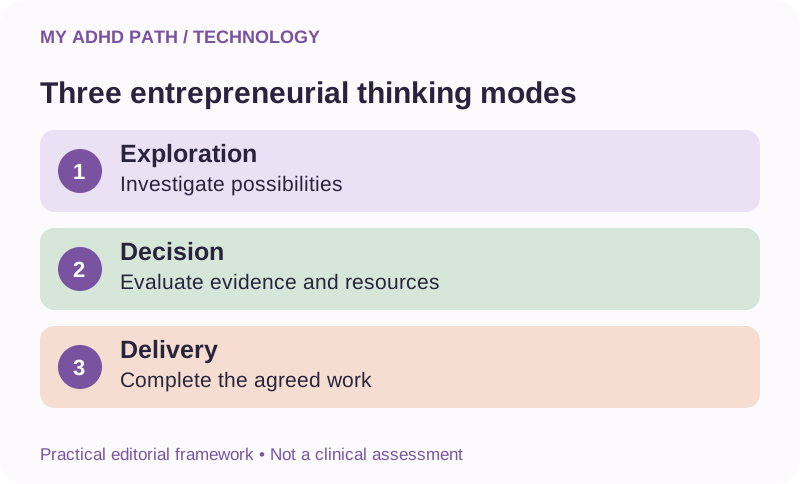
You can instruct your AI assistant to work with you in three distinct modes.
Exploration mode
This is where you investigate possibilities.
AI can help brainstorm, challenge assumptions and develop potential concepts.
Ideas created here are not automatically commitments.
Decision mode
This is where you evaluate whether an opportunity deserves further attention.
Consider available evidence, resources, costs, risks and its relevance to your existing priorities.
Delivery mode
This is where you concentrate on completing work you have already committed to.
Ask AI to help identify the next useful action and avoid introducing unrelated opportunities.
Moving deliberately between these modes may help prevent every interesting conversation from becoming another business project.
Worked example: Four projects competing for attention
Imagine a fictional entrepreneur managing four projects.
Project A is an existing service generating revenue.
Project B is a nearly completed digital product.
Project C is an early-stage website concept.
Project D is a new business idea.
All four feel important for different reasons.
An AI assistant could help organise the situation.
| Project | Current position | Useful consideration |
|---|---|---|
| A | Active customer commitments | Protect existing delivery and revenue |
| B | Close to launch | Establish remaining launch requirements and evidence of demand |
| C | Early development | Review strategic relevance and available resources |
| D | New idea | Capture the opportunity without automatically committing to it |
This comparison does not establish a universally correct priority.
Important circumstances may be missing.
Perhaps Project B has regulatory issues.
Perhaps Project C involves an important contractual obligation.
Perhaps Project A is no longer financially sustainable.
The assistant should ask about relevant uncertainties before making a recommendation.
The value of the overview is that it helps the entrepreneur see the projects as separate commitments rather than one enormous collection of unfinished work.
The four project states
Not every business project needs to be active.
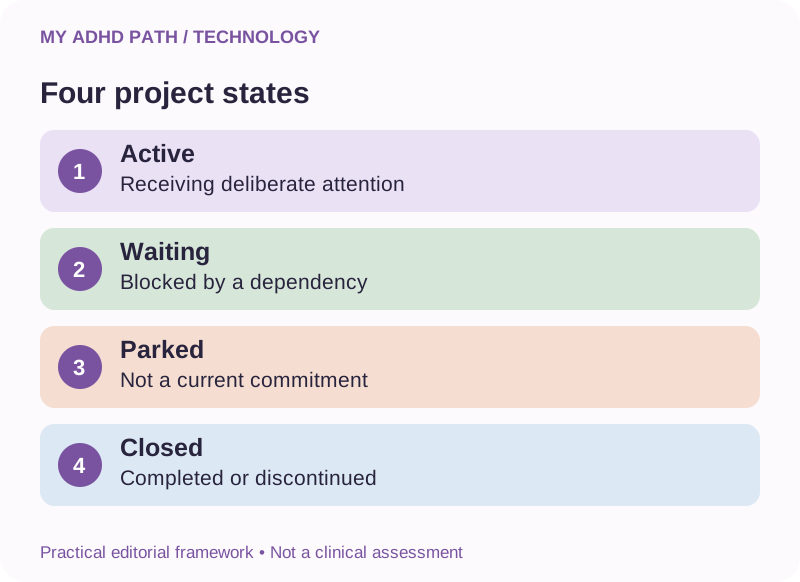
The following editorial framework can help make this distinction clearer.
Active
A project receiving deliberate attention and resources.
Waiting
A project requiring information, approval or another dependency before meaningful progress can continue.
Parked
A potentially worthwhile project that is not currently a commitment.
Closed
A completed, discontinued or otherwise concluded project.
A parked project is not a failed project.
It is an opportunity you have chosen not to pursue at the moment.
Ask AI to help review project states periodically.
Avoid repeatedly reopening decisions unless something meaningful has changed.
Creating a business source of truth
One challenge associated with managing multiple projects is preserving important information.
You may have discussed decisions in several conversations.
Saved information in different documents.
Made changes to a website.
Revised a pricing model.
Explored alternative technical approaches.
Agreed on a direction that later changed.
When you return to the project, it can become difficult to establish which information remains current.
AI conversations alone are not necessarily reliable business records.
Different tools have different memory and context capabilities.
Older information may not always be accessible or accurately recalled.
Create a trusted source of truth for each important project.
This might include:
- The current project objective.
- The intended audience.
- The agreed product or service.
- Confirmed pricing.
- Current development status.
- Important decisions.
- Known risks.
- Outstanding tasks.
- The next milestone.
- Links to authoritative documents and project files.
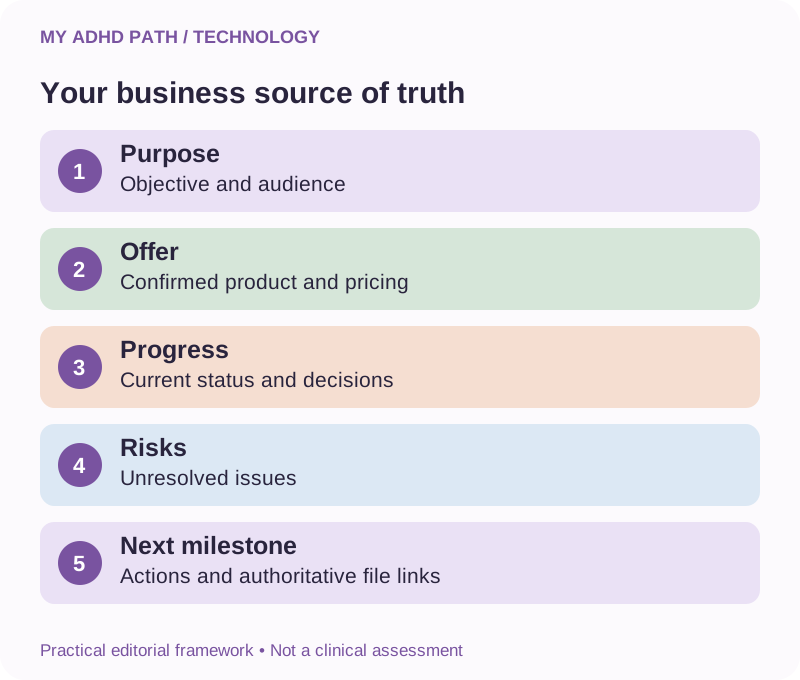
AI can help prepare and update this overview.
However, the business owner should ensure changes are accurate and preserved in a reliable location.
Building a useful AI project workspace
Rather than discussing every aspect of your business within one enormous collection of conversations, consider distinct project workspaces.
Depending on the service, these might include relevant instructions, reference documents and project-specific conversations.
For example, a workspace could contain:
- A product overview.
- Brand and tone guidelines.
- An editorial plan.
- Relevant technical documentation.
- A current project status summary.
- A decision log.
- A development backlog.
This structure may help reduce the amount of background information you need to provide repeatedly.
Do not assume every assistant automatically has access to every conversation or document.
Confirm which sources it can use.
Maintain independent copies of important business information.
Our guide to creating your own AI personal assistant explores this approach in more detail.
The importance of preserving project continuity
Interruptions are a normal feature of business life.
A customer calls.
An urgent issue appears.
You attend a meeting.
Another project requires attention.
You may return to the original activity hours or days later.
The difficulty is not always completing the next action.
Sometimes it's remembering what the next action was supposed to be.
A project handover note can help.
Before leaving a substantial activity, record:
- What you were trying to achieve.
- What has been completed.
- What decisions were made.
- What remains unresolved.
- Where the relevant files are located.
- What needs to happen next.
AI can help create this record from your working conversation.
Ask it to distinguish confirmed progress from planned work.
A task described as completed is not necessarily complete simply because AI says it is.
Verify important changes against actual files, systems, customer communications or other relevant evidence.
Creating a minimum useful business organisation system
You do not necessarily need an elaborate business dashboard.
A relatively simple system may provide a useful starting point.
A reliable calendar
For meetings, confirmed deadlines and time-sensitive commitments.
A project overview
For active work, milestones, outstanding responsibilities and project states.
A secure business information library
For important documents, records, decisions and source material.
An AI thinking assistant
For clarifying information, preparing work and supporting practical organisation.
A financial record system
For accurate accounting, invoices, payments and relevant reporting.
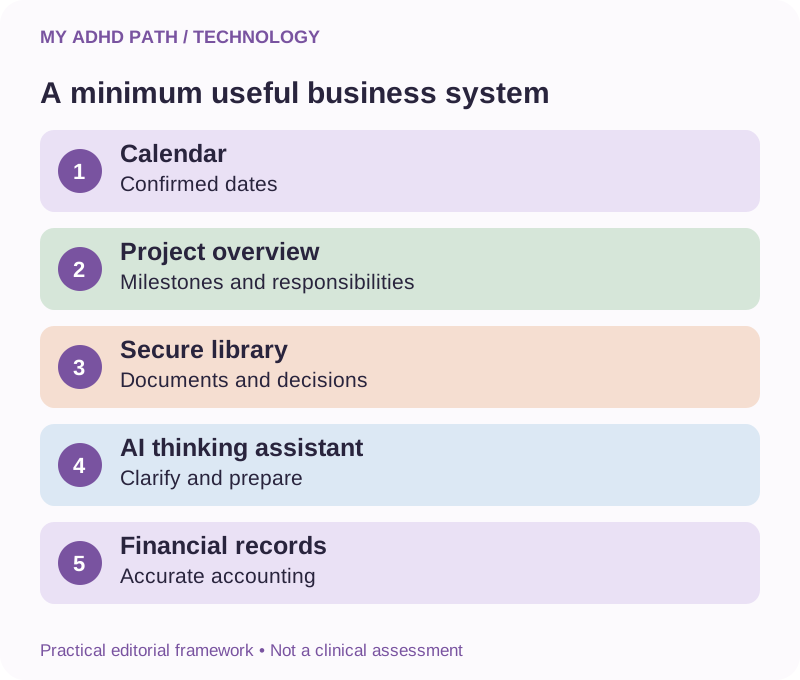
Choose tools that suit your business obligations and circumstances.
A system becomes less useful if maintaining it requires more effort than the work it supports.
Revenue-generating work versus business-building work
Not every commercially useful activity produces immediate revenue.
Developing a product, improving a website or preparing a marketing campaign may contribute to future income.
However, these activities can sometimes consume attention at the expense of existing commercial opportunities.
A useful business review distinguishes several types of work.
Revenue and delivery
Activities connected to acquiring customers, fulfilling existing commitments and receiving payment.
Business development
Activities intended to create future commercial opportunities.
Essential operations
Activities needed to maintain the business, meet obligations and protect continuity.
Optional improvements
Activities that could be useful but are not currently essential.
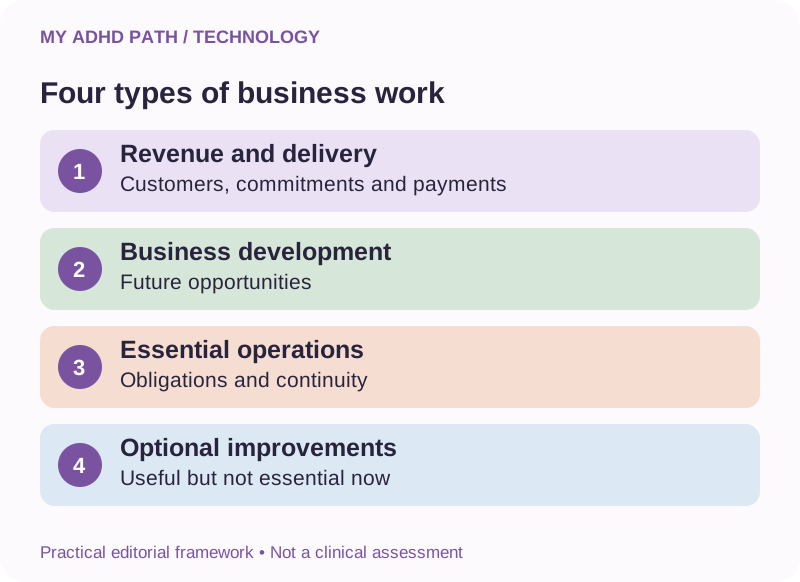
This framework is not intended to undervalue research, innovation or long-term investment.
Its purpose is to help you recognise where your working time is going.
AI can help categorise your current workload and identify important imbalances.
When being busy isn't the same as making progress
Imagine spending an entire afternoon refining the layout of a website.
You've improved the spacing.
Changed some illustrations.
Rewritten several headings.
Adjusted the colours.
These changes may be valuable.
But perhaps the website's payment system still doesn't work.
Or the business has no realistic plan for attracting customers.
The problem is not that design improvements are unimportant.
It's that another activity may currently have a greater effect on the business's ability to operate.
Try this
Ask your AI assistant: "Which of these activities will move the business closer to its current objective?" This can help connect individual tasks to meaningful outcomes.
Be clear about what the current objective actually is.
Product quality, safety, accessibility and compliance should never be neglected simply because they do not generate immediate revenue.
AI for commercially meaningful planning
Suppose your current objective is to acquire ten new customers.
Developing more website pages may help.
But so might speaking to potential customers, improving your offer or following up on existing enquiries.
AI can help you explore the different activities and identify the evidence supporting them.
Avoid treating predictions as facts.
For example, an assistant cannot reliably promise that a particular marketing campaign will produce ten customers.
It can help you establish assumptions and design ways to test them.
Good to know
A more useful question might be: "What would we need to learn before committing additional money or time to this campaign?"
A simple business revenue scenario
Imagine a business offering a service for £100 per month, excluding any applicable VAT.
It has 20 active paying customers.
Its illustrative monthly revenue is:
20 × £100 = £2,000.
If its monthly operating costs are £600, the amount remaining before other costs and taxes is:
£2,000 − £600 = £1,400.
This is not necessarily the business's profit or the owner's available personal income.
Additional costs, unpaid invoices, taxes, salaries and other obligations may affect the position.
AI can help organise scenarios like this.
It can also help you identify where important assumptions are missing.
However, important financial calculations should be checked using reliable records and appropriate professional advice.
Using AI to support marketing consistency
Marketing involves recurring activities that can be particularly challenging when your attention is divided across several projects.
Publishing content.
Responding to enquiries.
Preparing newsletters.
Reviewing results.
Keeping information accurate.
AI can help develop reusable processes.
For example, instead of creating a completely new marketing strategy every month, agree a manageable approach.
Develop one useful cornerstone article.
Prepare several shorter pieces of related content.
Create a newsletter.
Review the results.
Record what should be improved next time.
Use technology to support a sustainable publishing rhythm.
There is no requirement to be present on every platform or produce content every day.
Content quality, relevance and consistency matter more than the size of an unpublished content backlog.
Using AI to manage client work
Client-facing businesses may involve numerous commitments that need tracking.
A particular customer may require a proposal.
Another may be waiting for a revision.
Another may have provided feedback that needs processing.
AI can help convert information into a structured overview.
For each client, identify:
- The agreed scope.
- The current delivery status.
- Outstanding actions.
- Responsibilities.
- Relevant deadlines.
- Unresolved questions.
Keep confidential client records in appropriate systems.
An AI assistant should not be given unrestricted access to customer information simply because doing so appears convenient.
Ensure any processing complies with your contractual and data protection obligations.
AI for meetings and follow-through
A successful meeting does not necessarily mean the relevant work has been organised.
You may have agreed several actions without recording who is responsible for them.
You might remember the general discussion but forget a particular commitment.
AI can help process appropriately obtained meeting notes.
Ask it to distinguish:
- Decisions that were actually made.
- Ideas that were merely discussed.
- Actions that were agreed.
- Questions that remain unresolved.
- Deadlines that were confirmed.
- Responsibilities that were allocated.
This distinction matters.
A discussion about a potential service is not necessarily a commitment to deliver that service.
Review any meeting summary before circulating it.
Do not secretly record meetings or upload confidential discussions without considering relevant obligations, permissions and privacy requirements.
When to automate repetitive activities
AI and automation are related but different capabilities.
A conversational assistant may help you prepare an email.
An automation may send an approved message when a specific condition is met.
A connected AI service might help interpret information before an automated process proceeds.
Potential business applications include:
- Acknowledging new enquiries.
- Creating internal reminders.
- Organising incoming information.
- Monitoring defined system errors.
- Preparing routine reports.
- Transferring information between approved business systems.
Automation can reduce recurring demands.
But it can also introduce errors that repeat automatically.
Begin with low-risk, clearly defined processes.
Test them before relying on them.
Maintain logs, appropriate permissions and a way to intervene when something goes wrong.
Important payments, customer commitments, legal communications and changes to business-critical systems may require explicit human approval.
Our everyday automation guide explores these considerations further.
How much authority should your AI assistant have?
There is an important distinction between helping you think and being authorised to act.
A practical framework involves four levels.
Level one: Explain
The assistant provides information or analysis.
Level two: Prepare
The assistant creates a draft, plan or proposed action.
Level three: Act with approval
A suitably connected assistant performs an authorised action after confirmation.
Level four: Limited automation
An appropriately configured system performs specific recurring activities within defined boundaries.
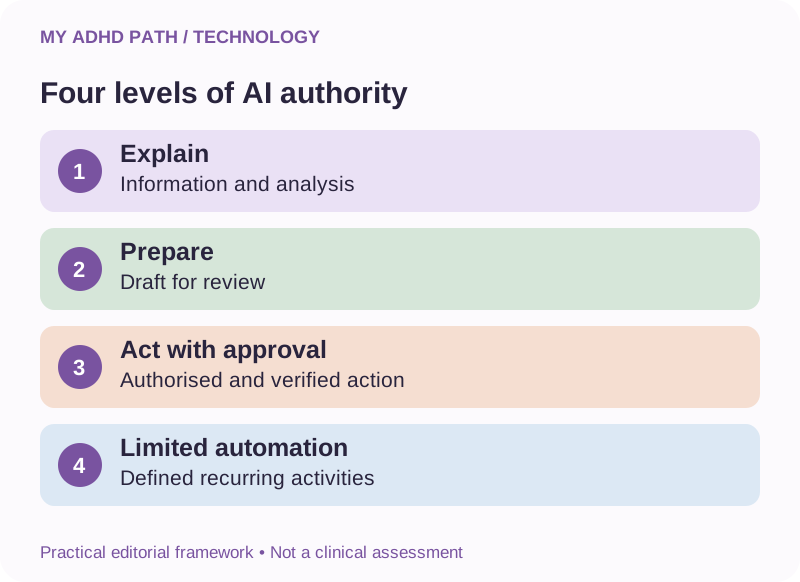
Greater authority introduces greater responsibility for security, oversight and error handling.
Your assistant does not need access to everything in order to be useful.
Provide only the information and permissions required for its intended activities.
Protecting your business information
Business owners may handle sensitive information, including customer records, financial information, confidential contracts and intellectual property.
Before using an AI tool, consider:
- What information are you providing?
- Where is it processed?
- Who may have access to it?
- How long is it retained?
- Can it be used to improve the provider's models?
- What contractual safeguards apply?
- Is the service suitable for the type of information involved?
A paid subscription does not automatically establish that a service is suitable for confidential business information.
Neither does using a locally hosted AI system automatically guarantee security or compliance.
Appropriate configuration, maintenance, access controls and data handling practices remain important.
In the UK, useful starting points include the Information Commissioner's Office and the National Cyber Security Centre.
Seek specialist guidance where necessary.
Avoiding the AI subscription collection
It can be tempting to subscribe to every new AI service that appears capable of improving your business.
One tool for writing.
Another for research.
Another for meetings.
Another for graphics.
Another for projects.
Another for automation.
Soon you may have an impressive collection of subscriptions, very little integration between them and another administrative responsibility to manage.
Before adding a tool, ask:
- Which specific difficulty does it address?
- Do I already own something that can perform the same activity?
- Will I use it regularly?
- What will it cost over a full year?
- Does it meet my business security requirements?
- Can I retain my information if I stop using it?
A tool costing £25 per month costs £300 over a year, assuming the price remains unchanged.
Several modest subscriptions can become a significant operating expense.
Choose tools according to their practical value rather than the excitement of their advertised capabilities.
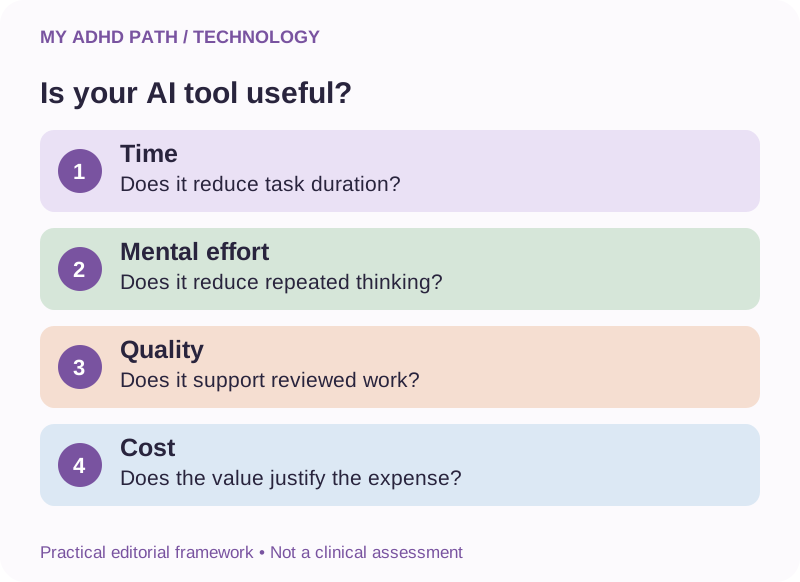
Reviewing the value of your AI tools
Consider the following four areas when evaluating an AI service.
Time
Does it reduce the time required to complete appropriate activities?
Mental effort
Does it reduce the need to repeatedly organise, remember or reconstruct information?
Quality
Does it support accurate, useful and appropriately reviewed work?
Cost
Does its overall value justify its financial and operational demands?
Time savings are not the only consideration.
A tool might not dramatically shorten an activity but could make beginning or completing it considerably more manageable.
For some entrepreneurs with ADHD, that practical difference may be especially valuable.
These are individual evaluations rather than clinical measurements.
AI and Access to Work for self-employed people
Entrepreneurs with ADHD may be eligible for employment-related support through Access to Work.
Access to Work is a government scheme operating in Great Britain: England, Scotland and Wales.
It can provide support for eligible people whose disability or health condition affects their ability to work.
Self-employed people may be eligible, subject to the scheme's requirements and individual circumstances.
Northern Ireland has separate arrangements.
Depending on assessed needs and eligibility, appropriate support may involve specialist equipment, assistive software, practical assistance or other employment-related support.
However, you should not assume that a general-purpose AI subscription will automatically be approved.
Good to know
A useful starting point is to explain the specific disability-related barriers affecting your work and how the proposed support would address them. For example: difficulty organising competing project responsibilities, challenges preserving important information across interrupted activities, difficulty translating complex instructions into manageable actions, or substantial difficulty with aspects of workplace administration.
Explain what happens in practice, what support you already use and where additional assistance is needed.
The official Access to Work information is available here:
https://www.gov.uk/access-to-work
Our dedicated Access to Work resource centre will explore applications, self-employment, assessments, possible support, waiting times and what to do when an application appears to have stalled.
Always check current government guidance before applying or purchasing equipment on the assumption that it will be funded.
Preparing to explain your AI support needs
If you are discussing assistive technology with an assessor, employer or other appropriate professional, it may be useful to demonstrate the functional difference the support makes.
Instead of simply stating that AI helps you be more productive, explain the activity involved.
- What is difficult?
- How does the difficulty affect your work?
- What existing approaches have you tried?
- How does the proposed support change the activity?
- What limitations remain?
For example, a conventional task manager might help you record responsibilities but provide little support with establishing priorities from an unstructured collection of information.
A conversational assistant may help organise that information before the tasks are recorded.
This illustrates a possible difference between a traditional organisational tool and AI-supported executive functioning assistance.
It does not establish eligibility for funding or prove that a particular service is necessary in every case.
Keep your account accurate and grounded in your own experience.
Running a business without working all the time
AI can make it easier to continue working.
You can generate another idea.
Prepare another article.
Investigate another opportunity.
Refine another feature.
When the technology remains available at any hour, there may be fewer natural stopping points.
For some entrepreneurs, this creates a risk of extending working hours rather than reducing the demands of work.
Establish deliberate working boundaries.
Decide when a project is sufficiently complete for the current stage.
Preserve your place before ending a working session.
Recognise when further activity is optional.
Protect time for sleep, relationships, rest and activities outside the business.
An effective support system should help you manage your working life, not encourage you to spend every available hour working.
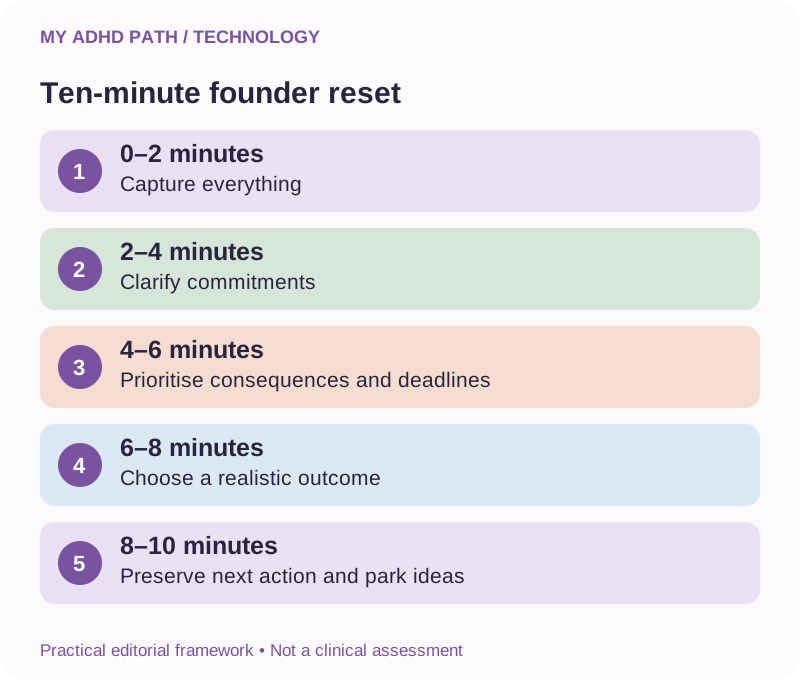
The ten-minute founder reset
When you feel pulled in several directions, try this flexible exercise.
Minutes one and two: Capture
Explain everything currently occupying your attention.
Minutes three and four: Clarify
Separate actual commitments from ideas, concerns and possible future activities.
Minutes five and six: Prioritise
Identify the responsibilities with significant consequences, genuine deadlines or important dependencies.
Minutes seven and eight: Simplify
Choose a realistic outcome for your next working period.
Minutes nine and ten: Preserve
Record the next action and park the remaining ideas somewhere reliable.
You can complete this independently or with an appropriate AI assistant.
It is an illustrative planning exercise rather than a fixed requirement or validated ADHD intervention.
Three fictional entrepreneurial experiences
Illustrative scenario
Rebecca, 46 - Managing several digital businesses
Rebecca enjoys developing new products and identifying opportunities. She manages several projects at different stages of development. However, switching between them can involve repeatedly reconstructing previous conversations and decisions. She creates a separate source of truth for each project and uses AI to prepare concise handover notes. She also distinguishes active projects from parked ideas. Her objective is to maintain continuity without constantly relying on her memory.
Illustrative scenario
Daniel, 39 - Running a client services business
Daniel is skilled at delivering his professional services. He finds recurring administration, proposal preparation and customer follow-ups more demanding. He uses AI to prepare communication drafts and organise verified meeting notes. He maintains a reliable customer record system and approves consequential communications before sending them. Where appropriate, he also explores employment-related disability support.
Illustrative scenario
Amira, 31 - Turning a creative idea into a product
Amira frequently develops ideas for new products. She finds the early creative stages particularly engaging but struggles to establish which opportunities justify further investment. She begins using AI to challenge assumptions and design small validation exercises. Instead of developing every idea into a complete product, she collects relevant customer feedback before deciding which project to pursue.
These experiences are fictional illustrations, not evidence of clinical or commercial outcomes.
What the research says
Research into ADHD and entrepreneurship has explored associations between ADHD characteristics and entrepreneurial intentions, behaviours and experiences. Some studies suggest that characteristics associated with ADHD may influence entrepreneurial activities in different ways. However, entrepreneurship research does not establish that people with ADHD are universally more creative, more successful or better suited to self-employment. Research into executive functioning provides relevant background for understanding some of the demands of running a business. Cognitive offloading research also explores how external resources may alter the cognitive demands associated with everyday tasks. Separately, experimental and workplace research into generative AI has reported benefits in certain types of professional work. These findings depend on the activities studied, the individuals involved, the quality of the technology and the surrounding working conditions. They should not be interpreted as proof that AI reliably improves business performance for entrepreneurs with ADHD. The frameworks in this article are practical editorial approaches inspired by relevant research. They are not clinically validated ADHD interventions.
Create your personal AI business support profile
Consider the following questions.
- What type of business do I run?
- What are my principal responsibilities?
- Which activities regularly require disproportionate mental effort?
- Which tasks do I repeatedly postpone?
- Where do I lose track of important information?
- Which responsibilities require professional advice or human approval?
- What business information needs protecting?
- What existing tools are already useful?
- Which activities would benefit from repeatable processes?
- What would a sustainable working week look like?
- What would meaningful business progress look like?
You can use these considerations to establish instructions for an appropriate AI assistant.
Focus on the actual support you need rather than developing an elaborate system before you have established its usefulness.
Downloadable resource
My ADHD Entrepreneur's AI Toolkit
A practical guide to building and running a business with ADHD. More meaningful progress. Less mental juggling.
Download PDFInstructions for your AI business assistant
The following template can be adapted to your own working circumstances.
AI prompt
Business assistant instructions template
"Act as my business organisation and executive functioning assistant. Help me organise complex information, establish meaningful priorities and preserve continuity across projects. Distinguish confirmed commitments from ideas. Do not automatically encourage every new business opportunity. Challenge my assumptions and identify relevant risks. Consider existing customer commitments, revenue opportunities, dependencies and available resources. When I am working on an established project, help me maintain focus on its current objective. Ask for missing information when it could materially change your recommendation. Distinguish verified facts from estimates and assumptions. Do not claim that an action has been completed unless its completion has been confirmed. Do not make consequential financial, legal or technical changes without appropriate authorisation. When we finish a working session, help me record important decisions and the next useful action."
Adapt the instructions according to the assistant's actual capabilities.
Save important business records separately.
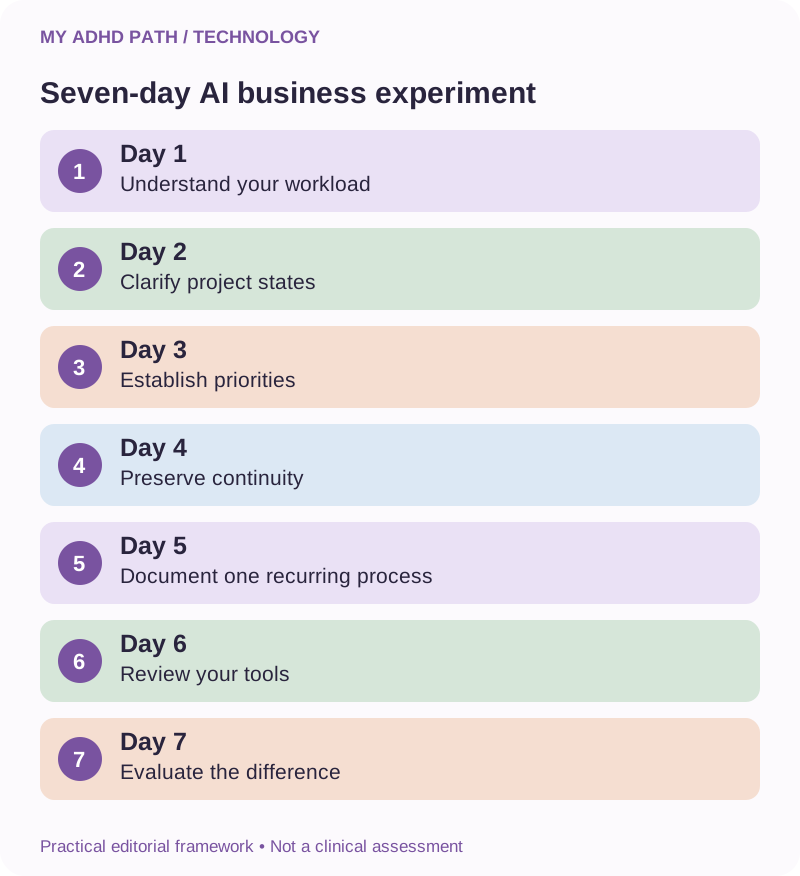
Your seven-day AI business experiment
Day one: Understand your workload
Identify the business responsibilities that create the greatest mental demands.
Day two: Clarify your projects
Separate active, waiting, parked and closed projects.
Day three: Establish your priorities
Identify work connected to current objectives, commitments and important dependencies.
Day four: Preserve continuity
Create a source-of-truth document for one important project.
Day five: Simplify a recurring activity
Document one business process that regularly needs repeating.
Day six: Review your tools
Identify overlapping subscriptions, unnecessary systems or opportunities to simplify your working environment.
Day seven: Evaluate the difference
Consider whether your new approach reduced mental effort, improved continuity or supported meaningful progress.
This is a personal working experiment, not a clinical assessment or guarantee of commercial results.
Twenty AI prompts for entrepreneurs with ADHD
AI prompt
1. Untangle my business workload
"I'm going to explain everything that's happening across my business. Organise it into existing commitments, outstanding actions, decisions, risks and new ideas."
AI prompt
2. Help me prioritise
"Identify the activities that deserve attention based on confirmed deadlines, commercial objectives, dependencies and consequences."
AI prompt
3. Clarify today's outcome
"Help me establish one realistic, meaningful outcome for today's available working time."
AI prompt
4. Break down this project
"Identify the stages, dependencies and first useful action required to move this project forward."
AI prompt
5. Stop encouraging every idea
"Challenge this business idea. Identify the evidence supporting it, the assumptions requiring validation and the potential costs of pursuing it."
AI prompt
6. Park this opportunity
"Create a concise record of this idea so I can return to it later without interrupting my current work."
AI prompt
7. Review my project portfolio
"Help me classify these projects as active, waiting, parked or closed. Explain any uncertainties."
AI prompt
8. Create a project handover
"Summarise confirmed progress, important decisions, unresolved issues, relevant files and the next useful action."
AI prompt
9. Prepare me for this meeting
"Organise my meeting objective, relevant background, questions and decisions I need to discuss."
AI prompt
10. Process my meeting notes
"Extract confirmed decisions, agreed actions, responsibilities and deadlines. Do not turn suggestions into commitments."
AI prompt
11. Help me follow up
"Draft a professional follow-up based only on the confirmed information I've provided."
AI prompt
12. Organise my marketing
"Create a realistic marketing plan using my existing content, available time and commercial objectives."
AI prompt
13. Repurpose this content
"Suggest appropriate alternative formats for this material without inventing new factual claims."
AI prompt
14. Document this process
"Turn these confirmed working steps into a repeatable business procedure, including important checks."
AI prompt
15. Review my subscriptions
"Compare these tools based on verified costs, actual usage, overlapping features and cancellation considerations."
AI prompt
16. Challenge my numbers
"Review this financial scenario for calculation errors, unsupported assumptions and information requiring professional verification."
AI prompt
17. Help me focus on delivery
"Work in delivery mode. Keep our attention on the agreed project outcome and avoid introducing unrelated ideas."
AI prompt
18. Create a simpler working day
"Help me protect important commitments while postponing optional improvements and non-essential activities."
AI prompt
19. Explain my workplace support needs
"Help me describe the practical barriers affecting my working activities and how my existing support addresses them. Keep everything factual."
AI prompt
20. Conduct my weekly business review
"Help me review completed outcomes, outstanding commitments, risks and priorities for next week. Distinguish actual progress from planned work."
Review AI-generated information before relying on it.
Protect confidential information and retain appropriate authority over business decisions.
Frequently asked questions
Can AI help entrepreneurs with ADHD?
It may provide practical support with planning, organisation, information processing, communication and project continuity. Its usefulness depends on individual needs and the particular tools involved.
Are people with ADHD naturally better entrepreneurs?
No universal conclusion is supported. Some people may find aspects of entrepreneurship suit their individual characteristics, while others experience substantial difficulties.
What is the best AI tool for ADHD business owners?
There is no single best tool. Consider the activities requiring support, the assistant's capabilities, cost, privacy and suitability for your business.
Can AI help me manage multiple businesses?
It may help organise project information, compare commitments and preserve continuity. Maintain reliable independent business records.
Can I use AI as a business manager?
AI can provide administrative and decision support. It should not be treated as an accountable independent business manager.
Can AI help me stop starting new projects?
It may help establish project priorities, capture new ideas and identify the implications of additional commitments.
Can AI help with business planning?
Yes. It can organise business objectives, assumptions, options and possible actions. Commercial predictions require verification and realistic evaluation.
Can AI manage my business finances?
It can help explain concepts, organise verified information and prepare illustrative calculations. Use appropriate accounting systems and qualified advice.
Can AI write my business contracts?
It may help prepare initial wording or questions, but important contracts require appropriate legal expertise and review.
Can AI help with customer communications?
Yes. It can prepare drafts and organise information. Review accuracy, confidentiality and commitments before sending.
Can AI automate my business?
It may support certain automated workflows when suitable tools, integrations and permissions are available. Automation requires testing, monitoring and appropriate safeguards.
Can I upload customer data to AI?
Only when the processing arrangements are appropriate and consistent with your legal, contractual and security obligations. Minimise unnecessary personal information.
Can self-employed people with ADHD apply for Access to Work?
Potentially, yes. Eligibility depends on the scheme's requirements and individual circumstances. Check GOV.UK for current Great Britain guidance.
Can Access to Work pay for AI subscriptions?
This should not be assumed. The scheme considers individual employment-related support needs and applicable funding requirements.
Can AI help prevent entrepreneurial burnout?
It may help reduce some administrative demands, but it is not an established burnout prevention or mental health treatment. Workload, health, rest and appropriate support remain important.
How do I know whether an AI subscription is worth paying for?
Consider its financial cost, usefulness, reliability, effect on mental effort and whether it introduces additional administrative demands.
Should I keep all my business projects in one AI conversation?
Not necessarily. Separate workspaces and independently stored project summaries may make information easier to manage and retrieve.
What happens if my AI service becomes unavailable?
Maintain independent copies of important records, suitable backups and alternative ways to complete business-critical activities.
Can AI make me more profitable?
It may support activities that contribute to business performance, but it cannot guarantee revenue, profit or commercial success.
Is AI a treatment for ADHD?
No. It is a potential practical support tool and does not replace appropriate assessment, treatment or clinical care.
Build a business that works with the way you think
Perhaps you've spent years wondering why developing an idea feels so much easier than managing everything surrounding it.
Perhaps you've created complicated productivity systems that worked beautifully for about a fortnight.
Perhaps you've wondered how other business owners seem to remember everything without having fifteen notebooks, several spreadsheets and a collection of unfinished plans.
There is no single correct way to run a business.
What matters is finding a way of working that supports your individual abilities, responsibilities and circumstances.
AI may help you organise the ideas.
Preserve the progress.
Understand the priorities.
Manage the transitions.
And reduce some of the invisible work that goes into keeping everything moving.
You don't necessarily need more ideas, more software or more hours in the day.
Sometimes you need better support for the business you're already building.
Sources and further reading
- Wiklund, J. et al. (2017). ADHD, Impulsivity and Entrepreneurship. Journal of Business Venturing. https://doi.org/10.1016/j.jbusvent.2017.07.002
- Diamond, A. (2013). Executive Functions. Annual Review of Psychology. https://doi.org/10.1146/annurev-psych-113011-143750
- Willcutt, E. G. et al. (2005). Validity of the Executive Function Theory of Attention-Deficit/Hyperactivity Disorder: A Meta-Analytic Review. Biological Psychiatry. https://doi.org/10.1016/j.biopsych.2005.02.006
- Risko, E. F. and Gilbert, S. J. (2016). Cognitive Offloading. Trends in Cognitive Sciences. https://doi.org/10.1016/j.tics.2016.07.002
- Noy, S. and Zhang, W. (2023). Experimental Evidence on the Productivity Effects of Generative Artificial Intelligence. Science. https://doi.org/10.1126/science.adh2586
- Brynjolfsson, E., Li, D. and Raymond, L. R. (2025). Generative AI at Work. Quarterly Journal of Economics. https://doi.org/10.1093/qje/qjae044
- Faraone, S. V. et al. (2021). The World Federation of ADHD International Consensus Statement. https://doi.org/10.1016/j.neubiorev.2021.01.022
- NICE - ADHD: diagnosis and management. https://www.nice.org.uk/guidance/ng87
- GOV.UK - Access to Work. https://www.gov.uk/access-to-work
- GOV.UK - Business and self-employed. https://www.gov.uk/browse/business
- Information Commissioner's Office. https://ico.org.uk/
- National Cyber Security Centre. https://www.ncsc.gov.uk/
- Northern Ireland government services. https://www.nidirect.gov.uk/
This article provides general educational information and practical suggestions. It does not constitute medical, legal, financial, tax or professional business advice. The frameworks and exercises are illustrative rather than clinically validated ADHD interventions. AI-generated information and consequential business decisions require appropriate human oversight.