

Parenting isn't just about doing all the things your family needs. It's about remembering all the things your family needs before anybody else realises they need them.
It's Wednesday evening.
You've just remembered that tomorrow is a non-uniform day.
There's a school email you haven't read, a dentist appointment you need to rearrange and a birthday party invitation somewhere in the kitchen.
One child needs something for a school project.
Another has grown out of their trainers.
You haven't decided what everyone's having for dinner.
And somebody has just asked you where their water bottle is.
Apparently, you're also the family's official water bottle tracking system.
None of these responsibilities is particularly complicated in isolation.
Together, however, they represent an enormous amount of information to remember, organise and act upon.
When you're a parent with ADHD, managing that invisible workload can be particularly demanding.
Artificial intelligence offers another possible way to manage some of it.
Not by telling you how to raise your children.
Not by turning your family into a perfectly organised productivity project.
But by helping you carry less of the information, planning and administrative work that comes with everyday family life.
At a glance
- Parenting involves a substantial amount of invisible cognitive work.
- ADHD-related executive functioning difficulties may make coordinating family responsibilities particularly demanding.
- AI can help organise information, prepare communications, simplify planning and identify outstanding responsibilities.
- Digital calendars, reminders and shared household systems remain important.
- Household responsibilities should be shared fairly wherever possible.
- AI should not replace parental judgement, human relationships or appropriate professional advice.
- Children's personal information requires particular care.
- AI is a potential practical support tool, not an established treatment for ADHD.
The invisible workload of parenting
When we think about parenting, we often think about visible activities.
Preparing meals.
Taking children to school.
Helping with homework.
Doing the washing.
Attending appointments.
But behind these activities is another collection of responsibilities.
Recognising when something needs doing.
Anticipating future needs.
Remembering deadlines.
Establishing what information is missing.
Making arrangements.
Coordinating other people's availability.
Checking whether something has been completed.
This is often described as the mental load of family life.
Research into cognitive household labour has explored how anticipating needs, identifying options, making decisions and monitoring progress contribute to this workload.
For some parents with ADHD, these demands can be especially challenging.
It isn't necessarily the number of practical activities that creates the greatest difficulty.
It's the amount of thinking required to keep everything moving.
Why family life can be demanding for the ADHD brain
Family life rarely provides uninterrupted opportunities to complete a single activity.
You might begin preparing dinner, receive a school notification, answer a question about homework and remember an outstanding bill within the space of a few minutes.
Each interruption introduces another collection of information and decisions.
Executive functions are cognitive processes involved in coordinating goal-directed behaviour.
Research has identified average differences in aspects of executive functioning among people with ADHD, although individual experiences vary.
Working memory, planning, organisation and managing competing demands may all be relevant to parenting.
Someone might be an engaged, loving and capable parent while finding the administrative demands of family life exhausting.
These are not contradictory experiences.
Being good at parenting and finding the organisation of parenting easy are two entirely different things.
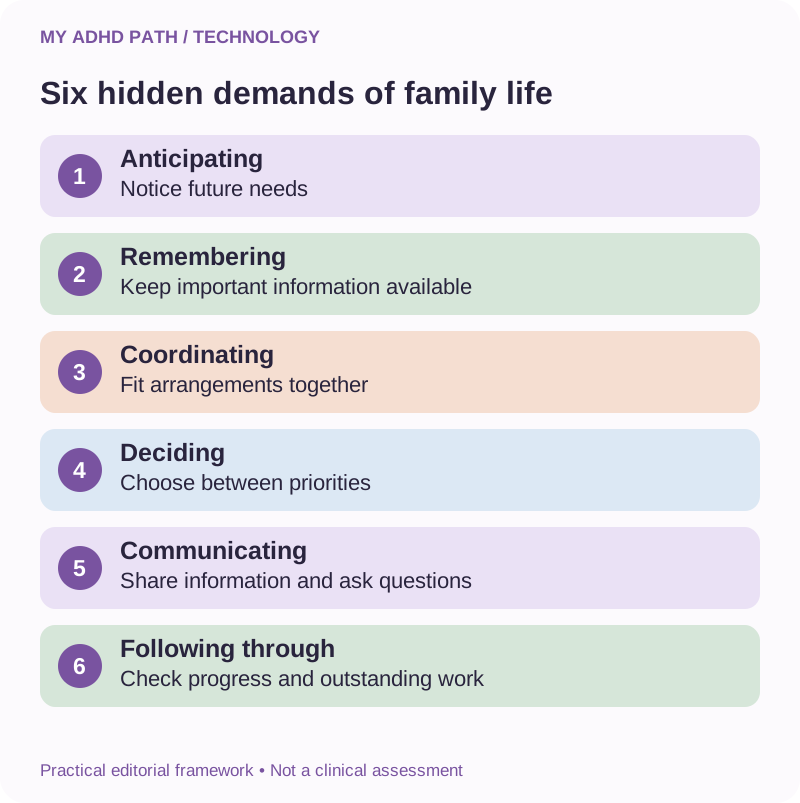
Six hidden demands of family life
The following My ADHD Path editorial framework illustrates some of the cognitive work involved in managing a household.
1. Anticipating
Recognising what family members might need before the need becomes urgent.
2. Remembering
Keeping appointments, deadlines, preferences and outstanding responsibilities available.
3. Coordinating
Making arrangements that work around several people's schedules.
4. Deciding
Choosing between competing priorities and possible courses of action.
5. Communicating
Sharing information, asking questions and making arrangements with other people.
6. Following through
Checking progress, identifying outstanding actions and ensuring responsibilities are not indefinitely forgotten.
AI may help support aspects of these activities.
But technology cannot remove the need for others to participate in family life.
Having better organisational tools should not mean becoming responsible for even more of the household's responsibilities.
What AI can actually do for parents
A conversational AI assistant can help process information that has not yet been fully organised.
You can explain everything that's happening in your family without first having to turn it into a perfectly structured plan.
The assistant may help identify:
What needs attention.
What has already been arranged.
What is waiting for somebody else.
What information is missing.
What could reasonably be postponed.
What needs adding to a calendar.
What could be shared with another household member.
This is different from simply creating another to-do list.
The potential value lies in helping you establish what the information means and how the various responsibilities fit together.
Fifteen ways parents with ADHD can use AI
1. Make sense of school emails
School communications can contain several dates, instructions and requests within a single message.
AI may help extract practical information, including deadlines, equipment requirements and forms that need completing.
Remove unnecessary identifying information before sharing correspondence.
Check all dates and instructions against the original message.
2. Create a family overview
Explain what is happening over the coming week.
Ask the assistant to organise confirmed activities, outstanding arrangements and possible scheduling conflicts.
Keep confirmed appointments in a reliable shared calendar.
AI-generated summaries should not become the only record.
3. Plan meals with fewer decisions
Rather than starting from an empty weekly meal planner, explain your circumstances.
Perhaps you need quick meals on two evenings, something suitable for reheating on another and meals using ingredients you already have.
AI can suggest a manageable selection.
Check dietary requirements, food safety and allergen information independently.
4. Organise the shopping
Ask AI to combine a meal plan with a list of ingredients you already have.
It may help identify essential purchases and group items into categories.
Check quantities and product suitability before shopping.
5. Prepare for school meetings
An assistant can help organise observations, questions and concerns before speaking with a teacher or SENCO.
It can help you distinguish factual examples from interpretations.
Keep children's sensitive educational and health records secure.
6. Manage appointments
Describe the appointments that need arranging or rescheduling.
Ask for a clear sequence of actions and relevant questions.
Record confirmed arrangements in your calendar.
Do not assume appointments have been booked simply because an assistant has prepared a plan.
7. Prepare for busy mornings
Work through your family's morning routine.
Identify activities that could be completed the previous evening and responsibilities that family members can manage independently.
Ask for a realistic routine rather than an idealised timetable.
8. Untangle birthday parties and celebrations
Planning a celebration can involve invitations, food, arrangements, purchases and numerous smaller tasks.
AI may help separate essential requirements from optional extras.
A successful birthday party does not necessarily require coordinated decorations, personalised party bags and three different homemade desserts.
9. Support children's homework
AI can help explain unfamiliar educational topics and generate additional practice questions.
Use age-appropriate services and follow school policies.
Encourage children to attempt their own work rather than relying on generated answers.
10. Prepare for family holidays
Ask AI to organise packing requirements, travel arrangements and outstanding preparations.
Check travel documents, destination requirements, bookings and official information independently.
Avoid sharing passport numbers or unnecessary personal information.
11. Organise household projects
A responsibility such as sorting out a bedroom may contain several different activities.
AI can help establish a realistic outcome, identify dependencies and suggest a useful first action.
The whole room does not have to be transformed in one afternoon.
12. Prepare difficult communications
Sometimes writing an email to a school, activity provider or another organisation can feel demanding.
AI may help prepare a clear, respectful and factual draft.
Review the wording and ensure it accurately represents your circumstances and intentions.
13. Share household responsibilities
Ask AI to help identify which responsibilities require ownership rather than occasional assistance.
A shared household plan can include who anticipates, arranges and follows through on each activity.
Agree responsibilities together rather than assigning them unilaterally.
14. Manage unexpected changes
When a child becomes unwell, an activity is cancelled or transport arrangements change, the rest of the day may need reorganising.
AI may help identify the practical consequences and outstanding actions.
For medical concerns, use appropriate healthcare services rather than relying on an AI assessment.
15. Preserve unfinished family administration
At the end of a busy day, ask AI to help summarise outstanding arrangements and next actions.
Save the relevant information in a trusted household system.
This may make it easier to return to responsibilities without reconstructing everything from memory.
The five-stage family organisation method
The following framework provides a practical way to work through family responsibilities with AI.
Stage one: Capture
Explain what's happening without worrying about the order.
Stage two: Clarify
Distinguish confirmed information from outstanding questions.
Stage three: Coordinate
Identify deadlines, family commitments and potential conflicts.
Stage four: Share
Agree who is responsible for each relevant activity.
Stage five: Preserve
Record confirmed arrangements, reminders and unfinished responsibilities somewhere reliable.
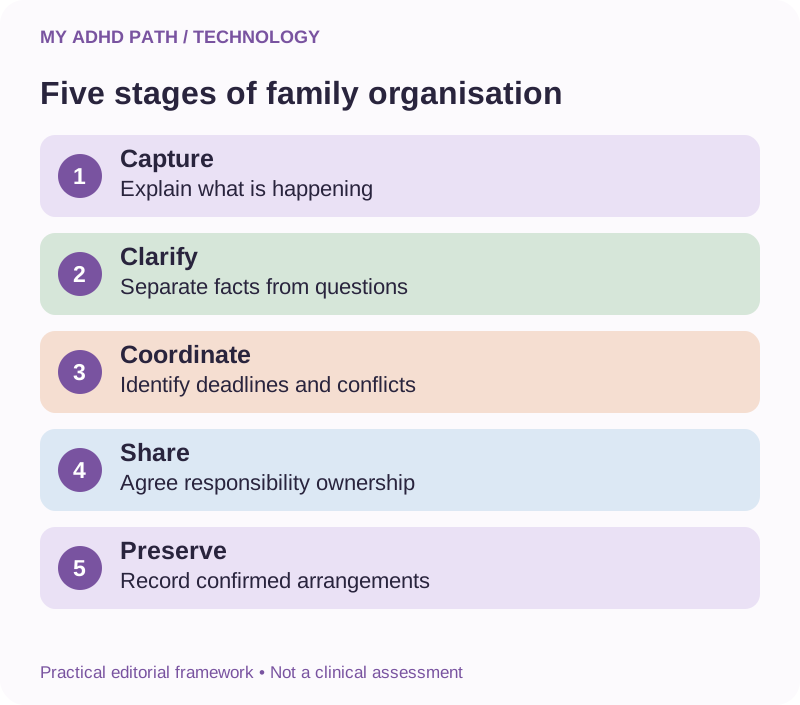
This is an editorial planning framework, not a clinically validated ADHD intervention.
Its purpose is to reduce the need to repeatedly reconstruct the same collection of information.
Worked example: The Sunday evening family brain dump
Imagine it's Sunday evening and the following things are occupying your attention.
There's a school trip on Thursday.
One child needs new football boots.
Another has a maths test.
You need to rearrange an appointment.
You haven't organised meals for the week.
There's a birthday present to buy.
You also have an important work meeting on Tuesday.
Rather than independently organising every activity before asking for help, you could explain the entire situation to an AI assistant.
Ask it to separate the information into confirmed commitments, outstanding actions, things that need clarification and responsibilities that could be shared.
The resulting overview might look like this.
| Responsibility | Next action |
|---|---|
| Thursday school trip | Check school instructions and equipment requirements |
| Football boots | Confirm size and when they are needed |
| Maths test | Agree a manageable revision session |
| Appointment | Contact the provider to rearrange |
| Meals | Plan quick options around busy evenings |
| Birthday present | Confirm date and agree who will buy it |
| Tuesday work meeting | Protect preparation and meeting time |
The assistant should not invent deadlines or assume these responsibilities all belong to you.
The next stage might be identifying which activities can be completed by your partner, children or another appropriate person.
The objective isn't to become more efficient at doing everything yourself.
It's to make the arrangements clearer and share the workload where possible.
Using AI as your school administration assistant
School communications can arrive through numerous channels.
Emails.
Apps.
Parent portals.
Paper letters.
Text messages.
Calendar announcements.
Messages from activity providers.
Keeping track of everything can become a substantial responsibility.
AI may help process the information you provide.
For example, you could copy a school email after removing unnecessary personal details and ask:
"Extract the practical information from this message. Tell me the event date, any deadlines, what needs paying, what equipment is required and what action I need to take. Mark anything that is unclear."
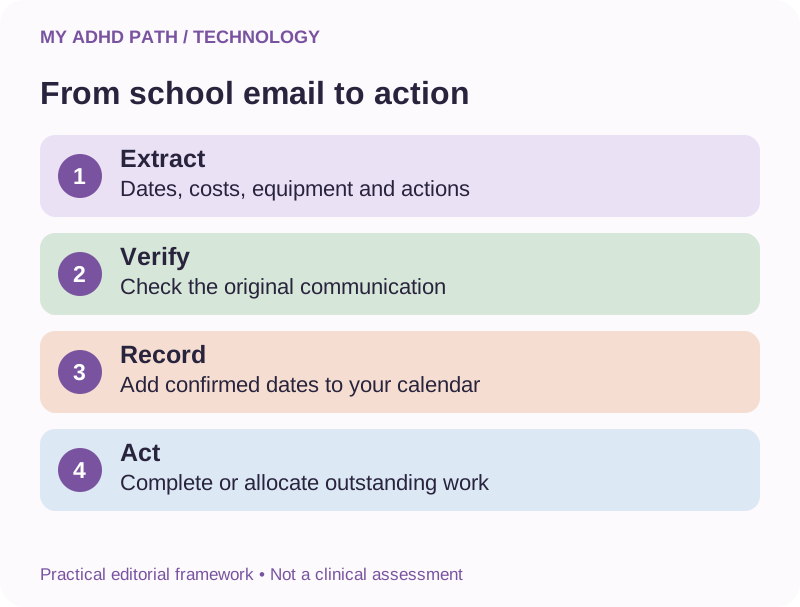
Always check the extracted information against the original communication.
If the email does not specify a deadline, the assistant should not invent one.
For confirmed events, add the information to your calendar.
For outstanding responsibilities, record an appropriate next action.
For missing information, prepare a question for the school.
This turns an information-heavy message into a more manageable set of practical requirements.
The difference between reading and processing information
Receiving information does not necessarily mean you have finished dealing with it.
You may read an email about a school trip and understand everything it says.
But that doesn't mean you've paid for the trip, completed the consent form, arranged transport or added the date to your calendar.
A useful school administration system distinguishes four states.
Received
The information has arrived.
Understood
You know what the information means and whether action is required.
Arranged
The relevant actions have been completed or allocated.
Recorded
Dates, confirmations and outstanding responsibilities are available in your trusted system.
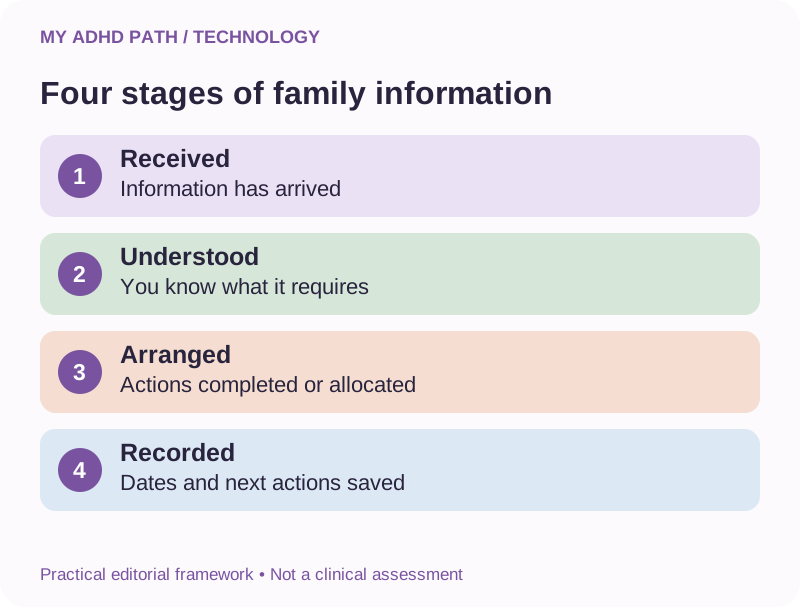
Not every message needs to pass through every stage.
Some information is simply for awareness.
AI may help distinguish between these different types of communication.
Rather than aiming for an empty inbox, focus on making important information actionable.
Family calendars that actually help
A calendar can be extremely useful.
But having several calendars, numerous notifications and conflicting records can introduce additional work.
A manageable family system might include:
A shared calendar for confirmed arrangements.
A shared list for practical household responsibilities.
A single place for outstanding questions or arrangements.
An AI assistant to help organise information when needed.
Not every family member needs access to every detail.
Consider children's privacy, individual appointments and appropriate boundaries between work and family information.
Choose a calendar with suitable sharing and notification settings.
AI may help interpret or prepare calendar entries.
Whether it can create those entries directly depends on the service, available integrations and permissions.
Always distinguish a suggested calendar entry from one that has actually been created.
Using AI for meal planning without creating another project
Meal planning can become surprisingly complicated.
You may start with the intention of organising five evening meals and end up researching recipes, comparing nutritional information and building an enormous collection of ideas.
For a busy household, simplicity can be more useful.
Explain the practical circumstances to your AI assistant.
For example:
"We need five evening meals. Two evenings are particularly busy. We have pasta, rice and potatoes already. I don't want complicated recipes or a large shopping list. Give me a realistic plan that uses overlapping ingredients."
The resulting suggestions might include familiar meals, leftovers and low-preparation options.
You can ask for alternatives without creating an entirely new weekly plan.
Food allergies and medical dietary requirements need particular care.
Good to know
Never rely exclusively on an AI-generated recipe, product recommendation or ingredient summary to establish allergen safety. Check actual product labels and follow relevant professional dietary guidance. The assistant can help with planning. It cannot guarantee that a meal is safe for a particular person.
A family meal plan for different levels of capacity
Some evenings you have time and energy to cook.
Other evenings, preparing anything complicated is unrealistic.
Instead of planning every evening around your most optimistic expectations, maintain several options.
Lower-demand meals
Familiar options requiring little preparation.
Moderate-demand meals
Straightforward meals using ingredients and methods you already know.
Higher-demand meals
Meals involving additional preparation, cooking time or unfamiliar recipes.
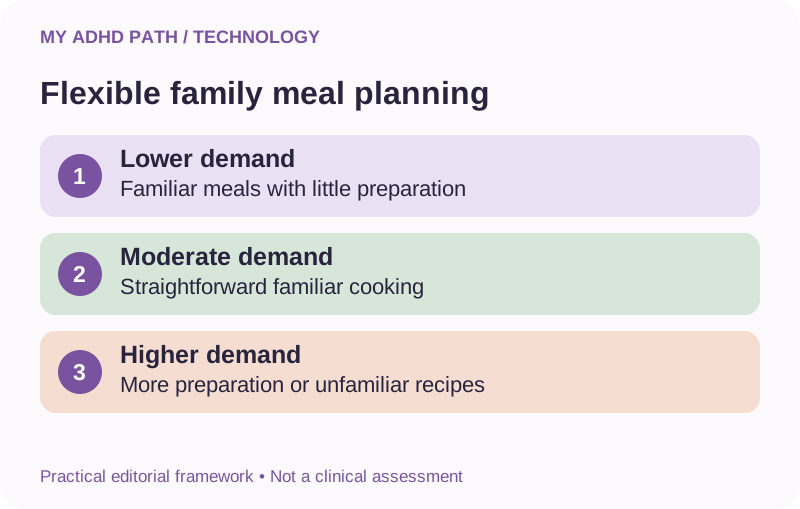
Your AI assistant can help organise a selection around your family's preferences and practical circumstances.
Having an easier alternative available can help when plans change.
A meal plan is a resource, not a contract.
When everybody needs something at once
Imagine you finish work and discover that one child needs help with homework, another needs collecting from an activity and dinner has not been organised.
There's also a message requiring a response.
You know everything needs some attention.
But what needs attention first?
Ask AI to help distinguish:
Immediate safety and supervision requirements.
Fixed-time commitments.
Responsibilities involving other people.
Essential household needs.
Flexible activities.
Things that can wait.
Immediate safety and children's basic needs take precedence over administrative convenience.
The assistant needs accurate information about your circumstances.
It cannot reliably determine whether a child is safe, whether an arrangement is appropriate or how urgently a medical concern needs attention.
Use human judgement and appropriate services for those decisions.
Parenting when your child also has ADHD
When both parent and child have ADHD, family routines may require particular flexibility.
A parent might understand exactly why their child struggles to organise school materials, while experiencing similar difficulties with their own responsibilities.
AI can provide a practical opportunity to make some of that organisation more explicit.
For example, you might work together to create:
A manageable school bag checklist.
A homework starting routine.
A sequence for preparing sports equipment.
A revision session structure.
A plan for an upcoming school project.
The objective should be to support the child's growing independence.
Avoid creating a system in which the parent becomes responsible for prompting every stage indefinitely.
Where age-appropriate, allow the child to help design the routine and identify what makes it useful.
Good to know
Our guide to helping teenagers with ADHD build independence explores these themes further.
Using AI to prepare for SENCO meetings
Meetings about a child's educational support can involve numerous observations, documents and questions.
Parents may find it difficult to remember everything they intended to discuss.
An AI assistant may help prepare a factual meeting outline.
Start with non-identifying examples of the difficulties you have observed.
Perhaps your child regularly struggles to remember instructions, organise homework or begin tasks independently.
Ask the assistant to help group these observations and prepare questions.
For example:
- What support is currently available?
- Which difficulties have been observed at school?
- What strategies have already been tried?
- How is their effectiveness being reviewed?
- What are the agreed next steps?
These are illustrative questions, not recommendations for a particular child's educational provision.
Do not allow an assistant to fabricate evidence, infer diagnoses or determine statutory entitlements.
SEND arrangements differ across the UK.
For England, official information is available through GOV.UK.
https://www.gov.uk/children-with-special-educational-needs
Children's medical reports, educational assessments and school records may contain highly sensitive information.
Use appropriate safeguards and seek qualified assistance when necessary.
Supporting homework without doing it for your child
It can be difficult to support homework after a long working day.
Especially when the subject is unfamiliar or has changed considerably since you were at school.
An AI assistant can potentially provide another explanation of a concept.
It can generate unrelated practice questions.
It can help you understand the method your child is attempting.
It may also help structure a short revision session.
However, the child needs opportunities to do the thinking independently.
A useful approach is to ask the assistant to explain a method, provide a different example and then allow your child to attempt a question.
Check explanations against reliable educational materials.
Follow the school's AI and assessment policies.
Good to know
Our AI for Students with ADHD guide contains practical examples and tutoring prompts.
The danger of becoming the household's AI manager
Introducing technology to family life can create unexpected responsibilities.
Somebody needs to choose the tools.
Set them up.
Check notifications.
Maintain the shared calendar.
Update information.
Correct mistakes.
Explain the system to other family members.
If one person is responsible for all of this, the new technology may simply create another layer of mental workload.
Before introducing a family organisation system, ask:
Who will maintain it?
Who needs access?
Who is responsible for recording their own activities?
What happens when information changes?
Can the system remain useful without one person managing everybody else?
A shared tool should support shared responsibility.
It should not make one parent the unpaid administrator of another increasingly complicated system.
Sharing ownership rather than delegating individual jobs
There is a difference between asking somebody to complete a task and sharing ownership of a responsibility.
Imagine one parent usually manages the children's school uniforms.
They recognise when clothing needs replacing, identify sizes, compare options, purchase replacements and check that everything is ready.
Asking another person to collect an order shares one practical action.
Transferring appropriate ownership of the responsibility may distribute a greater proportion of the planning and follow-through as well.
Where possible, agree responsibilities clearly.
AI can help make the stages visible and prepare a shared overview.
It cannot establish what is fair without understanding the household's circumstances.
Nor should it become an automated source of criticism or pressure.
The goal is a system that supports the people using it.
A minimum useful family organisation system
You do not need ten apps to organise family life.
Three components may be sufficient to begin.
One reliable calendar
A place for confirmed arrangements and important dates.
One place for outstanding responsibilities
A shared or personal list that distinguishes what needs doing, what is waiting and who is responsible.
One thinking assistant
An appropriate AI tool or another source of support to help process complicated information when necessary.
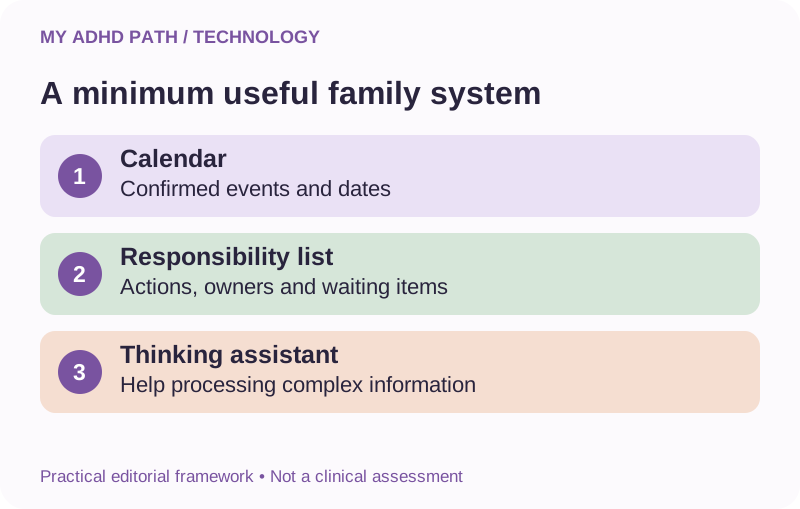
These components do not need to come from the same company.
You may already have suitable tools.
The most useful system is one that fits your household and remains manageable during busy periods.
AI for single parents with ADHD
Not every family has another adult available to share everyday responsibilities.
Single parents may face particular coordination demands, including work, childcare, appointments and arrangements across different households.
AI may help organise information and prepare communications.
It may also help identify responsibilities that do not need to be completed immediately.
However, technology cannot replace practical childcare, financial assistance, trusted relationships or other appropriate support.
Where possible, explore relevant community, educational and family services.
Official information about childcare support and family benefits is available through GOV.UK.
https://www.gov.uk/browse/childcare-parenting
Eligibility and provision can vary according to individual circumstances and location.
AI can help prepare questions about available support.
It should not be relied upon to determine eligibility or calculate entitlements without authoritative verification.
AI for working parents with ADHD
Managing professional and family responsibilities simultaneously can create considerable administrative demands.
Work meetings may overlap with school events.
A child's appointment may affect several other commitments.
Unexpected changes can disrupt a carefully prepared schedule.
An AI assistant may help identify conflicts, prepare revised plans and organise communications.
Where possible, keep appropriate boundaries between personal and professional information.
Do not upload confidential workplace documents into an unauthorised personal AI service.
If ADHD-related difficulties affect your working life, employer adjustments and formal support may also be relevant.
In Great Britain, Access to Work may provide eligible workers with disability-related employment support.
It is not a general household organisation or parenting support scheme.
Funding for specific AI products is not automatic.
https://www.gov.uk/access-to-work
Good to know
Our dedicated Access to Work resource centre explores the scheme and application process in more detail.
When AI should not make parenting decisions
Parenting involves important decisions requiring knowledge of a child's individual circumstances.
AI can help organise questions and explain general information, but it should not be treated as an authority on:
A child's medical diagnosis.
Medication or treatment.
Safeguarding concerns.
Whether a particular adult or environment is safe.
Significant dietary restrictions.
Legal custody or contact arrangements.
Educational placement decisions.
Emergency situations.
Seek appropriate professional assistance for consequential concerns.
For urgent medical or safety emergencies in the UK, contact the relevant emergency services.
Technology should support responsible human judgement rather than replace it.
Protecting your children's privacy
Parents frequently manage highly personal information on behalf of their children.
This may include health information, school reports, behavioural observations, photographs, addresses and appointment details.
Before entering information into an AI service, consider whether the identifying details are actually required.
For example, instead of uploading an entire school report containing personal information, you may be able to describe the specific issue you want help understanding.
Instead of providing a child's full name, date of birth and school, you could use a generic description.
Review the service's privacy information, data retention policies and sharing arrangements.
Consider age requirements and parental controls when children use AI themselves.
Avoid creating a detailed permanent AI profile of your child without considering necessity, consent, security and their developing independence.
The ICO provides information about UK data protection and children's privacy.
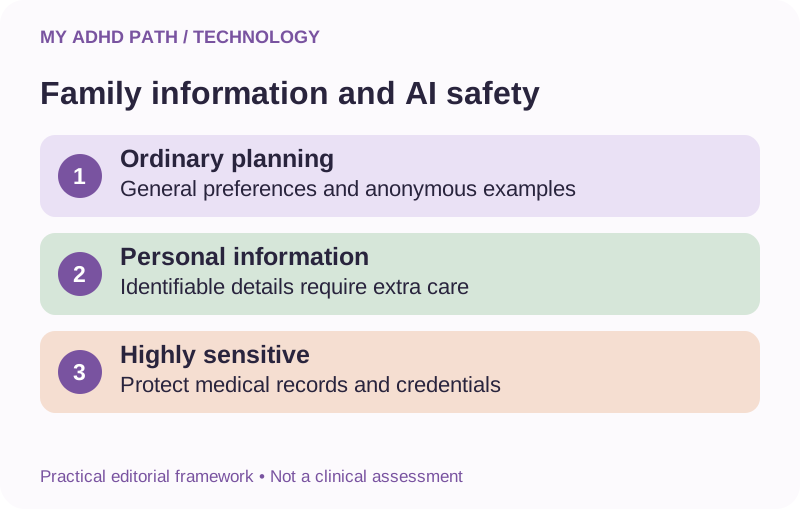
Sharing family information with AI
A useful starting point is to distinguish three categories of information.
Ordinary planning information
General meal preferences, anonymous scheduling examples and non-sensitive household routines.
Personal information requiring additional care
Names, appointment details, identifiable school correspondence and family schedules.
Highly sensitive or restricted information
Medical reports, safeguarding records, passwords, financial credentials, identification documents and confidential legal information.
The categories are a practical editorial framework, not a legal classification.
Even ordinary information may become sensitive when combined with other details.
Use only services and arrangements appropriate to the information involved.
Share the minimum information necessary.
When a difficult day needs a simpler plan
Some days arrive with considerably more demands than you expected.
Perhaps somebody is unwell.
You've slept badly.
Work has become particularly demanding.
A planned arrangement has fallen through.
In those circumstances, it may be useful to temporarily reduce the demands of family life.
Ask AI to help create a simpler version of the day.
Identify essential care and safety needs.
Preserve important appointments or appropriately rearrange them.
Choose straightforward meals.
Prepare necessary communications.
Postpone optional household activities.
Identify where another person could help.
This is not about neglecting important responsibilities.
It's about distinguishing essential needs from optional expectations.
A family doesn't need a perfectly organised day to have a good day.
A ten-minute family administration reset
When family responsibilities start feeling difficult to manage, try this flexible exercise.
Minutes one and two: Capture
Write or dictate the responsibilities occupying your attention.
Minutes three and four: Clarify
Identify confirmed dates, outstanding arrangements and missing information.
Minutes five and six: Prioritise
Distinguish essential or time-sensitive responsibilities from activities that can wait.
Minutes seven and eight: Share
Identify which responsibilities could appropriately be owned by somebody else.
Minutes nine and ten: Preserve
Record the important arrangements and choose one useful next action.
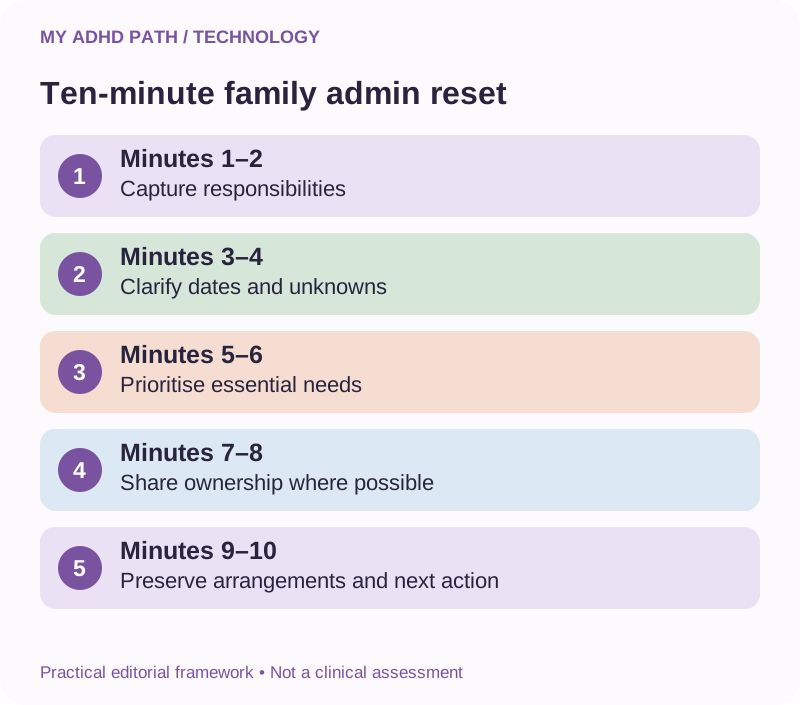
You can complete this independently, with another household member or using an appropriate AI assistant.
The ten-minute structure is illustrative.
Complex circumstances may require considerably more time or additional support.
Three fictional family experiences
Illustrative scenario
Rachel, 42 - Managing school administration
Rachel works full-time and has two school-aged children. She receives information through several different school communication channels. She often reads messages but struggles to keep track of the actions they require. Rachel begins using AI to extract practical requirements from selected, appropriately anonymised communications. She checks the results and adds confirmed dates to the family calendar. She also agrees that her partner will take ownership of certain school-related arrangements. The aim is not simply to process information faster, but to distribute the associated workload.
Illustrative scenario
Marcus, 38 - Coordinating life as a single parent
Marcus manages work, childcare and his daughter's activities. Unexpected schedule changes often require him to reconsider several arrangements. He uses an AI assistant to help identify practical dependencies and prepare questions for activity providers. He maintains a reliable calendar and records confirmed arrangements himself. He also explores appropriate practical support through people and services available to him. The assistant helps organise information without being treated as a replacement for that support.
Illustrative scenario
Anita, 47 - Supporting teenagers' independence
Anita finds herself repeatedly reminding her teenagers about school equipment, activities and homework. She uses AI to help develop simple preparation checklists with them. Together, they agree which responsibilities the teenagers are ready to manage independently. They review what is working and adjust the system when necessary. The objective is to make the support less dependent on Anita remembering everything for everybody.
What the research says
Research into cognitive household labour has drawn attention to the often-invisible work of anticipating, organising and monitoring household responsibilities. This work may be distributed unequally between household members. Research into ADHD and executive functioning also provides relevant background for understanding why managing competing demands can be particularly challenging for some parents. Cognitive offloading research explores how external tools and resources can change the cognitive requirements of activities. These areas offer useful theoretical foundations for exploring practical household support. However, there is not an established evidence base demonstrating that general-purpose AI assistants reliably reduce parenting stress or treat ADHD-related executive functioning difficulties. Technology may reduce some demands while introducing others. Its usefulness should be evaluated in the context of the individual household. The objective is not simply to complete more tasks. It is to create a system that supports family life without requiring unnecessary mental effort.
Your personal family mental load audit
Consider the following areas of family life.
- School administration.
- Appointments.
- Meals and shopping.
- Household maintenance.
- Children's activities.
- Family commitments.
- Financial administration.
- Travel and transport.
- Communications.
- Unexpected arrangements.
For each area, ask:
Who notices when something needs attention?
Who makes the arrangements?
Who completes the practical actions?
Who checks whether everything has been completed?
What information regularly needs remembering?
Could a tool reduce some of the administrative work?
Could responsibility be shared differently?
What additional support would be useful?
You don't need to audit your whole household at once.
Begin with one responsibility that regularly occupies more of your attention than you would like.
Downloadable resource
My ADHD AI Family Toolkit
A practical workbook covering family organisation, school administration, meal planning, shared responsibilities, children's independence and AI prompts for everyday parenting.
Download PDFYour seven-day AI family organisation experiment
Day one: Notice the invisible work
Identify one household responsibility involving considerable planning or remembering.
Day two: Simplify school administration
Try extracting the practical requirements from one appropriately anonymised communication.
Day three: Reduce meal planning decisions
Create a manageable meal plan using familiar options.
Day four: Review the family calendar
Separate confirmed arrangements from outstanding questions.
Day five: Share responsibility
Discuss ownership of one household responsibility where appropriate.
Day six: Preserve your progress
Create a short record of outstanding arrangements and next actions.
Day seven: Reflect
Consider whether the approaches reduced mental effort, introduced additional administration or helped distribute responsibilities.
Keep what is useful.
Change or remove what isn't.
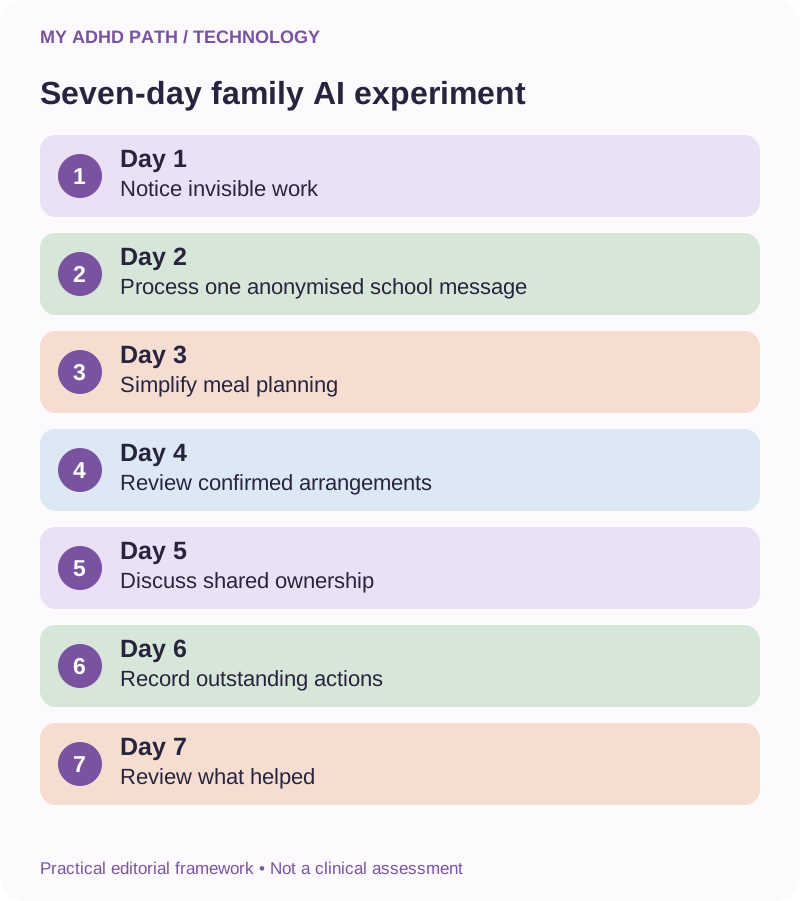
This exercise is intended for personal reflection rather than clinical assessment.
Fifteen AI prompts for parents with ADHD
AI prompt
1. Untangle my family brain dump
"I'm going to explain everything that's happening in our family. Organise it into confirmed arrangements, outstanding actions and things that need clarification."
AI prompt
2. Process this school email
"Extract the dates, deadlines, equipment requirements and actions from this message. Do not invent missing information."
AI prompt
3. Organise our week
"Help me identify potential conflicts and outstanding arrangements in our family schedule."
AI prompt
4. Make meal planning simpler
"Suggest a realistic meal plan using familiar ingredients and quick options for busy evenings."
AI prompt
5. Prepare a shopping list
"Combine these meal ideas with the ingredients we already have. Check for unnecessary duplication."
AI prompt
6. Help me prepare for a meeting
"Group these observations into factual examples and questions I can discuss with the school."
AI prompt
7. Simplify our mornings
"Help us identify a manageable morning routine, including activities that could happen the previous evening."
AI prompt
8. Share the workload
"Identify the planning, practical actions and follow-through involved in these household responsibilities so we can discuss sharing ownership."
AI prompt
9. Help me organise this celebration
"Separate essential arrangements from optional extras. Suggest a manageable plan within our available time and budget."
AI prompt
10. Help me respond to this message
"Draft a concise, respectful response using only the information I've provided. Mark anything I need to confirm."
AI prompt
11. Support our homework session
"Explain this educational topic and give us a different practice question. Don't complete the assessed work."
AI prompt
12. Rearrange our day
"These plans have changed. Help me identify the practical consequences, including who needs contacting."
AI prompt
13. Create a simpler version of today
"Help me preserve essential family responsibilities while postponing optional activities."
AI prompt
14. Support my child's independence
"Help us create an age-appropriate checklist that my child can gradually learn to manage independently."
AI prompt
15. Preserve our outstanding arrangements
"Summarise what has been confirmed, what remains unresolved and who is responsible for the next actions."
Good to know
Remove unnecessary identifying information before using these prompts. Review generated content and retain appropriate parental judgement.
Frequently asked questions
Can AI help parents with ADHD?
It may provide practical support with organisation, information processing, household planning and communication. Its usefulness varies according to individual circumstances.
What is the mental load of parenting?
It describes the cognitive work involved in anticipating needs, remembering responsibilities, organising arrangements and monitoring progress.
Why is family administration difficult with ADHD?
It often involves competing demands, working memory, planning and interruptions. These activities may be particularly demanding for some people with ADHD.
Can AI organise my family calendar?
Some services can help prepare or manage calendar entries when suitable integrations and permissions are available. Otherwise, entries need to be added manually.
Can AI read school emails?
It may help extract information from messages you provide or appropriately authorised connected accounts. Check accuracy and protect children's privacy.
Can AI help with family meal planning?
Yes. It can suggest meals and organise shopping requirements. Independently verify food safety, allergies and dietary requirements.
Can AI help when both parent and child have ADHD?
It may help make routines, instructions and responsibilities clearer. Support should reflect individual needs and encourage age-appropriate independence.
Can AI help me prepare for a SENCO meeting?
It may help organise observations and questions. It cannot establish diagnoses, determine statutory entitlements or replace appropriate professional support.
Should I upload my child's school reports to AI?
Consider whether the information is necessary and whether the service is suitable for handling sensitive records. Anonymised descriptions may often be sufficient.
Can AI make parenting decisions for me?
It can help organise information and explore general considerations. Important decisions require appropriate human judgement and professional support where necessary.
Can AI reduce parenting stress?
Reducing uncertainty or administrative demands may be helpful for some parents. AI is not an established treatment for stress or other mental health difficulties.
Does everyone in my family need to use AI?
No. A single person may use it to process information while confirmed arrangements are shared through ordinary calendars or household systems.
Can AI help single parents?
It may support practical planning and administration. It cannot replace childcare, financial support or trusted human relationships.
Can Access to Work fund AI for parenting?
Access to Work is employment-related support rather than a general parenting or household support scheme. Eligibility and potential workplace funding depend on individual circumstances.
Should I rely on AI to remember everything?
No. Keep important arrangements, deadlines and records in reliable systems that you can access independently.
How do I know whether AI is helping our family?
Consider whether it reduces repeated planning, makes responsibilities clearer, supports independence and avoids creating additional administrative demands.
Is AI a treatment for parental ADHD?
No. It is a potential practical support tool, not a replacement for assessment, treatment or appropriate professional care.
More space for the parts of parenting that matter
Family life will never be completely predictable.
There will always be unexpected changes, missing PE kits, forgotten water bottles and last-minute requests.
You don't necessarily need a system that prevents every possible complication.
You may simply need a system that makes those complications easier to work through.
Somewhere to put the information.
Something to help organise it.
A reliable way to preserve important arrangements.
And people who share responsibility wherever possible.
Technology cannot do the most meaningful parts of parenting for you.
It cannot replace the conversations, relationships, experiences and individual moments that make up family life.
But it may help reduce some of the administrative work surrounding them.
And perhaps that creates a little more space for the things you would rather be doing.
Sources and further reading
- Daminger, A. (2019). The Cognitive Dimension of Household Labor. American Sociological Review. https://doi.org/10.1177/0003122419859007
- Diamond, A. (2013). Executive Functions. Annual Review of Psychology. https://doi.org/10.1146/annurev-psych-113011-143750
- Willcutt, E. G. et al. (2005). Validity of the Executive Function Theory of Attention-Deficit/Hyperactivity Disorder: A Meta-Analytic Review. Biological Psychiatry. https://doi.org/10.1016/j.biopsych.2005.02.006
- Risko, E. F. and Gilbert, S. J. (2016). Cognitive Offloading. Trends in Cognitive Sciences. https://doi.org/10.1016/j.tics.2016.07.002
- Faraone, S. V. et al. (2021). The World Federation of ADHD International Consensus Statement. Neuroscience and Biobehavioral Reviews. https://doi.org/10.1016/j.neubiorev.2021.01.022
- NICE - ADHD: diagnosis and management. https://www.nice.org.uk/guidance/ng87
- NHS - ADHD. https://www.nhs.uk/conditions/adhd/
- Information Commissioner's Office. https://ico.org.uk/
- GOV.UK - Children with special educational needs and disabilities. https://www.gov.uk/children-with-special-educational-needs
- GOV.UK - Childcare and parenting. https://www.gov.uk/browse/childcare-parenting
- GOV.UK - Access to Work. https://www.gov.uk/access-to-work
- Food Standards Agency - Food allergy and intolerance. https://www.food.gov.uk/safety-hygiene/food-allergy-and-intolerance
- National Cyber Security Centre. https://www.ncsc.gov.uk/
This article provides general educational information and practical suggestions. It does not constitute medical, legal, dietary or professional parenting advice. The suggested frameworks and exercises are illustrative rather than clinically validated ADHD interventions. AI should not replace appropriate care, safeguarding, professional support or responsible parental judgement.