

Helping you learn something and doing the learning for you are two very different things.
You have a revision session planned.
You've opened your laptop.
You've found your notes.
You've reread the same paragraph three times.
You still don't understand it.
So you highlight it. Because highlighting feels productive.
Then you reorganise your folder structure. Because that also feels productive.
Then you watch a twenty-minute video that covers the topic but also covers six other topics you don't need.
An hour has passed. You've highlighted things. You've reorganised things. You've watched things.
But you haven't really learned anything.
This is not a failure of effort or intelligence.
It may be a reflection of the particular demands that academic learning places on executive functioning.
Identifying what to study. Choosing how to approach it. Maintaining attention through difficult material. Monitoring your own understanding. Knowing when to move on.
These are cognitively demanding activities, and for students with ADHD, they can be especially challenging.
Artificial intelligence offers an opportunity to approach some of these demands differently.
Not by removing the need to learn, but by supporting the process of learning itself.
At a glance
- Academic learning involves significant executive functioning demands beyond understanding the subject itself.
- AI can provide personalised explanations, generate practice questions and help organise revision.
- The student must still do the learning - AI supports the process, not the outcome.
- Active recall and spaced practice remain more effective than passive review.
- AI-generated information can contain errors and must be checked against reliable sources.
- Using AI to complete assessed work may constitute academic misconduct.
- Schools, colleges and universities have their own policies on AI use.
- Students with ADHD may be eligible for exam access arrangements and Disabled Students' Allowance.
- Parents and carers can support younger students to use AI responsibly.
The six hidden demands of academic learning
When we think about studying, we often focus on the subject material itself.
Understanding photosynthesis. Memorising historical dates. Solving equations.
But the process of studying involves additional cognitive activities that are less visible.
1. Deciding what to study
Identifying which topics need attention and in what order.
2. Choosing how to study
Selecting an approach that suits the material and the learner.
3. Maintaining focus
Sustaining attention through material that may not be immediately engaging.
4. Monitoring understanding
Recognising when something has been understood and when it hasn't.
5. Managing time
Allocating appropriate time across subjects, topics and revision activities.
6. Recovering from interruptions
Returning to study after a break, distraction or competing demand.
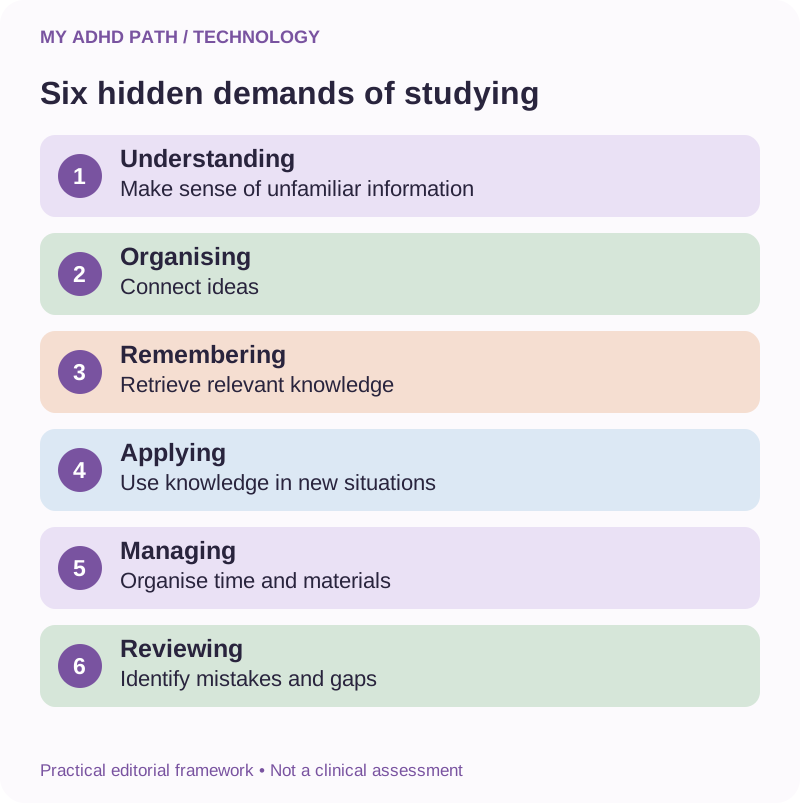
For students with ADHD, these demands can consume significant mental energy before the actual learning begins.
AI may help reduce some of this overhead.
Four roles of an AI learning assistant
A useful way to think about AI in education is to consider four distinct roles it can support.
Explainer
Providing alternative explanations of concepts the student finds difficult.
Questioner
Generating practice questions to test understanding.
Organiser
Helping structure revision sessions, prioritise topics and manage time.
Reviewer
Providing feedback on practice work and identifying areas needing further attention.
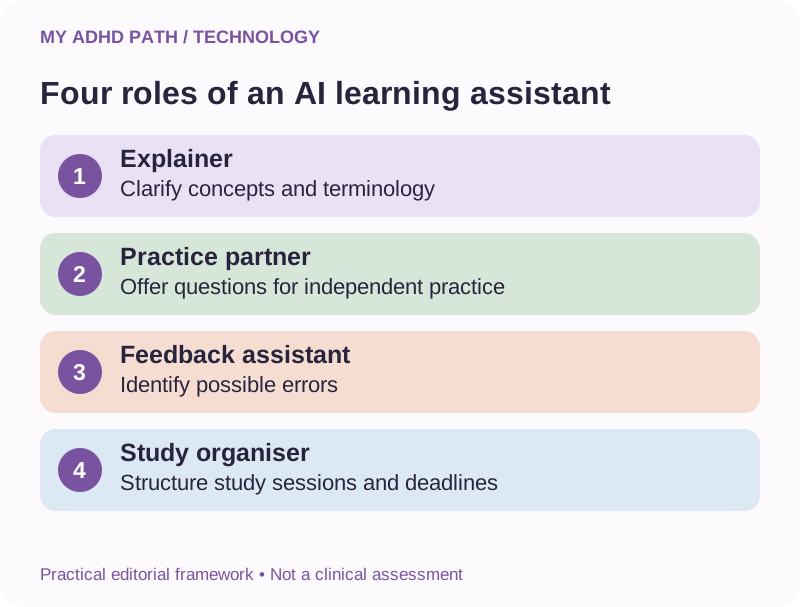
These roles do not replace teachers, tutors or the student's own effort.
They provide additional support between lessons, during independent study and when other help is not immediately available.
The five-stage AI learning cycle
The following editorial framework describes one approach to using AI during a revision session.
Stage one: Orient
Explain what you need to learn and what you already understand.
Stage two: Explore
Ask for an explanation tailored to your current level of understanding.
Stage three: Test
Request practice questions to check whether you've understood.
Stage four: Review
Examine your answers and identify what needs further attention.
Stage five: Consolidate
Summarise what you've learned in your own words.
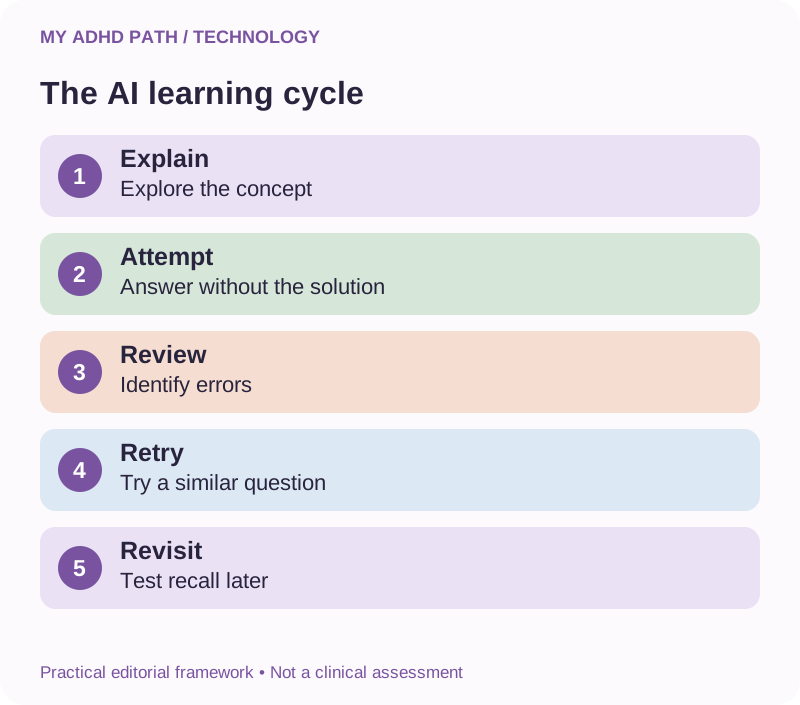
The final stage is particularly important.
Reading an AI explanation is not the same as understanding it.
If you can explain the concept back without looking at the original explanation, that's a stronger indicator of learning.
The student must still do the retrieving.
How students with ADHD can use AI for revision
Get a personalised explanation
Textbooks and class notes may explain concepts in a way that doesn't suit every learner.
AI can rephrase an explanation using different examples, simpler language or a step-by-step approach.
Tell the assistant your current level and what specifically you find confusing.
Generate practice questions
Instead of searching for past papers or waiting for a teacher to set exercises, ask AI to create questions on a specific topic.
Request questions at an appropriate difficulty level.
Ask for mark scheme-style answers so you can assess your own responses.
Break down complex topics
A topic like "the causes of the First World War" involves multiple interconnected factors.
AI can help separate these into distinct components, explain the connections and identify which parts you need to study further.
Create revision summaries
Ask for a concise summary of a topic you've already studied.
Compare it with your own notes.
Identify gaps in your understanding.
Explain mark schemes
Many students struggle not with the subject but with understanding what examiners expect.
AI can help explain marking criteria and suggest what a strong answer might include.
Always check against the official mark scheme from the relevant examination board.
Prepare for specific question types
Different subjects require different types of response.
A science explanation, a history essay, a maths proof and a literature analysis each have distinct structures.
AI can help you practise the specific format required.
Organise a revision timetable
Explain your subjects, exam dates and available time.
Ask for a realistic revision schedule that includes breaks, variety and achievable daily goals.
Identify what you don't understand
Sometimes the hardest part is knowing what you don't know.
Ask AI to quiz you on a topic and use your responses to identify areas needing attention.
Worked example: GCSE maths - Solving simultaneous equations
AI prompt
Understanding simultaneous equations
"I'm studying GCSE maths and I don't understand simultaneous equations. I can solve simple equations with one unknown but I get confused when there are two equations with two unknowns. Can you explain the elimination method step by step using simple numbers?"
Notice how the prompt explains what the student already understands and what specifically is confusing.
This helps the assistant pitch its explanation at the right level.
After receiving the explanation, the student should try solving a new example independently before asking for more help.
Worked example: GCSE chemistry - Atomic structure
AI prompt
Testing atomic structure knowledge
"I've been revising atomic structure for GCSE chemistry. Can you give me five questions testing my understanding of protons, neutrons, electrons, atomic number and mass number? Start with straightforward recall questions and then include two that require me to work something out. Don't give me the answers yet - I'll attempt them first."
The request for delayed answers is important.
If answers appear immediately, it's tempting to read them rather than attempting the questions.
Active retrieval - trying to recall information from memory - is more effective for learning than passive recognition.
Worked example: GCSE English literature - Analysing a character
AI prompt
Practising character analysis
"I'm studying An Inspector Calls for GCSE English literature. I need to practise writing about how Priestley presents Mr Birling. Can you give me a practice question in the style of AQA Paper 2, then after I've written my response, give me feedback on whether I've included relevant quotations, explained Priestley's methods and connected my points to the social and historical context?"
This approach uses AI as a practice partner rather than an answer generator.
The student writes the response. The assistant provides structured feedback.
Check any quotations against the actual text, as AI may misremember or fabricate them.
Worked example: GCSE geography - Comparing case studies
AI prompt
Organising case study revision
"I'm revising for GCSE geography and I need to compare two case studies about natural hazards - one from a higher income country and one from a lower income country. I've studied the 2011 Japan earthquake and tsunami and the 2010 Haiti earthquake. Can you help me create a comparison table covering causes, effects and responses? Then quiz me on the key differences without giving me the answers straight away."
Comparison tables can be particularly useful for geography and history revision.
They help organise information that might otherwise feel overwhelming.
Verify the factual content against your class notes and approved textbooks.
Worked example: University assignments - Structuring an essay
AI prompt
Planning an essay structure
"I have a 2,500-word university essay on [topic]. My argument is [brief thesis]. I've identified three main points but I'm struggling to organise them into a logical structure. Can you help me create an essay plan with an introduction, three body paragraphs and a conclusion? For each section, suggest what I should include and how it connects to my overall argument. Don't write the essay - just help me plan it."
This prompt explicitly asks for planning support rather than written content.
The distinction matters for academic integrity.
Using AI to help organise your own ideas is different from using it to generate the ideas themselves.
Check your institution's specific policy on AI use in assessed work.
Active recall and spaced practice
Two of the most effective learning strategies are active recall and spaced practice.
Active recall
Actively retrieving information from memory rather than passively rereading it.
Testing yourself, answering questions from memory, explaining concepts without looking at your notes.
Spaced practice
Distributing study sessions across time rather than concentrating them in a single session.
Reviewing material at increasing intervals to strengthen long-term retention.
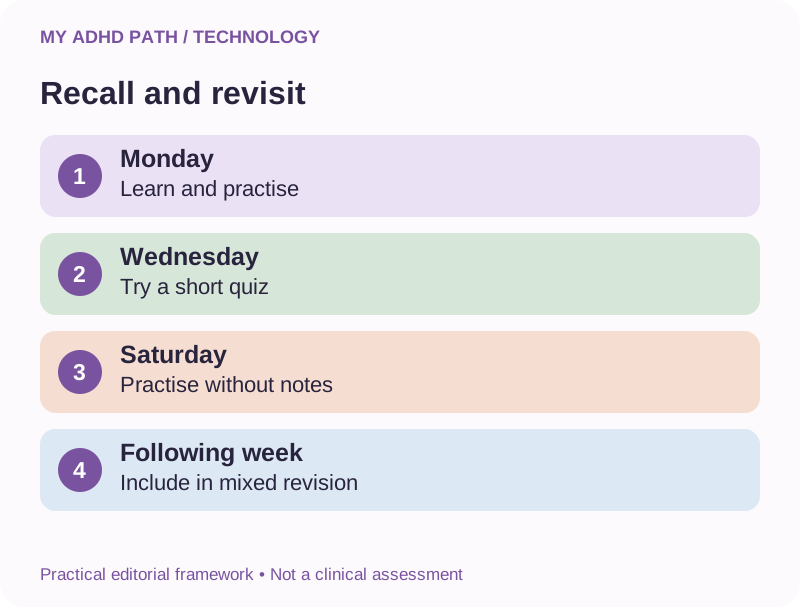
AI can support both strategies.
It can generate recall questions on demand.
It can help you plan spaced revision sessions across your available time.
But the student must still do the retrieving.
Reading an AI-generated answer is not active recall. Attempting to answer the question before checking is.
What the research says
Research into learning and memory consistently identifies active retrieval practice and spaced repetition as effective strategies for long-term retention. Dunlosky et al. (2013) reviewed ten learning techniques and found that practice testing and distributed practice had high utility across a range of learning conditions. Passive techniques such as rereading and highlighting were rated as less effective. These findings are from general cognitive psychology research and are not specific to ADHD. However, they provide a useful evidence base for structuring study sessions. AI tools that generate practice questions and support spaced revision may help students engage in these strategies more consistently, though this specific application has not yet been extensively studied.
A thirty-minute AI-assisted revision session
The following is an illustrative structure for a focused revision period.
Minutes one to three: Set up
Choose one specific topic. Tell your AI assistant what you're studying and what you already know.
Minutes four to ten: Explore
Ask for an explanation of the parts you find difficult. Request examples or analogies if the standard explanation isn't clear.
Minutes eleven to twenty: Test
Ask for practice questions. Attempt each one before checking the answer. Note which questions you found difficult.
Minutes twenty-one to twenty-five: Review
Return to the topics you found difficult. Ask for a different explanation or additional practice on those specific areas.
Minutes twenty-six to thirty: Consolidate
Summarise what you've learned in your own words. Write down three things you now understand that you didn't before.
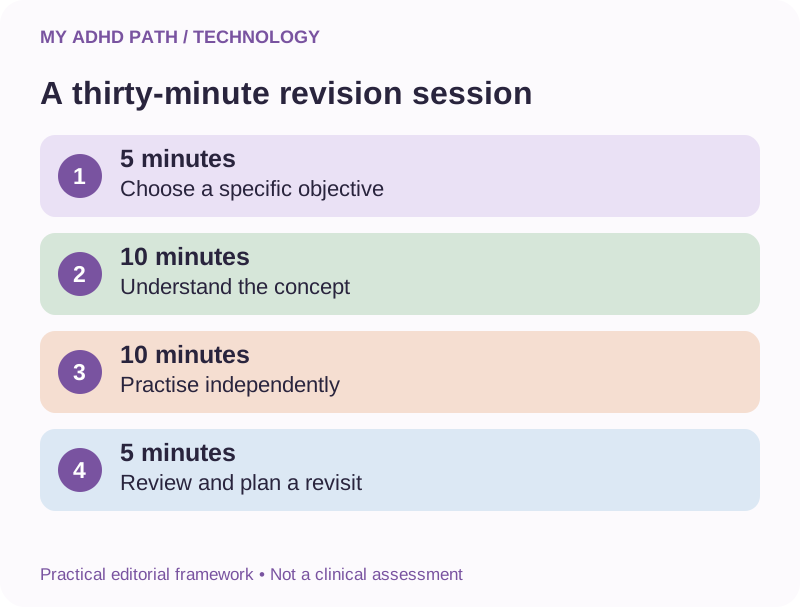
Thirty minutes of focused, structured revision may be more productive than two hours of unfocused study.
If you find it difficult to study for longer periods, shorter focused sessions with breaks between them may be more sustainable.
Try this
At the end of a revision session, close your notes and AI assistant. Write down everything you can remember about what you just studied. The gaps in your recall show you exactly what needs more attention next time.
From dependence to independence
The purpose of AI in learning is not to create a permanent dependency on technology.
It is to support the development of understanding and skills that the student can eventually demonstrate independently.
A useful progression might look like this.
Stage one: Supported learning
AI provides explanations, examples and guided practice.
Stage two: Assisted practice
The student attempts work independently and uses AI for feedback and clarification.
Stage three: Independent application
The student completes work without AI assistance, using it only for occasional review.
Stage four: Exam conditions
The student works entirely independently under timed conditions.
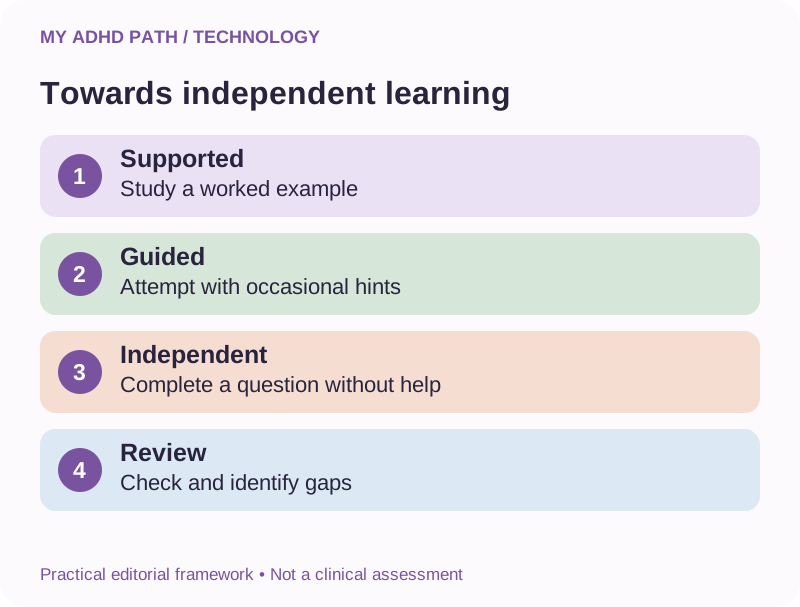
The most valuable moment isn't when AI produces the answer. It's when you realise you can produce the answer yourself.
AI and academic integrity
This is important.
Using AI to help you understand a topic is different from using AI to produce work you submit as your own.
Schools, colleges and universities have policies about AI use in assessed work.
These policies vary between institutions and may change over time.
Some may permit AI for research or planning but not for drafting.
Some may prohibit AI use entirely in certain assessments.
Some may require students to declare any AI use.
Submitting AI-generated work as your own, without appropriate declaration where required, may constitute academic misconduct.
The consequences can be serious.
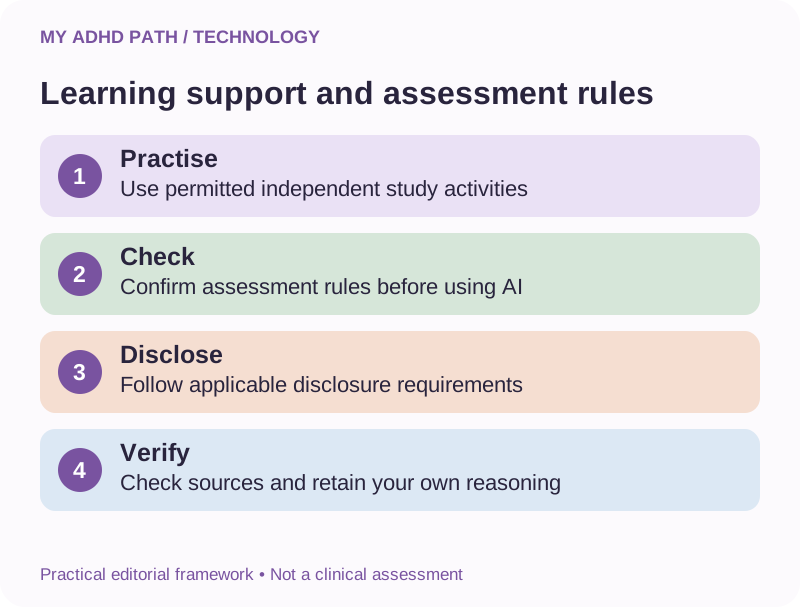
Good to know
If you are unsure whether a particular use of AI is permitted, ask your teacher, tutor or institution before submitting the work. The rules vary and ignorance of them is not usually accepted as a defence.
Examination boards
The Joint Council for Qualifications (JCQ) provides guidance on AI use in assessments for schools and colleges in England, Wales and Northern Ireland.
Individual examination boards may also publish their own guidance.
AQA • Pearson Edexcel • OCR • WJEC • CCEA • SQA
Important limitations of AI for academic work
AI assistants can produce confident, well-structured responses that are factually incorrect.
This is particularly important for academic work.
- AI may cite sources that do not exist.
- AI may misquote texts, including set texts for literature exams.
- AI may present outdated information as current.
- AI may oversimplify complex topics.
- AI may not follow the specific requirements of your examination board.
- AI-generated mark scheme answers may not reflect actual marking criteria.
Always check AI-generated academic content against your class notes, approved textbooks, official mark schemes and your teacher's guidance.
Use AI as a starting point for understanding, not as an authoritative academic source.
Common misconception
"If AI explains it clearly, it must be correct." Clarity and accuracy are different qualities. An assistant can produce a beautifully structured explanation of something that is factually wrong. Check the content, not just the presentation.
For younger students: Using AI with support
Younger students may benefit from AI-assisted learning but may also need guidance on using it appropriately.
Parents and carers can help by:
- Sitting alongside the student during initial AI-assisted revision sessions.
- Helping them formulate useful questions rather than asking for answers.
- Checking AI-generated explanations against reliable sources.
- Discussing the difference between learning support and doing the work for you.
- Ensuring the student understands their school's policy on AI use.
- Reviewing the privacy and age requirements of any AI service used.
Many AI services have minimum age requirements.
Check the terms of service before allowing younger students to use them independently.
Some schools provide their own approved AI tools with appropriate safeguards.
For teenagers: Building responsible AI habits
Teenagers may be more independent in their study habits but still benefit from understanding responsible AI use.
Key principles include:
- Use AI to support understanding, not to avoid effort.
- Always attempt a question before asking AI for help.
- Check AI-generated information against reliable sources.
- Understand your school's or college's policy on AI use in assessed work.
- Keep personal information out of AI conversations.
- Recognise when AI is being unhelpful and seek human support instead.
What you could say
"I'm not asking you to write my essay. I'm asking you to help me understand the topic well enough to write it myself."
For university students: AI as a research and study companion
University students face additional demands including independent research, complex argumentation and discipline-specific conventions.
AI may help with:
- Understanding difficult concepts in lectures or readings.
- Organising research notes and identifying themes.
- Planning essay structures and arguments.
- Preparing for seminars and presentations.
- Managing deadlines across multiple modules.
- Reviewing draft work for logical consistency.
University academic integrity policies can be particularly strict.
Many institutions now use AI detection tools, though their reliability varies.
The safest approach is to use AI for understanding and planning, write in your own words, and declare AI use where your institution requires it.
Disabled Students' Allowance
University students in England with ADHD may be eligible for Disabled Students' Allowance (DSA).
DSA can fund specialist equipment, software and support to help with the effects of a disability on studying.
The assessment considers individual needs and may include assistive technology recommendations.
Whether specific AI tools would be funded depends on the individual assessment and current DSA guidance.
https://www.gov.uk/disabled-students-allowance-dsa
Scotland, Wales and Northern Ireland have their own student support arrangements.
Contact your university's disability or student support service for guidance on applying and what support might be available.
Exam access arrangements
Students with ADHD may be eligible for exam access arrangements such as extra time, rest breaks, a separate room or the use of a computer.
These arrangements are assessed individually and are subject to the policies of the relevant examination board or institution.
They do not currently include the use of AI during examinations.
Schools and colleges can apply for access arrangements through the JCQ process.
University students should contact their disability service.
Evidence of diagnosis and functional impact is usually required.
Three fictional student experiences
Illustrative scenario
Oliver, 15 - Preparing for GCSEs
Oliver finds it difficult to begin revision sessions. He knows what subjects he needs to study but struggles to decide where to start and which approach to use. He begins using AI to generate specific practice questions on topics he's covered in class. The structured questions give him a clearer starting point than an open textbook. He attempts each question before checking, and asks for harder questions when a topic starts to feel familiar. His school has told students they may use AI for revision but not for coursework. He checks AI-generated answers against his class notes and raises any discrepancies with his teacher.
Illustrative scenario
Amira, 17 - Studying A-levels
Amira often understands concepts during lessons but finds it difficult to organise her knowledge under exam conditions. She uses AI to practise timed essay planning, asking for practice questions in the style of her examination board. After writing a plan, she asks for feedback on whether she's addressed the question, included relevant evidence and structured her argument logically. She writes the essays herself. She also uses AI to create a revision timetable that accounts for her tendency to spend too long on subjects she enjoys and not enough on those she finds less engaging.
Illustrative scenario
Ben, 21 - At university
Ben often begins assignments with enthusiasm but finds it difficult to maintain momentum through longer pieces of work. He uses AI to break a 3,000-word essay into manageable sections, each with a clear purpose and approximate word count. When he gets stuck on a particular argument, he discusses it with the assistant to clarify his own thinking, then writes the section himself. He checks his university's academic integrity policy and declares his use of AI planning support where required. He has applied for DSA and his needs assessment is considering appropriate assistive technology.
These experiences are fictional illustrations, not evidence of academic or clinical outcomes.
Create your personal AI study profile
Consider the following questions.
- What subjects or topics do I find most difficult?
- What type of studying do I find hardest to begin?
- How long can I typically maintain focused attention?
- What time of day am I most able to concentrate?
- What types of distraction most commonly interrupt my study?
- Which learning approaches have worked well for me in the past?
- What exam or assessment formats do I find most challenging?
- What support is currently available to me?
- What does a realistic and sustainable study routine look like for me?
Share relevant information with your AI assistant to help it provide more useful support.
Keep personal details to a minimum and check the privacy policy of any service you use.
Downloadable resource
My ADHD AI Study Toolkit
A practical guide to using AI for revision, study and academic work. Better learning. Less struggle.
Download PDFYour seven-day AI learning experiment
Day one: Choose your focus
Identify one subject or topic that you find particularly difficult. Tell your AI assistant what you're studying and what you already understand.
Day two: Get a personalised explanation
Ask for an explanation of a concept you find confusing. Request a different approach if the first explanation doesn't help. Try explaining it back in your own words.
Day three: Test yourself
Ask for practice questions on yesterday's topic. Attempt them without looking at your notes first. Note which questions you found difficult.
Day four: Revisit the gaps
Return to the areas you found difficult on day three. Ask for additional explanation or different practice questions on those specific areas.
Day five: Plan a revision session
Ask AI to help you create a thirty-minute revision plan for a different subject. Follow the plan and note whether the structure helped.
Day six: Practise under pressure
Ask for a timed practice question in the style of your examination board. Complete it without AI assistance. Then ask for feedback on your response.
Day seven: Review what works
Consider which approaches helped your learning and which didn't. Adjust your study plan based on what you've discovered.
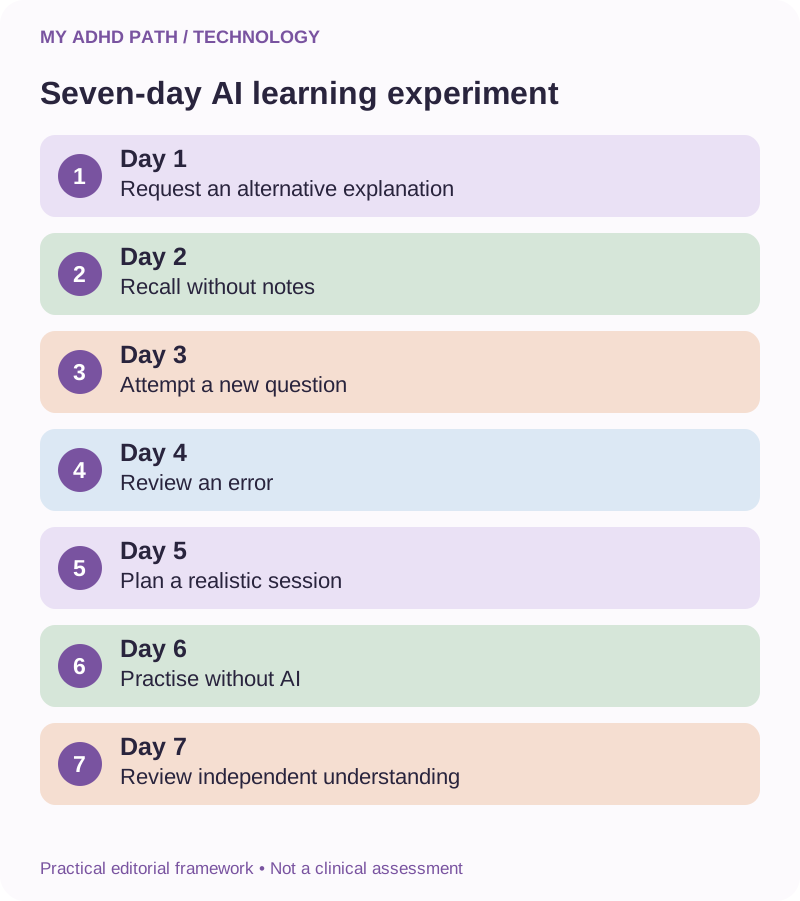
This is a personal learning experiment, not a clinically validated ADHD intervention or a guaranteed method for improving academic results.
Fifteen AI prompts for students with ADHD
AI prompt
1. Help me understand this topic
"I'm studying [subject] at [level]. I need to understand [topic]. I already know [what you know]. Can you explain [specific concept] in a way that builds on what I already understand?"
AI prompt
2. Quiz me on this topic
"Give me five practice questions on [topic] at [level]. Start with two recall questions and then three that require application or analysis. Don't give me the answers until I've attempted them."
AI prompt
3. Explain this differently
"I've read the textbook explanation of [concept] but I still don't understand it. Can you explain it using a different approach, with a concrete example?"
AI prompt
4. Break this topic into smaller parts
"[Topic] feels overwhelming. Can you break it into smaller subtopics and suggest which order I should study them in, based on how they connect?"
AI prompt
5. Help me plan my revision
"I have [number] subjects to revise. My exams start on [date]. I can study for about [hours] per day. Help me create a realistic revision timetable that includes breaks and variety."
AI prompt
6. Help me plan this essay
"I need to write an essay on [topic] for [subject] at [level]. My argument is [brief thesis]. Help me create a paragraph-by-paragraph plan. Don't write the essay for me."
AI prompt
7. Check my understanding
"I'm going to explain [topic] in my own words. Tell me if I've got anything wrong or missed anything important."
AI prompt
8. Give me feedback on my answer
"Here is my answer to a practice [subject] question at [level]. Can you give me feedback on whether I've addressed the question, included relevant evidence and structured my response clearly? Here is my answer: [paste answer]"
AI prompt
9. Create a comparison table
"I need to compare [thing A] and [thing B] for my [subject] revision. Create a comparison table covering [relevant categories]. Then quiz me on the key differences."
AI prompt
10. Help me start
"I need to study [topic] but I can't get started. Give me one specific, small task I can do right now that will take less than five minutes and get me into the material."
AI prompt
11. Explain the mark scheme
"I'm preparing for [exam board] [subject] [paper]. Can you explain what examiners are looking for in a [number]-mark question on [topic type]? What would a strong answer include?"
AI prompt
12. Summarise what I've learned today
"Based on our conversation today, create a concise summary of the key things I've studied. Highlight anything I seemed to find difficult so I know what to revisit."
AI prompt
13. Create flashcard-style questions
"Create ten question-and-answer pairs on [topic] that I can use for active recall practice. Keep the answers concise."
AI prompt
14. Help me organise my notes
"I have scattered notes on [topic]. I'm going to share them with you. Help me organise them into a clear revision summary with the most important points highlighted."
AI prompt
15. Help me manage my deadline
"I have an assignment due on [date]. It requires [brief description]. Help me break it into daily tasks between now and the deadline, with built-in time for review and unexpected delays."
Always check AI-generated academic content against reliable sources.
Use AI to support your learning, not to replace it.
Frequently asked questions
Can students with ADHD use AI for revision?
Yes. AI can provide explanations, generate practice questions and help organise revision. It should support learning rather than replace the student's own effort.
Is using AI for homework cheating?
It depends on how it is used and your school's or institution's policy. Using AI to understand a topic is different from using it to generate answers you submit as your own work.
Can AI replace a tutor?
No. AI can provide explanations and practice but it lacks the ability to truly understand a student's individual learning needs, provide pastoral support or adapt in the way an experienced human tutor can.
What is the best AI tool for students with ADHD?
There is no single best tool. Consider the subject, the type of support needed, the student's age, privacy requirements and the policies of their educational institution.
Can AI help with exam technique?
It can explain what examiners look for and provide practice questions. Always verify against official mark schemes and your teacher's guidance.
Is AI accurate for academic subjects?
Not always. AI can produce confident but incorrect explanations, fabricated quotations and non-existent sources. Always check against reliable materials.
Can AI help with maths?
It can explain methods and generate practice questions. For step-by-step calculation work, verify each step carefully as AI can make mathematical errors.
Can AI help with essay writing?
It can help with planning, structure and understanding the topic. The writing itself should be the student's own work, in accordance with their institution's policy.
Should parents supervise AI use?
For younger students, yes. Parents can help ensure AI is used as a learning tool rather than an answer service, and check that the service meets age and privacy requirements.
Can AI help organise study time?
Yes. It can help create revision timetables, break down tasks and suggest realistic daily goals based on available time and upcoming deadlines.
What is active recall?
Actively retrieving information from memory rather than passively rereading it. Testing yourself and answering questions from memory are forms of active recall.
What is spaced practice?
Distributing study sessions across time rather than concentrating them. Reviewing material at increasing intervals helps strengthen long-term retention.
Can students get extra time in exams for ADHD?
Potentially. Exam access arrangements are assessed individually through the JCQ process for schools and colleges, or through university disability services.
What is Disabled Students' Allowance?
A government scheme in England that can fund specialist equipment, software and support for university students whose disability affects their studying. Scotland, Wales and Northern Ireland have separate arrangements.
Can AI help with concentration?
It can help structure study sessions and provide more engaging learning activities, but it is not a treatment for attention difficulties. ADHD management may involve additional clinical support.
Will schools ban AI?
Policies are evolving. Some schools restrict AI use in certain assessments while permitting it for revision. Check your school's current policy.
Can AI detect whether work was written by AI?
AI detection tools exist but their reliability varies. The safest approach is to use AI for understanding and planning and to write in your own words.
Is AI a treatment for ADHD?
No. It is a potential practical support tool and does not replace appropriate assessment, treatment or clinical care.
Learn your way
Perhaps you've spent years feeling like studying is harder for you than it seems to be for everyone else.
Perhaps you've been told to try harder, concentrate more, or just sit down and do it.
As though the difficulty were simply a shortage of willpower.
The challenge is not usually about wanting to learn.
It's about the invisible demands that surround the learning itself.
Deciding where to start. Knowing what you don't know. Maintaining attention through material that doesn't immediately engage you. Recovering your place after every interruption.
AI won't remove those challenges entirely.
But it may help you approach them differently.
A clearer starting point. A more structured session. A way to test yourself without waiting for someone else to set the questions.
The goal is not to depend on technology.
It's to use it as a bridge between where you are and what you're capable of demonstrating on your own.
Helping you learn something and doing the learning for you are two very different things.
Sources and further reading
- Dunlosky, J. et al. (2013). Improving Students' Learning With Effective Learning Techniques. Psychological Science in the Public Interest. https://doi.org/10.1177/1529100612453266
- Roediger, H. L. and Butler, A. C. (2011). The Critical Role of Retrieval Practice in Long-Term Retention. Trends in Cognitive Sciences. https://doi.org/10.1016/j.tics.2010.09.003
- Karpicke, J. D. and Blunt, J. R. (2011). Retrieval Practice Produces More Learning than Elaborative Studying with Concept Mapping. Science. https://doi.org/10.1126/science.1199327
- Cepeda, N. J. et al. (2006). Distributed Practice in Verbal Recall Tasks: A Review and Quantitative Synthesis. Psychological Bulletin. https://doi.org/10.1037/0033-2909.132.3.354
- DuPaul, G. J. et al. (2009). College Students With ADHD. Journal of Attention Disorders. https://doi.org/10.1177/1087054708320869
- Faraone, S. V. et al. (2021). The World Federation of ADHD International Consensus Statement. https://doi.org/10.1016/j.neubiorev.2021.01.022
- NICE - ADHD: diagnosis and management. https://www.nice.org.uk/guidance/ng87
- Joint Council for Qualifications. https://www.jcq.org.uk/
- GOV.UK - Disabled Students' Allowance. https://www.gov.uk/disabled-students-allowance-dsa
- GOV.UK - Access to Work. https://www.gov.uk/access-to-work
- Diamond, A. (2013). Executive Functions. Annual Review of Psychology. https://doi.org/10.1146/annurev-psych-113011-143750
- Risko, E. F. and Gilbert, S. J. (2016). Cognitive Offloading. Trends in Cognitive Sciences. https://doi.org/10.1016/j.tics.2016.07.002
- Noy, S. and Zhang, W. (2023). Experimental Evidence on the Productivity Effects of Generative Artificial Intelligence. Science. https://doi.org/10.1126/science.adh2586
- Information Commissioner's Office. https://ico.org.uk/
This article provides general educational information and practical suggestions for using AI as a study tool. It does not constitute medical, educational or professional advice. The frameworks and exercises are illustrative rather than clinically validated ADHD interventions. AI-generated academic content requires verification against authoritative sources. Students should comply with the academic integrity policies of their educational institution. ADHD assessment, treatment and support should involve appropriately qualified professionals.