

Imagine what you might be capable of if you spent as much time recognising your abilities as you've spent questioning them.
At a glance
- Confidence is not the same as self-worth.
- ADHD-related difficulties do not necessarily reflect underlying ability.
- Confidence can vary between activities and environments.
- Self-trust can involve recognising and arranging appropriate support.
- Meaningful experiences can provide evidence of competence.
- Strengths are individual rather than universal ADHD characteristics.
- Personal value does not depend entirely on productivity.
Somebody asks whether you'd be interested in taking on an exciting new opportunity.
It's something you'd genuinely enjoy.
You have the experience. You have relevant skills. You've even done something remarkably similar before.
But before you've had a chance to consider how wonderful the opportunity might be, your mind has already started compiling evidence against you.
What if you forget something important?
What if you can't maintain the level of organisation required?
What if the last time you succeeded was simply because everything happened to go particularly well?
What if somebody eventually discovers that you're not quite as capable as they seem to think?
Interestingly, if a friend with exactly the same experience asked whether they should accept the opportunity, you'd probably be enthusiastically encouraging them to go for it.
You can see their abilities without immediately searching for reasons to disqualify them.
Applying the same judgement to yourself may feel considerably more difficult.
For some people with ADHD, confidence isn't held back by a lack of ability. It's held back by uncertainty about whether they'll be able to access and use that ability when they need it.
Understanding that distinction can change how you approach building confidence.
What does genuine confidence look like?
Confidence is often associated with being outgoing, speaking comfortably in front of other people or having an impressive collection of achievements.
But somebody can be remarkably confident without being particularly loud.
They might know what they're good at.
Recognise when they need assistance.
Feel comfortable asking questions.
Accept that they have more to learn.
And be willing to undertake something without requiring certainty that everything will go perfectly.
Genuine confidence doesn't involve believing you're exceptional at absolutely everything.
It involves having a reasonably balanced understanding of your abilities, your needs and your capacity to navigate unfamiliar circumstances.
You can be confident and nervous.
You can be confident and inexperienced.
You can be confident and require support.
These experiences are entirely compatible.
Confidence, self-esteem, self-worth and self-efficacy
These terms are often used interchangeably, but they describe somewhat different aspects of how we understand ourselves.
| Concept | What it broadly describes | Everyday example |
|---|---|---|
| Confidence | Belief in your ability to manage a particular situation | I feel comfortable presenting my ideas |
| Self-esteem | Your overall evaluation of yourself | I generally feel positively about who I am |
| Self-worth | Your sense of personal value | I have value regardless of today's achievements |
| Self-efficacy | Belief in your ability to carry out actions required for a particular outcome | I believe I can learn to use this new software |
These descriptions are simplified, and psychological definitions sometimes overlap.
However, distinguishing between them can help you understand why you might feel highly capable in one area of life but uncertain in another.
You may have enormous confidence in your professional expertise while finding everyday administration difficult.
You may feel comfortable supporting other people but hesitate when expressing your own needs.
You may recognise that you're capable of producing excellent work without trusting yourself to complete it consistently.
You don't necessarily need to rebuild every aspect of your confidence.
You might need to develop it in a particular area or find more suitable conditions in which to use an ability you already have.
How ADHD can affect confidence
ADHD does not inevitably lead to low confidence or poor self-esteem.
Many people with ADHD have a strong sense of identity, recognise their abilities and feel comfortable approaching new opportunities.
However, certain experiences associated with ADHD may make confidence more difficult to develop or maintain.
Inconsistent performance
Perhaps you've produced excellent work on one occasion and struggled considerably with a similar task on another.
You know you're capable.
What's less certain is whether you'll be able to perform in the same way next time.
This uncertainty may gradually influence how much you trust your abilities.
Repeated criticism
Some people with ADHD have spent years receiving feedback about being forgetful, distracted, disorganised or inconsistent.
When similar experiences occur repeatedly, it can become difficult to separate criticism of a particular behaviour from your wider understanding of yourself.
Comparing effort with other people's outcomes
You see somebody complete a responsibility that required considerable effort for you.
They appear to manage it almost automatically.
Without knowing their circumstances or recognising your own support needs, you may conclude that they are simply more capable.
Unrecognised support needs
Working in environments that don't suit your needs can influence how you evaluate your performance.
A person who struggles to concentrate in a noisy office may produce excellent work in a quieter environment.
Their underlying knowledge hasn't changed.
Their ability to use it has.
Difficulty recognising progress
Attention frequently moves towards the next responsibility, problem or interesting opportunity.
For some people with ADHD, this means achievements receive relatively little attention once they've happened.
Over time, your memory of what remains unfinished may become more accessible than your memory of everything you've already accomplished.
When your ability and your performance tell different stories
Imagine two students.
Both understand a subject extremely well.
One revises regularly, remembers examination equipment and comfortably organises their time.
The other understands the material but struggles to establish a revision routine, occasionally overlooks instructions and finds managing time during an examination particularly demanding.
Their final results may differ.
But the results don't necessarily provide a complete picture of their understanding or potential.
Similar situations occur in employment and everyday life.
You may be an excellent problem-solver while struggling to manage a complicated diary.
You may be a talented designer while finding the administrative aspects of running a business particularly demanding.
You may have extensive knowledge of a subject but find it difficult to retrieve information during an unexpected conversation.
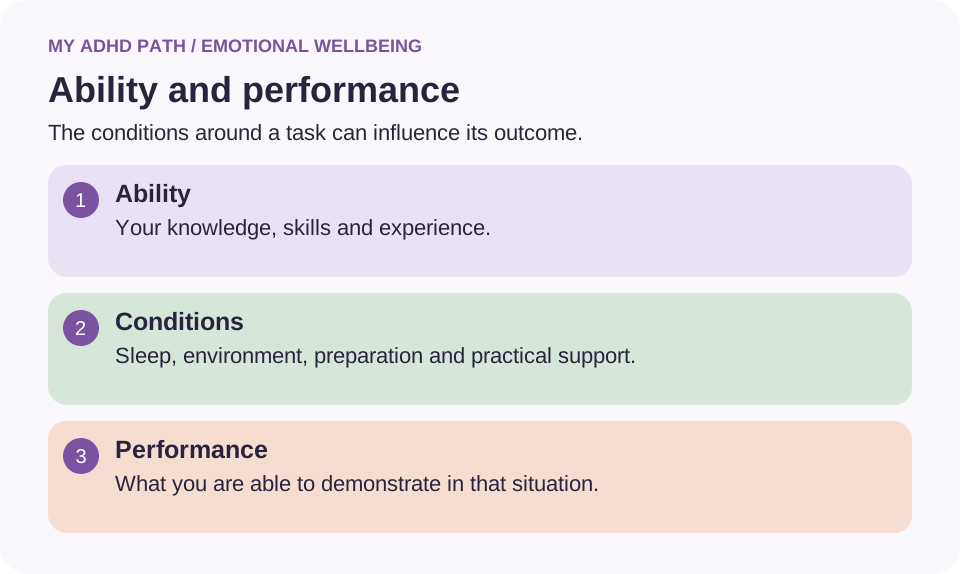
Performance is influenced by more than underlying ability.
It can also depend on preparation, available support, sleep, health, environmental conditions and the particular demands of a task.
Recognising these factors doesn't mean avoiding responsibility for outcomes.
It means developing a more accurate understanding of what helps you perform well.
The difference between believing in yourself and trusting yourself
You might genuinely believe you're capable of doing something while feeling reluctant to trust yourself to do it.
Perhaps you've forgotten important commitments before.
Started ambitious projects that remained unfinished.
Agreed to responsibilities that became difficult to maintain.
Or established routines that gradually disappeared.
When these experiences accumulate, you may begin approaching new commitments with considerable uncertainty.
You don't necessarily need somebody to tell you that you're brilliant.
You may need practical ways of making your intentions easier to follow through.
For example, promising yourself that you'll remember an important appointment may not provide much confidence if remembering appointments has previously been difficult.
Putting the appointment in your calendar, setting suitable reminders and planning the journey might provide a more reliable arrangement.
Self-trust doesn't have to mean relying entirely on your memory, motivation or determination.
It can involve trusting yourself to recognise what you need and put appropriate support in place.
Twelve signs your confidence may need some attention
Practical checklist
- You dismiss achievements that other people recognise. When somebody praises your work, you immediately explain why it wasn't particularly impressive.
- You remember mistakes more readily than successes. One uncomfortable experience can remain memorable long after numerous positive experiences have faded from your attention.
- You hesitate to pursue opportunities you're qualified for. You focus on the requirements you might struggle with rather than the experience and abilities you already possess.
- You assume other people know considerably more than you. Confidence in somebody else's delivery can lead you to overestimate their knowledge and underestimate your own.
- You feel the need to prove yourself repeatedly. Previous achievements never seem to provide quite enough reassurance about your current abilities.
- You apologise for needing support. Asking for written instructions, additional clarification or a quieter working environment feels like admitting inadequacy.
- You avoid activities where you're a beginner. You would genuinely enjoy learning something but feel uncomfortable being visibly inexperienced.
- You frequently seek other people's approval. Making a decision feels difficult until somebody confirms that you've made the right choice.
- You interpret mistakes as evidence about your identity. An overlooked email becomes evidence that you're unreliable rather than one responsibility that needs addressing.
- You attribute success entirely to favourable circumstances. You recognise the role of luck, timing or assistance but overlook your own contribution.
- You struggle to describe your strengths. You can identify numerous things you'd like to improve but find it considerably harder to explain what you do well.
- You feel confident only when you're being productive. When you're achieving something, you feel capable and worthwhile. When you're resting, struggling or having an ordinary day, that feeling becomes less accessible.
Good to know
These experiences are not diagnostic criteria and are not unique to ADHD. They may provide useful opportunities for reflection.
ADHD and imposter feelings
Imagine being invited to contribute your expertise to a professional discussion.
Other people clearly believe you have something valuable to offer.
You spend the days beforehand researching the subject, reviewing your experience and preparing answers to questions nobody has actually asked.
You participate successfully.
Afterwards, you conclude that the discussion went well because you prepared so thoroughly.
Your preparation may indeed have been useful.
But you haven't necessarily recognised the knowledge, judgement and experience that made it possible.
Experiences like these are sometimes described as the imposter phenomenon or, more informally, imposter syndrome.
The term describes patterns of doubting achievements or feeling undeserving of success despite evidence of competence.
It is not a standalone medical diagnosis.
People with ADHD may experience imposter feelings, particularly where their performance varies or considerable unseen effort is involved.
However, research does not establish that imposter feelings are exclusive to ADHD or inevitable consequences of it.
Preparation and competence aren't opposites.
Experienced professionals prepare.
Talented people seek advice.
Successful individuals use tools and support.
These behaviours do not invalidate their abilities.
Why positive affirmations aren't always enough
Standing in front of a mirror and repeatedly telling yourself that you're confident might be helpful for some people.
For others, the statement feels disconnected from their actual experiences.
If you've spent years doubting your ability to manage particular situations, a broad statement about being capable may not feel especially convincing.
Consider a more specific, credible approach.
Try this
Instead of: "I am good at everything I do." Try: "I have successfully learnt unfamiliar skills before."
Instead of: "I never need to doubt myself." Try: "I can feel uncertain and still take a manageable next step."
Instead of: "I can handle absolutely anything." Try: "I can identify what support I need when something becomes difficult."
These statements don't require you to disregard genuine challenges.
They recognise existing abilities and create room for development.
Confidence can be grounded in evidence rather than optimism alone.
The confidence-building cycle
What the research says
Psychological research into self-efficacy has explored how experiences of successfully performing activities can influence people's beliefs about their ability to manage similar situations. This provides a useful principle for developing confidence.
You don't necessarily need to feel entirely confident before taking action.
Confidence can develop through experiences that demonstrate what you're capable of doing.
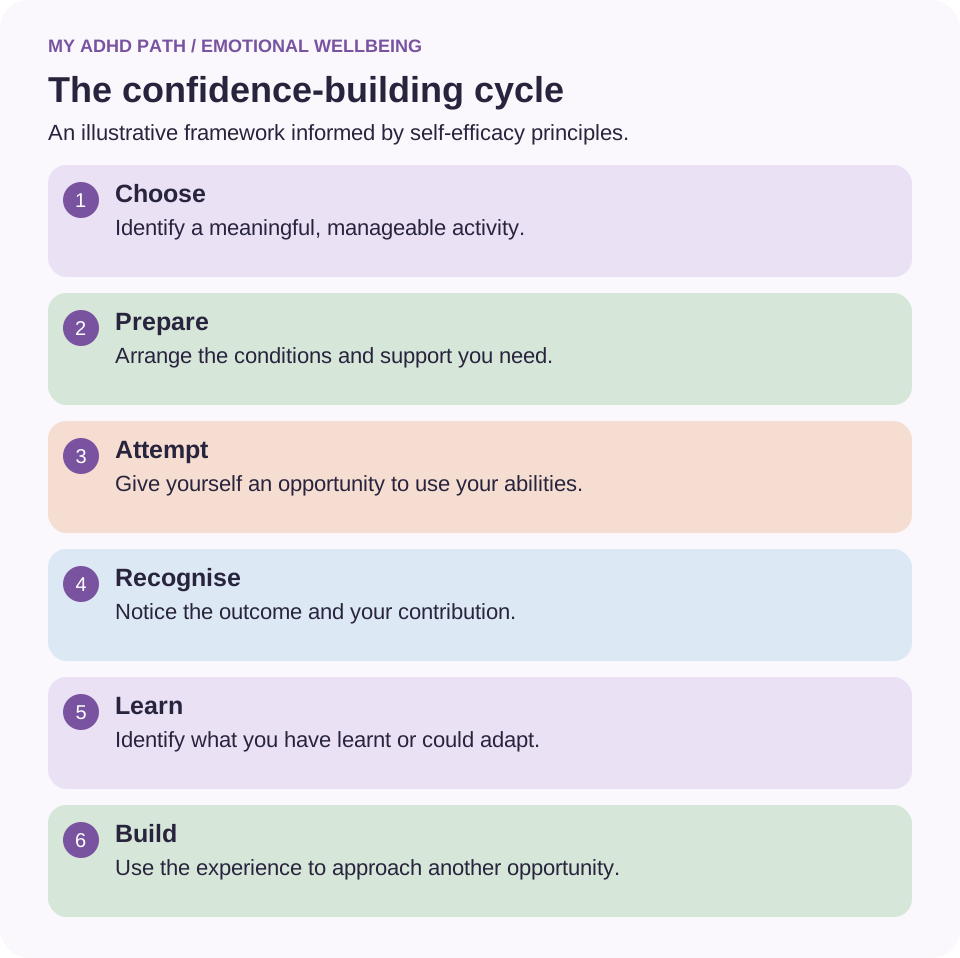
A practical approach might look like this:
- Choose a meaningful, manageable activity.
- Identify the conditions or support you need.
- Attempt the activity.
- Recognise what happened and your contribution to it.
- Identify what you've learnt.
- Use that experience when approaching another opportunity.
Good to know
This is an illustrative framework informed by broad self-efficacy principles, not a validated ADHD-specific treatment.
Not every attempt will produce the outcome you hoped for.
However, recognising what you've learnt, how you adapted and what you might approach differently can still provide useful information.
The objective isn't uninterrupted success.
It's developing a more informed understanding of your abilities.
Recognise your strengths without creating ADHD stereotypes
Discussions about ADHD increasingly focus on potential strengths alongside difficulties.
That can be valuable, particularly for people who have spent years hearing predominantly about challenges.
However, it is equally important not to replace negative stereotypes with unrealistic positive ones.
Common misconception
Not everybody with ADHD is exceptionally creative. Not everybody enjoys taking risks, working under pressure or developing new ideas. And you don't need to identify a remarkable ADHD-related talent to have something valuable to offer.
Your strengths are individual.
They may include:
- Explaining complicated information clearly.
- Noticing details other people overlook.
- Developing original ideas.
- Listening thoughtfully to other people.
- Solving practical problems.
- Learning about subjects that interest you.
- Adapting to changing circumstances.
- Making people feel welcome.
- Persisting with meaningful challenges.
- Recognising connections between different ideas.
- Demonstrating practical or technical skills.
- Creating things that improve other people's lives.
Some of your strengths may relate to how you experience ADHD.
Others may reflect your personality, education, interests, values or acquired experience.
You don't have to establish where every ability comes from before appreciating it.
Build your personal strengths map
Rather than creating a general list of qualities you would like to possess, consider identifying strengths through examples.
| Strength | Evidence | Conditions that help me use it |
|---|---|---|
| Problem-solving | I found a simpler way to manage a recurring work process | Uninterrupted thinking time |
| Communication | Colleagues ask me to explain unfamiliar technical concepts | Time to organise my thoughts |
| Creativity | I developed a successful fundraising idea | Freedom to explore possibilities |
| Practical skills | I repaired something that had stopped working | Access to suitable tools |
| Empathy | Friends feel comfortable discussing difficult experiences with me | Quiet, unhurried conversations |
| Learning | I taught myself how to use unfamiliar software | Practical examples and opportunities to experiment |
These are illustrative examples rather than a list of universal ADHD strengths.
The third column is particularly important.
Recognising an ability is useful. Understanding the conditions under which you can access it may be even more valuable.
Create an evidence bank
Have you ever reached the end of a demanding week and felt that you haven't accomplished anything?
Then somebody reminds you that you've completed a substantial piece of work, helped a colleague, arranged several appointments and resolved a problem that had been outstanding for months.
Suddenly, the week looks rather different.
An evidence bank is simply a place to record meaningful experiences that you might otherwise forget or dismiss.
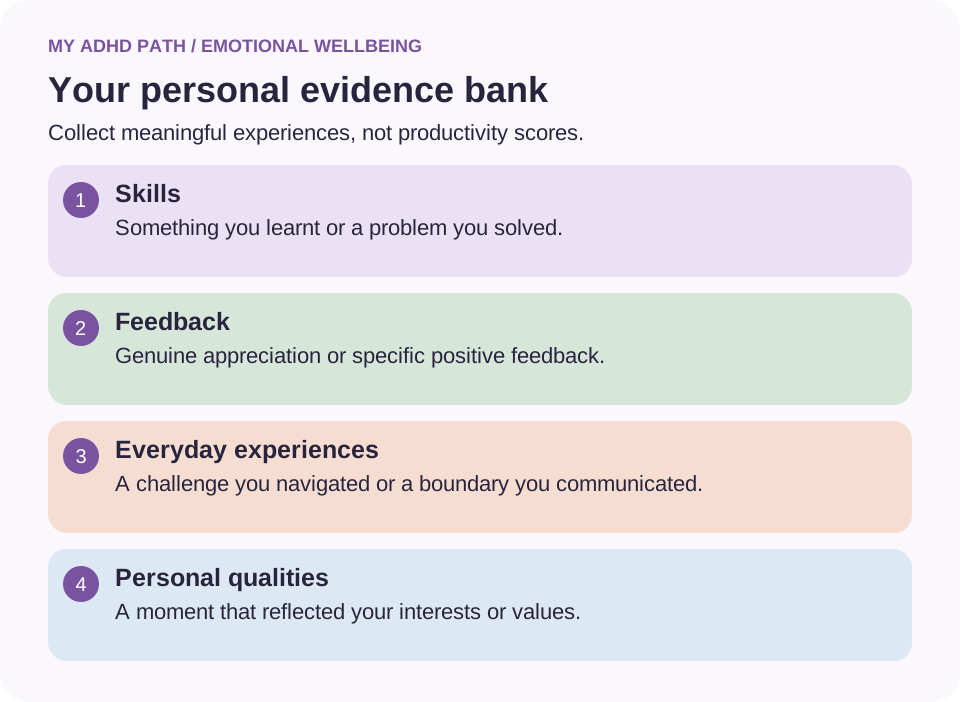
It could contain:
- Positive feedback.
- Problems you've solved.
- Skills you've developed.
- Difficult situations you've navigated.
- Projects you've completed.
- Helpful things you've done for other people.
- Boundaries you've successfully communicated.
- Times you've recognised a need for support.
- Enjoyable experiences you've created.
- Decisions that have improved your everyday life.
Try this
You don't need to record something every day. You don't need to categorise every achievement or build an elaborate database. A note on your phone, a folder of positive feedback or an occasional entry in a notebook may be sufficient. The purpose is to create a more balanced record of your experiences. Not another system through which to assess your productivity.
If you find yourself questioning whether you're capable of something, previous experiences may provide useful context.
Stop measuring your value through productivity
You might feel considerably more confident on a day when you've completed numerous responsibilities.
Everything is moving forward.
Your ideas are developing.
Your inbox is under control.
You've remembered to put the washing away without discovering it three days later.
On another day, you experience interruptions, struggle to concentrate and achieve considerably less.
Your understanding of your own value changes alongside your productivity.
But the difference between those two days doesn't necessarily reflect a difference in your intelligence, personality or personal worth.
Human capacity varies.
Your health, sleep, responsibilities and circumstances influence what you can manage.
Your achievements can be worth celebrating without becoming the conditions under which you allow yourself to feel worthwhile.
You are more than the work you produce.
You are also the person who enjoys particular things, cares about particular people, holds particular values and experiences a life beyond completing responsibilities.
Confidence that can accommodate ordinary days is often more useful than confidence that exists only on exceptionally productive ones.
Borrow the way you speak to someone you care about
Imagine that a friend comes to you following a difficult job interview.
They forgot one of the examples they'd prepared.
They stumbled over a question.
They left feeling disappointed.
Would you tell them that the experience demonstrates they're incapable of having a successful career?
Probably not.
You would likely recognise their preparation, acknowledge the difficulty and help them consider what they might do differently next time.
Now imagine the same interview happened to you.
Would your response be equally balanced?
What the research says
Self-compassion is a psychological concept involving a considerate and understanding response to personal difficulties. It doesn't require ignoring mistakes, avoiding accountability or believing that every outcome was satisfactory. It involves responding to your own experiences without unnecessary personal condemnation.
You can recognise that you made a mistake without using it to describe your entire identity.
What you could say
"I overlooked something important, and I need to address it" is both more specific and more useful than "I'm completely useless."
The first statement creates an opportunity for action.
The second provides very little information about what needs to happen next.
Fifteen practical ways to build genuine confidence with ADHD
1. Identify the areas where you already feel capable
Confidence is rarely absent from every part of somebody's life.
Consider the activities, environments and relationships in which you feel most comfortable using your abilities.
2. Record evidence rather than relying on memory
Keep useful feedback, meaningful experiences and examples of progress somewhere accessible.
Return to them when you want a more balanced perspective.
3. Recognise the conditions that help you succeed
Consider the role of your environment, available support, preparation and practical tools.
Recreate helpful conditions where possible.
4. Choose manageable commitments
Rather than promising yourself you'll completely transform an area of your life, establish a commitment that reflects your circumstances.
A smaller commitment can provide a useful opportunity to develop self-trust.
5. Adjust commitments when circumstances change
Keeping a promise to yourself does not mean ignoring illness, exhaustion or unexpected responsibilities.
Revising a plan appropriately can itself demonstrate good judgement.
6. Ask for specific feedback
Instead of asking somebody whether you're good at something, ask which aspects of your work were effective and what could be improved.
Specific information can help you develop a more accurate understanding of your abilities.
7. Practise receiving compliments
When somebody expresses genuine appreciation, try accepting it without immediately listing the reasons it might be undeserved.
A straightforward "Thank you" is sufficient.
8. Develop skills through achievable experiences
Choose a practical opportunity to learn or practise something that matters to you.
Your initial attempts do not need to resemble the work of somebody with years of experience.
9. Separate mistakes from identity
Identify what happened, what needs addressing and whether additional support would be useful.
Avoid turning one experience into an explanation of your entire character.
10. Recognise the value of appropriate support
Calendars, assistive technology, coaching, workplace adjustments and other forms of support can help you use your abilities more effectively.
Their contribution doesn't cancel yours.
11. Reduce unhelpful comparisons
Other people's achievements rarely reveal everything about their circumstances, opportunities or support.
Compare your experiences where doing so provides useful information rather than simply encouraging self-criticism.
12. Make room for your own preferences
Practise expressing ordinary opinions, choosing activities you enjoy and communicating appropriate boundaries.
Confidence includes recognising that your preferences deserve consideration.
13. Allow achievements to exist before moving on
When you complete something meaningful, give yourself an opportunity to recognise it before immediately expanding your expectations.
14. Build confidence beyond achievement
Spend time on activities that reflect your interests, relationships or values without requiring measurable improvement.
15. Seek appropriate support for persistent difficulties
If low self-esteem, anxiety, depression or self-criticism significantly affects your life, qualified psychological or healthcare support may help.
Confidence is not something you are required to develop entirely independently.
The self-trust ladder
Rather than expecting yourself to feel completely confident in a difficult situation, consider identifying a smaller, relevant step.
Suppose you'd love to contribute more ideas during meetings.
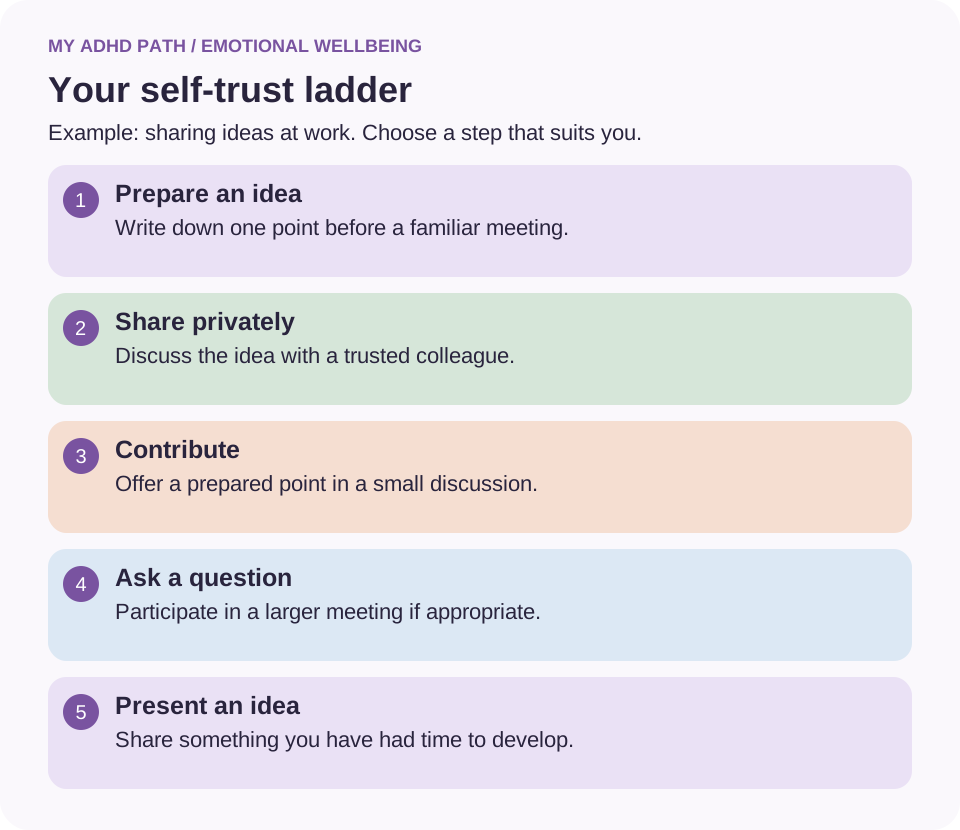
You might begin by:
- Writing down an idea before a familiar meeting.
- Sharing it with one trusted colleague.
- Contributing a prepared point during a small discussion.
- Asking a question during a larger meeting.
- Presenting an idea you've had time to develop.
These are possible opportunities rather than compulsory stages.
You might already feel comfortable with several of them.
You may also decide that sharing ideas in writing is a better way to contribute in particular circumstances.
Good to know
The ladder is not intended to force you into situations that feel unsafe or genuinely unsuitable. It is a way to identify manageable opportunities for using an ability you would like to develop.
Progress doesn't need to be dramatic to be meaningful.
When confidence depends on the environment
Illustrative scenario
Imagine a professional who finds large, spontaneous meetings difficult. They struggle to retrieve information quickly, lose track of conversations and rarely find an appropriate moment to contribute. Over time, they begin questioning their communication skills.
Now imagine the same professional receives an agenda in advance, has time to prepare their ideas and participates in a smaller discussion with fewer interruptions. They communicate clearly. Offer useful observations. And make substantial contributions to the conversation.
Their underlying knowledge and personality haven't undergone a sudden transformation. The conditions have changed.
This distinction matters because confidence-building advice sometimes concentrates exclusively on what an individual should change about themselves.
But accessible environments, supportive relationships and appropriate expectations can make a considerable difference.
You don't always need to become better at functioning in unsuitable conditions.
Sometimes the conditions themselves deserve attention.
Building confidence at work
Professional confidence can become particularly difficult when you feel capable of performing your role but struggle with some of its surrounding administrative or organisational demands.
You might have considerable technical expertise while finding consecutive meetings exhausting.
You may develop excellent ideas but struggle to explain them spontaneously.
You may perform well when priorities are clear but become overwhelmed when several assignments compete for attention.
Consider identifying the difference between your professional expertise and the executive functioning demands associated with delivering it.
| Professional ability | Surrounding demand | Possible support |
|---|---|---|
| Understanding complex information | Remembering verbal instructions | Written summaries |
| Creative development | Managing competing project deadlines | Agreed priorities and milestones |
| Technical problem-solving | Frequent interruptions | Protected working periods |
| Explaining ideas | Responding to unexpected questions | Advance agendas or preparation time |
| Working with customers | Remembering follow-up commitments | Accessible reminder and scheduling tools |
Appropriate support can help you demonstrate abilities you already possess.
Our ADHD at Work hub explores workplace disclosure, adjustments and Access to Work in further detail.
Building confidence when you're self-employed
Running a business can make it particularly difficult to maintain a balanced assessment of your abilities.
There are always new things to learn.
New competitors to consider.
New technologies to understand.
And usually several additional responsibilities that nobody mentioned when you first decided to become self-employed.
You might be exceptionally good at creating a product but feel uncertain about marketing it.
Confident in your technical abilities but less comfortable with selling.
Capable of developing exciting ideas but unsure how to prioritise them.
Rather than interpreting every unfamiliar responsibility as evidence that you're insufficiently capable, consider recognising the very different skills involved in running a business.
You don't need to excel equally at all of them.
You can develop unfamiliar skills.
Create processes.
Use suitable technology.
Seek advice.
Work with other people.
And recognise areas where somebody else's expertise would complement your own.
Confidence in your business doesn't require you to become every department within it.
Building social confidence with ADHD
Social confidence doesn't necessarily mean enjoying large gatherings or comfortably talking to anybody you meet.
For some people, it means recognising where and with whom they feel most comfortable.
You might prefer small groups.
Enjoy conversations organised around shared interests.
Find walking alongside somebody easier than sitting opposite them.
Or feel more connected through regular, informal contact than occasional elaborate social occasions.
These preferences are valid.
If you'd like to expand your social opportunities, consider environments that suit your interests and communication preferences.
A creative workshop, community gardening group, local sports activity or shared-interest group may offer natural opportunities to connect.
You don't need to become a different kind of person to develop meaningful friendships.
Our guide to ADHD and friendships explores practical approaches to maintaining social connections.
Confidence and speaking up for yourself
Sometimes confidence is less about demonstrating what you can achieve and more about recognising that your needs deserve attention.
You might want to request clarification during a meeting.
Ask somebody not to interrupt you.
Explain that an arrangement isn't working particularly well.
Or decline a commitment that would leave you with too little capacity.
If you're concerned about criticism or rejection, these ordinary conversations may feel uncomfortable.
Start with clear, straightforward communication.
What you could say
"Could you send that information in writing so I can refer back to it?"
"I'd like to check my existing commitments before agreeing."
"I've got a different suggestion that I'd like us to consider."
"That arrangement doesn't work particularly well for me. Could we explore an alternative?"
Being assertive doesn't require becoming confrontational.
It involves expressing your needs and preferences whilst recognising those of other people.
You don't need to provide an extensive explanation every time you make a reasonable request.
Confidence after a late ADHD diagnosis
Receiving an ADHD diagnosis in adulthood may provide a new way to understand experiences that previously seemed difficult to explain.
You might reconsider academic difficulties, professional challenges or relationships in which you struggled to meet certain expectations.
You may recognise that some of your achievements required considerably more effort than other people realised.
This can provide a useful opportunity to reconsider your understanding of your abilities.
However, a diagnosis doesn't automatically remove longstanding self-doubt.
You may still encounter familiar difficulties.
Continue responding to criticism in familiar ways.
Or find yourself uncertain about what you can reasonably expect from yourself.
Confidence can develop gradually as you gain greater understanding, explore appropriate treatment and support, and experience more suitable ways of managing everyday life.
There is no requirement to reinvent yourself.
You might simply become more familiar with the person you've always been.
Our article on late ADHD diagnosis explores this period of reflection in greater detail.
When confidence becomes another performance
Have you ever attended an event where you appeared entirely comfortable while internally monitoring almost everything you said?
You asked appropriate questions.
Smiled at the right moments.
Contributed to conversations.
Then spent the journey home reviewing whether you'd behaved appropriately.
People may have interpreted your behaviour as confidence.
But from your perspective, the experience involved considerable effort.
For some people, appearing confident and feeling confident are quite different things.
Masking can contribute to this distinction, although not every instance of preparation or self-monitoring constitutes masking.
Developing genuine confidence may involve finding environments where you can communicate more comfortably, request appropriate support and spend less time monitoring how you're perceived.
This might mean sharing information about your ADHD in suitable circumstances.
It might mean allowing yourself to ask questions rather than pretending you've understood something.
Or recognising that you don't need to fill every silence in a conversation.
There is no universal requirement to disclose ADHD or stop using strategies that help you navigate important environments.
Your safety, privacy and personal preferences matter.
Supporting confidence in children and teenagers with ADHD
Children often learn about their abilities through the responses they receive from adults.
When feedback concentrates predominantly on mistakes, forgotten responsibilities or difficulties with behaviour, a child may receive a rather incomplete picture of themselves.
Specific, balanced feedback can help them recognise their developing abilities.
Instead of offering only general praise such as "You're brilliant", consider recognising what the child actually did.
What you could say
"You found a different way to solve that problem."
"You asked for help when you weren't sure."
"You remembered to use your checklist before leaving."
"You explained that idea really clearly."
"You noticed you were getting frustrated and asked for a break."
These comments identify meaningful behaviours, skills and decisions.
It is also important to offer appropriate guidance when something needs improving.
Confidence doesn't require protecting children from all disappointment or telling them that every attempt was successful.
Children benefit from opportunities to understand what they can do, what they're learning and what support is available.
Make room for enjoyable activities that aren't always measured through grades, competitions or comparative achievement.
A child deserves to develop a sense of themselves beyond how well they perform at school.
Three different journeys towards greater confidence
Good to know
The following scenarios are fictional illustrations.
Illustrative scenario
Emma, 42 - Recognising the expertise she already has
Emma has worked in a specialist professional role for several years.
Despite receiving positive feedback, she regularly assumes that colleagues are more knowledgeable.
She begins keeping examples of problems she's solved, areas where colleagues seek her advice and skills she's developed.
She also identifies that spontaneous meetings are particularly demanding and starts preparing key points in advance.
Rather than attempting to become confident in every professional situation, she develops a clearer understanding of her existing expertise and the conditions that help her communicate it.
Illustrative scenario
Marcus, 35 - Rebuilding trust in his commitments
Marcus frequently establishes ambitious personal routines.
When they become difficult to maintain, he concludes that he cannot rely on himself.
He experiments with smaller commitments and uses suitable reminders.
When an arrangement becomes unsuitable, he revises it rather than abandoning the wider objective.
He begins recognising that trusting himself can involve making manageable plans and adapting them appropriately.
Illustrative scenario
Anita, 57 - Exploring new interests after diagnosis
Anita receives an ADHD diagnosis in her fifties and begins reconsidering how she has approached work, responsibilities and personal interests.
She realises that she has postponed learning several things because she worries about appearing inexperienced.
She joins a local ceramics group with the simple intention of enjoying the activity.
Some weeks she produces something she's delighted with.
Other weeks things don't quite go according to plan.
She discovers that being comfortable learning something new can be a meaningful form of confidence in itself.
Create your personal confidence profile
Use these questions to identify the areas of your life where confidence is already present and where additional support might be valuable.
| Question | Illustrative answer |
|---|---|
| When do I feel most like myself? | When I'm explaining subjects I enjoy |
| What do people genuinely value about me? | My practical ideas and willingness to help |
| What have I learnt that once felt difficult? | Using unfamiliar technology |
| Where do I underestimate my abilities? | Professional discussions |
| Which environments help me perform well? | Quiet spaces with clear expectations |
| What support makes a meaningful difference? | Written instructions and reminders |
| What would I like to feel more comfortable doing? | Sharing my own ideas |
| What matters to me beyond achievement? | Family, creativity and meaningful relationships |
There is no score associated with this exercise.
You don't need to arrive at a comprehensive understanding of yourself in one sitting.
Choose a question that feels interesting or particularly relevant.
A seven-day confidence-building experiment
The purpose of this optional exercise is to recognise abilities and create manageable opportunities to use them.
It is not a programme for becoming a completely different person within a week.
Practical checklist
- Day one: Recognise. Identify three skills or personal qualities you genuinely appreciate about yourself. If this feels difficult, begin with one.
- Day two: Remember. Record an experience in which you navigated something unfamiliar or demanding. Consider your own contribution to the outcome.
- Day three: Understand. Identify one environmental condition or form of support that helps you use your abilities.
- Day four: Communicate. Express an ordinary preference, ask a useful question or make a reasonable request.
- Day five: Explore. Choose a small activity that interests you without requiring yourself to perform exceptionally well.
- Day six: Receive. Notice a genuine compliment or positive piece of feedback. Try allowing yourself to accept it without immediately qualifying it.
- Day seven: Reflect. Consider what you've learnt about your abilities, preferences and support needs.
Good to know
Complete these activities at your own pace. Missing a day doesn't invalidate the exercise. You are exploring confidence, not sitting an examination in it.
Using AI to help develop confidence
AI assistants may help organise achievements, identify transferable skills and prepare for unfamiliar situations.
Their usefulness lies in helping you recognise and make sense of existing information, not simply providing reassurance or compliments.
AI prompt
Help me identify my strengths
"Help me identify skills and personal strengths from these examples of things I've done. Explain which details support each observation. Don't invent abilities or offer exaggerated praise."
AI prompt
Create my personal evidence bank
"Organise these achievements, examples of feedback and experiences into a concise record. Include practical skills, learning, relationships and personal qualities, not just professional achievements."
AI prompt
Help me identify transferable skills
"I'm considering this new opportunity. Compare its requirements with my actual experience. Identify relevant transferable skills, genuine gaps and practical ways to develop them."
AI prompt
Help me communicate with greater confidence
"Help me prepare for this conversation. Suggest clear, considerate ways to express my needs and ideas without unnecessary apologising. Preserve the meaning of what I want to say."
AI prompt
Help me reflect on a difficult experience
"Help me separate what happened, what I contributed, what was outside my control and what I could learn. Be balanced and specific rather than simply reassuring me."
Good to know
AI-generated information can be inaccurate or excessively flattering. Check conclusions against your actual experiences and seek appropriate human feedback. Avoid sharing confidential employment, business or health information unnecessarily. Your sense of personal worth should not become dependent on the approval of an AI assistant.
What does the research say about ADHD and confidence?
What the research says
Research has identified associations between ADHD and lower self-esteem in some populations. However, findings vary according to age, individual circumstances, coexisting mental health conditions and the measures used.
People with ADHD may also experience educational, occupational and social difficulties that influence how they understand their abilities.
Research into self-efficacy provides a broader framework for considering how beliefs about one's abilities develop. Psychologist Albert Bandura identified several potential sources of self-efficacy beliefs, including personal experiences of successfully performing activities, observing other people, encouragement and interpretations of emotional or physical responses.
This research is not specific to ADHD. Nevertheless, it offers useful principles for considering how manageable experiences and appropriate support may influence confidence.
Research into self-compassion has also explored the relationship between how individuals respond to their own difficulties and aspects of psychological wellbeing.
These areas of evidence provide context for the practical suggestions in this article. They do not establish a single universal approach to building confidence with ADHD.
The exercises described here are educational reflection and planning tools rather than clinically validated ADHD confidence interventions.
Can ADHD treatment help with confidence?
Effective ADHD treatment may help some individuals manage symptoms that interfere with everyday functioning.
When responsibilities become more manageable, some people may experience improvements in how they understand and trust their abilities.
However, medication is not a direct or guaranteed treatment for low self-esteem.
Longstanding patterns of self-criticism, anxiety or uncertainty may require additional support.
Psychological interventions may help some individuals explore these patterns while developing practical ways of approaching everyday challenges.
Appropriate ADHD support may also include environmental changes, assistive technology and practical organisational strategies.
Discuss treatment options with qualified healthcare professionals.
Do not independently change medication in an attempt to improve confidence or self-esteem.
When low confidence needs additional support
Everybody experiences uncertainty about their abilities from time to time.
However, persistent low self-esteem or self-criticism can significantly affect everyday life.
Consider seeking appropriate professional support if:
- You regularly feel worthless or hopeless.
- Self-doubt prevents you from participating in meaningful activities.
- Anxiety about other people's opinions significantly affects everyday decisions.
- You experience persistent low mood or loss of interest.
- You repeatedly disregard your own needs or boundaries.
- Fear of failure substantially affects work, education or relationships.
- You continue to feel distressed despite positive changes in your circumstances.
These experiences may occur alongside ADHD, depression, anxiety or other mental health conditions.
An appropriate assessment can help identify relevant support.
If your confidence has been affected by bullying, discrimination, controlling behaviour or abuse, changing your self-perception alone may not address the underlying situation.
Appropriate practical, safeguarding or specialist support may be important.
For urgent mental health advice in England, call NHS 111 and select the mental health option.
If you or somebody else is in immediate danger, call 999 or attend A&E.
Samaritans provides confidential listening support on 116 123 in the UK and Ireland.
Frequently asked questions
Does ADHD cause low self-esteem?
ADHD is associated with lower self-esteem in some populations, but it does not inevitably lead to low self-esteem. Personal experiences, social environments and coexisting conditions may influence the relationship.
Can you have ADHD and be very confident?
Absolutely. Many people with ADHD have strong confidence in their abilities or feel particularly comfortable in certain environments and activities.
Why do I doubt myself even when I'm successful?
You may be responding to previous experiences, inconsistent performance, perfectionistic expectations or difficulty recognising your contribution to achievements.
What is ADHD imposter syndrome?
The phrase describes imposter feelings experienced by some people with ADHD. It is not a formally recognised ADHD subtype or separate clinical diagnosis.
How can I rebuild trust in myself?
Consider establishing manageable commitments, using practical support, recognising successful experiences and adapting your plans when circumstances change.
Why do I feel confident in some situations but not others?
Confidence can be specific to particular activities and environments. Previous experience, familiarity, preparation and available support may influence how comfortable you feel.
Can ADHD medication improve confidence?
Effective treatment may help some people manage symptoms that contribute to difficulties in everyday life. Improvements in confidence are possible but not guaranteed.
Can an ADHD diagnosis improve self-esteem?
Some people find a diagnosis helpful in understanding previous experiences and recognising support needs. Others experience mixed emotions or continue to require additional support.
How do I identify my ADHD strengths?
Look at real examples of things you enjoy, skills you've developed, problems you've solved and qualities other people appreciate. Your strengths do not need to match common ADHD stereotypes.
How can I become more confident at work?
Recognise your professional expertise, identify conditions that help you perform well, seek specific feedback and explore appropriate workplace support.
How can parents help children with ADHD develop confidence?
Provide balanced, specific feedback, recognise individual strengths, offer appropriate support and create opportunities for enjoyable, manageable learning experiences.
Is self-compassion the same as making excuses?
No. Self-compassion involves responding to your difficulties with understanding while still recognising responsibility and opportunities for improvement.
Can therapy help with low self-esteem?
Appropriate psychological support may help individuals understand persistent self-criticism, anxiety, avoidance and other patterns that affect confidence.
How long does it take to build confidence?
There is no universal timeframe. Confidence may develop gradually through experience, understanding, appropriate support and changes in circumstances.
You don't need to earn the right to believe in yourself
Perhaps you've spent years waiting for something to happen before allowing yourself to feel genuinely capable.
Another qualification.
Another successful project.
Another promotion.
Another piece of feedback that finally convinces you that you know what you're doing.
But every time you reach one of those milestones, another appears.
What if confidence didn't have to remain somewhere in the future?
What if you could recognise your abilities as they exist today, alongside the things you're still learning?
You can be proud of what you've achieved without needing to achieve something else immediately.
You can recognise that you're good at something without claiming to be the best.
You can ask for support without feeling that you've surrendered your independence.
You can begin something unfamiliar without requiring proof that you'll excel at it.
And you can experience an ordinary, unremarkable day without questioning your value.
Genuine confidence isn't about persuading yourself that you can do everything.
It's about recognising that the person you are already has something to offer.
Sources and further reading
- NICE - Attention deficit hyperactivity disorder: diagnosis and management (NG87). https://www.nice.org.uk/guidance/ng87
- NHS - Attention deficit hyperactivity disorder (ADHD). https://www.nhs.uk/conditions/attention-deficit-hyperactivity-disorder-adhd/
- NHS - Raising low self-esteem. https://www.nhs.uk/mental-health/self-help/tips-and-support/raise-low-self-esteem/
- Bandura, A. (1977). Self-efficacy: Toward a unifying theory of behavioral change. Psychological Review. https://doi.org/10.1037/0033-295X.84.2.191
- Bandura, A. (1997). Self-Efficacy: The Exercise of Control. W. H. Freeman.
- Neff, K. D. (2003). Self-compassion: An alternative conceptualization of a healthy attitude toward oneself. Self and Identity. https://doi.org/10.1080/15298860309032
- Clance, P. R. and Imes, S. A. (1978). The imposter phenomenon in high achieving women: Dynamics and therapeutic intervention. Psychotherapy: Theory, Research & Practice. https://doi.org/10.1037/h0086006
- Bravata, D. M. et al. (2020). Prevalence, predictors, and treatment of impostor syndrome: A systematic review. Journal of General Internal Medicine. https://doi.org/10.1007/s11606-019-05364-1
- Faraone, S. V. et al. (2021). The World Federation of ADHD International Consensus Statement: 208 Evidence-based conclusions about the disorder. https://doi.org/10.1016/j.neubiorev.2021.01.022
- Diamond, A. (2013). Executive functions. Annual Review of Psychology. https://doi.org/10.1146/annurev-psych-113011-143750
- Acas - Reasonable adjustments. https://www.acas.org.uk/reasonable-adjustments
- GOV.UK - Access to Work. https://www.gov.uk/access-to-work
- Samaritans. https://www.samaritans.org/
This article provides general educational information, not individual medical or psychological advice. All personal scenarios are fictional. The practical exercises and reflection frameworks are educational tools rather than clinically validated ADHD assessments or treatments.