

What if the intensity of your emotional response isn't a character flaw, but a recognisable pattern that many people with ADHD experience, and one you can learn to navigate?
At a glance
- Rejection sensitive dysphoria (RSD) is a commonly used term in the ADHD community, not a formal clinical diagnosis.
- Some people with ADHD experience unusually intense emotional responses to real, perceived or anticipated rejection.
- The emotional pain can be sudden, overwhelming and difficult to articulate to others.
- Separating what actually happened from what you believe it means is a valuable core skill.
- Avoidance, people-pleasing and emotional withdrawal can develop as protective responses.
- Practical strategies and professional support can help manage the experience over time.
- Having intense feelings about rejection does not mean those feelings are an accurate reflection of reality.
Your manager sends you a message.
"Can we have a quick chat later today?"
That's all it says.
No context. No reassurance. No indication of what it might be about.
Within seconds, your mind has already decided.
Something is wrong. You've made a mistake. They're disappointed. This is probably serious. Perhaps you should start thinking about what you've done recently that could have caused a problem.
By the time the meeting happens, three hours later, you've mentally replayed every interaction from the past fortnight, identified at least four possible errors and rehearsed several versions of how you might defend yourself.
The meeting turns out to be a brief conversation about a schedule change.
Nothing was wrong.
But the three hours of emotional distress were entirely real.
The pain is real, even when the rejection isn't.
If that experience feels familiar, you are not alone. Many people with ADHD describe emotional responses to rejection, criticism or perceived disapproval that feel disproportionate to the situation, arrive without warning and can be remarkably difficult to manage in the moment.
This article explores what that experience involves, where the term rejection sensitive dysphoria comes from, what the research currently tells us and, most importantly, what you can do about it.
It is important to say clearly, before we go any further, that rejection sensitive dysphoria is not a formal clinical diagnosis. It is a term used widely within the ADHD community to describe a recognisable pattern of intense emotional responses to rejection and criticism. We use the term throughout this article because it has become a useful way for many people to understand and communicate about their experiences, whilst being transparent about its current status in clinical research.
If you have never encountered the term before, you may find this article helps you understand something about yourself that you have always known but never had the language for.
If you have already read about RSD elsewhere, this article aims to go deeper: beyond the basic description and into the practical frameworks, strategies and evidence that can help you manage the experience more effectively.
What is rejection sensitive dysphoria?
The term rejection sensitive dysphoria, often abbreviated to RSD, was popularised by Dr William Dodson, a psychiatrist specialising in ADHD, to describe the intense emotional pain that some people with ADHD experience in response to rejection or criticism.
The word dysphoria comes from the Greek for "difficult to bear" and was chosen to reflect the severity of the emotional experience, which many people describe as going far beyond ordinary disappointment or hurt feelings.
Common misconception
Rejection sensitive dysphoria is not a formal clinical diagnosis, a recognised psychiatric condition or an established subtype of ADHD. It does not appear in the DSM-5, the ICD-11 or NICE clinical guidelines. However, the experience it describes is widely recognised in the ADHD community, and emerging research on emotional dysregulation in ADHD suggests the underlying experiences are genuine and clinically relevant. The absence of a formal diagnostic category does not mean the emotional pain is imaginary or unimportant.
The concept has resonated with large numbers of people with ADHD because it gives a name to something many have experienced for years without being able to explain it clearly.
For many people, simply learning that this experience has a name, and that other people share it, produces a profound sense of relief. After years of being told they are "too sensitive" or "overreacting", discovering that the pattern is recognised and discussed widely within the ADHD community can be genuinely transformative.
At the same time, it is important not to use the term in a way that becomes limiting. Having a name for the experience is a starting point for understanding and managing it, not a permanent label that defines what you are capable of feeling or doing.
Some important distinctions are worth noting from the outset.
Everyone experiences rejection as unpleasant. Human beings are social creatures, and the pain of social rejection has deep evolutionary roots. Being excluded from the group, in ancestral environments, could genuinely threaten survival.
The difference that people with ADHD often describe is the intensity, speed and duration of the response. A comment that might cause mild disappointment for one person can produce a physical sensation of pain, an overwhelming flood of emotion or hours of rumination for somebody experiencing rejection sensitivity.
It is worth emphasising: this is not about being more emotional than other people in some general sense. Many people with ADHD describe being emotionally robust in many areas of their lives. What they experience is a specific, disproportionate vulnerability to anything that resembles rejection, criticism or disapproval.
Good to know
Throughout this article, we use the terms "rejection sensitivity" and "rejection sensitive dysphoria" to describe a pattern of emotional experience, not a clinical diagnosis. The language reflects how many people with ADHD describe their own experiences, whilst acknowledging that the scientific understanding continues to develop.
What rejection sensitivity can feel like
People describe the experience in remarkably similar ways, even when they have never heard the term before.
The emotional response is often sudden. One moment you feel entirely stable. The next, something has shifted dramatically.
It can feel like a physical blow. People describe a tightening in the chest, a sinking sensation in the stomach, heat rising to the face, or a sudden heaviness that makes it difficult to think clearly.
Some people describe a feeling of being winded, as though something has physically knocked the breath out of them. Others experience it as a wave of heat that moves through the body, or as a sudden weight pressing down on the chest and shoulders.
The emotional dimension is equally intense. People describe feelings of shame, humiliation, worthlessness, rage or despair that arrive fully formed, without the gradual build-up that most emotions have.
And then there is the cognitive component. Within seconds, the mind begins constructing a narrative. The ambiguous comment becomes definitive proof. The unanswered message becomes a clear signal. The brief tone in someone's voice becomes an unmistakable statement about how they feel about you.
The trigger is often small. An ambiguous text message. A change in somebody's tone of voice. Being left out of a group conversation. A piece of feedback that includes one mildly critical observation alongside several positive ones. A friend who doesn't laugh at your joke. A colleague who walks past without making eye contact.
What makes the experience so disorienting is that the size of the trigger bears very little relationship to the size of the response.
People who don't experience rejection sensitivity may struggle to understand this. They see the small trigger and the large response and conclude that you are overreacting. What they cannot see is the internal experience: the speed, the intensity, the physical sensations and the overwhelming sense that the threat is real.
| What others might see | What it can feel like inside |
|---|---|
| A brief, neutral email from a colleague | Immediate certainty that they are angry with you |
| A friend not replying to a message for a few hours | A growing conviction that the friendship is over |
| Constructive feedback on a piece of work | A sense of complete personal failure |
| Not being invited to a social event | Overwhelming evidence that nobody likes you |
| A partner seeming quieter than usual | Certainty that they are about to leave |
| A supervisor requesting a meeting | Absolute conviction that you are about to be dismissed |
The gap between the actual event and the emotional experience can be substantial.
What makes rejection sensitivity particularly challenging is that the emotions feel completely justified in the moment. You are not choosing to overreact. The threat feels entirely real.
The emotions feel completely justified in the moment. You are not choosing to overreact.
It is only afterwards, sometimes hours or days later, that you can look back and recognise that the intensity of your response may not have matched the situation.
And that recognition itself can produce a secondary wave of distress. You may feel embarrassed about your reaction, frustrated with yourself for not being able to control it, or ashamed that something so small could affect you so profoundly.
This double layer, the original pain of the perceived rejection followed by the shame of having reacted so intensely, is one of the most exhausting aspects of the experience.
It can also create a reluctance to talk about rejection sensitivity with others. If you are already ashamed of the intensity of your emotional response, the idea of explaining it to somebody else can feel like an invitation for further judgement. This keeps the experience private and isolated, which often makes it worse.
Breaking this cycle, even with one trusted person, can make a significant difference. When somebody else understands what you are experiencing and responds with empathy rather than judgement, the secondary shame begins to lose its power.
Try this
If you recognise the pattern of feeling ashamed about the intensity of your reactions, try reframing it: "My emotional response system is very sensitive. That's a feature of how my brain works, not a judgement on my character. I can learn to work with it without punishing myself for having it."
Three types of rejection
Not all rejection sensitivity is triggered by the same kind of experience. It can be helpful to distinguish between three different types.
| Type | Description | Example |
|---|---|---|
| Actual rejection | A clear, genuine experience of being turned down, excluded or criticised | Receiving a job rejection, being told a friendship has ended, getting negative feedback on work you submitted |
| Perceived rejection | Interpreting an ambiguous situation as rejection when the other person may not have intended it that way | A colleague not saying good morning, a friend's short reply to a message, a partner seeming distracted during a conversation |
| Anticipated rejection | Avoiding situations because of the expectation that rejection will occur | Not applying for a promotion, not sharing creative work, avoiding social events, not expressing your opinion in meetings |
Actual rejection is painful for everyone. What characterises the experience many people with ADHD describe is that all three types can produce a similarly intense emotional response.
The pain of a rejection that hasn't actually happened, and may never happen, can feel just as real as a genuine one.
Anticipated rejection deserves particular attention because it is the type most likely to shape your behaviour over time. When you avoid applying for a job, sharing your work, or expressing your feelings because you have already decided that rejection is inevitable, the rejection becomes self-fulfilling. Not because the other person would have rejected you, but because you never gave them the opportunity to respond.
Many people with rejection sensitivity can look back at their lives and identify significant choices that were driven not by what they wanted but by what they were afraid of losing. Career paths not taken, relationships not pursued, creative work never shared, opinions never expressed. The cumulative weight of avoidance can become a source of grief in its own right.
Perceived rejection, meanwhile, can be particularly confusing because it feels so real in the moment. You are not imagining the emotional pain. The pain is genuine. What may not be accurate is the interpretation that caused it. Learning to hold both truths simultaneously, that the pain is real and that the rejection may not be, is one of the most valuable skills you can develop.
Good to know
It can be helpful to notice which type of rejection most frequently affects you. Some people are primarily triggered by perceived rejection in existing relationships, whilst others find that anticipated rejection is the dominant pattern, leading to widespread avoidance. Understanding your own pattern can help you direct your attention and strategies more effectively.
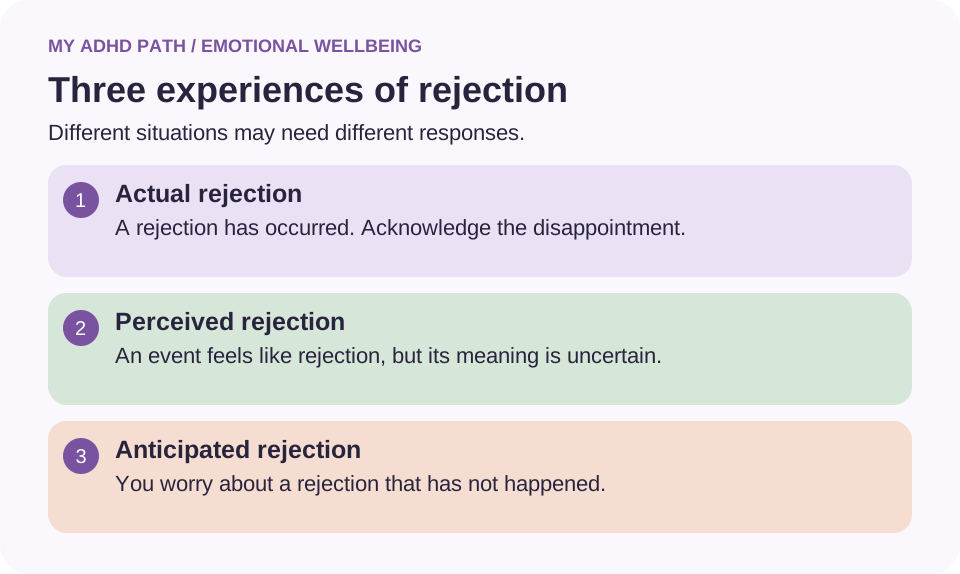
How an emotional response develops
To understand how rejection sensitivity works in practice, it helps to trace the sequence of an emotional response from trigger to reaction.
Consider the following example. It describes a common workplace scenario that many people with rejection sensitivity will recognise.
The manager's message
It's Tuesday morning. You're working steadily through your tasks.
At 10:14, your manager sends you a message: "Have you got five minutes this afternoon?"
Here is what might happen next.
This sequence is not universal. Different people will experience it differently. But the general pattern of trigger, interpretation, escalation and eventual resolution is remarkably consistent across the accounts of people who experience rejection sensitivity.
| Time | What happens | What you feel |
|---|---|---|
| 10:14 | You read the message | An immediate jolt of anxiety. Your stomach tightens. |
| 10:15 | You re-read the message, looking for clues | Growing dread. The lack of context feels ominous. |
| 10:20 | You begin reviewing your recent work for possible mistakes | Increasing certainty that something is wrong |
| 10:45 | You recall a minor error from last week | Conviction that this is what the meeting is about |
| 11:30 | You draft a defensive response in your head | A combination of anger, shame and helplessness |
| 12:00 | You can barely concentrate on anything else | Exhaustion, irritability, desire to leave |
| 14:00 | The meeting happens. It's about a minor schedule change. | Relief, followed by embarrassment about the energy spent worrying |
The entire morning was dominated by an emotional response to something that turned out to be entirely neutral.
And the cost wasn't limited to the worrying itself. The three hours of emotional distress affected concentration, productivity, mood and energy. By the time the afternoon arrived, you were exhausted, not from the work you'd been doing, but from the emotional experience that had been running in the background of everything else.
This is one of the hidden costs of rejection sensitivity. It doesn't just affect the moment of perceived rejection. It consumes cognitive and emotional resources that would otherwise be available for other things.
The important thing to notice is that at every stage, the feelings were genuine. You didn't choose to spend three hours worrying. The emotional escalation happened automatically, and once it began, it was remarkably difficult to interrupt.
This automatic quality is one of the defining features of the experience. It is not a thinking problem that can be solved by thinking harder. The emotional response bypasses rational analysis and goes straight to alarm, which is why strategies that work after the initial surge, rather than trying to prevent it, tend to be more effective.
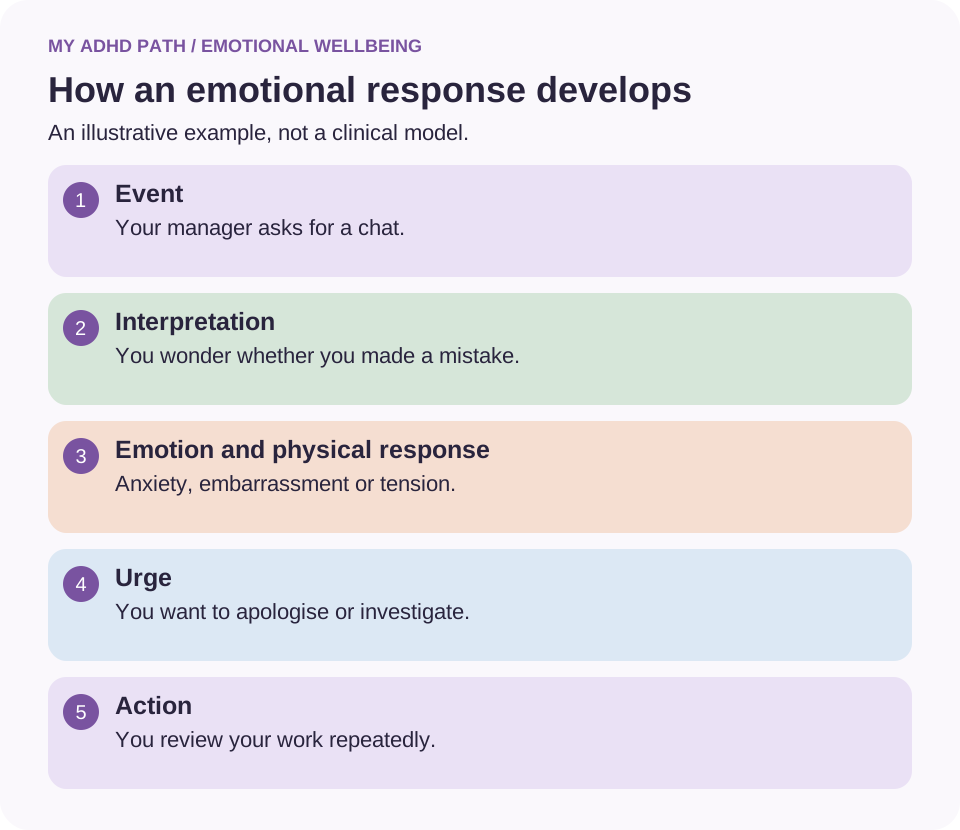
Facts, interpretations and feelings
One of the most useful frameworks for managing rejection sensitivity is learning to separate three things that often feel like they are the same thing.
| Category | Definition | Example |
|---|---|---|
| Fact | What actually, observably happened | My manager sent a message asking for a brief meeting |
| Interpretation | The meaning you assigned to the fact | Something must be wrong. I've made a serious mistake. |
| Feeling | The emotional response generated by your interpretation | Dread, shame, panic, desire to escape |
When rejection sensitivity is active, these three categories collapse into one. The fact, the interpretation and the feeling arrive simultaneously, and they feel inseparable.
Your manager sent a message. That's a fact.
Something is terribly wrong. That's an interpretation.
The overwhelming dread you feel. That's the emotional response to your interpretation, not to the fact itself.
Try this
Next time you notice a sudden intense emotional response, pause and try writing down three separate sentences: "What actually happened was..." (the fact), "The story I'm telling myself is..." (the interpretation), and "What I'm feeling is..." (the emotion). Simply separating them on paper can begin to reduce the intensity.
This isn't about dismissing your feelings. The emotions are real and valid. But recognising that the emotions are responding to your interpretation rather than to the event itself opens up the possibility of questioning the interpretation.
If the interpretation changes, the emotional response often shifts too.
Consider the manager's message from the earlier example. The fact is that your manager asked for a meeting. If you interpret this as "they want to discuss a schedule change," the emotional response is neutral. If you interpret it as "they are unhappy with my work," the emotional response is dread, shame and anxiety.
The fact hasn't changed. Only the interpretation has.
This doesn't mean the emotional response is your fault or that you should be able to simply think your way out of it. The interpretation often arrives automatically, faster than conscious thought. But with practice, you can learn to notice it, question it and sometimes revise it.
Try this
When you catch yourself in a strong emotional reaction, ask: "If my best friend told me this same situation had happened to them, what would I say?" You would probably offer several alternative explanations and encourage them not to assume the worst. Try offering yourself the same perspective.
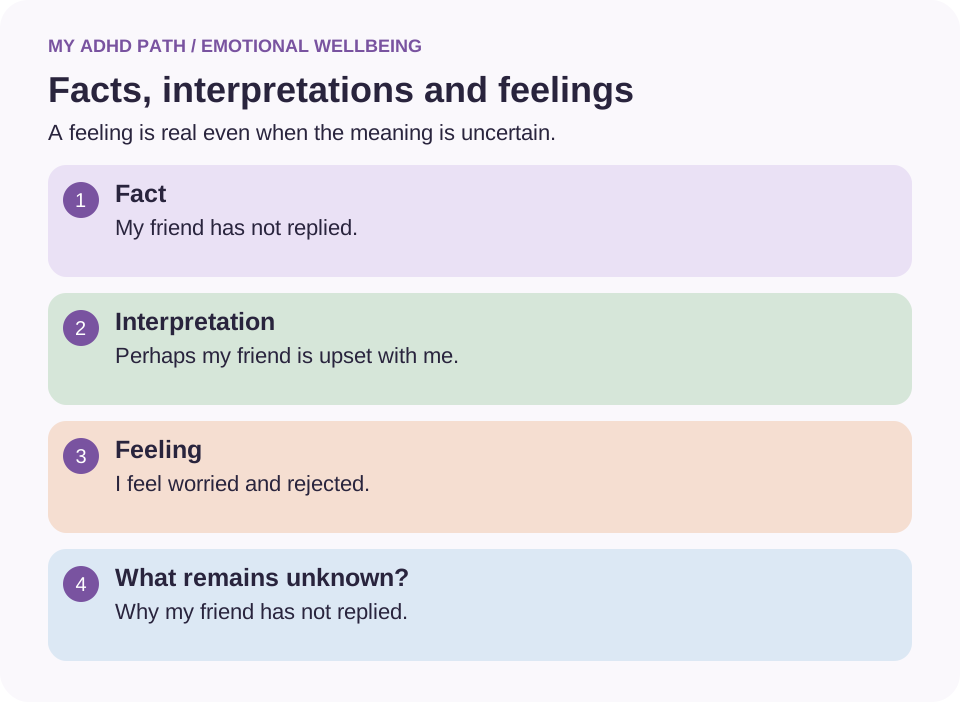
Why rejection can remain in your thoughts
Even when you recognise that your interpretation may not be accurate, the emotional experience can be difficult to release.
Many people with ADHD describe being unable to stop thinking about a perceived rejection long after it happened. A comment made on Monday can still be producing emotional distress on Thursday.
Several factors may contribute to this.
Emotional memory. Experiences with strong emotional content tend to be encoded more vividly. A moment of perceived rejection can create a memory that feels almost as intense when recalled as it did when it first happened.
Rumination. The mind returns to the event repeatedly, replaying it from different angles, searching for meaning or preparing for the worst. Each replay reinforces the emotional charge rather than resolving it.
Pattern matching. A current experience of perceived rejection can activate memories of previous rejections. What started as a reaction to one comment can become connected to a lifetime of similar moments, making the current event feel far more significant than it might be on its own.
Difficulty with emotional transitions. Some people with ADHD find it harder to shift from one emotional state to another. Getting stuck in a painful emotional experience may be related to broader difficulties with cognitive and emotional flexibility.
The absence of resolution. Many perceived rejections are never explicitly resolved. If you interpret a friend's short reply as evidence of anger, and the friend simply carries on normally the next day without addressing it, the emotional charge of the original interpretation may never fully dissipate. There was no moment of reassurance, no conversation that put the matter to rest. The uncertainty lingers.
Hyperfocus on the negative. The same capacity for intense focus that allows some people with ADHD to concentrate deeply on interesting tasks can also lock attention onto a painful emotional experience. The mind becomes stuck in a loop, examining the event from every possible angle, unable to shift its attention to something else.
A comment made on Monday can still be producing emotional distress on Thursday.
Understanding why the experience persists is not the same as being able to stop it. But it can help to know that rumination is a recognisable pattern, not evidence that you are dwelling on things unreasonably or that the event genuinely deserves this much attention.
Some people find that the most effective way to interrupt rumination is through physical movement or sensory engagement. A brisk walk, cold water on the hands and face, vigorous exercise or a task that requires focused attention can help shift the brain out of the loop. The goal is not to suppress the emotion but to give the mind something else to engage with, creating enough of a gap for the intensity to begin reducing.
Try this
When you notice yourself ruminating about a perceived rejection, set a timer for fifteen minutes and engage in a physical activity: a walk, stretching, tidying a room, or anything that requires physical movement and mild cognitive engagement. After fifteen minutes, check in with yourself. The emotional intensity has often reduced, even if only slightly.
Good to know
Rumination is not the same as problem-solving. Problem-solving moves towards a resolution. Rumination circles the same territory without reaching one. If you notice yourself going over the same event repeatedly without arriving anywhere new, that may be rumination rather than productive reflection.
The relationship between ADHD and emotional responses
ADHD has historically been understood primarily in terms of attention, hyperactivity and impulsivity. However, a growing body of research recognises that emotional dysregulation is a significant feature of the condition for many people.
This is an important distinction. For decades, the emotional aspects of ADHD were overlooked in both clinical practice and public understanding. Many adults with ADHD were told that their emotional difficulties were separate from their ADHD, or were caused by something else entirely. The growing recognition that emotional regulation is a core part of the ADHD experience has been validating for many people.
It has also opened up new possibilities for understanding and managing rejection sensitivity. If intense emotional responses to rejection are connected to the broader pattern of emotional dysregulation in ADHD, then the strategies that help with emotional regulation more generally may also help with rejection sensitivity specifically.
The research in this area is still developing, but the clinical and personal evidence suggests a meaningful connection between ADHD, emotional regulation and the experience that many people describe as rejection sensitivity.
What the research says
Research by Shaw et al. (2014) and Barkley (2015) has highlighted emotional impulsiveness and deficient emotional self-regulation as important aspects of ADHD that are not fully captured by the current diagnostic criteria. Faraone et al. (2021), in the World Federation of ADHD International Consensus Statement, included emotional dysregulation among the evidence-based conclusions about the disorder. However, the specific construct of rejection sensitive dysphoria has not been extensively studied as a distinct phenomenon in controlled research. The emotional experiences people describe may relate to broader patterns of emotional dysregulation, difficulties with executive functioning, or the cumulative impact of living with ADHD in environments that frequently produce criticism and misunderstanding.
Several aspects of ADHD may contribute to the intensity of emotional responses to rejection.
Executive functioning and emotional regulation. The prefrontal cortex, which plays a role in regulating emotional responses, is implicated in ADHD. Difficulties with executive functioning may make it harder to pause before reacting, consider alternative explanations, or modulate the intensity of an emotional response. The same brain systems that help you stop and think before acting on an impulse also help you stop and think before acting on an emotion. When those systems are working less efficiently, emotional responses can bypass rational evaluation and produce immediate, intense reactions.
Processing speed. The emotional reaction can arrive before the rational assessment has had time to catch up. You feel the pain before you have the opportunity to evaluate whether the situation genuinely warrants it. This is not a failure of willpower or intelligence. It reflects the speed at which the emotional brain can respond compared to the slower, more deliberate processes of rational evaluation.
A history of criticism. Many people with ADHD have experienced years of being told they are lazy, careless, too sensitive, too much, or not trying hard enough. This cumulative history can create a heightened sensitivity to any suggestion of failure or disapproval. By the time an adult with ADHD encounters a piece of constructive feedback at work, their nervous system may already be primed to treat any criticism as evidence of the same message they have been hearing their entire lives: that they are not good enough.
Social difficulties. Research suggests that some people with ADHD experience more social difficulties throughout their lives, including peer rejection in childhood. These experiences can shape expectations about how others will respond to them. If you were frequently excluded, misunderstood or criticised during formative years, your nervous system may have learned to anticipate rejection as the default outcome of social interactions.
The gap between intention and action. Many people with ADHD have experienced being misunderstood because the gap between what they intended and what they did was interpreted negatively by others. If you have spent years being judged not on your intentions but on your inconsistencies, you may become hypervigilant to any sign that the same thing is happening again.
Try this
If you recognise that a history of criticism has made you more sensitive to perceived rejection, consider writing a brief timeline of significant rejection experiences. Sometimes seeing the pattern in black and white helps you recognise that your current sensitivity has roots in real experiences, and that understanding can be the beginning of separating past pain from present situations.
Common misconception
Rejection sensitivity is not caused by being weak, overly dramatic or lacking resilience. The intensity of the emotional response may be influenced by neurological factors, cumulative life experiences and the broader challenges of living with ADHD. Telling somebody with rejection sensitivity to "just not care so much" is about as helpful as telling somebody with poor eyesight to try looking harder.
Rejection sensitivity and self-worth
Over time, repeated experiences of intense rejection sensitivity can begin to shape how you see yourself.
Consider what it means to spend decades responding to perceived rejection with overwhelming emotional pain. Each experience leaves a trace. And the accumulation of those traces can create a deeply held belief that you are somehow fundamentally unacceptable.
This is not a logical conclusion drawn from evidence. It is an emotional narrative built from thousands of individual moments of pain, most of which were based on interpretations rather than facts. But it can feel as solid and undeniable as anything you have ever known.
If every piece of criticism feels catastrophic, you may begin to organise your life around avoiding it.
If you regularly feel rejected by people who don't intend to reject you, you may start to believe that rejection is somehow inevitable.
If your emotional responses feel out of proportion, you may conclude that something is fundamentally wrong with you.
Many adults with ADHD who experience rejection sensitivity describe a persistent sense of being "too much" and "not enough" simultaneously. Too emotional, too reactive, too sensitive, but also not organised enough, not focused enough, not reliable enough. Living between these two poles is exhausting and can gradually erode the foundation of self-worth that makes it possible to tolerate ordinary disappointments.
When your self-worth has been eroded by years of this experience, even small positive achievements can feel fragile and conditional. You may dismiss compliments, minimise your successes, or live in constant anticipation of the moment when somebody will discover that you are not as capable as they thought.
These beliefs can lead to patterns that become self-reinforcing.
| Pattern | How it develops | What it costs |
|---|---|---|
| People-pleasing | If I make sure everyone is happy with me, nobody can reject me | Exhaustion, loss of authenticity, resentment |
| Avoidance | If I don't try, I can't be rejected | Missed opportunities, stagnation, regret |
| Pre-emptive withdrawal | If I leave before they reject me, it will hurt less | Difficulty maintaining relationships, isolation |
| Perfectionism | If my work is flawless, nobody can criticise me | Procrastination, burnout, paralysis |
| Anger as protection | If I become angry, the pain feels more manageable | Damaged relationships, guilt, isolation |
None of these patterns are character flaws. They are understandable attempts to manage an experience that can feel genuinely unbearable.
The challenge is that whilst these strategies may protect you from the immediate pain of rejection, they can also limit your life in significant ways. Avoidance keeps you safe but prevents growth. People-pleasing maintains approval but costs authenticity. Pre-emptive withdrawal prevents rejection but guarantees isolation.
Over time, the cumulative cost of these protective strategies can become greater than the pain they were designed to prevent.
But recognising them as protective strategies, rather than fixed aspects of who you are, opens the possibility of developing alternative approaches.
It is worth pausing here to acknowledge something important. These patterns usually developed for good reasons. If you were frequently criticised as a child, people-pleasing may have been a genuinely effective survival strategy. If expressing your opinion regularly led to dismissal or punishment, avoidance made sense. If relationships had repeatedly ended painfully, pre-emptive withdrawal protected you from a kind of pain you already knew was unbearable.
The question now is whether these strategies are still serving you, or whether they are costing more than they protect.
This is not about blaming yourself for having developed them. It is about recognising that you now have more options. You can keep the strategies that still serve you and begin, gradually, to explore alternatives for the ones that don't.
Good to know
Changing longstanding protective patterns takes time and often benefits from professional support. These are not habits you can simply decide to drop overnight. Be patient with yourself. The fact that you can recognise the pattern is already significant progress.
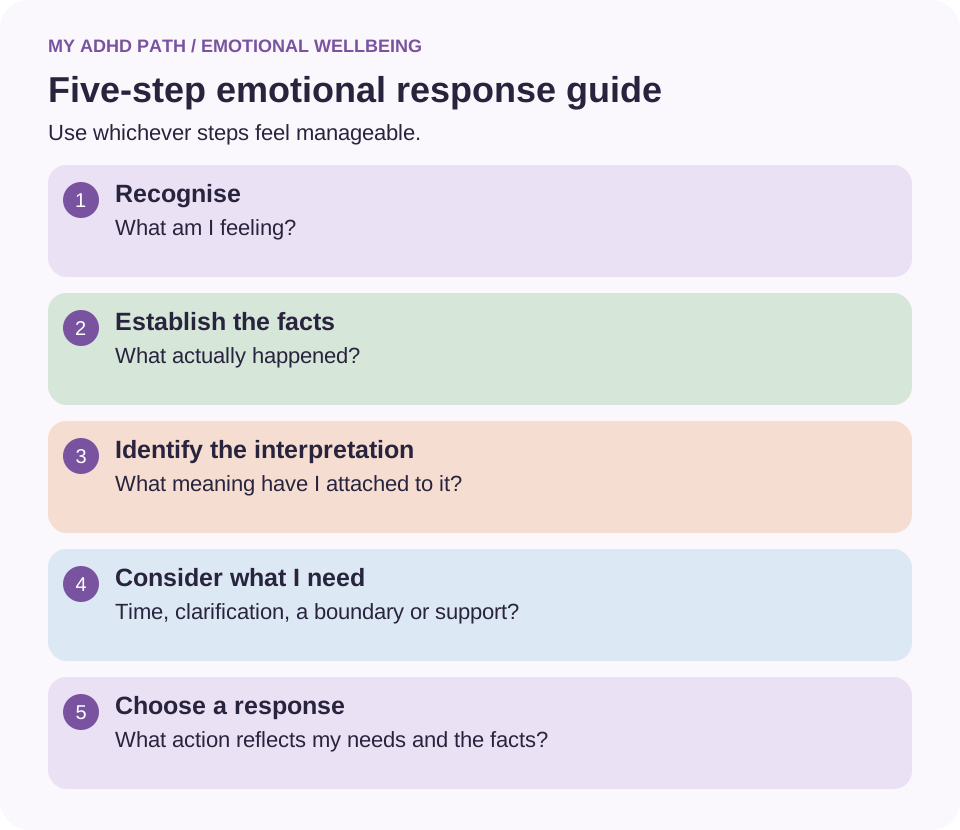
The five-step emotional response guide
When you notice a sudden, intense emotional reaction to something that feels like rejection, the following five steps can help you respond rather than simply react.
Step one: Pause before responding
The most important thing you can do in the first few seconds is nothing.
Do not send the message you are composing in your head. Do not confront the person. Do not make any decisions based on what you are feeling right now.
This is not about suppressing your feelings. It is about creating a small gap between the emotional response and your action, so that you have the opportunity to choose what happens next rather than being carried along by the intensity of the moment.
The intensity of the initial response is at its peak. Give yourself time for it to begin settling before you take any action.
If you need to do something physical to manage the pause, that is perfectly fine. Leave the room, make a cup of tea, go for a brief walk, or use a grounding technique. The goal is to avoid taking any action directed at the perceived rejection until the initial surge has begun to settle.
Try this
Create a personal rule: if you feel a sudden emotional surge in response to something that feels like rejection, wait at least thirty minutes before responding. Write down what you want to say, but don't send it yet.
Step two: Name what you are feeling
Put specific words to the emotion. Not "I feel terrible" but something more precise.
Am I feeling rejected? Humiliated? Angry? Frightened? Ashamed? Invisible? Alone? Worthless?
You may notice that the emotion is more specific than you initially thought. What felt like a general sense of "everything is awful" might turn out to be specifically shame, or specifically fear of abandonment, or specifically anger at being misunderstood. The more precise the label, the more useful the exercise.
Research on affect labelling suggests that putting a name to an emotion can begin to reduce its intensity. The act of naming engages the prefrontal cortex, which can help modulate the emotional response.
Some people find it helpful to rate the intensity on a scale of one to ten. This isn't about minimising the experience. It's about introducing a small amount of analytical thinking into what is otherwise a purely emotional moment. Even the brief cognitive effort of choosing a number can begin to shift the balance.
Step three: Identify what actually happened
Write down only the observable facts. What was said or done? Strip away all interpretation.
Not "my manager is disappointed in me" but "my manager asked for a brief meeting."
Not "my friend is ignoring me" but "my friend hasn't replied to my message sent two hours ago."
This can be surprisingly difficult, because rejection sensitivity blurs the line between observation and interpretation. "She was cold towards me" feels like a fact, but it contains an interpretation. The fact might be: "She said hello without making eye contact." The interpretation of coldness is something you added.
Being precise with language matters here. The more carefully you describe what actually happened, the more space you create for alternative explanations.
Step four: Consider alternative explanations
For each interpretation you've made, generate at least two alternative explanations that also fit the facts.
Your manager asked for a meeting. Possible explanations include: they want to discuss a schedule change, they have a question about an ongoing project, they want to share some positive news, or they need your input on something.
Your friend hasn't replied. Possible explanations include: they're busy at work, their phone is in another room, they're composing a longer reply, or they simply haven't seen the message yet.
Notice how many alternative explanations there are for each situation. When rejection sensitivity is active, your mind often selects the most threatening interpretation and treats it as though it were the only one. The reality is that it is usually one of many possibilities, and rarely the most likely.
The goal is not to convince yourself that the most positive explanation is definitely correct. It is to recognise that your initial, fear-based interpretation is only one of several possibilities, and usually not the most likely one.
Good to know
When you are in the grip of rejection sensitivity, your mind may resist alternative explanations. It may insist that you know what the other person meant. That feeling of certainty is part of the emotional experience, not evidence that your interpretation is correct. The more certain you feel that rejection has occurred, the more valuable it is to deliberately consider other possibilities.
Step five: Choose your response
Now that you have identified the facts, named your feelings and considered alternative explanations, you are in a much better position to decide what to do.
Often, the best response is to wait and see. Many perceived rejections resolve themselves without any action at all. The friend replies. The manager's meeting turns out to be routine. The colleague's brief tone was because they were preoccupied with their own problem, not because they were upset with you.
Waiting is not passive. It is an active choice to gather more information before acting. And it is one of the most powerful skills you can develop for managing rejection sensitivity.
If a response is needed, you can choose one that is proportionate to what you actually know, rather than what you feared.
The five steps will not always prevent an intense emotional response. Sometimes the feeling arrives too quickly and too powerfully for any framework to interrupt it in the moment. That is entirely normal.
What the five steps can do is shorten the duration of the experience. Even if you cannot prevent the initial surge of emotion, you can often reduce the time you spend in the cycle of escalation and rumination that follows.
Over time, with repeated practice, many people find that the gap between the trigger and their ability to engage the five steps becomes shorter. What once took hours to recognise and address might eventually take minutes.
Good to know
Some people find it helpful to write the five steps on a card and keep it somewhere accessible: in their wallet, on their phone, or pinned to their desk. Having a physical reminder can make it easier to remember the steps when emotional intensity makes clear thinking difficult.
Helpful phrases for the moment
When rejection sensitivity is active, it can be useful to have some prepared phrases that help you communicate without escalating the situation.
Having these phrases ready in advance matters because rejection sensitivity makes it difficult to think clearly in the moment. If you try to compose the perfect response whilst experiencing intense emotional distress, the result is likely to reflect the distress rather than your actual intentions.
Many people report that having said the wrong thing in the heat of a rejection-sensitive moment has caused more damage than the original perceived rejection. A defensive reply, an accusatory question, or an abrupt withdrawal can create real relationship problems that didn't exist before the emotional response began.
The following phrases are suggestions. Adapt them to your own voice and relationships. The important thing is not the exact words but the principle behind them: buying time, checking your interpretation, and communicating honestly without acting on unverified assumptions.
Some people find it helpful to save these phrases in their phone, so they are available without having to construct them in the moment.
When you need time to process
What you could say
"I want to respond to this properly, but I need a little time to think about it first. Can I come back to you later today?"
When you are unsure whether rejection has actually occurred
What you could say
"I might be reading this wrong, but I'm picking up on something and I'd rather check than assume. Is everything all right between us?"
When you need to explain your reaction
What you could say
"I had a strong emotional reaction to that, and I think it might have been bigger than the situation warranted. I'm working on recognising when that happens."
When someone asks why you seem upset
What you could say
"Sometimes I have really intense reactions to things that feel like criticism or rejection. It's something I'm aware of and working on. It's not your fault."
When you are ready to re-engage after a difficult moment
What you could say
"I was struggling earlier with how that landed, but I've had time to think about it and I'd like to talk about it more calmly now."
Fifteen practical strategies for managing rejection sensitivity
No single strategy will transform rejection sensitivity overnight. The goal is to build a collection of approaches that gradually change your relationship with the experience. Some will work better for you than others. The ones that help most are the ones you actually use, not the ones that look most impressive on paper.
Many of these strategies work best when they are established as habits before they are needed. If you wait until you are in the middle of an intense emotional response to try a new technique for the first time, it is unlikely to work well. Practise when things are calm, so the approaches are available to you when things are not.
It may also help to tell somebody you trust about the strategies you are trying. Having an ally who can gently remind you of your own plan during a difficult moment can be more effective than trying to remember it yourself when your emotional brain is in control.
Practical strategies
- Build in a response delay. Create a personal rule that you wait before responding to anything that triggers a strong emotional reaction. Thirty minutes is a good starting point.
- Practise separating facts from interpretations. When you notice a strong reaction, write down what actually happened and what story you are telling yourself about it. The gap between these two things is often where the pain lives.
- Keep a rejection sensitivity journal. Record triggers, your interpretations, what actually happened and how the situation resolved. Over time, this creates evidence that most feared rejections do not materialise.
- Develop a grounding routine. Have a specific activity you turn to when rejection sensitivity is active: a short walk, a breathing exercise, splashing cold water on your face, or holding something cold. Physical sensations can help interrupt the emotional spiral.
- Identify your most common triggers. Understanding which situations reliably activate rejection sensitivity allows you to prepare for them in advance rather than being caught off guard.
- Challenge the all-or-nothing thinking. Rejection sensitivity often produces extremes: "Everyone hates me" or "I always get it wrong." Look for the middle ground that is almost always closer to reality.
- Build a folder of positive evidence. Save kind messages, positive feedback and compliments somewhere accessible. When rejection sensitivity is active, this provides a counterbalance to the narrative that everything is terrible.
- Start with low-stakes exposure. If avoidance has become a pattern, begin practising in situations where the stakes are low. Share a small opinion, ask a minor question, submit work that doesn't need to be perfect.
- Talk to someone who understands. Having even one person who recognises what you are experiencing and doesn't dismiss it can make a significant difference. This might be a friend, partner, therapist or someone in an ADHD community.
- Learn to recognise the physical warning signs. Many people notice physical sensations before they become aware of the emotional content: a tightening chest, heat in the face, a sinking stomach. Recognising these early gives you more time to intervene.
- Reduce exposure to unnecessary triggers. This doesn't mean avoiding all feedback or difficult conversations. It means being thoughtful about which environments, relationships and situations consistently produce the most distress, and making deliberate choices about how you engage with them.
- Develop self-compassion practices. Speak to yourself the way you would speak to a friend experiencing the same thing. Rejection sensitivity is not a personal failure. It is a recognisable pattern that you are learning to manage.
- Create post-event processing time. After a situation that triggered rejection sensitivity, schedule time to review it calmly. What actually happened? What did you feel? What turned out to be accurate and what didn't?
- Practise asking for clarification. When a message or comment feels ambiguous, ask what the person meant rather than assuming the worst. Most people would rather clarify than be misunderstood.
- Consider professional support. Cognitive behavioural therapy (CBT), dialectical behaviour therapy (DBT) and other approaches can provide structured support for managing intense emotional responses. An ADHD-informed therapist can help you work with your specific patterns.
You don't need to implement all fifteen strategies. Start with the two or three that feel most relevant to your experience. Once those have become more natural, you can consider adding others.
Remember that progress is not measured by the absence of rejection sensitivity. It is measured by the growing gap between the trigger and your response, by the reduced time spent in rumination, by the increased willingness to take risks despite the possibility of rejection, and by the developing capacity to treat yourself with compassion when the experience does occur.
Try this
Choose one strategy from the list above and commit to practising it for two weeks. Keep a brief daily note about when you used it and what happened. At the end of the fortnight, review your notes and decide whether to continue, adjust or try a different approach.
Three different experiences
Rejection sensitivity affects different people in different ways. The following scenarios illustrate three common patterns: fixating on criticism, avoiding opportunities, and over-reading social cues.
All three are fictional, but they are based on the kinds of experiences that people with rejection sensitivity commonly describe. If you recognise yourself in one or more of them, that may be a useful starting point for thinking about your own patterns.
Illustrative scenario
Hannah, 38 - The one critical comment
Hannah works as a marketing manager and receives a performance review that is overwhelmingly positive. Her supervisor praises her creativity, her leadership and her consistency. Near the end, there is one sentence suggesting she could improve her time management on larger projects.
Hannah cannot stop thinking about that one sentence. She replays it for days. She lies awake wondering whether her supervisor has secretly been dissatisfied with her work for months. She begins questioning whether she is in the right career.
With support from a therapist, Hannah begins practising the facts-and-interpretations exercise. The fact: her review was positive with one area for development. Her interpretation: she is failing and her supervisor is disappointed. When she writes these side by side, she can see the gap. She also creates a rule: she waits twenty-four hours before drawing any conclusions about feedback, and she re-reads the full review rather than focusing on a single sentence.
Illustrative scenario
Ben, 44 - The avoidance pattern
Ben has worked in the same role for nine years. He is good at his job and his colleagues respect him, but he has never applied for a promotion, never submitted his photography to a competition and never volunteered to lead a project. The possibility of being told he isn't good enough feels unbearable.
When Ben reads about rejection sensitivity, he recognises the avoidance pattern immediately. He can see that by protecting himself from potential rejection, he has also prevented himself from experiencing opportunities, growth and recognition.
He begins with low-stakes exposures: sharing a photograph on an online forum, volunteering for a small additional responsibility at work, expressing his opinion in a team meeting. Each experience that doesn't result in the catastrophic rejection he anticipated gradually builds his tolerance. The discomfort doesn't disappear, but it becomes more manageable each time. After several months, he submits a formal application for a senior role. He doesn't get it, but the experience, whilst painful, is survivable. And he learns something important: the anticipation of rejection was considerably worse than the rejection itself.
Illustrative scenario
Priya, 27 - The interpretation habit
Priya sends a message to a close friend on Saturday morning and doesn't receive a reply until Sunday evening. By Sunday afternoon, she has convinced herself the friendship is over. She has reviewed every recent interaction for evidence of what she might have done wrong.
Her friend replies with a warm, detailed message. She had been at a family event with limited phone access.
Priya starts keeping a small notebook where she records her interpretations and what actually happened. After two months, she has clear evidence: in forty-three instances where she interpreted something as rejection, the feared outcome occurred only twice, and both were mild. She develops a habit of asking herself "What do I actually know?" before allowing the interpretation to escalate. She also learns to tell close friends that she sometimes needs reassurance, which feels vulnerable but consistently helps.
Each of these scenarios involves a recognisable pattern, a practical strategy and a gradual improvement. None of them involve the rejection sensitivity disappearing entirely. What changes is the ability to recognise what is happening and respond to it differently.
If you see yourself in one of these stories, that recognition is itself a form of progress. Many people spend years experiencing rejection sensitivity without understanding what it is or knowing that it can be managed. Simply being able to name the pattern and identify your own version of it is a meaningful step forward.
Rejection sensitivity at work
The workplace can be a particularly challenging environment for rejection sensitivity. Performance reviews, team feedback, project critiques and even casual comments from colleagues can all become triggers.
For people who experience rejection sensitivity, the ordinary demands of professional life, being evaluated, receiving constructive criticism, competing for opportunities, can produce levels of emotional distress that are difficult to manage alongside the work itself. The irony is that the emotional energy consumed by worrying about whether you are performing well enough can itself affect your performance.
Some specific workplace situations that people with rejection sensitivity commonly find difficult include:
| Situation | Common interpretation | What might actually be happening |
|---|---|---|
| Not being included in a meeting | They don't value my contribution | The meeting covers a different area, or the invite list was based on project roles |
| Receiving tracked changes on a document | My work is inadequate | Editing is a normal part of collaborative work |
| A manager giving direct feedback | They think I'm incompetent | They are doing their job and helping you develop |
| A colleague not responding to your idea in a meeting | They think it was a stupid suggestion | The discussion moved on, or they are thinking about it |
| Being asked to redo a piece of work | I'm about to lose my job | The brief has changed, or additional information has become available |
Try this
If workplace feedback is a consistent trigger, consider asking your manager whether they can provide written feedback in advance of a conversation, so you have time to process it before discussing it face to face. Many managers are willing to adjust their approach when they understand why it helps.
It can also help to have a trusted colleague who understands your experience and can offer a reality check when needed. After a meeting that triggered rejection sensitivity, a brief conversation with someone who was also present can help you assess whether your interpretation matches what others observed.
Rejection sensitivity in relationships
Rejection sensitivity can have a particularly significant impact on close relationships: romantic partnerships, friendships and family dynamics.
When you are emotionally close to somebody, the stakes of rejection feel higher. A partner's distracted mood can feel like withdrawal. A friend's cancelled plans can feel like abandonment. A family member's offhand comment can feel like a judgement on your entire character.
The patterns that develop in response, seeking constant reassurance, withdrawing pre-emptively, responding with sudden anger, or avoiding difficult conversations entirely, can create cycles that strain even strong relationships.
Partners and close friends often describe feeling confused by the intensity of the reaction. They may not understand why a small comment or a brief period of distraction has produced such a powerful emotional response. Without understanding, this confusion can itself become a source of conflict.
Sharing what you know about rejection sensitivity with the people closest to you can be a valuable step. It doesn't excuse harmful behaviour, but it provides a framework for understanding what is happening and working through it together.
Some people find it helpful to have a conversation about rejection sensitivity at a neutral time, rather than trying to explain it in the middle of an episode. When you are calm and clear-headed, you can describe the experience more accurately, and the other person is more likely to hear and understand what you are saying.
It can also help to establish a simple signal or phrase that you can use when rejection sensitivity is active, something that communicates "I'm having a strong emotional response and I need a moment" without requiring a full explanation every time.
What you could say
"I know my reaction just then seemed bigger than the situation. I experience something that makes criticism and rejection feel really intense, and I'm learning to manage it. It helps if you can be patient with me whilst I work through it."
Good to know
This article focuses on the broader experience of rejection sensitivity. For a detailed exploration of how rejection sensitivity affects romantic relationships, friendships and family dynamics, including specific communication strategies and relationship-building approaches, see our companion article RSD in Relationships.
Using AI to process difficult emotional experiences
AI assistants can serve as a useful tool for processing emotional responses, particularly when you need to work through something before talking to another person about it.
One of the challenges of rejection sensitivity is that the emotional response often arrives at inconvenient times. It may happen in the middle of a workday, late at night, or in a situation where you don't have access to a therapist, a trusted friend, or even a quiet space to think.
An AI assistant is available immediately, doesn't judge your emotional response, and can help you work through the facts-versus-interpretations framework at any time. It can be particularly useful for drafting responses when you are unsure whether your planned reply is proportionate to the situation.
AI prompt
Separate facts from interpretations
"I'm having a strong emotional reaction to something that happened. Help me separate the observable facts from my interpretations. Here's what happened: [describe the situation]. Ask me questions to help me identify what I actually know versus what I'm assuming."
AI prompt
Generate alternative explanations
"I received this message and I'm interpreting it as [your interpretation]. Can you help me generate five alternative explanations that also fit the facts? I want to practise considering other possibilities before deciding how to respond."
AI prompt
Review my response before sending
"I want to respond to something that triggered my rejection sensitivity. Here's what I'm thinking of saying: [your draft]. Can you help me check whether this response is proportionate, clear and unlikely to escalate the situation? Suggest a calmer alternative if needed."
AI prompt
Process a past rejection that still bothers me
"There's something that happened recently that I keep replaying in my mind. Help me process it by walking me through what happened, what I felt, what I interpreted, and what I know to be true. Then help me identify what I can learn from it and what I can let go of."
AI prompt
Help me prepare for a potentially triggering situation
"I have [describe the situation] coming up and I'm worried about rejection sensitivity being triggered. Help me prepare by identifying likely triggers, planning responses using the five-step guide and creating a few phrases I can use if I need to pause and process."
An AI assistant cannot replace professional therapeutic support or the comfort of a trusted relationship. It cannot assess your mental health or provide clinical advice.
Use it as a thinking tool and a first step, not as a substitute for human connection or professional guidance.
Protect personal information when discussing emotional experiences, and be cautious about sharing identifying details about other people involved in the situations you describe.
If you find that talking to an AI assistant helps you process emotional experiences, you might also consider whether professional therapeutic support, such as CBT or DBT, could provide more sustained and structured help. An AI can be a valuable first step or supplement, but it is not a replacement for a therapeutic relationship with a trained professional.
The prompts above are designed to be used in the moment, when you need help working through something before it escalates. They are most useful when combined with the broader strategies described earlier in this article, particularly the facts-versus-interpretations framework and the five-step emotional response guide.
What does the research say?
What the research says
The term rejection sensitive dysphoria was introduced by Dodson (2005) and has been widely adopted in ADHD advocacy and community discussions. However, it has not been extensively studied as a distinct clinical construct in peer-reviewed research. The underlying experiences it describes, intense emotional responses to rejection and criticism, do have a growing research base. Shaw et al. (2014) demonstrated that emotional dysregulation is common in ADHD and may represent a core feature rather than a comorbid condition. Barkley (2015) proposed that deficient emotional self-regulation, including emotional impulsiveness, is a fundamental aspect of ADHD. The broader rejection sensitivity literature, including work by Downey and Feldman (1996), provides frameworks for understanding how expectations of rejection can shape emotional responses and behaviour. Emotional dysregulation in ADHD has been associated with difficulties in prefrontal cortical functioning and executive control processes (Surman et al., 2013). Further research specifically examining rejection sensitive dysphoria as a distinct construct in ADHD populations would help clarify its relationship to these broader phenomena.
It is important to be transparent about the current state of evidence.
The experiences people describe are real. The emotional pain is genuine. The impact on daily life can be substantial.
What is less clear, at this point in the research, is whether rejection sensitive dysphoria represents a distinct phenomenon specific to ADHD, or whether it is better understood as one expression of the broader emotional dysregulation that is increasingly recognised as part of the ADHD experience. Both interpretations can coexist. The practical strategies for managing the experience are similar regardless of how the underlying mechanisms are eventually classified.
At the same time, the specific term rejection sensitive dysphoria does not have the same level of research support as other aspects of ADHD. Using the term can be helpful if it validates your experience and helps you communicate about it. It becomes less helpful if it is treated as a fixed, immutable diagnosis rather than a description of a pattern that can be understood and gradually managed.
Beheshti et al. (2020) conducted a meta-analysis examining emotion dysregulation in adults with ADHD and found consistent evidence of greater emotional difficulties across multiple domains. Bodalski et al. (2019) demonstrated associations between ADHD, emotion dysregulation and interpersonal problems in adults. The work of Lieberman et al. (2007) on affect labelling provides neurological evidence for why the act of naming emotions can help reduce their intensity, which supports the naming step in the five-step guide described earlier in this article.
What the research collectively suggests is that emotional difficulties in ADHD are real, significant and deserving of clinical attention, even if the specific term RSD has not yet been subjected to the same level of rigorous investigation as other aspects of the condition.
Good to know
Rejection sensitivity can also feature in other conditions, including borderline personality disorder, social anxiety disorder and depression. If you are experiencing persistent difficulties with emotional regulation, it is worth discussing this with a healthcare professional who can consider the full picture rather than attributing everything to a single explanation.
Some people find that understanding the research helps them feel more confident about discussing their experiences with healthcare professionals. If you are considering raising rejection sensitivity with your GP or therapist, the sources at the end of this article may provide useful context. You might also direct them to the broader research on emotional dysregulation in ADHD, which is well-established even if the specific term RSD is not.
It is also worth noting that the online discourse around RSD can sometimes present it in overly simplified terms. Viral social media content may describe it as a definitive ADHD symptom or suggest that experiencing rejection sensitivity is sufficient for self-diagnosis. Whilst raising awareness is valuable, it is important to engage with the evidence base honestly and to seek professional assessment if you have concerns about ADHD or emotional regulation difficulties.
Reading about rejection sensitivity can be a valuable starting point for understanding your own experiences. It should not be an endpoint. The next step, for many people, is to explore these experiences with a qualified professional who can help you develop a fuller picture of what is contributing to your emotional responses and how best to manage them.
Frequently asked questions
What is rejection sensitive dysphoria?
Rejection sensitive dysphoria (RSD) is a term used to describe the intense emotional pain that some people, particularly those with ADHD, experience in response to real, perceived or anticipated rejection, criticism or failure. It was popularised by Dr William Dodson and is widely used in the ADHD community, though it is not a formal clinical diagnosis.
Is RSD a real diagnosis?
No. RSD is not listed in the DSM-5, the ICD-11 or any major clinical diagnostic framework. It is a descriptive term used in the ADHD community. However, the emotional experiences it describes are recognised in research on emotional dysregulation in ADHD. The absence of a formal diagnostic label does not mean the experience is imaginary or unimportant.
Is RSD the same as social anxiety?
They share some features, particularly avoidance of social situations, but they are not the same. Social anxiety tends to involve a more pervasive fear of social evaluation, whereas rejection sensitivity as described in the ADHD context often involves sudden, intense emotional reactions to specific triggers. Some people experience both. A healthcare professional can help distinguish between them.
Why do people with ADHD experience rejection more intensely?
The exact mechanisms are not fully understood, but several factors may contribute: difficulties with emotional regulation linked to executive functioning, a history of receiving more criticism and negative feedback throughout life, neurological differences in how emotions are processed, and the cumulative impact of feeling different or misunderstood. Research on emotional dysregulation in ADHD continues to develop.
Can you have RSD without ADHD?
Rejection sensitivity is not exclusive to ADHD. It can feature in other conditions, including borderline personality disorder, social anxiety disorder and depression. Some people without any diagnosed condition also experience higher levels of rejection sensitivity. However, the particular intensity and speed of the emotional response is especially commonly reported by people with ADHD.
How do I know if I have RSD?
Because RSD is not a formal diagnosis, there is no clinical test for it. You might recognise the pattern if you regularly experience intense emotional pain in response to criticism or perceived rejection, if you spend extended periods ruminating about these experiences, or if you have developed patterns of avoidance or people-pleasing to prevent potential rejection. Discussing these experiences with a healthcare professional can help you understand what is contributing to them.
Can rejection sensitivity get better over time?
Many people find that with awareness, practice and appropriate support, they can manage rejection sensitivity more effectively. The intensity may not disappear entirely, but the ability to recognise what is happening, separate facts from interpretations and respond rather than react can improve significantly. Professional therapeutic support, such as CBT or DBT, can accelerate this process.
What is the difference between normal hurt and RSD?
Everyone feels hurt by rejection. What people describe as rejection sensitive dysphoria tends to involve a faster onset, greater intensity, longer duration and a wider gap between the trigger and the emotional response. A mildly critical comment might produce a level of emotional pain that others would associate with a much more serious event. The experience often feels physical as well as emotional.
Can medication help with rejection sensitivity?
Some people report that ADHD medication, by improving overall emotional regulation and executive functioning, helps reduce the intensity of rejection sensitivity. Dr Dodson has written about the potential role of certain medications, though the evidence base for this specific application is limited. Medication decisions should be discussed with a prescribing clinician who understands your full clinical picture.
How do I explain RSD to somebody who doesn't have ADHD?
You might explain that sometimes your emotional response to criticism or perceived rejection is much more intense than the situation might seem to warrant, and that this isn't a choice or something you can simply switch off. Comparing it to a volume dial that is turned up much higher than other people's can be a helpful analogy. You could also share this article or similar resources to help them understand.
Can therapy help with rejection sensitivity?
Yes. Cognitive behavioural therapy (CBT) can help you identify and challenge unhelpful thought patterns. Dialectical behaviour therapy (DBT) teaches specific skills for managing intense emotions. Schema therapy can address deeper patterns related to rejection and self-worth. An ADHD-informed therapist who understands the specific challenges of emotional regulation in ADHD can be particularly helpful.
Why do I feel rejected when nobody has actually rejected me?
Perceived rejection, interpreting ambiguous situations as evidence of rejection, is a core feature of rejection sensitivity. Your brain may be primed to detect threat in social situations, particularly if you have a history of negative experiences. The emotional response is real even when the rejection isn't. Learning to identify when you are interpreting rather than observing is a key skill for managing this experience.
How do I stop overthinking after a perceived rejection?
Rumination can be difficult to interrupt, but several strategies can help: writing down the facts of the situation separately from your interpretation, engaging in a physical activity that requires attention, using a grounding technique to bring yourself into the present moment, setting a time limit for thinking about it and then deliberately switching activities, or talking it through with someone you trust. If rumination is persistent and significantly affecting your daily life, therapeutic support may be beneficial.
Is RSD connected to people-pleasing?
Many people with rejection sensitivity develop people-pleasing behaviours as a protective strategy. If the emotional pain of rejection feels unbearable, it makes sense that you would work hard to prevent it by ensuring everyone around you is satisfied. Over time, this can become exhausting and may lead to difficulties setting boundaries, expressing your own needs or making decisions based on what you actually want rather than what will avoid disapproval.
When should I seek professional help for rejection sensitivity?
Consider seeking professional support if rejection sensitivity is significantly affecting your relationships, work performance or quality of life; if you regularly avoid important opportunities because of fear of rejection; if you experience intense emotional distress that is difficult to manage on your own; if people-pleasing or avoidance patterns are causing problems; or if you notice persistent low mood, anxiety or social withdrawal alongside your rejection sensitivity. A GP can be a good starting point for referral to appropriate support.
You are not too sensitive
If you have read this far, there is a reasonable chance that something in this article has felt uncomfortably familiar.
Perhaps you have spent years believing that there is something wrong with you. That you care too much. That you are too sensitive. That you should be able to handle criticism the way other people seem to.
Perhaps you have been told, repeatedly, that you need thicker skin. That you are overreacting. That you should stop taking things so personally.
Those comments, however well intentioned, may have added another layer of rejection on top of the rejection sensitivity itself. You were already in pain, and then you were told that the pain was unreasonable.
What you have been experiencing has a name, even if that name doesn't appear in a diagnostic manual. It is a recognisable pattern. It is shared by many other people with ADHD. And it is not evidence that you are broken, weak or incapable of change.
The same emotional depth that makes rejection sensitivity so painful can also make joy more vivid, connection more meaningful and empathy more instinctive. Many people with ADHD describe being deeply attuned to other people's emotions, quick to offer support, and intensely loyal in their relationships.
These are not separate qualities from your rejection sensitivity. They come from the same capacity to feel deeply.
Learning to manage rejection sensitivity is not about becoming less emotional. It is about developing the skills and self-awareness to navigate your emotional life more effectively, so that the depth of your feeling can be an asset rather than only a source of pain.
The fact that you feel things deeply is not a flaw. It's part of who you are. The work is in learning to navigate it, not in trying to stop feeling.
The strategies in this article are starting points. They will not eliminate rejection sensitivity, but they can help you develop a different relationship with it.
You can learn to pause before reacting. You can learn to separate facts from interpretations. You can learn to recognise when your emotional response is being shaped by an interpretation rather than by reality.
And you can learn to treat yourself with the same compassion you would naturally offer to somebody else going through the same experience.
Progress is not linear. There will be days when you manage rejection sensitivity brilliantly and days when it floors you completely. Both are part of the process. A difficult day does not erase the progress you have made.
If you take one thing from this article, let it be this: the intensity of your emotional response to rejection is not a measure of your worth, your maturity or your capability. It is a recognisable pattern that you share with many other people, and it is something you can learn to navigate with increasing skill and self-compassion over time.
That is not weakness. That is an extraordinarily useful skill.
Downloadable resource
Understanding My Rejection Sensitivity
Worksheets for identifying your personal triggers, practising the facts-versus-interpretations framework, the five-step emotional response guide, and building a personal response plan for managing rejection sensitivity.
Download PDFSources and further reading
- NICE - Attention deficit hyperactivity disorder: diagnosis and management (NG87). https://www.nice.org.uk/guidance/ng87
- NHS - Attention deficit hyperactivity disorder (ADHD). https://www.nhs.uk/conditions/attention-deficit-hyperactivity-disorder-adhd/
- Faraone, S. V. et al. (2021). The World Federation of ADHD International Consensus Statement: 208 Evidence-based conclusions about the disorder. Neuroscience and Biobehavioral Reviews. https://doi.org/10.1016/j.neubiorev.2021.01.022
- Dodson, W. (2005). Emotional regulation and rejection sensitivity in ADHD. ADDitude Magazine clinical guidance. https://www.additudemag.com/rejection-sensitive-dysphoria-and-adhd/
- Shaw, P., Stringaris, A., Nigg, J. and Leibenluft, E. (2014). Emotion dysregulation in attention deficit hyperactivity disorder. American Journal of Psychiatry, 171(3), 276-293. https://doi.org/10.1176/appi.ajp.2013.13070966
- Barkley, R. A. (2015). Emotional dysregulation is a core component of ADHD. In R. A. Barkley (Ed.), Attention-Deficit Hyperactivity Disorder: A Handbook for Diagnosis and Treatment (4th ed.). Guilford Press.
- Downey, G. and Feldman, S. I. (1996). Implications of rejection sensitivity for intimate relationships. Journal of Personality and Social Psychology, 70(6), 1327-1343. https://doi.org/10.1037/0022-3514.70.6.1327
- Surman, C. B. H., Biederman, J., Spencer, T., Miller, C. A., McDermott, K. M. and Faraone, S. V. (2013). Understanding deficient emotional self-regulation in adults with attention deficit hyperactivity disorder: a controlled study. Attention Deficit and Hyperactivity Disorders, 5(3), 273-281. https://doi.org/10.1007/s12402-012-0100-8
- Rosen, P. J., Walerius, D. M., Fogleman, N. D. and Factor, P. I. (2017). The association of emotional lability and emotional and behavioural difficulties among children with and without ADHD. Attention Deficit and Hyperactivity Disorders, 9, 141-153. https://doi.org/10.1007/s12402-016-0205-0
- Beheshti, A., Chavanon, M. L. and Christiansen, H. (2020). Emotion dysregulation in adults with attention deficit hyperactivity disorder: a meta-analysis. BMC Psychiatry, 20, 120. https://doi.org/10.1186/s12888-020-2442-7
- Lieberman, M. D. et al. (2007). Putting feelings into words: affect labeling disrupts amygdala activity in response to affective stimuli. Psychological Science, 18(5), 421-428. https://doi.org/10.1111/j.1467-9280.2007.01916.x
- Bodalski, E. A., Knouse, L. E. and Kovalev, D. (2019). Adult ADHD, emotion dysregulation, and interpersonal problems. Journal of Attention Disorders, 23(14), 1684-1693. https://doi.org/10.1177/1087054718762462
This article provides general educational information and is not a substitute for individual medical or psychological advice. All personal scenarios are fictional. Rejection sensitive dysphoria (RSD) is not a formal clinical diagnosis or a recognised psychiatric condition. It is a descriptive term used within the ADHD community. The strategies and frameworks in this article are practical educational tools, not clinically validated diagnostic assessments or treatments for ADHD or any other condition. If you are experiencing persistent difficulties with emotional regulation, rejection sensitivity or related challenges, please consult an appropriate healthcare professional.