

Sometimes you don't need somebody to tell you what needs doing. You need help working out how to do it.
There's something you need to do.
You've known about it for weeks.
You've added it to your list.
You've moved it to tomorrow.
You've highlighted it.
You've created a reminder.
You've probably spent more time thinking about doing it than it would take to complete it.
And yet, here it is again.
Still waiting.
Perhaps it's completing an application form.
Sorting out your finances.
Preparing for a meeting.
Starting a university assignment.
Organising a family event.
Or dealing with an administrative responsibility that seems to involve several other responsibilities you haven't quite established yet.
From the outside, it might look like one task.
From where you're sitting, it feels like an enormous collection of decisions, questions and unfinished activities.
Being told to break it into smaller steps may be perfectly reasonable advice.
What if breaking it into smaller steps is itself part of the difficulty?
This is where artificial intelligence may offer an interesting form of practical support.
Not because it can magically remove the demands of everyday life.
But because it can help you work through some of the thinking involved before you begin.
At a glance
- A single task can contain numerous hidden cognitive demands.
- ADHD-related executive functioning difficulties may affect planning, sequencing, prioritisation and starting activities.
- Breaking tasks into smaller actions can make the practical demands easier to identify.
- Creating an effective task breakdown can itself require considerable executive functioning.
- AI may help organise unstructured information, clarify requirements and identify manageable starting actions.
- More steps are not necessarily better.
- Effective AI support should reflect your circumstances, available time and current capacity.
- AI-generated plans need checking, particularly when they involve important decisions or specialist requirements.
- AI tools are practical aids, not established treatments for ADHD.
Why one task can feel like twenty
Imagine you've written the following on your to-do list:
"Sort out insurance."
It looks relatively straightforward.
But what does sorting out insurance actually involve?
You might need to find your existing policy.
Identify when it expires.
Understand your current cover.
Check whether your circumstances have changed.
Find comparable policies.
Establish whether those policies provide suitable protection.
Compare prices.
Make a decision.
Arrange payment.
Save the new documents.
Check that the previous policy will not renew unnecessarily.
What appeared to be one task contains numerous different activities.
Some require information retrieval.
Some involve decision-making.
Some require understanding unfamiliar terminology.
Some depend on completing earlier stages.
And some involve consequential financial decisions.
If all of this information is represented by three words on a list, the demands remain largely invisible.
Your brain may be trying to work through the entire collection whenever you see the reminder.
The hidden cognitive demands of everyday tasks
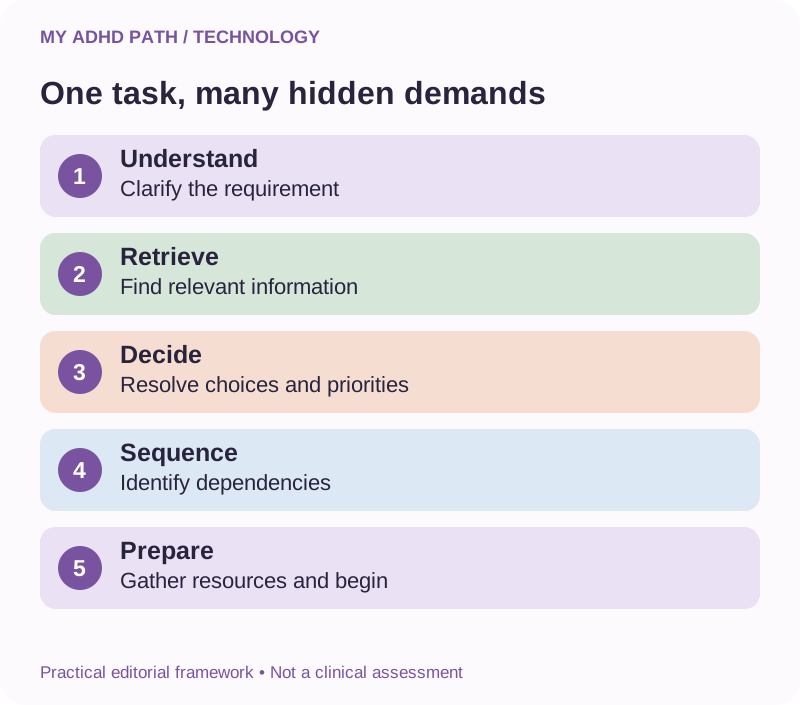
Completing an activity often involves much more than carrying out its visible actions.
Before beginning, you may need to:
Understand what is required.
Establish what information is available.
Identify what is missing.
Determine which actions depend on others.
Decide where to start.
Estimate how long things might take.
Gather relevant resources.
Maintain your understanding while moving between stages.
For some people with ADHD, these demands can create significant difficulties.
Executive functions are cognitive processes involved in coordinating goal-directed behaviour.
Research has identified average differences in several executive functions among people with ADHD, although experiences vary considerably.
Someone might understand the objective perfectly well while finding the process of organising the actions particularly demanding.
The problem isn't necessarily a lack of understanding.
It may be the difficulty of translating understanding into an organised sequence of activity.
Why another to-do list might not help
A list can preserve information outside your memory.
That is useful.
But a list does not automatically tell you:
Which task matters most.
What each task actually involves.
What needs to happen first.
Whether something is currently possible.
How long an activity might take.
Which information is missing.
Or where to begin when everything feels equally important.
Imagine asking for help with an overwhelming responsibility and receiving a list of thirty actions.
Technically, you now have a plan.
Practically, you may have thirty more things competing for your attention.
This is an important distinction when using AI with ADHD.
The objective is not simply to generate more information. It is to make the information easier to work with.
Six reasons a task might feel overwhelming
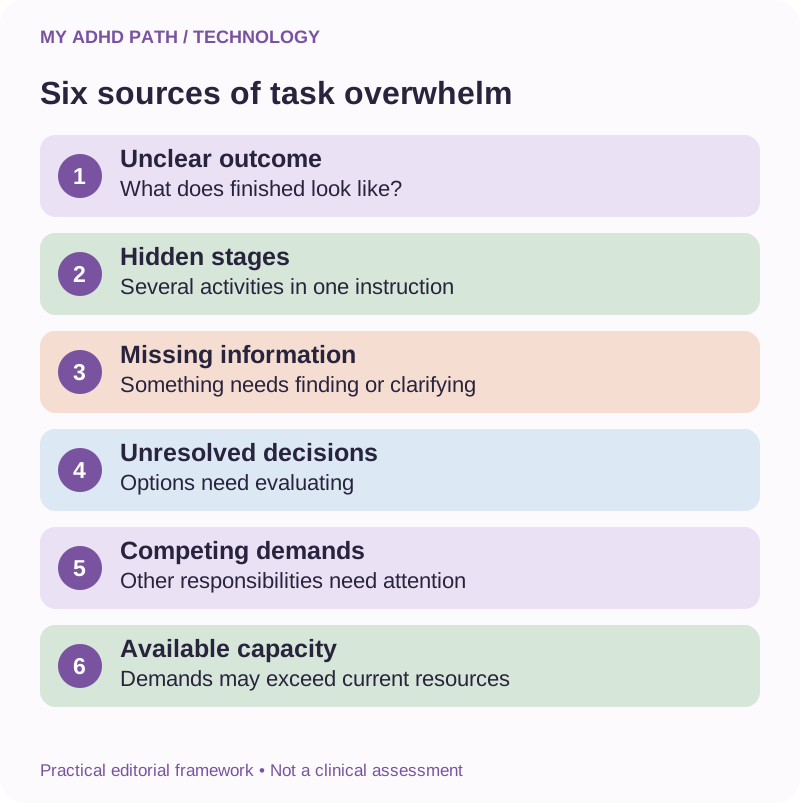
The following is a My ADHD Path editorial framework for exploring different sources of task difficulty.
It is not a diagnostic tool or clinically validated assessment.
1. The outcome is unclear
You aren't entirely sure what completing the task would look like.
2. The task contains too many hidden stages
Several separate activities are represented by a single instruction.
3. Information is missing
You cannot confidently proceed without obtaining or understanding something first.
4. Decisions are unresolved
Several options exist, but you haven't established which to pursue.
5. Other responsibilities are competing for attention
The task needs to be considered alongside your wider circumstances.
6. Your current capacity doesn't match the demands
The activity may require more concentration, time or emotional effort than you currently have available.
These difficulties can overlap.
Understanding which ones are relevant may help you choose more effective support.
What AI can contribute
A conversational AI assistant can work with information that has not yet been fully organised.
You don't necessarily need to know the exact question to ask.
You can explain:
What you're trying to achieve.
What you already understand.
What you're uncertain about.
What you've attempted.
What feels particularly difficult.
The assistant may then help identify a more manageable structure.
This can include clarifying the objective, separating different activities, identifying missing information and suggesting an appropriate starting point.
You remain responsible for checking whether the interpretation is accurate.
The potential value lies in having support with the preliminary thinking, rather than needing to complete that thinking before asking for assistance.
Begin with the messy explanation
Imagine you need to complete some business administration.
Instead of attempting to write a perfectly structured prompt, you might say:
"I need to sort out my business paperwork. I've got a load of receipts, some emails from my accountant and a few things I think are missing. I don't really know what I need to do first, and I've been avoiding it because it feels like an enormous job."
That's enough to begin a useful conversation.
An appropriate AI assistant could help distinguish between:
Information you already have.
Information you need to retrieve.
Questions for your accountant.
Activities you can complete independently.
Activities requiring specialist advice.
A manageable next action.
It may need to ask a clarifying question.
But you do not have to produce a complete administrative plan before receiving help with planning.
Good to know
You don't need to write a perfectly structured prompt to get useful support. Describing the difficulty in your own words is often the most effective starting point.
The five-stage task breakdown method
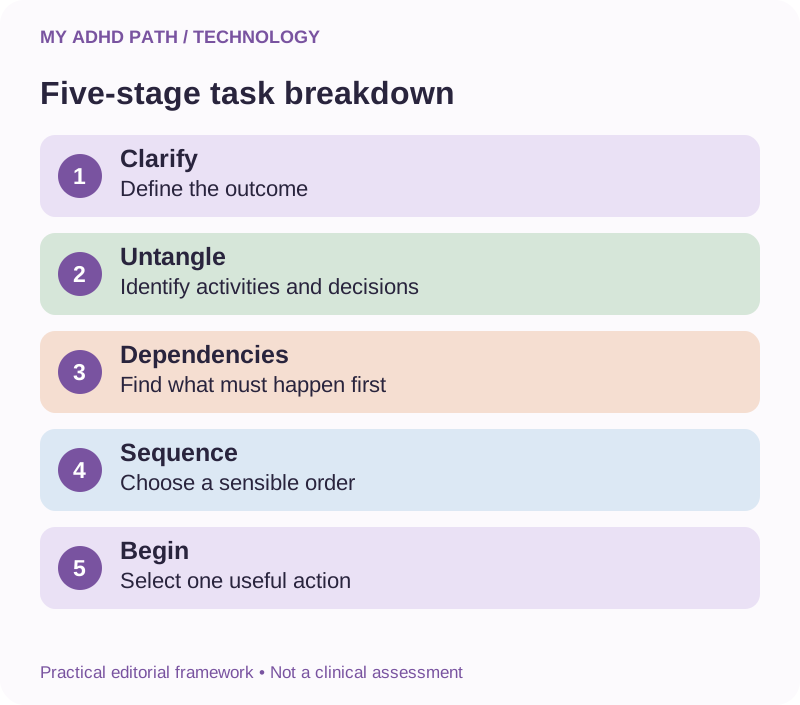
The following practical framework can be used with an AI assistant, a trusted person or independently.
Stage one: Clarify
What are you actually trying to achieve?
Stage two: Untangle
What separate activities, questions and decisions are contained within the task?
Stage three: Establish dependencies
What needs to happen before something else becomes possible?
Stage four: Sequence
What is a sensible order in which to approach the relevant activities?
Stage five: Begin
What is one specific action that can be completed or started now?
This framework is designed to support practical planning.
It is not a clinically validated ADHD treatment method.
Stage one: Clarify the outcome
"Organise the house" could mean hundreds of different things.
"Make the dining table available for dinner" is much more specific.
"Sort out my business" could represent anything from reviewing finances to developing a new website.
"Identify which invoices are still outstanding" establishes a clearer outcome.
Before breaking down an activity, consider what you actually need to achieve.
Ask your AI assistant:
"Help me define a realistic outcome for this task. Don't create a detailed plan until we've established what I'm trying to accomplish."
The outcome doesn't have to be ambitious.
It needs to be recognisable.
You'll be able to tell whether you've achieved it.
Stage two: Untangle the hidden activities
Once the objective is reasonably clear, identify what the activity involves.
Suppose you need to prepare for an important workplace meeting.
The visible task is attending the meeting.
The hidden activities might include:
Finding previous meeting notes.
Understanding the purpose of the discussion.
Collecting relevant information.
Identifying questions.
Preparing documents.
Establishing whether another person needs to provide information.
Arranging enough preparation time.
AI may help identify activities you haven't considered.
However, an assistant cannot necessarily know your organisation's procedures or the exact requirements of the meeting.
Check the suggestions against the information available to you.
A task breakdown is a working plan, not proof that all requirements have been identified.
Stage three: Establish what depends on what
Some tasks can be completed immediately.
Others are waiting for something else.
This distinction can be particularly useful when an overwhelming activity contains numerous stages.
For example, you may need to submit a document that requires information from a colleague.
You cannot complete the final document until that information is available.
But you can request it.
This means the meaningful action may be considerably smaller than the original task.
Instead of repeatedly carrying "complete document" as an outstanding responsibility, you can record:
"Request the missing figures."
Then:
"Waiting for figures."
Some AI-generated plans fail to identify dependencies and give you activities that cannot yet be completed.
Ask the assistant to distinguish between actions that are possible now, those that require preparation and those that are currently blocked.
Stage four: Establish a useful order
Not every part of a task needs completing in the order it first occurred to you.
Some activities may need to happen early because other people require time to respond.
Other activities may be easier to complete together.
Some may turn out to be unnecessary.
Ask AI to identify a reasonable sequence and explain the important dependencies.
For consequential activities, such as legal, financial or medical matters, check requirements against authoritative information or appropriate professional advice.
A sequence that appears convincing is not necessarily correct.
AI can help organise a process.
It cannot establish every real-world requirement without reliable information.
Stage five: Choose one starting action
A useful starting action should be specific enough that you know what to do.
Consider the difference between:
"Work on your application."
And:
"Open the application confirmation email and find the reference number."
The second action doesn't complete the application process.
But it provides an identifiable starting point.
The first useful action may involve finding something, asking a question, opening a document or making a brief note.
It doesn't have to be the smallest imaginable action.
It needs to be meaningful and achievable within your current circumstances.
Try this
Before starting a difficult task, ask yourself or your AI assistant: "What is one specific action I can complete in the next ten minutes that would move this forward?" You don't need the whole plan. You need the first step.
The first-action test
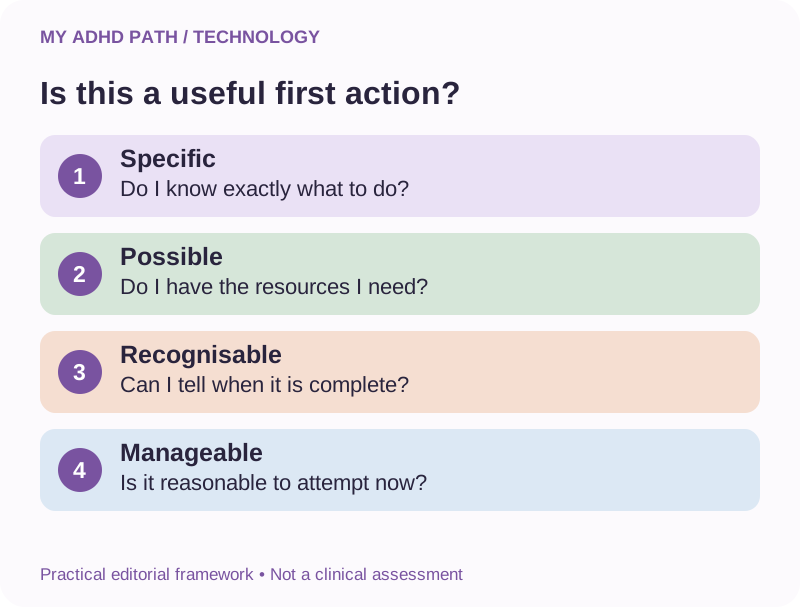
Before beginning, consider four questions.
1. Do I know exactly what to do?
2. Do I have the information and resources I need?
3. Can I tell when this action is complete?
4. Is this a reasonable action for me to attempt now?
If the answer to one of these questions is no, the action may need clarification or further preparation.
For example, "email the organisation" becomes considerably easier once you know which organisation, what you need to ask and where to send the message.
AI may help identify what is still missing.
It shouldn't invent the contact information or assume that a message has been sent.
Different tasks need different types of breakdown
A helpful AI assistant should not necessarily respond to every difficulty with identical planning advice.
| Type of difficulty | Potential support |
|---|---|
| Unclear outcome | Identify what completion means |
| Complicated process | Separate stages and dependencies |
| Missing information | Produce focused questions |
| Too many responsibilities | Compare priorities and deadlines |
| Difficult decision | Establish options and criteria |
| Emotionally demanding activity | Prepare wording and practical support |
| Limited time | Identify a realistic partial outcome |
| Difficulty getting started | Suggest one accessible action |
Some tasks need a plan.
Some need a conversation.
Some need information.
Some need somebody else to help.
And some need postponing or reconsidering.
The task breakdown should reflect the actual difficulty.
Worked example one: Completing an Access to Work application
Access to Work is a government support scheme in Great Britain for eligible people whose disability or health condition affects their ability to work.
ADHD is included among the conditions that may qualify.
Applying can involve explaining your work, describing the difficulties you experience and identifying support that may help.
For some people, organising this information is itself demanding.
Imagine your task is:
"Apply for Access to Work."
An AI assistant might help separate this into stages.
Clarify
Understand the purpose of the scheme and whether the published eligibility criteria appear relevant to your circumstances.
Use official information: https://www.gov.uk/access-to-work/eligibility
Gather
Identify the contact, workplace and employment information requested on the official application guidance.
https://www.gov.uk/access-to-work/apply
Describe
Consider genuine examples of how your ADHD affects particular work activities.
Connect
Explore how potential support might address those difficulties.
Review
Check that the information accurately reflects your circumstances.
Apply
Complete the official application yourself, or obtain appropriate assistance if necessary.
Record
Keep the application confirmation and relevant correspondence securely.
Follow up
Refer to official guidance on what happens after applying.
https://www.gov.uk/access-to-work/after-you-apply
AI can help structure your explanation or prepare questions.
It cannot determine whether you will receive a grant.
Avoid asking it to invent examples, exaggerate difficulties or guarantee funding.
Do not share National Insurance numbers or other unnecessary sensitive identifiers with an unsuitable AI service.
Our dedicated Access to Work resources explore the scheme in greater detail.
Good to know
Access to Work is a government scheme in Great Britain. ADHD is included among conditions that may qualify. Eligibility and funding depend on individual circumstances. Use official GOV.UK information rather than relying on AI-generated guidance about the scheme.
Worked example two: Starting an essay
A student has been asked to produce a 1,500-word essay.
They understand the general subject but are struggling to begin.
The task currently appears on their list as:
"Write essay."
A more useful breakdown might include:
Understanding the question.
Identifying the assessment requirements.
Establishing relevant sources.
Choosing the main argument.
Creating a provisional structure.
Writing an initial section.
Reviewing and editing.
Checking references.
But the student may not need to see every stage at once.
Their immediate action could be:
"Read the assignment question and identify the instruction words."
An AI assistant may help explain the difference between analysing, evaluating and describing, for example.
It may also help the student identify areas requiring further independent research.
The student must follow their educational institution's AI policies and complete assessed work in accordance with applicable rules.
Task planning should support independent learning rather than replace it.
Worked example three: Sorting out the kitchen
"Sort out the kitchen" might represent a substantial amount of work.
Perhaps there are dishes waiting to be washed, food to put away, surfaces to clean and cupboards that need reorganising.
But what needs to happen now?
If the immediate objective is making enough space to prepare dinner, the relevant activities become clearer.
Put away food that needs refrigerating.
Move items occupying the preparation surface.
Wash the utensils required for dinner.
Clean the relevant worktop.
Leave cupboard organisation for another occasion if it isn't necessary.
AI can help distinguish the immediate functional objective from the larger collection of possible improvements.
The kitchen doesn't need to be perfectly organised before you can prepare a meal.
Worked example four: Chasing an unanswered request
You've been waiting for a response from an organisation.
You know you should chase it.
But you can't quite remember when you originally contacted them, which documents you sent or what you need to ask.
The task becomes increasingly demanding whenever you think about it.
A practical task breakdown could be:
1. Find the most recent correspondence.
2. Confirm the date and reference details.
3. Identify what information or decision is outstanding.
4. Draft a concise follow-up message.
5. Review the factual details and send it.
6. Record an appropriate date to check for an update.
AI may help organise the correspondence you provide and draft the follow-up message.
It should distinguish confirmed information from assumptions.
It cannot guarantee that the organisation will respond or that the request will be escalated.
Worked example five: Launching a business website
A business owner writes "finish website" on their list.
The task contains design, content, technical implementation, legal information, payment arrangements, accessibility checks and numerous other responsibilities.
A useful first conversation with AI might establish:
What is already complete?
What functionality is essential for launch?
Which activities depend on other people?
What legal or regulatory guidance is required?
Which improvements can reasonably be considered after launch?
The result might be a distinction between essential launch requirements and optional later improvements.
The immediate action should reflect the actual state of the project.
This is where maintaining reliable project records can be particularly valuable.
If an assistant has access to accurate current information, it may be able to help identify the next stage without requiring the owner to reconstruct the entire project.
If the information is incomplete, the assistant needs to say so.
The difference between a task, a project and a decision
Some overwhelming activities have been represented using the wrong type of instruction.
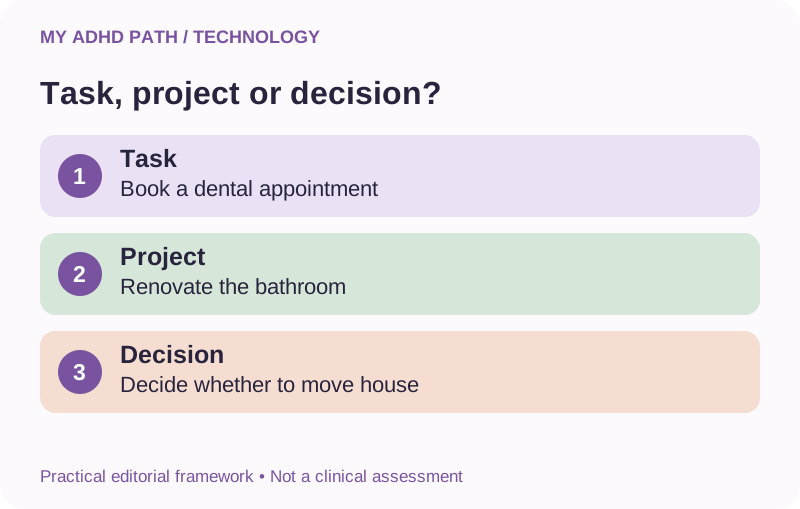
"Book a dental appointment" may be a task.
"Renovate the bathroom" is more likely to be a project.
"Decide whether to move house" involves a substantial decision.
A project contains several related activities.
A decision may require gathering information and evaluating alternatives before committing to an action.
Trying to manage all three as an ordinary item on a to-do list can conceal important differences.
AI may help identify what kind of support is required.
Ask:
"Is this a single action, a project, an unresolved decision or a collection of separate responsibilities? Explain why."
This simple distinction may change how you approach the activity.
The difference between the whole plan and today's plan
Understanding an entire project can be useful.
But you don't necessarily need to look at every outstanding responsibility every time you work on it.
Consider maintaining two different views.
The project overview
This contains the wider objective, major stages, dependencies, decisions and outstanding work.
Today's working view
This contains the small collection of activities relevant to your current working session.
The project overview protects continuity.
The working view supports immediate action.
An AI assistant can help generate the second from the first, provided the project information is accurate.
You don't need to lose sight of the bigger picture to make the current activity more manageable.
You simply don't need the entire bigger picture occupying your attention all the time.
Fifteen ways AI can help you break down overwhelming tasks
1. Explain the task in your own words
Describe what you are trying to do without worrying about producing a perfectly structured prompt.
2. Ask AI to identify the actual objective
Establish what a useful completed outcome would look like.
3. Distinguish projects from single actions
Identify whether the task represents a larger collection of responsibilities.
4. Expose the hidden stages
Ask what different activities might be involved.
Review the suggested stages for accuracy.
5. Establish what is already complete
Avoid recreating work you've already undertaken.
6. Identify missing information
Ask the assistant to distinguish genuine gaps from information it can establish using authorised sources.
7. Separate blocked activities
Record what cannot proceed and what would allow it to move forward.
8. Identify essential requirements
Distinguish necessary activities from optional improvements.
Check specialist requirements independently.
9. Ask for a manageable starting action
Request a practical first action rather than another comprehensive list.
10. Match activities to available time
Explain whether you have ten minutes, an hour or a longer working session.
Treat estimates as approximations rather than promises.
11. Adapt the plan to your current capacity
Describe the level of effort you can reasonably manage.
Ask for a smaller version of the activity if appropriate.
12. Request instructions one stage at a time
If seeing the entire plan feels unhelpful, ask the assistant to present only the current stage.
13. Use AI to prepare difficult communications
Ask for help drafting questions, requests or explanations.
Check that they accurately reflect your situation.
14. Review the plan when circumstances change
A plan should be able to accommodate new information, delays and unexpected responsibilities.
15. Preserve your progress
Before stopping, ask the assistant to help prepare a brief, factual record of what you've completed and where you should resume.
Ask for one instruction at a time
Some people find a complete roadmap reassuring.
Others find it easier to work with one instruction at a time.
You can ask an AI assistant to adapt its communication accordingly.
For example:
"Keep the overall plan available, but show me only the next action. Wait until I've completed it or told you why I'm stuck before introducing the next stage."
This can create a more interactive approach.
You complete an action.
You report what happened.
The assistant helps establish what follows.
If new information appears, the plan can be reconsidered.
This is different from receiving an enormous set of instructions and needing to independently manage every stage.
However, you should retain access to the overall plan where useful, particularly for activities involving consequential requirements or dependencies.
When the next step is still too big
Sometimes a suggested action looks manageable but remains difficult to attempt.
Perhaps the assistant suggests:
"Contact your accountant."
You may still need to explain that you don't know what to ask.
A more useful approach might be:
"Help me identify the three questions I need to ask my accountant, and then draft a short email containing them."
Alternatively, the difficulty may involve anxiety about the interaction rather than the wording.
In that situation, practical communication support may help, but it won't necessarily address the underlying anxiety.
There is no requirement to keep reducing tasks until the difficulty disappears.
Some activities may require appropriate emotional, professional or practical support in addition to planning.
Using different levels of capacity
Your available capacity may change.
The same activity can feel relatively manageable on one day and considerably more demanding on another.
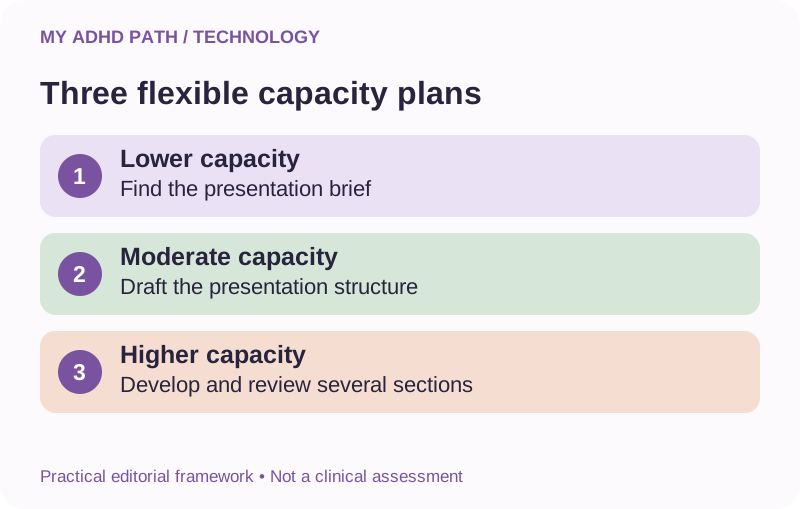
You might ask AI to produce three versions of a plan.
Lower-capacity version
Preserve important information and complete one essential preparatory action.
Moderate-capacity version
Complete a small sequence of related actions.
Higher-capacity version
Work through a larger part of the project, allowing appropriate time for breaks and review.
For example, if you need to prepare a presentation:
A lower-capacity action might be finding the brief.
A moderate-capacity session might involve drafting the structure.
A higher-capacity session might involve developing and reviewing several sections.
These are flexible planning options, not clinical measurements of cognitive or physical capacity.
You don't have to complete the most ambitious version simply because you've created it.
Avoiding unrealistic AI-generated plans
AI assistants can produce plans that appear impressively comprehensive.
They may include estimates, deadlines, suggested routines and numerous supporting activities.
But they can also underestimate the effort involved.
They may fail to consider existing responsibilities.
They may assume resources are available when they aren't.
They may overlook dependencies or specialist requirements.
A schedule that looks impressive on a screen may be unrealistic in everyday life.
Ask AI to include:
Preparation time.
Time needed to find information.
Potential waiting periods.
Existing commitments.
Appropriate breaks.
Uncertainty.
A reasonable allowance for unexpected difficulties.
When exact timing is unknown, use approximate ranges and review the estimates as you learn more.
When a five-minute task isn't really a five-minute task
An AI assistant might describe an activity as taking five minutes.
Perhaps it suggests sending a short email.
But sending that email could involve finding a previous document, checking a date, understanding the recipient's request and deciding on an appropriate response.
Typing the message might take five minutes.
Preparing to type it might take considerably longer.
This is why time estimates should account for the entire activity rather than just its most visible action.
Ask:
"Does this estimate include locating information, making decisions and preparing the necessary resources?"
You may discover that the activity needs a different starting point.
Using AI when several tasks feel overwhelming
Sometimes the issue isn't one complicated responsibility.
It's twelve different responsibilities all competing for your attention.
Begin by giving the assistant an overview of the situation.
Ask it to distinguish:
Confirmed deadlines.
Activities with serious consequences if delayed.
Responsibilities involving other people.
Activities currently blocked.
Flexible intentions.
Optional improvements.
Potentially unnecessary tasks.
Then review the classification.
The assistant should not assume that something is urgent simply because it sounds important.
It should ask for clarification when consequences or deadlines are unclear.
Once you have a more accurate overview, you can choose which responsibility to work on first.
Our next article explores AI-supported decision-making and prioritisation in greater depth.
When the right answer is less work
AI task breakdowns often focus on how to complete everything.
But sometimes, completing everything is neither necessary nor realistic.
Imagine you're preparing for a family gathering.
You could create a comprehensive plan involving cleaning, cooking, decorations, shopping and several other activities.
Alternatively, you could identify what genuinely matters for the gathering to take place.
Perhaps some responsibilities can be shared.
Perhaps simpler food arrangements are suitable.
Perhaps decorating isn't important.
Perhaps some areas of the house don't need your attention.
Ask an AI assistant:
"Which parts of this plan are essential, which could be simplified, and which could be delegated or postponed?"
Check that the suggestions reflect your priorities.
Reducing the overall demands may be more useful than finding a more efficient way of completing every possible activity.
Task breakdown and emotional demands
Not every overwhelming task is overwhelming because it's complicated.
Some responsibilities involve uncertainty, difficult conversations, financial worries or experiences of criticism.
A simple telephone call may carry substantial emotional demands.
In these circumstances, breaking the process into steps may be useful, but it may not fully address the difficulty.
AI might help prepare a short script.
Identify questions.
Explain unfamiliar terminology.
Role-play an ordinary interaction.
Or draft information you want to communicate in writing.
You may also benefit from support from a trusted person or qualified professional.
AI should not be treated as a replacement for appropriate mental health care.
Using a supportive AI conversation at work
Imagine you regularly need to manage unfamiliar administrative processes.
You may understand the importance of the work and possess the necessary professional skills.
But organising the stages, identifying priorities and resuming interrupted activities might require significant effort.
AI may provide practical support with:
Structuring project information.
Preparing meetings.
Organising written instructions.
Clarifying responsibilities.
Identifying missing information.
Drafting progress summaries.
Maintaining continuity between working sessions.
Discuss suitable arrangements with your employer where relevant.
Use only technology authorised for the information involved.
In Great Britain, Access to Work may provide eligible people with support related to workplace barriers.
Potential support depends on individual needs and scheme rules.
Funding for specific AI products or subscriptions is not automatic.
Our dedicated assistive technology and Access to Work guides will explore how to describe support needs and discuss possible provision.
The role of human judgement
AI-generated task breakdowns are suggestions.
They are not necessarily complete, accurate or appropriate.
This matters particularly when tasks involve:
Medical decisions.
Financial commitments.
Legal requirements.
Employment matters.
Child safeguarding.
Confidential business information.
Government applications.
Significant purchases.
Use authoritative guidance and appropriate professional support where required.
An assistant can help organise the information and prepare questions.
That does not mean it has the expertise or authority to make the final decision.
Do not allow an AI assistant to submit applications, send consequential messages or make financial commitments without appropriate authorisation and review.
A five-minute task untangling exercise
If a responsibility currently feels overwhelming, try this short exercise.
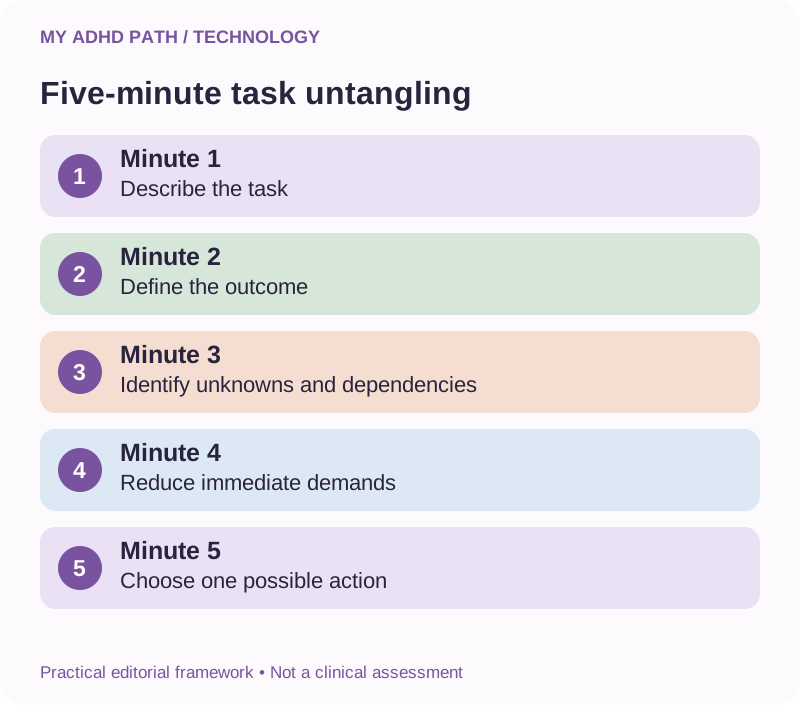
Minute one: Describe it
Explain the task in ordinary language.
Include what is making it feel difficult.
Minute two: Define the outcome
Identify what you actually need to achieve.
Minute three: Separate the unknowns
Identify missing information, unresolved questions and dependencies.
Minute four: Reduce the immediate demands
Distinguish what needs attention now from what can wait.
Minute five: Choose your starting action
Identify one meaningful action that is currently possible.
You can do this independently, with another person or using an appropriate AI assistant.
Five minutes may not be enough for a complex activity.
That's fine.
The exercise is intended to establish a starting point, not solve every possible difficulty.
Illustrative scenario
Hannah, 39 - Managing business administration
Hannah runs a small creative business. She regularly puts "sort out admin" on her weekly task list. The same instruction remains there for several weeks. She explains the situation to an AI assistant, including the documents she's collected, the correspondence she's received and the areas she's uncertain about. Together they identify questions for her accountant, information she already has and a smaller collection of actions she can complete independently. Instead of trying to resolve every issue herself, Hannah begins by preparing a focused email.
Illustrative scenario
Daniel, 28 - Starting a professional qualification
Daniel is completing a qualification alongside his job. He finds the course assignment instructions difficult to translate into a working plan. He uses an AI assistant to help distinguish the assessment requirements from the different activities involved in preparing his work. He checks the suggestions against the official course materials. His immediate plan focuses on reading the requirements and choosing the first relevant topic. The assistant supports planning while Daniel remains responsible for his own assessed work.
Illustrative scenario
Leila, 46 - Following up an outstanding application
Leila has been waiting for a response to a workplace support application. She finds it difficult to return to the correspondence because several months have passed and the details are no longer familiar. An AI assistant helps her organise a factual chronology from the non-sensitive information she provides. It identifies questions she can ask and helps draft a follow-up message. Leila checks the facts and sends the message herself. She also records when she intends to review the situation again. The task becomes a series of identifiable actions rather than an indefinite responsibility.
What the research says
Several established areas of research are relevant to the principles discussed in this article. Executive functioning research examines processes involved in planning, working memory and goal-directed behaviour. Cognitive load research explores the demands associated with processing information. Cognitive offloading research considers how external resources can change the requirements of cognitive tasks. Research into implementation intentions has also explored how specifying when, where and how to act may support goal pursuit in some contexts. These areas provide useful theoretical background for practical task planning. However, important distinctions remain. There is not yet an established clinical evidence base showing that general-purpose conversational AI reliably treats ADHD-related task initiation difficulties. A useful AI-generated plan does not necessarily improve underlying executive functioning. The effectiveness of a particular approach will depend on the task, the person, the accuracy of the information and the quality of the support. AI task breakdown should therefore be considered an optional practical aid rather than a replacement for evidence-based ADHD treatment or appropriate professional support.
Your personal task breakdown worksheet
Choose a responsibility you are currently finding difficult.
Complete as much of the following as is useful.
The task: What am I trying to deal with?
The outcome: What would a useful result look like?
Already complete: What have I already done?
Unknowns: What information or decisions are missing?
Dependencies: What needs to happen before other activities become possible?
Essential requirements: What genuinely needs completing?
Optional activities: What could be simplified, postponed or removed?
Available support: Who or what could help?
My first action: What is one specific thing I can do next?
Where I'll restart: What should I remember if I need to stop?
You do not have to complete the worksheet before receiving support.
An AI assistant or trusted person can help you work through the questions.
Downloadable resource
My ADHD Task Breakdown Toolkit
A comprehensive toolkit including task breakdown worksheets, next-action cards, the five-stage method and AI prompt templates to help you turn overwhelming responsibilities into manageable actions.
Download PDFYour seven-day task breakdown experiment
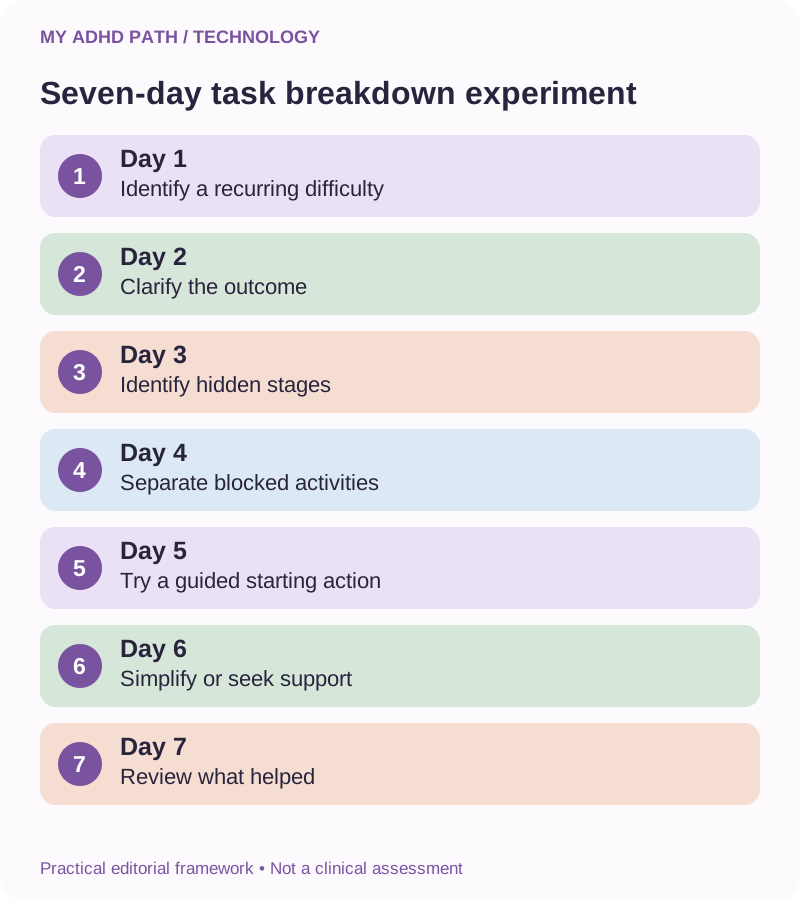
Day one: Identify a recurring difficulty
Choose one responsibility you regularly find difficult to begin.
Day two: Clarify the outcome
Explore what genuinely needs to happen.
Day three: Identify hidden stages
Break the activity into meaningful groups.
Day four: Separate what is blocked
Identify missing information and outstanding dependencies.
Day five: Try a guided starting action
Ask AI or another suitable source of support to help you work through one stage.
Day six: Adapt the demands
Explore whether the activity could be made smaller, simpler or better supported.
Day seven: Review your experience
Consider whether you spent less time reconstructing information, felt clearer about what to do or found it easier to resume the activity.
Notice what didn't help as well.
This exercise is for personal reflection, not clinical assessment.
Fifteen AI prompts for overwhelming tasks
AI prompt
1. Help me untangle this
"I'm going to explain a task in my own words. Help me understand what it involves before producing a plan."
AI prompt
2. Help me define the outcome
"Help me establish what a useful completed outcome would look like. Ask only the questions necessary to clarify it."
AI prompt
3. Identify the hidden stages
"Separate this responsibility into its meaningful stages, including information gathering, decisions and practical actions."
AI prompt
4. Tell me what is missing
"Identify the information I need before I can confidently proceed. Do not invent missing details."
AI prompt
5. Separate what is blocked
"Distinguish between actions I can take now, activities waiting for information and responsibilities depending on somebody else."
AI prompt
6. Help me prioritise
"Identify the essential requirements and explain which activities could reasonably wait. Ask me about deadlines or consequences if they're unclear."
AI prompt
7. Give me one starting action
"Based on what we've established, suggest one specific, manageable action I can begin now."
AI prompt
8. Guide me one step at a time
"Maintain the overall plan, but present only the next action. Wait for me to report what happened before continuing."
AI prompt
9. Make this less demanding
"Suggest a simpler way to achieve the necessary outcome without introducing unnecessary stages or compromising important requirements."
AI prompt
10. Work with my available time
"I have twenty minutes available. Help me choose a useful action that fits this time, including any necessary preparation."
AI prompt
11. Work with my current capacity
"I'm finding sustained concentration difficult today. Help me identify a lower-demand version of this activity."
AI prompt
12. Prepare a difficult message
"Help me draft a clear, factual message asking for the information or assistance I need. Mark anything I must confirm before sending."
AI prompt
13. Check whether this plan is realistic
"Review this plan for hidden work, missing resources, unrealistic estimates and dependencies."
AI prompt
14. Help me restart
"I stopped working on this task previously. Use the information I've provided to identify what is complete, what remains and where I should resume."
AI prompt
15. Create my parking note
"Summarise what I have actually completed, what is unresolved and my next action. Distinguish confirmed progress from proposed work."
Avoid sharing unnecessary personal or confidential information.
Check AI-generated content before acting on it.
Frequently asked questions
Can AI help people with ADHD break down tasks?
AI may help organise information, clarify goals and suggest manageable actions. Its usefulness depends on the person's needs, the activity and the accuracy of the support.
Why do simple tasks sometimes feel overwhelming with ADHD?
A seemingly simple responsibility may contain several hidden activities involving planning, working memory, decisions and preparation.
Is task paralysis an official ADHD symptom?
Task paralysis is an informal description of difficulty initiating or progressing an activity. It is not itself a formal diagnostic criterion.
Why doesn't breaking a task into steps always help?
Creating, prioritising and following the steps may introduce further cognitive demands. Other difficulties, including missing information or emotional distress, may also remain.
Can AI help me start something I've been avoiding?
It may help identify a specific starting action, clarify uncertainties or prepare information. It cannot guarantee that starting will become easy.
What is the best AI task breakdown tool for ADHD?
There is no universally best tool. Conversational flexibility, accessibility, accuracy, privacy and the ability to adapt instructions are relevant considerations.
Do I need to write a detailed AI prompt?
No. You can often begin by explaining the difficulty in ordinary language and asking the assistant to help clarify it.
Can AI help me with applications and forms?
AI may help explain questions, structure information and prepare draft answers. Use official instructions, provide truthful information and check the final application carefully.
Can AI help with Access to Work?
It may help you organise information about workplace difficulties, prepare questions and draft correspondence. It cannot determine your eligibility or guarantee a grant.
Can Access to Work pay for AI tools?
Assistive software may be considered under the scheme where appropriate. Specific AI products are not automatically funded, and individual approval is necessary.
Can AI tell me which task is most important?
It can help compare deadlines, consequences and dependencies using the information available. You may need to provide additional context and make the final judgement.
Should I ask AI to break every task into tiny steps?
Not necessarily. Overly detailed instructions can introduce unnecessary information. Choose a level of detail that supports the activity.
Can AI help estimate how long a task will take?
It can suggest approximate estimates, but these may overlook hidden work and individual circumstances. Review and adjust them using your experience.
Can I ask AI to guide me one step at a time?
Yes. Many conversational AI tools can adapt their responses to this approach, although accurate continuity depends on the service and available context.
Can AI reduce task-related anxiety?
Practical preparation may reduce uncertainty for some people. AI is not an established treatment for anxiety disorders, and appropriate professional support may be necessary.
Can children and teenagers use AI for task planning?
Age-appropriate tools may help with structuring responsibilities. Consider provider age restrictions, privacy, adult guidance and educational policies.
Is AI task breakdown an ADHD treatment?
No. It is a potential practical support strategy and should not replace appropriate ADHD assessment, treatment or professional care.
What is the simplest way to get started?
Describe one task you are finding difficult and ask for help establishing the first useful action, rather than requesting a complete productivity plan.
You don't need to carry the entire task at once
Sometimes the most demanding part of completing an activity is everything that happens before you begin.
Remembering.
Interpreting.
Planning.
Deciding.
Trying to establish what comes first.
AI offers another possible way to work through some of that thinking.
It won't remove every difficulty.
It won't always understand your circumstances correctly.
And it cannot make every responsibility manageable simply by dividing it into smaller pieces.
But it may help you establish a clearer relationship with the task in front of you.
You might discover that you don't need to complete the entire project today.
You need to ask a question.
Find a document.
Make a decision.
Or identify what is currently preventing progress.
You don't necessarily need another list. You may simply need support understanding what the list actually means.
And somewhere useful to begin.
Sources and further reading
- Diamond, A. (2013). Executive Functions. Annual Review of Psychology. https://doi.org/10.1146/annurev-psych-113011-143750
- Willcutt, E. G. et al. (2005). Validity of the Executive Function Theory of Attention-Deficit/Hyperactivity Disorder: A Meta-Analytic Review. Biological Psychiatry. https://doi.org/10.1016/j.biopsych.2005.02.006
- Baddeley, A. (2012). Working Memory: Theories, Models, and Controversies. Annual Review of Psychology. https://doi.org/10.1146/annurev-psych-120710-100422
- Risko, E. F. and Gilbert, S. J. (2016). Cognitive Offloading. Trends in Cognitive Sciences. https://doi.org/10.1016/j.tics.2016.07.002
- Sweller, J. (1988). Cognitive Load During Problem Solving: Effects on Learning. Cognitive Science. https://doi.org/10.1207/s15516709cog1202_4
- Gollwitzer, P. M. (1999). Implementation Intentions: Strong Effects of Simple Plans. American Psychologist. https://doi.org/10.1037/0003-066X.54.7.493
- Faraone, S. V. et al. (2021). The World Federation of ADHD International Consensus Statement. https://doi.org/10.1016/j.neubiorev.2021.01.022
- NICE - Attention deficit hyperactivity disorder: diagnosis and management (NG87). https://www.nice.org.uk/guidance/ng87
- GOV.UK - Access to Work. https://www.gov.uk/access-to-work
- GOV.UK - Access to Work eligibility. https://www.gov.uk/access-to-work/eligibility
- GOV.UK - Apply for Access to Work. https://www.gov.uk/access-to-work/apply
- GOV.UK - After you apply. https://www.gov.uk/access-to-work/after-you-apply
This article provides general educational information and practical suggestions. It does not constitute medical, legal or financial advice. The task breakdown frameworks and exercises are illustrative rather than clinically validated ADHD interventions. AI-generated information should be independently checked where appropriate.