

Sometimes the hardest part of making a decision isn't choosing between the options. It's organising everything you need to consider before you can choose.
You've spent three evenings researching something you originally intended to buy in ten minutes.
You've read the reviews.
You've compared the prices.
You've discovered several alternatives you didn't previously know existed.
You've changed your mind about what matters most.
And somewhere along the way, you've forgotten which product you originally thought was the best option.
So you start looking again.
Making an informed decision is generally a good thing. But there comes a point when gathering more information doesn't necessarily make the decision any easier.
Sometimes it just gives you more information to manage.
For some people with ADHD, making decisions can involve considerable mental effort.
Artificial intelligence offers another way to work through that process.
Not by deciding how you should live your life, but by helping you organise the information, understand your options and establish what actually matters.
At a glance
- Decision-making involves several cognitive processes, including working memory, planning and evaluating alternatives.
- Decision paralysis is an informal description of difficulty making a choice, not a recognised medical diagnosis.
- Gathering more information does not always resolve uncertainty.
- AI can help structure options, identify missing information and compare relevant criteria.
- Not every decision deserves the same amount of time or research.
- AI should distinguish evidence from assumptions and personal preferences.
- Important medical, legal and financial decisions require appropriate professional guidance.
- The purpose of AI-supported decision-making is to strengthen your independence, not replace your judgement.
Why making decisions can be demanding with ADHD
Making a decision can involve much more than choosing between two alternatives.
You may need to remember previous information, compare several characteristics, anticipate consequences, understand your priorities and decide whether you have enough information to proceed.
You might also need to consider how a decision will affect other people or fit alongside existing responsibilities.
Executive functions are cognitive processes involved in managing goal-directed behaviour.
Research has identified average differences in several executive functions among people with ADHD, although individuals vary considerably.
When a decision involves numerous competing considerations, managing all of those considerations simultaneously may become demanding.
Imagine comparing five different holiday destinations.
Each has a different price, travel time, accommodation arrangement, departure airport and collection of activities.
You might also need to consider school holidays, other people's preferences and your available budget.
You don't necessarily have difficulty understanding any individual piece of information.
The difficulty may be keeping everything available while trying to establish which combination works best.
What is decision paralysis?
Decision paralysis describes the experience of finding it difficult to make or commit to a choice.
It can occur when there are many alternatives, when the consequences feel significant or when relevant information remains uncertain.
You might experience it as:
- Repeatedly researching the same options.
- Changing your mind frequently.
- Avoiding a decision altogether.
- Asking several people for their opinions.
- Struggling to distinguish important details from less important ones.
- Feeling that you need more information but not knowing what information is missing.
- Finding it difficult to stop comparing alternatives.
- Making no decision until circumstances effectively decide for you.
These experiences are not exclusive to ADHD and are not diagnostic criteria.
Anxiety, perfectionism, uncertainty, financial pressure and previous experiences may also influence decision-making.
Our guide to decision paralysis explores these experiences in greater depth.
Six hidden demands of making a decision
The following My ADHD Path framework illustrates some of the activities that may be involved in a decision.
1. Remembering
Keeping relevant information available while evaluating alternatives.
2. Comparing
Identifying meaningful similarities and differences.
3. Prioritising
Establishing which characteristics matter most.
4. Predicting
Considering possible future consequences.
5. Managing uncertainty
Recognising that some information may not be available.
6. Committing
Choosing an option and acting on that decision.
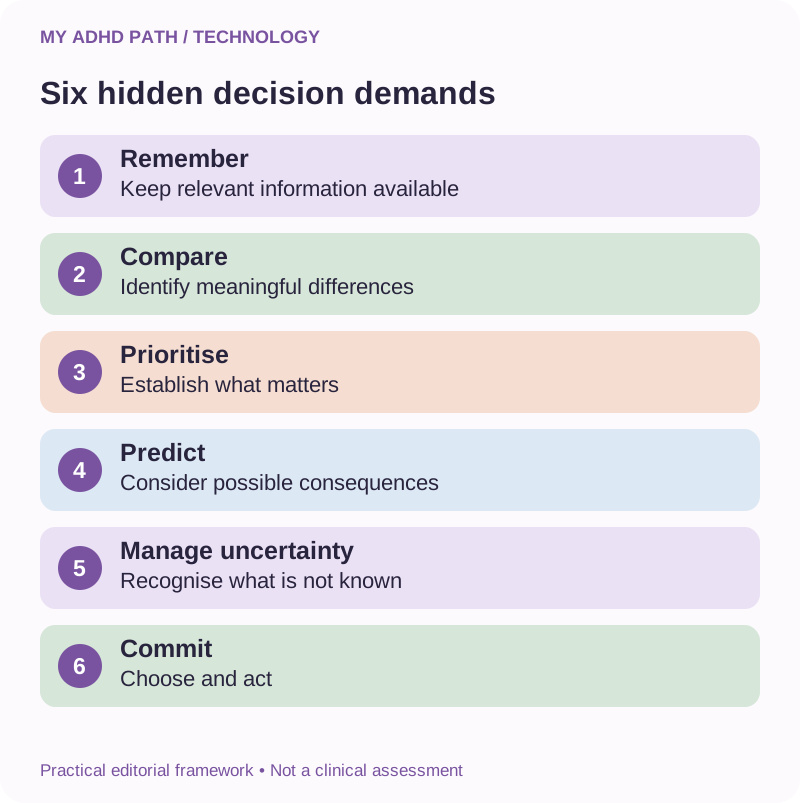
AI may provide practical support with several of these activities.
But not every decision-making difficulty is an information problem.
Some decisions involve emotional uncertainty, conflicting values or circumstances that cannot be resolved through further analysis alone.
Why more information isn't always the answer
Imagine you've narrowed a purchase down to three suitable products.
You know their prices.
You understand their main features.
Each appears capable of doing what you need.
At this point, you could make a reasonable decision.
Instead, you discover another comparison website.
There are now seven products to consider.
One has a feature you hadn't previously considered important.
Another appears to have a better warranty.
Another is available at a temporary discount.
Your research has increased the number of possibilities rather than resolving the original decision.
Research into choice overload suggests that encountering numerous alternatives can make choosing more difficult in some circumstances, although the effect is not universal.
The complexity of the choice, individual preferences and familiarity with the options can all matter.
Rather than automatically searching for more information, it may be useful to identify what information would genuinely change your decision.
AI as a decision-making partner
An AI assistant can help you work through an untidy collection of information.
You might provide descriptions of several options, your concerns, previous research and your initial preferences.
The assistant may be able to organise that information into a clearer comparison.
It could also identify contradictions, ask about missing criteria or distinguish essential requirements from desirable features.
This is potentially useful because you don't have to keep reconstructing the entire comparison yourself.
However, an AI assistant is not automatically impartial or accurate.
It may misunderstand your preferences, rely on incorrect information or present an unjustifiably confident recommendation.
Treat the assistant's output as decision support.
You remain the person who determines what matters.
Sometimes the hardest part of making a decision isn't choosing between the options. It's organising everything you need to consider before you can choose.
Three levels of everyday decisions
Not every choice requires extensive analysis.
A useful starting point is to consider its consequences, cost and reversibility.
Level one: Low-consequence decisions
These might include choosing tonight's dinner, selecting a film or deciding which ordinary household activity to complete first.
A quick comparison or simple recommendation may be sufficient.
Level two: Meaningful but manageable decisions
These may include choosing a software subscription, buying a moderately priced appliance or selecting a course.
Some research and comparison may be worthwhile.
Consider the financial commitment, suitability and ability to change your mind.
Level three: High-consequence decisions
These might include significant investments, medical treatment, major contractual commitments or important career changes.
More extensive verification and appropriate professional support may be necessary.
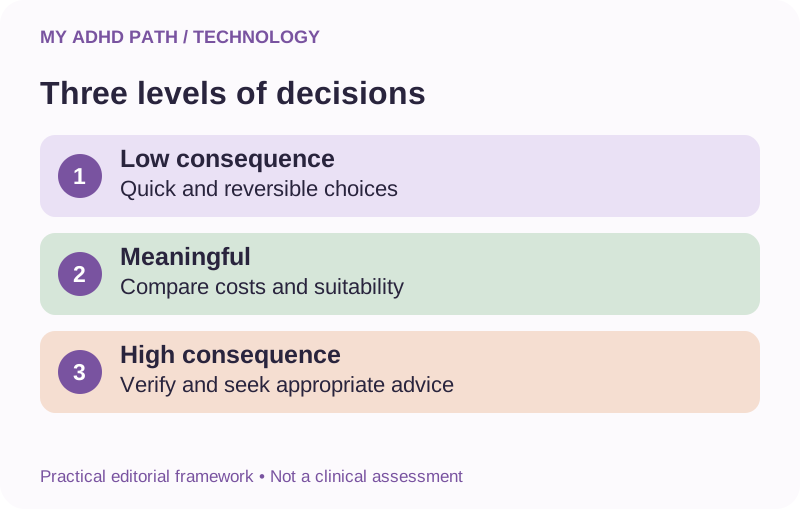
The same decision can have different consequences for different people.
A £100 purchase may be relatively straightforward for one person but financially significant for another.
The categories are intended to guide the amount of attention you give a decision, not establish universal spending thresholds.
The five-stage AI decision method
This practical framework can be used independently or with an AI assistant.
Stage one: Define
Establish exactly what you are deciding.
Stage two: Filter
Identify essential requirements and remove unsuitable options.
Stage three: Compare
Evaluate the remaining alternatives using relevant criteria.
Stage four: Check
Identify uncertainty, missing evidence and consequential risks.
Stage five: Choose
Make a decision, take the appropriate action or deliberately defer it.
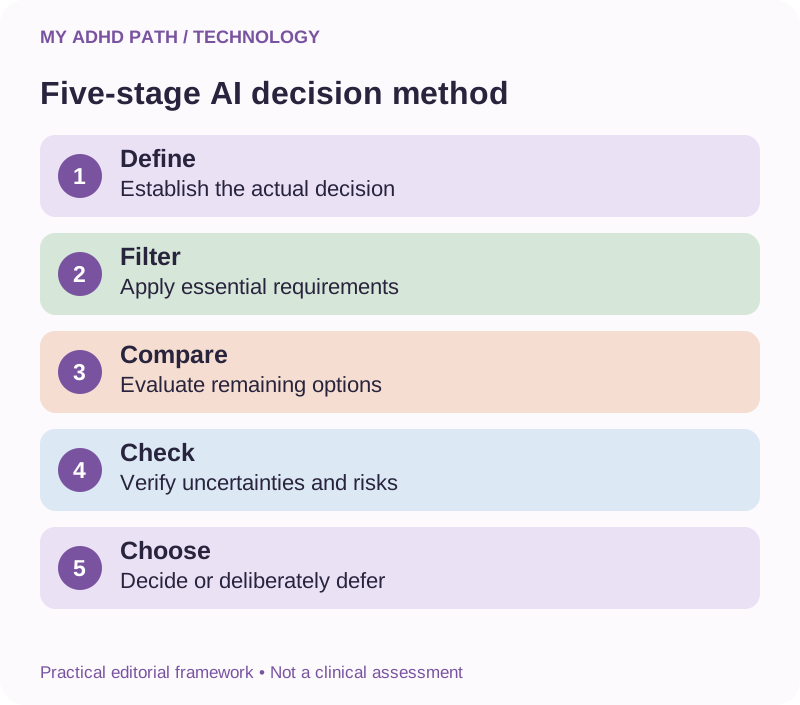
The method is intended to support practical thinking. It is not a clinically validated ADHD intervention.
Stage one: Define the decision
Before comparing options, establish the question you are actually trying to answer.
"Which computer is best?" is a broad question.
"Which computer can comfortably run my work applications within a budget of £1,200?" is more useful.
The second question provides a clearer basis for eliminating unsuitable options.
Ask AI to help you define the objective before it begins recommending anything.
You may discover that you've been researching the wrong question.
Stage two: Establish your non-negotiables
Some criteria are essential.
Others are preferences.
Others are interesting but unlikely to affect your decision.
Imagine choosing a new software service.
Your essential requirements might include compatibility with existing equipment, an appropriate level of security and a maximum budget.
You might prefer a particular interface.
An additional design feature could be a bonus.
These criteria shouldn't necessarily receive equal weight.
A product failing a genuine essential requirement should not become the preferred option simply because it has several attractive additional features.
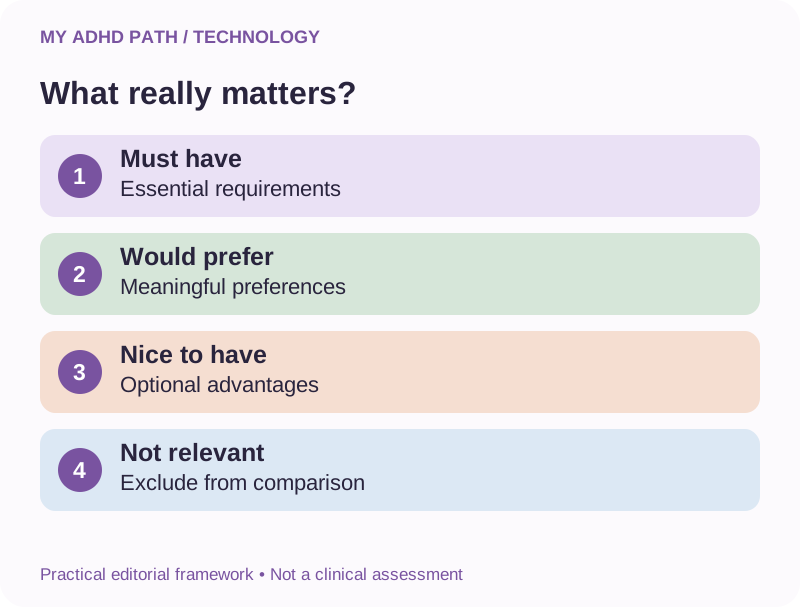
Ask your AI assistant to distinguish between:
- Must have.
- Would prefer.
- Nice to have.
- Not relevant.
Review the classification yourself.
Stage three: Compare the remaining options
Once unsuitable alternatives have been removed, create a manageable comparison.
For many decisions, a small table is sufficient.
You might compare price, practical suitability, ongoing costs and relevant limitations.
Ask the assistant to use the same units and assumptions for each option.
This matters particularly when comparing subscriptions, product bundles or costs quoted over different periods.
An apparently cheaper option may become more expensive once you account for additional requirements or ongoing charges.
A useful comparison should help you understand the full implications, not simply highlight the lowest advertised price.
Stage four: Identify uncertainty
An AI assistant should distinguish confirmed information from assumptions.
If a product's compatibility is unknown, it should be recorded as unknown.
If a figure is an estimate, it should be labelled as an estimate.
If a recommendation depends on a particular condition being met, that condition should be visible.
Ask:
"What information could change this recommendation?"
This can help you focus further research on meaningful uncertainties rather than continually investigating every possible detail.
For significant decisions, check the original sources and obtain appropriate advice.
Stage five: Make or deliberately defer the decision
Once you have enough relevant information, you may be ready to choose.
But sometimes an appropriate decision is to wait.
Perhaps you need confirmation of a contractual term.
Perhaps the available options don't meet your essential requirements.
Perhaps you need time to consider the consequences.
Deliberately deferring a decision is different from indefinitely avoiding it.
Record why you are waiting and what needs to happen before you review the choice.
You may find it easier to stop repeatedly reconsidering the decision when its current status is clear.
Worked example: Comparing three software subscriptions
Imagine you're choosing between three fictional software services.
All three offer the main function you need.
Your preferred annual budget is £150.
| Feature | Option A | Option B | Option C |
|---|---|---|---|
| Monthly cost | £12 | £9 | £15 |
| Annual equivalent | £144 | £108 | £180 |
| Required feature | Included | Included | Included |
| Data export | Available | Unconfirmed | Available |
| Integration | Available | Available | Available |
Option C exceeds the preferred budget.
Option B is the cheapest, but an important feature remains unconfirmed.
Option A meets the stated requirements based on the information available.
Rather than continuing to research all three products, you could focus on establishing whether Option B offers the necessary export function.
If it does, it may become the more suitable choice.
If it doesn't, Option A may better meet your requirements.
Good to know
This illustrative comparison shows how identifying one meaningful uncertainty can simplify a decision. It does not represent real products or current market prices.
Fifteen ways to use AI for everyday decisions
1. Explain the situation naturally
You don't need a perfectly formulated question. Describe what you're trying to decide and why you're finding it difficult.
2. Clarify what you're deciding
Ask the assistant to express the actual decision in one sentence.
3. Identify your essential requirements
Establish which criteria must be met before an option is considered suitable.
4. Separate requirements from preferences
Prevent attractive but unnecessary features from dominating the comparison.
5. Compare like with like
Ask for consistent units, costs, specifications and assumptions.
6. Reduce the number of options
Remove alternatives that clearly fail your agreed requirements.
7. Identify the missing information
Ask what you still need to establish and whether the missing information is likely to change your choice.
8. Look beyond the initial cost
Consider ongoing charges, accessories, maintenance and any relevant cancellation costs.
9. Explore disadvantages
Ask for meaningful limitations and circumstances in which each option might be unsuitable.
10. Consider reversibility
Establish how easily you could change your mind and what doing so would involve.
11. Explore realistic scenarios
Ask how the options might compare under different relevant circumstances.
12. Challenge the assistant's recommendation
Request reasonable arguments against its preferred option.
13. Establish a stopping point for research
Agree what information you need before you can make an informed choice.
14. Record why you chose something
Create a short decision note containing your criteria and the information supporting your choice.
15. Reconsider when something meaningful changes
Avoid restarting the entire comparison simply because you encounter another option. Review the decision if new information genuinely affects it.
Using a weighted decision matrix
Some decisions benefit from a more structured comparison.
A weighted decision matrix allows you to assign greater importance to some criteria than others.
For example, you might be comparing three training courses.
You decide that course relevance is particularly important, followed by flexibility and price.
| Criterion | Weight | Course A | Course B | Course C |
|---|---|---|---|---|
| Relevance | 50% | 5 | 3 | 4 |
| Flexibility | 30% | 3 | 5 | 4 |
| Price suitability | 20% | 3 | 5 | 4 |
| Weighted score out of 5 | 100% | 4.0 | 4.0 | 4.0 |
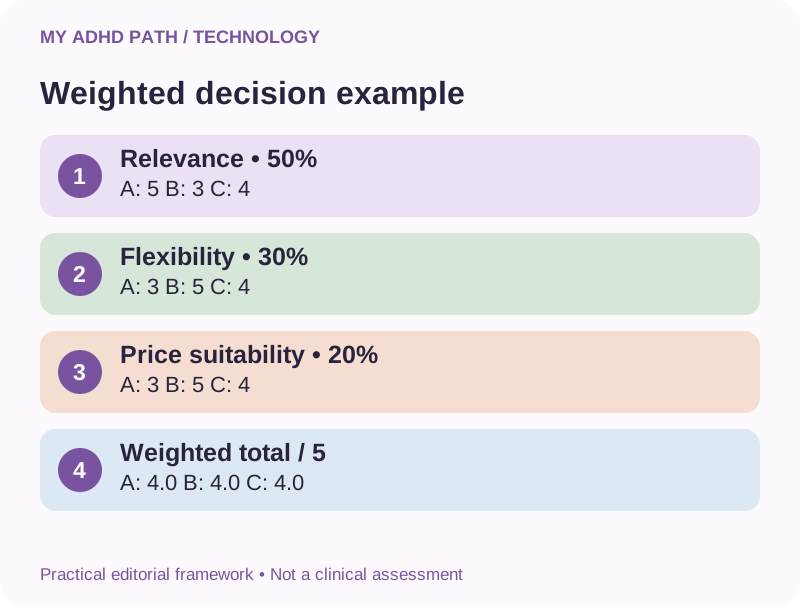
All three courses receive the same illustrative score, despite offering different advantages.
The example highlights an important limitation.
A numerical result doesn't always resolve a choice.
The scores reflect subjective judgements and the importance you assigned to each criterion.
Changing the weights could change the outcome.
Use a decision matrix to understand your preferences and trade-offs, not to create an artificial impression of certainty.
Apply essential requirements before scoring alternatives.
What if AI agrees with everything you say?
An assistant may sometimes produce responses that reinforce your existing preferences rather than challenge them.
This can be particularly unhelpful when you're trying to establish whether your original judgement is reasonable.
Suppose you already prefer one option.
If you describe that option enthusiastically and present the alternatives negatively, your assistant may produce a comparison that reflects the imbalance in your description.
Ask it to examine the decision more critically.
"Don't assume my preferred option is the best one. Identify any important disadvantages I've overlooked and explain when another option might be more suitable."
Even then, the response is not guaranteed to be impartial.
Review its assumptions and check relevant evidence independently.
Don't mistake confidence for accuracy
AI assistants can produce polished explanations and recommendations.
The quality of the writing does not necessarily establish the quality of the underlying information.
An assistant might incorrectly describe a product feature, misunderstand a cancellation policy or use outdated prices.
It may omit important considerations or invent details when its information is incomplete.
For current products, services, regulations or government schemes, use reliable and current sources.
Ask for links to original information where available.
Check that these sources support the relevant claims.
A confident answer is not a substitute for verification.
The objective is not simply to generate more information. It is to make the information easier to work with.
When AI should recommend fewer options
An assistant may respond to a request for help choosing between products by suggesting several additional alternatives.
Sometimes this is useful.
But if your existing options meet your requirements, introducing more choices may increase the demands involved.
You can explicitly tell the assistant:
"Compare only the options I've provided. Do not introduce alternatives unless none of these meet my essential requirements."
This establishes the boundaries of the task.
You don't need to consider every available option before making a reasonable decision.
When the cheapest option isn't the best value
Imagine you're choosing equipment for your business.
One product is considerably cheaper than another.
But the more expensive product includes accessories you would otherwise need to purchase separately.
It might also support future expansion or provide a longer warranty.
Establishing value requires considering what the purchase actually enables you to do.
A useful AI comparison could include:
- Initial purchase cost.
- Additional required equipment.
- Recurring costs.
- Relevant capacity or performance.
- Warranty and support.
- Compatibility.
- Future expansion.
- Relevant limitations.
Ask for all comparisons to use equivalent configurations.
Where information is missing, establish it rather than assuming the products are directly comparable.
For consequential purchases, use verified specifications and current prices.
Using AI to prioritise your responsibilities
Decision-making isn't always about buying something.
You may need to choose which responsibility deserves your attention first.
Perhaps you have several outstanding projects, important emails, family arrangements and administrative tasks.
An AI assistant may help you distinguish:
Confirmed deadlines.
Activities involving other people's availability.
Responsibilities with significant consequences if delayed.
Activities blocking other work.
Flexible intentions.
Optional improvements.
Ask it to identify a manageable starting point and explain its reasoning.
Ensure the assistant understands your actual circumstances.
It cannot accurately establish priorities from a list of task titles if important deadlines, dependencies and consequences are missing.
Using AI for career decisions
Choosing a career, training programme or new position can involve numerous considerations.
Salary may be important.
So might working hours, accessibility, professional development, commuting demands, workplace culture and long-term prospects.
An AI assistant may help create a structured comparison based on your priorities.
It could also help prepare questions for an employer or identify information you need to establish before making a commitment.
However, it cannot reliably predict whether you will enjoy a particular workplace.
It may not have accurate information about a specific employer.
Important decisions should be informed by reliable sources, your experiences and appropriate professional guidance.
Avoid assuming that a particular career is suitable or unsuitable simply because you have ADHD.
Using AI for business decisions
Business owners regularly face decisions involving competing demands.
Which product should be launched first?
Which subscription is still useful?
Should a particular project be continued?
Is an additional development feature essential?
AI may help organise the commercial considerations behind these decisions.
For example, when choosing between two projects, an assistant might help compare:
Potential customer demand.
Development requirements.
Expected costs.
Current progress.
Operational commitments.
Revenue opportunities.
Legal or regulatory considerations.
The strength of available evidence.
A useful assistant should not simply encourage every new idea.
It should help distinguish enthusiasm from evidence, and opportunities from commitments.
Financial projections, market assumptions and legal requirements need independent verification.
The assistant can help organise a decision. It cannot guarantee commercial success.
Using AI for family decisions
Family decisions can involve several people's preferences.
Choosing a holiday, school activity or household purchase may require balancing different priorities.
An assistant can help organise the practical information and identify possible compromises.
But it should not determine whose preferences matter most without appropriate context.
Keep relevant family members involved.
Respect children's developing independence and privacy.
Avoid uploading unnecessary personal, educational or medical information to an unsuitable AI service.
The technology should support conversations, not replace them.
Using AI for significant financial decisions
AI can help explain general financial concepts and organise available information.
It may be useful for comparing costs, illustrating scenarios or identifying questions for a qualified adviser.
However, it may not understand your complete financial circumstances or the applicable regulations.
Investment, pension, tax, borrowing and insurance decisions can have significant consequences.
Use authoritative guidance and seek appropriately qualified advice where necessary.
In the UK, useful starting points include:
MoneyHelper:
https://www.moneyhelper.org.uk/
Financial Conduct Authority:
https://www.fca.org.uk/consumers
GOV.UK:
https://www.gov.uk/
Do not share banking passwords, security credentials or unnecessary personal financial information with an AI assistant.
Using AI for medical decisions
An assistant may help you organise questions before an appointment or understand general health information.
It can help prepare a discussion about possible treatment options.
However, a general-purpose AI assistant should not determine which ADHD medication you should take, change your dose or replace an appropriate clinical assessment.
Medical decisions require consideration of your individual circumstances by suitably qualified healthcare professionals.
Use reliable public health resources, including NHS and NICE guidance.
https://www.nice.org.uk/guidance/ng87
AI should support informed conversations with professionals, not replace them.
The importance of knowing when to stop researching
For some decisions, it helps to establish a research boundary in advance.
You might decide to:
Compare three suitable products.
Check the manufacturer's specifications.
Confirm the total price.
Review the relevant warranty conditions.
Check one remaining uncertainty.
Once those activities are complete, you can reconsider whether further research is worthwhile.
This doesn't guarantee the best possible decision.
It helps establish whether you have enough information to make a reasonable one.
For high-consequence decisions, appropriate additional checks may remain necessary.
A research boundary should never be used to avoid essential verification.
When you keep revisiting the same decision
Have you ever made a decision, felt reasonably satisfied with it and then started researching the alternatives again?
Sometimes there is a genuine reason to reconsider.
A price changes.
New information becomes available.
Your circumstances change.
But sometimes you're returning to exactly the same information.
A decision record may help.
Capture:
What you decided.
The alternatives you considered.
The criteria that mattered.
The information available at the time.
Any remaining uncertainties.
The circumstances that would justify reopening the decision.
This may reduce the need to reconstruct your reasoning.
AI can help produce a concise record from confirmed information.
Keep it somewhere you can reliably find it.
What if there isn't a perfect option?
Some decisions don't have an alternative that satisfies every preference.
One course might be better suited to your interests, while another offers greater flexibility.
One product might provide excellent performance but have higher ongoing costs.
One job might offer a better salary but involve a more demanding commute.
AI can help identify these trade-offs.
It cannot remove them.
Ask yourself which disadvantage you are most comfortable accepting.
Sometimes the most useful choice is not the option with the longest list of advantages.
It's the option whose compromises fit your actual circumstances.
You don't need to consider every available option before making a reasonable decision.
A five-minute decision reset
When a decision feels difficult to manage, try this short exercise.
Minute one: State the decision
Write down exactly what you need to choose.
Minute two: Identify what matters
Choose the most important requirements.
Minute three: Narrow the options
Set aside alternatives that clearly do not meet those requirements.
Minute four: Identify what is missing
Establish which uncertainties could change your choice.
Minute five: Choose the next action
Make the decision if appropriate, or identify the information or advice you need next.
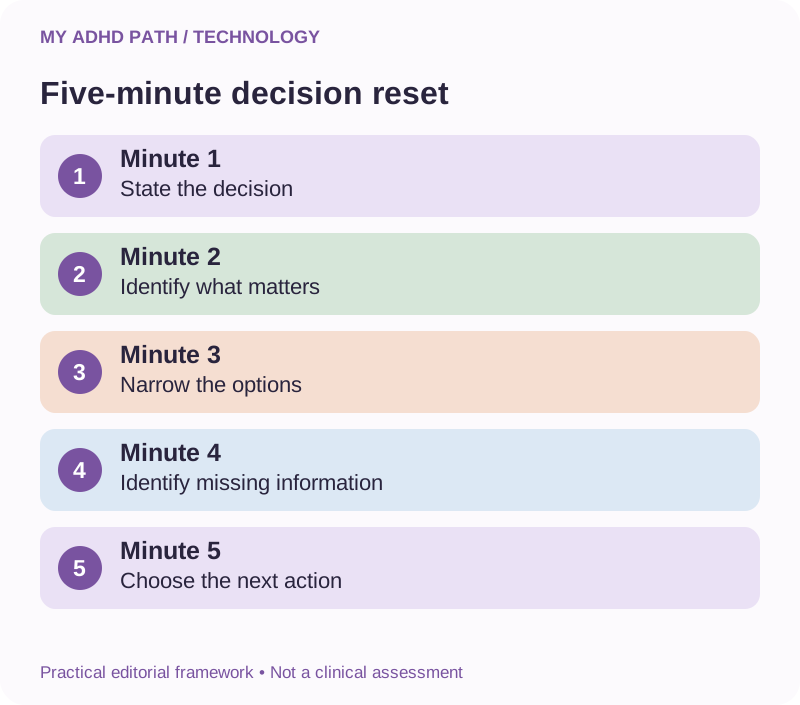
This is a flexible planning exercise, not a requirement to make consequential decisions within five minutes.
Illustrative scenario
Rebecca, 43 - Comparing equipment for her business
Rebecca needs to purchase equipment to support her business. She has been comparing several different products and promotional bundles. Every time she returns to the decision, she spends time reconstructing her earlier research. She asks an AI assistant to compare only the products she is considering, using equivalent configurations and her actual requirements. The assistant identifies a specification that remains unconfirmed. Rebecca checks the manufacturer's documentation and updates the comparison. She creates a record of her final choice and the reasons behind it.
Illustrative scenario
Aiden, 19 - Choosing a university course
Aiden has several university offers. He finds it difficult to compare the academic content, location, support arrangements and wider student experience. He asks AI to help organise the information and prepare questions for university admissions teams. He checks official course information, attends relevant visits and considers his own preferences. The assistant helps structure the decision, but Aiden makes the final choice.
Illustrative scenario
Priya, 36 - Choosing what to work on
Priya has several projects competing for her attention. New ideas frequently appear more interesting than existing responsibilities. She explains the current state of each project to an AI assistant, including deadlines and dependencies. The assistant prepares a comparison and suggests which activity appears to require attention first. Priya adjusts the recommendation to reflect information she had not initially included. She records a working priority and deliberately parks the other projects.
What the research says
Research into executive functioning, working memory and cognitive offloading provides relevant background for understanding the demands of decision-making. Research examining ADHD has identified differences in aspects of decision-making in some experimental contexts. However, findings vary according to the tasks studied, the characteristics of participants and the methods used. It would be inappropriate to assume that everybody with ADHD makes decisions in the same way. Research into choice overload also indicates that the consequences of having more options depend on context. There is not an established clinical evidence base demonstrating that general-purpose AI assistants reliably resolve ADHD-related decision paralysis. The strategies in this article are therefore best understood as practical approaches inspired by relevant cognitive principles. They are not validated ADHD treatments.
Your personal decision worksheet
Use this structure when you need to make a choice.
The decision: What exactly am I deciding?
My outcome: What do I want this choice to achieve?
Essential requirements: What must an option provide?
Preferences: What would be useful but isn't essential?
Alternatives: Which options am I considering?
Evidence: What information has been confirmed?
Unknowns: What could still change my decision?
Consequences: What happens if I choose each option?
Support: Do I need professional advice or somebody else's input?
My decision: What have I chosen, or why am I waiting?
Review trigger: What would justify reconsidering this choice?
You may find that smaller decisions need only one or two of these questions.
Use the amount of structure that is useful.
Downloadable resource
My ADHD Decision-Making Toolkit
Compare your options. Understand what matters. Choose with confidence. Includes decision worksheets, comparison templates, weighted decision matrices, research boundaries, decision records and AI prompt templates.
Download PDFYour seven-day decision experiment
Day one: Notice
Identify the types of choices you repeatedly find difficult.
Day two: Categorise
Distinguish low-consequence decisions from more significant ones.
Day three: Filter
Try establishing essential requirements before comparing alternatives.
Day four: Compare
Use AI to produce a neutral comparison of a small number of options.
Day five: Check
Identify and verify any meaningful uncertainties.
Day six: Record
Create a short decision record explaining one choice you've made.
Day seven: Reflect
Consider which aspects of the process helped and whether any introduced unnecessary work.
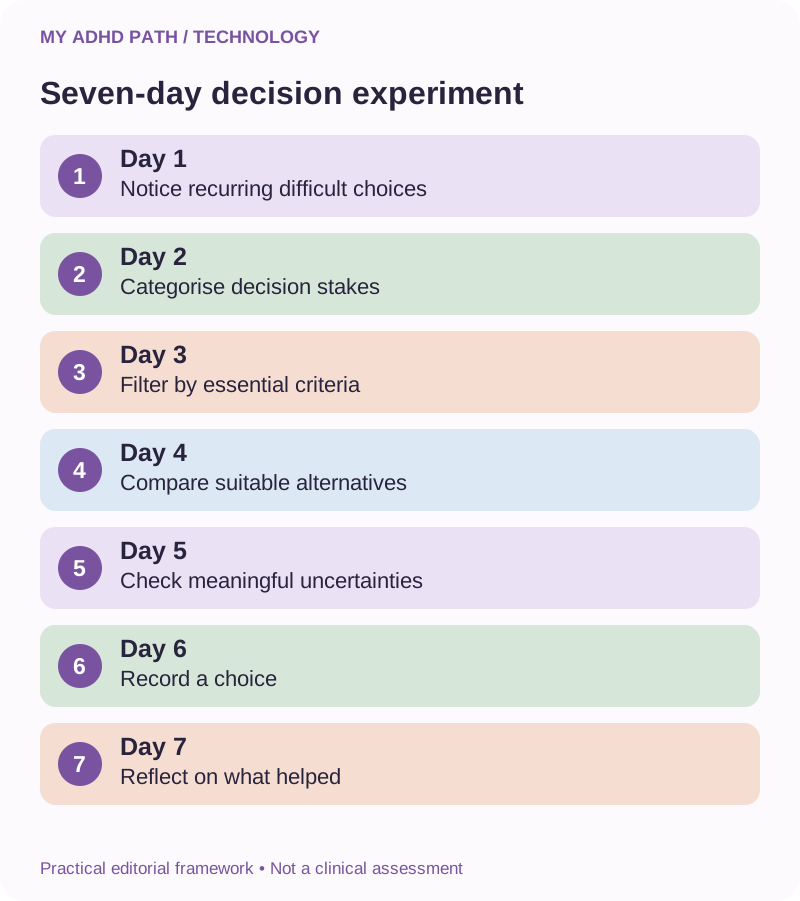
This experiment is intended for personal reflection, not clinical assessment.
Fifteen AI prompts for making decisions
AI prompt
1. Untangle my decision
"I'm going to explain the situation in my own words. Help me identify the decision I'm actually trying to make."
AI prompt
2. Establish what matters
"Help me distinguish essential requirements from preferences and optional features."
AI prompt
3. Compare my existing options
"Compare these options using consistent criteria. Don't introduce additional alternatives unless none meets my essential requirements."
AI prompt
4. Explain the differences simply
"Identify the meaningful differences between these options without repeating information that is the same for all of them."
AI prompt
5. Check the real cost
"Compare the total costs over the same period, including necessary extras and recurring charges. Mark anything that remains unknown."
AI prompt
6. Challenge my preference
"Don't automatically agree with my preferred option. Explain its disadvantages and when an alternative might be more suitable."
AI prompt
7. Identify what is missing
"Which pieces of missing information could materially change this decision?"
AI prompt
8. Compare different circumstances
"Show how these options might compare under different realistic circumstances. Clearly identify assumptions."
AI prompt
9. Consider reversibility
"Explain the practical consequences of changing my mind after choosing each option."
AI prompt
10. Help me prioritise
"Help me compare these responsibilities using deadlines, consequences, dependencies and my available resources."
AI prompt
11. Reduce the number of choices
"Remove options that clearly fail my agreed essential requirements. Explain why each has been excluded."
AI prompt
12. Help me stop researching
"Based on my criteria, identify whether further research is likely to change my decision and what essential checks remain."
AI prompt
13. Prepare questions for an expert
"Help me identify questions to ask an appropriately qualified adviser before making this decision."
AI prompt
14. Summarise my options
"Give me a concise comparison, including advantages, limitations, confirmed information and uncertainties."
AI prompt
15. Record my decision
"Summarise what I've chosen, why I chose it and what circumstances would justify reconsidering it."
Check AI-generated information independently where appropriate.
Do not provide unnecessary sensitive information.
Frequently asked questions
Can AI help with ADHD decision paralysis?
It may help organise information, compare alternatives and establish priorities. Its usefulness varies, and it is not an established clinical treatment.
Is decision paralysis an ADHD symptom?
Decision paralysis is an informal description rather than a formal ADHD diagnostic criterion. Some people with ADHD experience related difficulties.
Why do I keep researching the same decision?
Possible explanations include unresolved uncertainty, difficulty remembering previous comparisons, perfectionism and concern about consequences.
Can I use AI to choose between products?
Yes. It can help compare relevant features and costs, but current prices, specifications and availability should be verified.
Can AI make decisions for me?
It can suggest options and recommendations. Retain appropriate control, particularly for consequential decisions.
How can AI help me stop overthinking?
It may help identify what remains genuinely uncertain and distinguish important considerations from unnecessary additional research.
Should I always choose the cheapest option?
No. Consider suitability, total costs, quality, relevant limitations and your circumstances.
What is a weighted decision matrix?
It is a comparison method that assigns different levels of importance to decision criteria. It can support analysis but does not establish an objectively correct choice.
Can AI help me prioritise my tasks?
It can help organise deadlines, consequences and dependencies when it has reliable information about them.
Why does AI sometimes change its recommendation?
New information, different assumptions, wording and model behaviour may affect the recommendation. Ask it to explain what has changed.
Can AI be biased?
Yes. AI-generated recommendations may reflect biases in available information, assumptions and the way a question is presented.
Should I trust an AI financial recommendation?
Do not rely on a general-purpose AI assistant alone for consequential financial decisions. Verify information and seek qualified advice where appropriate.
Can AI help me choose ADHD medication?
It may help prepare questions for a clinician, but it should not select or change your medication.
How much research is enough?
The answer depends on the consequences and uncertainty of the decision. Establish what information is necessary to make a reasonable, informed choice.
What if all my options are equally suitable?
Consider which compromises you are most comfortable accepting. A convenient or reversible choice may be appropriate for lower-consequence decisions.
Can AI support independent decision-making?
Potentially. Used appropriately, it can make information more accessible while leaving the final judgement with you.
Your decisions should still feel like your own
Imagine facing a complicated decision without needing to keep every price, specification, possibility and concern available in your head simultaneously.
Imagine being able to return to a comparison without rebuilding it from the beginning.
Imagine knowing which unanswered question actually matters.
That is where AI may offer genuine practical value.
It can help bring structure to uncertainty.
It can help you see differences more clearly.
It can help you recognise when you've gathered enough information to make a reasonable choice.
But your preferences, circumstances and values still matter.
The purpose of using AI to make decisions is not to hand over responsibility for your life.
It's to give yourself more support in making the choices that shape it.
The purpose of using AI to make decisions is not to hand over responsibility for your life. It's to give yourself more support in making the choices that shape it.
Sources and further reading
- Diamond, A. (2013). Executive Functions. Annual Review of Psychology. https://doi.org/10.1146/annurev-psych-113011-143750
- Willcutt, E. G. et al. (2005). Validity of the Executive Function Theory of Attention-Deficit/Hyperactivity Disorder: A Meta-Analytic Review. Biological Psychiatry. https://doi.org/10.1016/j.biopsych.2005.02.006
- Risko, E. F. and Gilbert, S. J. (2016). Cognitive Offloading. Trends in Cognitive Sciences. https://doi.org/10.1016/j.tics.2016.07.002
- Scheibehenne, B., Greifeneder, R. and Todd, P. M. (2010). Can There Ever Be Too Many Options? A Meta-Analytic Review of Choice Overload. Journal of Consumer Research. https://doi.org/10.1086/651235
- Chernev, A., Bockenholt, U. and Goodman, J. (2015). Choice Overload: A Conceptual Review and Meta-Analysis. Journal of Consumer Psychology. https://doi.org/10.1016/j.jcps.2014.08.002
- Faraone, S. V. et al. (2021). The World Federation of ADHD International Consensus Statement. https://doi.org/10.1016/j.neubiorev.2021.01.022
- NICE - ADHD: diagnosis and management. https://www.nice.org.uk/guidance/ng87
- MoneyHelper. https://www.moneyhelper.org.uk/
- Financial Conduct Authority - Consumer information. https://www.fca.org.uk/consumers
- National Cyber Security Centre. https://www.ncsc.gov.uk/
This article provides general educational information and practical suggestions. It does not constitute medical, legal, financial or investment advice. Its frameworks and exercises are illustrative rather than clinically validated ADHD interventions.